


Local SEO for dental chains and multi-location dental practices in India: the highest-velocity specialty
Local SEO for dental practices in India runs at higher volume and velocity than almost any other healthcare specialty. Dental patients search "dentist near me" more frequently than "cardiologist near me" by a factor of 10-15x in most metro catchments. The upside: the compound gai
No pitch. Written root-cause diagnosis. AI-powered, healthcare only.
Direct answer
Local SEO for dental practices in India runs at higher volume and velocity than almost any other healthcare specialty. Dental patients search "dentist near me" more frequently than "cardiologist near me" by a factor of 10-15x in most metro catchments. The upside: the compound gai
TL;DR

Local SEO for dental practices in India runs at higher volume and velocity than almost any other healthcare specialty. Dental patients search "dentist near me" more frequently than "cardiologist near me" by a factor of 10-15x in most metro catchments. The upside: the compound gains from competent local SEO execution show up faster and more visibly in dental than in any other specialty. The catch: the competition is intense, review-flow expectations are higher, and single-location dentists compete against multi-location chains with structural advantages. ICG runs healthcare local SEO for dental practices at solo-doctor, chain and hospital scales using Angryturtle calibrated for the dental query patterns and review-velocity requirements the specialty demands.
Why dental local SEO is different
Three specialty-specific features shape the local SEO problem.
Search volume is highest in the specialty. In any Indian metro, "dentist near me" and its variants ("dental clinic near me," "dental hospital near me," "cosmetic dentist near me," "orthodontist near me," "root canal specialist near me") produce combined monthly search volume in the tens of thousands. This is 5-10x higher than most healthcare specialties. The consequence: dental profiles that rank well capture materially more traffic than similarly-ranked profiles in lower-volume specialties.
Patient consideration cycle is short. A dental patient with a toothache decides on a clinic within hours or days. A dental patient considering orthodontics decides over weeks. Compare against IVF (6-12 months) or cosmetic surgery (2-4 months). The short consideration cycle means local SEO impact translates to booking impact faster — a ranking improvement typically shows up in appointment flow within 2-4 weeks rather than months.
Multi-location chain dynamics. Dental is one of the most chain-heavy specialties in Indian healthcare. Practices like Clove Dental, Dentzz, Sabka Dentist, Vardhaan Dental Clinic operate 20-100+ locations each. Single-location dentists compete against these chains for the same local queries. Chain competitors have structural advantages (aggregate brand awareness, multi-location citation flow, shared content investment) that single locations don't. Local SEO for single-location dentists needs to compete against this.
Angryturtle's sie" style="color:inherit;text-decoration:underline;text-decoration-color:rgba(42,126,200,.5);text-underline-offset:2px">Rank OS for dental profiles weights Review Health heavily (dental is the specialty where review volume and velocity matter most), with Relevance and Freshness close behind. Entity Authority matters less than in cardiology or oncology because dental patients rarely check medical association listings before booking. AIO Readiness is growing as dental patients ask AI systems specific questions ("best dentist for root canal near me," "affordable orthodontist in Bandra").


GBP configuration for a dental practice
Primary category. "Dentist" for most solo dental practices; "Dental Clinic" as an alternative if Google's category tree offers it in the specific market. Sub-specialty dentists (orthodontist, endodontist, periodontist, prosthodontist, oral surgeon, paediatric dentist) should typically use their sub-specialty as primary category — the specific category ranks better for the sub-specialty queries than "Dentist" does. Multi-specialty dental clinics can use "Dental Clinic" as primary with sub-specialties as secondary.
Secondary categories. Cosmetic Dentist, Orthodontist, Endodontist, Periodontist, Oral Surgeon, Prosthodontist, Paediatric Dentist, Emergency Dental Service, Dental Implants Periodontist, Dental Hygienist. Fill up to 9 secondary slots with the sub-specialties the practice covers.
Services list. Dental has 15-25 distinct procedures worth listing individually: Dental Consultation, Dental Cleaning (Scaling and Polishing), Tooth Extraction, Root Canal Treatment (RCT), Dental Crowns, Dental Bridges, Dental Implants, Full-Mouth Rehabilitation, Cosmetic Dentistry (Veneers, Bonding), Teeth Whitening, Orthodontic Treatment (Braces, Aligners like Invisalign), Wisdom Tooth Extraction, Paediatric Dentistry, Gum Treatment, Periodontal Surgery, Dentures (Complete and Partial), Emergency Dental Care. Each specific procedure is a query surface.
Business description. 750 characters covering: practice name and dental specialty, years of operation, sub-specialties offered, distinguishing capabilities (specific dental technology like digital impressions, CBCT scanning, laser dentistry, sedation dentistry), insurance panels accepted, EMI/financing arrangements for high-value treatments (implants, orthodontics), and any distinguishing credentials.
Attributes. Health-and-safety attributes, appointment scheduling, payments accepted, insurance panels, gender-of-provider (some patients prefer female dentists specifically), languages spoken, accessibility features. Dental profiles typically underuse attributes.
Angryturtle's Category Picker surfaces dental-specific category options that generic agencies routinely miss (differentiating "Cosmetic Dentist" from "Dentist," or "Orthodontist" from "Dentist" — separate categories for genuinely separate practice types).
The review velocity requirement for dental

Dental practices need higher review velocity than most specialties.
Competitive minimum: 100-200 reviews for a solo dental practice in a metro market. Below 100, the profile competes at a disadvantage against local leaders.
Metro chain benchmark: 500-2,000 reviews for a metro-competitive dental chain location. Chain locations with strong operational review-collection consistently exceed 1,000 reviews per location.
Velocity expectation: 15-30 new reviews per month for a solo dental practice with moderate patient flow; 40-80 per month for a chain location with strong operational review-collection.
Response rate requirement: 100% response rate is achievable and important in dental. Patients read the practice's response quality as an operational-professionalism signal.
Compliance in dental reviews is less restrictive than cardiac or oncology but still requires care. NMC Ethics Code applies — a dental practice cannot present specific treatment outcomes ("Dr. X cured my TMJ") as clinical evidence. Cosmetic dentistry reviews often mention "smile transformation" which is on the boundary of before-and-after claim territory. Angryturtle's AI-drafted replies for dental profiles use compliance-safe framings by default.
Review-request cadence for dental is aggressive — most competitive dental practices send review requests to every patient after every visit (not just first-visit), typically 24-48 hours post-visit when the experience is fresh. Angryturtle's review-request kit supports this cadence with pre-approved templates and consent frameworks.
Multi-location chain playbook
Dental chains with 5+ locations face the portfolio problem discussed in GBP optimization for multi-specialty hospitals, adapted to dental specifics:
Per-location GBP as the core asset. Each location gets its own GBP with location-specific address, phone, operating hours, doctor lineup, and services. Never merge locations under one GBP or use a shared GBP for multi-location coverage.
Consistent NAP across all locations. The chain brand name should appear identically on every GBP (Clove Dental — Bandra vs Clove Dental Bandra vs CloveDental Bandra are three different NAP presentations that hurt entity authority). Angryturtle enforces NAP consistency across the portfolio.
Per-location review-collection operations. Each location's operations team runs its own review-request cadence for the location's own patients. Aggregating reviews at the chain brand level (not location level) is a common mistake — Google's local pack ranks locations, not chain brands.
Chain-brand website structure. The chain's website should have per-location pages (URL structure like /locations/bandra or /mumbai/bandra-clinic) that Google can associate with the specific GBP for that location. Weak per-location website presence hurts local ranking even if the GBP is well-optimised.
Corporate content shared across locations. Educational content (root canal explainer, orthodontics guide, dental implants FAQ) lives at the chain brand's central content library and links from every location page. Reduces duplicate content risk while giving each location the content depth benefit.
Angryturtle's multi-tenant portfolio view surfaces chain-level performance patterns — which locations lead on Rank OS, which are declining, which have review-velocity issues, which have citation gaps. Operations teams triage across the portfolio rather than one location at a time.
Dental-specific citation targets
Beyond the general healthcare directory list, dental practices benefit from dental-specific citations:
- Indian Dental Association member directory
- Federation of Dental and Orthodontic Associations of India (FDOAI) listings
- Delhi State Dental Council, Maharashtra State Dental Council, Karnataka State Dental Council (state dental council registers)
- Dental-specific insurance-panel provider directories (many insurers have dental-specialist directories)
- Dental-tourism directories for practices with international patient acquisition
- Specialty association directories (Indian Orthodontic Society, Indian Endodontic Society, Indian Society of Periodontology)
Angryturtle's citation engine includes dental-specific directories in the target list for dental-tagged profiles.
Content operations for dental profiles
Google Posts for dental practices work well with high frequency because dental patients revisit profiles more than most healthcare specialties.
Post patterns that work: - Procedure explainers — what to expect during a root canal, orthodontics treatment timeline, dental implants recovery. Educational, no outcome claims. - Doctor introductions — new dentist joining, existing dentist's specific sub-specialty focus (cosmetic, orthodontics, paediatric). - Insurance and payment updates — new insurance panel added, new EMI arrangement for orthodontics or implants. - Facility updates — new equipment (digital scanner, laser system, CBCT scanner), new sub-specialty capability, expanded hours. - Preventive dental content — oral hygiene tips, dietary guidance for dental health, paediatric dental care. Educational and de-stigmatising. - Sub-specialty focus — "Now offering Invisalign," "Weekend orthodontic consultations," "Sedation dentistry for anxiety patients."
Cadence: 3-4 Posts per week for competitive metro dental practices; 2 Posts per week for less-competitive markets. Angryturtle's Content Studio schedules against a per-location calendar and drafts within compliance defaults.
Pricing tiers for dental practices
Solo dentist / single-location practice: Starter tier at ₹25,000-₹50,000/month covers full GBP optimisation, monthly Post cadence, review operations (20-40 reviews per month), monthly rank tracking, quarterly citation audit. Sufficient for a solo dentist or small dental practice testing local SEO investment.

Multi-location dental group (3-15 locations): Chain tier at ₹75,000-₹1,50,000/month covers per-location GBP management, weekly Post cadence, per-location review operations with escalation, monthly Geo-Grid tracking per location, monthly citation building.
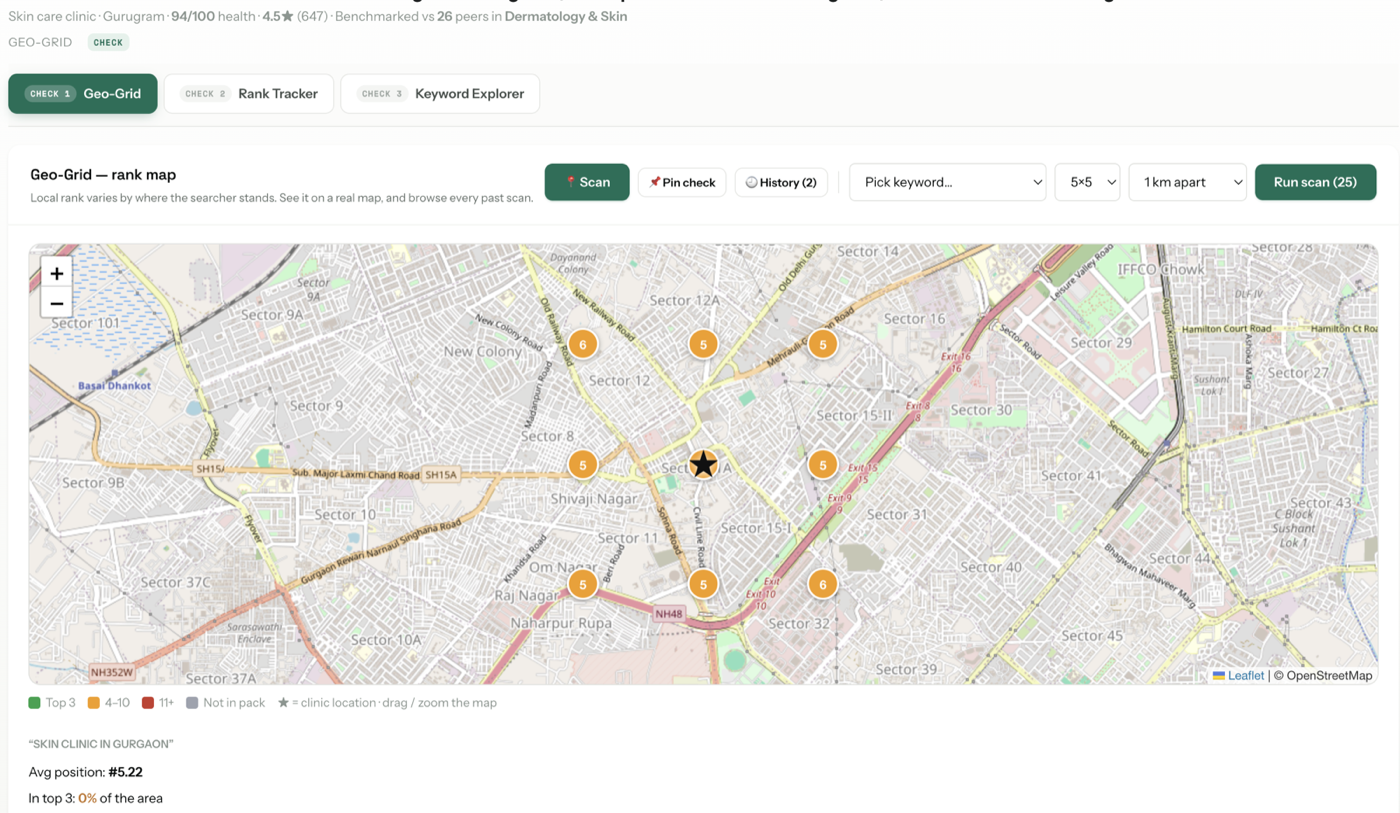
Large dental chain (20+ locations): Hospital tier at ₹1,50,000-₹4,00,000/month covers portfolio-level operations including per-location deep-work plus chain-level content strategy, per-location Ask Maps AIO management, custom reporting into chain marketing dashboards, and dedicated account team.
Media spend for paid dental marketing (Google Ads, Meta Ads) runs separately through ICG's performance marketing service.
Related reading
- Healthcare local SEO agency India — the pillar service page
- Local SEO for cardiology clinics India — comparison specialty (referral-heavy)
- Local SEO for IVF centres India — comparison specialty (long-consideration)
- How to rank a hospital on Google Maps in India — the six controllable signals
- Dental marketing agency India — ICG's dental-specific marketing service
- Dental marketing cost India — budget context
- Dental patient acquisition cost India — CPQL context
FAQ

How is local SEO for dental different from other specialties? Higher search volume (10-15x most other healthcare specialties for "near me" queries), shorter patient consideration cycle (hours to days for pain, weeks for elective), and heavy multi-location chain competition. Review velocity matters more than in most other specialties.
How many reviews does a competitive dental practice need? 100-200 minimum for solo practice, 500-2,000 for metro-competitive chain location. Chains with strong operational review-collection often exceed 1,000 per location.
What review velocity should a dental practice target? 15-30 new reviews per month for solo practices with moderate patient flow; 40-80 per month for chain locations with strong review-collection operations.
Can a solo dental practice compete against a multi-location chain? Yes, with focused local SEO. Chains have structural advantages (aggregate brand awareness, multi-location citation flow, shared content investment) but single-location dentists compete effectively by dominating the local pack for hyper-local queries in their specific catchment. Rank OS-driven execution consistently produces top-3 local pack ranking for solo dentists in most metro neighbourhoods.
What Google category should a dental practice use? "Dentist" for solo generalist dental practices; sub-specialty as primary for sub-specialists (Orthodontist, Endodontist, Periodontist, Prosthodontist, Oral Surgeon, Paediatric Dentist). "Dental Clinic" as an alternative if Google's category tree offers it. Cosmetic Dentist as primary for aesthetic-focused practices.
How long before a dental practice sees ranking improvement? Faster than most specialties due to short patient consideration cycle. First measurable movement in 2-4 weeks; substantive ranking improvement in 6-12 weeks; full compound effect (top-3 local pack for primary dental queries) in 4-8 months depending on competitive intensity.
Are Google reviews the only reviews that matter for dental? For Indian dental, yes — Google reviews dominate 85-90% of the meaningful review flow. Doctor-directory platforms, local business directories and specialty-specific sites contribute but Google is the primary local ranking signal.
How does chain-brand marketing interact with per-location local SEO? Chain brand awareness helps aggregate patient recognition but doesn't directly help per-location local pack ranking. Each location's Google Business Profile needs its own optimisation, own reviews, own citations. The chain's centralised content library (procedure explainers, etc.) provides content depth that per-location pages link to.
Can a dental practice run its own local SEO with Angryturtle? Yes, at the Solo tier (₹999/month for 2 profiles). The tool guides the workflow — Rank OS score, action queue, direct GBP write-back, review reply drafting, geo-grid rank tracking. Suits solo dentists with time to execute; managed service tier fits practices that prefer done-for-you.

What Angryturtle features matter most for dental? Review reply drafting at scale (dental gets the highest review volume, needs the strongest AI-drafted reply workflow), Content Studio for weekly Post cadence, Ask Maps for dental-specific patient queries, Geo-Grid for catchment mapping in competitive metro markets.
How does ICG's dental local SEO differ from a generic local SEO agency's approach? Rank OS with dental-specific weighting, dental-specific category picker knowledge, dental-directory citation targets, compliance-aware AI content drafting (NMC boundaries), review-request kit calibrated for dental patient behaviour (per-visit request cadence, not just first-visit), and portfolio-level operations for chain clients.
Does ICG handle both dental clinics and dental hospitals? Yes. Solo dentists, small dental practices, multi-location dental chains, and large dental groups all fit ICG's local SEO service across the appropriate tier. Dental hospitals with in-patient capability fit at the Hospital tier alongside multi-specialty hospitals.
Book a free SEO diagnostic.
Hanuman Sihag's team runs a live crawl, checks technical health, cannibalisation, schema coverage and content gaps. 60 minutes, prioritised fix list.
The three platforms
behind every ICG engagement.
Beacon
CAPI middleware that fixes Event Match Quality, translates CRM statuses to Meta-standard events, dedups across channels.
Agency OS
Live client dashboard. GSC, GA4, Google Ads, Meta Ads, IVR calls in one view. Login anytime, not monthly.
Phoenix
Clinic revenue intelligence over your PMS. Daily action queue: Prevent Loss, Maintain & Engage, Grow Revenue. Multi-centre rollout.
Or book a free 30-min audit to see all three in action on your account.
Healthcare brands
that already run on ICG.
A representative slice of the 150+ healthcare brands ICG has delivered for across India. Most engagements remain under NDA.


What ICG clients say · on video.
"Dental marketing in Delhi is brutally competitive. ICG's local SEO + Google Ads stack moved the needle steadily."
"Scale up of organic channels and business consulting. ICG has absolute domain authority in their field."
The intelligence stack behind this playbook.
Every ICG engagement runs on the Search Intelligence Trifecta — Angryturtle for GMB, SIE for search and AI Overview, YODA for YouTube. Live product screens below.
Need help operationalising this?
Every ICG service is healthcare-only, NMC + DPDP-aware, and built around the patient-research patterns that drive Indian healthcare growth in 2026.
Every practice welcome — packages from ₹20,000/mo.
Goals-Driven engagements · Performance-Linked Payout Models available



More from
ICG.
Five trends shaping Indian healthcare marketing through 2027: AI-first patient research, Conversions API adoption, ABDM discovery, the AEO w...
Healthcare AIO is the discipline of getting your clinic or hospital cited inside Google AI Overviews, ChatGPT and Perplexity answers — not j...
Conversational-search advertising places brand messages inside AI chat answers — ChatGPT, Perplexity, Copilot — rather than beside a results...
Stop guessing.
Book a Diagnostic.
30 minutes. Free. With the AI-powered healthcare-only marketing agency 150+ brands already run on. No slides, no pitch, no hard close.


