


How to rank a hospital on Google Maps in India: what actually moves the needle in 2026
Ranking a hospital on Google Maps in India comes down to six controllable signals — category depth, review health, geographic authority, freshness, entity trust across healthcare-specific directories, and now AI-answer visibility — plus one uncontrollable one proximity. ICG uses
No pitch. Written root-cause diagnosis. AI-powered, healthcare only.
Direct answer
Ranking a hospital on Google Maps in India comes down to six controllable signals — category depth, review health, geographic authority, freshness, entity trust across healthcare-specific directories, and now AI-answer visibility — plus one uncontrollable one proximity. ICG uses
TL;DR
Ranking a hospital on Google Maps in India comes down to six controllable signals — category depth, review health, geographic authority, freshness, entity trust across healthcare-specific directories, and now AI-answer visibility — plus one uncontrollable one (proximity). ICG uses Angryturtle to score hospitals across all five controllable dimensions and executes the specific edits that move ranking, publishing directly to Google without the audit-to-execution gap that kills most local SEO retainers. Hospitals that rank in Google's local pack for their primary specialty queries capture 60-80% of the local patient-discovery traffic; hospitals ranked outside the top three capture almost none. The map pack is winner-take-most for healthcare.
Why Google Maps matters more for hospitals than most agencies acknowledge
A patient in Gurgaon typing "cardiology hospital near me" into Google gets three types of results: the local pack (three hospitals shown with map, ratings, distance, and quick actions like Call and Directions), the AI Overview (a generative summary that may cite specific hospitals), and organic web results below. Roughly 70% of clicks on that page go to the top three local pack entries. The organic web results below the pack — where hospital websites live — get the remaining 20-25%, and the AI Overview citation drives 5-10% of clicks depending on how frequently it appears for that query type.
 yoda/02-aio-lab-rank-checker.png" alt="YODA AIO Lab Rank Checker — daily monitoring of AI Overview citation status for every tracked healthcare query" loading="lazy" decoding="async" style="width:100%;height:auto;display:block;">
A hospital ranked #4 or below in the local pack is functionally invisible for that query. The patient sees three options, picks one to call or drive to, and never scrolls down to the hospital website. Local SEO for hospitals is not about vanity ranking positions — it is about being in the top three where actual patient acquisition happens.
The stakes compound in metros where competitive density is high. In Bengaluru, a dental clinic ranking #4 for "dentist near me" in Indiranagar has essentially no local visibility despite technically being in the search results. In Chennai, a fertility centre ranked #6 for "IVF clinic in Chennai" gets almost no map-pack clicks despite being a real medical option. Being #4 is the same as being #40 in terms of business outcome.
The six signals that move hospital Google Maps ranking
1. Category depth (the largest single lever)
Google Business Profile lets a hospital pick one primary category and up to nine secondary categories. Most hospitals pick "Hospital" as primary and stop. That is the largest ranking mistake a healthcare local SEO operation can make.
Google has hundreds of healthcare-specific categories that map to specific search intents. "Hospital" ranks for generic hospital searches, but "Cardiology Hospital," "Fertility Clinic," "Multi-specialty Hospital," "Emergency Care Physician," "Cardiac Rehabilitation Center," "Pediatric Cardiologist" and "Cardiovascular and Thoracic Surgeon" are all distinct categories that map to different queries. A cardiology hospital that chooses "Hospital" as primary loses cardiology-specific queries to competitors who chose the specific category.
The right approach: pick the most specific primary category that describes the hospital's dominant service, then add up to nine secondary categories covering every additional service line. A multi-specialty hospital might set primary as "Multi-specialty Hospital" (or the closest available parent) with secondary categories for each specialty department: Cardiology Hospital, Orthopedic Surgeon, Oncology, Fertility Clinic, Paediatrician, Neurologist. Every category is a discrete surface for Google to match to a query.
Angryturtle's Category Picker surfaces the full Google category tree at edit time — most agencies work from an incomplete list — and its Rank OS Relevance dimension scores whether the primary category matches the queries actually driving impressions to the profile. When the impression data shows the profile ranking for "cardiology hospital" queries but the primary category is "Hospital," Angryturtle flags the mismatch and suggests the specific category change with expected point-lift on sie" style="color:inherit;text-decoration:underline;text-decoration-color:rgba(42,126,200,.5);text-underline-offset:2px">Rank OS.
2. Review health (rating × volume × velocity × response rate)
The four sub-signals inside review health each matter, and hospitals typically fail on one of them without knowing.
Rating (average star rating) needs to be at least 4.0 to compete in most healthcare local packs. Below 4.0, Google's ranking algorithm penalises the profile regardless of other signals. Above 4.5, the marginal return of additional rating improvement drops sharply. Most hospitals sit at 4.2-4.6, which is a competitive but not dominant range.
Volume is the total review count. A hospital with 800 reviews outranks one with 60 reviews at similar rating, all else equal. Volume signals age and legitimacy of the business to Google. The competitive minimum in a typical Indian metro hospital catchment is 200-400 reviews; below that, the profile struggles.
Velocity is the rate of new reviews. Google's algorithm reads a steady flow of recent reviews as an active business signal. A hospital that averaged 5 reviews per month for two years, then stopped, shows a decay pattern that hurts ranking within 6-8 weeks. A hospital that maintains 10-15 new reviews per month even at moderate rating typically outranks a hospital with higher rating but no new-review flow.
Response rate is the percentage of reviews the business responds to. Google reads response rate as an engagement signal — a business that replies to every review, positive and negative, signals active management. A 100% response rate materially helps ranking; a 30% response rate hurts it.
Angryturtle's Review Health dimension inside Rank OS tracks all four signals against the local competitive set and coaches a monthly new-review target above the local leader plus 100% reply rate. The AI-drafted reply system generates on-brand replies in the hospital's tone with NMC compliance built in, then holds a review-and-publish step so the hospital's team confirms the reply before it goes live.
The compliance dimension matters more for hospitals than most agencies understand. NMC Ethics Code 2026 prohibits doctors from soliciting reviews that mention specific treatments received, and prohibits featuring individual patient stories as clinical evidence. The right review-request approach for a hospital asks about visit experience, not treatment outcome, and routes any patient story mentioning treatment details to internal review before it becomes a Google review. ICG's healthcare-specific review-request kit (built into Angryturtle) handles the compliance-safe framing automatically.
3. Geographic authority (proximity plus catchment intelligence)
Proximity is the searcher's location relative to the business — the only ranking signal a hospital cannot influence directly. A patient searching from Andheri sees Andheri hospitals first regardless of any optimisation.
But proximity is not just distance. Google reads geographic authority signals — service area listings, city and neighbourhood mentions in reviews and Posts, geographic keyword density on the linked website, and citation coverage in geographically-specific directories — as extending the effective radius the profile ranks within. A hospital that legitimately serves patients from 20 km away should show up in searches from that radius, and geographic authority signals help Google recognise the extended catchment.
Angryturtle's Geo-Grid module scans the hospital's rank across a lat/long grid — a heatmap showing exactly where the profile ranks well and where it drops out — so the hospital sees the specific streets and pincodes where ranking is weak. Combined with the Pin Checker (which lets the operator test rank at any exact location or pincode), this is the tool that turns local SEO from a single-position metric into a geographic strategy.
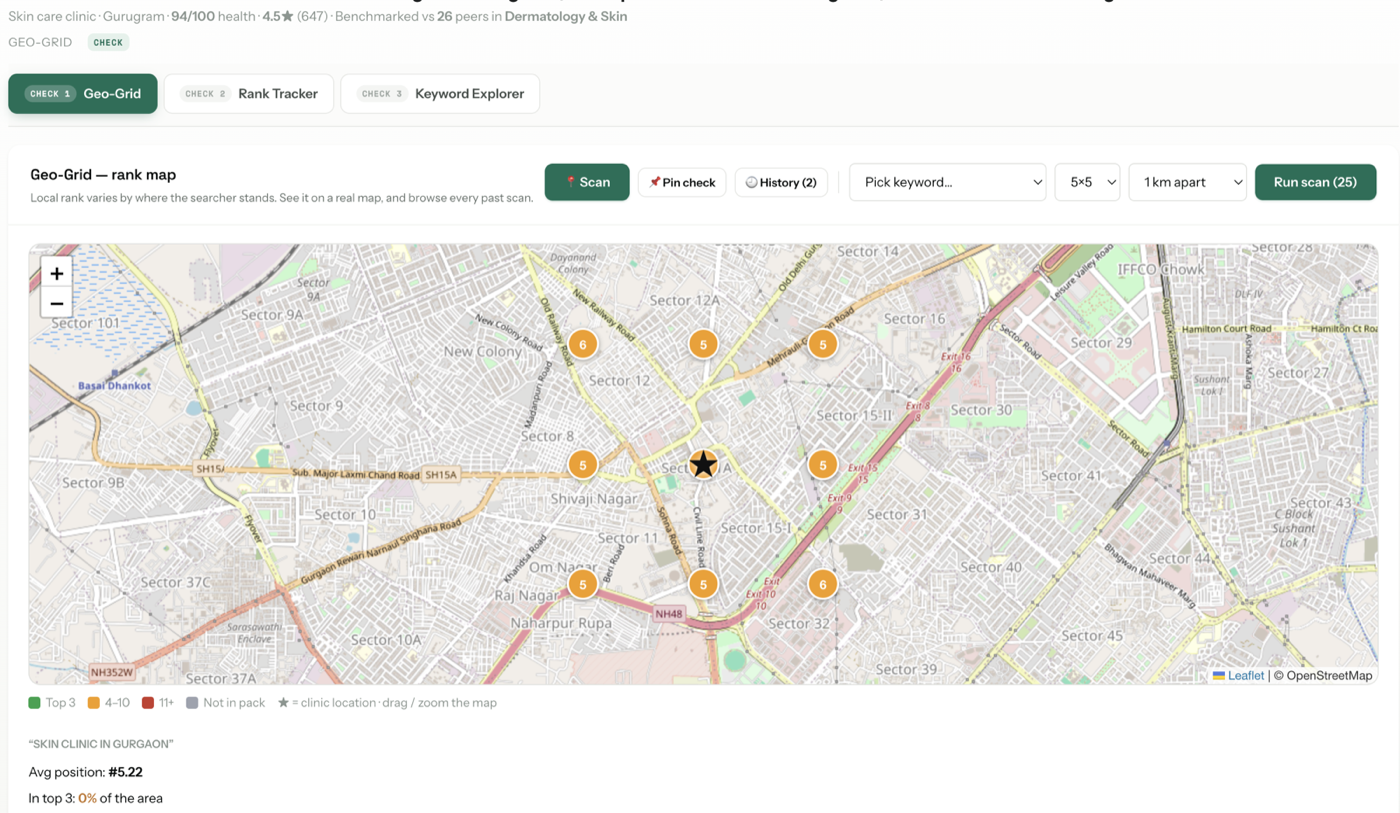
For multi-location hospital chains, geographic authority signals are more complex. Each location needs its own optimised GBP with local citations and local review flow; the corporate parent shouldn't try to aggregate signals across locations. Angryturtle's multi-tenant portfolio view lets an operations team see all locations at once, filter by health status, and prioritise attention on the locations losing ranking that quarter.
4. Freshness (Posts, photos, edits within a rolling window)
Google's local algorithm applies a freshness signal that begins decaying at roughly 21 days of profile inactivity. A hospital that publishes Google Posts, uploads photos, confirms holiday hours, and edits services on a regular cadence maintains freshness signal; one that ignores the profile after initial setup loses ranking within three months.
The cadence that maintains freshness signal for a hospital:
Google Posts every 5-10 days. Not marketing announcements (those bore Google) but genuinely useful patient-facing content — a new specialist joining, a health awareness update, an operating hours change for a festival, a new insurance provider added to the panel. Angryturtle's Content Studio schedules Posts against a per-listing calendar, drafts them with compliance-aware AI, and publishes to Google timezone-correctly for each location.
Photos monthly at minimum. Interior, exterior, staff, facilities, equipment. Google's photo view metrics feed engagement signals that indirectly help ranking. A hospital that hasn't uploaded new photos in a year shows a stale profile pattern that Google's algorithm penalises.
Hours confirmation before every major holiday. Setting special hours for Diwali, Christmas, Eid, Independence Day, Republic Day, Holi and regional festivals is a small edit that signals active management and prevents the "may be closed" pattern that erodes patient trust.
Service edits quarterly. Adding new services as they launch, refining service descriptions, removing services no longer offered. Each edit is a freshness signal.
5. Entity authority (NAP consistency plus citation coverage)
NAP consistency means the hospital's name, address and phone are identical across every directory Google trusts. Inconsistencies — "Sector 27" versus "Sec-27" versus "Sector-27", "9876543210" versus "+91 9876543210" versus "+91-98765-43210", "Apollo Hospital" versus "Apollo Hospitals" — each cost a small ranking increment. Compounded across 30-50 directories, the effect is meaningful.
Citation coverage means being present in the directories Google recognises for healthcare. The Indian healthcare directory landscape is specific: national doctor-listing and booking platforms (the largest healthcare directory category in India, essential for any healthcare business), national local business directories (broad Indian business directories with strong healthcare categories), Sulekha (services-focused directory with healthcare vertical), IndiaMART Healthcare (B2B healthcare directory), HealthEnclave (specialised healthcare provider directory), insurance-panel directories (Star Health Provider Network, HDFC ERGO Provider Directory, Bajaj Allianz Provider Panel, Care Health Insurance Network), Medical Council of India state registers where relevant, city-level Chamber of Commerce healthcare listings, and directories run by professional associations (Indian Medical Association, Society for Assisted Reproduction, Indian Society of Cataract and Refractive Surgeons, etc.).
Angryturtle's citation engine automates the discovery — showing where competitors are listed and the hospital is not — and provides both the direct link to submit each missing citation and a Deep-Dive citation sweep that maps one competitor's full directory footprint. For hospitals with genuine competitive threats from a specific rival, the Deep-Dive is the fastest way to close the citation gap.
6. AI-answer visibility (the newest signal)
Google AI Overviews cite specific hospitals when a patient asks a healthcare question that maps to a hospital catchment. ChatGPT and other consumer AI systems draw on similar signals — a hospital's website content, its GBP information, its aggregated review sentiment — to decide whether to cite the hospital by name when asked about local healthcare options.
Being AI-answer visible is a new form of local visibility. A hospital cited in Google AI Overviews for "best paediatric hospital in Gurgaon" captures the click share that used to go to the top of the map pack for that query. A hospital not cited gets no visibility from that query even if it ranks #2 in the classic local pack.
Angryturtle's Ask Maps AIO Readiness module seeds a per-listing question bank — the natural-language questions patients ask AI systems about the hospital's specialty — and scores whether the profile carries the information to be cited. Missing information gets added to Services, Description, Attributes or Questions & Answers. Present-but-unclear information gets restructured for extraction. This is the local SEO discipline of 2026 that separates ICG-with-Angryturtle from every generic local SEO agency.
What a monthly hospital local SEO retainer with ICG actually executes
Week 1 of each month: Rank OS score check across all locations, comparison against the previous month, identification of the three highest-value fixes per location. Category audit if any location's primary category no longer matches its dominant query cluster. Review of any negative reviews from the previous month with AI-drafted replies queued for hospital confirmation.
Week 2: Citation building against the healthcare-directory list. Two-to-four new citations per location per month is a sustainable pace; more than that and the pattern looks unnatural to Google. Directory submissions with the exact NAP as authoritative reference.
Week 3: Content operations. Two-to-four Google Posts per location scheduled across the coming fortnight. Photos added if any facility, staff or event photos are available. Service description refresh for any service line that changed since last audit.
Week 4: AIO readiness audit. New questions added to Ask Maps bank based on the past month's search-term data. Missing information added to profile. Monthly white-label report generated and sent to the hospital's marketing team with the trajectory across all five Rank OS dimensions, geo-grid rank change, cluster momentum shifts, and every specific action executed with the point impact on Rank OS.
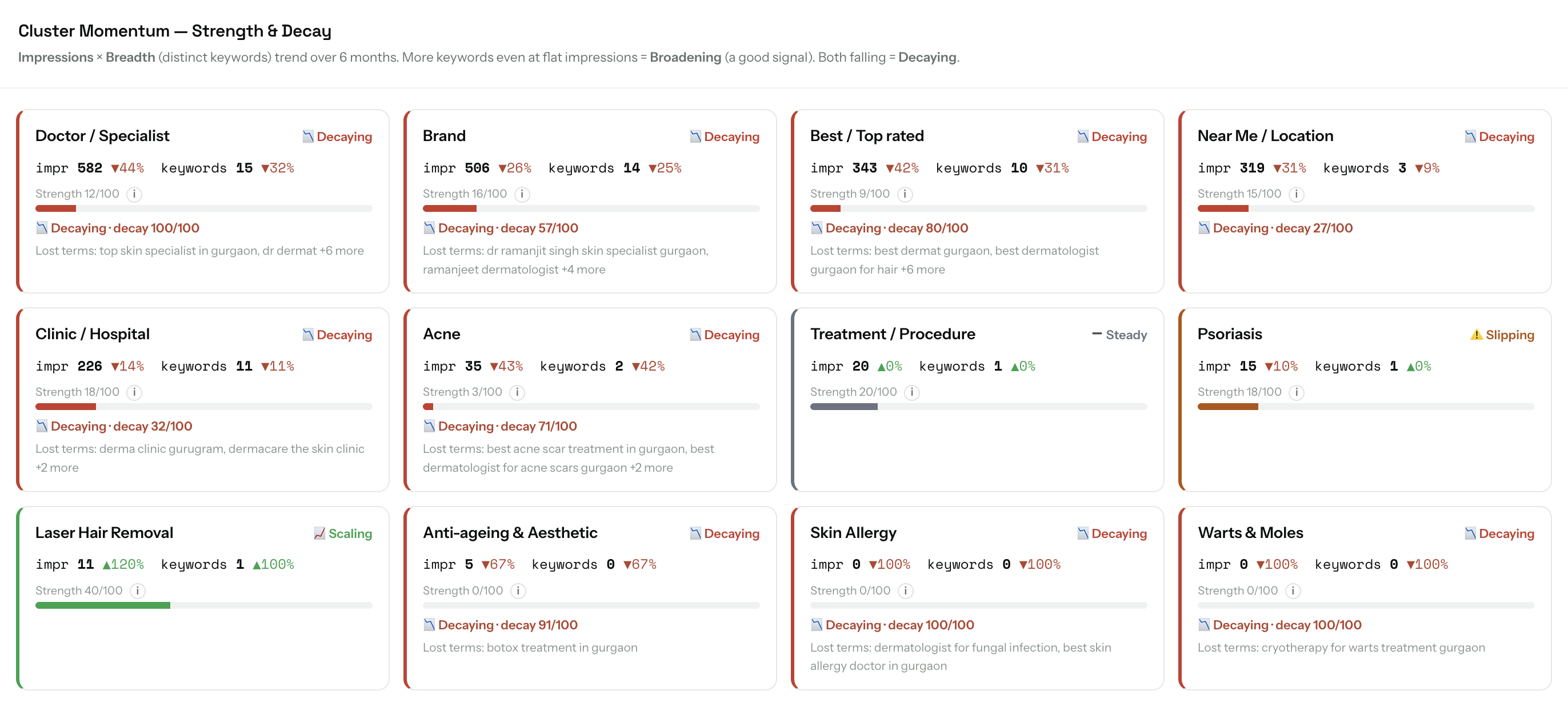
Between weeks: negative reviews responded to within 24 hours (SLA), profile-edit requests from the hospital's team executed within 48 hours (SLA), and any Google notifications about the profile (verification requirements, category changes suggested by Google, edits pending) handled immediately.
What most agencies do differently, and worse
Most local SEO agencies for hospitals run on quarterly cycles. A comprehensive audit in month one, execution of some (not all) recommendations in month two, and coasting in month three while the client wonders what the retainer bought. The next quarter starts with a similar audit, executes some more recommendations, and coasts again.
The pattern loses hospitals ranking positions over 12-18 months because the freshness dimension of Google's algorithm penalises inactivity within 21-day windows. A hospital on a quarterly-cycle agency loses freshness signal in month two of every quarter, regains some of it in month three, and rebuilds ranking each quarter from a lower baseline. The compound effect is a hospital that ranked #2 at engagement start slipping to #4 by month 18.
ICG's approach — enabled by Angryturtle's ability to execute in the same tool as the audit — runs on weekly cycles. Ranking improvements compound instead of decaying. Hospitals that engage ICG and don't churn typically see Rank OS gains of 20-40 points across the first 6 months, translating to 2-4 position improvements in the local pack for their primary specialty queries.
When Google Maps ranking isn't the right investment for a hospital
Hospitals in tier-3 cities with low search volume for their specialty may see the marketing spend on aggressive local SEO exceed the incremental patient value it generates. A single-specialty facility in a district town where 3-4 patients per month search "specialty hospital near me" cannot justify a ₹1.5L/month retainer against ₹8K per acquired patient at a specialty CPQL that might not exist yet in ICG's benchmark data. The tool-only tier of Angryturtle (₹999/month for Solo) covers what such a facility needs.
Hospitals whose primary patient flow comes through insurance-panel referral or corporate tie-ups also see limited return from local SEO. If 70% of a hospital's patients arrive because their insurance plan directs them, or their employer's corporate health plan lists the hospital as the preferred provider, local SEO affects only the remaining 30% of flow. A cheaper retainer tier is appropriate.
Hospitals looking to sign a lead-guarantee arrangement — agency promises 50 patients per month or the retainer refunds — should walk away from any agency offering it. No agency can honestly guarantee patient counts in healthcare; anything offered on that basis is either junk-lead volume that doesn't book, or a fee arrangement the agency will churn the client on the moment it stops being profitable for them.
Related reading
- Healthcare local SEO agency India — the pillar page for ICG's local SEO service, powered by Angryturtle
- Digital marketing company for hospitals in India — the broader digital marketing scope beyond local SEO
- Schema markup for healthcare SEO — the technical layer that helps GBP + website work together
- Healthcare CPQL benchmarks — what to test any agency's numbers against
FAQ
How long before a hospital sees ranking improvement on Google Maps? First measurable movement in 4-6 weeks after engagement start, if the initial audit finds high-impact fixes (category corrections, missing services, sparse description). Substantial ranking improvement in 3-4 months. Full compound effect (top-3 local pack for primary specialty queries) in 9-12 months for a competitive metro; 4-6 months for less competitive markets.
Which local pack signals matter most for hospitals? Category depth is the single largest lever. Review health (all four sub-signals) is the second. Geographic authority via GBP service areas and directory citations is the third. Freshness signals (Posts, photos, edits within 21 days) is the fourth. Entity authority via NAP consistency and healthcare-specific citation coverage is the fifth. AIO readiness for AI-answer visibility is the sixth and newest. All six weighted transparently in Angryturtle's Rank OS.
How many Google reviews does a hospital need to compete in a metro? The competitive minimum for a metro hospital's primary specialty queries is 200-400 reviews. Top-quartile competitors typically have 800-2,000 reviews. Above 2,000, marginal ranking benefit tapers. Below 200, the profile struggles regardless of other signals.
Can a hospital rank for "near me" searches from outside its immediate neighbourhood? Yes, through geographic authority signals. A hospital that legitimately serves patients from 15-20 km away can extend its effective ranking radius through GBP service area listings, citations in geographically-broader directories, and geographic keyword coverage on the website. Angryturtle's Geo-Grid heatmap shows the current effective radius and where to invest to extend it.
What is Angryturtle's Rank OS? The 0-100 rank-probability score that Angryturtle assigns to every GBP based on five weighted dimensions: Relevance (25 pts), Review Health (25 pts), Freshness (20 pts), Entity Authority (15 pts), AIO Readiness (15 pts). Each dimension has a deep-dive showing the specific actions that would raise the score with expected point-lift per action. Weights are transparent and tunable per agency or client engagement.
Does Google Business Profile allow direct booking for hospitals? Yes, via Reserve with Google in supported categories, and via the Appointment link field in most healthcare categories. Setting up direct booking materially improves conversion rate from profile view to booked consultation. ICG configures booking links as part of the standard local SEO onboarding.
How is healthcare local SEO different from healthcare SEO? Local SEO covers Google Business Profile ranking and the map pack. Broader healthcare SEO covers website ranking for organic search (condition queries, procedure queries, information queries), technical SEO, schema markup, content operations, and link building. Local SEO is a specialty inside healthcare SEO; ICG's healthcare SEO agency service covers both.
Can a hospital manage its own Google Maps ranking without an agency? Yes, using Angryturtle's Solo tier (₹999/month) which gives the hospital access to the same Rank OS scoring, geo-grid, and edit-and-publish capabilities that ICG uses. The tool guides the workflow; the hospital's own team executes. This works for single-location hospitals with limited scope. Multi-location chains and hospitals with growth ambition typically need the managed-service tier.
How often does Google update local ranking? Continuously. Ranking updates are near-real-time for most signals — a new review or a Google Post typically influences ranking within 24-48 hours. Category changes take 3-7 days to fully reflect. Citation additions take 4-8 weeks to influence ranking as Google discovers and indexes the new listings. Freshness decays continuously; the 21-day inflection point is when the decay accelerates.
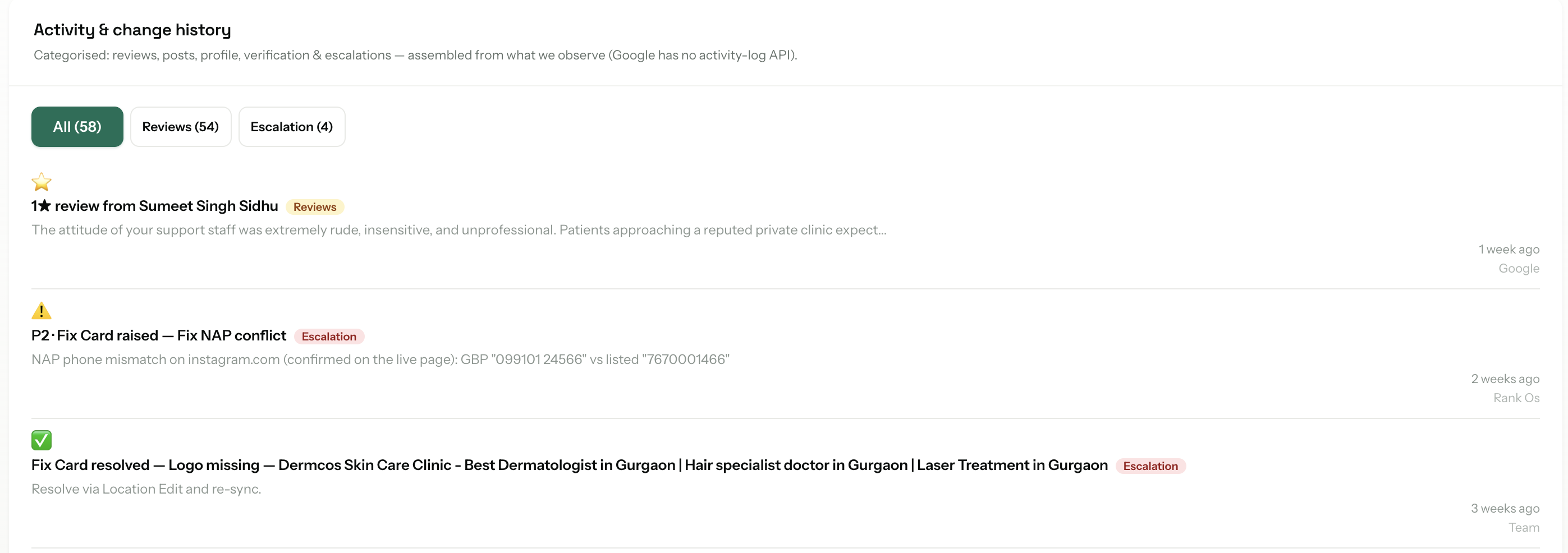
What causes a hospital's Google Maps ranking to drop suddenly? Common causes: a new competitor opening nearby, a spate of negative reviews (2-3 one-star reviews can materially shift the rating average and ranking), a Google algorithm update (which affect local ranking every 4-8 weeks on average), a GBP profile edit that got rejected by Google's manual review, or a compliance flag from a competitor complaint. Angryturtle's Change History surfaces exactly what changed in the profile and Suspension Shield monitors for compliance risk signals.
Should a hospital use paid Google Local Services Ads (LSA)? Not currently — LSA is not available for most Indian healthcare categories, and where it is, patient response has been limited compared to organic local pack visibility. Paid search via standard Google Ads with location targeting produces better returns than LSA for Indian hospitals. Local SEO focuses on organic local pack ranking; paid runs under a separate performance marketing scope.
How does ICG report local SEO progress? Monthly white-label reports generated inside Angryturtle covering Rank OS trajectory across all five dimensions, geo-grid rank change across the catchment, cluster momentum shifts, review sentiment analysis with prioritised action items, competitor citation gap closure, and every specific action executed that month with the point impact on Rank OS. Reports are print-ready PDFs, readable in 10 minutes by a hospital's marketing head or CEO.
Book a free 30-minute Brand & Growth Diagnostic.
It's a working session, not a sales pitch — you leave with a written root-cause analysis you can act on, whether or not you engage ICG.
The three platforms
behind every ICG engagement.
Beacon
CAPI middleware that fixes Event Match Quality, translates CRM statuses to Meta-standard events, dedups across channels.
Agency OS
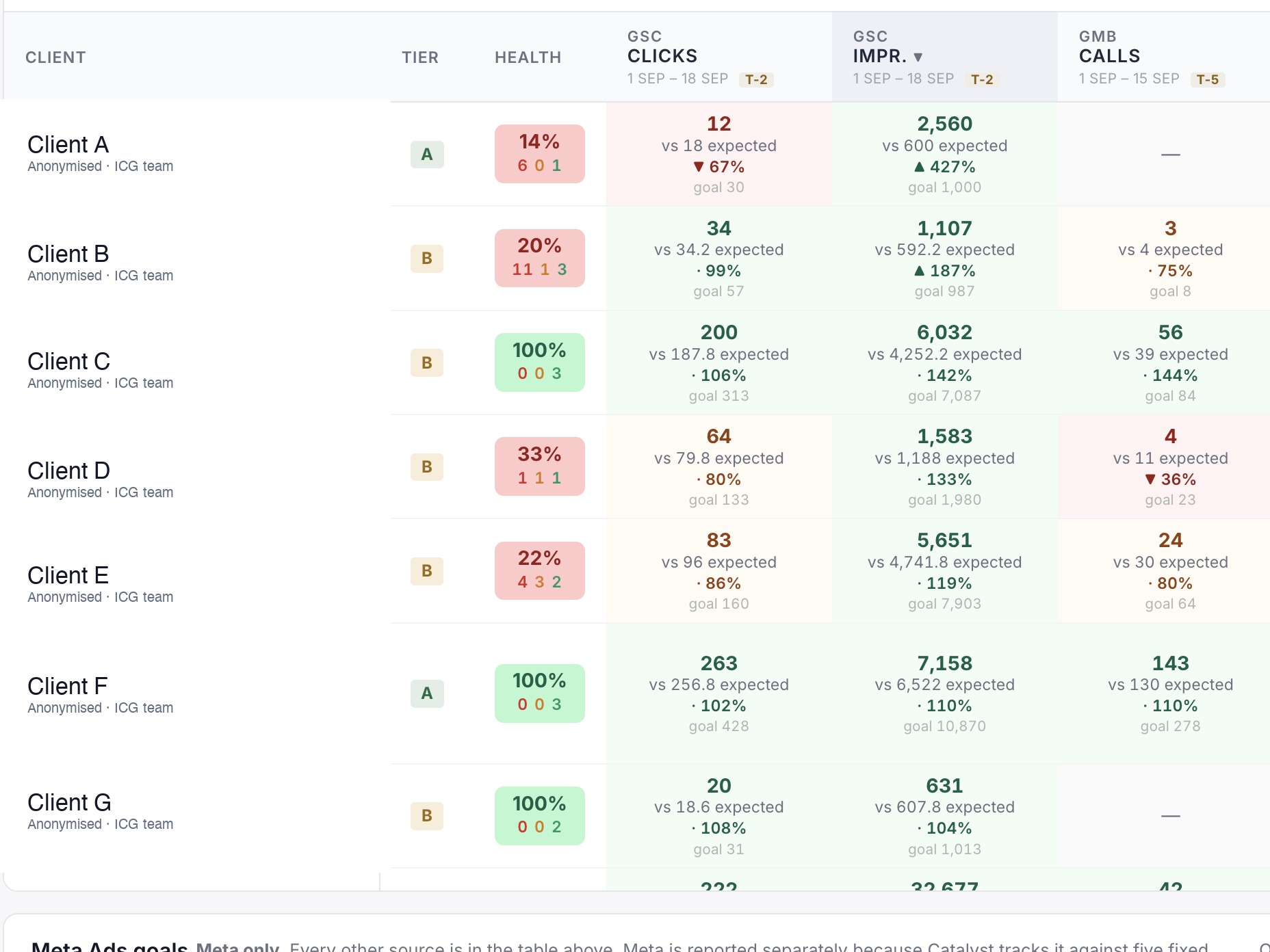
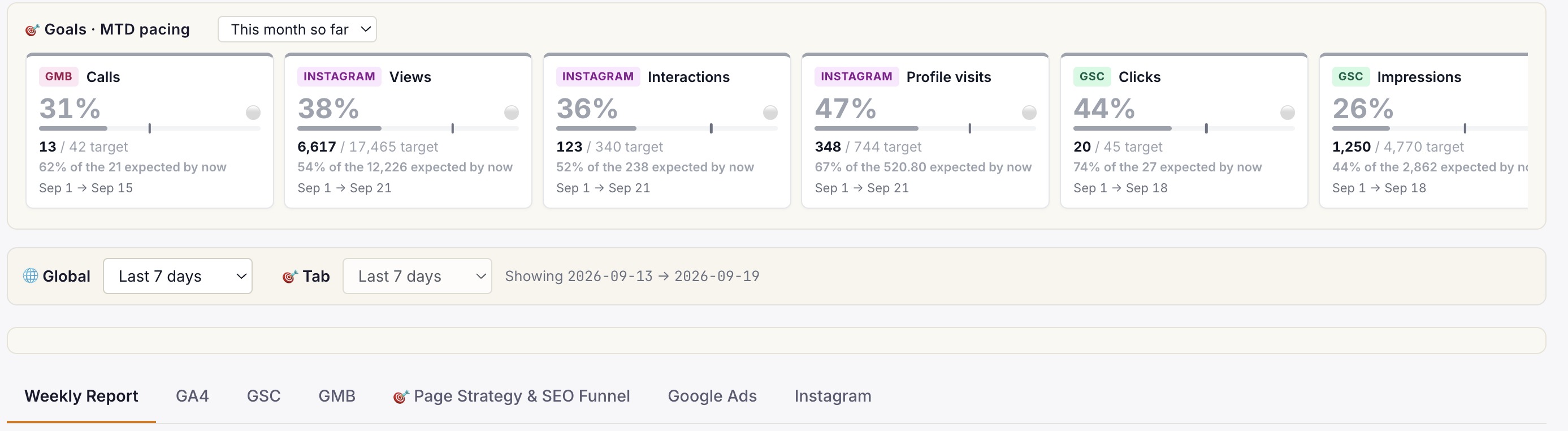
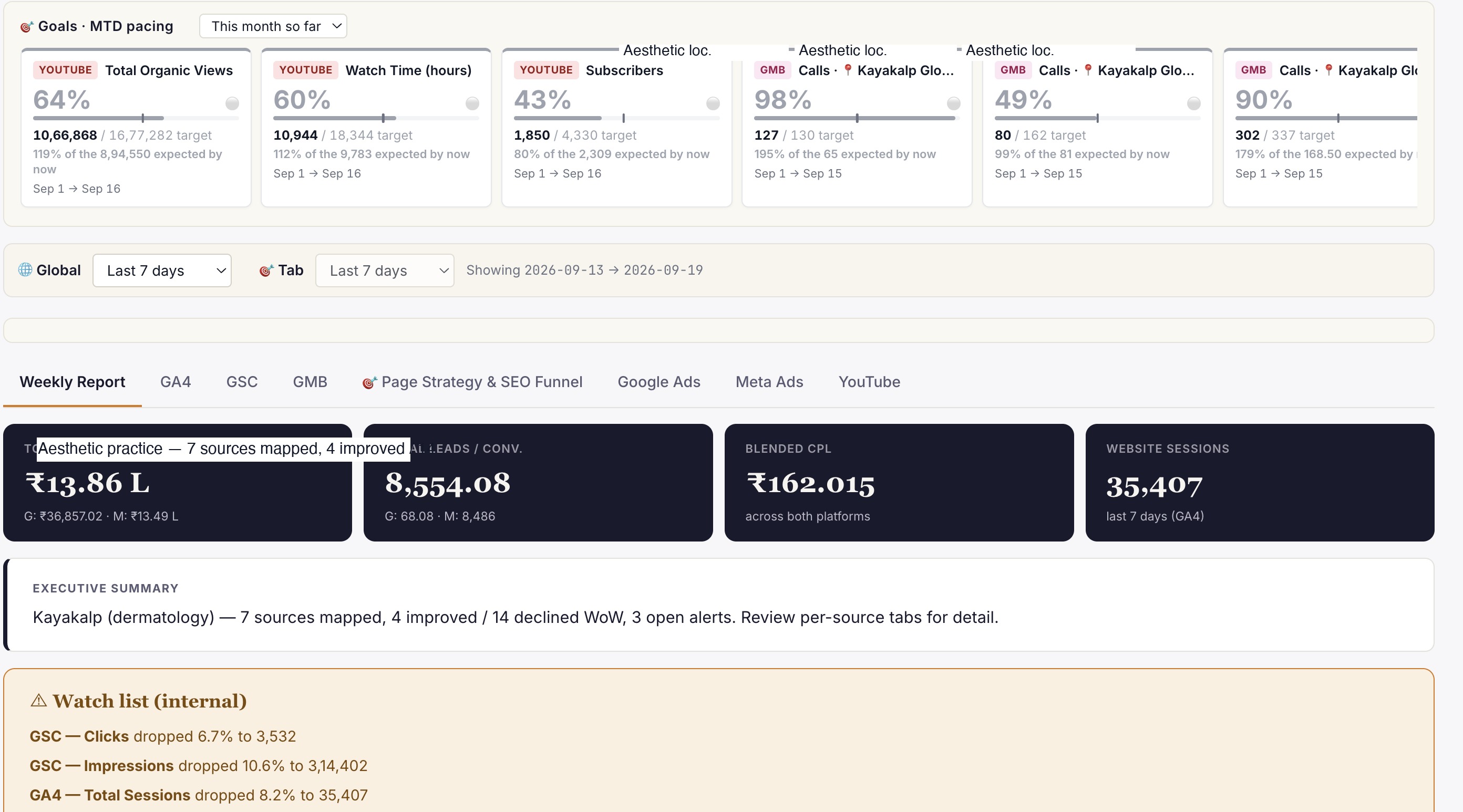
Live client dashboard. GSC, GA4, Google Ads, Meta Ads, IVR calls in one view. Login anytime, not monthly.
Phoenix
Clinic revenue intelligence over your PMS. Daily action queue: Prevent Loss, Maintain & Engage, Grow Revenue. Multi-centre rollout.
Or book a free 30-min audit to see all three in action on your account.
Healthcare brands
that already run on ICG.
A representative slice of the 150+ healthcare brands ICG has delivered for across India. Most engagements remain under NDA.


What ICG clients say · on video.
"Mental health marketing requires a different sensitivity. ICG built compliance-aware campaigns that respect both patients and our..."
"Bariatric surgery patients need a long consideration cycle. ICG built a content + paid system that respects that timeline."
"Working with ICG felt like working with an in-house growth team that happens to specialise in healthcare."
Need help operationalising this?
Every ICG service is healthcare-only, NMC + DPDP-aware, and built around the patient-research patterns that drive Indian healthcare growth in 2026.
Every practice welcome — packages from ₹20,000/mo.
Goals-Driven engagements · Performance-Linked Payout Models available
More from
ICG.
Five trends shaping Indian healthcare marketing through 2027: AI-first patient research, Conversions API adoption, ABDM discovery, the AEO w...
Healthcare AIO is the discipline of getting your clinic or hospital cited inside Google AI Overviews, ChatGPT and Perplexity answers — not j...
Conversational-search advertising places brand messages inside AI chat answers — ChatGPT, Perplexity, Copilot — rather than beside a results...
Stop guessing.
Book a Diagnostic.
30 minutes. Free. With the AI-powered healthcare-only marketing agency 150+ brands already run on. No slides, no pitch, no hard close.


