


Local SEO for cardiology clinics and hospitals in India: the referral-heavy specialty that most agencies get wrong
Local SEO for a cardiology practice in India is a different problem from most healthcare specialties because half or more of cardiac patients arrive through physician referral rather than direct search. A cardiologist's Google Business Profile still matters — for the patients who
No pitch. Written root-cause diagnosis. AI-powered, healthcare only.
Direct answer
Local SEO for a cardiology practice in India is a different problem from most healthcare specialties because half or more of cardiac patients arrive through physician referral rather than direct search. A cardiologist's Google Business Profile still matters — for the patients who
TL;DR

Local SEO for a cardiology practice in India is a different problem from most healthcare specialties because half or more of cardiac patients arrive through physician referral rather than direct search. A cardiologist's Google Business Profile still matters — for the patients who do search, for the referring GPs checking a cardiologist's reputation before referring, and for the emerging AI-answer queries that summarise cardiology options in a catchment — but the optimisation weighting differs from an aesthetic dermatology practice or a dental clinic. ICG runs healthcare local SEO for cardiology practices using Angryturtle tuned specifically for cardiology query patterns and referring-physician content signals. The specialty produces some of the highest-value patient bookings in Indian healthcare (₹15,000-₹5 lakh per procedure depending on complexity) so the ROI math for local SEO investment is favourable when executed correctly.
Why cardiology local SEO looks different from other specialties
The cardiac patient journey has structural features that shape how local SEO should be run.
Most cardiac patients don't cold-search "cardiologist near me." They arrive at a cardiologist through one of three paths: a GP referral (the most common path — patient sees their GP, GP identifies a cardiac concern, GP refers to a specific cardiologist), an emergency-room admission (patient presents with chest pain, hospital's cardiac team takes over, patient becomes a follow-up patient of that hospital's cardiologist), or a second-opinion search after an initial diagnosis (patient has already been told they need cardiac attention and is now researching options — this is the path where local SEO matters most).
The second-opinion patient is the one local SEO can capture. They know they need a cardiologist. They're researching options in their catchment. They read Google reviews, look at doctor credentials, compare hospital reputations. If the cardiologist or the hospital's cardiac unit ranks well in local search and presents compelling profile information, the patient converts to a consultation.
The GP-referred patient is less directly influenced by local SEO but is indirectly influenced through the "reputation moat" that strong local SEO creates. GPs check a cardiologist's Google reviews and profile before referring; a cardiologist with 4.7 stars and 400 reviews is a lower-risk referral than one with 4.2 stars and 40 reviews. Local SEO builds the reputation signal that supports referral flow.
The emergency-admission patient becomes a follow-up patient of whichever hospital handled the emergency, so local SEO for that patient starts after the admission. What matters is the hospital's ability to retain the patient for follow-up care — a functional Google Business Profile with clear contact information, appointment booking flow, and reviews from happy follow-up patients supports the retention.
Angryturtle's sie" style="color:inherit;text-decoration:underline;text-decoration-color:rgba(42,126,200,.5);text-underline-offset:2px">Rank OS scoring for cardiology profiles weights the review dimension heavily because reviews affect both direct patient acquisition and referring-physician confidence.

The specific GBP configuration for a cardiology practice
Primary category. The most-common right choice: "Cardiologist" for a solo or small-group cardiac practice, "Cardiology Hospital" if the entity is a dedicated cardiac facility, "Heart Hospital" as an alternative if Google's category tree offers it in the specific market. For multi-specialty hospitals where cardiology is one department, the primary category typically stays at the hospital-level ("Multi-specialty Hospital") and cardiology becomes a secondary category.
Secondary categories. For a dedicated cardiology practice, useful secondary categories include: Cardiovascular and Thoracic Surgeon (if the practice does CTVS), Cardiovascular Diagnostic Center, Cardiac Rehabilitation Center, Interventional Cardiology, Pediatric Cardiologist (if the practice has paediatric cardiac capability), Electrophysiologist (if the practice does electrophysiology procedures). Each secondary category is a discrete ranking surface for the queries mapping to that sub-specialty.
Services list. Cardiology has 8-15 distinct procedures worth listing individually: Coronary Angiography, Angioplasty (PCI), Coronary Artery Bypass Grafting (CABG), Cardiac Catheterization, Echocardiography (Transthoracic and Transoesophageal), Holter Monitoring, Cardiac Stress Test (Treadmill and Pharmacological), Pacemaker Implantation, ICD Implantation, Cardiac Ablation, Structural Heart Procedures (TAVR, MitraClip if performed), Cardiac Rehabilitation, Preventive Cardiology Consultation, ECG Interpretation. A cardiology profile using all 30 GBP service slots covers meaningful ranking surface for specific-procedure queries.
Business description. 750 characters, natural prose covering: the cardiologist's or hospital's name and specialty, years of practice or operation, sub-specialties offered (interventional, non-invasive, electrophysiology, cardiothoracic surgery, paediatric cardiology as applicable), key procedures the practice is known for, insurance panels accepted, emergency availability, and any distinguishing credentials (Fellowship training, published research, specific technology like cath lab configuration).
Attributes. Health-and-safety attributes (universal), payments accepted, insurance panels (each major insurer as a separate attribute where GBP allows), appointment scheduling (yes / URL), gender-of-provider attributes if relevant. Every attribute is a small ranking signal that most cardiology profiles leave empty.
Angryturtle's Category Picker and services suggestions surface cardiology-specific options that most agencies miss. The Ask Maps question bank for cardiology includes the specific questions patients ask AI systems about cardiac care ("does this hospital do primary angioplasty within 90 minutes of ER arrival," "which cardiologist here does structural heart procedures," "what's the cath lab door-to-balloon time here") which drives the AIO Readiness scoring for cardiology profiles.
The review pattern for a cardiology practice
Cardiac patients tend to write reviews of a different quality than aesthetic dermatology patients. A cardiac patient's review usually reflects the seriousness of the encounter — either deep gratitude for a life-saving intervention, or serious complaint about a perceived failure. The middle-ground three-star review is less common than in low-stakes specialties.
The volume expectation for a competitive cardiology practice in a metro: 300-500 reviews minimum. Below 300, the practice competes at a disadvantage against local leaders. Above 500, the review count reads as an established practice with meaningful patient volume.
The velocity expectation: 5-10 new reviews per month for a solo cardiologist with moderate patient flow; 20-40 per month for a hospital's cardiac unit. Below these levels, the freshness signal in Rank OS Review Health penalises the profile.
The response requirement: 100% response rate is achievable and important. Cardiac patients (and their families, who often manage the review-writing on behalf of elderly patients) read the practice's response quality as a signal of the practice's engagement. Unresponsive practices signal that the practitioner isn't watching.
Compliance in cardiac review responses is particularly sensitive. NMC's 2026 advertising guidelines prohibit presenting individual patient stories as evidence of specific outcomes. A review that says "Dr. X saved my life after my heart attack" cannot be replied to in a way that acknowledges the specific clinical outcome. The compliant reply pattern acknowledges the patient's experience without confirming or denying the clinical detail — "Thank you for sharing your experience with us. Our team is glad to have been able to help. We wish you continued good health."
Angryturtle's AI-drafted reply system uses this NMC-safe framing by default for cardiac reviews. Every draft passes through hospital compliance-reviewer confirmation before publishing.
The referring-physician signal layer that most agencies miss
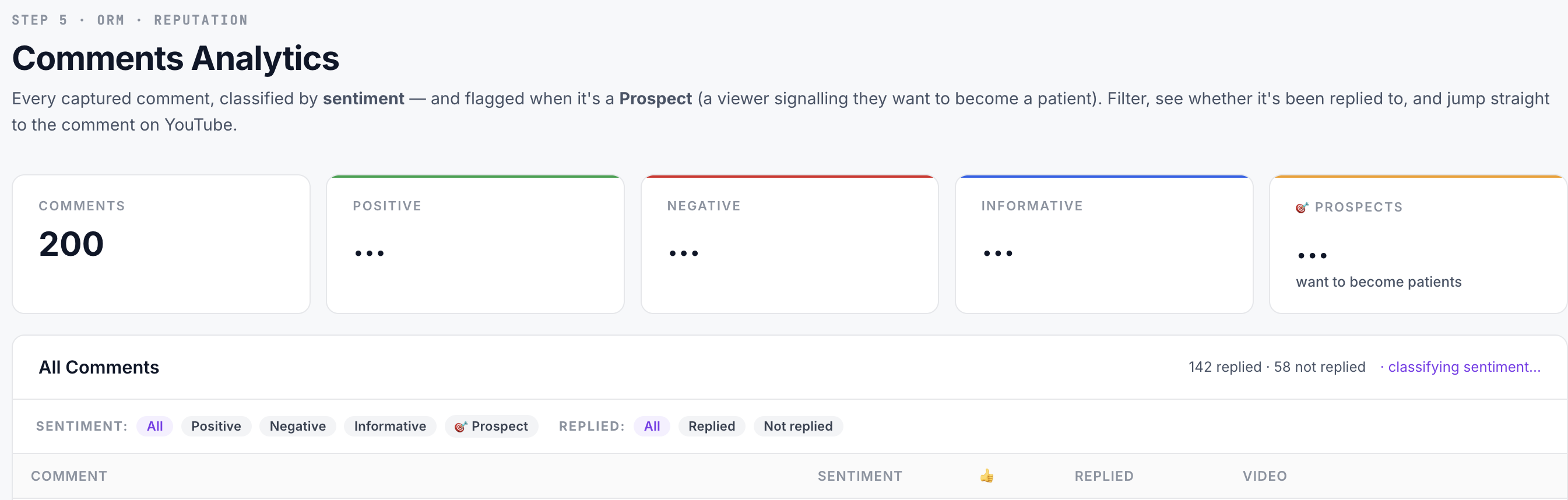
Cardiology's referral-heavy patient flow means the profile needs to signal to referring GPs, not just to patients. GPs use Google Search to check a cardiologist's credentials before referring, and the signals they read differ from what patients read.
GP-relevant signals: - Cardiologist's medical qualifications (MD, DM Cardiology, Fellowship training) prominently displayed on GBP or linked website - Publications and research listings if relevant (linked to journal listings or ResearchGate profile) - Case-mix indicators (procedure types the cardiologist handles — GPs prefer referring complex cases to sub-specialists rather than generalist cardiologists) - Hospital affiliations if the cardiologist works across multiple hospitals - Emergency-availability indicators (a GP is more likely to refer an emergency case to a cardiologist known for 24/7 responsiveness)
None of these signals live natively in Google Business Profile — they live on the cardiologist's or hospital's website. But GBP links to the website, and the website's structured data (Physician schema, Hospital schema) can surface these signals in the search-result snippet that a GP sees.
ICG's healthcare local SEO service extends beyond the GBP itself into the schema and website content that supports the GBP for the referring-physician audience. This is where the broader healthcare SEO service intersects with the local SEO service for a cardiology practice.
Cardiology-specific citation targets
Beyond the general healthcare directory list, cardiology practices benefit from cardiology-specific citations:
- Cardiological Society of India directory listings
- Association of Cardiovascular Interventions of India (ACVII) member listings
- Indian College of Cardiology directory
- Specialty-specific insurance-panel listings (many insurers have cardiology-specialist directories separate from general provider directories)
- Hospital-network directories (Fortis, Apollo, Max, Manipal, Medanta network directories if the cardiologist practices at network hospitals)
- Second-opinion platforms (some Indian second-opinion services list cardiologists specifically)
Angryturtle's citation engine includes cardiology-specific directories in its target list for cardiology-tagged profiles. The Deep-Dive Citation feature can map a specific competing cardiologist's or cardiac unit's citation footprint to identify directories the practice is missing.
Geographic catchment for cardiology practices
Cardiac patients travel farther than most other patients. A cardiologist with a specific reputation for interventional cardiology can attract patients from 30-50 km away. A cardiac hospital known for CABG can attract patients from other cities in the state.
Angryturtle's Geo-Grid heatmap for a cardiology practice should extend beyond the typical 5-10 km grid to cover the practice's actual catchment. The Pin Checker can test rank at specific towns and cities the practice has historically drawn patients from, showing where extending geographic authority signals would produce meaningful ranking improvement.
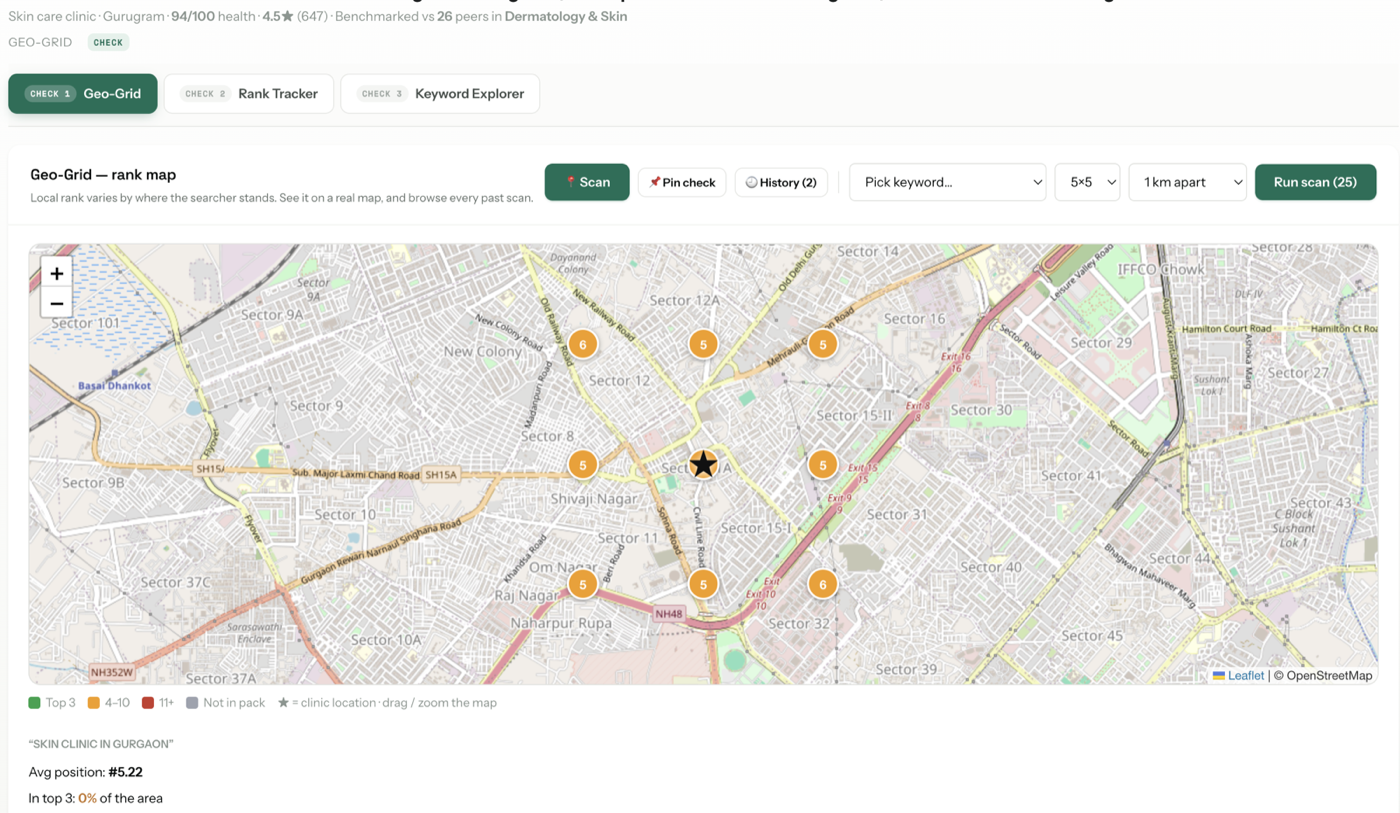
For cardiac hospitals with medical-tourism ambitions (patients from other Indian cities or from neighbouring countries seeking cardiac care in India), Geo-Grid scans across multiple cities show which international-tier reputation signals are working and which need investment.
Cardiology-specific content operations
Google Posts for a cardiology practice should reflect the specialty's clinical seriousness while maintaining NMC compliance.
Post content patterns that work: - Health awareness posts — World Heart Day, Heart Failure Awareness Week, hypertension awareness content. Educational, no treatment claims. - Facility updates — new cath lab equipment, new sub-specialty capability, new insurance panel added. Factual, patient-facing utility. - Doctor introductions — new cardiologist joining, existing cardiologist's specific sub-specialty focus. Credential-based, avoids testimonial framing. - Community engagement — CME lectures the hospital's cardiologists have given, medical association leadership positions, published research references (without embedded clinical claims).
Post content patterns to avoid: - Patient success stories — even generic ones can be read as testimonials that violate NMC Section 6. - Specific procedure success rates — cannot be published without formal outcome studies backing them. - Comparative claims — "the best cardiology hospital in Bangalore" violates ASCI guidelines 2022 on comparative advertising. - Aspirational marketing language — "life-saving care" or "world-class cardiology" without specific supporting facts reads as puffery.
Angryturtle's Content Studio drafts cardiology-specific Posts within these constraints, using an AI system aware of NMC and ASCI restrictions. The drafts pass through hospital compliance-reviewer approval before publishing.
What ICG's cardiology local SEO retainer produces
For a cardiology practice or a hospital's cardiac unit on ICG's healthcare local SEO retainer:
Weeks 1-4 (onboarding): Full profile audit against the cardiology-specific Rank OS calibration. Category correction if primary is wrong. Full services list build-out to include specific cardiac procedures. Description rewrite to full 750 characters with cardiology-specific keyword coverage. Initial photo audit — cath lab, hospital exterior, medical team. Ask Maps question bank seeded for cardiology-specific patient queries. First citation batch against cardiology-directory list.
Months 2-3: Weekly Post cadence covering cardiology health awareness, facility updates, doctor introductions. Review-request campaign initiated with NMC-safe framing focused on visit experience. AI-drafted replies to existing unresponded reviews with compliance-review workflow. First monthly Geo-Grid scan showing catchment ranking.
Months 4-6: Citation coverage builds against cardiology-directory list. AIO Readiness score improves as Ask Maps gaps close. Rank OS score typically moves 15-25 points across the first 90 days. First-time ranking in local pack for cardiology-specific queries the practice previously didn't rank for.
Months 7-12: Compound gains from consistent execution. Review volume grows meaningfully (velocity signal). Reputation moat builds — new patient reviews plus GP-facing signals via website schema. Rank OS score plateau in the 80-90 range depending on local competitive intensity.
Pricing tier for cardiology practices
Cardiology practices typically fit ICG's local SEO service across all tiers depending on scale:
Solo cardiologist (single practice location): Starter tier at ₹25,000-₹50,000/month covers GBP optimisation, monthly Post cadence, review operations, quarterly citation audit. Sufficient for a solo cardiologist testing local SEO investment.

Small cardiac group (2-5 cardiologists, 1-2 locations): Chain tier at ₹75,000-₹1.5L/month covers per-location GBP management, weekly Post cadence, review operations with escalation, monthly Geo-Grid tracking, monthly citation building.
Hospital cardiac unit or dedicated cardiac hospital: Hospital tier at ₹1.5L-₹4L/month covers department-level campaign structuring, daily Post cadence, review operations across the full cardiac patient footprint, weekly Geo-Grid tracking per location, ongoing citation building, monthly AIO audit, custom reporting into hospital marketing dashboards.
Related reading
- Healthcare local SEO agency India — the pillar service page
- How to rank a hospital on Google Maps in India — the six controllable signals
- GBP optimization for multi-specialty hospitals — for cardiology-as-department contexts
- Cardiology patient acquisition cost India — the CPQL context for cardiology
- Cardiology marketing cost India — the marketing budget context
FAQ
How different is local SEO for cardiology from local SEO for other specialties? Different weighting on the underlying signals. Reviews and reputation-signal strength matter more for cardiology because of the specialty's referral-heavy patient flow. Sub-specialty category depth matters more (interventional vs non-invasive vs electrophysiology vs paediatric cardiology). GP-facing signals via website schema matter more. AIO Readiness matters increasingly as patients ask AI systems specific cardiac care questions.
How many reviews does a competitive cardiology practice need? 300-500 minimum for metro-level competition. Solo cardiologists at the lower end; hospital cardiac units toward the higher end. Above 500, the review count reads as established practice.
Does a cardiologist need to worry about referring-physician signals in local SEO? Yes. GPs check a cardiologist's Google presence before referring. Credential signals, publication history, sub-specialty focus, and hospital affiliations affect referral flow even though they're not classic local SEO signals. Website schema and structured data supporting the GBP address this.
Can a cardiology practice use patient testimonials in Google Posts or reviews? Not with treatment-specific details. NMC's 2026 advertising guidelines prohibit presenting individual patient stories as clinical evidence. Educational content, factual updates, and generic patient-experience acknowledgments are compliant; treatment-outcome stories are not.
What's the ROI math on local SEO for a cardiology practice? Cardiology procedures produce ₹15,000-₹5 lakh per booking depending on complexity. Even one additional booked patient per month covers a Starter-tier retainer; five additional bookings per month covers a Hospital-tier retainer. Local SEO investment breaks even quickly for cardiology when execution is competent.
How long before a cardiology practice sees ranking improvement? First measurable movement in 4-6 weeks. Substantive ranking improvement in 3-4 months. Full compound effect (top-3 local pack for primary cardiology queries in the catchment) in 6-12 months depending on competitive intensity.
Which Angryturtle features matter most for cardiology? Rank OS with cardiology-specific weighting, Ask Maps AIO with cardiology-specific question bank, healthcare-specific citation targets including cardiology directories, NMC-safe review reply drafting, Geo-Grid heatmap for the extended catchment cardiac patients travel across.
Does ICG's cardiology local SEO include paid ads? No — paid Google Ads and Meta Ads run under ICG's performance marketing service. Local SEO is organic; paid runs as a separately scoped service that pairs well with local SEO.
How does cardiology local SEO integrate with hospital HIS/PMS? Attribution setup: local SEO enquiries (calls, direction requests, appointment link clicks) tag back to the hospital's HIS or PMS to record which patients arrived via local SEO channels. ICG builds this attribution as part of Hospital-tier engagements.
Can Angryturtle handle a hospital cardiac unit's local SEO alongside the hospital's other departments? Yes. A multi-specialty hospital's cardiac unit is optimised as part of the hospital's primary GBP with cardiology-specific service listings, cardiology-specific Post content, cardiology-focused Ask Maps questions, and cardiology-directory citations. Not a separate GBP; a specialty focus within the shared hospital GBP.
What about paediatric cardiology? Sub-specialty. Handled as an additional secondary category ("Pediatric Cardiologist"), specific services in the services list (paediatric echocardiography, congenital heart procedures if performed), and paediatric-specific Ask Maps questions. Warrants specific attention because paediatric cardiology has different search patterns and different insurance-panel considerations than adult cardiology.
How is competitive benchmarking done for cardiology? Angryturtle's Competitors module identifies the top-5 competing cardiology practices or cardiac units in the catchment based on distance and category matching. Comparison covers Rank OS score, review counts, citation coverage, and specialty-specific ranking. Enables direct comparison of how the practice stacks against its actual competitive set.
Book a free SEO diagnostic.
Hanuman Sihag's team runs a live crawl, checks technical health, cannibalisation, schema coverage and content gaps. 60 minutes, prioritised fix list.
The three platforms
behind every ICG engagement.
Beacon
CAPI middleware that fixes Event Match Quality, translates CRM statuses to Meta-standard events, dedups across channels.
Agency OS
Live client dashboard. GSC, GA4, Google Ads, Meta Ads, IVR calls in one view. Login anytime, not monthly.
Phoenix
Clinic revenue intelligence over your PMS. Daily action queue: Prevent Loss, Maintain & Engage, Grow Revenue. Multi-centre rollout.
Or book a free 30-min audit to see all three in action on your account.
Healthcare brands
that already run on ICG.
A representative slice of the 150+ healthcare brands ICG has delivered for across India. Most engagements remain under NDA.


What ICG clients say · on video.
"Scale up of organic channels and business consulting. ICG has absolute domain authority in their field."
"Working with ICG transformed how we acquire IVF patients in Gurgaon. They understand the fertility journey from inquiry to consult..."
"What Ichelon accomplished — they got all my ideas and worked over 3-4 months to create an amazing, super-customised website."
The intelligence stack behind this playbook.
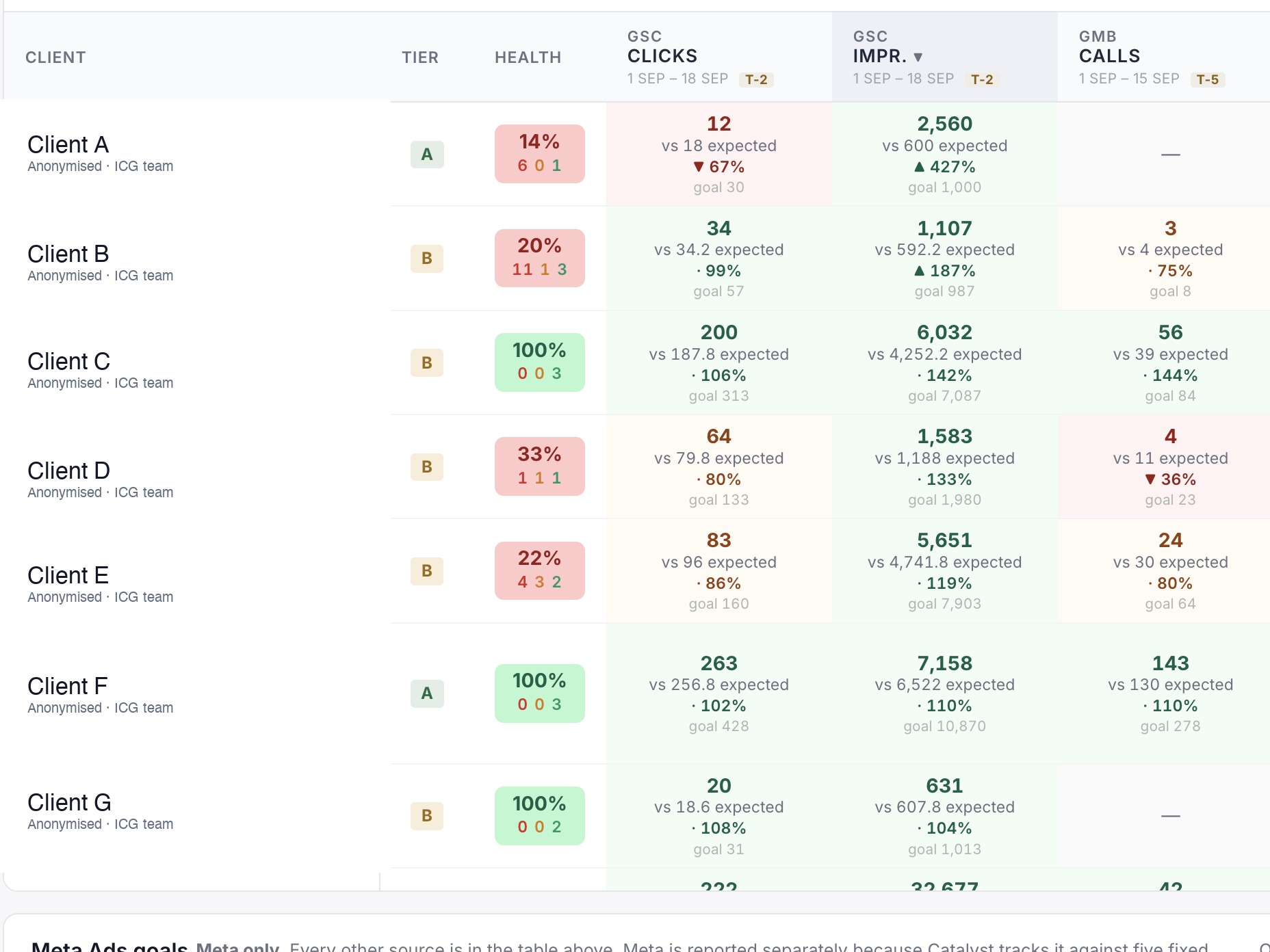
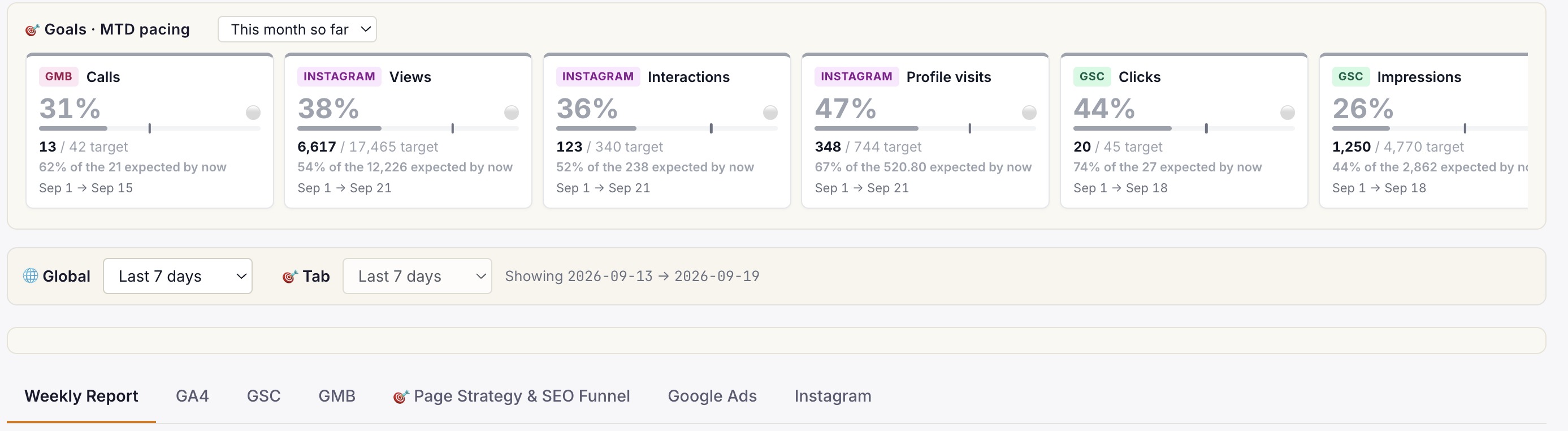
Every ICG engagement runs on the Search Intelligence Trifecta — Angryturtle for GMB, SIE for search and AI Overview, YODA for YouTube. Live product screens below.
Need help operationalising this?
Every ICG service is healthcare-only, NMC + DPDP-aware, and built around the patient-research patterns that drive Indian healthcare growth in 2026.
Every practice welcome — packages from ₹20,000/mo.
Goals-Driven engagements · Performance-Linked Payout Models available
More from
ICG.
Five trends shaping Indian healthcare marketing through 2027: AI-first patient research, Conversions API adoption, ABDM discovery, the AEO w...
Healthcare AIO is the discipline of getting your clinic or hospital cited inside Google AI Overviews, ChatGPT and Perplexity answers — not j...
Conversational-search advertising places brand messages inside AI chat answers — ChatGPT, Perplexity, Copilot — rather than beside a results...
Stop guessing.
Book a Diagnostic.
30 minutes. Free. With the AI-powered healthcare-only marketing agency 150+ brands already run on. No slides, no pitch, no hard close.


