


GBP post scheduling and cadence for Indian healthcare: what to publish, how often, and inside which compliance perimeter
GBP post scheduling for Indian hospitals and clinics is one of the highest-ROI freshness activities inside local SEO, but healthcare posts have to work inside NMC, ASCI, PC-PNDT and ART Act restrictions that most templates ignore. This 2026 guide covers the four post types, compliance-safe framings, cadence, best-performing patterns, and how ICG uses Angryturtle to draft and schedule at scale.
No pitch. Written root-cause diagnosis. AI-powered, healthcare only.
Direct answer
GBP post scheduling for Indian hospitals and clinics is one of the highest-ROI freshness activities inside local SEO, but healthcare posts have to work inside NMC, ASCI, PC-PNDT and ART Act restrictions that most templates ignore. This 2026 guide covers the four post types, compl...
TL;DR

GBP post scheduling for Indian healthcare brands sits at the intersection of freshness signal, patient education, and layered advertising compliance — NMC's 2026 advertising guidelines, ASCI Guidelines, PC-PNDT restrictions for fertility profiles, ART Act 2021 restrictions for ART clinics, and DPDP Act 2023 for anything patient-adjacent. ICG runs Google Posts for 150+ Indian healthcare brands using Angryturtle's Content Studio drafting engine and calendar scheduler, and the pattern is clear: brands that publish 1 to 3 compliance-safe posts per week compound freshness signal materially faster than brands that post sporadically or that publish generic marketing templates a compliance-aware algorithm will not amplify. This guide covers the four post types, the compliance-safe framings that actually work, cadence recommendations for healthcare local SEO, and the patterns that produce sustained visibility.
The four Google Post types and what each does on a healthcare profile
Google Business Profile supports four post types: Update, Offer, Event, and Product. Each behaves differently in how it renders, how long it stays visible, and how it contributes to the profile's freshness signal.
Update posts are the general-purpose format. They render in the profile's updates carousel, stay visible indefinitely (though only the most recent 3 to 4 appear prominently), and function as the workhorse post type for weekly cadence. Most healthcare posts should default to Update.
Offer posts require a promotional structure — title, promotion terms, start and end date, optional coupon code. Offer posts render with a distinct offer badge and expire automatically at the end date. For healthcare, Offer posts are usable only when the offer is compliant — a health-check package at a stated price, a diagnostic screening camp with defined dates, a wellness assessment discount within ASCI-substantiable pricing claims.
Event posts include a start and end date and appear in the events section of the profile. Health awareness days, patient education seminars, health camps, and CSR activities fit Event framing. Event posts drive event-specific engagement and expire after the event date.
Product posts appear in a distinct Products section on the profile and function best when the practice sells specific packaged services (health check-ups, diagnostic bundles, dental packages). Product posts stay visible until manually removed and support price display.
Compliance-safe post framings that clear NMC and ASCI review
Every healthcare post has to pass three compliance filters simultaneously. First, the National Medical Commission Ethics Code 2026 restriction against advertising that solicits patients using patient testimonials, guaranteed outcomes, or superiority claims. Second, ASCI Guidelines 2022 requirement that every advertising claim be substantiated by evidence. Third, specialty-specific restrictions where applicable — PC-PNDT for fertility and ultrasound clinics, ART Act 2021 for assisted reproductive technology clinics, PC and PNDT for gynaecology practices offering ultrasound.
Framings that clear all three filters. Educational content explaining a condition, a treatment approach, or a diagnostic process in factual terms without outcome claims. Awareness content tied to national or international health awareness days (World Diabetes Day, World Cancer Day, World AIDS Day, Breast Cancer Awareness Month). Facility and equipment updates factual and dated. Team credentials factual and verifiable. Health camp announcements with specific date, location, and non-clinical framing.
Framings that fail. "Best cardiology hospital in Bengaluru" — ASCI violation on superlative. "Patient success story: how Dr Sharma cured Rajesh's diabetes" — NMC violation on testimonial framing and outcome claim. "99% IVF success rate" — ASCI substantiation failure and ART Act advertising restriction. "Guaranteed pain relief after our treatment" — outcome guarantee violates NMC and ASCI.
Angryturtle's Content Studio drafts posts inside the compliance perimeter by default. Every AI-drafted post passes through a compliance-check pass before it enters the scheduling queue, and drafts that fail the check surface as flagged for editor review.
Cadence recommendations for single-location clinics and multi-location chains
The sustainable cadence for a single-location clinic: 1 to 2 posts per week, distributed across Update and occasional Event or Offer posts. Weekly posting is the freshness signal minimum that produces measurable sie" style="color:inherit;text-decoration:underline;text-decoration-color:rgba(42,126,200,.5);text-underline-offset:2px">Rank OS movement over a 90-day window.

The sustainable cadence for a multi-location hospital or chain: 2 to 3 posts per week per major location, with additional group-level posts on the flagship profile for health awareness days and organisation-wide announcements. Chains that let individual locations lapse below one post per week see the affected locations lose freshness score relative to matched competitors within 6 to 8 weeks.
Above 3 posts per week produces diminishing returns. Google's freshness algorithm reads the cadence signal at roughly a week-granular resolution. Publishing 6 posts on Monday and none for the rest of the week reads as one week of activity rather than six units of activity. Even distribution across the week outperforms bunching.
Below 1 post per week produces limited freshness signal. A profile that posts once a month or once a quarter derives almost no freshness benefit from the activity, though the individual posts still function as content for patients who visit the profile.
Best-performing post patterns for Indian healthcare profiles
Pattern one — health awareness day content. World Diabetes Day (14 November), World Cancer Day (4 February), World Kidney Day (second Thursday in March), World Health Day (7 April), World IVF Day (25 July), and dozens of other awareness days give healthcare profiles a natural content calendar. Awareness-day posts consistently generate above-average engagement because Google surfaces them to users searching around the awareness day itself.
Pattern two — service explanations in plain language. "What happens during a paediatric cardiology consultation" or "How our fertility clinic prepares patients for IVF" written factually without outcome claims. Educational posts build the profile's topical authority and answer patient research questions.
Pattern three — team introductions. "Meet Dr Priya Sharma, our new interventional cardiologist" with credential facts, sub-specialty focus, and consultation hours. Team posts humanise the profile and directly answer the patient question "who will I see."
Pattern four — facility and equipment updates. "New robotic surgery equipment installed" or "Expanded paediatric ICU capacity from 12 to 20 beds." Factual, dated, no outcome claims. Facility posts signal ongoing investment and update the profile's current capabilities picture.
Pattern five — health camps and community programmes. Free diabetes screening camp with date and location. Free breast cancer awareness talk with speaker and date. These posts serve a dual purpose — CSR framing and direct patient acquisition.
What not to post — the common mistakes that either fail compliance or waste freshness signal
Do not post patient testimonials. The temptation is universal because patient stories are the most emotionally powerful content available. The NMC restriction is unambiguous, and using patient testimonials risks both regulatory enforcement and Google guideline violation.
Do not post generic motivational quotes or wellness aphorisms without healthcare specificity. Google's freshness algorithm reads the semantic content of posts; posts that could apply to any profile in any vertical contribute almost nothing to specialty-specific ranking signal.
Do not post promotional Offer posts with unsubstantiated claims. An "up to 50% off" without terms or an "unbeatable prices" claim fails ASCI review and may trigger platform enforcement.
Do not post competitor comparisons. "Better than the hospital across the road" fails ASCI comparative advertising rules and violates NMC restrictions on comparative claims. Even oblique comparisons carry compliance risk.
Do not repost identical content month over month. Google detects duplicate post content and either treats subsequent posts as low-value or hides them from search results. Post rotation matters.
Scheduling across time of day and day of week for maximum engagement

Google Business Profile does not weight post publish-time into ranking directly, but publish-time affects how many users see the post in the fresh state. For Indian healthcare, engagement data across the ICG client base shows two peak windows: weekday mornings between 9 AM and 11 AM when patients research clinics before or after their workday starts, and weekday evenings between 7 PM and 10 PM when patients research from home.
The practical scheduling recommendation: publish 60 to 70% of posts inside these engagement windows on weekdays Monday through Friday, and the remaining 30 to 40% at various times to test what works for the specific profile's audience.
Saturday morning posting (9 AM to 12 PM) also produces strong engagement for practices with weekend consultation hours — patients research on Saturday morning for weekend appointments. Sunday posting produces the weakest engagement for most healthcare specialties and is worth avoiding for high-effort posts.
Health awareness days should publish 1 to 2 days before the awareness day itself, not on the day, so the post has time to accumulate views and reach the search-freshness threshold before the awareness-day traffic peaks.
Angryturtle's scheduling and Content Studio drafting workflow
Angryturtle's Content Studio for GBP Posts runs in three modes. Autopilot mode drafts the week's posts using the profile's specialty configuration, publishes them directly to GBP through the API integration, and reports engagement metrics back into Rank OS scoring. Editor-review mode drafts the posts and holds them in an approval queue for the client's marketing team or ICG account manager to approve before publishing. Manual mode gives operators a blank composer with compliance guardrails but no AI drafting.
Most healthcare clients use editor-review mode for the first 60 to 90 days while calibrating the AI drafts against their brand voice and internal compliance standards. Once calibrated, many switch to autopilot mode for standard weekly cadence and use editor-review only for major announcements.
The scheduling calendar visualises 4 to 12 weeks of upcoming posts across the profile cluster, colour-coded by post type. Operators can drag posts to reschedule, batch-edit content, and see gaps in cadence at a glance.
For managed clients on ICG's Hospital tier, the workflow includes monthly editorial planning where the ICG content team plans health awareness days, service launches, team announcements, and facility updates 3 to 4 weeks ahead so the Content Studio drafts arrive in the approval queue with context.
Measuring post performance and what to optimise for
Google exposes limited post-performance metrics in the Business Profile Manager: post views, post clicks (when the post has a call-to-action button), and post-driven actions (calls, direction requests, website visits). These metrics are directional rather than precise, and they lag the post by several days.
The optimisation loop that works. Track which post types (Update, Offer, Event, Product) generate the highest engagement for the specific profile. Track which content themes (health awareness, service explanation, team introduction, facility update, health camp) generate the highest engagement. Increase the share of the top-performing types and themes in subsequent months while maintaining variety.
Attribute post performance to Rank OS movement rather than to booked-patient outcomes directly. Post cadence contributes to freshness which contributes to ranking which contributes to profile impressions which contribute to booked patients. The chain is long enough that direct post-to-patient attribution is noisy; the ranking-level attribution is stable enough to drive optimisation.
The tool ICG uses to run this at scale: Angryturtle
ICG runs local SEO and GBP intelligence for 150+ Indian healthcare brands using Angryturtle — our own AI-native GBP intelligence and management OS. The platform scores every profile 0-100 via a proprietary Rank OS model with five weighted dimensions (Relevance, Review Health, Freshness, Entity Authority, AIO Readiness), publishes edits, Posts, media, and review replies directly to Google, and includes Ask Maps AIO Readiness scoring for Google AI Overviews and ChatGPT visibility.

Available in two shapes: self-serve at ₹999/- per month for solo owners with 1-2 profiles, and ICG's managed service from ₹25,000/- per month where our healthcare specialists execute inside the same platform. Both are anchored in the Healthcare Local SEO Agency India pillar page which has full scope, methodology and pricing.
Book a demo on WhatsApp → or start a free trial at angryturtle.ai →
Related reading
- Healthcare local SEO agency India — the pillar service page
- GBP photo strategy for Indian healthcare 2026
- GBP Q&A strategy for Indian healthcare 2026
- Duplicate GBP listings: how to find, merge and prevent them
- Angryturtle Rank OS explained — the scoring model
FAQ

How often should a small clinic post on GBP? 1 to 2 posts per week is the sustainable minimum that produces freshness signal. A single-doctor clinic can meet this cadence with one hour of monthly content planning if the content is drafted in advance and scheduled through Angryturtle or a similar tool.
Do I need to post every day for GBP to work? No. Daily posting produces diminishing returns and creates content-supply pressure that pushes brands into low-quality posts. 1 to 3 posts per week distributed evenly outperforms daily posting for most healthcare profiles.
Can I use Offer posts for a health check-up discount? Yes if the offer complies with ASCI substantiation requirements. A stated-price package with clear terms and defined start-and-end dates is compliant. An "up to 50% off" claim without terms is not.
Are Event posts worth the effort for a small clinic? Yes when there is a genuine event — a health awareness talk, a free screening camp, a patient education seminar. Event posts drive event-specific engagement and show up in the events section of the profile which is a distinct discovery surface.
Should I include a call-to-action button on every post? Yes when it adds meaningful navigation value. "Learn more" linking to a service page, "Book" linking to an appointment page, "Call now" for urgent-care service. Do not force a CTA on a purely educational post where the CTA reads awkwardly.
How long do Update posts stay visible on my profile? Update posts stay indefinitely but only the most recent 3 to 4 render prominently. Older Update posts remain accessible in the profile's updates history but do not appear in the main profile view.
Can Angryturtle write posts specifically for my specialty? Yes. Content Studio is trained on healthcare content patterns and applies specialty-specific templates (cardiology, orthopaedics, paediatrics, gynaecology, dermatology, dental, ophthalmology, ENT, fertility, oncology, and more). The specialty configuration affects both content topics and compliance filters.
What happens if I post something that violates ASCI or NMC? Google may remove the post or flag the profile for review. ASCI enforcement occurs when a complaint is filed and can result in advertising withdrawal orders. NMC enforcement affects the doctor's registration status in serious cases. Compliance filters in Angryturtle exist specifically to prevent this class of exposure.
How do I measure whether posting is actually driving business? Track the composite chain: post cadence to Rank OS freshness score to profile impressions to profile actions (calls, directions, website visits) to booked appointments. Individual post-to-booking attribution is noisy, but the composite chain shows the mechanism reliably over 60 to 90 day windows.
Can I schedule posts in advance for the whole month? Yes through Angryturtle's calendar. Scheduling a month in advance is the operational pattern most sustainable for busy clinic teams. Reserve the calendar's edit window so time-sensitive posts (news, urgent updates) can slot in without displacing the planned cadence.
Book a free 30-minute Brand & Growth Diagnostic.
It's a working session, not a sales pitch — you leave with a written root-cause analysis you can act on, whether or not you engage ICG.
The three platforms
behind every ICG engagement.
Beacon
CAPI middleware that fixes Event Match Quality, translates CRM statuses to Meta-standard events, dedups across channels.
Agency OS
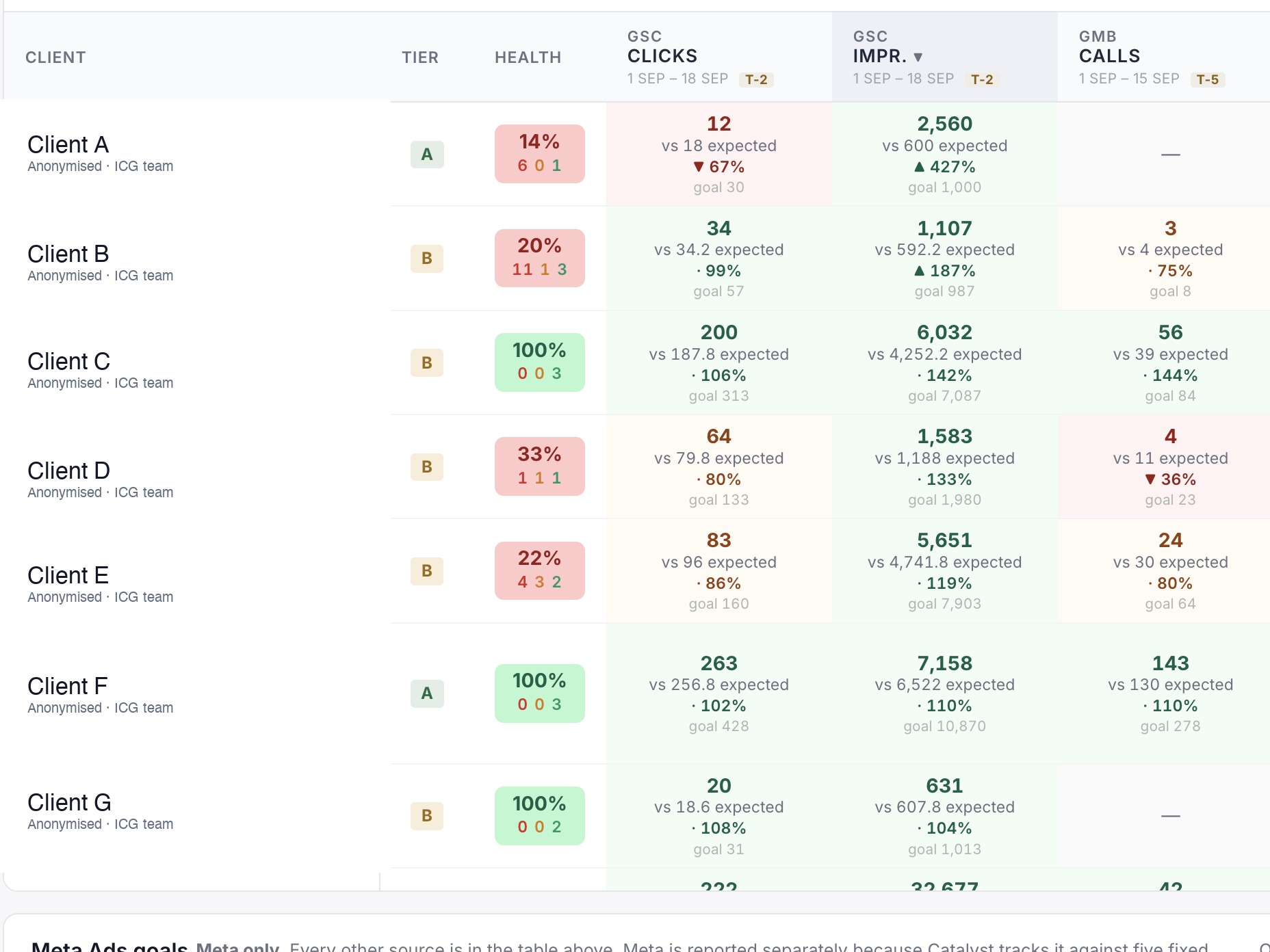
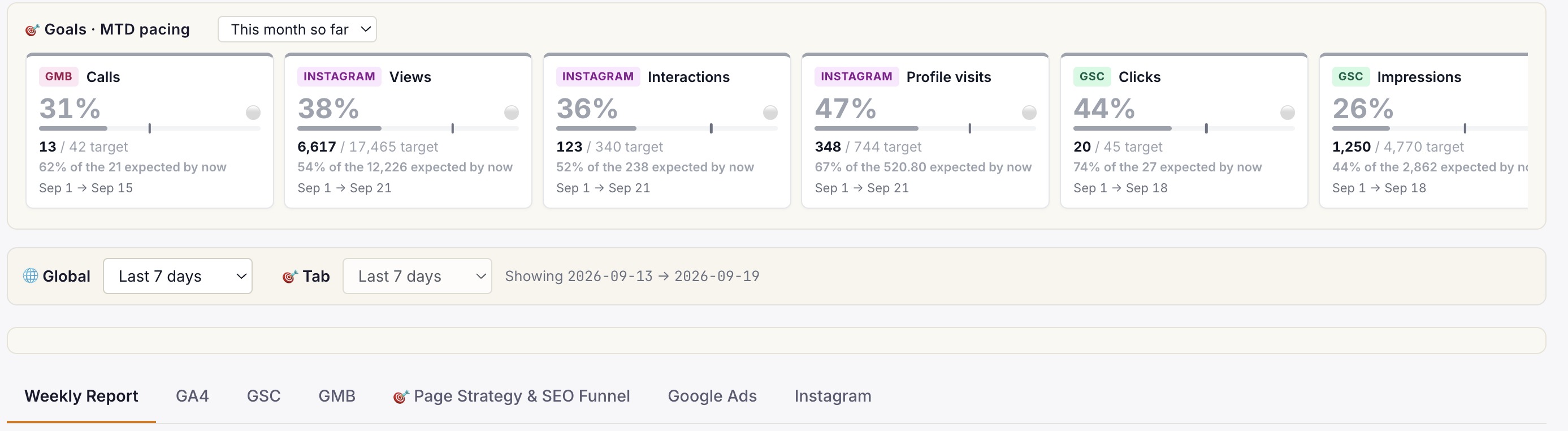
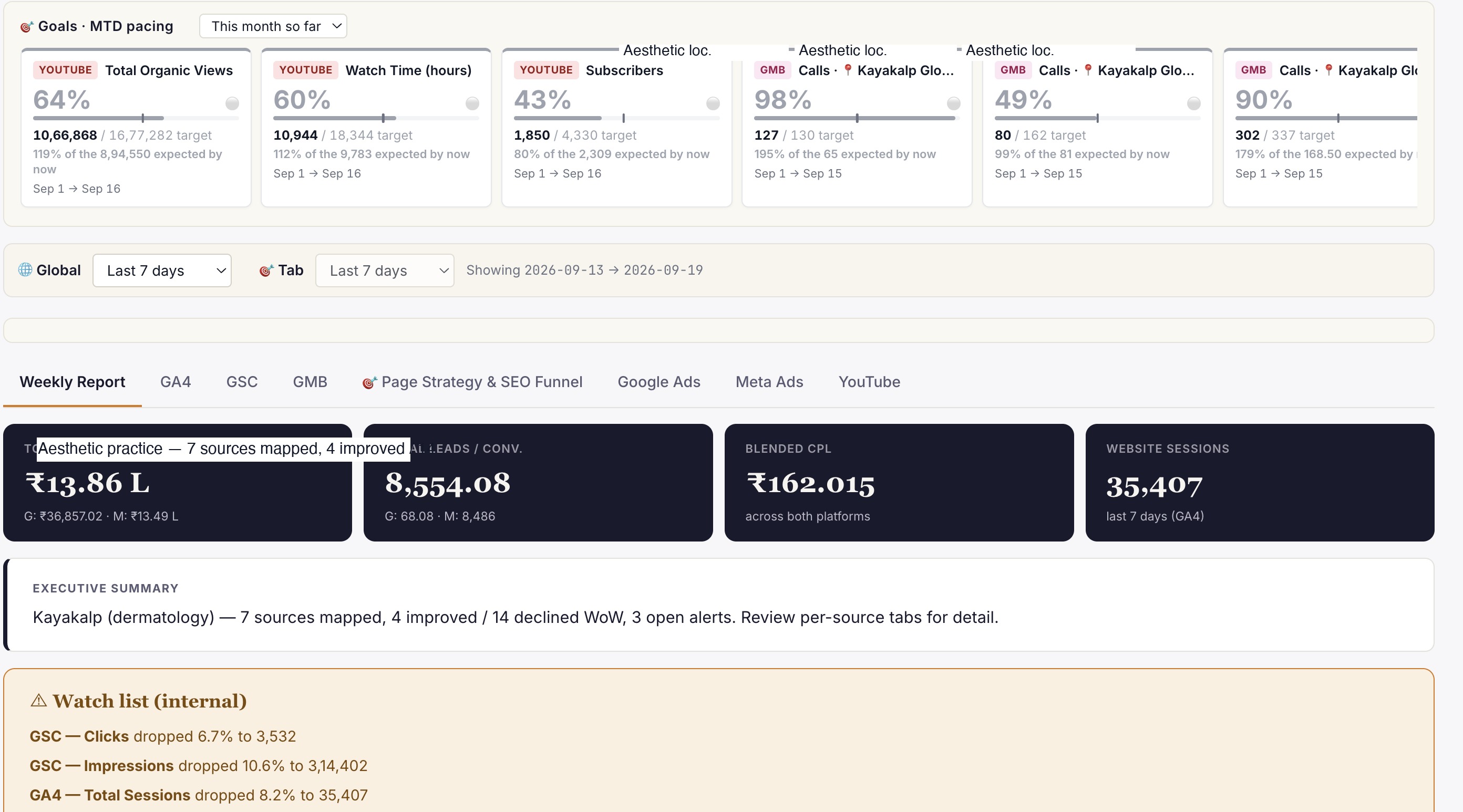
Live client dashboard. GSC, GA4, Google Ads, Meta Ads, IVR calls in one view. Login anytime, not monthly.
Phoenix
Clinic revenue intelligence over your PMS. Daily action queue: Prevent Loss, Maintain & Engage, Grow Revenue. Multi-centre rollout.
Or book a free 30-min audit to see all three in action on your account.
Healthcare brands
that already run on ICG.
A representative slice of the 150+ healthcare brands ICG has delivered for across India. Most engagements remain under NDA.


What ICG clients say · on video.
"Scale up of organic channels and business consulting. ICG has absolute domain authority in their field."
"Working with ICG transformed how we acquire IVF patients in Gurgaon. They understand the fertility journey from inquiry to consult..."
"What Ichelon accomplished — they got all my ideas and worked over 3-4 months to create an amazing, super-customised website."
Need help operationalising this?
Every ICG service is healthcare-only, NMC + DPDP-aware, and built around the patient-research patterns that drive Indian healthcare growth in 2026.
Every practice welcome — packages from ₹20,000/mo.
Goals-Driven engagements · Performance-Linked Payout Models available
More from
ICG.
Five trends shaping Indian healthcare marketing through 2027: AI-first patient research, Conversions API adoption, ABDM discovery, the AEO w...
Healthcare AIO is the discipline of getting your clinic or hospital cited inside Google AI Overviews, ChatGPT and Perplexity answers — not j...
Conversational-search advertising places brand messages inside AI chat answers — ChatGPT, Perplexity, Copilot — rather than beside a results...
Stop guessing.
Book a Diagnostic.
30 minutes. Free. With the AI-powered healthcare-only marketing agency 150+ brands already run on. No slides, no pitch, no hard close.


