


Medical SEO Agencies in India 2026: 8 Agencies Compared
Eight Indian agencies that offer medical and healthcare SEO, compared using facts from their own websites (checked 8 October 2026), with typical costs, technical and local SEO checks, and the questions to ask before you hire. Written by ICG, which is one of the eight.
No pitch. Written root-cause diagnosis. AI-powered, healthcare only.
Quick answer
How do you choose a medical SEO agency in India?
Shortlist agencies that focus on healthcare and publish a dedicated medical SEO service, then check four things: that they name Indian rules such as the NMC's October 2026 advertising guidelines, ASCI and the DPDP Act; that they show results through Search Console access; who writes and clinically reviews the content; and that no part of the fee is tied to patients procured.
Direct answer
Eight Indian agencies that offer medical and healthcare SEO, compared using facts from their own websites (checked 8 October 2026), with typical costs, technical and local SEO checks, and the questions to ask before you hire. Written by ICG, which is one of the eight.
TL;DR
About this list. This comparison is written by Ichelon Consulting Group (ICG), a healthcare marketing agency that offers medical SEO, and ICG is one of the eight agencies listed. To keep it fair, agencies are listed alphabetically, not ranked; every fact about another agency comes from that agency's own website as it stood on 8 October 2026; we do not repeat any agency's self-reported results or client counts; and no agency paid to be included. Links to other agencies are marked nofollow.
Medical SEO agencies in India at a glance
| Agency | Based in (as stated) | Founded (as stated) | Focus | Regulations named on its site |
|---|---|---|---|---|
| BeTopSEO | Hyderabad | Not stated | Multi-industry, with healthcare SEO page | None on healthcare page |
| Bloom Agency | Mumbai | Not stated | Multi-industry, with healthcare SEO page | HIPAA |
| Branding Pioneers | Gurugram | 2016 | Healthcare-only | HIPAA |
| DigiScrub | Mumbai | Not stated | Healthcare-only | None named |
| Ichelon Consulting Group (ICG) | Gurugram | 2018 | Healthcare-only | NMC, ASCI, DPDP Act |
| Ocean Multivision | Noida | 2007 | Healthcare-only | General compliance wording |
| Praxis360 Marketing | Nagpur | 2013 | Healthcare-only | NMC, HIPAA |
| Techmagnate | New Delhi | 2006 | Multi-industry, with healthcare SEO page | HIPAA |
How we chose and described the agencies
To be included, an agency had to be based in India and publish a dedicated healthcare or medical SEO service page on its own website. For each one we recorded only what that site states: where it is based, when it was founded (if stated), whether it serves healthcare only, the healthcare SEO services it lists, and any regulations it names. We then compared them on five criteria a clinic or hospital can check for itself:
- Healthcare focus: healthcare-only, or a general agency with a healthcare service line.
- Service depth: whether technical SEO, local SEO and Google Business Profile, and medical content are all offered.
- Regulatory awareness: whether Indian rules (NMC, ASCI, DPDP Act) are named, not only US HIPAA.
- AI search readiness: whether AI Overviews or answer-engine optimisation is addressed.
- Transparency: whether process, team or pricing is published.
We have not audited any agency's client work, so this list describes offerings, not results. Ask every shortlisted agency for evidence before you sign.
Why medical SEO is different from generic SEO
1. Google's YMYL treatment of health content. Health pages fall under Google's “Your Money or Your Life” standard, so experience, expertise, authoritativeness and trust (E-E-A-T) carry extra weight: named and qualified authors or reviewers, cited sources, clear ownership and review dates.
2. Indian advertising rules apply to web content. The NMC's Guidelines on Ethical Advertising and Public Communication (6 October 2026) treat search-engine and website content with a promotional character as advertising. “Best cardiologist”, success rates, testimonials and before-and-after images are out; factual information about departments, facilities, doctors' qualifications and fees is in. See our NMC code of ethics guide.
3. AI Overviews sit above the results. For many health questions, Google's AI Overview answers first and cites a handful of pages. Pages that answer the question directly, carry clear structure and show who wrote them are easier to cite.
4. Local search is hyperlocal. “Eye specialist near me” is decided largely in the Google Maps pack, so Google Business Profile, consistent citations and location pages matter as much as the website.
5. Large sites need architecture. A multi-specialty hospital needs a page structure that covers departments, conditions, procedures, doctors and locations without the pages competing with each other.
The agencies, in alphabetical order
BeTopSEO
Based in: Hyderabad, Telangana. Focus: multi-industry SEO company with a dedicated healthcare SEO page and a separate SEO-for-doctors page.
Healthcare SEO services listed: healthcare SEO audit, keyword research and mapping, on-page and technical SEO, healthcare content, conversion optimisation, link building, and local SEO for doctors and hospitals. Its general SEO packages are priced publicly on its homepage.
Worth asking: how Indian advertising rules are handled in content, as none are named on the healthcare page.
Bloom Agency
Based in: Mumbai (Andheri). Focus: multi-industry digital agency with a healthcare SEO services page and a separate dental SEO page.
Healthcare SEO services listed: healthcare SEO, local SEO for medical practices, healthcare content, reputation management, conversion optimisation, medical website design, PPC and social media. Its site refers to HIPAA-compliant content marketing.
Worth asking: how its process maps to Indian rules (NMC, ASCI, DPDP Act) rather than US HIPAA.
Branding Pioneers
Based in: Gurugram, with offices also listed in the United States. Founded: 2016, as stated on its site. Focus: healthcare-only marketing agency with a healthcare SEO agency page.
Healthcare SEO services listed: healthcare SEO, local SEO and Google Maps, performance media, AI and automation, web and software, branding, social and video, direct marketing and PR. It publishes healthcare SEO price tiers on its site and refers to HIPAA-aware workflows.
Worth asking: which team members would work on your account and how Indian advertising rules are reviewed.
DigiScrub
Based in: Mumbai, with Pune and Bangalore also listed. Focus: healthcare-only marketing agency with an SEO services page.
Healthcare SEO services listed: on-page SEO, local SEO and Google Business Profile, healthcare content writing, technical SEO and website audits, off-page SEO, analytics, plus Google Ads, website design, social media and online reputation management.
Worth asking: how compliance review fits into content production, as no specific regulation is named.
Ichelon Consulting Group (ICG) — the publisher of this guide
Based in: Gurugram, with a US practice in Dallas. Founded: 2018. Focus: healthcare-only marketing agency; 150+ healthcare brands served since 2018. Service pages: medical SEO and healthcare SEO.
Healthcare SEO services listed: technical and on-page SEO, local SEO and Google Business Profile management (on ICG's own platform, Angryturtle), medical content, AI Overview and answer-engine optimisation, and paid media. Its site names the NMC rules, ASCI and the DPDP Act, and it publishes its cost-per-qualified-lead benchmark dataset. Engagements start from ₹20,000/month.
Worth asking: the same questions as every other agency on this list, below.
Ocean Multivision
Based in: Noida (first-listed office), with Mumbai and Ahmedabad offices. Founded: 2007, as stated on its healthcare SEO page. Focus: healthcare-only digital marketing with a healthcare SEO services page.
Healthcare SEO services listed: healthcare SEO audits, local SEO, medical content strategy, technical SEO, managed SEO, AI SEO, SEO for doctors, dental SEO and B2B healthcare SEO, plus Google Ads. Its site describes a compliance-first approach without naming specific regulations.
Worth asking: which Indian rules its compliance review covers.
Praxis360 Marketing
Based in: Nagpur, Maharashtra. Founded: experience since 2013, as stated on its homepage. Focus: healthcare-only marketing with an SEO page for doctors and hospitals.
Healthcare SEO services listed: SEO for doctors and hospitals, local search, website design, performance marketing, brand kits, consulting and coaching. Its site refers to medical council codes of conduct, including India's NMC code, as well as HIPAA.
Worth asking: how its content process has changed for the NMC's October 2026 advertising guidelines.
Techmagnate
Based in: New Delhi, with other Indian offices listed. Founded: 2006, as stated on its about page. Focus: multi-industry SEO and digital agency with a healthcare SEO services page.
Healthcare SEO services listed: healthcare SEO, local and multi-location SEO, technical SEO, content marketing, AI SEO and LLM optimisation, conversion optimisation and analytics. Its healthcare page refers to HIPAA and to Google's YMYL and E-E-A-T guidelines.
Worth asking: who on the team has healthcare experience and how Indian rules are reviewed.
How much does medical SEO cost in India?
Among the agencies in this list that publish prices, monthly figures run from about ₹13,000 for a general local SEO package to ₹1,50,000 for a hospital-tier healthcare SEO retainer, usually with a minimum term and GST extra. Most agencies quote after an audit. What drives the price is the number of locations, the volume of medical content, how much technical work the site needs, and whether Google Business Profile management is included.
Judge the cost against outcomes you can measure, such as enquiries that turn into attended consultations. For reference, ICG's public dataset puts the market median cost per qualified lead at ₹2,100 across 16 specialties, against ₹1,220 for ICG-managed accounts (CPQL Benchmarks India 2026).
Technical SEO requirements specific to healthcare
Healthcare sites need structured data that describes medical content and people accurately:
MedicalWebPage,MedicalConditionandMedicalProcedurefor health contentPhysicianorPersonfor doctor profiles, with qualifications and registration detailsHospitalorMedicalOrganizationfor the institutionFAQPagefor genuine question-and-answer sectionsBreadcrumbListandArticlewith author, publisher and dates
Healthcare pages are often image-heavy, so compressing images, setting explicit dimensions and lazy-loading below-the-fold media matter for Core Web Vitals, especially on mobile.
Local SEO for healthcare — what to check
- Primary category precision: the most specific category that matches the main service.
- Services and attributes: every relevant service listed on the Google Business Profile.
- Photos: current photos of the facility, team and equipment, added regularly.
- Reviews: a steady flow of genuine reviews, collected without scripts or incentives; the NMC's October 2026 guidelines bar fake, paid or manipulated reviews.
- Posts and updates: regular, factual updates such as timings, services and health information.
- Citations: identical name, address and phone everywhere; see our list of healthcare citation sites in India.
Read more in our local SEO for healthcare guide.
AI Overview optimisation for medical websites
Google's AI Overviews cite a small set of pages for each question. Pages are easier to cite when they answer the question in the first lines, use clear headings and tables, show a named and qualified author or reviewer with a review date, and cover the topic in enough depth. In ICG's study of 2,140 Indian healthcare URLs, pages of 1,500 to 2,499 words were cited in AI Overviews on 19.1% of matched queries, against 4.1% for pages under 500 words (Word Count vs AIO Citation Rate, India Healthcare 2026).
Choosing a medical SEO agency — 7 questions to ask
- Can you show healthcare results with Google Search Console access, not screenshots?
- Who will write our content, and which qualified clinician reviews it?
- How do you check content against the NMC's October 2026 advertising guidelines, ASCI and the DPDP Act?
- What structured data will you implement, and on which page types?
- How do you manage Google Business Profiles and citations across our locations?
- How do you find and fix pages that compete with each other for the same searches?
- Is any part of your fee linked to patients or leads procured? (The NMC's October 2026 guidelines bar agency payments linked to procuring or referring individual patients.)
For more on this, see our framework for choosing a healthcare SEO agency.
Related reading
- Hospitals comparing partners can read about our medical SEO agency approach.
FAQ
Q1: What is medical SEO and why is it different? Medical SEO is search engine optimisation for doctors, clinics and hospitals. It differs from general SEO because Google holds health content to a higher standard, Indian advertising rules limit what pages can claim, and much patient search is local.
Q2: How long before medical SEO shows results? Local profile improvements can show within weeks; ranking movement for competitive service pages usually takes several months, and results compound over a year or more. Be wary of any agency that guarantees rankings or timelines.
Q3: Can I do medical SEO without an agency? A single clinic can handle its Google Business Profile, listings and a few good service pages in-house. Technical work, structured data and multi-location architecture usually need specialist help.
Related reading
- ICG SEO services
- Hospital marketing agency India
- Top 10 healthcare marketing agencies India 2026
- Book an SEO audit
Agency details checked against each agency's website on 8 October 2026. If you represent a listed agency and something has changed, contact us and we will update it.
Book a free SEO diagnostic.
Hanuman Sihag's team runs a live crawl, checks technical health, cannibalisation, schema coverage and content gaps. 60 minutes, prioritised fix list.
Questions readers ask
about this topic.
The three platforms
behind every ICG engagement.
Beacon
CAPI middleware that fixes Event Match Quality, translates CRM statuses to Meta-standard events, dedups across channels.
Agency OS
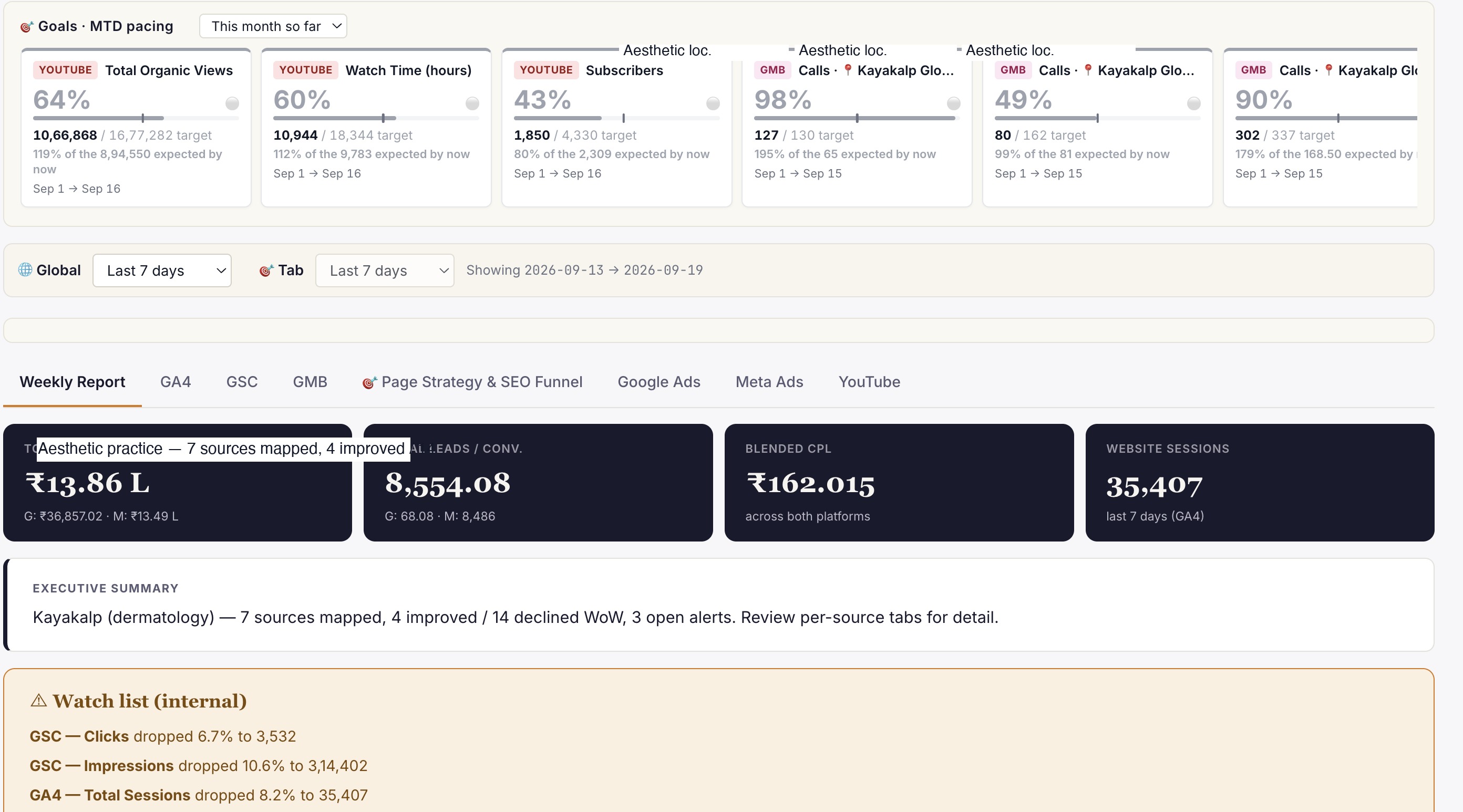
Live client dashboard. GSC, GA4, Google Ads, Meta Ads, IVR calls in one view. Login anytime, not monthly.
Phoenix
Clinic revenue intelligence over your PMS. Daily action queue: Prevent Loss, Maintain & Engage, Grow Revenue. Multi-centre rollout.
Or book a free 30-min audit to see all three in action on your account.
Healthcare brands
that already run on ICG.
A representative slice of the 150+ healthcare brands ICG has delivered for across India. Most engagements remain under NDA.


What ICG clients say · on video.
"Scale up of organic channels and business consulting. ICG has absolute domain authority in their field."
"Working with ICG transformed how we acquire IVF patients in Gurgaon. They understand the fertility journey from inquiry to consult..."
"What Ichelon accomplished — they got all my ideas and worked over 3-4 months to create an amazing, super-customised website."
The intelligence stack behind this playbook.
Every ICG engagement runs on the Search Intelligence Trifecta — Angryturtle for GMB, SIE for search and AI Overview, YODA for YouTube. Live product screens below.
Need help operationalising this?
Every ICG service is healthcare-only, NMC + DPDP-aware, and built around the patient-research patterns that drive Indian healthcare growth in 2026.
Every practice welcome — packages from ₹20,000/mo.
Goals-Driven engagements · Performance-Linked Payout Models available


More from
ICG.
Five trends shaping Indian healthcare marketing through 2027: AI-first patient research, Conversions API adoption, ABDM discovery, the AEO w...
Healthcare AIO is the discipline of getting your clinic or hospital cited inside Google AI Overviews, ChatGPT and Perplexity answers — not j...
Conversational-search advertising places brand messages inside AI chat answers — ChatGPT, Perplexity, Copilot — rather than beside a results...
Stop guessing.
Book a Diagnostic.
30 minutes. Free. With the AI-powered healthcare-only marketing agency 150+ brands already run on. No slides, no pitch, no hard close.


