


Angryturtle monthly audit report: what an Indian clinic owner should look for (2026 walkthrough)
Your monthly Angryturtle audit report is a decision document, not a data dump. This walkthrough shows a clinic owner exactly what to look at first — Rank OS score trend, Review Health delta, dimension breakdown, competitor gap chart, action queue, and next-month priorities — and how to spend 15 minutes on it well.
No pitch. Written root-cause diagnosis. AI-powered, healthcare only.
Direct answer
Your monthly Angryturtle audit report is a decision document, not a data dump. This walkthrough shows a clinic owner exactly what to look at first — Rank OS score trend, Review Health delta, dimension breakdown, competitor gap chart, action queue, and next-month priorities — and...
TL;DR

Your monthly Angryturtle audit report is one of the highest-leverage 15 minutes you spend on your clinic's marketing. Handled well, it tells you whether local rankings are trending your way, whether reviews are healthy enough to convert, which competitors are pressuring you and which two or three actions in the coming month will matter most. Handled poorly, it becomes a PDF that gets forwarded, glanced at and forgotten. This walkthrough shows a clinic owner exactly what to look at, in what order, using the same report structure ICG uses across our Healthcare Local SEO Agency India managed clients.
Why the audit report deserves 15 focused minutes
The audit report is not a data dashboard — a dashboard is what your marketing team stares at daily. The audit report is a decision document produced once a month for the person who signs off on marketing direction. It compresses 30 days of operational activity into six sections: what the sie" style="color:inherit;text-decoration:underline;text-decoration-color:rgba(42,126,200,.5);text-underline-offset:2px">Rank OS score did, what happened with reviews, where each dimension of the scoring model stands, how you compare to your top-5 competitors, what work sits in the action queue, and what the coming month's priorities should be.


Spending 15 focused minutes on those six sections gives a clinic owner two things a general marketing meeting cannot. First, a defensible view of where local rankings are actually going, independent of anecdote or gut feel. Second, the ability to redirect the marketing team's effort toward the two or three items that will move the needle rather than the ten that feel productive but do not.
Section 1 — Rank OS score and trend
The first page of the report shows the current Rank OS score (0-100) and the trend line for the trailing 6-12 months. Look for three things.
The current score band tells you where you sit. Under 40 is a serious problem — you are likely invisible in the local pack for most competitive queries. 40-60 is fragile — you show up sometimes, mostly for lower-intent queries. 60-75 is competitive — you rank well for many queries but have room to consolidate. 75-90 is dominant — you are winning the local pack for most primary specialty queries. Above 90 is exceptional and rare.
The 30-day delta tells you the direction. A positive delta of 3-5 points is a good month. A delta above 5 usually means a compounding intervention landed (a fresh review-collection campaign, a category correction, a Content Studio cadence lift). A negative delta of any size deserves attention — regressions compound if unaddressed.
The trailing 6-12 month trajectory tells you the strategy is working or not. A steady climb from 45 to 68 over eight months is a good news story. A flat line at 55 for six months means whatever you are doing is holding position but not gaining — a strategic conversation is due.
If you look at nothing else in the report, look at this section.
Section 2 — Review Health delta
Reviews do two things — they drive rankings (Review Health is a heavily-weighted Rank OS dimension) and they drive conversion (patients read reviews before booking). The Review Health section covers both.
Four numbers matter here.
Total review count. The absolute number. Below 50 is thin for an urban Indian clinic. 50-200 is normal. Above 200 is strong. Above 500 is exceptional.
Current rating. 4.5 and above is healthy. 4.0-4.5 is workable but has friction — every one-star review pulls disproportionate weight. Under 4.0 is a red flag — you need a rating-recovery playbook, not just a review-collection push.
Review velocity (new reviews per month). This is the number most owners under-weight. A clinic with 300 reviews at 4.6 average and 3 new reviews per month is fading; the same clinic at 20 new reviews per month is compounding. Velocity above the competitor set's average is what wins Review Health delta.

Response cadence. Percentage of reviews (positive and negative) that received a public response within seven days. Google weights response cadence as a management-quality signal; patients read responses as a service-quality signal. Anything below 70% is worth improving.
Section 3 — dimension breakdown and the weakest dimension
Rank OS aggregates five weighted dimensions into the composite score. The dimension breakdown shows each dimension's current score and its own trend.
Relevance. How well your GBP is optimised for the specialty and services you want to rank for — category choice, services list, description, primary keyword coverage. Improvements here move rankings for specific-query long-tail traffic.
Review Health. Covered above.
Freshness. How consistently you are publishing Posts, adding photos and updating profile fields. Freshness discounts stale profiles independent of other signals.
Entity Authority. How consistent and credible your citation footprint is across independent directories. NAP drift lives here.
AIO Readiness. How well your profile is structured for AI Overviews and answer-engine surfaces — schema, description clarity, Q&A coverage, entity disambiguation.

The single most useful move in this section is identifying the weakest dimension and prioritising work against it. A clinic with Rank OS 62 comprising Relevance 78, Review Health 68, Freshness 45, Entity Authority 62 and AIO Readiness 52 has an obvious answer to "what should we work on this month?" — Freshness first, AIO Readiness second. Working on the strongest dimension is a common mistake; the marginal-lift is smaller than fixing the weakest.
Section 4 — competitor gap chart
The competitor section shows your top-5 local pack competitors on a single chart with side-by-side comparison across the same Rank OS dimensions. This is where a clinic owner learns whether the ranking dynamics are shifting.
Look at three things.
Your rank position within the competitive set. Are you the strongest of the five? Middle of the pack? Bottom? Position in the set is what actually drives 3-pack placement.
Dimensions where you are behind. The competitor comparison usually reveals a specific weakness. Two of your competitors have 3x your review velocity. One has a much cleaner citation footprint. Another publishes Posts at 5x your cadence. These are the specific tactical gaps to close.
Movement flags. Which competitors gained ground this month, which lost ground. A competitor rising sharply is a signal to investigate — usually a category change, a new content cadence, or a review-collection campaign has landed. The competitor alerts workflow feeds these flags.
Section 5 — the action queue and what shipped
The action queue section shows two things — what was executed in the past month, and what remains queued for the coming month.
The what-shipped list is the audit trail. Every published Post, review response, category change, citation cleanup and profile-field edit shows up here. A clinic owner scanning this list confirms the marketing spend is being converted into visible operational output.
The what-remains list is the backlog. Items are ordered by expected Rank OS lift — highest-expected-impact items first. A queue growing month over month means capacity is under-scaled for the work required; a queue shrinking with the highest-impact items cleared means the specialist team is prioritising well.
The most useful clinic-owner question here is "what is the top item and what is it waiting on?". Sometimes the answer is a specialist bandwidth constraint. Sometimes it is waiting on a clinic-side approval or content input. Either way, unblocking the top item is often more valuable than the next 10 lower-priority items combined.
Section 6 — next month's priorities
The final section is the recommendation summary — the account manager's written view of the two or three things that should get the most attention in the coming month, tied to the specific findings from the earlier sections.
A good recommendation summary reads like: "Freshness is the weakest dimension and is the primary drag on the composite score; we recommend shifting to 4 Posts per week via Content Studio for the next 60 days. Competitor B has doubled review velocity in the last 45 days; we recommend triggering the review-collection SMS campaign to defend Review Health. NAP drift on three directories was surfaced this month; we will close those in the first two weeks."
A weak recommendation summary reads like: "Continue current activities and monitor". If your report's summary reads like the second version consistently, the strategic conversation with your account manager is overdue.
A sample walkthrough: a mid-sized dental clinic
Concretely, here is a 15-minute walkthrough of a report for a fictional mid-sized dental clinic in a Delhi NCR suburb.
Rank OS trend: current 64, up from 58 three months ago, up from 51 a year ago. Steady climb. Good.
Review Health: 187 total reviews, 4.6 average, 14 new reviews this month (up from 8 last month), response cadence 82%. All healthy; velocity uplift is a positive.
Dimension breakdown: Relevance 72, Review Health 74, Freshness 58, Entity Authority 66, AIO Readiness 48. Weakest dimension is AIO Readiness by a wide margin.
Competitor gap: The clinic is #3 in a set of five, up from #4 last month. Competitor A has stronger Freshness; Competitor B has stronger AIO Readiness. Clinic is stronger than the bottom two on all dimensions.
Action queue: 12 items shipped last month including three category corrections, a citation cleanup on doctor-directory and local business directory listings, and 8 Posts. 18 items remain; top item is AIO Readiness schema build-out.
Recommendations: prioritise AIO Readiness in the coming month (schema build-out, Q&A coverage, entity disambiguation); sustain the review-collection cadence; extend citation cleanup to the healthcare-native directory set.
A clinic owner reading this in 15 minutes now knows the strategy is working, the specific weakness to fix and the specific action being taken. That is what the report is for. The National Medical Commission restrictions and ASCI Guidelines both apply to any promotional recommendation the report surfaces; the account manager's recommendations respect those regimes by default.
What the audit report is not
The audit report is not a lead-count report. Leads and enquiries live in your CRM and are reported separately. A rising Rank OS score tends to correlate with rising enquiry volume, but the two are not the same document.
The audit report is not a full analytics dump. Every underlying data point is available in the dashboard for the marketing team to explore; the report summarises for a decision-maker's attention span.
The audit report is not a substitute for the strategic conversation. If a regression appears or a competitor shifts the board, the report flags the pattern; the strategic conversation between the clinic owner and the account manager is where the tactical response gets designed.
The tool ICG uses to run this at scale: Angryturtle
ICG runs local SEO and GBP intelligence for 150+ Indian healthcare brands using Angryturtle — our own AI-native GBP intelligence and management OS. The platform scores every profile 0-100 via a proprietary Rank OS model with five weighted dimensions (Relevance, Review Health, Freshness, Entity Authority, AIO Readiness), publishes edits, Posts, media, and review replies directly to Google, and includes Ask Maps AIO Readiness scoring for Google AI Overviews and ChatGPT visibility.
Available in two shapes: self-serve at ₹999/- per month for solo owners with 1-2 profiles, and ICG's managed service from ₹25,000/- per month where our healthcare specialists execute inside the same platform. Both are anchored in the Healthcare Local SEO Agency India pillar page which has full scope, methodology and pricing.
Book a demo on WhatsApp → or start a free trial at angryturtle.ai →
Related reading
- Healthcare Local SEO Agency India — pillar service page
- Angryturtle Rank OS explained — the scoring model your report references
- Angryturtle competitor alerts: what to watch — the workflow behind the competitor gap chart
- Google review strategy for Indian healthcare — how to lift Review Health
- Google AI Overviews optimisation for Indian healthcare — how to lift AIO Readiness
FAQ
How often is the audit report generated? Monthly by default. Weekly summaries are available on Agency and Enterprise tiers for tenants that prefer higher-cadence reporting.
What score band should a healthy clinic be at? 60-75 is competitive for most urban Indian catchments; 75+ is dominant. The right target depends on competitive intensity in your specific catchment — a solo dental clinic in a Tier 2 city might be dominant at 62 where a fertility centre in South Delhi needs 78 to be competitive.
Why is the composite score the same but dimensions changed? Dimensions move independently. A month where Freshness dropped 6 points and Review Health gained 6 points can leave the composite flat. That is a signal to investigate — a flat composite can hide meaningful under-the-hood shifts.
What if I disagree with a report recommendation? The account manager's recommendations are a starting point, not a mandate. Report reviews with your account manager are the right place to redirect priorities if the recommended focus does not match your strategic goals.
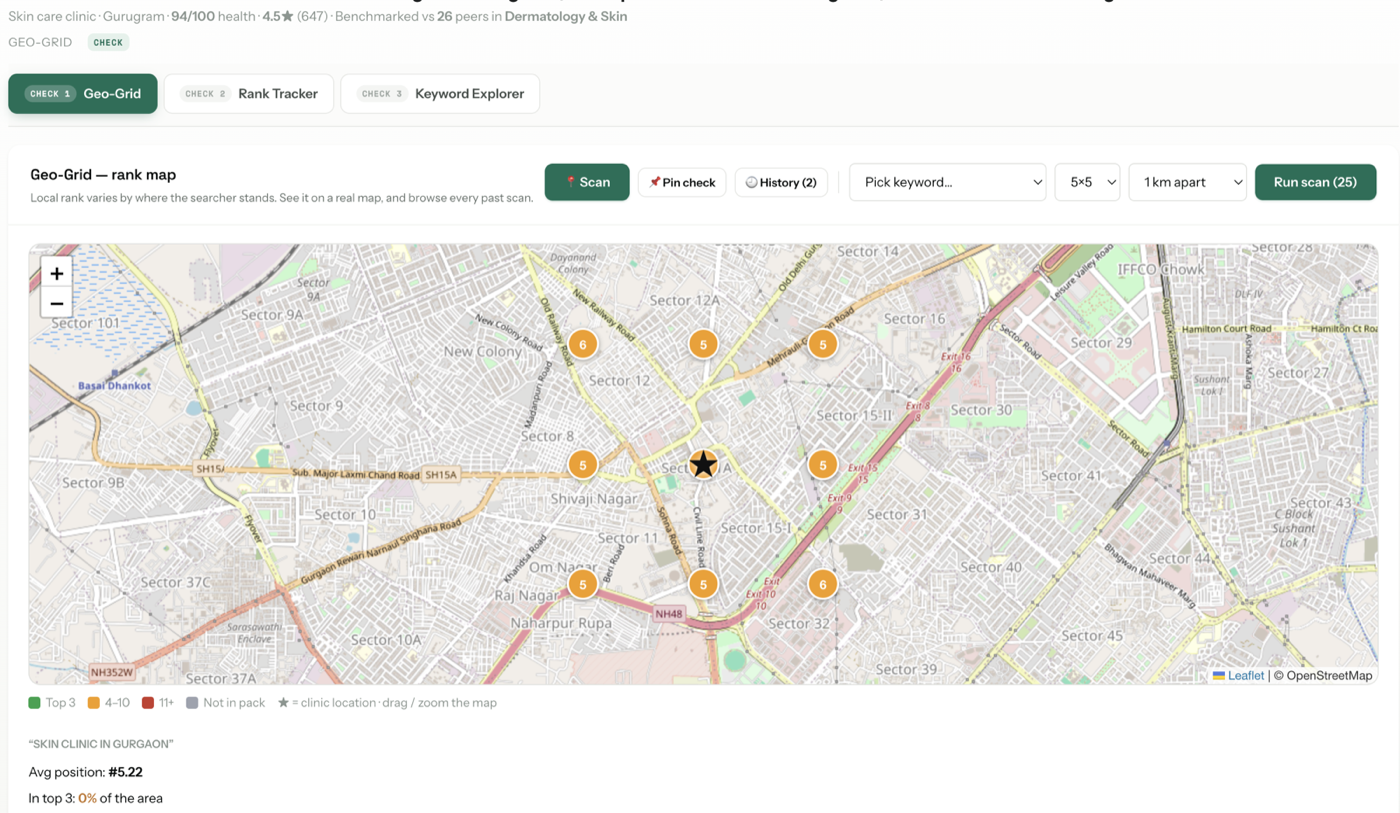
How do I know the Rank OS score is accurate? The score is derived from observable signals — Geo-Grid rank data, review corpus, Post cadence, citation footprint and schema/structured-data coverage. Every dimension score has drill-down evidence available in the dashboard for verification.
What happens if Rank OS drops sharply in a single month? The report flags the drop and the account manager's recommendation section identifies the specific driver — a category regression, a citation drift event, a competitor surge or a Google algorithm shift. Sharp drops warrant an out-of-cycle strategic conversation.
Can the report be sent to more than one recipient? Yes. Tenant configuration supports multiple recipient email addresses. Recipients can include the clinic owner, the marketing manager, an external advisor and the ICG account manager.
Is the report available in a format other than PDF? PDF is the default. HTML dashboard views and CSV exports of the underlying data are also available for teams that want to build their own visualisations.
What if my clinic's specialty is not represented in the standard report structure? The default template covers most Indian healthcare specialties; the Enterprise tier supports custom template sections for specialty-specific metrics (e.g., fertility clinics wanting cycle-conversion visibility, oncology centres wanting second-opinion enquiry tracking).
How does ICG run report reviews with managed clients? Managed-tier clients get a scheduled monthly review call with their account manager to walk through the report, agree on the coming month's priorities and unblock any queued items that need clinic-side input. The 15-minute framework in this article is the same framework the account manager uses.
Book a free 30-minute Brand & Growth Diagnostic.
It's a working session, not a sales pitch — you leave with a written root-cause analysis you can act on, whether or not you engage ICG.
The three platforms
behind every ICG engagement.
Beacon
CAPI middleware that fixes Event Match Quality, translates CRM statuses to Meta-standard events, dedups across channels.
Agency OS
Live client dashboard. GSC, GA4, Google Ads, Meta Ads, IVR calls in one view. Login anytime, not monthly.
Phoenix
Clinic revenue intelligence over your PMS. Daily action queue: Prevent Loss, Maintain & Engage, Grow Revenue. Multi-centre rollout.
Or book a free 30-min audit to see all three in action on your account.
Healthcare brands
that already run on ICG.
A representative slice of the 150+ healthcare brands ICG has delivered for across India. Most engagements remain under NDA.


What ICG clients say · on video.
"Scale up of organic channels and business consulting. ICG has absolute domain authority in their field."
"Working with ICG transformed how we acquire IVF patients in Gurgaon. They understand the fertility journey from inquiry to consult..."
"What Ichelon accomplished — they got all my ideas and worked over 3-4 months to create an amazing, super-customised website."
Need help operationalising this?
Every ICG service is healthcare-only, NMC + DPDP-aware, and built around the patient-research patterns that drive Indian healthcare growth in 2026.
Every practice welcome — packages from ₹20,000/mo.
Goals-Driven engagements · Performance-Linked Payout Models available



More from
ICG.
Five trends shaping Indian healthcare marketing through 2027: AI-first patient research, Conversions API adoption, ABDM discovery, the AEO w...
Healthcare AIO is the discipline of getting your clinic or hospital cited inside Google AI Overviews, ChatGPT and Perplexity answers — not j...
Conversational-search advertising places brand messages inside AI chat answers — ChatGPT, Perplexity, Copilot — rather than beside a results...
Stop guessing.
Book a Diagnostic.
30 minutes. Free. With the AI-powered healthcare-only marketing agency 150+ brands already run on. No slides, no pitch, no hard close.


