


Angryturtle competitor alerts: which GBP signals matter for Indian healthcare and how to escalate them (2026)
Angryturtle competitor alerts fire when a rival healthcare GBP changes photos, category, hours, services, or shows a review-velocity spike. This piece walks through which alerts matter most for clinic and hospital rankings in India, the cadence that avoids alert fatigue, and the escalation workflow ICG uses across 150+ healthcare tenants.
No pitch. Written root-cause diagnosis. AI-powered, healthcare only.
Direct answer
Angryturtle competitor alerts fire when a rival healthcare GBP changes photos, category, hours, services, or shows a review-velocity spike. This piece walks through which alerts matter most for clinic and hospital rankings in India, the cadence that avoids alert fatigue, and the...
TL;DR

Competitor alerts are Angryturtle's early-warning layer for local-pack competition — the notifications that fire when one of your tracked competitors quietly ships a change that could shift ranking dynamics in your catchment. For Indian healthcare, the "which alerts matter" question is more subtle than in retail, because a dental clinic's competitors move differently from a fertility centre's, and both move differently from a multi-specialty hospital's. This piece unpacks the alert taxonomy inside the Competitors module, ranks the alerts by ranking-impact for Indian healthcare, and shows the escalation workflow ICG runs for tenants on the Healthcare Local SEO Agency India managed programme.
Why competitor alerts matter more in healthcare than in retail
In retail, a competitor changing photos or updating hours is background noise — search intent is broad, buyer switching cost is low, and one merchant's change doesn't materially threaten another. In healthcare, the local pack is a much narrower zero-sum board. There are typically 3-8 credible competitors in a catchment for any given specialty; the 3-pack has only three slots; and a competitor that suddenly starts showing 25 new reviews a month or adds a well-chosen secondary category can pressure your position in weeks rather than quarters.
The specific asymmetry that makes alerts valuable is response time. If you find out a competitor added a "Fertility Clinic" category three months after they did it, you've already lost a quarter of specialty-query traffic. If you find out inside a week, you can respond with your own category audit, cadence adjustment or content push before Google finishes re-weighting the local pack.
The alert taxonomy inside Angryturtle's Competitors module
Alerts fire on eight change classes across each tracked competitor profile. Each class carries a default severity and a default routing that a tenant admin can tune.
Category change. Primary or secondary category added, removed or reordered.
Services added. New line items appended to the services list.
Hours change. Regular hours, special-hours or holiday-hours edit.
Photo activity spike. Unusual uplift in photo uploads over the trailing 14-day window compared with the trailing 90-day baseline.
Review-velocity spike. Statistically abnormal uplift in review-arrival rate.
Rating trajectory shift. Sustained rating change over 30 days beyond a threshold band.
Post cadence surge. Cadence increase above baseline.
Ownership or verification signal. New owner-attributed content, a verification badge change, or a shift in profile completeness that suggests active management.
Not all classes deserve equal attention. The next section ranks them by ranking-impact for the Indian healthcare context.
Which alerts matter most for healthcare local ranking
Ranking impact per alert class differs materially. Here is the ICG-calibrated priority list based on what we see move the needle across our client portfolio.
Priority 1 — Category change. The single most consequential competitor alert. A competitor changing from a generic "Hospital" to a specialty-precise "Fertility Clinic" or "Dermatology Clinic" can flip specialty-query results in weeks. Response should be a category audit on the client tenant within 3-5 days.
Priority 1 — Review-velocity spike. Sustained review-velocity uplift (say, from an 8-per-month baseline to a 25-per-month run rate over 60 days) signals an active review-collection campaign at the competitor. Review Health dimension in sie" style="color:inherit;text-decoration:underline;text-decoration-color:rgba(42,126,200,.5);text-underline-offset:2px">Rank OS is heavily weighted; the client needs a matching cadence lift.

Priority 2 — Services added. New specialty services on a competitor's list expand their surface area for specific-procedure queries. Worth an audit of the client's own services list within a week.
Priority 2 — Post cadence surge. A competitor shifting from 2 Posts/month to 5-6 Posts/month drives Freshness delta. Response is a Content Studio cadence bump for the client.
Priority 3 — Photo activity spike. Meaningful for Freshness but rarely the sole driver of a rank move. Track as context; don't escalate as urgent.
Priority 3 — Rating trajectory shift. Slow-moving; useful for quarterly review rather than weekly action.
Priority 4 — Hours change. Rarely ranking-material unless the competitor is expanding to 24x7 in a market where nobody else is.
Priority 4 — Ownership/verification signal. Context; worth logging but not usually urgent.
How alert cadence avoids alert fatigue
The single most common failure mode with competitor alerting is fatigue. If every trivial photo upload fires a notification, account managers stop reading them within two weeks. Angryturtle's default cadence is calibrated to avoid this in three ways.
Severity-tuned routing. Priority 1 and Priority 2 alerts fire immediately as tenant-dashboard notifications with in-app red-dot indicators. Priority 3 alerts batch into a weekly digest. Priority 4 alerts batch into a monthly review section.
Baseline-relative thresholds. Photo activity and review-velocity alerts use a rolling baseline per competitor, not a fixed threshold. A photo upload that would be routine for an active competitor doesn't fire; the same upload from a normally-inactive competitor does. This keeps signal-to-noise ratio high across a diverse competitive set.
Deduplication window. The same alert class from the same competitor within a 7-day window collapses into a single notification with an aggregated summary rather than five separate notifications.
These defaults keep the average tenant's weekly alert volume at 3-8 notifications rather than 30-50 — a level a human can actually read and act on.
The escalation workflow ICG uses across managed clients
Alerts without an escalation path become noise. ICG's managed-service delivery runs a three-tier escalation flow per alert.
Tier 1 — Account manager triage (0-24 hours). Priority 1 or 2 alert lands. The account manager reads the alert, opens the competitor profile snapshot in Angryturtle, checks the delta context, and either dismisses (false positive or immaterial) or converts it into an action-queue entry for the client tenant.
Tier 2 — Specialist response (24-72 hours). Action-queue entries get routed to the specialist who owns the relevant workstream — a category-change alert routes to the local SEO specialist for a client category audit; a review-velocity spike routes to the reputation specialist for a review-collection campaign review; a Post cadence surge routes to the content specialist for a Content Studio calendar review.
Tier 3 — Strategic escalation (72 hours-30 days). If the competitor threat sustains — the review velocity spike continues past 30 days, or the category change is followed by a services build-out — the alert cluster escalates into the client's monthly strategic review. Client leadership sees the pattern and the recommended tactical response in the monthly report.

The three-tier structure means routine alerts get handled by the account manager alone; only genuinely strategic patterns reach the client-leadership review — where their attention is actually useful.
What competitor alerts cannot tell you
Alerts observe visible GBP changes. There are several things they cannot see and should not be expected to.
Alerts cannot see paid-media activity. A competitor spending on Google Ads and Meta Ads is invisible to the Competitors module; that competitive intelligence requires separate tools (Google Ads Auction Insights and the Meta Ad Library).
Alerts cannot see backlink or website content changes. Broader SEO competitive intelligence for competitors' organic ranking is out of scope; tools like SEMrush and Ahrefs cover that ground.
Alerts cannot see off-platform reputation events (news mentions, forum threads, regulatory action) unless they show up as review-content changes. Sentiment and news monitoring is a separate workstream.
Alerts cannot see intent behind a change. A category change is visible; whether it is a deliberate strategic move or a data-entry mistake by a junior team member at the competitor is not something a monitoring platform can infer. Judgment on intent is a human job — which is why the tier-1 triage step exists.
Setting up competitor alerts for a new tenant
For a new tenant onboarding onto Angryturtle, competitor-alert configuration takes about 30 minutes and follows five steps.
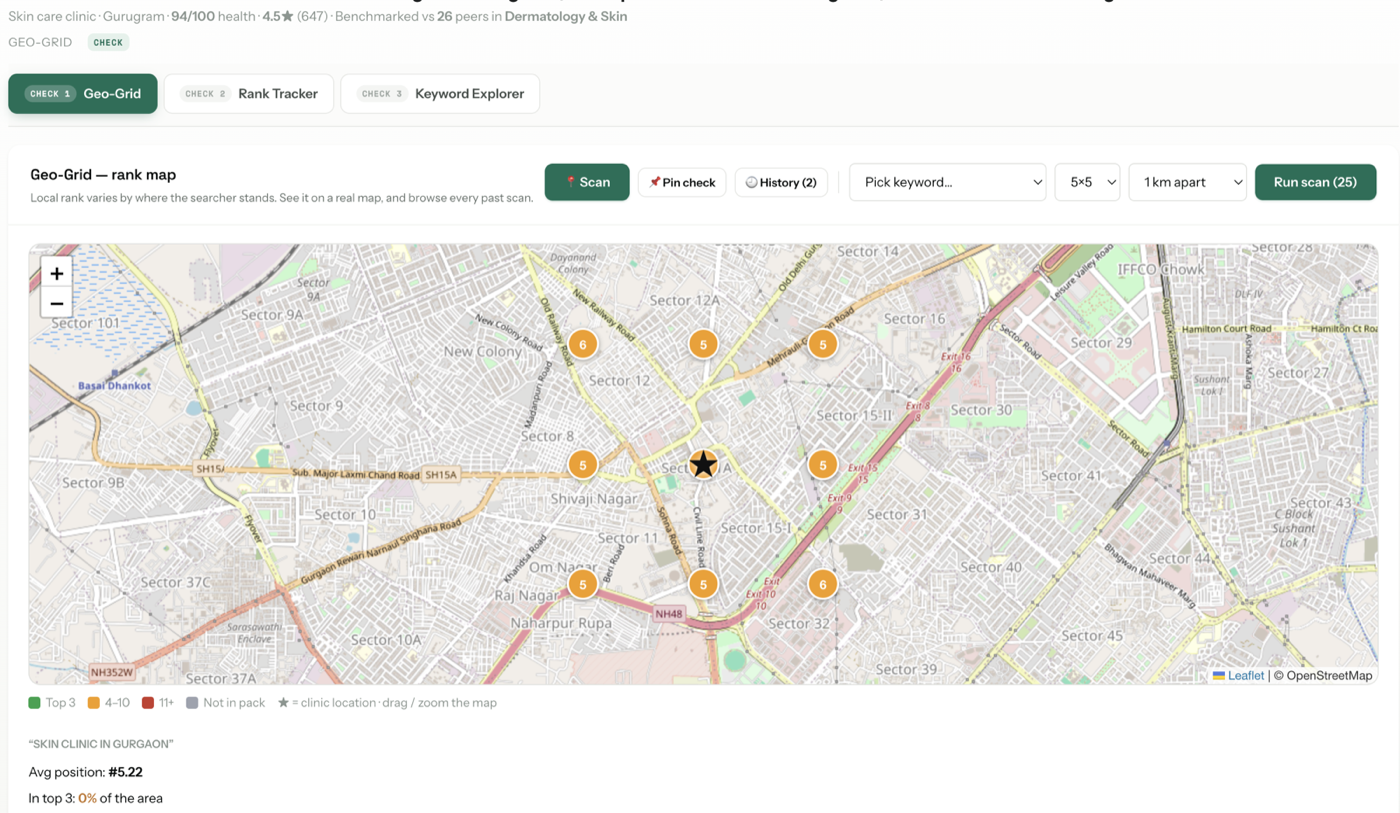
Step 1 — Confirm the auto-identified top-5. The platform Geo-Grid scan identifies the top-5 competitors that consistently appear in the local pack for the client's primary specialty queries. The tenant admin confirms or adjusts.
Step 2 — Add custom strategic competitors. Regional-chain competitors, recently-opened neighbourhood competitors or strategically-important non-immediate competitors get added beyond the auto-identified top-5.
Step 3 — Set severity routing. The default routing (Priority 1-2 immediate, Priority 3 weekly, Priority 4 monthly) suits most tenants; some prefer to elevate services-added alerts to Priority 1 in high-competition metros.
Step 4 — Configure notification channels. In-app dashboard notifications are the default; email digests and Slack/WhatsApp notifications are opt-in per user.
Step 5 — Baseline calibration period. The platform takes 2-3 weeks to establish per-competitor baselines for photo activity and review velocity. During this period, threshold-based alerts run in "shadow" mode — visible but not yet routed as notifications.
The tool ICG uses to run this at scale: Angryturtle


ICG runs local SEO and GBP intelligence for 150+ Indian healthcare brands using Angryturtle — our own AI-native GBP intelligence and management OS. The platform scores every profile 0-100 via a proprietary Rank OS model with five weighted dimensions (Relevance, Review Health, Freshness, Entity Authority, AIO Readiness), publishes edits, Posts, media, and review replies directly to Google, and includes Ask Maps AIO Readiness scoring for Google AI Overviews and ChatGPT visibility.

Available in two shapes: self-serve at ₹999/- per month for solo owners with 1-2 profiles, and ICG's managed service from ₹25,000/- per month where our healthcare specialists execute inside the same platform. Both are anchored in the Healthcare Local SEO Agency India pillar page which has full scope, methodology and pricing.
Book a demo on WhatsApp → or start a free trial at angryturtle.ai →
Related reading
- Healthcare Local SEO Agency India — pillar service page
- Angryturtle Competitors module explained — the module underlying these alerts
- Angryturtle Rank OS explained — how Review Health and Freshness scoring works
- GBP categories for Indian healthcare — category audit playbook
- Google review strategy for Indian healthcare — response to review-velocity competitor pressure
FAQ
How many competitors can a tenant track for alerts? Auto-identified top-5 are always tracked. Custom competitor slots depend on tier — Solo has 3 custom slots; Agency and Enterprise scale with the tier.
How quickly does an alert fire after the underlying change? Category, services, hours and ownership signals typically fire within 24-72 hours of the competitor edit becoming visible on Google. Review-velocity and photo-activity spikes need a few days of data before the baseline-relative threshold trips.
Can I route alerts to my agency's Slack or WhatsApp? Yes. Notification channel configuration is per-user; Slack, WhatsApp business and email are all supported alongside in-app dashboard notifications.
What is a "review-velocity spike" really? Statistically abnormal uplift in review-arrival rate — measured as a rolling z-score against the competitor's trailing 90-day baseline. A short-lived one-week bump might not fire; a sustained 30-day shift will.
How does the platform avoid firing on trivial changes? Severity-tuned routing routes Priority 3-4 alerts into batched digests rather than immediate notifications; deduplication windows collapse repeat alerts within 7 days; baseline-relative thresholds prevent noise from active competitors dominating the queue.
Can I mute alerts for a specific competitor temporarily? Yes. Per-competitor mute for a defined window (7, 30, 90 days) is supported for cases where a competitor is undergoing operational change (relocation, rebrand) that would otherwise flood the alert queue.
Do alerts cover competitors in a different city if my clinic serves both? For multi-location clinics, each location has its own competitor set and its own alert routing. Portfolio-level roll-ups show which competitors appear across multiple locations.
How do I know an alert is actionable and not a false positive? Every alert includes a delta context view — before/after snapshots of the changed field, the competitor's recent activity trend and a suggested action. The tier-1 triage step is designed to make dismiss-vs-escalate a 60-second decision, not a research task.
Does the platform recommend the response action? Yes for the common alert classes. Category-change alerts suggest a client category audit; review-velocity spikes suggest a review-collection cadence review; Post-cadence surges suggest a Content Studio calendar bump. The suggested action is a default; the specialist judges whether to execute.
How does ICG use alerts for managed clients? Every managed-tier client has a named account manager who owns tier-1 triage and specialists who own tier-2 response. The client sees the escalation summary in the monthly report and the sustained-threat patterns in the quarterly strategic review.
Book a free 30-minute Brand & Growth Diagnostic.
It's a working session, not a sales pitch — you leave with a written root-cause analysis you can act on, whether or not you engage ICG.
The three platforms
behind every ICG engagement.
Beacon
CAPI middleware that fixes Event Match Quality, translates CRM statuses to Meta-standard events, dedups across channels.
Agency OS
Live client dashboard. GSC, GA4, Google Ads, Meta Ads, IVR calls in one view. Login anytime, not monthly.
Phoenix
Clinic revenue intelligence over your PMS. Daily action queue: Prevent Loss, Maintain & Engage, Grow Revenue. Multi-centre rollout.
Or book a free 30-min audit to see all three in action on your account.
Healthcare brands
that already run on ICG.
A representative slice of the 150+ healthcare brands ICG has delivered for across India. Most engagements remain under NDA.


What ICG clients say · on video.
"Scale up of organic channels and business consulting. ICG has absolute domain authority in their field."
"Working with ICG transformed how we acquire IVF patients in Gurgaon. They understand the fertility journey from inquiry to consult..."
"What Ichelon accomplished — they got all my ideas and worked over 3-4 months to create an amazing, super-customised website."
Need help operationalising this?
Every ICG service is healthcare-only, NMC + DPDP-aware, and built around the patient-research patterns that drive Indian healthcare growth in 2026.
Every practice welcome — packages from ₹20,000/mo.
Goals-Driven engagements · Performance-Linked Payout Models available
More from
ICG.
Five trends shaping Indian healthcare marketing through 2027: AI-first patient research, Conversions API adoption, ABDM discovery, the AEO w...
Healthcare AIO is the discipline of getting your clinic or hospital cited inside Google AI Overviews, ChatGPT and Perplexity answers — not j...
Conversational-search advertising places brand messages inside AI chat answers — ChatGPT, Perplexity, Copilot — rather than beside a results...
Stop guessing.
Book a Diagnostic.
30 minutes. Free. With the AI-powered healthcare-only marketing agency 150+ brands already run on. No slides, no pitch, no hard close.


