


YouTube marketing for cardiologists in India (2026): cardiac channel playbook for interventional, preventive, and IHD education — inside NMC compliance and patient-family decision dynamics
How cardiologists and cardiac hospitals in India should run YouTube — content archetypes across interventional cardiology, preventive cardiology, and IHD education; the split between emergency and chronic-condition consideration cycles; NMC compliance for interventional claims; patient-family decision dynamics on high-ticket cardiac procedures; LTV maths per patient (angioplasty ₹1.5-3L, bypass ₹3-6L, long-term follow-up); and the YODA 6-step workflow adapted for a cardiac channel.
No pitch. Written root-cause diagnosis. AI-powered, healthcare only.
Direct answer
How cardiologists and cardiac hospitals in India should run YouTube — content archetypes across interventional cardiology, preventive cardiology, and IHD education; the split between emergency and chronic-condition consideration cycles; NMC compliance for interventional claims; p...
TL;DR
Cardiology is the healthcare specialty where YouTube produces the highest per-patient revenue impact and simultaneously carries the tightest NMC compliance perimeter around procedural claims. A patient searching "chest pain when climbing stairs," a middle-aged professional researching "angioplasty vs bypass," an adult child of a parent recently diagnosed with heart disease looking up "best cardiologist near me" — the search intent runs across urgent, chronic, and family-decision patterns simultaneously, and the clinic that shows up trustworthily across those patterns earns disproportionate consult volume. This guide is ICG's playbook for how a cardiologist or cardiac hospital in India should run YouTube — the split between interventional, preventive, and IHD-education content, the NMC and ASCI compliance perimeter around procedural claims, the family-decision dynamics that shape high-ticket cardiac conversions, and how the YODA 6-step workflow is adapted for a cardiac channel.
Why cardiology YouTube is different from every other healthcare YouTube
Cardiac patients exist in two entirely different search modes, and a channel that does not consciously address both leaves half its addressable audience unserved.
Emergency mode. A patient or family member searches "heart attack symptoms," "chest pain going to left arm," "sudden shortness of breath cause." Search intent is urgent, decision timeline is hours to days, and the channel that surfaces with a credible cardiologist explaining what the symptoms mean and when to seek immediate care earns immediate trust that translates into follow-up bookings once the acute episode resolves.
Chronic-condition mode. A patient already diagnosed with hypertension, high cholesterol, or ischaemic heart disease researches "what is angioplasty," "angioplasty vs bypass surgery," "cardiac diet plan," "life after bypass surgery." Search intent is educational, decision timeline is weeks to months, and the family often researches alongside the patient. This is where high-ticket procedural conversions actually happen — an interventional cardiology procedure like angioplasty runs ₹1.5L/- to ₹3L/-, bypass surgery runs ₹3L/- to ₹6L/-, and complex structural cardiac procedures (TAVR, valve replacement) run ₹5L/- to ₹15L/-+.
The two modes require different content approaches — emergency-mode content is short-form-friendly and symptom-focused, chronic-mode content is long-form-friendly and procedure-detailed. A single cardiac channel that segments its content thoughtfully across both modes captures both audiences.
LTV per cardiac patient is layered and long. Initial procedural revenue (angioplasty ₹1.5-3L, bypass ₹3-6L, valve procedure ₹5-15L) is followed by long-term cardiac follow-up — quarterly to biannual consultations, medication management, periodic diagnostic imaging (ECG, echo, stress test, angiography) at ₹2,000/- to ₹15,000/- per test. A cardiac patient who stays with the clinic for 5-10 years post-procedure produces ₹5L/- to ₹20L/-+ in cumulative revenue. Add the family-referral effect (a patient who trusts the cardiac clinic often brings a parent or sibling for evaluation), and the multi-year LTV per acquired cardiac patient is materially higher than most healthcare specialties.
The three ranking races a cardiac channel has to win
Race 1 — YouTube search. The user opens YouTube and searches "angioplasty procedure," "bypass surgery recovery," "high blood pressure treatment," "heart attack warning signs." Title-query match and cardiologist credential signal both matter. The winning title pattern is "Procedure Name: Interventional Cardiologist Explains Process, Recovery, and When It Is Needed (India 2026)."
Race 2 — Google web search. When Google returns a video carousel for "angioplasty cost India" or "difference between angioplasty and bypass," this is where cardiac videos surface inside standard web results. Description density with specific procedural context, structured chapter timestamps, and video embed on the clinic's treatment landing page all shape this race.
Race 3 — Google AI Overview citations. Cardiac queries generate AI Overviews frequently — "is angioplasty a major surgery," "how long is recovery after bypass," "what does an echo test show." Overviews cite cardiologist videos with structured intros, factual density, and clear chapter markers. Cardiology has one of the highest AI Overview citation rates of any healthcare specialty because the queries are informational-plus-clinical and AI models prefer to cite credentialed sources for medical answers.
The NMC, ASCI, and DPDP compliance perimeter cardiac content must sit inside
Cardiology carries the tightest NMC compliance perimeter of any healthcare specialty because procedural claims — success rates, complication rates, comparative safety — are legally sensitive in a way that aesthetic derma or dental claims are not.
NMC Ethics Code 2026. Restricts doctors from claiming superior clinical outcomes, from soliciting patient testimonials that read as clinical evidence, and from making comparative claims about procedural safety or success against other clinicians. For interventional cardiology this means no "highest angioplasty success rate," no "safest bypass surgery in the city," no "best interventional cardiologist" — regardless of what internal audit data the clinic actually holds. Success and complication rates can only be presented as clinic-specific figures with the specific procedural context that makes the number honest.
ASCI Guidelines 2022. Reinforces the NMC restrictions on superlatives and comparative claims. Prohibits any presentation of a specific cardiac procedure as a guaranteed cure or as risk-free.
DPDP Act 2023. Cardiac patient footage — ICU imagery, cath lab imagery, post-procedure recovery visuals — is highly personal data. Any cardiac patient appearance in a video requires signed consent that covers the specific channels, retention period, and withdrawal mechanism.
Patient testimonial restrictions. Cardiac testimonials are the most emotionally powerful format and simultaneously the most legally risky. A patient narrating "Dr X saved my life" without careful editorial framing reads as a clinical superlative claim that violates NMC. The compliance-safe framing is personal-experience-narrated-by-patient, without direct comparison to other treatment options, and without the treating cardiologist on-screen in a way that reads as clinical endorsement.
Practically, every cardiac video needs a documented compliance review before publication, every procedural claim needs a substantiation source, every superlative gets replaced with a specific-and-verifiable phrasing, and every patient appearance has signed consent on file.
Content format archetypes that work for cardiac channels
Symptom Explainer. The cardiologist explains a common cardiac symptom cluster — chest pain differentials, causes of breathlessness on exertion, when palpitations require evaluation, what a specific ECG finding means. Symptom Explainers rank strongly in YouTube search on the highest-volume cardiac queries and serve the emergency-mode audience. Should be 25-30% of a cardiac channel.
Procedure Explainer. The cardiologist walks through what happens during a procedure — how angioplasty is performed, what bypass surgery involves, what a valve replacement procedure looks like. Procedure Explainers serve the chronic-mode audience deep in the pre-decision phase and reduce the family's anxiety, which is often the largest barrier to procedure consent. Should be 20-25% of the channel.
Preventive Cardiology / Lifestyle. The cardiologist covers preventive topics — how to reduce cholesterol, cardiac-friendly diet, exercise safety after a cardiac event, medication compliance. Preventive content has the largest search volume and the widest addressable audience but the lowest per-video consult conversion. Should be 20-25% of the channel — it builds channel authority and long-tail organic reach.
Q&A. The cardiologist answers real questions from patients and viewers. Should be 10-15% of the channel.
Family-Decision Support. Content specifically addressing the family member of a cardiac patient — "what to ask when your parent is diagnosed with heart disease," "how to evaluate a cardiac hospital for your family member," "second opinion in cardiology." This is a materially under-served content cluster in Indian cardiac YouTube and converts to consults at high rates because families making decisions on behalf of parents are the primary economic decision-makers for high-ticket cardiac procedures. Should be 10-15% of the channel.
Post-procedure Recovery / Chronic-condition Management. Content for existing cardiac patients on medication management, follow-up cadence, warning signs during recovery. Serves patient retention and reduces post-procedure complications. Should be 5-10% of the channel.
Patient and family decision dynamics on high-ticket cardiac procedures
Cardiac procedures are rarely decided by the patient alone. In Indian family structures, an adult child, a spouse, or a sibling frequently participates in the treatment decision — particularly when the patient is elderly or when the procedure is high-cost. A well-built cardiac channel serves both audiences, because both audiences are researching in parallel and the family member is often the primary economic decision-maker.
The channel structure that works is a mix of patient-facing content (symptom explainers, procedure walk-throughs, recovery guides) and family-facing content (evaluation guides, second-opinion frameworks, how-to-ask-the-cardiologist question lists). Content bumpers and end-screens should route both audiences to the same consult booking flow — typically a WhatsApp handoff that supports the family member initiating the booking on behalf of the patient.
YODA's Audience Voice module surfaces the family-versus-patient split in comment patterns automatically — comments phrased as "my father has been diagnosed with" or "we are considering surgery for our mother" indicate family-audience engagement. Strategy uses this signal to weight the family-facing content share in the next cycle.
The YODA 6-step workflow adapted for a cardiac channel
Step 1 — Overview. Connect the channel, calibrate against the cardiology specialty benchmark band (cardiac channels average 5-8 minute view duration on Procedure Explainers and 4-7% CTR on target queries), separate paid promotion history from organic.
Step 2 — Diagnostics. Cluster videos by cardiac vertical (Symptoms, Interventional Procedures, Bypass and Surgical, Preventive and Lifestyle, Cardiac Diagnostics like ECG/Echo/TMT, Structural Cardiac, Paediatric Cardiac if applicable) and by audience mode (patient-facing vs family-facing). Identify which clusters convert best and which need retention fixes.
Step 3 — Strategy. Produce a 90-day content plan weighted toward the highest-margin procedural verticals the hospital wants to grow. Include family-decision-support content in every monthly plan. Identify ad-spend picks on 2-3 organic Winners per month.
Step 4 — Optimisation. Rewrite titles for query-match, credential-signal, and AI Overview citation readiness. Insert structured chapters. Update descriptions with substantiated context that satisfies NMC review while remaining search-optimised. Queue thumbnail A/B tests.
Step 5 — Reputation (ORM). Cluster comments by theme and by patient-vs-family voice. Reply inside NMC and DPDP constraints — never give clinical advice in reply text, never quote comparative success rates, always route substantive questions to a WhatsApp consult booking.
Step 6 — Competitor Intel. Track 5-8 peer cardiac channels — a mix of independent cardiologists, mid-sized cardiac hospitals, and 1-2 aspirational large cardiac centres of excellence. Identify content gaps and format opportunities.
Sample 90-day channel build plan for a Chennai cardiac hospital
Days 1-15. YODA setup, historical data pull, first Diagnostics output. Baseline Rank OS scoring on the top 50 target cardiac queries across YouTube search, Google web, and AI Overview. Compliance audit of any existing library — anything violating NMC procedural claim restrictions gets pulled or re-edited. Shoot planning for the treating cardiologists including intro pieces, credibility segments, cath lab and OR credibility footage (DPDP-safe framing), and specialty-specific segments per interventional and CT-surgery team members.
Days 16-45. Publish 8-10 new videos across the archetypes — 3 Symptom Explainers on the highest-volume symptom queries, 2 Procedure Explainers on the highest-margin interventional procedures, 2 Preventive/Lifestyle videos, 1 Family-Decision Support video. Apply Optimisation writebacks to existing library. Launch first thumbnail A/B tests. Start compliance-safe comment reply cadence.
Days 46-90. Publish another 10-12 videos calibrated by first-45-day retention and CTR data. Add depth to the highest-converting cluster with 2-3 additional videos. Start ad-spend picks on 2 organic Winners at ₹10,000-20,000/- per boost. First measurable consult-booking uplift typically shows up in weeks 8-12 for interventional procedure enquiries and weeks 6-8 for symptom-evaluation consult bookings.
By day 90, a well-run cardiac channel typically has 20-24 videos published, 1,800-4,500 new subscribers, and a demonstrable channel-to-consult attribution trail that separates emergency-mode consultations (symptom evaluation appointments) from chronic-mode consultations (procedure planning consultations).
Which ICG retainer tier fits a cardiac YouTube engagement
Chain tier — ₹75,000/- to ₹1.5L/- per month. Fits single-location cardiac practices, standalone cardiac clinics, and small cardiac chains (up to 2-3 locations). Includes YODA platform access, monthly content plan for 6-8 videos, script support with NMC compliance review, SEO writebacks, thumbnail A/B tests, comment moderation inside compliance, and one strategy review per month. Suits practices doing ₹5Cr/- to ₹25Cr/- annual cardiac revenue where a new consult-booking flow can meaningfully move procedural volumes.
Hospital tier — ₹1.5L/- to ₹4L/- per month. Fits multi-specialty hospitals with prominent cardiac departments, standalone cardiac centres of excellence, and cardiac chains (4+ locations). Includes everything in Chain tier plus multi-channel management if the group runs separate channels per city, multi-cardiologist channel management where several senior cardiologists appear as on-screen faces, deeper Competitor Intel across a larger peer set, and integrated paid-media planning through the Ad-Spend Picks module. Suits hospitals doing ₹25Cr/-+ annual cardiac revenue.
Below ₹75,000/- per month, ICG's honest recommendation is that a solo cardiologist should first invest in local GBP through Angryturtle self-serve at ₹999/- while building an initial video library through in-house effort, and add ICG's managed YouTube service once the practice scale supports a Chain-tier engagement.
Angryturtle plus YODA together for a cardiac practice — full local plus YouTube coverage
A cardiac patient or family member typically searches "cardiologist near me" on Google Maps (where Angryturtle covers) and "angioplasty vs bypass" or "best cardiologist for my father" on YouTube (where YODA covers). For cardiac in particular, the local map-pack presence and the YouTube educational presence reinforce each other multiplicatively — a family evaluating a cardiologist for a parent typically checks both the map pack for location and reviews and the YouTube channel for the cardiologist's explanatory depth before booking a consult.
Angryturtle runs GBP intelligence, review operations, Google Posts, and Ask Maps AIO Readiness for the cardiac clinic's Google Business Profile. YODA runs the YouTube channel end-to-end with NMC compliance-aware content review. Together, the two platforms give a cardiac practice presence on every surface a family member touches during the evaluation cycle.
The platform ICG uses to run this at scale: YODA
 sie" style="color:inherit;text-decoration:underline;text-decoration-color:rgba(42,126,200,.5);text-underline-offset:2px">Rank OS into a single 0-100 score with sub-scores and next-best-actions per listing" width="1200" height="675" loading="lazy" decoding="async" style="width:100%;height:auto;display:block;">
ICG runs healthcare YouTube marketing for clinics, hospitals, and specialty groups using YODA — our AI-native healthcare YouTube marketing platform. YODA sits on top of a channel's data and does four things no dashboard does: it separates organic from paid views at every step (so a promoted video can never masquerade as organic growth), it gives decisions not dashboards (every video gets a state + next action), it writes back to YouTube directly (improved titles, tags, descriptions, chapters applied straight to the platform), and it tracks the three rank races — YouTube search, Google web, and Google AI Overview citations.
YODA runs the full 6-step workflow — Overview, Diagnostics, Strategy, Optimisation, Reputation (ORM), and Competitor Intel — with 40+ analysis modules organised under those steps. ICG's managed YouTube service uses YODA end-to-end. See the Healthcare YouTube Marketing pillar guide for the full scope, or the Healthcare YouTube Marketing Agency service page for engagement details.
Book a YODA demo on WhatsApp → or request a free healthcare YouTube channel audit →
Related reading
- Healthcare YouTube marketing pillar guide 2026
- YODA 6-step workflow explained for healthcare marketing agencies
- Hospital video marketing in India 2026
- Case study — 142 consults in 90 days from a healthcare YouTube channel
- Healthcare YouTube marketing agency service page
FAQ
How long before a cardiac YouTube channel starts producing booked consults? Symptom-evaluation consult bookings typically appear in weeks 6-8 for a channel publishing Symptom Explainer content on a disciplined weekly cadence. Interventional procedure-planning consult bookings appear in weeks 8-12 because the chronic-mode consideration cycle is longer.
Can we quote our hospital's angioplasty or bypass success rates in videos? Only as clinic-specific figures with the specific procedural context that makes the number honest — procedure type, patient population, complication definition. Never as a comparative superlative and never as a generalisable guarantee. YODA's compliance filter reviews every procedural-outcome claim before publication.
How do we handle patient testimonial videos for cardiac procedures inside NMC restrictions? Signed consent under DPDP Act 2023, editorial framing that presents the story as personal experience rather than clinical evidence, and the treating cardiologist not appearing alongside the testimonial in a way that reads as clinical endorsement. YODA reviews every testimonial script and cut against NMC guardrails.
Should our cardiac channel target emergency-mode viewers or chronic-mode viewers? Both, deliberately segmented. Emergency-mode Symptom Explainer content builds broad reach and initial trust. Chronic-mode Procedure Explainer and Family-Decision Support content produces the high-ticket consult bookings. A channel that serves only one mode leaves half the addressable audience unserved.
What is the LTV per cardiac patient from a YouTube-sourced consult? ₹5L/- to ₹20L/-+ over 5-10 years, layered across the initial procedure (angioplasty ₹1.5-3L, bypass ₹3-6L, valve procedure ₹5-15L), ongoing follow-up consultations, medication management, periodic diagnostic imaging, and family-referral effects.
How should we handle family-decision content for cardiac patients? Build a dedicated Family-Decision Support content cluster — evaluation guides, question checklists, second-opinion frameworks. Route family viewers to a WhatsApp consult booking flow that explicitly supports the family member initiating the booking on behalf of the patient. This is a materially under-served content cluster in Indian cardiac YouTube.
Should our cardiac channel be branded around a single cardiologist or around the hospital? Depends on the practice. Solo interventional cardiologist channels work well around the credentialed individual. Multi-specialty cardiac hospitals do better with a hospital-brand channel that features multiple cardiologists as segment-specific on-camera faces (interventional lead, CT-surgery lead, preventive cardiology lead). YODA supports both channel structures.
How much paid promotion should a cardiac channel run alongside organic content? Modest amounts on identified organic Winners — ₹10,000/- to ₹20,000/- per boost on 2-3 videos per month. Higher spends risk ASCI attention on the promoted videos and produce a paid-inflates-organic distortion YODA's paid-vs-organic separation is designed to prevent.
Does YouTube Shorts work for a cardiac channel? Yes as a symptom-awareness format. 45-second Shorts that describe a specific cardiac symptom cluster and route viewers to the long-form Symptom Explainer video work well for reach and subscriber growth. Consult conversion happens on the long-form videos, not the Shorts directly.
What is the difference between running our own cardiac channel and ICG's managed service? Running the channel in-house works when the hospital has a dedicated marketing team that can execute the 6-step workflow weekly with NMC compliance discipline. ICG's managed service works when the hospital wants a healthcare-specialist team to run the workflow inside YODA end-to-end with cardiac-specific compliance review handled as a default.
Book a free 30-minute Brand & Growth Diagnostic.
It's a working session, not a sales pitch — you leave with a written root-cause analysis you can act on, whether or not you engage ICG.
The three platforms
behind every ICG engagement.
Beacon
CAPI middleware that fixes Event Match Quality, translates CRM statuses to Meta-standard events, dedups across channels.
Agency OS
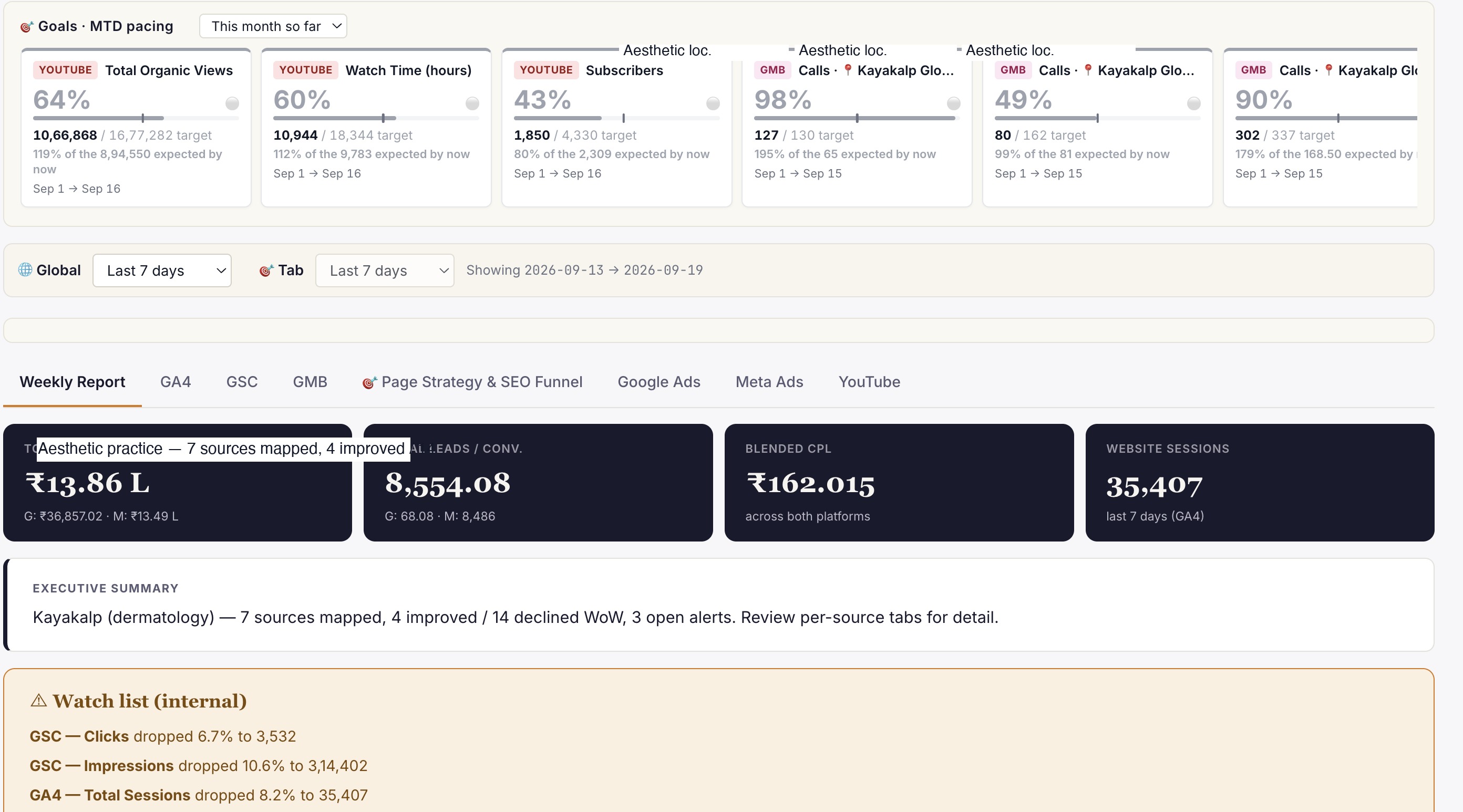
Live client dashboard. GSC, GA4, Google Ads, Meta Ads, IVR calls in one view. Login anytime, not monthly.
Phoenix
Clinic revenue intelligence over your PMS. Daily action queue: Prevent Loss, Maintain & Engage, Grow Revenue. Multi-centre rollout.
Or book a free 30-min audit to see all three in action on your account.
Healthcare brands
that already run on ICG.
A representative slice of the 150+ healthcare brands ICG has delivered for across India. Most engagements remain under NDA.


What ICG clients say · on video.
"Scale up of organic channels and business consulting. ICG has absolute domain authority in their field."
"Working with ICG transformed how we acquire IVF patients in Gurgaon. They understand the fertility journey from inquiry to consult..."
"What Ichelon accomplished — they got all my ideas and worked over 3-4 months to create an amazing, super-customised website."
Need help operationalising this?
Every ICG service is healthcare-only, NMC + DPDP-aware, and built around the patient-research patterns that drive Indian healthcare growth in 2026.
Every practice welcome — packages from ₹20,000/mo.
Goals-Driven engagements · Performance-Linked Payout Models available


More from
ICG.
Five trends shaping Indian healthcare marketing through 2027: AI-first patient research, Conversions API adoption, ABDM discovery, the AEO w...
Healthcare AIO is the discipline of getting your clinic or hospital cited inside Google AI Overviews, ChatGPT and Perplexity answers — not j...
Conversational-search advertising places brand messages inside AI chat answers — ChatGPT, Perplexity, Copilot — rather than beside a results...
Stop guessing.
Book a Diagnostic.
30 minutes. Free. With the AI-powered healthcare-only marketing agency 150+ brands already run on. No slides, no pitch, no hard close.


