


How to scale up a healthcare YouTube channel: the practical playbook from 20 videos to 200, and from occasional consults to a repeatable pipeline
The scale-up playbook for a healthcare YouTube channel that has proven the model on 15-25 videos and needs to move to a repeatable pipeline: batch production, editorial calendar discipline, cadence, subscriber conversion, playlist strategy, cross-channel amplification, and how YODA's diagnostic module walks through the specific scale bottlenecks that appear at each channel size.
No pitch. Written root-cause diagnosis. AI-powered, healthcare only.
Direct answer
The scale-up playbook for a healthcare YouTube channel that has proven the model on 15-25 videos and needs to move to a repeatable pipeline: batch production, editorial calendar discipline, cadence, subscriber conversion, playlist strategy, cross-channel amplification, and how YO...
TL;DR
A clinic YouTube channel goes through three distinct phases. The first — from zero to about 20 videos — is proving that the model works at all. Can the doctor be on camera, can the content team publish consistently, do consults arrive from videos, is the compliance perimeter respected. The second phase — from about 20 videos to 100 — is the messy scale-up where every well-run channel hits the specific bottlenecks that force operational discipline. The third phase — beyond 100 videos — is when the channel becomes a durable compounding asset that produces a repeatable pipeline of consults. This piece is about the second phase. Most channels that fail do so between videos 20 and 60, not because the content or the strategy was wrong, but because the operational scaffolding for scale was missing.
The signal that you are actually ready to scale up
Before spending money and headcount on scaling, verify the base case. Three specific signals indicate the channel is ready.
Signal 1: Consult conversion is working, not just view generation. The channel has produced measurable booked consultations tagged to specific videos over the last 60-90 days. If views are rising but consults are flat, the CTA architecture or the target audience match is broken; fix that before scaling.
Signal 2: At least 3-5 videos are in YODA's Winning state. The channel has real evidence of what works — specific topics, formats, and hooks that produce compounding organic Discovery. Scaling without knowing what works produces 80 more videos of the same undifferentiated content.
Signal 3: The doctor and the content team can sustain the current cadence without burnout. The typical Phase 1 cadence is one video every 10-14 days. If that cadence is already stretching capacity, doubling the cadence will produce the collapse point around video 40. Scale-up requires an honest assessment of team bandwidth first.
If any of the three signals is missing, the correct action is to strengthen the base case before scaling. Scaling a broken model just scales the breakage.
Batch production — the single biggest scale-up lever
The Phase 1 channel usually shoots one video at a time. Doctor arrives, sets up, shoots one video in 60-90 minutes, leaves. The content team edits it, the marketing team publishes it. Everything is per-video overhead. This does not scale.
Batch production is the specific shift that unlocks the scale-up. In one shoot session — typically a half-day (3-4 hours) or full-day (6-7 hours) — 4-8 videos get shot in sequence. The doctor arrives once, the lighting is set once, the audio setup is verified once. Each video is shot in a defined slot (usually 15-25 minutes of shoot time per 6-10 minute finished video, including takes and setup adjustments).
The batch-production discipline changes the economics substantially. Per-video shoot time drops from 60-90 minutes to 20-30 minutes. Doctor commitment consolidates from weekly to bi-monthly or monthly. Edit-team throughput doubles because they can batch-edit related videos, share thumbnail templates across the batch, and align B-roll and stock footage requests to a single production run.
The correct batch-production cadence for a scaling channel is 1 shoot session per month producing 4-8 videos, feeding a weekly publishing cadence. Some channels move to fortnightly shoots as they scale further. Very few well-run channels shoot on a per-video basis beyond the first 20 videos.
The editorial calendar that makes batch production work
Batch production only works if there is a real editorial calendar 4-8 weeks ahead. The Phase 1 channel operating one video at a time can decide topics week by week. A Phase 2 channel shooting 6 videos in a batch cannot — the doctor needs to know all 6 scripts before the shoot, and the content team needs to have researched and drafted each one.
The editorial calendar for a serious healthcare channel has four columns per row — publish date, video title (working), primary audience clock (patient / caregiver / marketing buyer / peer), and content status (idea / brief / scripted / shot / edited / scheduled / published). Each video moves left-to-right through the status column over 3-4 weeks.
YODA's Strategy step feeds the editorial calendar directly — the Content Planner module produces 8-12 proposed videos per quarter with titles, target keywords, hook concepts, and script outlines. The marketing team refines these into the actual editorial calendar, sequences them for publishing cadence and audience clock balance, and hands scripts to the doctor for review before the batch shoot.
The specific discipline that separates surviving Phase 2 channels from collapsing ones — the editorial calendar is 6-8 weeks ahead at all times. When it drops below 4 weeks ahead, the team is in reactive mode; when it drops below 2 weeks ahead, the batch-production model breaks and the channel falls back to per-video production, at which point scale-up stalls.
Cadence discipline — what YouTube actually rewards
YouTube's ranking systems reward consistent publishing over sporadic bursts. A channel publishing every Wednesday for 30 weeks outperforms a channel publishing 4 videos in a single week then going dark for 6 weeks then resuming. This is not a subtle effect — cadence consistency is one of the largest channel-level ranking factors.
For a scaling healthcare channel, the sustainable cadence question is: 1 video per week, 2 videos per week, or 1 every 10 days.
Weekly (Wednesday or Thursday). The most common sustainable cadence for a well-resourced Phase 2 channel. Produces 50-52 videos per year. Requires batch production every 4-5 weeks producing 4-6 videos each session.
Twice weekly (Tuesday + Friday, or Wednesday + Sunday). Doubles annual output to 100+ videos. Requires much larger content team capacity. Sustainable for enterprise-tier hospital channels with dedicated content operations, rarely sustainable for single-clinic channels without visible quality drop.
Every 10 days. Approximately 36 videos per year. Slower than weekly but sustainable for smaller channels with tight resource constraints. Still cadence-consistent, still algorithmically rewarded.
What YouTube penalises specifically is irregularity. A channel that publishes 3 videos in a week then nothing for 3 weeks looks (to the algorithm and to viewers) like a channel with unstable commitment. The Suggested surface begins to under-place videos from inconsistent channels. Recovery from a broken cadence takes 6-10 weeks of restored consistency.
Subscriber conversion — the metric most channels ignore during scale-up
Views grow more visibly than subscribers, so most scaling channels focus on views and let subscribers accumulate as a byproduct. This is a mistake. Subscribers are the compounding audience — the people who see next uploads in their notifications and their homepage feed, and whose watch time in the first 6-12 hours after publish helps YouTube's ranking systems decide how widely to place the new video.
Subscriber conversion has specific levers.
Verbal subscribe prompt. A specific line in the video (typically around the 30-40% mark and at the end) inviting the viewer to subscribe. Not "please like and subscribe" — that has been over-used and now under-converts. Something specific — "if you want more videos on hair loss treatment options as we release them, subscribe to the channel." Adds 30-80% to subscriber conversion rate on well-executed videos.
End-screen subscribe card + related video. The last 15 seconds of every video should have a subscribe card + a related video suggestion. Videos without end-screen elements convert subscribers at roughly half the rate of videos with them.
Channel homepage optimisation. When a first-time viewer clicks through to the channel page, what they see determines subscribe conversion sharply. A well-organised homepage with a channel trailer, playlists by topic, and a clear "who this channel is for" section converts at 2-4x the rate of a default channel homepage.
Cross-video linking. A viewer who watches 3 videos in a session subscribes at 5-8x the rate of a viewer who watches one. End-screens, in-video card links to related videos, and playlist architecture all serve this.
Subscribers matter because they compound. A channel that grows from 800 to 8,000 subscribers in a scale-up phase sees new-video velocity in the first 24 hours grow substantially because the notified subscriber base has grown 10x. Views on new videos rise even before any Discovery Organic amplification kicks in.
Playlist strategy that actually drives session watch time
Playlists are the least-used lever in most healthcare channels. Videos live in "uploads" and never get organised into meaningful topical or format-based playlists. This costs session watch time — the metric that YouTube uses to reward channels that keep viewers on the platform.
The correct playlist architecture for a scaling healthcare channel has three layers.
Layer 1: Topical playlists per major service. "Hair transplant recovery," "Skin whitening treatments," "Acne treatment guide" for a dermatology channel. Each playlist has 4-15 videos ordered from foundational to advanced. Viewers who land on video 1 of the playlist are auto-suggested video 2, 3, 4 — dramatically increasing session watch time per viewer.
Layer 2: Format-based playlists. "Myth vs Fact series," "Patient Q&A compilations," "Procedure walkthroughs." A viewer who enjoys the Myth vs Fact format gets served the whole series in sequence.
Layer 3: Journey-based playlists. "First-time IVF patient — what to know," "Post-op recovery week by week." These target specific viewer stages of the patient journey and often outperform topical playlists for consult conversion because they map more closely to how patients actually think.
Every video should belong to at least 2 playlists (typically one topical + one journey). The playlist sequencing should be reviewed and adjusted quarterly as new videos are added.
YODA's Distribution module inside Optimisation handles playlist assignment as part of the writeback flow — new videos get added to relevant playlists automatically, and playlist sequences get re-ordered based on which videos are currently in the Winning state.
Cross-channel amplification — turning one long-form video into 8 distribution assets
A scaling YouTube channel should not exist in isolation. Every long-form YouTube video is the source asset for a set of downstream distribution assets. The specific pattern that works:
From one 8-minute long-form YouTube video, produce:
2-4 YouTube Shorts (60-second clips of the strongest moments, each with hook + payoff structure). Published 3-7 days after the long-form, each pointing back to the long-form.
1-2 Instagram Reels (recut for the 9:16 aspect ratio and Instagram audience). Not the same as the Shorts — Instagram audience behaves differently.
1 clinic blog post (1,200-1,800 words) that embeds the long-form video and extends the topic in text. Feeds Google web organic search and adds another surface for the video to be found from.
1-2 WhatsApp broadcast messages that link to the long-form video (for existing patient list nurturing).
2-4 short-form social posts (LinkedIn for physician-peer content, Facebook for older patient audience, X/Twitter for opinion-driven positioning content).
1 email newsletter mention (for clinics running a monthly patient newsletter).
The amplification does not cannibalise the YouTube channel because most of the derivative content links back to the long-form. What it does is put the long-form in front of audiences that would not have found it through YouTube's discovery surfaces alone.
The operational lesson — the clip-and-repurpose workflow needs its own dedicated resource. A scaling channel that tries to make the editor of the long-form also do all the derivative content will hit a bottleneck. Separate the long-form edit from the derivative edit.
YODA's diagnostic module walkthrough for specific scale-up bottlenecks
Every scaling healthcare channel hits at least one of five bottlenecks. YODA's Diagnostics step surfaces which one is active.
Bottleneck 1: Cadence collapse. Videos are still being made but publishing is inconsistent. Root cause is usually editorial calendar dropping below 4 weeks ahead. Fix — rebuild the calendar to 8 weeks ahead before the next batch shoot.
Bottleneck 2: Topic drift. The scaling channel has drifted into topics that dilute topical authority. Videos are being published but Discovery Organic per video is dropping. Fix — return to anchor topics for the next 8-12 videos, hard.
Bottleneck 3: Format monotony. Every video looks identical. Retention is starting to drop even on well-topical videos. Fix — introduce a new format every 3-4 videos (Myth vs Fact, patient Q&A, walk-and-talk clinic tour).
Bottleneck 4: CTA erosion. Views continue growing, consult conversion has flattened. The CTA architecture that worked at video 15 has become boilerplate at video 60. Fix — audit last 10 videos' CTA architecture, refresh, re-measure.
Bottleneck 5: Compliance drag. Legal review has become conservative and content is losing its edge. Fix — work with a compliance-aware editorial team that can produce defensible content that still lands emotionally.
YODA's Decision Engine synthesises which of these five is currently the highest-impact fix for the channel's next cycle. Typically one bottleneck dominates at any point; fixing it moves the channel forward for 8-12 weeks until the next bottleneck emerges.
The platform ICG uses to run this at scale: YODA
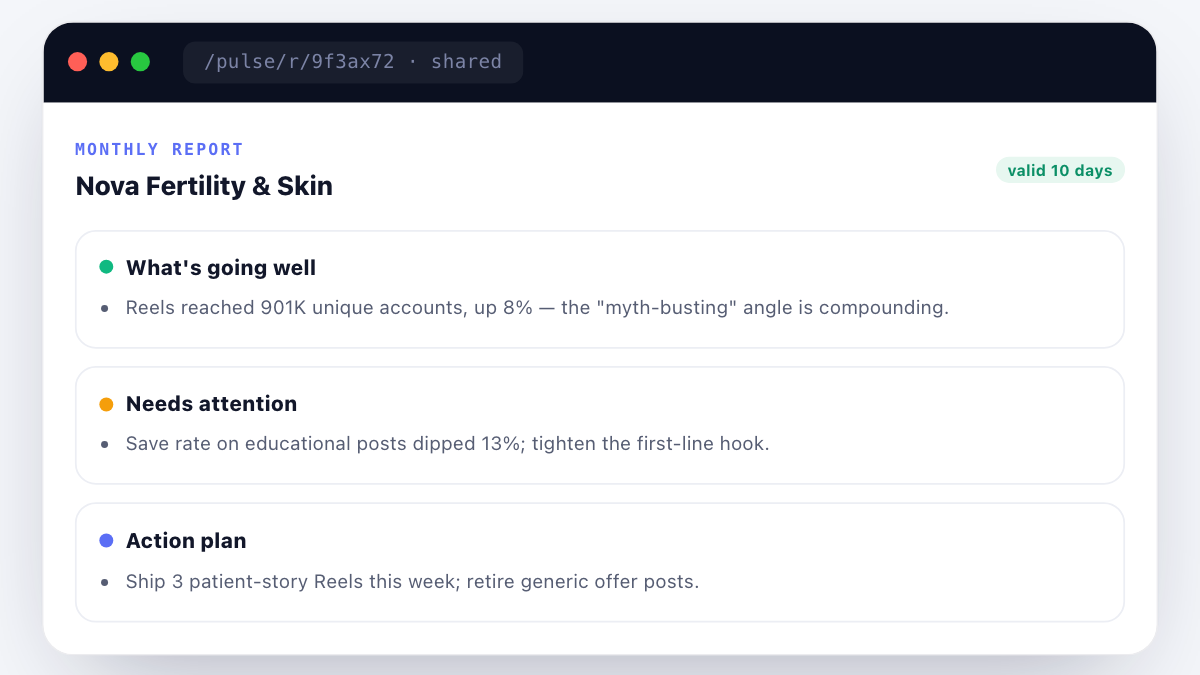 Prism Pulse client-shareable monthly report with what-is-working, needs-attention and action-plan sections signed off for a healthcare Instagram account" width="1200" height="675" loading="lazy" decoding="async" style="width:100%;height:auto;display:block;">
ICG runs healthcare YouTube marketing for clinics, hospitals, and specialty groups using YODA — our AI-native healthcare YouTube marketing platform. YODA sits on top of a channel's data and does four things no dashboard does: it separates organic from paid views at every step (so a promoted video can never masquerade as organic growth), it gives decisions not dashboards (every video gets a state + next action), it writes back to YouTube directly (improved titles, tags, descriptions, chapters applied straight to the platform), and it tracks the three rank races — YouTube search, Google web, and Google AI Overview citations.
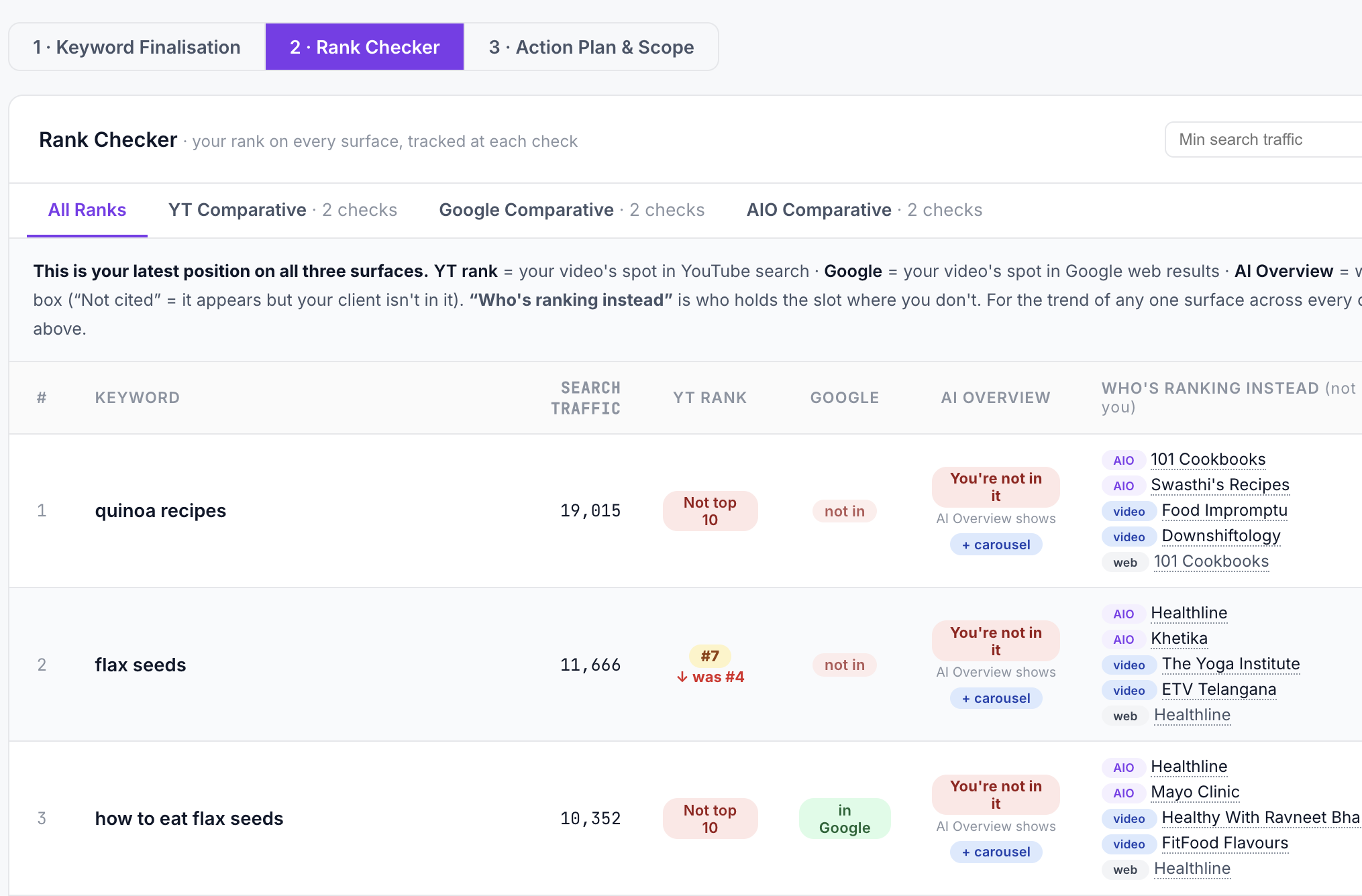
YODA runs the full 6-step workflow — Overview, Diagnostics, Strategy, Optimisation, Reputation (ORM), and Competitor Intel — with 40+ analysis modules organised under those steps. ICG's managed YouTube service uses YODA end-to-end. See the Healthcare YouTube Marketing pillar guide for the full scope, or the Healthcare YouTube Marketing Agency service page for engagement details.
Book a YODA demo on WhatsApp → or request a free healthcare YouTube channel audit →
Related reading
- Healthcare YouTube marketing pillar guide 2026
- YODA 6-step workflow explained
- How a doctor YouTube channel generates consultations
- What a healthcare YouTube agency delivers monthly
- Cost of YouTube marketing for doctors
FAQ
When should we move from per-video shooting to batch shooting? Around video 15-20, or as soon as the doctor's per-video shoot time is becoming a scheduling constraint. Batch shooting is the single largest scale-up lever.
How far ahead should the editorial calendar be for a scaling channel? 6-8 weeks ahead at all times. Below 4 weeks ahead the team is reactive; below 2 weeks the batch-production model breaks.
What is the correct publishing cadence for scale? Weekly (52 videos per year) is the most common sustainable cadence for a Phase 2 healthcare channel. Twice-weekly is possible for enterprise hospital operations with dedicated content teams. Every 10 days is a valid slower cadence for resource-constrained channels.
Should we optimise for subscribers or views during scale-up? Both — but subscribers matter more than most channels realise. Subscribers are the compounding audience that lifts new-video velocity. Ignoring subscriber conversion during scale-up is one of the most common regrets.
How many playlists should our channel have? Enough that every video belongs to at least 2 (typically one topical + one journey). A 40-video channel might have 6-10 playlists; a 200-video channel might have 15-25 playlists.
What is the biggest reason scaling channels stall between videos 40 and 80? Editorial calendar collapse. The batch production breaks when the calendar drops below 4 weeks ahead, and the channel reverts to reactive per-video mode. Everything else usually follows from this.
Should every long-form video be clipped into Shorts and Reels? Yes, every one. Not because Shorts convert directly, but because Shorts are a discovery funnel that surfaces the long-form to viewers who would not have found it through YouTube search or Suggested.
How much should a Phase 2 channel spend per month? For a serious clinic operation with agency support, ₹2-4 lakh per month is typical. For hospital chains running enterprise-tier operations, ₹5-12 lakh per month depending on scope and cadence.
Can we scale up without an agency partner? Yes, if the in-house team includes a content strategist, a producer, an editor, and a marketing lead with YouTube-specific SEO expertise. Below that threshold most in-house teams stall around video 40 because the operational load exceeds capacity.
What is the honest timeline from starting scale-up to seeing repeatable pipeline? 6-9 months from committing to Phase 2 discipline to reaching the "repeatable pipeline" state where consult flow from the channel is predictable enough to build a quarterly forecast around. Faster is possible for well-resourced hospital channels; slower is common for solo-doctor clinics on tight budgets.
Book a free 30-minute Brand & Growth Diagnostic.
It's a working session, not a sales pitch — you leave with a written root-cause analysis you can act on, whether or not you engage ICG.
The three platforms
behind every ICG engagement.
Beacon
CAPI middleware that fixes Event Match Quality, translates CRM statuses to Meta-standard events, dedups across channels.
Agency OS
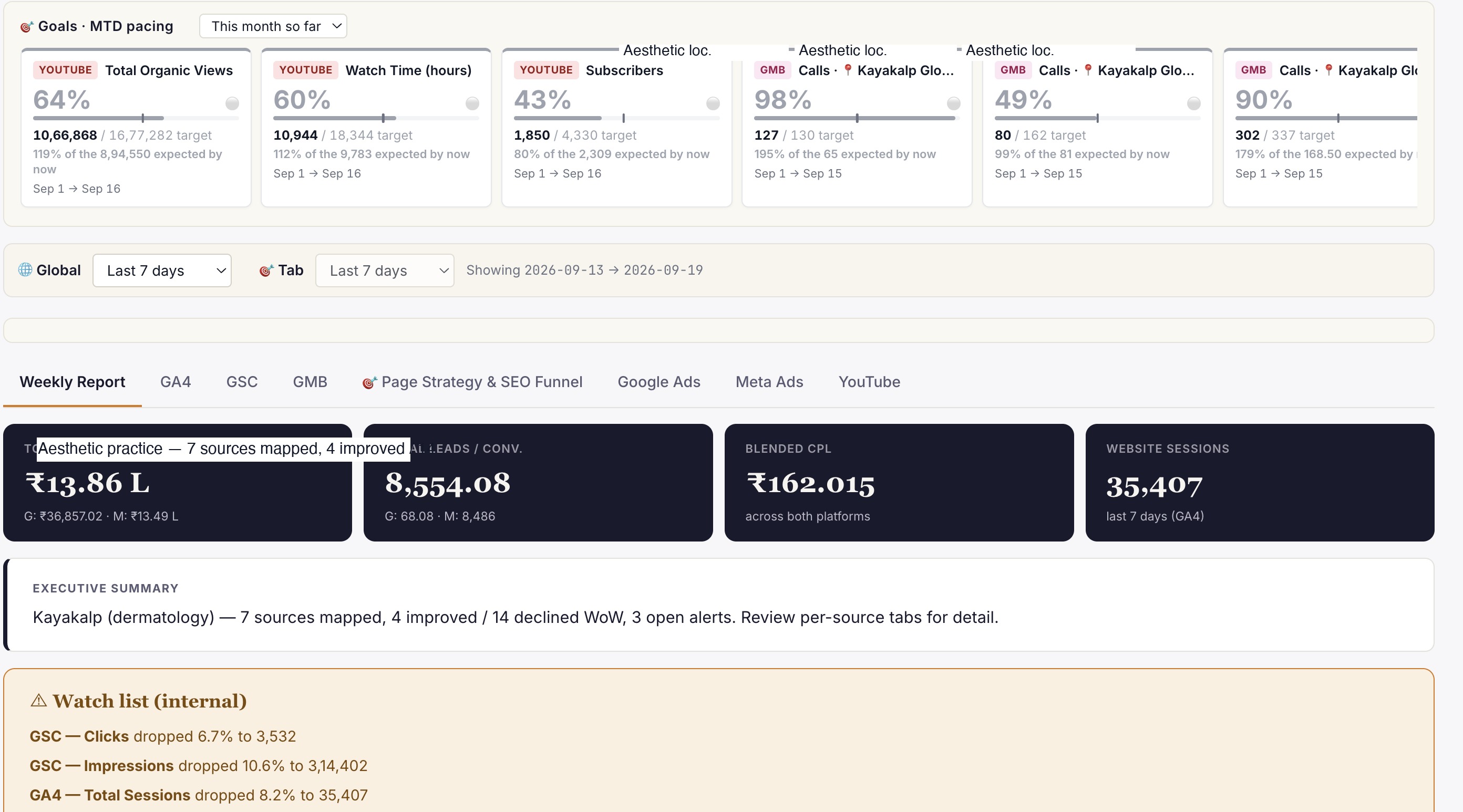
Live client dashboard. GSC, GA4, Google Ads, Meta Ads, IVR calls in one view. Login anytime, not monthly.
Phoenix
Clinic revenue intelligence over your PMS. Daily action queue: Prevent Loss, Maintain & Engage, Grow Revenue. Multi-centre rollout.
Or book a free 30-min audit to see all three in action on your account.
Healthcare brands
that already run on ICG.
A representative slice of the 150+ healthcare brands ICG has delivered for across India. Most engagements remain under NDA.


What ICG clients say · on video.
"Scale up of organic channels and business consulting. ICG has absolute domain authority in their field."
"Working with ICG transformed how we acquire IVF patients in Gurgaon. They understand the fertility journey from inquiry to consult..."
"What Ichelon accomplished — they got all my ideas and worked over 3-4 months to create an amazing, super-customised website."
Need help operationalising this?
Every ICG service is healthcare-only, NMC + DPDP-aware, and built around the patient-research patterns that drive Indian healthcare growth in 2026.
Every practice welcome — packages from ₹20,000/mo.
Goals-Driven engagements · Performance-Linked Payout Models available


More from
ICG.
Five trends shaping Indian healthcare marketing through 2027: AI-first patient research, Conversions API adoption, ABDM discovery, the AEO w...
Healthcare AIO is the discipline of getting your clinic or hospital cited inside Google AI Overviews, ChatGPT and Perplexity answers — not j...
Conversational-search advertising places brand messages inside AI chat answers — ChatGPT, Perplexity, Copilot — rather than beside a results...
Stop guessing.
Book a Diagnostic.
30 minutes. Free. With the AI-powered healthcare-only marketing agency 150+ brands already run on. No slides, no pitch, no hard close.


