


GMB Management: Agency vs Software vs In-House (2026)
Compare GMB management options with a 12-point framework, real cost bands, healthcare compliance flags and red flags before signing. Chat with a Co-Founder.
No pitch. Written root-cause diagnosis. AI-powered, healthcare only.
Direct answer
Compare GMB management options with a 12-point framework, real cost bands, healthcare compliance flags and red flags before signing. Chat with a Co-Founder.
TL;DR
TL;DR
- The GMB management decision is not "agency vs in-house" — it is "which combination of model, tool, and expertise delivers the best outcome per rupee invested for your specific situation"
- Four variables determine the right model: location count, healthcare compliance requirement, internal local SEO expertise, and monthly budget
- A 12-point evaluation framework helps you score each option against your actual situation — not against a generic recommendation
- The most common mistake: choosing in-house because it looks cheaper without calculating the true total cost of ownership (tool + staff time + training + error cost)
- ICG is not the right choice for everyone — this framework will tell you honestly whether a specialist managed service, a self-serve tool, or a hybrid model fits your situation best
Every healthcare business that has discovered the commercial importance of Google Business Profile eventually faces the same decision: do we manage this internally, hire a freelancer, subscribe to a software tool, or engage a specialist agency?
The question looks simple. The answer is complicated by four variables that most decision frameworks ignore: the compliance requirement (which changes everything for healthcare), the true total cost of different models, the capability gap between what you think in-house means and what it actually requires, and the difference between a generalist digital agency offering GMB as an add-on and a specialist with healthcare-specific expertise and proprietary tooling.
This framework is designed to walk you through those variables honestly — including situations where a managed agency like ICG is not the right answer.
Table of contents
- The four decision variables
- The 12-point evaluation framework
- Score interpretation
- The honest model recommendations
- The 5 questions to ask any GMB management provider
- Frequently asked questions
The four decision variables
Before any model evaluation, establish your position on four variables:
Variable 1 — Location count
| Count | What it means for GMB management |
|---|---|
| 1 | Single-location; simpler to manage; freelancer or self-serve tool viable |
| 2–5 | Small portfolio; freelancer or basic managed service; spreadsheet starting to strain |
| 5–20 | Portfolio management needed; self-serve tool requires significant dedicated time; managed service ROI case starts |
| 20–50 | Multi-location management discipline required; in-house needs full-time local SEO resource + enterprise tool |
| 50+ | Enterprise portfolio; automation infrastructure required; managed service with proprietary tooling |
Variable 2 — Healthcare compliance requirement
| Situation | Compliance implication |
|---|---|
| Non-healthcare business | Standard Google policy compliance; no sector-specific layer |
| Healthcare, no clinical content in GBP | Basic NMC awareness needed; DPDP for data collection |
| Healthcare with active GBP content (posts, description) | Full NMC Ethics Code compliance review in content workflow |
| Healthcare with patient testimonials / reviews | NMC + DPDP in review response workflow |
| IVF / fertility clinic | NMC + DPDP + ART Act 2021 triple compliance |
| NABH pursuing hospital | NMC + DPDP + NABH PRE chapter digital alignment |
For columns 3–6 above: a generalist GMB provider cannot deliver compliant content management. Healthcare compliance depth is a non-negotiable requirement.
Variable 3 — Internal local SEO expertise
| Expertise level | What it means |
|---|---|
| None (no one in team understands local SEO) | Self-serve tool will produce reports no one can act on; managed service required |
| Basic (marketing team has seen GSC, knows what GBP is) | Can manage 1–3 listings with a good tool; will struggle with scale or compliance |
| Intermediate (can interpret geo-grid data, knows citation theory) | Can self-manage 3–10 listings with a good tool; healthcare compliance is still a gap |
| Expert (dedicated local SEO specialist on staff) | Can self-manage 10–30 listings with enterprise tooling; needs healthcare compliance training |
| Expert + compliance-trained | Can self-manage almost any portfolio; managed service is optional optimisation |
Most healthcare marketing teams sit at Basic to Intermediate. The healthcare compliance gap is present at all levels except the last.
Variable 4 — Monthly budget
| Budget range | What it buys |
|---|---|
| Under ₹5,000/month | Self-serve tool only (Local Viking, Moz Local entry tier); no managed service viable |
| ₹5,000–₹15,000/month | Mid-market self-serve tool (BrightLocal); basic freelancer for 1–2 locations |
| ₹15,000–₹40,000/month | Freelancer for 3–8 locations; ICG managed service for 1–3 locations |
| ₹40,000–₹1L/month | ICG managed service for 4–10 locations; enterprise tool with dedicated in-house resource |
| ₹1L–₹2.5L/month | ICG managed service for 10–20 locations |
| ₹2.5L+/month | Enterprise managed service for 20–50+ locations |
The 12-point evaluation framework
Score yourself on each point (0 = No / 1 = Partially / 2 = Yes) for each model you're considering. The model with the highest total score for your situation is the recommended starting point.
Section A — Capability requirements (0–2 each)
Point 1: Can the model handle my location count without quality degradation?
- In-house: 2 (if expert local SEO resource) / 0 (if marketing generalist managing 10+ locations)
- Freelancer: 2 (1–5 locations) / 1 (5–15 locations) / 0 (15+ locations)
- Self-serve tool: 2 (if team has expertise to act on it) / 0 (if no one can act on the data)
- Specialist agency: 2 (designed for multi-location scale)
Point 2: Does the model include healthcare compliance (NMC, DPDP, ART Act) in the workflow?
- In-house: 2 (if compliance-trained) / 0 (if not)
- Freelancer: 1 (some awareness) / 0 (most lack specific NMC/DPDP knowledge)
- Self-serve tool: 0 (no tool has NMC compliance built in)
- ICG managed service: 2 (built into every workflow)
Point 3: Does the model provide continuous suspension risk monitoring?
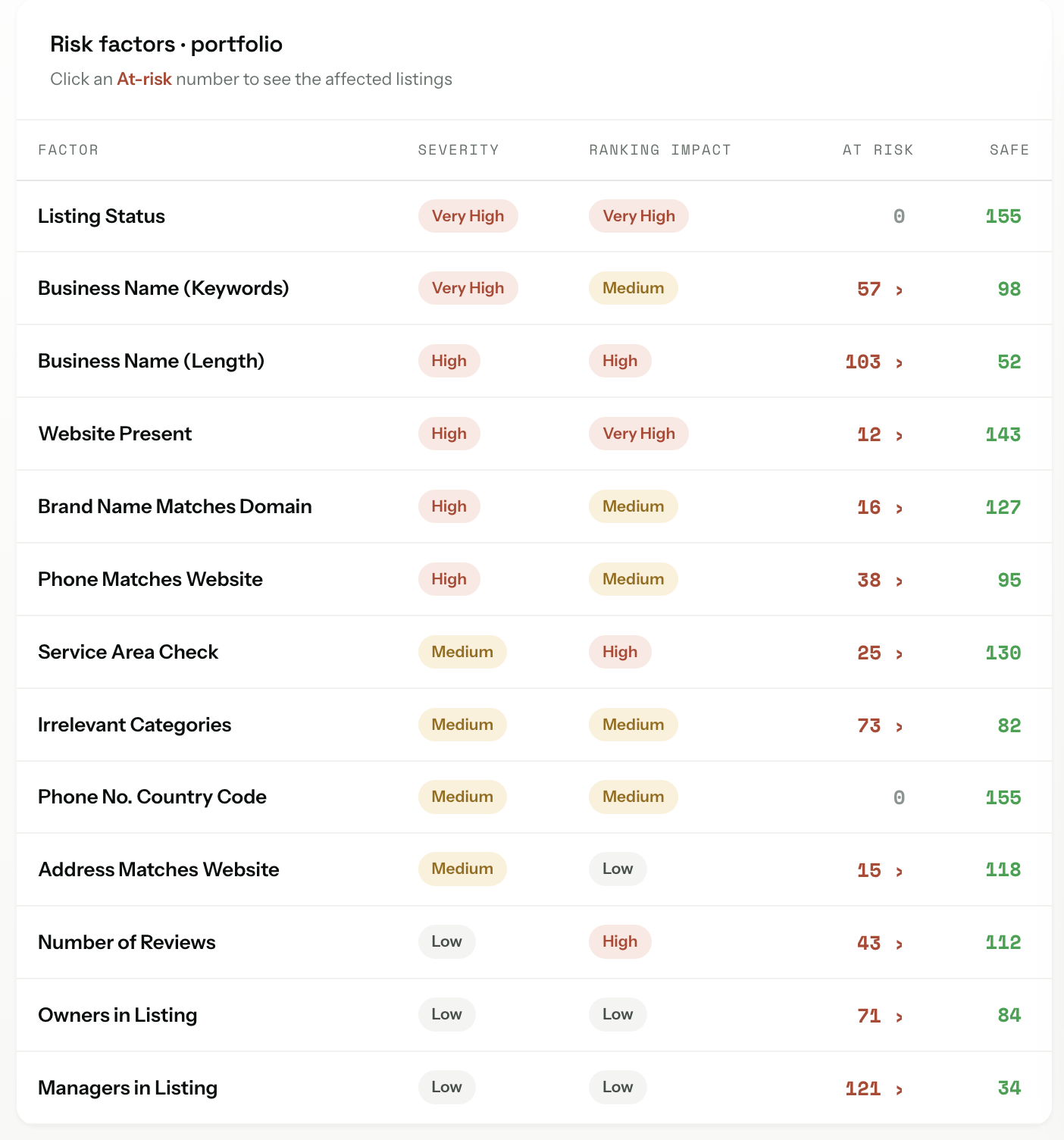
- In-house: 1 (periodic manual checks) / 0 (no tool)
- Freelancer: 1 (if they have a tool)
- Self-serve tool (BrightLocal, Local Viking): 0 (no continuous suspension monitoring)
- ICG managed service (Turtle): 2 (531 factors monitored continuously)
Point 4: Does the model include geo-grid rank tracking at appropriate frequency?
- In-house: 2 (if using Local Viking or Turtle) / 0 (if no rank tracking tool)
- Freelancer: 2 (if they use geo-grid tool) / 0 (if not)
- Self-serve tool: 2 (Local Viking, BrightLocal with rank add-on)
- ICG managed service: 2 (included in Turtle)
Point 5: Does the model provide automated NAP and citation monitoring?
- In-house: 2 (with BrightLocal/Whitespark) / 0 (without)
- Freelancer: 1 (if they use a citation tool)
- Self-serve tool: 2 (BrightLocal, Whitespark)
- ICG managed service: 2 (automated via Turtle)
Point 6: Does the model include weekly Google Posts and review response management?
- In-house: 2 (if bandwidth exists) / 0 (if GBP management is a secondary task)
- Freelancer: 2 (typically included)
- Self-serve tool: 0 (software shows data; doesn't write or post)
- ICG managed service: 2 (included in every engagement)
Section B — Risk management (0–2 each)
Point 7: Does the model have a documented suspension reinstatement process?
- In-house: 1 (if team has researched this) / 0 (most teams haven't)
- Freelancer: 1 (depends on individual)
- Self-serve tool: 0 (software doesn't reinstate listings)
- ICG managed service: 2 (documented playbook + zero suspensions in managed portfolio)
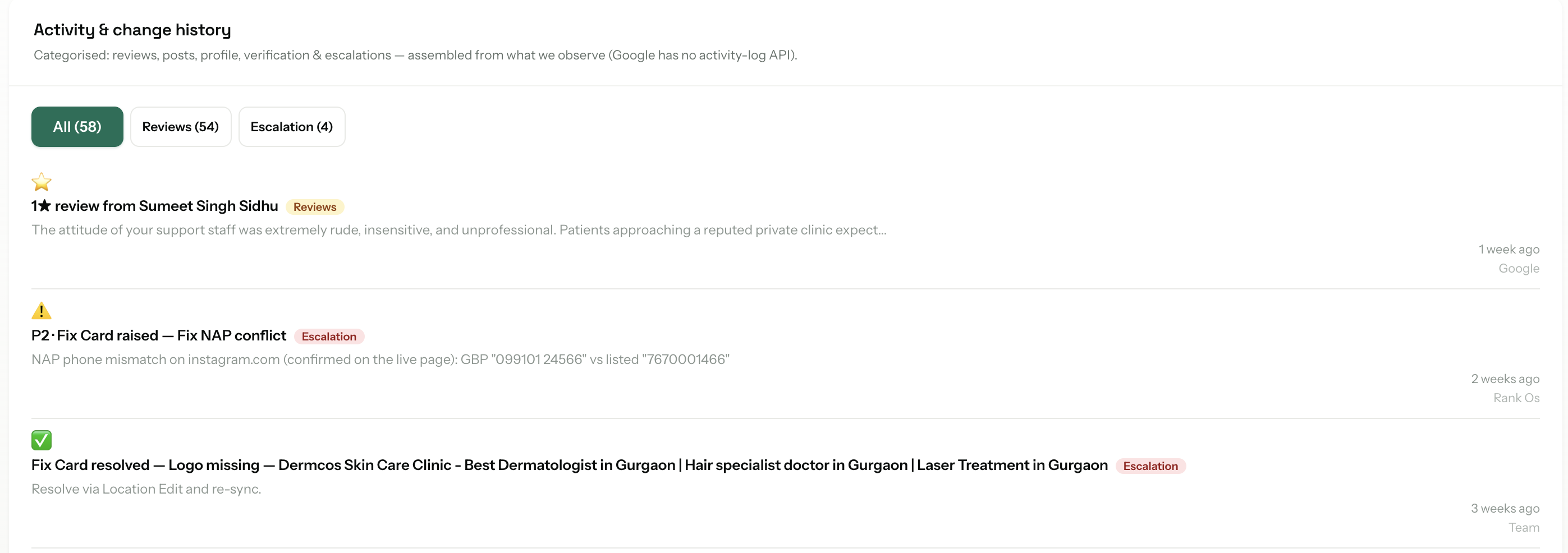
Point 8: Does the model detect and revert unauthorised Google edits within 24–48 hours?
- In-house: 0 (almost never monitored at this frequency)
- Freelancer: 0–1 (depends on monitoring setup)
- Self-serve tool: 1 (some tools have edit alerts)
- ICG managed service: 2 (Profile Shield monitoring)
Point 9: Is there business continuity if the primary manager leaves?
- In-house: 0 (single point of failure if one person manages GBP)
- Freelancer: 0 (high single-point-of-failure risk)
- Self-serve tool: 1 (tool continues; knowledge transfer needed)
- Specialist agency: 2 (team continuity; documented processes)
Section C — Outcome measurement (0–2 each)
Point 10: Does the model produce monthly reporting on outcomes (impressions, calls, conversions) not just activities?
- In-house: 1 (if someone builds a dashboard) / 0 (most report activities: "we posted 4 times this month")
- Freelancer: 1 (varies significantly)
- Self-serve tool: 2 (most tools produce performance reports)
- ICG managed service: 2 (standard monthly report with outcome metrics)
Point 11: Does the model track portfolio-level health score trend over time?

- In-house: 0 (no single health score exists without a specialised tool)
- Freelancer: 0 (individual listing focus)
- Self-serve tool: 1 (BrightLocal has profile completeness tracking)
- ICG managed service (Turtle): 2 (7-dimension health score per listing, portfolio average, monthly trend)
Point 12: Does the model include competitor benchmarking?
- In-house: 1 (manual competitive analysis)
- Freelancer: 1 (if they research competitors)
- Self-serve tool: 2 (most have competitor comparison features)
- ICG managed service: 2 (Turtle competitor benchmarking across rank, reviews, and profile strength)
Score interpretation
Maximum possible score: 24
| Total score | Interpretation |
|---|---|
| 20–24 | Model is well-suited to your situation |
| 14–19 | Model covers most needs; identify specific gaps and address them |
| 8–13 | Model has significant capability gaps; consider supplementing or switching |
| Below 8 | Model is not suited to your situation; re-evaluate |
Run this scoring for each model you're considering against your specific situation. The model with the highest score is the right starting point.
The honest model recommendations

When in-house is the right answer
- You have a dedicated local SEO specialist (not a generalist doing GMB as 20% of their role)
- You manage 3–10 non-healthcare locations
- You have a budget for enterprise tooling (BrightLocal + Local Viking + Whitespark = ₹12,000–₹35,000/month minimum)
- Your industry has no healthcare compliance layer
When in-house fails: When the "dedicated local SEO specialist" does not exist and the work is distributed across a marketing team. The appearance of in-house management with actual part-time generalist management is the most expensive outcome — you pay staff salaries, tool costs, and still get poor results.
When a freelancer is the right answer
- 1–5 non-healthcare locations
- Budget constraint is the primary constraint
- You have an engaged internal contact who can oversee the work monthly
- You're in a lower-competition market where citation and review fundamentals are sufficient
When freelancers fail: At scale (10+ locations), in healthcare (no NMC/DPDP compliance knowledge), and when the freelancer leaves (total knowledge and access transfer risk).
When self-serve software is the right answer
- You have genuine local SEO expertise in-house
- You want tools to augment in-house capacity, not replace it
- You can act on the data the tool surfaces every week without exception
- Non-healthcare, or healthcare with a compliance-trained internal team
When self-serve software fails: When no one has time to act on what the tool surfaces. Software that produces reports no one acts on is a subscription that produces no outcome.
When ICG's managed service is the right answer
- Healthcare businesses with NMC/DPDP/ART Act compliance requirements (any scale)
- Multi-location businesses with 5+ locations where portfolio management matters
- Businesses that have had a suspension or are concerned about suspension risk
- Businesses where the outcome (more patient enquiries, more calls, better rating) is more important than the activity (someone managing a GBP)
- Businesses where the CMO/COO wants a monthly outcomes report, not an activity log
When ICG is not the right answer: Single-location non-healthcare businesses with very limited budgets; businesses with a genuine in-house local SEO expert and healthcare compliance training; businesses in very low-competition markets where basic maintenance is sufficient.
The 5 questions to ask any GMB management provider
Regardless of which model you choose, these five questions separate qualified providers from generic digital agencies with GBP as a line item:
-
"What is your health score methodology, and how do you score my listing today?" — A qualified provider can answer this immediately. A generalist cannot.
-
"How do you monitor for suspension risk continuously?" — The answer should describe a specific monitoring system. "We check monthly" is not continuous monitoring.
-
"How do you handle NMC Ethics Code compliance in GBP content for healthcare clients?" — A healthcare-specialist provider has a documented workflow. A generalist has never considered this question.
-
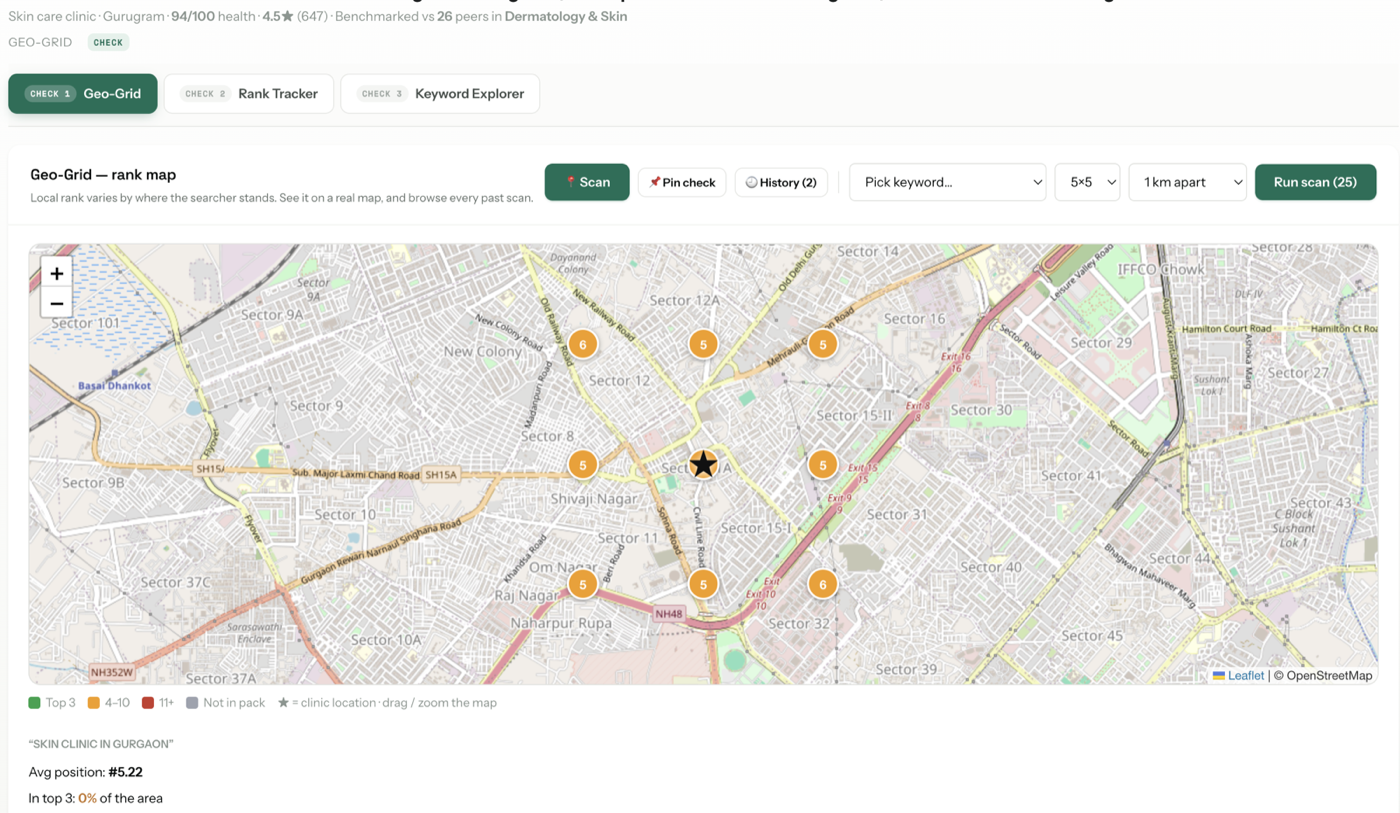
"Can you show me a geo-grid rank scan for a healthcare client in my specialty and city?" — A qualified provider has this data. A generalist does not.
-
"What does my monthly report look like, and does it show outcomes or activities?" — The answer should show impressions, calls, direction requests, and health score trend — not "we published 4 posts and responded to 8 reviews."
Frequently asked questions
Q1: Is ICG the right choice for a single-location clinic with a limited budget? Not necessarily. ICG's managed service starts at ₹7,500/month — viable for single high-value locations where the patient acquisition economics justify it (aesthetic clinics, IVF centres, specialist surgeons). For a GP clinic with a limited budget and no compliance complexity, a freelancer plus BrightLocal is likely a better fit.
Q2: How do I know if my current GMB management is actually working? Three indicators: your Map Pack impressions in GSC are growing month-on-month; your review rating and count are improving; and you have received zero suspension alerts. If all three are positive, your current management is working. If any is negative and your current provider cannot explain why, the management is not working.
Q3: What is the minimum viable GMB management for a small clinic? At minimum: a claimed and verified GBP with accurate information, 2+ reviews per month, one Google Post per week, and a review response within 48 hours for every review. This is achievable in-house with 2–3 hours per week. It is not competitive in high-density urban markets — but it is the floor below which a clinic is actively losing visibility.
Q4: How long should a GMB management engagement run before evaluating results? 3 months for initial profile and citation improvements to register. 6 months for review velocity to materially change rating and review count. 9–12 months for sustained local pack improvement to be clearly attributable. GMB management that is evaluated at 30 days and cancelled if rankings haven't moved is almost always cancelled too early.

Q5: Can I switch GMB management providers without losing my GBP data? Yes. GBP data belongs to the business owner, not the agency. When switching providers: ensure you hold owner-level GBP access (not just manager), request a handover document covering current health score, active suspension risk factors, citation conflict status, and content calendar. ICG provides a full portfolio handover document to every client at engagement end.
Q6: What is the single most important thing to look for in a GMB management agency? Suspension monitoring. A suspension removes your listing from Google Maps entirely — zero calls, zero directions, zero new patients from the platform. An agency that monitors for suspension risk continuously and maintains a zero-suspension track record has demonstrated the capability that matters most. Everything else is optimisation. A suspension is a crisis.
Sources:
- Google Business Profile guidelines — support.google.com/business
- NMC Guidelines on Ethical Advertising (6 Oct 2026) — nmc.org.in
- DPDP Act 2023 — meity.gov.in
- ART Act 2021 — Ministry of Health and Family Welfare
- ICG managed portfolio data, 2024–2026
Internal links:
- Top 10 GMB Management Software India 2026
- GMB Agency vs In-House TCO 2026
- Google Business Profile Management Services
- GMB Management Software India
- Multi-Location GMB Management
- Enterprise Local SEO for Hospital Groups
The tool ICG uses to run this at scale: Angryturtle
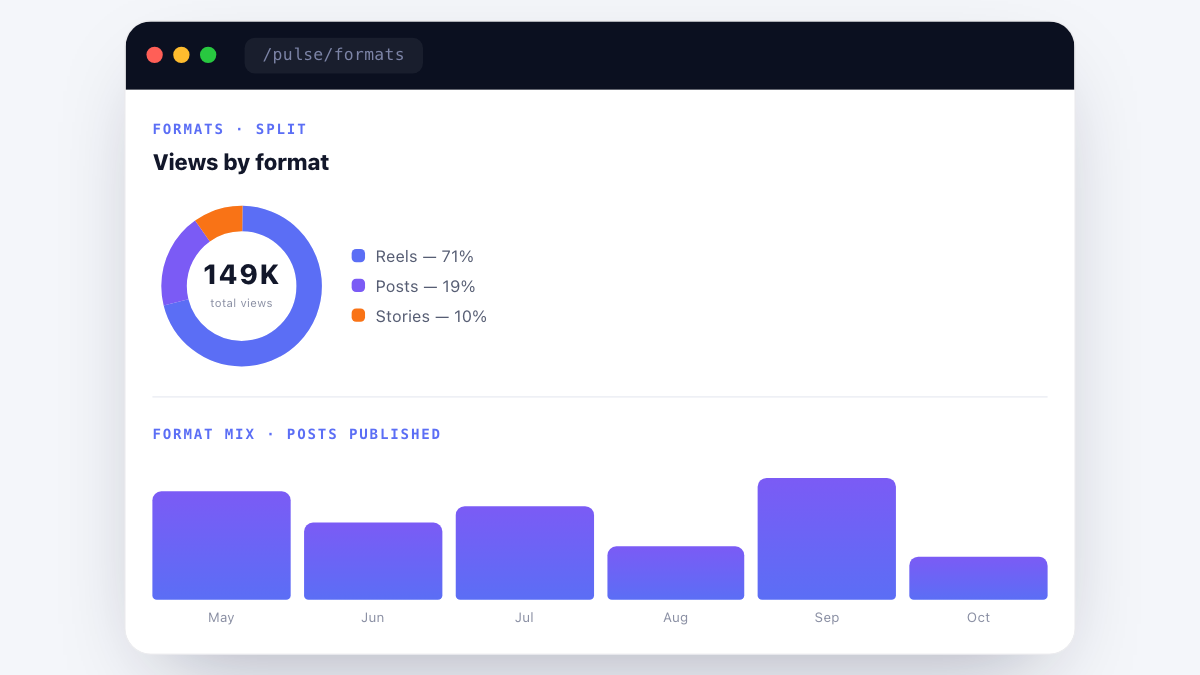
ICG runs local SEO and GBP intelligence for 150+ Indian healthcare brands using Angryturtle — our own AI-native GBP intelligence and management OS. The platform scores every profile 0-100 via a proprietary Rank OS model with five weighted dimensions (Relevance, Review Health, Freshness, Entity Authority, AIO Readiness), publishes edits, Posts, media, and review replies directly to Google, and includes Ask Maps AIO Readiness scoring for Google AI Overviews and ChatGPT visibility.

Available in two shapes: self-serve at ₹999/- per month for solo owners with 1-2 profiles, and ICG's managed service from ₹25,000/- per month where our healthcare specialists execute inside the same platform. Both are anchored in the Healthcare Local SEO Agency India pillar page which has full scope, methodology and pricing.
Book a demo on WhatsApp → or start a free trial at angryturtle.ai →
Hidden costs, red flags and healthcare-specific traps most GMB contracts hide
The 12-point framework tells you what to score. This section tells you where the money actually leaks after you sign, and the compliance clauses healthcare buyers should never miss. We built this from live audits across dental groups, IVF chains, single-specialty hospitals and multi-city clinic brands.
Cost bands buyers should benchmark against in 2026
| Model | Fair monthly range (per location) | What is usually excluded |
|---|---|---|
| Freelancer | Rs 3,000 to 8,000 | Review response SLA, photo shoots, dispute filings |
| Self-serve software | Rs 999 to 4,999 | Human review replies, competitor teardown, GBP suspension recovery |
| Boutique agency | Rs 12,000 to 35,000 | Paid ads, landing pages, call tracking |
| Enterprise agency retainer | Rs 60,000 plus | Custom reporting, on-site shoots, doctor bio SEO |
If a quote sits 50% below the fair band, assume the provider is either fresh, offshoring the work, or padding a longer contract to recover margin later. Ask them to itemise.
Seven red flags to catch before signing
- No named account manager, only a shared inbox.
- Refuses to share the raw GBP Insights export monthly.
- No written escalation path if the listing gets suspended.
- Bundles review generation with incentivised reviews (a Google policy violation).
- Cannot show three anonymised case studies from your specialty.
- Locks you into a 12-month contract with no 30-day exit for missed SLAs.
- Will not commit to the primary category, service list and Q and A cadence in writing.
Healthcare-specific clauses to add to any GMB contract
- Doctor profile ownership — each practitioner must retain edit access to their own GBP.
- Review moderation policy — no responses that confirm diagnoses, prices or outcomes in public.
- Emergency hours handling — after-hours listings for OT, labour rooms or 24x7 pharmacies handled separately.
- NABH and MCI-safe language — no superlatives like number one or best in city (see our NABH consulting notes for why).
Most agencies that pass this section end up running the workflow on Angryturtle for daily GBP hygiene, layered with the human review and dispute cover of the Client-Elevation Programme. If you want us to score your current provider against this checklist, WhatsApp Rohit.
Book a free 30-minute Brand & Growth Diagnostic.
It's a working session, not a sales pitch — you leave with a written root-cause analysis you can act on, whether or not you engage ICG.
Questions readers ask
about this topic.
The three platforms
behind every ICG engagement.
Beacon
CAPI middleware that fixes Event Match Quality, translates CRM statuses to Meta-standard events, dedups across channels.
Agency OS
Live client dashboard. GSC, GA4, Google Ads, Meta Ads, IVR calls in one view. Login anytime, not monthly.
Phoenix
Clinic revenue intelligence over your PMS. Daily action queue: Prevent Loss, Maintain & Engage, Grow Revenue. Multi-centre rollout.
Or book a free 30-min audit to see all three in action on your account.
Healthcare brands
that already run on ICG.
A representative slice of the 150+ healthcare brands ICG has delivered for across India. Most engagements remain under NDA.


What ICG clients say · on video.
"Scale up of organic channels and business consulting. ICG has absolute domain authority in their field."
"Working with ICG transformed how we acquire IVF patients in Gurgaon. They understand the fertility journey from inquiry to consult..."
"What Ichelon accomplished — they got all my ideas and worked over 3-4 months to create an amazing, super-customised website."
The intelligence stack behind this playbook.
Every ICG engagement runs on the Search Intelligence Trifecta — Angryturtle for GMB, SIE for search and AI Overview, YODA for YouTube. Live product screens below.
Need help operationalising this?
Every ICG service is healthcare-only, NMC + DPDP-aware, and built around the patient-research patterns that drive Indian healthcare growth in 2026.
Every practice welcome — packages from ₹20,000/mo.
Goals-Driven engagements · Performance-Linked Payout Models available


More from
ICG.
Five trends shaping Indian healthcare marketing through 2027: AI-first patient research, Conversions API adoption, ABDM discovery, the AEO w...
Healthcare AIO is the discipline of getting your clinic or hospital cited inside Google AI Overviews, ChatGPT and Perplexity answers — not j...
Conversational-search advertising places brand messages inside AI chat answers — ChatGPT, Perplexity, Copilot — rather than beside a results...
Stop guessing.
Book a Diagnostic.
30 minutes. Free. With the AI-powered healthcare-only marketing agency 150+ brands already run on. No slides, no pitch, no hard close.


