


Local SEO for ophthalmology clinics and eye hospitals in India: high-volume routine care meets high-value surgical work
Local SEO for ophthalmology practices in India runs on a two-track economic model that shapes the strategy: high-volume routine consultations refraction, general eye check-ups, dry-eye management, allergic conjunctivitis drive the everyday patient flow that keeps the profile fres
No pitch. Written root-cause diagnosis. AI-powered, healthcare only.
Direct answer
Local SEO for ophthalmology practices in India runs on a two-track economic model that shapes the strategy: high-volume routine consultations refraction, general eye check-ups, dry-eye management, allergic conjunctivitis drive the everyday patient flow that keeps the profile fres
TL;DR

Local SEO for ophthalmology practices in India runs on a two-track economic model that shapes the strategy: high-volume routine consultations (refraction, general eye check-ups, dry-eye management, allergic conjunctivitis) drive the everyday patient flow that keeps the profile fresh and reviewed, while high-value surgical work (cataract surgery, refractive procedures like LASIK/PRK, retinal procedures, glaucoma management) drives the revenue that justifies the marketing investment. The local pack ranking for "eye specialist near me" produces the routine consultations; the specific-procedure query rankings ("cataract surgeon in [city]," "LASIK centre near me") produce the surgical patients. ICG runs healthcare local SEO for ophthalmology practices using Angryturtle calibrated for both tracks — routine-consultation query optimisation alongside procedure-specific local SEO for the high-value surgical work.
Why ophthalmology local SEO looks different
Three specialty-specific features shape the problem.
Two economic tracks share one GBP. A general ophthalmology practice does refractions and general consultations (₹500-1,500 per visit) alongside cataract surgeries (₹30,000-1,50,000+ per eye), LASIK (₹40,000-1,00,000+ per eye), and retinal procedures (varies widely). The two economic tracks have different patient acquisition costs, different consideration cycles, and different appropriate local SEO investments — but they share one GBP. Optimising for one track without the other leaves money on the table.
Age-driven demand patterns. Ophthalmology patient demand skews strongly by age. Under-40 patients dominate refractive procedure queries (LASIK, PRK, SMILE, contact lens fitting). Over-50 patients dominate cataract, glaucoma, and retinal query volume. Local SEO strategy should reflect the age-demographic mix of the practice's catchment.
Sub-specialty depth matters more than in most specialties. Ophthalmology splits into refractive, cataract, retina and vitreous, glaucoma, cornea, oculoplastics, paediatric ophthalmology, and neuro-ophthalmology. Each sub-specialty has distinct query patterns. A solo cornea specialist competes against other cornea specialists, not against general ophthalmologists. Sub-specialty categorisation and content depth is the ranking lever.
Angryturtle's sie" style="color:inherit;text-decoration:underline;text-decoration-color:rgba(42,126,200,.5);text-underline-offset:2px">Rank OS for ophthalmology profiles balances Relevance (sub-specialty categorisation depth), Review Health (patient volume creates review flow), and Freshness (visual content for aesthetic-oriented refractive practices).

GBP configuration for ophthalmology practices
Primary category. "Ophthalmologist" for solo generalist eye specialists; "Eye Care Center" for dedicated ophthalmology facilities; sub-specialty categories for focused practices — "LASIK Surgeon," "Retina Specialist," "Cataract Surgeon" where Google's category tree offers them. Multi-specialty hospitals with eye departments stay at hospital-level primary with "Ophthalmologist" as secondary.
Secondary categories. Fill up to 9 slots with sub-specialties: Optometrist (if the practice has integrated optometry), LASIK Surgeon, Cataract Surgeon, Retina Specialist, Glaucoma Specialist, Cornea Specialist, Oculoplastic Surgeon, Pediatric Ophthalmologist, Neuro-Ophthalmologist, Eye Care Center (for facilities offering multiple sub-specialties).
Services list. Ophthalmology has 15-20 distinct services worth listing: Eye Examination, Refraction and Spectacle Prescription, Contact Lens Fitting, Cataract Surgery (Phacoemulsification, Femto-assisted, Multi-focal IOL — separate services), LASIK, PRK, SMILE Refractive Surgery, Glaucoma Management, Retinal Surgery (Vitrectomy, Retinal Detachment Repair), Diabetic Retinopathy Screening, Corneal Surgery (DALK, DSAEK, DMEK), Oculoplastic Surgery (Blepharoplasty, Ptosis Repair), Pediatric Ophthalmology Consultation, Squint Surgery, Dry Eye Treatment, Allergic Eye Care.
Business description. 750 characters covering: practice name and ophthalmology focus, years of operation, sub-specialties, notable technology (specific LASIK platform — Wavelight, VisuMax, Contoura; cataract IOL options; retinal imaging systems like OCT, fundus photography), consultant credentials with emphasis on fellowship training in sub-specialties, insurance panels for medical work, EMI arrangements for elective refractive surgery, appointment scheduling flexibility.
Attributes. Health-and-safety attributes, appointment scheduling, insurance panels, wheelchair accessible (matters for elderly cataract patients), languages spoken, financing options.
Photo requirements for ophthalmology
Ophthalmology profiles benefit from specific photo types:
Clinical environment: examination rooms, consultation setups with slit lamps and imaging equipment, LASIK suite for refractive practices, cataract theatre for surgical practices, optometry section for practices with integrated optometry.
Technology: specific LASIK platforms with brand names in captions, OCT and fundus imaging equipment, biometry systems for cataract measurement, retinal laser systems.
Team: ophthalmologists, optometrists, technicians in clinical settings.
Facility: clean, welcoming, professional. Waiting areas that accommodate elderly patients (comfortable seating, accessibility). LASIK-focused practices benefit from modern-clinic-aesthetic photos for the younger refractive patient demographic.
Compliance-safe alternatives: for refractive practices, avoid identifiable patient photos even with consent. Procedure demonstration photos with masked subjects, technology showcase photos, and clinical-outcome imaging (OCT scans, fundus images without patient identification) work well for education.
Review flow for ophthalmology
Volume: 200-500 minimum for competitive metro ophthalmology practices. Dedicated eye hospitals typically 500-1,500+. LASIK-focused practices tend to accumulate high review volumes because of the elective, satisfaction-driven nature of the procedure.
Velocity: 10-25 new reviews per month for solo ophthalmology practices; 30-60 per month for eye hospitals.
Response rate: 100% response rate expected.
Compliance for ophthalmology reviews. Refractive procedure reviews often mention specific outcomes ("I got 20/20 vision after LASIK") — compliant reply pattern acknowledges the patient's experience without confirming specific clinical results. Cataract reviews similarly touch on specific outcomes ("I can see clearly for the first time in years"). All reply drafting uses NMC-safe framing that acknowledges experience without endorsing specific clinical results.
Ask Maps for ophthalmology patient queries
Angryturtle's Ask Maps question bank for ophthalmology covers:
- "Best LASIK surgeon in [city]"
- "Which ophthalmologist does cataract surgery with multi-focal IOL"
- "Does this eye hospital do retinal detachment surgery"
- "What's the cost of LASIK at this clinic"
- "Is there a paediatric ophthalmologist at this practice"
- "Which insurance panels does this eye clinic accept"
- "Does this clinic have a female ophthalmologist"
- "What LASIK technology does this practice use"
- "How long is the recovery from cataract surgery here"
- "Are there dry-eye treatments at this practice"
The question bank differs across ophthalmology sub-specialties. A LASIK-focused practice sees refractive-heavy question defaults; a retinal specialist sees retinal-heavy defaults.
Pricing tiers for ophthalmology practices
Solo ophthalmologist / single-location practice: Starter tier at ₹25,000-₹50,000/month covers GBP optimisation, monthly Post cadence, review operations, monthly rank tracking, quarterly citation audit.

Multi-doctor ophthalmology group or eye clinic chain: Chain tier at ₹75,000-₹1,50,000/month covers per-location GBP management, weekly Post cadence, review operations, monthly Geo-Grid tracking, monthly citation building.
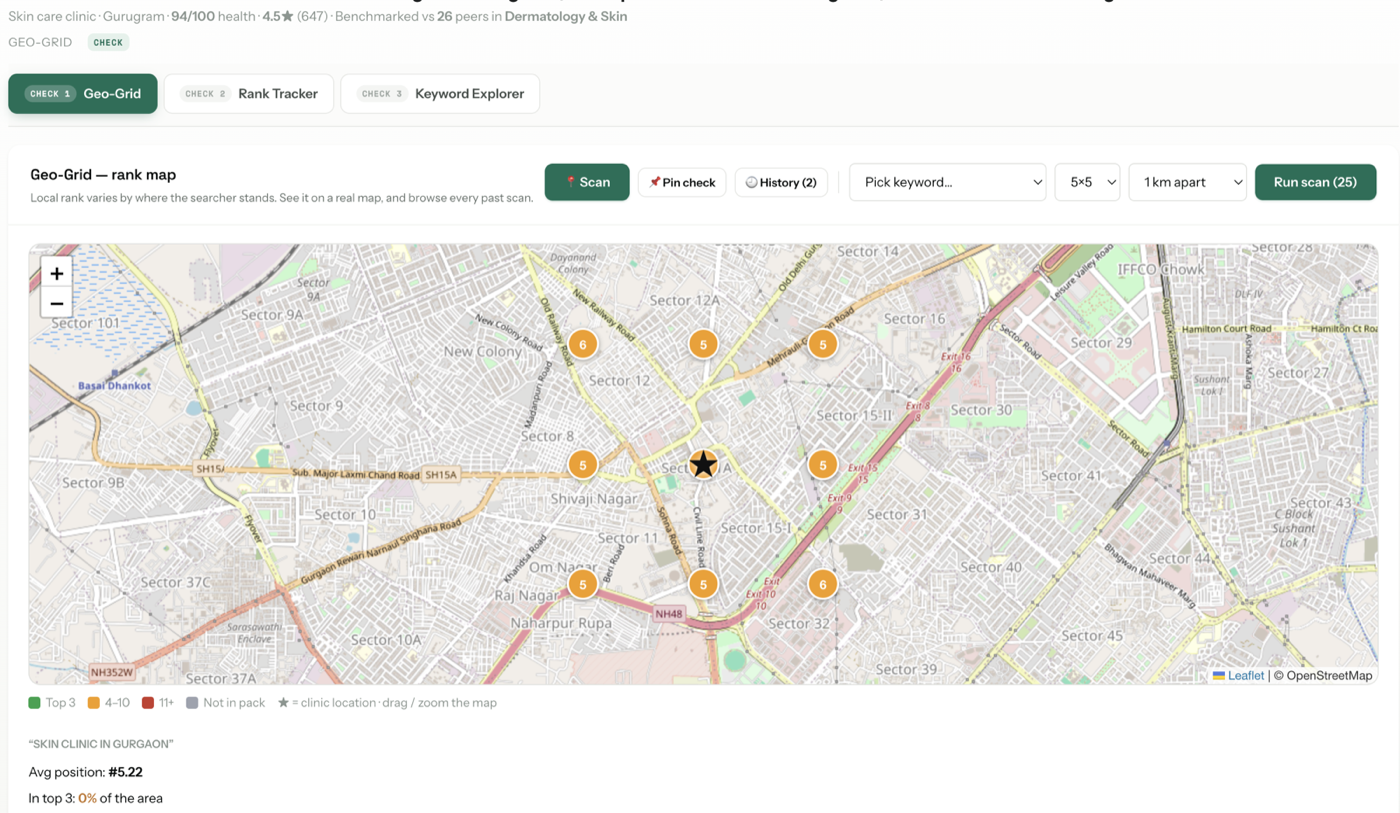
Eye hospital or LASIK-focused chain: Hospital tier at ₹1,50,000-₹4,00,000/month covers department-level operations, daily Post cadence, review operations across full ophthalmology patient footprint, weekly Geo-Grid tracking, ongoing citation building, monthly AIO audit, custom reporting.
Related reading
- Healthcare local SEO agency India — pillar service page
- Local SEO for cardiology clinics India — sub-specialty comparison
- Local SEO for dermatology clinics India — visual-medium comparison
- Ophthalmology marketing cost India — budget context
FAQ
How is ophthalmology local SEO different from other specialties? Two economic tracks share one GBP (routine consultations + high-value surgeries), age-driven demand patterns (younger patients for refractive, older for cataract/retina/glaucoma), and sub-specialty depth matters more than in most specialties.
Should LASIK-focused practices have separate GBP from general ophthalmology? Usually no. One GBP per physical location. Sub-specialty focus should be reflected in categories, services list, and content strategy rather than separate profiles.
How many reviews does an ophthalmology practice need? 200-500 for competitive metro positioning. Eye hospitals 500-1,500+. LASIK-focused practices tend to accumulate high review volumes.
What Google category should a sub-specialty ophthalmologist use? Sub-specialty as primary if Google offers it (LASIK Surgeon, Retina Specialist, Cataract Surgeon). "Ophthalmologist" as primary otherwise, with sub-specialty in description and services.
How long before an ophthalmology practice sees ranking improvement? Similar to other specialties: 4-8 weeks for first movement, 3-4 months for substantive improvement, 6-12 months for full compound effect.
Can Angryturtle handle both refractive and general ophthalmology configurations? Yes. Rank OS weights, Ask Maps question banks, and Content Studio drafting adjust per sub-specialty focus.
Should the practice run Google Ads for LASIK? Usually yes — LASIK is high-consideration elective surgery that responds well to intent-driven paid search alongside local SEO. Meta ads viable for younger LASIK demographics.
What Angryturtle features matter most for ophthalmology? Rank OS with sub-specialty tuning, Ask Maps AIO with sub-specialty question banks, Content Studio for procedure-education content drafting, NMC-safe review reply drafting for the outcome-adjacent reviews ophthalmology receives.
Book a free SEO diagnostic.
Hanuman Sihag's team runs a live crawl, checks technical health, cannibalisation, schema coverage and content gaps. 60 minutes, prioritised fix list.
The three platforms
behind every ICG engagement.
Beacon
CAPI middleware that fixes Event Match Quality, translates CRM statuses to Meta-standard events, dedups across channels.
Agency OS
Live client dashboard. GSC, GA4, Google Ads, Meta Ads, IVR calls in one view. Login anytime, not monthly.
Phoenix
Clinic revenue intelligence over your PMS. Daily action queue: Prevent Loss, Maintain & Engage, Grow Revenue. Multi-centre rollout.
Or book a free 30-min audit to see all three in action on your account.
Healthcare brands
that already run on ICG.
A representative slice of the 150+ healthcare brands ICG has delivered for across India. Most engagements remain under NDA.


What ICG clients say · on video.
"ICG's healthcare-only focus made the difference. They speak our language and understand patient acquisition specifics."
"Bariatric surgery patients need a long consideration cycle. ICG built a content + paid system that respects that timeline."
"Dental marketing in Delhi is brutally competitive. ICG's local SEO + Google Ads stack moved the needle steadily."
The intelligence stack behind this playbook.
Every ICG engagement runs on the Search Intelligence Trifecta — Angryturtle for GMB, SIE for search and AI Overview, YODA for YouTube. Live product screens below.
Need help operationalising this?
Every ICG service is healthcare-only, NMC + DPDP-aware, and built around the patient-research patterns that drive Indian healthcare growth in 2026.
Every practice welcome — packages from ₹20,000/mo.
Goals-Driven engagements · Performance-Linked Payout Models available



More from
ICG.
Five trends shaping Indian healthcare marketing through 2027: AI-first patient research, Conversions API adoption, ABDM discovery, the AEO w...
Healthcare AIO is the discipline of getting your clinic or hospital cited inside Google AI Overviews, ChatGPT and Perplexity answers — not j...
Conversational-search advertising places brand messages inside AI chat answers — ChatGPT, Perplexity, Copilot — rather than beside a results...
Stop guessing.
Book a Diagnostic.
30 minutes. Free. With the AI-powered healthcare-only marketing agency 150+ brands already run on. No slides, no pitch, no hard close.


