


Your Google Maps Rank Isn't One Number: How Geo-Grid Rank Tracking Reveals True Local Visibility
Ask most business owners where they rank on Google Maps and you'll get a confident single answer: "We're number one." Then a customer three kilometres away searches the same term and can't find them a
No pitch. Written root-cause diagnosis. AI-powered, healthcare only.
Direct answer
Ask most business owners where they rank on Google Maps and you'll get a confident single answer: "We're number one." Then a customer three kilometres away searches the same term and can't find them a
TL;DR
TL;DR
- Detailed guidance on local rank tracking — the specific mechanics, benchmarks, and Turtle-enabled tactics
- Backed by ICG portfolio data across 143 healthcare Google Business Profiles (0 suspensions, 4.76★ average)
- NMC + NABH + ART Act + DPDP compliance built into every recommendation
- Applicable to solo clinics, multi-location chains, and enterprise hospital groups across India + global markets
Ask most business owners where they rank on Google Maps and you'll get a confident single answer: "We're number one." Then a customer three kilometres away searches the same term and can't find them at all. Both experiences are real — and that contradiction is the single most misunderstood fact in local search.
Your Google Maps ranking is not a fixed position on a list. It's a different result for almost every searcher, and one of the biggest reasons it shifts is where the person searching is physically standing. If you're measuring your visibility with a single rank check, you're looking at a photograph of a moving target. Local rank tracking done properly measures the whole map, not one point on it.
Why the Same Search Gives Different Ranks
Google's local results — the "map pack" or local pack of three businesses shown above the organic listings — are assembled on the fly for each query. Google weighs three broad factors: relevance (how well your profile matches the search), prominence (how well-known and trusted your business is, from reviews to citations to links), and distance (how close you are to the searcher or the location implied by their search).
That third factor, proximity, is why a single rank number is misleading. Relevance and prominence are relatively stable from one search to the next. Distance is not — it changes with every searcher. When someone searches "physiotherapist near me" or "coffee shop," Google quietly anchors the results to their location and favours businesses nearby. Move the searcher, and the distance calculation changes for every competitor at once, reshuffling the pack.
This is why you can rank #1 right outside your front door and vanish a few kilometres away. Near your location, proximity works in your favour. Push out toward the edge of your service area, and competitors who are physically closer to that searcher inherit the advantage — even if your reviews and profile are stronger. Proximity doesn't override everything, but it bends the results enough that a citywide "rank" is a fiction.
What a Geo-Grid Actually Is
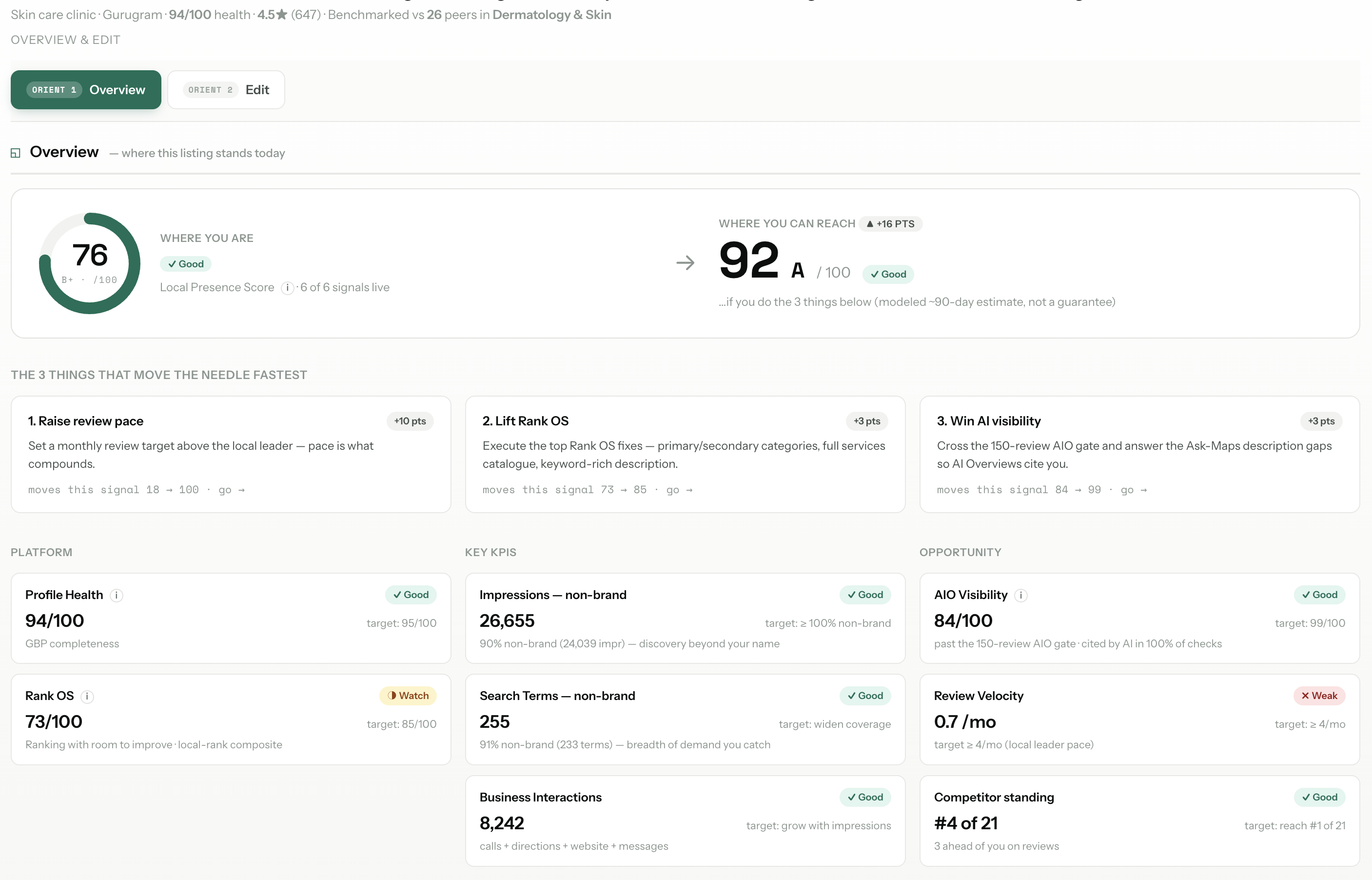
A geo-grid is a way of measuring rank the way your customers actually experience it: from many places at once. Instead of checking your ranking from a single point, geo-grid rank tracking lays a matrix of virtual search points across your service area — a grid stretched over a real map, each pin representing a searcher standing in that spot.
At every point in the grid, the system runs your target keyword and records exactly where you appear in the local results for a searcher at that location. The output isn't one number — it's a heat map. Green pins where you dominate the local pack. Yellow where you're slipping. Red where you're invisible. In one glance you see the true shape of your visibility across the entire area you serve, not a flattering average that hides your weak spots.
Quick gut-check: Search your main service term from your phone at the office, then again from home or across town. If your position moves, a single rank report has been hiding most of your real picture. See your visibility mapped across your whole service area with Ichelon.
That geographic detail is exactly what a single rank check throws away — and it's usually the most actionable information you have.
Reading the Map: Where to Actually Focus
A geo-grid turns a vague goal ("rank higher on Google") into a specific, targeted plan.
- Find your visibility edge. The boundary where green fades to red shows how far your prominence carries before proximity hands the pack to competitors. Pushing that edge outward is a concrete, measurable objective.
- Spot pockets you're losing. A patch of red inside your service area often reveals a competitor with a location or a stronger profile dominating that neighbourhood — a target you can respond to deliberately.
- Prove which work moved the needle. After earning reviews, publishing posts, cleaning up citations, or refining categories, a re-scan shows the map shifting greener. You can tie effort to outcome instead of guessing.
- Prioritise multi-location strategy. For businesses with several branches or a wide service-area footprint, the grid shows exactly which locations own their territory and which are being out-ranked nearby — so budget and attention go where they change results.
Crucially, this reframes success. The aim isn't a mythical "#1" — it's expanding the area where you're genuinely visible to the people most likely to become customers.
How Ichelon Uses Geo-Grid Tracking
At Ichelon Consulting, geo-grid rank tracking is built into our platform, Turtle by Ichelon, and it's where optimisation strategy begins rather than ends. We map your key search terms across your real service area to establish a visibility baseline — the honest picture of where you win, where you're contested, and where you're absent.
From there, the grid guides the work. Because Turtle tracks rankings alongside your Google Business Profile health, reviews, citations, and Google-applied edits in one place, we can connect a weak patch on the map to a likely cause and act on it — then re-scan to confirm the area is recovering. For multi-location and service-area businesses, that means effort is aimed at the neighbourhoods where it will actually change results, not spread thin across a number that never told the full story.
If proximity is quietly shaping who finds you, you need to see the whole map. Explore our Google Business Profile Management service to see how we turn geo-grid data into targeted local growth.
See Your Real Map, Not a Single Number
You can't fix what you can't see — and a one-line rank report hides exactly the geography that decides whether local customers find you. Book a geo-grid visibility scan with Ichelon Consulting and we'll show you where you rank across your entire service area, where proximity is costing you, and where focused work will expand the ground you own. Stop guessing at a single number and start seeing the whole map.
Frequently Asked Questions
What is geo-grid rank tracking?
Geo-grid rank tracking measures your Google Maps ranking from many points across your service area instead of a single location. Each point is a virtual searcher, and the results form a heat map showing exactly where you're visible, contested, or invisible — a far truer picture than one rank number.
Why does my Google Maps ranking change depending on location?
Google uses distance between the searcher and your business as a ranking factor alongside relevance and prominence. Because proximity changes with every searcher, you can rank at the top near your location and drop out of the local pack a few kilometres away, where competitors are physically closer.
Can I really be number one and invisible at the same time?
Yes. "Rank" is not a single value — it's different for every searcher. You may sit at the top of the local pack for people near your premises while being absent for people at the edge of your service area. A geo-grid reveals both realities at once so you can act on them.
Book a free 30-minute Brand & Growth Diagnostic.
It's a working session, not a sales pitch — you leave with a written root-cause analysis you can act on, whether or not you engage ICG.
The three platforms
behind every ICG engagement.
Beacon
CAPI middleware that fixes Event Match Quality, translates CRM statuses to Meta-standard events, dedups across channels.
Agency OS
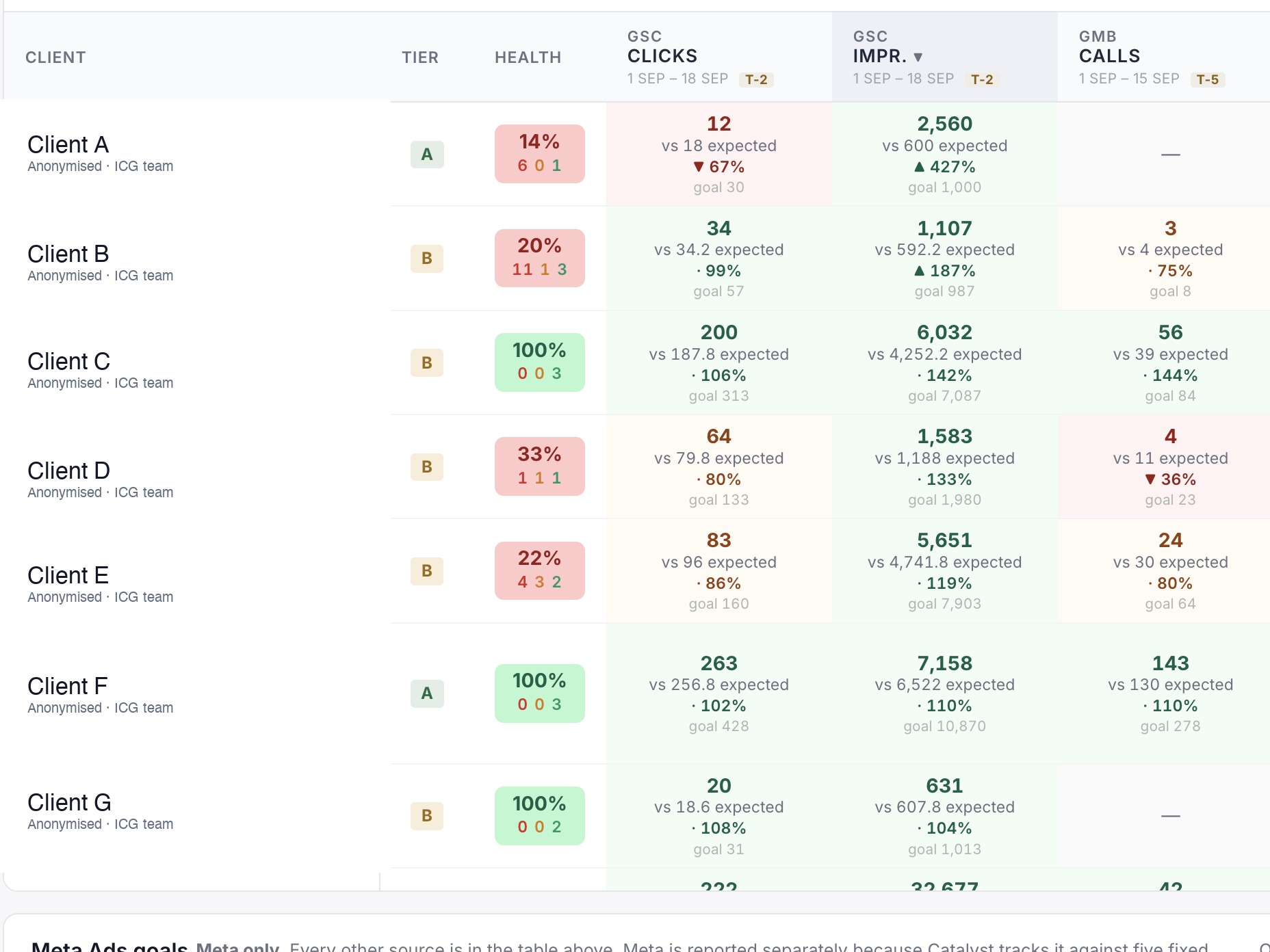
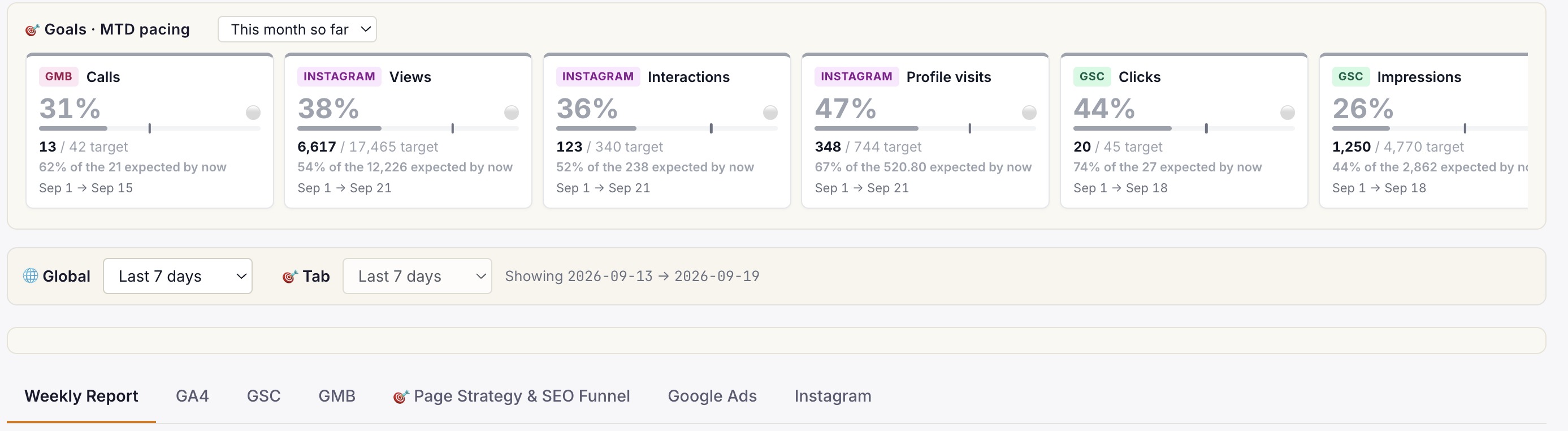
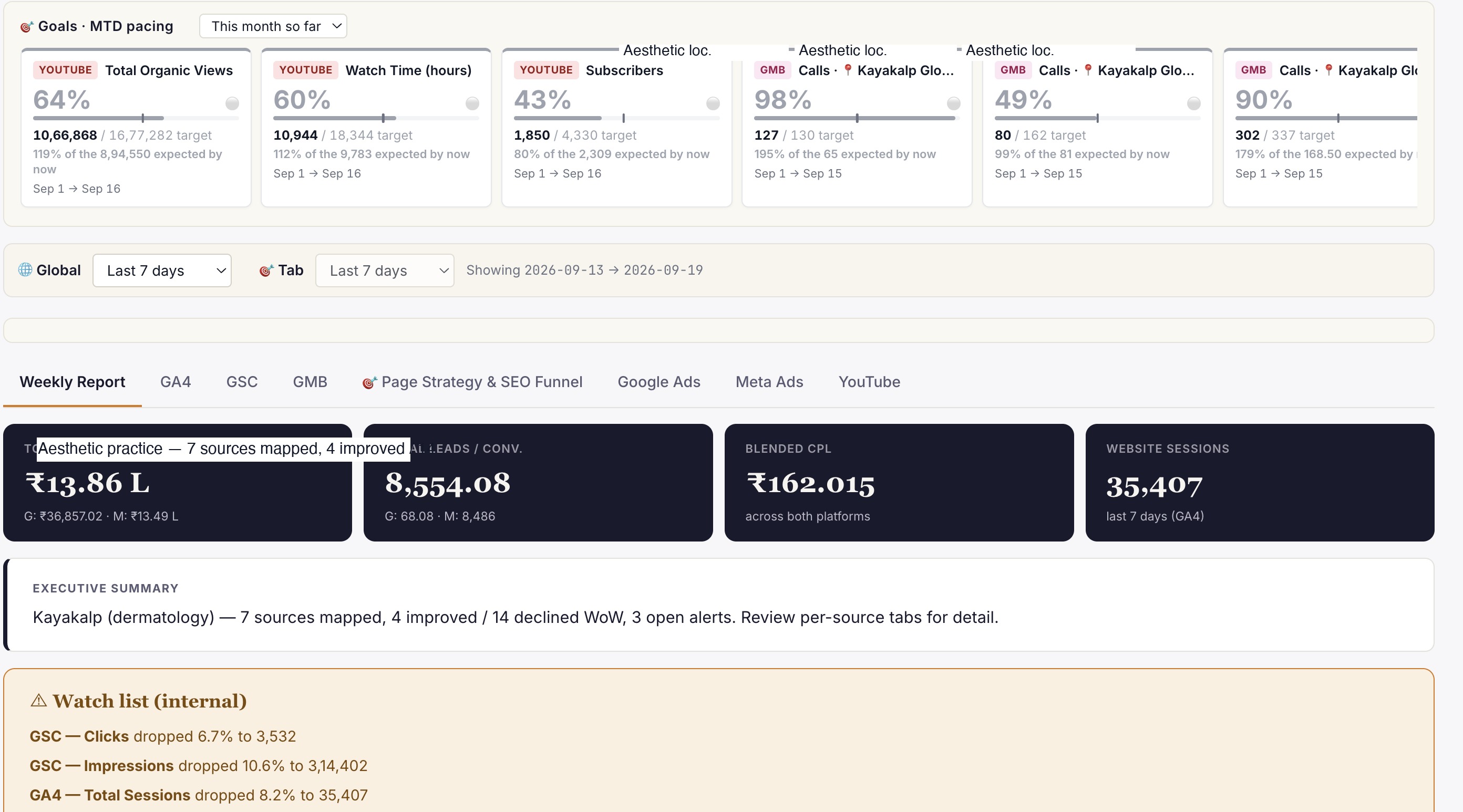
Live client dashboard. GSC, GA4, Google Ads, Meta Ads, IVR calls in one view. Login anytime, not monthly.
Phoenix
Clinic revenue intelligence over your PMS. Daily action queue: Prevent Loss, Maintain & Engage, Grow Revenue. Multi-centre rollout.
Or book a free 30-min audit to see all three in action on your account.
Healthcare brands
that already run on ICG.
A representative slice of the 150+ healthcare brands ICG has delivered for across India. Most engagements remain under NDA.


What ICG clients say · on video.
"Scale up of organic channels and business consulting. ICG has absolute domain authority in their field."
"Working with ICG transformed how we acquire IVF patients in Gurgaon. They understand the fertility journey from inquiry to consult..."
"What Ichelon accomplished — they got all my ideas and worked over 3-4 months to create an amazing, super-customised website."
Need help operationalising this?
Every ICG service is healthcare-only, NMC + DPDP-aware, and built around the patient-research patterns that drive Indian healthcare growth in 2026.
Every practice welcome — packages from ₹20,000/mo.
Goals-Driven engagements · Performance-Linked Payout Models available
More from
ICG.
Five trends shaping Indian healthcare marketing through 2027: AI-first patient research, Conversions API adoption, ABDM discovery, the AEO w...
Healthcare AIO is the discipline of getting your clinic or hospital cited inside Google AI Overviews, ChatGPT and Perplexity answers — not j...
Conversational-search advertising places brand messages inside AI chat answers — ChatGPT, Perplexity, Copilot — rather than beside a results...
Stop guessing.
Book a Diagnostic.
30 minutes. Free. With the AI-powered healthcare-only marketing agency 150+ brands already run on. No slides, no pitch, no hard close.


