


Enterprise Local SEO for Hospital Groups — Portfolio Management at 100+ Locations
When a hospital group operates 50 locations, the question is not whether any individual listing is optimised. The question is whether the *system* managing all 50 listings is working — whether it dete
No pitch. Written root-cause diagnosis. AI-powered, healthcare only.
Direct answer
When a hospital group operates 50 locations, the question is not whether any individual listing is optimised. The question is whether the *system* managing all 50 listings is working — whether it dete
TL;DR
TL;DR
- Enterprise local SEO for hospital groups is a portfolio discipline, not a listing-by-listing task — the competitive advantage comes from seeing and acting on the whole at once
- At 100+ GBP listings, the failure mode is silent degradation: NAP drift, review response gaps, per-location suspension risk, and naming inconsistency accumulate across the portfolio faster than any manual team can detect
- The three non-negotiable capabilities for enterprise hospital GBP management: portfolio health scoring (one number per listing, portfolio average, trend), automated suspension risk monitoring, and a prioritised action queue that tells the team what to fix first
- Healthcare compliance at enterprise scale requires systematic content governance — NMC Ethics Code compliance cannot be reviewed manually per post across 100 listings; it must be built into the content template and workflow
- ICG manages 143 GBPs for a single healthcare client with 0 suspensions, 76/100 average health score, and 4.76★ portfolio average — this is the operational benchmark for enterprise healthcare GBP management
When a hospital group operates 50 locations, the question is not whether any individual listing is optimised. The question is whether the system managing all 50 listings is working — whether it detects problems before they become revenue-affecting incidents, whether it ensures every location is consistently maintained, and whether it produces the portfolio-level intelligence that leadership needs to make resourcing and investment decisions.


This is enterprise local SEO. It is fundamentally different from single-location or small-portfolio GBP management — in the capabilities required, the technology infrastructure needed, and the governance model that determines whether 100 listings are 100 brand assets or 100 independent liabilities.
Section 1 — The enterprise local SEO challenge at 100+ listings
1.1 The mathematics of portfolio management
A hospital group with 100 GBP listings, each requiring weekly management:
| Task | Frequency | Time per listing | Total time per week |
|---|---|---|---|
| Health score review | Weekly | 5 minutes | 500 minutes (8.3 hours) |
| Review response | Daily (avg 3 reviews/listing/week) | 4 minutes each | 20 hours |
| Google Posts | Weekly | 20 minutes | 2,000 minutes (33 hours) |
| Citation monitoring | Monthly | 15 minutes | 1,500 minutes/month |
| Suspension risk check | Weekly | 10 minutes | 1,000 minutes (16.7 hours) |
| Total manual management time | ~80 hours/week |
80 hours per week of competent local SEO management time for 100 listings. At a senior marketing coordinator's cost (₹60,000/month), that is ₹4.8L/month in staff time alone — before tools, management overhead, and the compounding opportunity cost of the errors that manual management at this scale inevitably produces.
This is why enterprise local SEO requires automated intelligence infrastructure, not more headcount. Turtle by ICG processes the health scoring, citation monitoring, and suspension risk assessment for 143 listings continuously, at a fraction of the manual time equivalent, and surfaces only the items that need human action.
1.2 The silent degradation problem
At 100+ listings, the most dangerous outcome is not a single dramatic failure — it is the slow, invisible accumulation of small problems across many listings that collectively erode portfolio-level visibility over months.
The four degradation patterns ICG consistently finds in enterprise healthcare portfolios at onboarding:
Pattern 1 — Naming drift: Over 18–24 months, individual hospital administrators have made name field edits — adding a department descriptor here, correcting a perceived spelling here, updating after a rebranding that the GBP team was not informed of. At intake, a 50-location chain typically has 6–9 distinct naming variants active across its portfolio.
Pattern 2 — Review response gap: The central team manages responses for 20 flagship locations. The remaining 30 have not had a review responded to in 4+ months. 68% of those locations have unanswered negative reviews visible to prospective patients.
Pattern 3 — Citation drift: 3–4 hospital relocations over 5 years have been updated on Google but not on 12+ secondary citation sources. Old addresses are still live on national local-business directories and 3 healthcare directories. These conflicts have been silently suppressing local pack rankings for the affected locations.
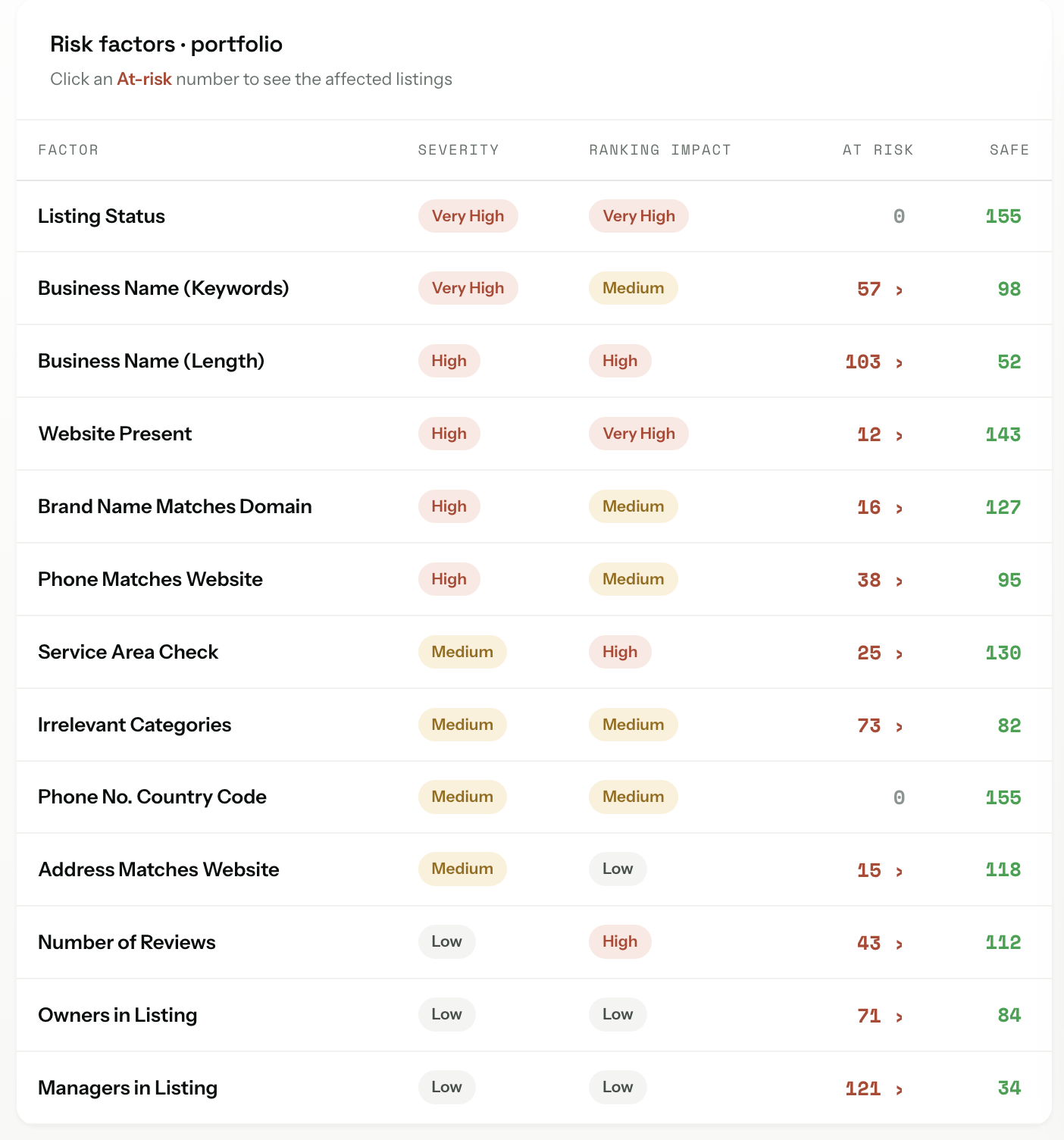
Pattern 4 — Suspension risk accumulation: 8 listings have P0 suspension risk factors (keyword-stuffed names, address anomalies, unusual edit history) that have been accumulating for months. None have caused a suspension yet. All will, without intervention.
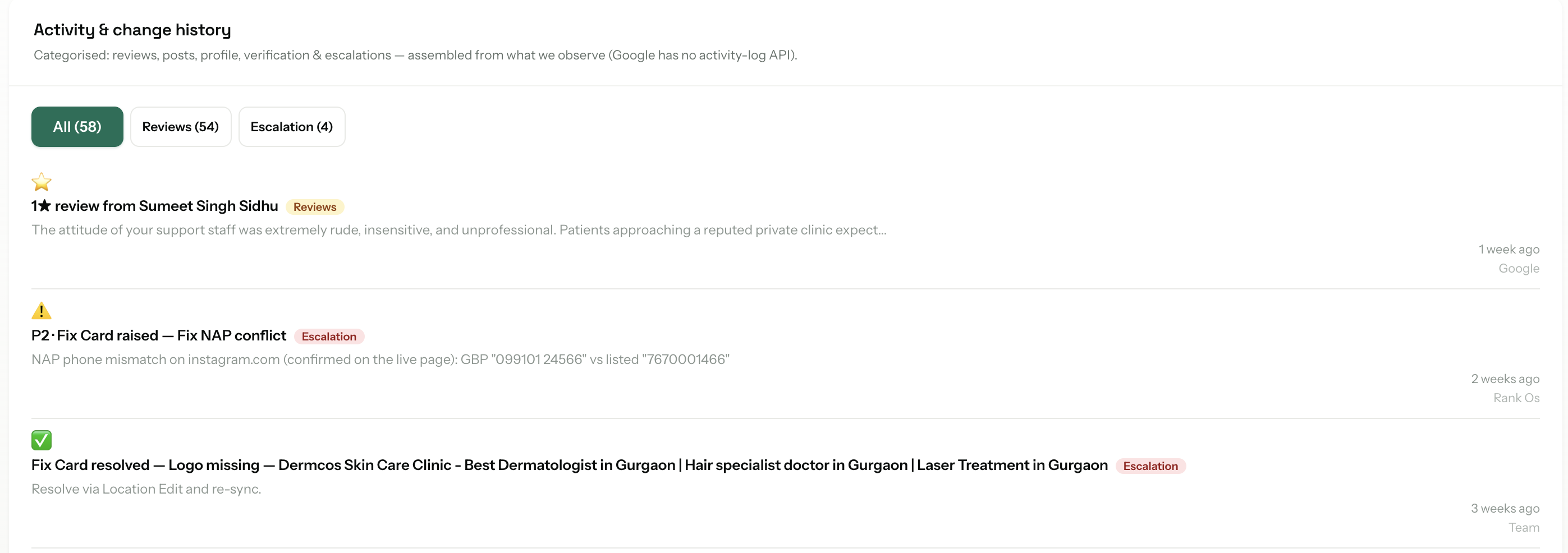
ICG's Turtle platform identifies all four patterns in the baseline audit conducted within 48 hours of portfolio onboarding.
Section 2 — The enterprise GBP governance model
Enterprise healthcare GBP governance answers a structural question that smaller portfolios can avoid: who is authorised to change what, and how is that enforced at scale?
2.1 The governance matrix
| GBP element | Central control | Location level | ICG managed |
|---|---|---|---|
| Business name | ✓ Strict — no location edits | ✗ | Reviews naming audit |
| Primary category | ✓ Set centrally | ✗ | Monitors drift |
| Secondary categories | ✓ Approved list | ✗ | Monitors drift |
| Brand description (first paragraph) | ✓ Template | ✗ | Writes + reviews |
| Location-specific description (second paragraph) | ✗ | ✓ Within template | Reviews before publish |
| Hours (regular) | ✗ | ✓ | Monitors accuracy |
| Hours (special/holiday) | ✗ | ✓ | Prompts updates at festivals |
| Photos (brand standards) | ✓ Provided centrally | Add location-specific | Reviews for compliance |
| Google Posts (brand content) | ✓ Centrally produced | ✗ | Publishes + schedules |
| Google Posts (local content) | ✗ | ✓ Within guidelines | Reviews before publish |
| Review responses | ✗ | ✓ Within templates | Escalates violations |
| Q&A seeding | ✓ Standard questions | Add location-specific | Reviews |
2.2 The content governance workflow for NMC compliance at scale
NMC Ethics Code compliance cannot be reviewed manually for every Google Post across 100 locations on a weekly basis — the throughput requirement is too high for manual review to be sustainable.
ICG's enterprise content governance model for NMC compliance:
Pre-approved content library: Central content team produces 8–12 Google Post templates per month — health awareness, service announcements, educational content — all NMC-reviewed before distribution. Each location selects from the pre-approved library for their weekly posts. No original content is published without going through the library or a compliance review step.
Location-specific content gateway: For content that is genuinely location-specific (a new surgeon joining, a local health camp), a review workflow is required: location staff submit draft → central compliance review → approve/modify → publish. ICG manages this workflow for hospital chain clients via a shared content management process.
Automated compliance screening: ICG's content team screens all drafted content against an NMC compliance checklist (outcome promise language, superiority claims, comparative language, before/after imagery context) before any post is published across the portfolio.
2.3 The access control model
For a 100-location hospital group, GBP access control is a security as much as a governance matter:
Owner access (2–3 people maximum): The central GBP administrator (usually ICG + one internal senior manager). Owner access can change every GBP element, including transferring ownership.
Manager access (location administrators): Can update hours, photos, posts, and review responses. Cannot change business name, primary category, or GBP ownership.
No access (all other hospital staff): All GBP changes by unauthorised staff members are a suspension risk and a brand consistency risk. Policy enforcement is required.
The manager count problem: Turtle's suspension risk monitoring flags "Managers in Listing" as a risk factor when a GBP has 5+ manager accounts. For enterprise hospitals where GBP management has evolved organically, accumulated manager accounts from past agencies, past staff, and past marketing contractors are a common finding. ICG's onboarding process audits and rationalises manager access as a P1 action.
Section 3 — Portfolio health scoring and reporting
3.1 What portfolio health scoring enables
Without portfolio health scoring, enterprise local SEO management answers only one question: "Did we do the tasks this week?" With health scoring, it answers: "Is our portfolio actually getting better, and by how much?"
Turtle's 7-dimension health score — applied identically across all 143 managed listings — enables:
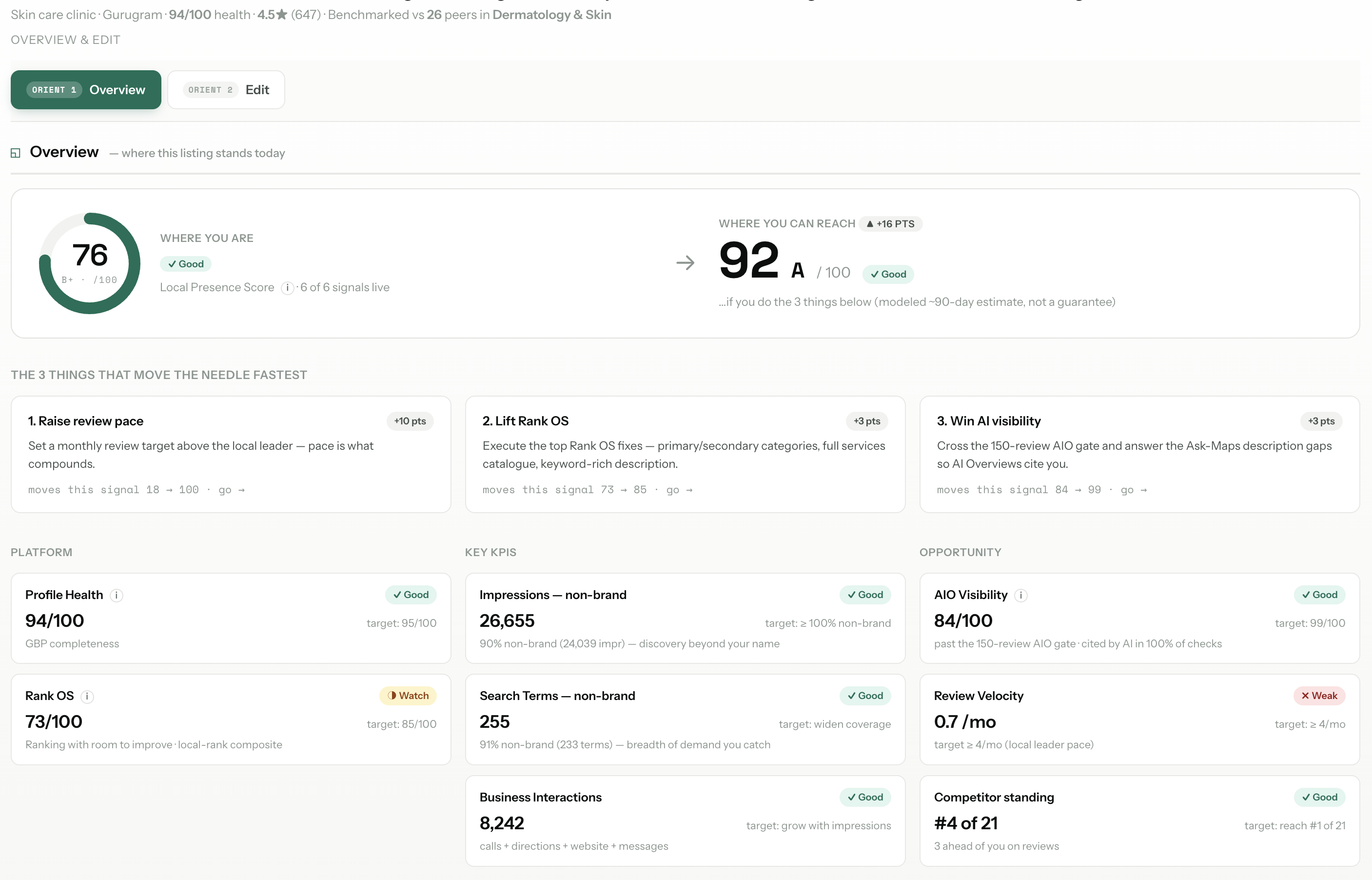
Benchmarking within the portfolio: Which 20% of locations are consistently performing above 80/100? Which 20% are consistently below 65/100 and need intensive attention? Where is the distribution of the middle 60%?
Trend tracking: Is the portfolio health score improving quarter over quarter? When a month's score dips, which dimension drove the change (review velocity slowdown? NAP drift? Suspension risk increase?) so the cause can be addressed rather than the symptom.

Resourcing decisions: A hospital group COO who can see that 12 locations are below 65/100 health while 60 are above 75/100 can make an evidence-based decision about where to concentrate clinical staff engagement in review generation, where to prioritise citation cleanup, and which locations need urgent suspension risk intervention.
Leadership reporting: Monthly portfolio health score report gives the CMO/COO a single dashboard view of the entire local digital presence — not a wall of individual listing data.
3.2 The monthly enterprise GBP report structure
ICG produces a monthly portfolio report for enterprise hospital chain clients covering:
Executive summary (1 page):
- Portfolio health score this month vs last month vs 3 months ago
- Total reviews in portfolio, portfolio average rating, review velocity trend
- Suspension risk factor count, suspensions YTD (target: 0)
- Map Pack impressions trend (aggregate across all locations)
- Top 3 actions completed this month, top 3 actions planned next month
Location performance table (1 page):
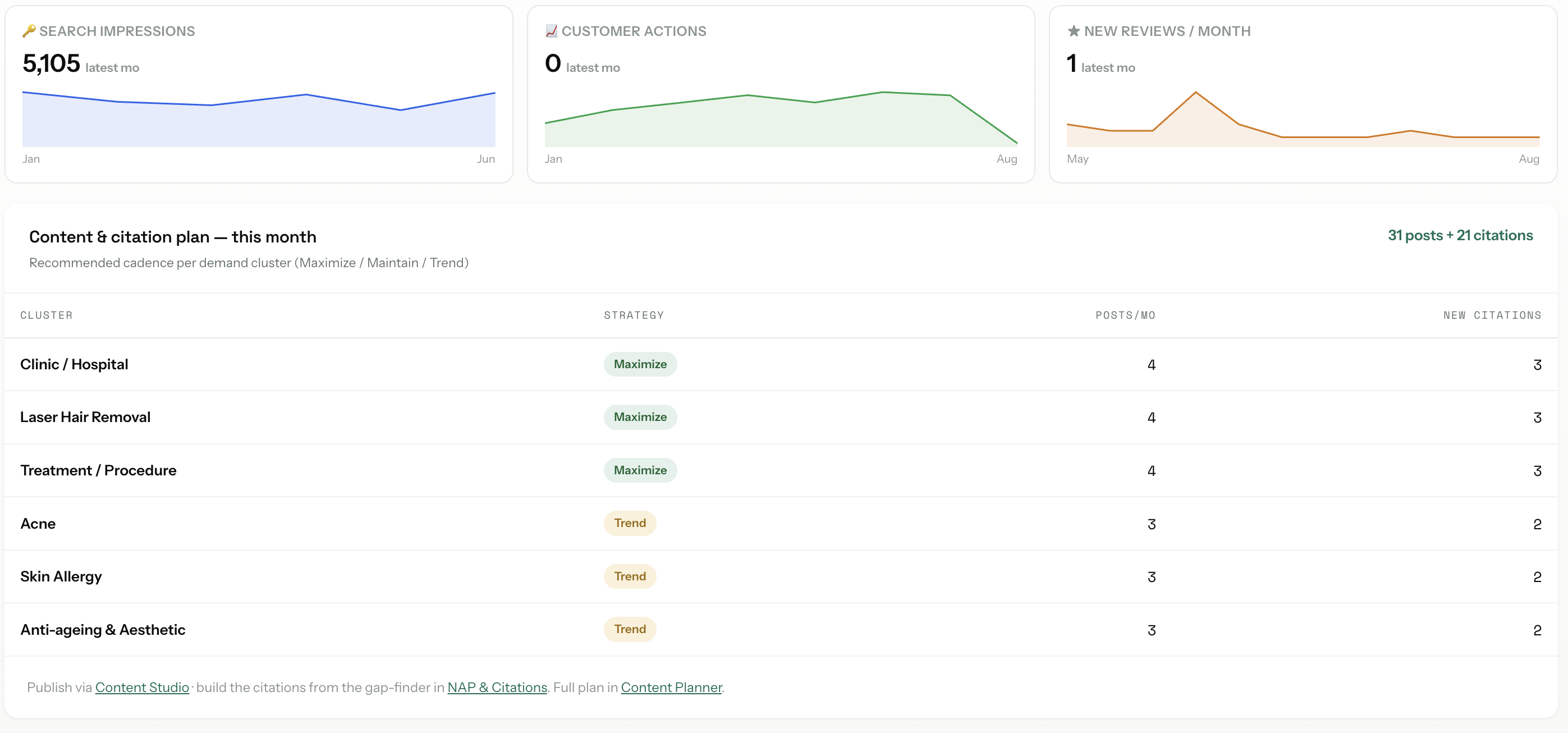
- All locations sorted by health score
- Red/amber/green health score colour coding
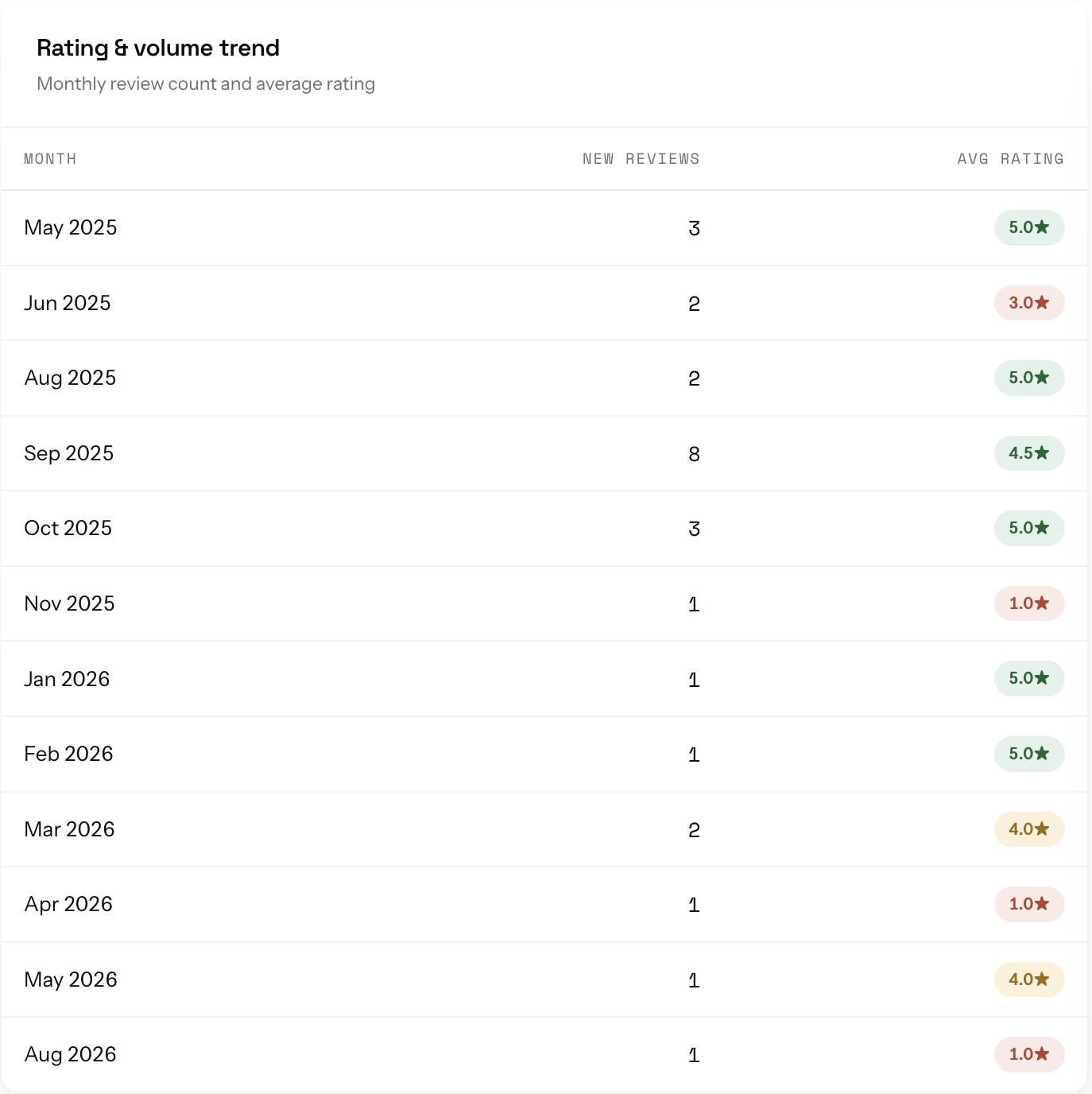
- Review count and rating per location
- Month-on-month change in key metrics
- Locations flagged for attention (below 65/100 health, 0 reviews in 30 days, active suspension risk)
Deep-dive spotlight (2–3 pages):
- 2–3 locations selected for geo-grid analysis and detailed performance review
- Rank movement for primary keywords, geo-grid heat map, action plan
Citation and NAP status (1 page):
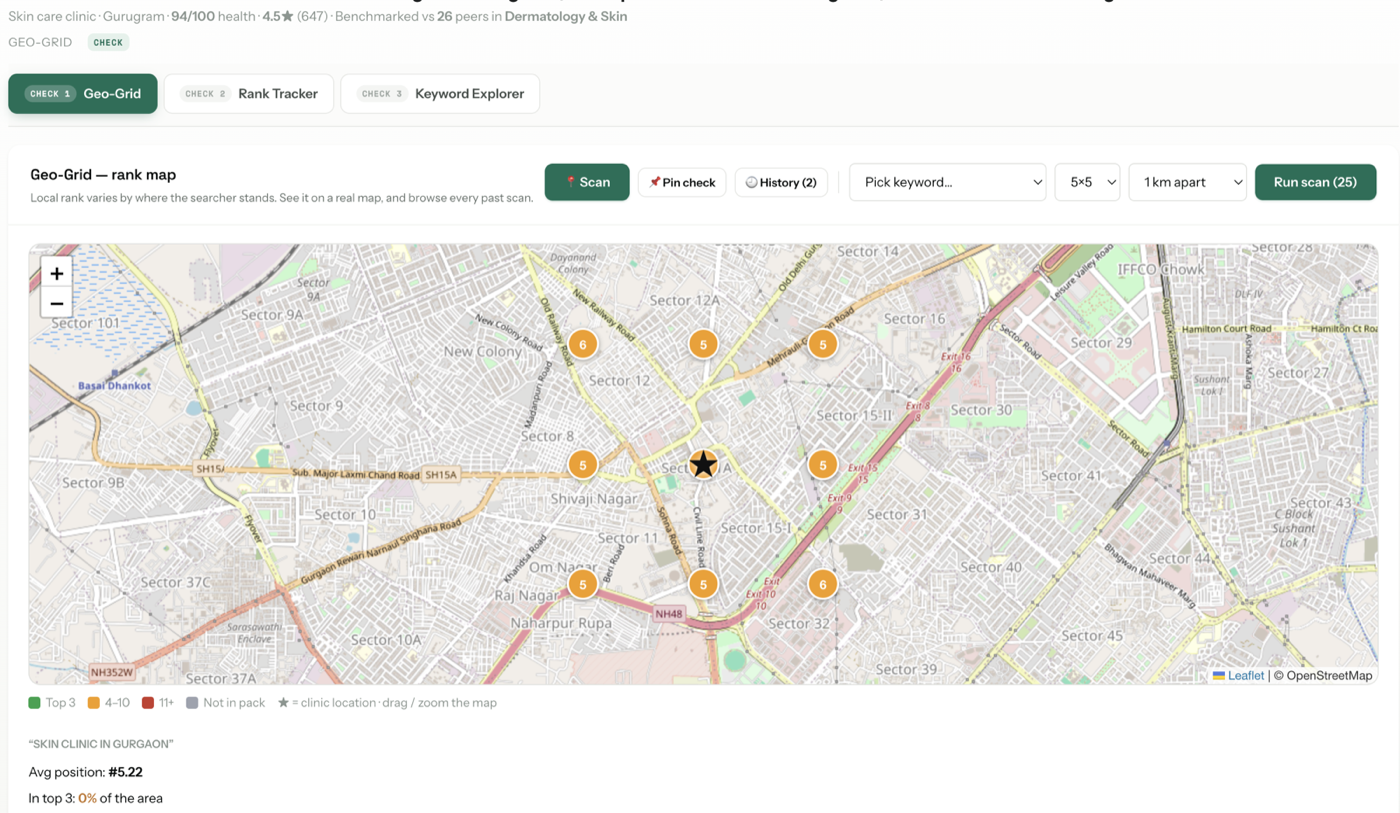
- Conflicts resolved this month
- New conflicts detected
- Citation gap closure progress vs competitors
Section 4 — Technology stack for enterprise healthcare GBP management
4.1 What enterprise local SEO technology must do
Minimum viable technology stack for managing 100+ healthcare GBPs:
| Capability | Why it's non-negotiable at scale |
|---|---|
| API-connected data ingestion | Manual data entry across 100 listings is not sustainable; live GBP data must be pulled automatically |
| Automated health scoring | Scoring 100 listings manually weekly is 100+ hours; automation is the only viable model |
| Portfolio-level dashboard | Individual listing views provide no portfolio intelligence; aggregate view is essential for management |
| Suspension risk monitoring | At 100 listings, even a 2% annual suspension rate means 2 suspensions/year; continuous monitoring prevents this |
| Citation monitoring | NAP drift across 100 listings with no automated detection is invisible until a ranking drops |
| Action queue prioritisation | Without priority ranking, 100 listings × multiple issues = paralysis; the queue must tell the team what to do first |
| NMC compliance workflow | Manual compliance review per post at scale is not feasible; template + gateway model is required |
| Multi-user access control | Central + location-level access with appropriate permissions; not a single shared login |
Turtle by ICG covers all eight. No off-the-shelf general-market tool covers all eight for Indian healthcare.
4.2 HIS integration as the enterprise differentiator
At enterprise hospital group scale, the highest-value GBP management capability is integration with the hospital's HIS (Hospital Information System) for:
Appointment data → review generation trigger: When a patient's appointment is marked as completed in the HIS, Turtle can trigger the post-visit satisfaction check (via CRM integration) without manual intervention. At 100 locations processing thousands of appointments weekly, this automation is what makes 10–20 new reviews per location per month achievable.
Department hours automation: Hospital departments with separate operating hours (OPD hours vs emergency hours vs OT hours) can be updated automatically from HIS operational data rather than requiring manual GBP updates for each schedule change.
New doctor joining → GBP profile update: When a new consultant is added to the HIS staff database, an automated workflow can trigger a GBP Q&A update and (for locations with independent GBP listings) a profile update prompt.
This level of HIS-GBP integration is where enterprise local SEO moves from management to automation — and where the ROI per location managed increases significantly with portfolio scale.
Section 5 — Case study: 143-listing healthcare portfolio
ICG's largest enterprise healthcare GBP management engagement is a 143-listing healthcare chain spanning multiple specialties and cities across India. The engagement represents the operational benchmark for enterprise healthcare local SEO.
Baseline at onboarding:
- Portfolio health score: 58/100 average across 143 listings
- Active suspension risk factors: 187 (across all listings)
- NAP conflicts: 312 (across major citation sources)
- Review response rate: 29% portfolio average
- Review rating: 4.31★ portfolio average
- Suspensions: 0 (fortunately — the risk was high but had not materialised)
ICG's 90-day programme:
- Week 1–2: Suspension risk triage — all P0 factors addressed first (67 factors cleared in 14 days)
- Week 2–6: NAP conflict resolution — 312 conflicts prioritised by impact, 280 resolved in first 6 weeks
- Week 1 onwards: Review generation SOP live across all 143 locations (WhatsApp satisfaction check post-appointment, direct review link to 4–5/5 scorers)
- Week 3 onwards: Weekly Google Posts published across all 143 locations from pre-approved content library
- Week 4 onwards: Review responses running at 100% within 24 hours across all locations
At 6 months:

- Portfolio health score: 76/100 (up from 58)
- Active suspension risk factors: 531 monitored (the count increased as Turtle's monitoring became more granular), but all high-severity factors cleared
- NAP conflicts: reduced to 18 (ongoing maintenance)
- Review response rate: 94% portfolio average
- Review rating: 4.76★ portfolio average (up from 4.31★)
- Suspensions: 0 (maintained)
- Map Pack impressions: +164% aggregate across all 143 locations
Frequently asked questions
Q1: How many people does ICG have managing 143 GBP listings? ICG's managed service uses Turtle's automated intelligence to eliminate the 80-hours-per-week manual task equivalent. The human team handles: action queue execution (fixing flagged issues), content creation and NMC compliance review, review response for escalated cases, and monthly reporting. Turtle handles: health scoring, citation monitoring, suspension risk detection, and action queue prioritisation. The combination allows a specialist team to manage 143 listings at a quality level that a purely manual team of 5–6 would struggle to match.
Q2: What is the minimum technology investment for enterprise healthcare GBP management? At a minimum: an API-connected GBP management tool with portfolio health scoring, suspension monitoring, and citation tracking. General local SEO tools cover some of these for general businesses; none of the general-market tools have NMC compliance workflow built in. ICG's Turtle platform was built specifically for this enterprise healthcare use case and is available as part of ICG's managed service.
Q3: How does enterprise GBP management differ from basic GBP management? Scale, automation, and governance. Basic GBP management is weekly tasks for 1–5 listings. Enterprise GBP management is systematic portfolio intelligence across 50–500 listings — requiring automated health scoring, portfolio-level dashboard, compliance workflow, access control governance, and HIS integration for appointment-driven review generation. The tasks are similar; the infrastructure required to execute them consistently across 100+ locations is fundamentally different.
Q4: Can a hospital group manage its own GBPs at enterprise scale without an agency? Yes, with the right technology infrastructure and dedicated internal resource. The requirements: a full-time GBP manager (not a generalist doing GMB as part of a broader role), access to a portfolio-scale GBP tool with all the capabilities listed in Section 4, a documented governance framework, and NMC compliance workflow built into the content process. Most hospital groups at 50+ locations lack one or more of these — which is why third-party managed service typically delivers better outcomes at lower total cost.
Q5: How does ICG handle NABH compliance across an enterprise portfolio? Adrito Basu (ICG's NABH Consulting Lead) participates in enterprise hospital portfolio engagements where NABH accreditation is active across multiple chain locations. Content mapping to NABH PRE chapter evidence is done at the template level — patient education content published across all locations is simultaneously optimised for GBP relevance and structured for NABH PRE chapter documentation. Individual location accreditation status is tracked and GBP descriptions updated to reflect current accreditation status accurately.
Q6: What is the ROI of enterprise GBP management for a 100-location hospital group? ICG's enterprise managed portfolio showed Map Pack impressions +164% in 6 months across 143 locations. At an average clinic generating 50 new patient enquiries per month from GBP before ICG, a 164% increase in impressions translates to approximately 50–80 additional enquiries per location per month. Across 100 locations at ₹1,500 average consultation value and 60% show-up rate: (65 additional enquiries × 60% × ₹1,500) × 100 locations = ₹5.85 crore per month in additional revenue potential from improved GBP visibility. Against an enterprise managed service investment of ₹2.5L–₹6L/month, the ROI is compelling.
Sources:
- Google Business Profile API documentation — developers.google.com
- NABH 6th edition standards — nabh.co
- NMC Guidelines on Ethical Advertising (6 Oct 2026) — nmc.org.in
- ICG enterprise portfolio data, 143-listing healthcare chain, 2025–2026
Internal links:
- Multi-Location GMB Management — How Brands Keep 50+ Listings Healthy
- GMB Management Software India 2026
- NABH Digital Standards for Hospital GBPs
- NMC-Safe GBP Content for Doctors
- Google Business Profile Management Services
- Hospital Marketing Agency India
BLOG 2 of 2
Book a free SEO diagnostic.
Hanuman Sihag's team runs a live crawl, checks technical health, cannibalisation, schema coverage and content gaps. 60 minutes, prioritised fix list.
Questions readers ask
about this topic.
The three platforms
behind every ICG engagement.
Beacon
CAPI middleware that fixes Event Match Quality, translates CRM statuses to Meta-standard events, dedups across channels.
Agency OS
Live client dashboard. GSC, GA4, Google Ads, Meta Ads, IVR calls in one view. Login anytime, not monthly.
Phoenix
Clinic revenue intelligence over your PMS. Daily action queue: Prevent Loss, Maintain & Engage, Grow Revenue. Multi-centre rollout.
Or book a free 30-min audit to see all three in action on your account.
Healthcare brands
that already run on ICG.
A representative slice of the 150+ healthcare brands ICG has delivered for across India. Most engagements remain under NDA.


What ICG clients say · on video.
"Mental health marketing requires a different sensitivity. ICG built compliance-aware campaigns that respect both patients and our..."
"Bariatric surgery patients need a long consideration cycle. ICG built a content + paid system that respects that timeline."
"Working with ICG felt like working with an in-house growth team that happens to specialise in healthcare."
The intelligence stack behind this playbook.
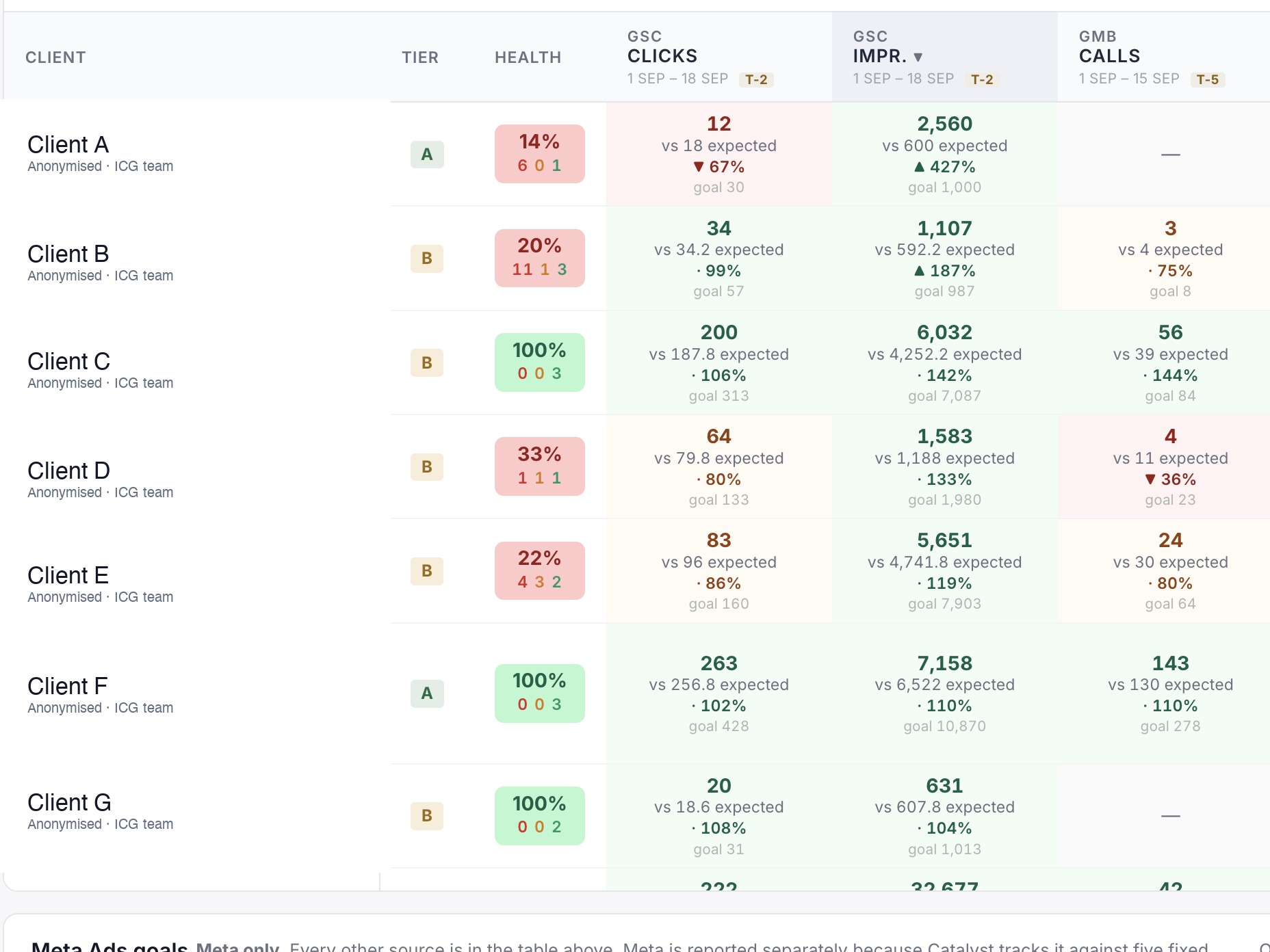
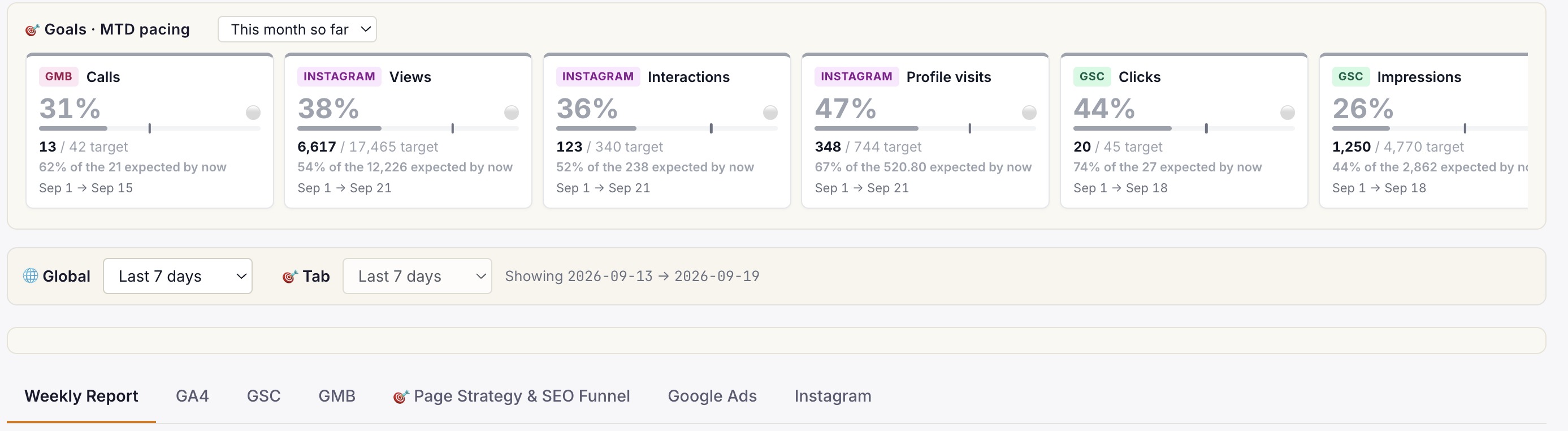
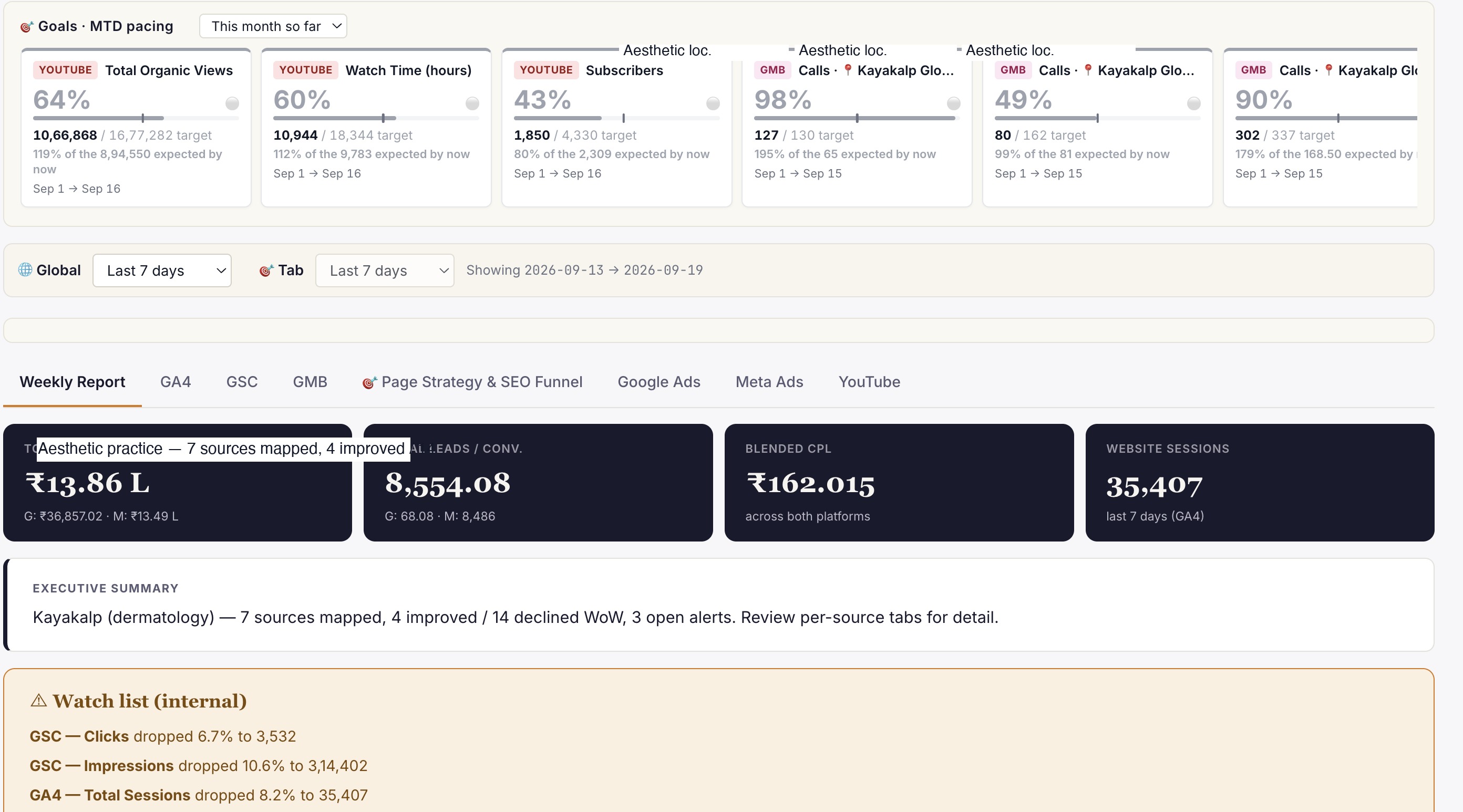
Every ICG engagement runs on the Search Intelligence Trifecta — Angryturtle for GMB, SIE for search and AI Overview, YODA for YouTube. Live product screens below.
Need help operationalising this?
Every ICG service is healthcare-only, NMC + DPDP-aware, and built around the patient-research patterns that drive Indian healthcare growth in 2026.
Every practice welcome — packages from ₹20,000/mo.
Goals-Driven engagements · Performance-Linked Payout Models available
More from
ICG.
Five trends shaping Indian healthcare marketing through 2027: AI-first patient research, Conversions API adoption, ABDM discovery, the AEO w...
Healthcare AIO is the discipline of getting your clinic or hospital cited inside Google AI Overviews, ChatGPT and Perplexity answers — not j...
Conversational-search advertising places brand messages inside AI chat answers — ChatGPT, Perplexity, Copilot — rather than beside a results...
Stop guessing.
Book a Diagnostic.
30 minutes. Free. With the AI-powered healthcare-only marketing agency 150+ brands already run on. No slides, no pitch, no hard close.


