


NMC Ethics Code 2026 — Complete Marketing Rules for Doctors and Hospitals
Marketing a medical practice in India operates under constraints that most digital marketing professionals — and many doctors — don't fully understand. The NMC Ethics Code defines what a registered me
No pitch. Written root-cause diagnosis. AI-powered, healthcare only.
Direct answer
Marketing a medical practice in India operates under constraints that most digital marketing professionals — and many doctors — don't fully understand. The NMC Ethics Code defines what a registered me
TL;DR
TL;DR
- NMC (National Medical Commission) Ethics Code 2026 replaces the MCI Code — marketing restrictions apply to all registered medical practitioners in India
- Allowed: educational content, appointment availability, qualifications, service information, general health awareness
- Not allowed: self-promotional superiority claims, patient testimonials about specific treatment outcomes, comparative claims against other doctors, before/after imagery without strict consent protocols
- Social media: educational posts are safe; promotional posts require careful compliance; Instagram/YouTube are viable with the right content framework
- Key insight: NMC-safe marketing — when done correctly — actually converts better than non-compliant marketing because it builds trust rather than triggering patient scepticism
Marketing a medical practice in India operates under constraints that most digital marketing professionals — and many doctors — don't fully understand. The NMC Ethics Code defines what a registered medical practitioner can and cannot do in public communications. Understanding these boundaries isn't just about avoiding complaints and NMC action. Done correctly, compliance-aware marketing is better marketing.
This guide covers the complete NMC marketing rules for doctors and hospitals, with practical guidance on what content is allowed across every channel.
What the NMC Ethics Code 2026 changed
The National Medical Commission Act 2019 replaced the Medical Council of India (MCI) with the NMC, and the NMC Ethics Code (currently in its 2026 revision, operational under the NMC Registered Medical Practitioners (Professional Conduct) Regulations) updated the ethics and advertising framework that governs all registered doctors.
Key changes from MCI code to NMC 2026:
- Advertising restrictions maintained but with clearer guidance on digital/social media context
- Telemedicine advertising given specific framework (doctors can advertise telemedicine availability, not outcomes)
- Social media posts by doctors clarified — educational content explicitly cited as permissible
- Before/after imagery: consent and disclosure requirements tightened
- Penalties: escalated — misconduct under the NMC Code can lead to registration suspension
The core principle remains unchanged: a registered medical practitioner shall not use the press or other media to publicise themselves or their services in a manner that tends to deceive or mislead the public, bring the profession into disrepute, or create unrealistic patient expectations.
The NMC allowed/not-allowed matrix for marketing
What is explicitly allowed
1. Factual information about qualifications and credentials Stating your degrees (MBBS, MD, MCh, DM, FRCS, etc.), your registration number, your institutional affiliations, and your area of specialisation is permitted. This is considered factual public information.
2. Appointment and access information Clinic address, contact numbers, website URL, OPD hours, telemedicine availability, appointment booking links — all permitted. You can advertise that you are available for consultations.
3. Service information (factual, non-comparative) "Our department offers FESS, septoplasty, and cochlear implant surgery" is factual service listing — permitted. "We are the best ENT department in Delhi" is a comparative superiority claim — not permitted.
4. General health awareness content Educational posts about disease prevention, health tips, symptom awareness, and treatment options (in general terms, not personalised advice to specific patients) are the backbone of compliant doctor social media. Most of what a doctor posts on Instagram, YouTube, or LinkedIn falls into this category.
5. Research and publication references Citing your published research, presenting at conferences, noting academic positions — permitted and encouraged as E-E-A-T (expertise, experience, authority, trustworthiness) signals.
6. NMC registration number display Displaying your NMC registration number (now mandatory on prescription pads and clinical communications) is required, not merely permitted.
What is not allowed
1. Self-promotional superiority claims "Best cardiologist in Mumbai," "Top-rated knee replacement surgeon in India," "Most experienced IVF specialist" — these are comparative superiority claims that the NMC Code prohibits. Even Google Ads headlines that claim "best" or "top" in the ad copy are at risk.
2. Patient testimonials about specific treatment outcomes A patient saying "Dr X cured my cancer" or "Dr Y's surgery fixed my back in one month" is a patient testimonial about a specific treatment outcome. These are prohibited. They create unrealistic patient expectations and are misleading (the same outcome cannot be guaranteed for all patients).
Note: General practice reviews on Google ("The doctor was patient and explained everything clearly") are different from testimonials about outcomes ("The treatment completely resolved my knee pain") — the latter is the prohibited category.
3. Comparative claims against other doctors or hospitals "Unlike other hospitals, we have zero post-surgical infection rates" — comparative and unverifiable. Not permitted.
4. Promise of specific clinical results "Guaranteed pain relief," "100% success rate in knee replacement," "Complete recovery in 6 weeks" — these are result promises that no ethical medical claim can make. They also attract ASCI scrutiny beyond NMC.
5. Before/after imagery of surgical outcomes without proper disclosure Showing pre and post-surgical photographs requires: written patient consent specifically for the images, disclosure that results vary, and the images must not be misleadingly selected. In practice, before/after imagery for cosmetic and surgical procedures is a high-risk content category. ICG's recommendation: use only with explicit legal consent documentation and always with "individual results may vary" disclosure.
Doctor social media — the 12 rules
Social media is where most NMC compliance failures happen — because the informal, real-time nature of Instagram and Twitter/X creates situations where doctors post without thinking through compliance implications.
The 12 rules for NMC-compliant doctor social media:
- Educational content first: Explain conditions, symptoms, treatment options, prevention — this is what builds your authority audience
- No specific patient outcomes in video testimonials: Patient testimonials about "how Dr X cured me" are prohibited; patient testimonials about the consultation experience are permissible
- No miracle cure framing: "This surgery changed my life" as a doctor's own claim is prohibited; patient saying it (in non-testimonial format) still creates implied outcome promise
- Before/after only with full consent documentation and "results vary" disclosure
- No comparative superiority: "Best in India" type claims in bios or posts
- No specific number claims without sources: "95% success rate" requires a verifiable, published source — not an internal claim
- Telemedicine consultation ads are fine: "Available for online consultations — book at [link]" is permitted
- Health awareness campaigns are ideal content: World Heart Day, Diabetes Awareness Month, etc. — compliant and shareable
- Educational videos about procedures: Explaining how a procedure works (not your specific outcomes) is permitted
- Credentials and experience in bio: Factual bio with qualifications, specialisation, years of experience is allowed
- Press coverage and awards: Sharing that you've been featured in media or received an award is allowed — it's factual
- AI-generated content must be reviewed: AI tools may generate non-compliant claims — review all AI-generated medical content before posting
Google Ads for doctors — NMC-safe ad copy
Google restricts healthcare advertising in its policies (particularly around claims that may be misleading), and the NMC Code adds an additional Indian regulatory layer.
NMC-compliant Google Ads framework:
| Ad element | Compliant example | Non-compliant example |
|---|---|---|
| Headline 1 | Knee Replacement Surgery — Dr [Name] | Best Knee Surgeon in Delhi |
| Headline 2 | MBBS MS Orthopaedics — 15 Years Experience | Guaranteed Pain Relief |
| Headline 3 | Book Appointment — [Clinic Name] | 95% Success Rate Knee Surgery |
| Description | "Dr [Name] performs total and partial knee replacements at [Clinic]. Book an OPD consultation." | "India's top orthopaedic surgeon. Cures knee pain permanently." |
| Call extension | "Call to book appointment" | "Get free second opinion — better than hospital" |
NMC-safe ad copy formula: Specialty + qualification/experience + action (book/consult/call). No superlatives. No outcomes. No comparisons.
Meta Ads for doctors — creative framework
Meta (Instagram/Facebook) healthcare advertising restrictions overlap with NMC constraints:
Allowed on Meta (and NMC-compliant):
- Service awareness ads: "Dr X's ENT clinic now offering telemedicine consultations in Pune"
- Health awareness video: "Signs of sinusitis — when to see an ENT specialist" (educational)
- Location-specific availability ads: "New ophthalmology clinic open in Andheri West"
- Appointment booking ads: "Book your diabetes consultation with Dr X"
Not allowed on Meta (and NMC non-compliant):
- Before/after cosmetic surgery ads (Meta restricts these; NMC prohibits without disclosure)
- "Guaranteed" outcome claims (Meta's healthcare ad policy + NMC overlap)
- Patient video testimonials about treatment outcomes
Format recommendations for NMC-safe Meta ads:
- Carousel: Service awareness (procedure types + "book a consultation")
- Video: Doctor explaining a condition (educational, builds authority)
- Lead generation form: "Book a consultation with [Doctor Name]" — captures intent without outcome promise
YouTube content strategy — NMC compliant
YouTube is the most underutilised channel for doctor marketing — and one of the most compliant-friendly if used correctly.
High-performing NMC-compliant YouTube formats:
- "What is [condition]?" explainer videos (5–12 min): explains symptoms, causes, when to see a doctor. No specific outcome claims.
- "What happens during [procedure]?" (3–8 min): walkthrough of a procedure. Factual, educational, builds trust.
- FAQ format: "Top 10 questions about knee replacement — answered by Dr X"
- Case discussion (anonymised, without patient identity): "How we approach complex spinal disc cases — educational discussion"
- Live Q&A sessions: Answering general patient questions (not diagnosing specific callers)
YouTube SEO + NMC compliance note: Video titles and descriptions follow the same rules as other content — no "best doctor" claims, no outcome promises.
Before/after imagery — the compliance minefield
Before/after photographs (and videos) are the highest-risk content category for doctors and especially for aesthetic/cosmetic surgeons and dermatologists. Multiple regulatory frameworks intersect:
- NMC Ethics Code: Requires consent; prohibits misleading presentation of outcomes
- ASCI (Advertising Standards Council of India): Requires "results may vary" or similar disclosure
- Meta advertising policy: Prohibits before/after ads in the standard healthcare advertising restrictions
- Consumer Protection Act: Misleading before/after imagery can constitute deceptive trade practice
ICG's framework for compliant before/after content:
- Written patient consent specifically authorising clinical photography for marketing use (separate from treatment consent)
- Disclosure in every publication: "Individual results may vary. These images are from a specific patient with their written consent."
- Do not selectively use only best outcomes — if you publish, ensure the selection is representative
- Never use stock photographs or AI-generated images as "real patient" before/after
- For aesthetic procedures: consult with a DPDP-qualified legal professional before publishing
- On Meta: before/after ads are typically rejected; use in organic content only (with disclosures)
Hospital marketing vs doctor marketing — different rules

An important distinction: NMC ethics rules apply to registered medical practitioners — individual doctors. Hospital marketing by the hospital entity (not by or on behalf of specific doctors) faces a different regulatory landscape:
- Hospitals (as corporate entities) are not registered medical practitioners and are not directly subject to the NMC Code
- However: hospital marketing that involves specific doctors' claims (featuring a doctor saying "I am the best in Delhi") involves the doctor in prohibited conduct
- Hospital advertising is governed by ASCI guidelines, Consumer Protection Act, and Clinical Establishments Act
- The delegation trap: A hospital running an ad that says "India's top cardiac surgeon — Dr X" puts Dr X in potential NMC violation, even if the hospital's marketing team wrote it
ICG's recommendation: All hospital marketing involving named doctors must be reviewed against NMC compliance before publication. The doctor — not the hospital's CMO — bears the regulatory consequence.
NMC-compliant marketing actually converts better
"Every doctor I've worked with who was initially reluctant to 'water down' their marketing for NMC compliance has told me the same thing after 6 months: their conversion rate from consultation to treatment improved. When you stop making outcome promises you can't guarantee, and instead demonstrate knowledge, build patient trust through education, and let your clinical track record speak through anonymised case discussions — patients who book are already sold on your approach. The enquiry quality goes up. The price negotiation goes down." — Rohit Gupta, Co-Founder — Business & Growth Lead, ICG
The logic: Patients who book a consultation based on "best doctor guaranteed results" copy arrive with unrealistic expectations and higher churn when the reality of clinical uncertainty asserts itself. Patients who book based on "Dr X explains complex conditions clearly and has relevant experience" arrive pre-educated and aligned.
Penalties and complaint mechanism
NMC violations are handled by State Medical Councils (for state-registered doctors) and the NMC Ethics and Medical Registration Board (EMRB) for cases escalated to the national level.
| Violation category | Possible consequence |
|---|---|
| Minor advertising infraction (first occurrence) | Warning + direction to remove offending content |
| Repeated advertising infractions | Warning, fine, or censure on record |
| Serious misconduct (false claims, systematic deception) | Suspension of registration (temporary) |
| Gross misconduct | Permanent removal from register |
Patient and competitor complaints can trigger NMC investigation. A single viral social media post with a non-compliant outcome claim can generate hundreds of complaints.
Case snapshot
A 12-doctor aesthetic clinic chain in Delhi was running Instagram ads with patient before/after videos and testimonials claiming specific outcome results ("I lost 8 kg in 3 months with Dr X's programme"). An NMC complaint was filed by a competing clinic. ICG engaged to rebuild the content strategy: all testimonial videos replaced with doctor-authored educational content, before/after replaced with procedure explainer videos, Google Ads copy updated to remove outcome language. Outcome: 0 NMC complaints in 12 months post-change; consultation bookings increased 22% (attributed to improved content quality driving better intent signalling — ICG internal data, 2026).
FAQ
Q1: Can a doctor say "best cardiologist in Mumbai" on their website? No — this is a comparative superiority claim prohibited under the NMC Ethics Code. Factual statements like "15 years of cardiology practice in Mumbai" or "MBBS, MD, DM Cardiology — Senior Consultant" are permitted.
Q2: Can doctors use patient testimonials in marketing? Testimonials about consultation experience ("The doctor explained my condition clearly and took time to answer questions") are in a grey zone. Testimonials about specific treatment outcomes ("The surgery resolved my back pain completely") are prohibited.
Q3: Can a doctor run Google Ads? Yes — with NMC-compliant ad copy. No "best" or "top" claims, no outcome guarantees, factual service and qualification-based copy is permitted.
Q4: Is before/after surgical photography allowed? With strict consent documentation (separate marketing consent), "results may vary" disclosure, and non-misleading selection. Meta advertising before/after is generally not permitted by Meta's own policies, separate from NMC.
Q5: What NMC rules apply to doctor social media? Educational content is explicitly permitted. Promotional claims about outcomes, comparative superiority claims, and testimonials about treatment results are prohibited. The informal tone of social media doesn't create a compliance exception.
Q6: Can hospitals advertise on behalf of doctors? Hospitals can advertise their services and their doctors' availability. If hospital advertising involves a doctor's name in connection with prohibited claims (superiority, guaranteed outcomes), the named doctor is in potential NMC violation.
Q7: What triggers an NMC complaint? Patient complaints, competitor complaints, and NMC's own monitoring. Viral social media posts with non-compliant claims are increasingly being flagged. The complaint mechanism is accessible — any person can file online with the State Medical Council or NMC EMRB.
Q8: Does NMC compliance limit marketing effectiveness? No — and ICG's experience consistently shows the opposite. NMC-safe content (educational, authority-building, trust-focused) drives higher consultation booking quality and lower patient churn than outcome-promise marketing.
Internal links
 Meta Catalyst IQ Naming Intelligence deconstructing Meta Ads campaign names into audience, format, funnel-stage and offer components" width="1200" height="675" loading="lazy" decoding="async" style="width:100%;height:auto;display:block;">
- NMC 2026 guide for doctors
- NMC social media compliance guide for doctors
- Doctor marketing agency India
- ICG healthcare marketing services
- DPDP Act 2023 healthcare compliance
- Book a marketing audit with ICG
External sources
- NMC Ethics Code 2026 — nmc.org.in
- NMC Registered Medical Practitioners (Professional Conduct) Regulations
- ASCI (Advertising Standards Council of India) healthcare guidelines — ascionline.in
- Consumer Protection Act 2019 — relevant to misleading advertising
- Indian Psychiatric Society — social media guidelines for mental health professionals
Compliance note. This article summarises NMC marketing compliance principles as interpreted through ICG's healthcare marketing practice. NMC regulations are subject to revision — verify current requirements at nmc.org.in. This article is for informational purposes only and does not constitute legal advice. For specific compliance questions, consult a medico-legal expert.
Book a free 30-minute Brand & Growth Diagnostic.
It's a working session, not a sales pitch — you leave with a written root-cause analysis you can act on, whether or not you engage ICG.
The three platforms
behind every ICG engagement.
Beacon
CAPI middleware that fixes Event Match Quality, translates CRM statuses to Meta-standard events, dedups across channels.
Agency OS
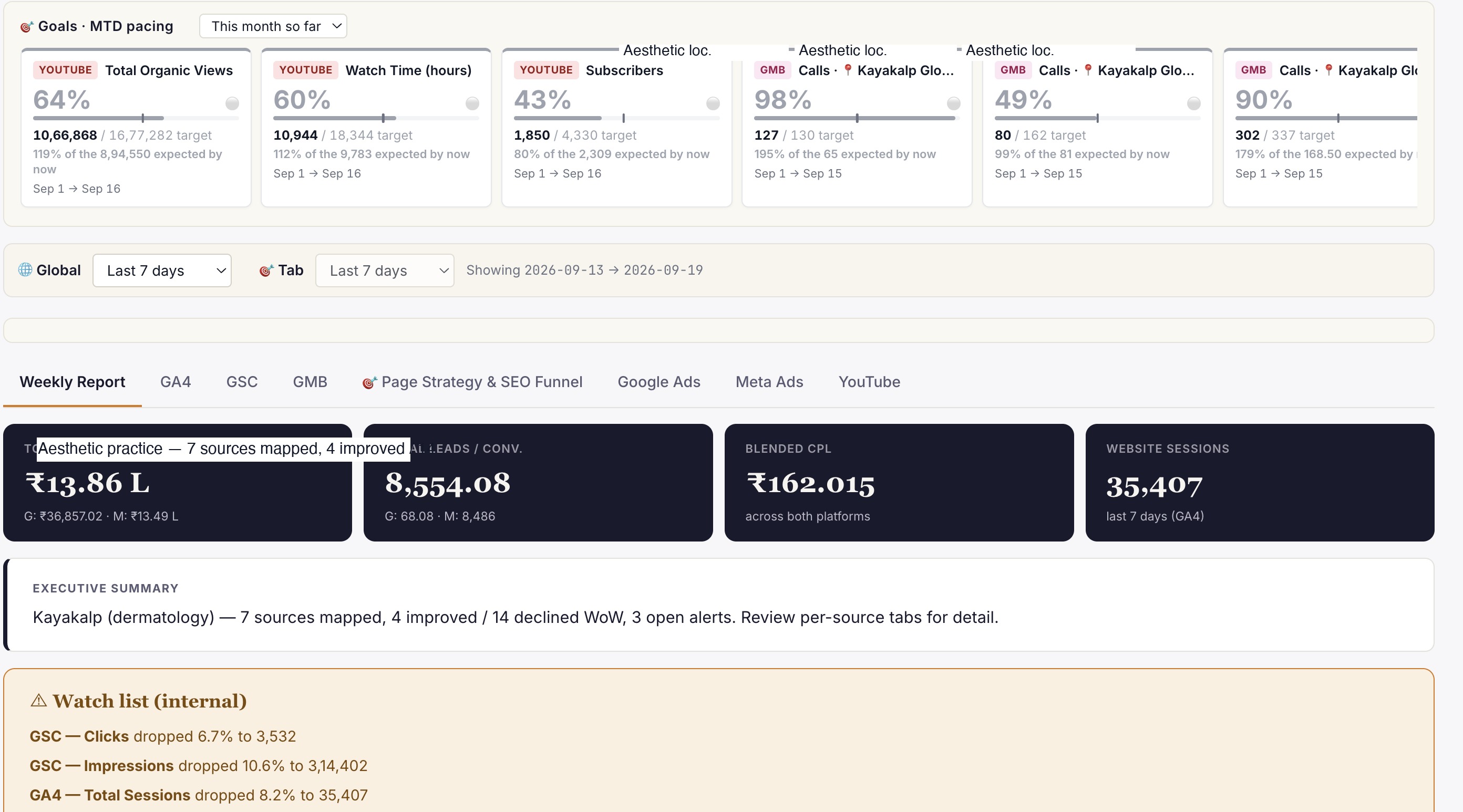
Live client dashboard. GSC, GA4, Google Ads, Meta Ads, IVR calls in one view. Login anytime, not monthly.
Phoenix
Clinic revenue intelligence over your PMS. Daily action queue: Prevent Loss, Maintain & Engage, Grow Revenue. Multi-centre rollout.
Or book a free 30-min audit to see all three in action on your account.
Healthcare brands
that already run on ICG.
A representative slice of the 150+ healthcare brands ICG has delivered for across India. Most engagements remain under NDA.


What ICG clients say · on video.
"Scale up of organic channels and business consulting. ICG has absolute domain authority in their field."
"Working with ICG transformed how we acquire IVF patients in Gurgaon. They understand the fertility journey from inquiry to consult..."
"What Ichelon accomplished — they got all my ideas and worked over 3-4 months to create an amazing, super-customised website."
Need help operationalising this?
Every ICG service is healthcare-only, NMC + DPDP-aware, and built around the patient-research patterns that drive Indian healthcare growth in 2026.
Every practice welcome — packages from ₹20,000/mo.
Goals-Driven engagements · Performance-Linked Payout Models available


More from
ICG.
Five trends shaping Indian healthcare marketing through 2027: AI-first patient research, Conversions API adoption, ABDM discovery, the AEO w...
Healthcare AIO is the discipline of getting your clinic or hospital cited inside Google AI Overviews, ChatGPT and Perplexity answers — not j...
Conversational-search advertising places brand messages inside AI chat answers — ChatGPT, Perplexity, Copilot — rather than beside a results...
Stop guessing.
Book a Diagnostic.
30 minutes. Free. With the AI-powered healthcare-only marketing agency 150+ brands already run on. No slides, no pitch, no hard close.


