


How to get cited in Google AI Overviews from a healthcare YouTube channel: 2026 playbook
Google AI Overviews now cite YouTube videos and the clinic pages that embed them when a patient asks a health question. Getting cited requires VideoObject schema, FAQ schema, quotable definitions, chapter timestamps, and transcript embedding — plus a testing loop through YODA's AIO tracker.
No pitch. Written root-cause diagnosis. AI-powered, healthcare only.
Direct answer
Google AI Overviews now cite YouTube videos and the clinic pages that embed them when a patient asks a health question. Getting cited requires VideoObject schema, FAQ schema, quotable definitions, chapter timestamps, and transcript embedding — plus a testing loop through YODA's A...
TL;DR

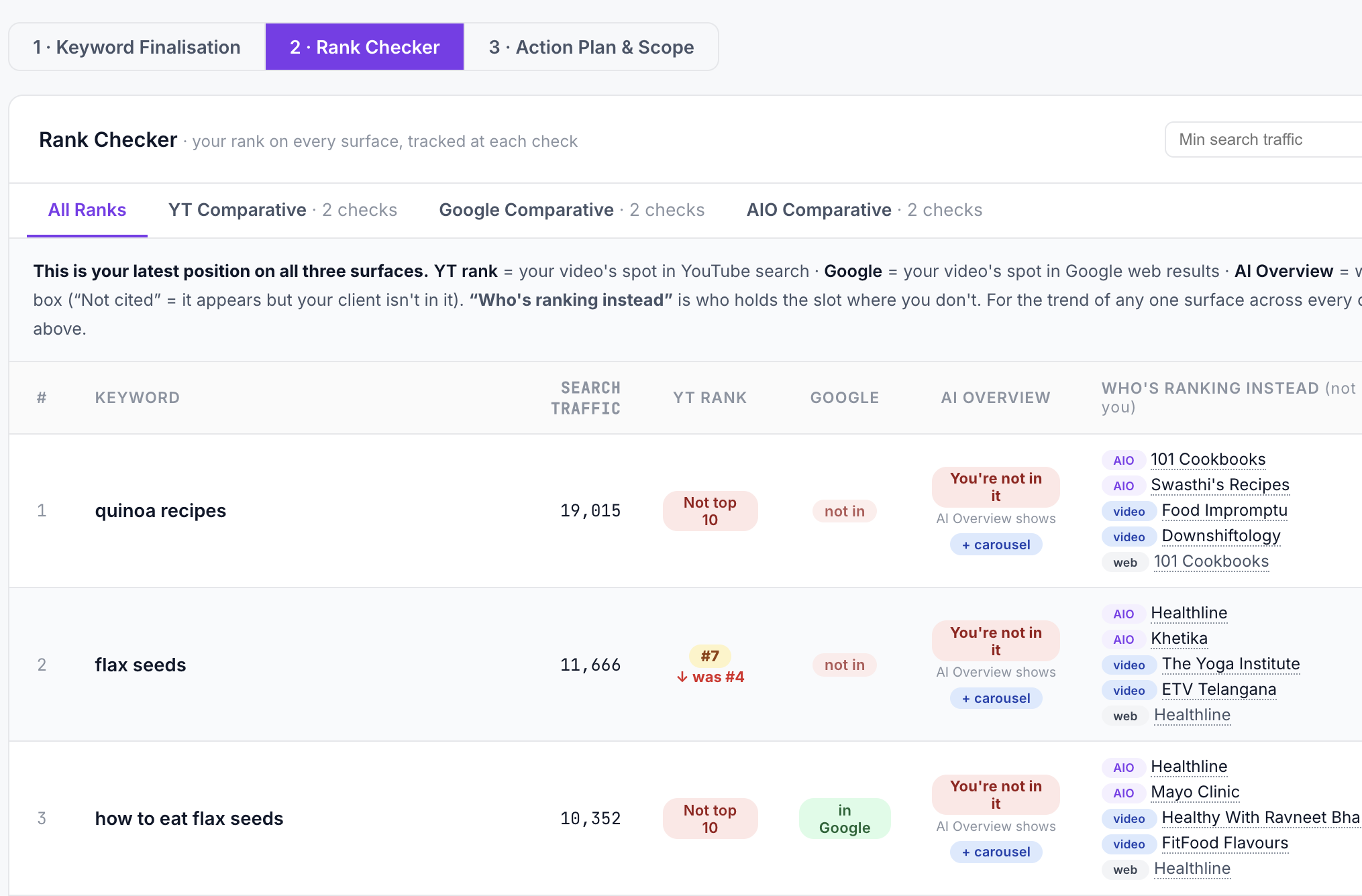
Getting cited in Google AI Overviews from a healthcare YouTube channel is not a byproduct of publishing more videos — it is the outcome of a specific structural discipline applied to the video's description, the website page that embeds it, the schema markup around both, and the transcript that Google is quietly indexing behind the scenes. When a patient searches "what causes recurrent tonsillitis in adults" or "does PRP hair treatment actually work", Google increasingly answers with an AI Overview that cites a small set of sources — often three to six. Healthcare channels that structure their content for citation earn that spot; channels that don't remain invisible even when they hold the top YouTube ranking for the same query. ICG builds the citation stack for our YouTube clients as part of the healthcare YouTube marketing service, tested continuously through YODA's AIO tracker inside the healthcare YouTube pillar operating model.
Why AI Overview citation is different from ranking
Classical ranking is a competitive process — one video, one page, one link fights for a limited number of positions on a search results page, and the winners take almost all the visibility. AI Overview citation is an inclusion process — Google's answer engine identifies a set of sources it will lift language from, and the winners are the sources whose language is quotable, structured, verifiable, and topically aligned with the patient's specific question.
The practical implication is that a video does not need to hold the number-one YouTube ranking to be cited. It needs to answer a specific question in specific language that Google's answer engine can lift with confidence. Small channels with well-structured content routinely earn citation ahead of larger channels with unstructured content.
A citation also carries different value from a click. A cited source gets its name and link surfaced above the classical results, often to a patient who never scrolls past the AI Overview. For healthcare queries, where trust cues drive booking decisions, being named as the cited source is often more valuable than being the top blue link.
VideoObject schema — the non-negotiable
Every YouTube video that is embedded on a clinic website page needs a VideoObject schema block on that page. This is not optional. Google's AI answer engine relies heavily on structured data to identify which content on a page is a video, what the video is about, when it was published, how long it runs, and whether it has a transcript.
The minimum viable VideoObject block for a healthcare video includes: name (matches the YouTube title), description (matches or expands the YouTube description first paragraph), thumbnailUrl (the YouTube thumbnail), uploadDate (ISO 8601), duration (ISO 8601 duration), embedUrl (the YouTube embed URL), and contentUrl (the YouTube watch URL). Extended fields that improve citation eligibility: transcript (full text transcript inline), hasPart (chapter markers as Clip objects with startOffset, endOffset, and url), publisher (Organization with the clinic's name, logo, and sameAs links to social profiles), and about (the medical condition or treatment the video covers, ideally referencing a medical terminology entity where relevant).
Schema validation matters. A broken schema block is worse than no schema — Google flags the page as attempting structured data and failing, which is a negative quality signal. Test every page through Google's Rich Results Test and the Schema Markup Validator before publishing.
FAQ schema alongside VideoObject
The single highest-leverage move for AIO citation is pairing VideoObject schema with FAQ schema on the same page. The FAQ schema block lists the questions the video answers, with the answers provided as short quotable text underneath.
The pattern that consistently earns citation on healthcare pages: identify 6-10 questions the video answers, phrase each question in the patient's own language (not clinical language), provide a 40-90 word answer per question that stands on its own without requiring the reader to have watched the video, and mark up each question-answer pair with FAQPage schema.
The answers are the quotable content. Google's AI answer engine reads FAQ schema as pre-structured lifting-ready content — a question is asked, an answer is provided, provenance is clear. The answer text is what gets lifted into the AI Overview with the page cited as source. If the answer is too long, Google truncates or skips; too short, it lacks the specificity to answer confidently. The 40-90 word range is the sweet spot for medical explanatory content.
Every FAQ answer on a healthcare page must sit inside the compliance perimeter — no unsubstantiated superlatives, no personal solicitation, no outcome guarantees. Compliance-safe framing also happens to be citation-safe framing, because the AI answer engine deprioritises language that looks promotional.
Quotable definitions in the video description
The video description on YouTube itself is a separate citation surface. Google reads the description when evaluating whether a video should be cited in an AI Overview that surfaces YouTube results (which increasingly happens for health queries).
The pattern is straightforward. In the first 200 characters of the description, provide a single-sentence definition or answer to the core question the video addresses. The sentence should stand on its own — subject, verb, complete thought, no cliffhanger that requires watching the video to complete. Immediately after the sentence, provide a two-to-three-sentence expansion that adds specificity — mechanism, timeline, patient-fit consideration.
Example structure for a video on "how PRP hair treatment works":
"PRP (platelet-rich plasma) hair treatment involves drawing a small volume of the patient's blood, spinning it in a centrifuge to concentrate the platelets, and injecting the concentrated plasma into the scalp to stimulate hair follicles. A typical PRP course involves 3-6 sessions spaced 4-6 weeks apart. Results are variable and depend on the underlying cause of hair loss, patient age, and consistency of the treatment protocol."
That opening block is what Google lifts. The rest of the description carries the video's context, related videos, timestamps, and clinic identification.
Chapter timestamps for key moments
Chapter timestamps drive AI Overview citation in a specific way — Google uses them to identify "key moments" inside the video, which are then quoted as time-stamped segments alongside the AI Overview answer. A patient asking "when should I see a doctor for tonsillitis" can get an AI Overview answer that cites a specific 30-second segment of a doctor's video with the timestamp linked directly to that point in playback.
For key-moment citation to work, chapters need to be substantive and correctly named. A chapter titled "Introduction" or "Section 3" carries no query alignment. A chapter titled "When to see a doctor for tonsillitis" carries exact query alignment. Rename every chapter using the specific question or claim the segment answers, mirroring the language of the questions in the FAQ schema block on the embedding website page.
Chapter minimum length is 10 seconds; below that, YouTube ignores the chapter marker. Practical minimum for AIO key-moment citation is 30-60 seconds — long enough to contain a substantive answer that Google can lift.
Transcript embedding and why it matters
The full video transcript is the most under-invested citation asset on healthcare channels. YouTube auto-generates transcripts, but auto-generated transcripts miss medical terminology — drug names, procedure names, condition names, doctor names — and the errors quietly kill citation eligibility because Google cannot verify that the video actually discusses the topic the AI answer engine is looking for.
Two transcript surfaces matter:
YouTube caption track — upload human-edited SRT or VTT captions for every video. These become the video's indexed transcript on YouTube and feed into Google's reading of the video for both classical ranking and AIO citation.
Website transcript block — on the clinic website page that embeds the video, publish the full transcript as visible text below the video embed. This is the transcript Google reads most reliably for AI Overview citation, because it is on-page HTML that Google's crawler processes normally. Mark the transcript up with the VideoObject schema's transcript property to make the association explicit.
Human-editing time for a 10-minute healthcare video runs 15-30 minutes. It is the highest per-minute-of-effort ROI activity on the channel.
Video page architecture on the clinic website
The website page that embeds the video is not a passive shell — it is a co-equal citation surface with the video itself. The architecture that consistently earns AIO citation:
1. H1 that matches the primary patient question the video addresses, phrased in the patient's language.
2. Introduction paragraph that provides the quotable definition in the first sentence (identical pattern to the video description).
3. Embedded video immediately after the introduction, with correctly configured VideoObject schema.
4. Full transcript block below the video, with speaker labels if the video features multiple speakers.
5. FAQ section with FAQPage schema — 6-10 questions the video answers with 40-90 word answers.
6. Doctor byline with credential, registration number, and link to the doctor's profile page — carries E-E-A-T signal.
7. Related videos and articles for internal linking and session depth.
8. Compliance and disclaimer footer.
Every element serves a specific purpose in the citation calculus. Missing any of them drops citation probability materially.
Testing citation via YODA's AIO tracker
Publishing the structural stack is only half the discipline. The other half is measuring whether Google actually cites the video for the queries it targets, and iterating when it doesn't.
YODA's AIO tracker runs on a defined query list per client — typically 50-500 patient-side questions per specialty and city — and checks weekly whether Google is generating an AI Overview for each query, and if so, which sources it cites. When a clinic's video or embedding page appears as a cited source, YODA logs it with the specific query, the AI Overview text lifted, the citation position, and the traffic pattern that followed.
When citation is missing for a query the clinic's content targets, YODA runs a diagnostic — is the query generating an AI Overview at all (some queries still return classical results only), is the clinic's page indexed for the query, is the schema block valid, is the FAQ answer within the citation-eligible length band, does the answer language match the query's framing. The diagnostic surfaces the specific gap so the next optimisation cycle addresses it.
Testing without a tracker is possible but tedious — a marketing lead would need to search each query manually every week and log the AI Overview state. At any scale beyond 20-30 queries, manual tracking degrades within weeks.
What breaks when you get AIO structure wrong
Three failure modes we see repeatedly on healthcare channels:
VideoObject schema present but incomplete. The page has schema, but critical fields (transcript, hasPart, publisher) are missing, and Google cannot verify enough about the video to cite it confidently. Rich Results Test passes; citation never arrives.
FAQ answers written for reading, not for lifting. Answers run 200-400 words, buried inside dense paragraphs, without the standalone quotable structure. The AI answer engine cannot cleanly extract a lift-ready segment. Rewriting FAQs into 40-90 word standalone answers typically triggers citation within a subsequent crawl cycle.
Transcript published as image or PDF. Google cannot read image-embedded text and processes PDF transcripts less reliably than HTML. The transcript must be visible HTML text on the page, ideally with schema markup identifying it as the video's transcript.
The platform ICG uses to run this at scale: YODA
ICG runs healthcare YouTube marketing for clinics, hospitals, and specialty groups using YODA — our AI-native healthcare YouTube marketing platform. YODA sits on top of a channel's data and does four things no dashboard does: it separates organic from paid views at every step (so a promoted video can never masquerade as organic growth), it gives decisions not dashboards (every video gets a state + next action), it writes back to YouTube directly (improved titles, tags, descriptions, chapters applied straight to the platform), and it tracks the three rank races — YouTube search, Google web, and Google AI Overview citations.
YODA runs the full 6-step workflow — Overview, Diagnostics, Strategy, Optimisation, Reputation (ORM), and Competitor Intel — with 40+ analysis modules organised under those steps. ICG's managed YouTube service uses YODA end-to-end. See the Healthcare YouTube Marketing pillar guide for the full scope, or the Healthcare YouTube Marketing Agency service page for engagement details.
Book a YODA demo on WhatsApp → or request a free healthcare YouTube channel audit →
Related reading
- Healthcare YouTube marketing pillar guide — the full channel operating manual
- Three ranking races: YouTube, Google web, and AI Overviews
- Verifying website videos are indexed in Google Search Console
- Google AI Overviews optimisation for Indian healthcare
- Healthcare YouTube marketing service — engagement details
FAQ
Do YouTube videos actually get cited in Google AI Overviews?
Yes, increasingly for health queries. Citations show up as named source links above the classical results, sometimes with a time-stamped key-moment segment that links directly into the video playback. Health, how-to, and educational queries are the query classes most likely to surface video citations.
Does the video need to hold the number-one YouTube ranking to be cited?
No. Citation eligibility is driven by structural signals (schema, FAQ, transcript, chapter alignment) more than by classical ranking position. Smaller channels with well-structured content routinely earn citation ahead of larger channels with weak structure.
What is the minimum VideoObject schema block a healthcare video page needs?
name, description, thumbnailUrl, uploadDate, duration, embedUrl, contentUrl. Add transcript, hasPart (chapters as Clip objects), publisher, and about for stronger citation eligibility.
How long should FAQ answers be for AIO citation?
40-90 words per answer. Shorter answers lack specificity; longer answers get truncated. The 40-90 word band is the sweet spot for medical explanatory content that Google's answer engine can lift cleanly.
Should the transcript be visible on the page or hidden behind a toggle?
Visible HTML text is preferred. Google reads visible on-page text most reliably. Toggle-hidden transcripts are readable to Google (usually) but signal lower emphasis. Best practice is visible transcript with a "show more" toggle for long transcripts.
Does uploading captions on YouTube also help with website AIO citation?
Indirectly. YouTube captions feed Google's understanding of the video's topical scope, which reinforces the structural signals on the embedding website page. Both surfaces matter and both should carry human-edited transcripts.
How long after publishing does AIO citation typically appear?
Highly variable. Some queries surface citations within days of publication; others take 60-120 days as Google's answer engine re-evaluates cited sources. YODA's AIO tracker logs the timing per query so patterns become visible over time.
Can compliance-safe framing hurt AIO citation eligibility?
No — the opposite. The answer engine deprioritises promotional language, superlative claims, and personal solicitation. Compliance-safe framings that Google reads as neutral, informational, and verifiable are also citation-safe framings. Being NMC-compliant helps citation.
What tool can validate the schema before publishing?
Google's Rich Results Test and the Schema Markup Validator. Both are free. Every video page should pass both before publishing. Broken schema is worse than no schema.
Does YODA's AIO tracker work for non-video content too?
Yes. YODA's AIO tracker measures citation across video and non-video queries, though the tool's primary focus is the YouTube-plus-embedding-page stack. For pure-website citation without video, the same principles apply — VideoObject is replaced with Article schema, and FAQ schema plus transcript-quality content still drives eligibility.
Book a free 30-minute Brand & Growth Diagnostic.
It's a working session, not a sales pitch — you leave with a written root-cause analysis you can act on, whether or not you engage ICG.
The three platforms
behind every ICG engagement.
Beacon
CAPI middleware that fixes Event Match Quality, translates CRM statuses to Meta-standard events, dedups across channels.
Agency OS
Live client dashboard. GSC, GA4, Google Ads, Meta Ads, IVR calls in one view. Login anytime, not monthly.
Phoenix
Clinic revenue intelligence over your PMS. Daily action queue: Prevent Loss, Maintain & Engage, Grow Revenue. Multi-centre rollout.
Or book a free 30-min audit to see all three in action on your account.
Healthcare brands
that already run on ICG.
A representative slice of the 150+ healthcare brands ICG has delivered for across India. Most engagements remain under NDA.


What ICG clients say · on video.
"Scale up of organic channels and business consulting. ICG has absolute domain authority in their field."
"Working with ICG transformed how we acquire IVF patients in Gurgaon. They understand the fertility journey from inquiry to consult..."
"What Ichelon accomplished — they got all my ideas and worked over 3-4 months to create an amazing, super-customised website."
Need help operationalising this?
Every ICG service is healthcare-only, NMC + DPDP-aware, and built around the patient-research patterns that drive Indian healthcare growth in 2026.
Every practice welcome — packages from ₹20,000/mo.
Goals-Driven engagements · Performance-Linked Payout Models available



More from
ICG.
Five trends shaping Indian healthcare marketing through 2027: AI-first patient research, Conversions API adoption, ABDM discovery, the AEO w...
Healthcare AIO is the discipline of getting your clinic or hospital cited inside Google AI Overviews, ChatGPT and Perplexity answers — not j...
Conversational-search advertising places brand messages inside AI chat answers — ChatGPT, Perplexity, Copilot — rather than beside a results...
Stop guessing.
Book a Diagnostic.
30 minutes. Free. With the AI-powered healthcare-only marketing agency 150+ brands already run on. No slides, no pitch, no hard close.


