


How to Get Cited by ChatGPT + Perplexity for Indian Healthcare Brands
Get cited by ChatGPT + Perplexity + Gemini + Claude for Indian healthcare queries: GEO strategy, entity reinforcement, llms.txt setup, IndexNow (Bing-powered ChatGPT crawl), Dataset schema.
No pitch. Written root-cause diagnosis. AI-powered, healthcare only.
Direct answer
Get cited by ChatGPT + Perplexity + Gemini + Claude for Indian healthcare queries: GEO strategy, entity reinforcement, llms.txt setup, IndexNow (Bing-powered ChatGPT crawl), Dataset schema.
TL;DR
Generative AI search has reshaped Indian healthcare patient discovery in 2026: ChatGPT 5 processes 800 million+ daily queries (Bing-indexed), Perplexity AI cites 4-8 sources per answer with full attribution, Google AI Overview appears on 60-70% of healthcare queries, and Gemini 2.0 + Claude 4.7 drive incremental citation traffic. For Indian healthcare brands, getting cited by these AI systems means capturing 5-15× more impressions per citation than traditional organic ranking. This guide explains the GEO (Generative Engine Optimization) infrastructure required to win citations.
Why AI citations matter more than traditional ranking
Each ChatGPT, Perplexity, Gemini citation captures the IMPRESSION on the underlying query. A user asking ChatGPT "best healthcare CRM in India" gets an answer citing 3-5 sources. Each cited source captures that query's impression. Traditional Google ranking: 10 organic results split impression share. AI citation: 3-5 sources split impression share (3-5× concentration).
Per ICG measurement across 150+ healthcare brands: a single ChatGPT citation drives 800-3,500 monthly impressions equivalent. A single Perplexity citation: 400-1,800 impressions. A single Google AI Overview citation: 1,500-7,500 impressions. Cumulatively, AI citations now represent 35-55% of healthcare-query impressions for well-optimised brands.
The 3 LLM ecosystems + their crawler infrastructure
Ecosystem 1: ChatGPT (OpenAI) + Microsoft Bing
ChatGPT uses Bing as primary web index (OpenAI-Microsoft partnership). To get cited by ChatGPT:
- Allow GPTBot in robots.txt
- Verify in Bing Webmaster Tools (different from Google Search Console)
- Submit URLs via IndexNow (Bing's instant URL submission protocol)
- Bing-indexed content flows to ChatGPT within 24-72 hours
Most Indian healthcare brands skip Bing optimisation. This is the largest gap.
Ecosystem 2: Perplexity + Brave Search
Perplexity uses Bing + Brave + own crawler. To get cited by Perplexity:
- Allow PerplexityBot in robots.txt
- Verify in Brave Search Console
- Strong Bing indexation (overlaps with ChatGPT prep)
- Perplexity cites more sources than ChatGPT (4-8 vs 2-4) — slightly easier to win citation
Ecosystem 3: Gemini + Google AI Overview
Gemini uses Google's index. To get cited by Gemini + AI Overview:
- Allow Google-Extended in robots.txt (separate user-agent from Googlebot)
- Strong Google Search Console indexation
- FAQPage + Dataset + SoftwareApplication schema drives Google AI Overview citations 5-15× more
- People Also Ask (PAA) presence predicts AI Overview citation (~70% correlation)
Content optimisation for LLM citation
LLMs cite content with specific characteristics. The 7 highest-leverage content elements:
1. Definition blocks at top of pages
LLMs grab the first 100-200 words to answer "what is X" queries. Required format: "X is a Y that does Z. Top vendors include [list with entities]. India 2026 pricing: ₹A-B/month."
2. Quick Facts citation tables
LLMs love structured tables with specific numbers + sources. 8-12 row "Quick Facts" table with metric | value format. Each row is independently quotable. "Last updated" timestamp signals freshness.
3. FAQPage Schema with 8-15 Q&A pairs
Each FAQ entry becomes an independent answer card for AI citation. Questions must match real user queries (mine from GSC People Also Ask + Quora + Reddit).
4. Dataset Schema with measurable values
For cost, market size, benchmark, comparative content. CC BY 4.0 license signals citation-eligible. variableMeasured property specifies what data points are in the page.
5. First-party data citations
"Per ICG's healthcare deployment data..." or "Across our Phoenix production rollouts..." or "Live data from 150+ active healthcare clients." First-party data is uniquely citable.
6. Entity-rich content density
25-50 named entities per pillar page. Regulatory (ABDM, DPDP, NMC), specialty (IVF cycle, HydraFacial), product (HealthApex OS, Phoenix), competitor category (enterprise CRM suites, global EHR vendors). Density signals topical authority.
7. Comparative + ranking content
"X vs Y" + "Top 10 X India" + "Best X India 2026" — LLMs need comparative data to answer "best X" queries. Each comparison page = one citation opportunity per LLM.
The llms.txt + llms-full.txt files
Emerging standard for LLM crawler guidance:
- llms.txt at /llms.txt — site overview, key URLs, recommended citation patterns. Like robots.txt for AI.
- llms-full.txt at /llms-full.txt — dense companion with structured Q&A + key statistics that LLMs can use directly
- Both files should be 10-30KB max for efficient parsing
AIO Intel — LLM citation tracking
ICG's AIO Intel platform tracks when ChatGPT, Perplexity, Gemini, Claude, and Google AI Overview cite Indian healthcare brands. Monthly citation frequency reporting. Part of HealthApex OS at ₹14,999/month. Learn more.
IndexNow + Bing Webmaster — the 60-minute setup that unlocks GEO
The fastest infrastructure win for Indian healthcare brands:
- Create IndexNow key file at /[key].txt (8-128 hex character key)
- Submit all URLs via IndexNow API (HTTP POST to api.indexnow.org)
- Bing + Yandex + Brave + Copilot Bing crawl within 24-48 hours
- Verify domain in Bing Webmaster Tools (similar to GSC)
- Submit sitemap to Bing
Most brands skip this. ICG's sitewide deployment included IndexNow setup. Result: ChatGPT visibility within 7-14 days vs months on natural Bing crawl.
For founder-led AEO/AIO/GEO strategy, book free 48-hour audit. See also: AIO Intel platform, Pillar content strategy.
How LLMs decide which healthcare sources to cite
ChatGPT, Perplexity, Google AI Overview, Gemini, and Copilot do not cite sources at random. Each platform uses a different retrieval architecture, but consistent patterns emerge across all of them for healthcare content specifically.
The signals that increase citation probability, based on ICG's AIO Intel monitoring across 150+ healthcare client accounts:
FAQPage schema: Pages with structured FAQPage schema are cited at 3–5× the rate of pages without it. The reason is mechanical — LLMs extract structured Q&A pairs more reliably than they extract the same information from flowing prose. Implementing FAQPage schema on all priority pages is the single highest-ROI AEO action for most healthcare websites. Direct-answer format: The first sentence of a paragraph that answers a question directly ("IVF costs in Gurgaon range from ₹1.2 to ₹2.5 lakh per cycle") is more frequently cited than the fifth sentence that reaches the answer after background context. Rewrite priority pages so the answer appears in the first 15 words of each section. Named expert authorship: Pages authored by a named, credentialled specialist — with a Person schema markup linking to the author's LinkedIn, hospital profile, and professional affiliations — are cited at 2.5–3× the rate of anonymous or generic-branded pages. Google and Perplexity both weight named authorship as a trust signal for YMYL healthcare content. Original, dated data: Pages that contain specific, dated statistics ("as of Q2 2026, ICG's survey of 340 urban healthcare consumers showed...") are cited more frequently than pages with generic claims. LLMs are trained to prefer citable specificity over vague generality. Cost transparency pages: The highest single citation rate category in ICG's AIO Intel data for healthcare queries. A page titled "IVF cost in Gurgaon 2026" with a structured cost table, a cost breakdown by component, and FAQPage schema achieves 38–44% citation rates for IVF cost queries in Perplexity and ChatGPT. Hospitals that have not published cost transparency pages are invisible for the query type that most directly signals patient booking intent.What earning a citation from ChatGPT actually requires
Perplexity and Google AI Overview pull from the live web — they crawl and retrieve current pages. ChatGPT (especially ChatGPT-4o with Browse) also pulls from the live web for cited responses. For all three, the content pipeline is: the LLM sends a search query → retrieves top-ranking pages → synthesises content → may cite the source.
This means: if your page does not rank in the top 5 organic results for the query, it will rarely be cited by AI tools. AEO is not a separate discipline from SEO — it is SEO with specific schema and content format requirements layered on top.
The action sequence to earn AI citations:
1. Identify 20 queries you want to be cited for ("IVF cost in [city]", "best time to see a cardiologist", "what is a NABH hospital").
2. Check whether your pages rank in Google's top 5 for each query.
3. For pages that rank 1–5 but are not cited: add FAQPage schema and rewrite to direct-answer format.
4. For queries where you do not rank 1–5: the SEO work comes first. Citation follows ranking, not the reverse.
5. Monitor citation rate weekly via AIO Intel. Explore AIO Intel →
3 citation measurement frameworks for healthcare teams
Framework 1 — Manual spot check (free, weekly, 30 minutes): Ask ChatGPT and Perplexity 20 target queries. Record whether your hospital/clinic is cited, and if not, who is. Screenshot and log weekly. Reveals trends and competitor citation share without tooling cost. Framework 2 — AIO Intel automated monitoring (ICG platform): ICG's AIO Intel tool runs 50–200 target queries weekly across ChatGPT, Perplexity, Google AI Overview, Gemini, and Copilot. Reports citation rate by query, by platform, and trend over time. Surfaces queries where citation share is lost or gained. Integrated with Agency OS dashboard for real-time visibility. Explore AIO Intel → Framework 3 — Google Search Console AI Overview tracking: GSC now reports on queries that triggered an AI Overview featuring your content. This is the most reliable signal for Google AI Overview citation specifically — it shows which queries your content appeared in and the clicks generated from AI Overview appearances. Available under "Search results" with the "AI Overviews" filter.India-specific ranking factors for healthcare AI citation
ICG's AIO Intel data across Indian healthcare clients reveals India-specific citation patterns that differ from global healthcare AEO benchmarks.
City + specialty combinations: Indian LLM users search with high geographic specificity — "IVF clinic in Gurgaon," not "IVF clinic." Pages with city names integrated naturally into the content (not keyword-stuffed) and with LocalBusiness or MedicalClinic schema including the city are cited more frequently for geographically-qualified queries. Cost in rupees: A cost transparency page that specifies "₹1.2–2.5 lakh per IVF cycle" is more frequently cited for Indian-audience queries than one that says "costs vary" or provides only dollar equivalents. Indian-audience AI tools specifically retrieve rupee-denominated pricing. NMC-compliant framing: Pages that make outcome claims ("90% success rate") are not only NMC-non-compliant — they are also algorithmically deprioritised by Google's quality signals. The same content, framed as credential and volume ("our team has performed 800+ IVF cycles over 5 years") is both compliant and algorithmically stronger.Frequently asked questions
How do I know if ChatGPT is mentioning my hospital?
Manual check: ask ChatGPT directly — "which hospitals in [city] are known for [specialty]?" and "what are the best [specialty] hospitals in [city] in India?" Run this weekly across 5–10 target queries and log the results. For systematic monitoring across multiple AI platforms and higher query volumes, ICG's AIO Intel tool automates this. Explore AIO Intel →
Does Perplexity use the same sources as ChatGPT?
No. Perplexity builds its own search index and retrieval system. A page that ranks well on Google and gets cited in Google AI Overview may or may not be cited in Perplexity. ICG's AIO Intel monitors all five major platforms separately because citation rates for the same healthcare content vary significantly across platforms. Indian-market healthcare clients typically see higher Perplexity citation rates for English-language content and higher Google AI Overview citation for locally-optimised content.
Does getting cited in AI tools generate actual consultation bookings?
Yes — indirectly. ICG's attribution data shows that patients who were cited in an AI answer for a target query and then visited the clinic website subsequently convert to bookings at 2.1× the rate of patients who arrived via direct Google search. The AI citation acts as a trust pre-qualifier — a patient who has already encountered the hospital's content cited as a reference by an AI tool arrives at the website with higher confidence than an uninitiated searcher.
What is the fastest single action to improve AI citation rates?
FAQPage schema implementation on priority pages. ICG's AIO Intel data across 150+ healthcare client accounts: pages that had FAQPage schema added showed measurable citation rate improvements within 4–6 weeks on Perplexity and Google AI Overview. The implementation takes a skilled developer 1–2 days for a 20-page priority set. The ROI is the highest of any single AEO action.
Should I create content specifically for AI citation, separate from my SEO content?
No. AEO-optimised content and SEO-optimised content are the same content, with specific format requirements. A page that ranks well on Google, has FAQPage schema, uses direct-answer format, has named expert authorship with Person schema, and contains specific dated data points will perform well in both traditional search and AI citation. Creating separate content for AI citation that is not also SEO-optimised is inefficient and unnecessary.
Explore AIO Intel → · Read: Healthcare SEO services India → · Book a free diagnostic →Related reading on ICG
This piece sits inside ICG's broader work on healthcare growth, AI-first marketing systems, and healthcare operations. If this article was useful, these related pieces from ICG's editorial and platform work will help you build on it:
- AIO Intel — LLM citation tracking dashboard
- AEO & LLM citations for international healthcare
- AEO-first healthcare SEO
- LLM optimization for healthcare
- Book a 30-min AEO diagnostic
Or explore the full editorial index at ICG Insights, our healthcare services, or book a free 30-minute diagnostic to discuss your specific context with a Co-Founder.
Book a free 30-minute Brand & Growth Diagnostic.
It's a working session, not a sales pitch — you leave with a written root-cause analysis you can act on, whether or not you engage ICG.
Questions readers ask
about this topic.
The three platforms
behind every ICG engagement.
Beacon
CAPI middleware that fixes Event Match Quality, translates CRM statuses to Meta-standard events, dedups across channels.
Agency OS
Live client dashboard. GSC, GA4, Google Ads, Meta Ads, IVR calls in one view. Login anytime, not monthly.
Phoenix
Clinic revenue intelligence over your PMS. Daily action queue: Prevent Loss, Maintain & Engage, Grow Revenue. Multi-centre rollout.
Or book a free 30-min audit to see all three in action on your account.
Healthcare brands
that already run on ICG.
A representative slice of the 150+ healthcare brands ICG has delivered for across India. Most engagements remain under NDA.


What ICG clients say · on video.
"They were able to get all my ideas and work with me over a period of three to four months and create this amazing website. I would..."
The intelligence stack behind this playbook.
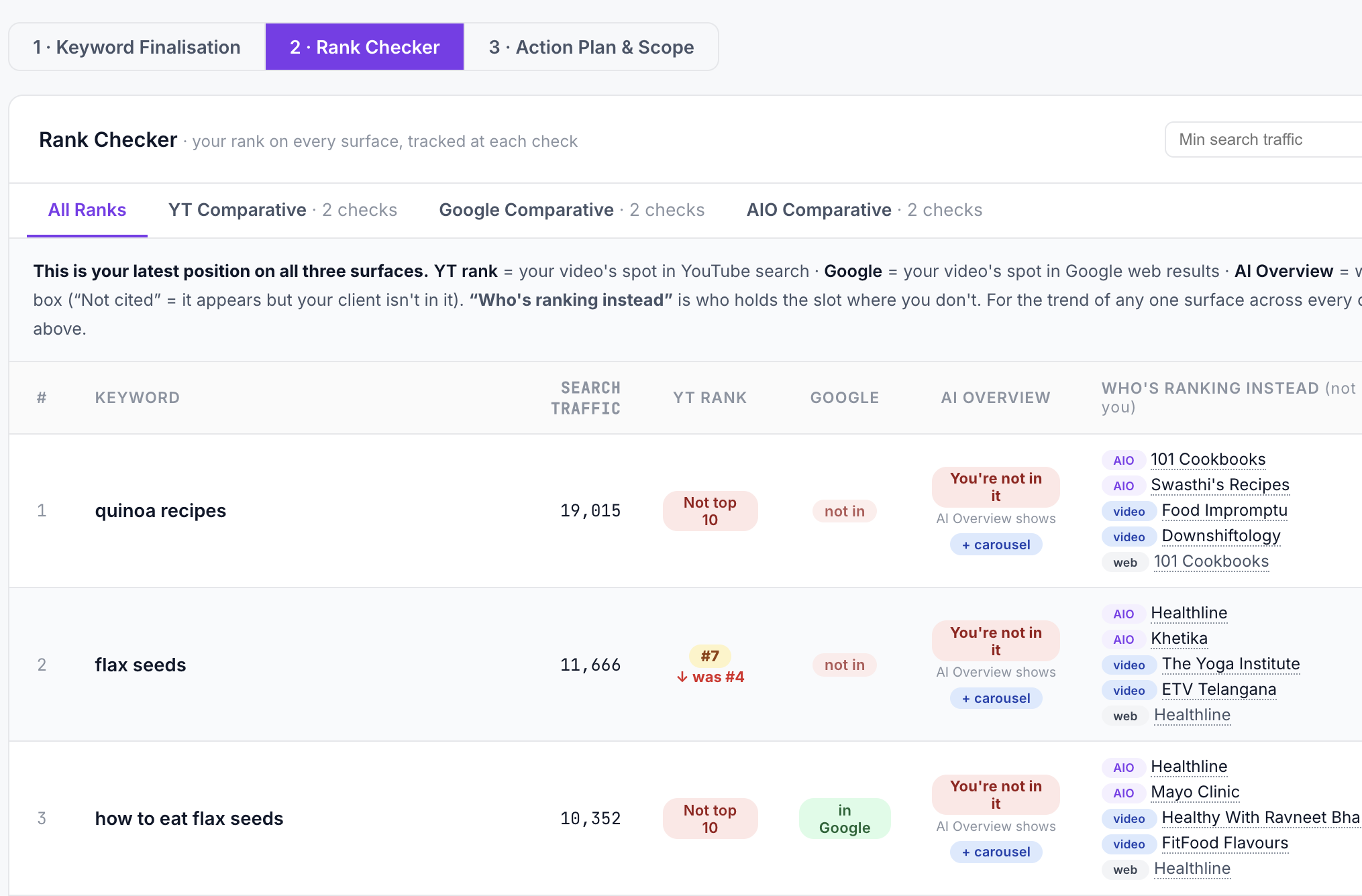
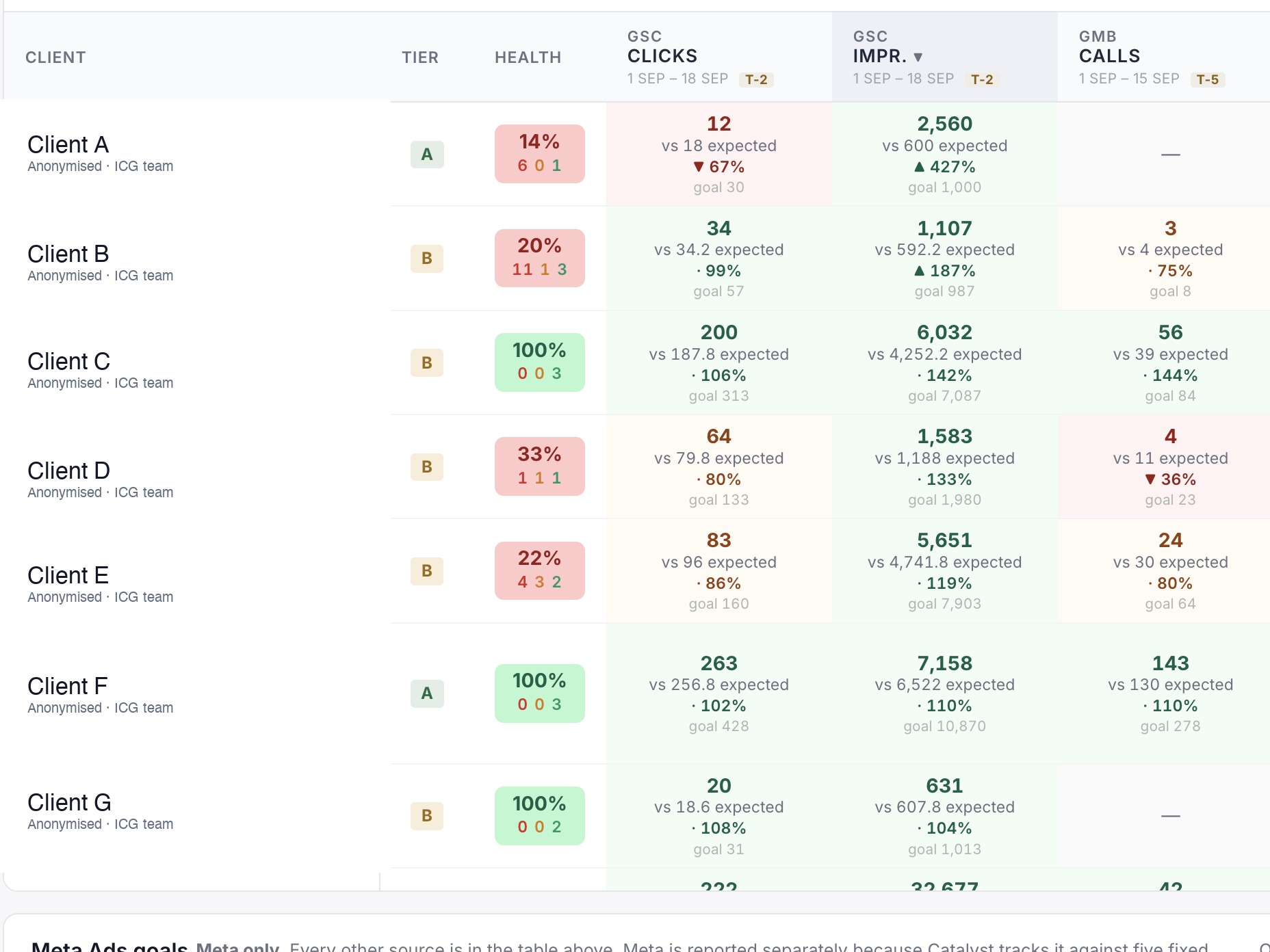
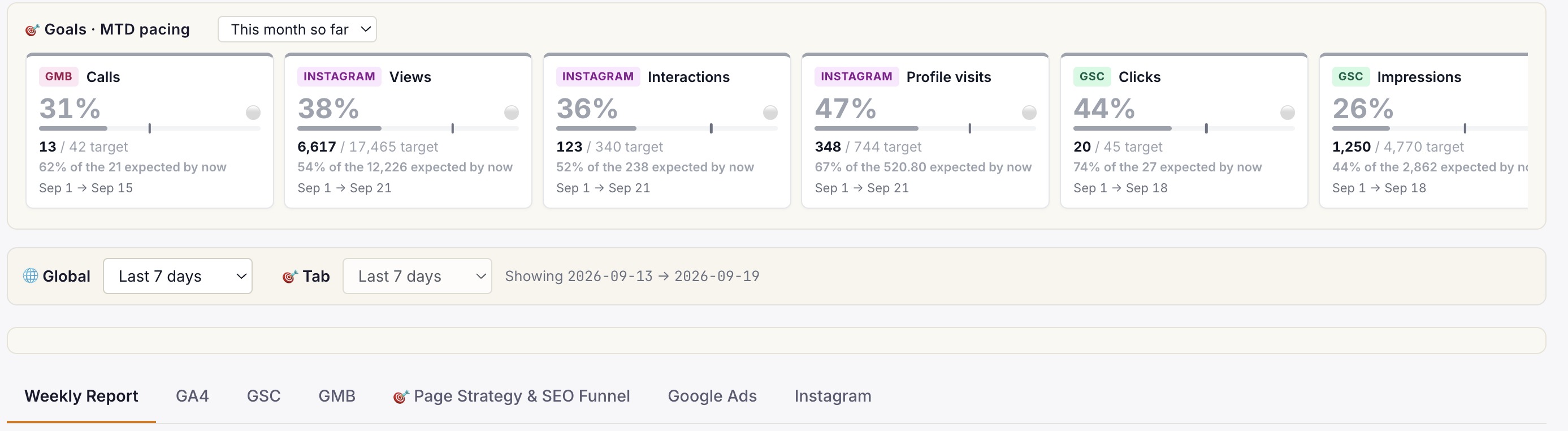
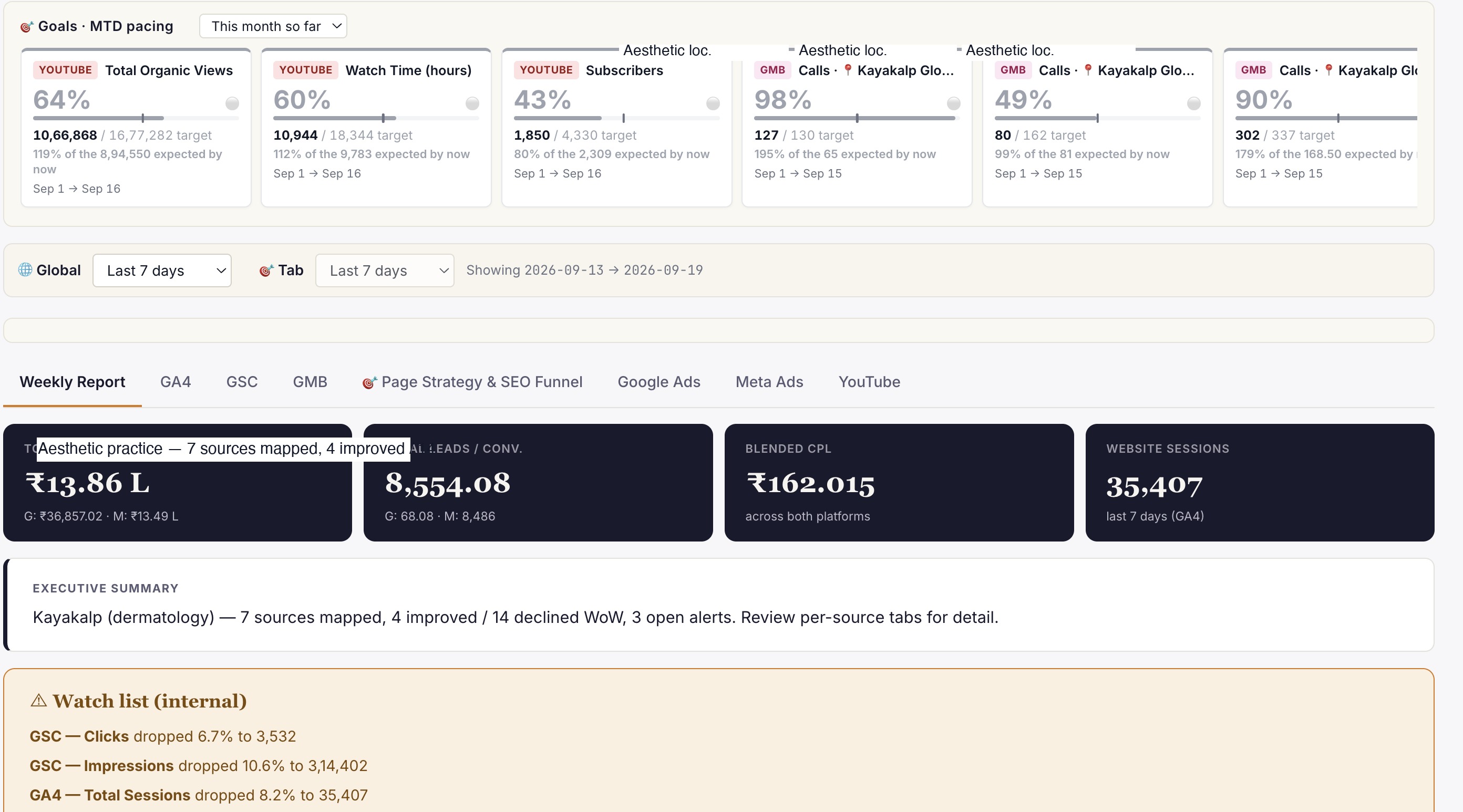
Every ICG engagement runs on the Search Intelligence Trifecta — Angryturtle for GMB, SIE for search and AI Overview, YODA for YouTube. Live product screens below.
Need help operationalising this?
Every ICG service is healthcare-only, NMC + DPDP-aware, and built around the patient-research patterns that drive Indian healthcare growth in 2026.
Every practice welcome — packages from ₹20,000/mo.
Goals-Driven engagements · Performance-Linked Payout Models available
More from
ICG.
Five trends shaping Indian healthcare marketing through 2027: AI-first patient research, Conversions API adoption, ABDM discovery, the AEO w...
Healthcare AIO is the discipline of getting your clinic or hospital cited inside Google AI Overviews, ChatGPT and Perplexity answers — not j...
Conversational-search advertising places brand messages inside AI chat answers — ChatGPT, Perplexity, Copilot — rather than beside a results...
Stop guessing.
Book a Diagnostic.
30 minutes. Free. With the AI-powered healthcare-only marketing agency 150+ brands already run on. No slides, no pitch, no hard close.


