


Angryturtle Competitors module explained: standardised top-5 competitor tracking + citation gap analysis for healthcare local SEO
The Competitors module is Angryturtle's competitive-intelligence layer for local SEO — the piece that identifies each client's top-5 competing healthcare businesses in the local pack for its primary specialty queries, tracks their aggregate performance metrics rating, review coun
No pitch. Written root-cause diagnosis. AI-powered, healthcare only.
Direct answer
The Competitors module is Angryturtle's competitive-intelligence layer for local SEO — the piece that identifies each client's top-5 competing healthcare businesses in the local pack for its primary specialty queries, tracks their aggregate performance metrics rating, review coun
TL;DR

The Competitors module is Angryturtle's competitive-intelligence layer for local SEO — the piece that identifies each client's top-5 competing healthcare businesses in the local pack for its primary specialty queries, tracks their aggregate performance metrics (rating, review count, category coverage, citation footprint), and surfaces the specific citation gaps and content gaps between the client and the competitive set. It runs continuously in the background and feeds monthly reporting with the specific competitor insights that turn abstract "we need to improve rankings" conversations into concrete "we're losing to Competitor X because they have Y and we don't" action items. ICG uses this across the healthcare local SEO service portfolio to keep client execution focused on the actual competitive threats rather than the theoretical general strengthening work.
Why competitive intelligence for local SEO is different from search-engine SEO
Search-engine SEO competitive intelligence looks at organic ranking for target keywords — SEMrush, Ahrefs, and similar tools show which competitors rank for the same keywords, backlink profiles, content depth, and other signals. Useful, but not calibrated for local pack ranking.
Local pack competitive intelligence needs to look at different signals: - Which competitors show up in the local pack for the primary specialty queries in the specific catchment - How their GBP profiles compare on the signals Google's local ranking algorithm actually weights - Where they're listed in local citation directories that the client isn't listed in - What review-flow patterns they exhibit - What content types they publish
Generic SEO tools don't map to these questions. Angryturtle's Competitors module is purpose-built for local SEO competitive intelligence in healthcare.
How the Competitors module works
Four components:
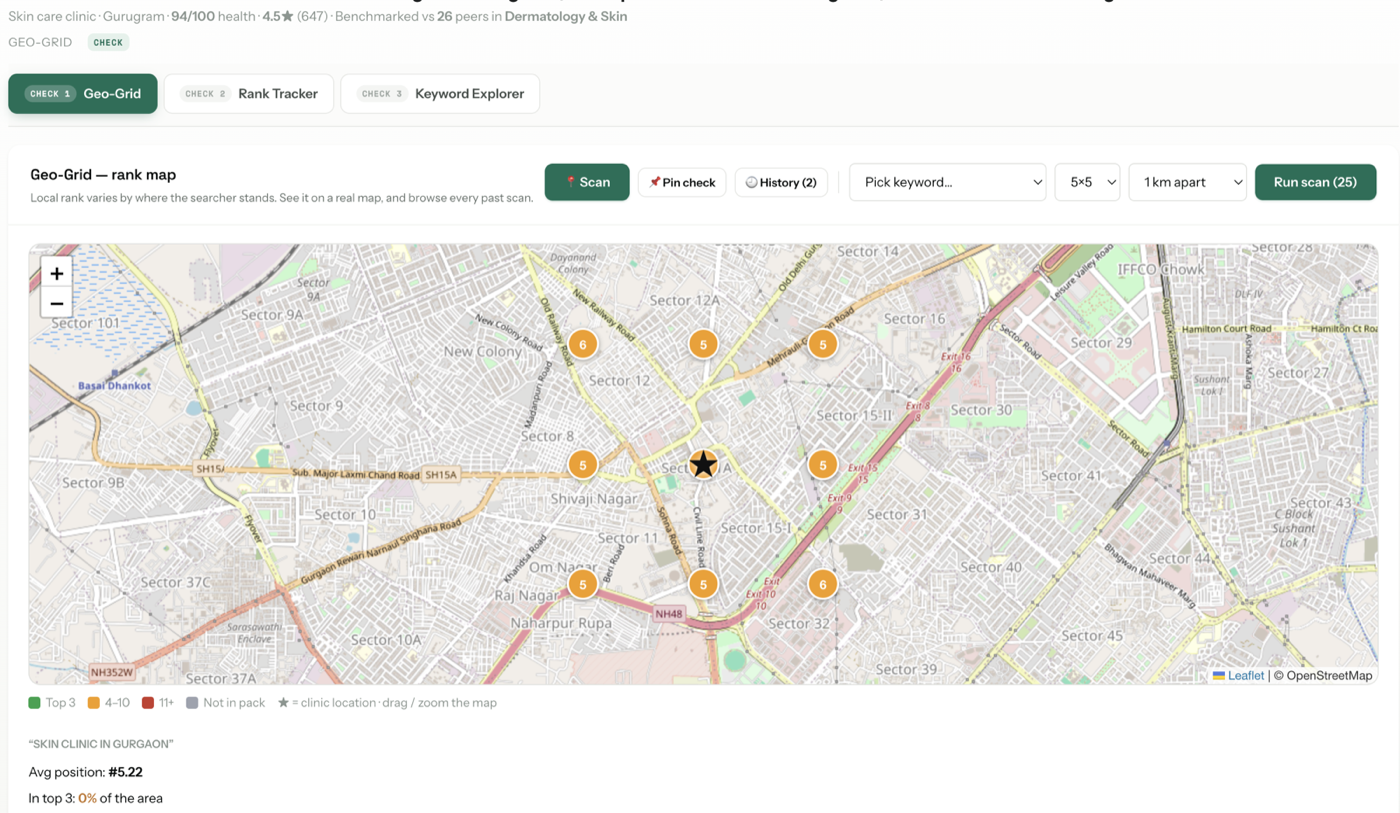
Standardised top-5 competitor identification. For each client profile and primary specialty query, Angryturtle identifies the top-5 competing healthcare businesses that consistently appear in the local pack. Identification uses Geo-Grid scan data across the catchment — competitors are the top-5 profiles that most consistently rank in the top-5 positions across the client's target catchment grid. This produces stable competitor lists that reflect actual competitive threat rather than one-time snapshot rankings.
Aggregate competitor metrics. For each identified competitor, the module tracks: current rating, total review count, review velocity (new reviews per month over trailing 90 days), category coverage (primary + secondary categories), services list depth, description length, Post cadence pattern, photo count, distance from the client's location, and any observable specialty focus. Data refreshes weekly.

Citation-landscape comparison. The module identifies which directories the top-5 competitors are listed in and cross-references against the client's citation footprint. Directories where multiple competitors are listed but the client isn't become high-priority citation-building targets — signalling that these specific directories are the ones that matter for the client's competitive set.
Deep-Dive competitor sweeps. For clients tracking a specific competitor as a strategic threat (a directly-adjacent hospital, a chain that just opened nearby), a Deep-Dive Citation sweep maps that competitor's full citation footprint across all discoverable directories. This produces the most detailed competitive intelligence when direct comparison against a specific rival matters.
What Competitors module reveals that generic tools don't
Three specific pattern types Angryturtle's Competitors module surfaces:
Category-choice mismatch. Client uses "Hospital" primary; three top-5 competitors use specialty-specific categories ("Cardiology Hospital," "IVF Centre," "Dental Clinic"). Client is losing specialty-query traffic to competitors with better category-choice discipline. Recommended action: category correction.
Review-velocity gap. Client averages 8 new reviews per month; top-3 competitors average 25-35 per month. Client is losing on Review Health dimension of sie" style="color:inherit;text-decoration:underline;text-decoration-color:rgba(42,126,200,.5);text-underline-offset:2px">Rank OS. Recommended action: review-collection campaign intensification.

Citation gap concentration. Client is present in 12 directories; top-5 competitors average 24 directories with 6-8 common directories the client is missing. Recommended action: prioritise the specific missing directories over generic citation-building.
Content-cadence gap. Client publishes 1 Post per week; top-5 competitors average 3-5 per week. Client is losing on Freshness dimension. Recommended action: Content Studio cadence increase.
Specialty-depth gap. Client lists 6 services; top-5 competitors list 20-25 services. Client is losing surface area for specific-procedure queries. Recommended action: services list build-out.
Each pattern is specific, evidence-based, and actionable. Generic SEO tools produce comparison data; Angryturtle's Competitors module produces prioritised action lists tied to Rank OS dimensions.
How competitive intelligence flows into monthly reporting
Every ICG healthcare local SEO client's monthly white-label report includes a Competitors section:
Top-5 competitor table. Ratings, review counts, review velocity, category coverage, citation counts side-by-side with the client. Client leadership sees exactly where the client stands versus specific named competitors.
Position changes. Which competitors moved up in the local pack over the past month, which moved down. Signals for the client's leadership about competitive dynamics.
Citation gap closure progress. Which competitor-directories the client added citations in over the past month, which remain gaps.
Content activity comparison. Client's Post cadence and photo activity versus the average across the top-5 competitors.
Strategic recommendations. Based on the specific competitor patterns, the report surfaces prioritised recommendations for the next month — not generic "improve reviews" but "close the 15-review-per-month velocity gap versus Competitor B who accelerated review collection in Q3."
Client leadership reads this in 10-15 minutes and understands exactly which competitors are pressuring the client's position and what the specific tactical response should be.
Competitive intelligence beyond the top-5
For clients with broader competitive concerns (regional chains expanding into the catchment, new competitors entering specific specialty markets), Angryturtle supports:
Custom competitor addition. Clients can add specific competitors beyond the auto-identified top-5. Useful for tracking regional chain competitors, new market entrants, or non-immediate-neighbourhood competitors whose broader positioning matters.
Category-level competitive intelligence. Beyond single-query top-5, clients can see the broader competitive set across their multi-specialty coverage. A multi-specialty hospital sees top-5 cardiology competitors, top-5 IVF competitors, top-5 orthopedic competitors — separate lists per specialty department.
Multi-location competitive intelligence. For hospital chains, each location has its own top-5 competitors reflecting the local market dynamics at that location. Portfolio-level roll-ups show which competitors are most impactful across the chain.
What Competitors module doesn't do
Not real-time competitor monitoring. Refresh cadence is weekly, not continuous. A competitor's specific rank movement during a specific hour isn't tracked.
Not competitor's paid ad monitoring. Google Ads and Meta Ads competitive intelligence for the client's competitors runs through separate tools (Meta Ad Library for Meta ads visibility, Google Ads Auction Insights for paid competitive intelligence). Angryturtle focuses on organic local pack competitors.
Not sentiment analysis of competitor reviews. The module surfaces competitors' review counts and rating trajectories but doesn't analyse the specific themes in competitor reviews. Brand Identity vs Image module handles review-content analysis for the client's own reviews.
Not competitor SEO or backlink analysis. Broader SEO competitive intelligence for competitors' website ranking, backlink profiles, and content depth runs through separate tools (SEMrush, Ahrefs). Angryturtle's Competitors module is local-pack-specific.
Related reading
- Healthcare local SEO agency India — pillar service page
- Angryturtle Rank OS explained — scoring model with Competitors data feeding
- Angryturtle Geo-Grid & Pin Checker explained — geographic rank tracking that identifies competitors
- Angryturtle Ask Maps AIO explained — AI-answer visibility
- Angryturtle Content Studio explained — content operations
- Angryturtle Brand Identity vs Image explained — perception analysis
FAQ


How does Angryturtle identify the top-5 competitors? Geo-Grid scan data across the catchment identifies profiles that consistently rank in top-5 positions for the client's primary specialty queries. Produces stable competitor lists reflecting actual competitive threat rather than one-time snapshot rankings.
How often does competitive data refresh? Weekly for standard tier. More frequently for Enterprise-tier clients with intensive competitive tracking needs.
Can clients add their own competitors to track? Yes. Custom competitor addition beyond auto-identified top-5 enables tracking regional chains, new market entrants, or specific strategic rivals.
Does the module analyse competitor review sentiment? No. Sentiment analysis of competitor reviews is separate. The Competitors module tracks review counts, rating trajectories, and velocity metrics but doesn't extract themes from competitor review corpuses.
How does competitive intelligence feed Rank OS scoring? Rank OS scores the client's absolute strength across five dimensions. Competitive intelligence contextualises those scores — a Rank OS 75 might be dominant if the top-5 competitors average 60, or middling if they average 82. Both need to be seen together.
What's the value of standardised top-5 competitor tracking? Focus. Attempting to compete against all local competitors dilutes execution. Focused competition against the specific top-5 that actually rank in the client's competitive set produces tactical wins faster.
Does the module identify competitors that competitors don't know exist? Sometimes. Emerging competitors (newly-opened practices, recently-expanded chains) that haven't yet accumulated top-5 tracking sometimes appear in the Geo-Grid data before manual competitive scanning would catch them.
How is Deep-Dive Citation different from standard citation tracking? Standard citation tracking monitors the client's own citation footprint across a healthcare-vertical directory list. Deep-Dive Citation maps a specific competitor's full citation footprint across all discoverable directories — the most detailed competitive intelligence when direct rival comparison matters.
Can Competitors module handle multi-location competitive intelligence? Yes. Each location has its own top-5 competitors reflecting local market dynamics. Portfolio-level roll-ups show most-impactful competitors across the chain.
What if a competitor drops out of the top-5? The module tracks the change. Reporting shows which competitors moved up and which moved down over the reporting period. If a specific tracked competitor is no longer in top-5, the client can decide whether to continue tracking them (as a strategic threat that might return) or focus on the current top-5.
Does the module work for very new profiles? Yes, with limitations. Very new profiles may not yet have Geo-Grid history sufficient to identify stable top-5 competitors. Onboarding-period identification uses the initial baseline scan; competitor list stabilises over the first 2-3 months of tracking.
How does ICG use Competitors data with clients? Every ICG healthcare local SEO client's monthly report includes the Competitors section. Client leadership reviews the section to understand specific competitive dynamics. Quarterly strategic reviews for hospital-tier clients include a Competitors deep-dive with strategic response planning.
Book a free 30-minute Brand & Growth Diagnostic.
It's a working session, not a sales pitch — you leave with a written root-cause analysis you can act on, whether or not you engage ICG.
The three platforms
behind every ICG engagement.
Beacon
CAPI middleware that fixes Event Match Quality, translates CRM statuses to Meta-standard events, dedups across channels.
Agency OS
Live client dashboard. GSC, GA4, Google Ads, Meta Ads, IVR calls in one view. Login anytime, not monthly.
Phoenix
Clinic revenue intelligence over your PMS. Daily action queue: Prevent Loss, Maintain & Engage, Grow Revenue. Multi-centre rollout.
Or book a free 30-min audit to see all three in action on your account.
Healthcare brands
that already run on ICG.
A representative slice of the 150+ healthcare brands ICG has delivered for across India. Most engagements remain under NDA.


What ICG clients say · on video.
"Scale up of organic channels and business consulting. ICG has absolute domain authority in their field."
"Working with ICG transformed how we acquire IVF patients in Gurgaon. They understand the fertility journey from inquiry to consult..."
"What Ichelon accomplished — they got all my ideas and worked over 3-4 months to create an amazing, super-customised website."
The intelligence stack behind this playbook.
Every ICG engagement runs on the Search Intelligence Trifecta — Angryturtle for GMB, SIE for search and AI Overview, YODA for YouTube. Live product screens below.
Need help operationalising this?
Every ICG service is healthcare-only, NMC + DPDP-aware, and built around the patient-research patterns that drive Indian healthcare growth in 2026.
Every practice welcome — packages from ₹20,000/mo.
Goals-Driven engagements · Performance-Linked Payout Models available



More from
ICG.
Five trends shaping Indian healthcare marketing through 2027: AI-first patient research, Conversions API adoption, ABDM discovery, the AEO w...
Healthcare AIO is the discipline of getting your clinic or hospital cited inside Google AI Overviews, ChatGPT and Perplexity answers — not j...
Conversational-search advertising places brand messages inside AI chat answers — ChatGPT, Perplexity, Copilot — rather than beside a results...
Stop guessing.
Book a Diagnostic.
30 minutes. Free. With the AI-powered healthcare-only marketing agency 150+ brands already run on. No slides, no pitch, no hard close.


