


Angryturtle Geo-Grid and Pin Checker explained: local rank across the whole catchment, not one number
Geo-Grid is Angryturtle's rank-tracking module that shows how a Google Business Profile ranks across a grid of geographic points spanning the business's catchment, rather than a single position at the pin. Pin Checker is the companion tool that lets an operator test rank at any s
No pitch. Written root-cause diagnosis. AI-powered, healthcare only.
Direct answer
Geo-Grid is Angryturtle's rank-tracking module that shows how a Google Business Profile ranks across a grid of geographic points spanning the business's catchment, rather than a single position at the pin. Pin Checker is the companion tool that lets an operator test rank at any s
TL;DR

Geo-Grid is Angryturtle's rank-tracking module that shows how a Google Business Profile ranks across a grid of geographic points spanning the business's catchment, rather than a single position at the pin. Pin Checker is the companion tool that lets an operator test rank at any specific latitude/longitude or Indian pincode. Both are essential for healthcare local SEO because a healthcare business's catchment usually extends beyond the immediate pin — a cardiac patient may travel 40 km for a specialist, an IVF patient may travel across a metro, a paediatric parent typically stays within 5-10 km. Ranking well at the pin but losing across the catchment produces the exact patient-flow mismatch that quarterly-cycle agencies mistake for stable performance.
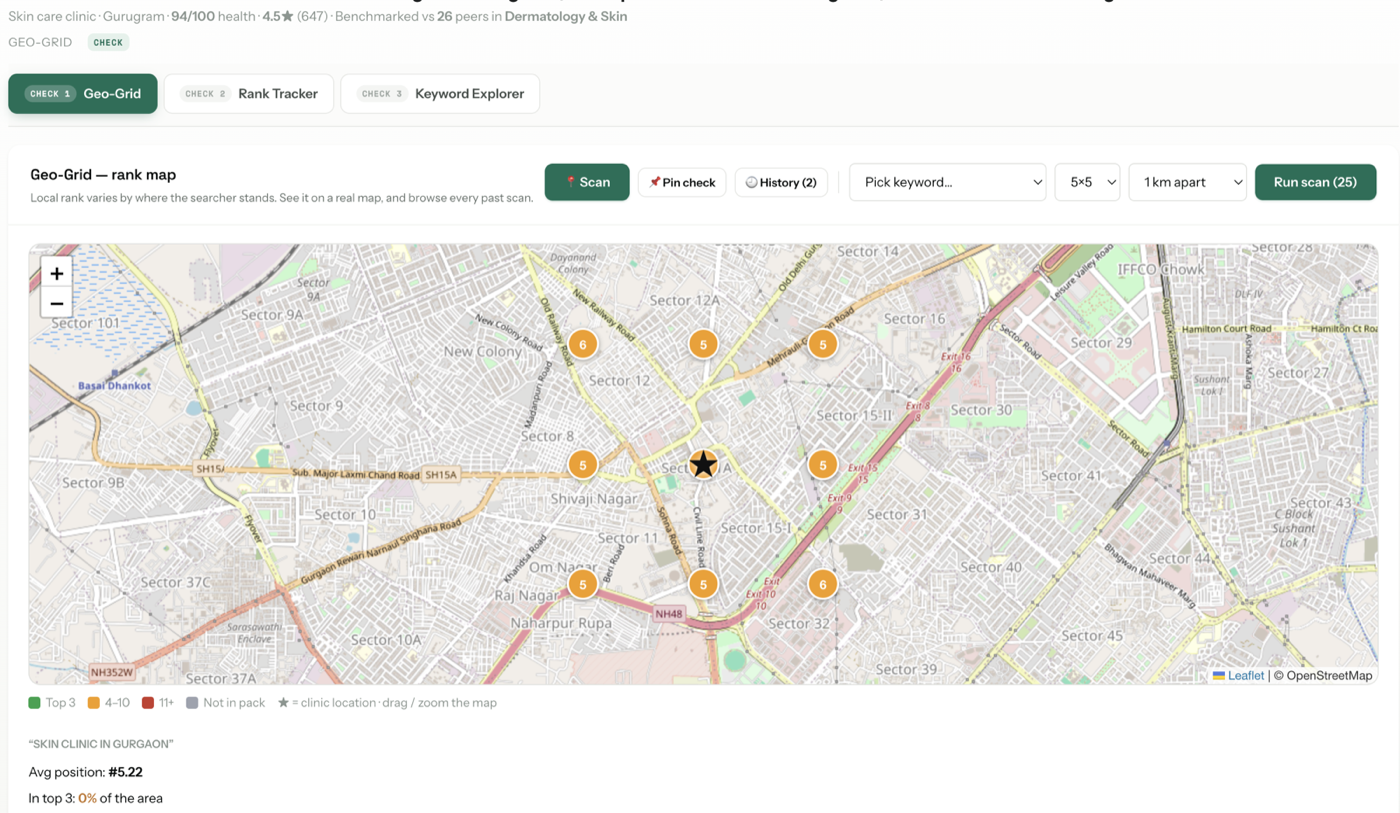
Why single-position rank tracking misleads healthcare businesses
A local rank tracker that shows "you rank #3 for [query]" is showing rank at one specific location — typically the pin of the business itself. That single number obscures a fundamental truth about local ranking: Google's local pack results vary meaningfully by searcher location. A hospital that ranks #2 when the searcher is standing outside the hospital may rank #12 when the searcher is 8 km away. Both are true simultaneously.
For a restaurant with a 2 km catchment, single-position tracking is directionally fine. For a healthcare business with a 15-40 km catchment (depending on specialty), single-position tracking hides half the story. A cardiac hospital in North Bengaluru showing "#2 in the local pack" for "cardiology hospital" hasn't shown you that patients searching from South Bengaluru see the hospital at #14, or that patients in Whitefield see the hospital at #22, or that patients in Sarjapur Road don't see it at all.
Geo-Grid solves this by scanning rank across a configurable lat/long grid — typically a 5x5 or 7x7 grid spanning the business's expected catchment — and displaying results as a heatmap. Green cells show top-3 rank, amber cells show 4-9, red cells show 10+, grey cells show not-in-pack. The operator sees at a glance which parts of the catchment the business dominates and which parts are lost to competitors.
How Geo-Grid actually works
Under the hood, Geo-Grid runs a series of Google search queries against each point in the grid. Each query is executed with the searcher-location parameter set to the specific lat/long of that grid cell. Google's local pack results for each query are captured and the target business's position (or absence) is recorded. The scan produces a matrix of positions across the grid.
For a healthcare business, Angryturtle's Geo-Grid ships with defaults tuned to the specialty:
Dental / GP / paediatric / dermatology: 5x5 grid at ~2 km spacing (covers ~10 km catchment). Patients in these specialties typically stay within a moderate radius.
Cardiology / orthopedic / IVF / cosmetic surgery: 7x7 grid at ~4 km spacing (covers ~28 km catchment). Referred and higher-consideration patients travel farther.
Multi-specialty hospitals / cancer centres: 9x9 grid at ~5 km spacing (covers ~40 km catchment). Multi-city referral flow.
Operators can adjust the grid size and spacing per client based on the actual catchment data. A hospital known to draw patients from a specific neighbouring city may set the grid to include that city as an additional row.
Each Geo-Grid scan consumes one credit per grid cell (a 5x5 scan uses 25 credits, a 7x7 uses 49, a 9x9 uses 81). The credit cost keeps scan cadence reasonable — most healthcare businesses run one scan per priority keyword per month on standard, weekly on high-priority queries in competitive markets.
What Geo-Grid reveals that single-position tracking hides
Three common patterns Geo-Grid surfaces:
Catchment fragmentation. A hospital ranks #1 at the pin, #2-3 in the immediate neighbourhood, but drops to #10+ within 4-5 km. The pattern suggests the profile has good relevance signals but weak geographic authority signals — Google reads the profile as local to a small area but not to the broader catchment. Fixes involve service-area configuration in GBP, geographic keyword coverage in the description and services, and citations in geographically-broader directories.
Competitor dominance in specific pockets. A hospital ranks well overall but loses consistently in one specific direction — say, all cells to the east are red or grey. Investigation typically reveals a specific competitor whose GBP is positioned to dominate that eastern catchment (maybe located in the east, or with strong local citations for eastern neighbourhoods). Fixes involve targeted content and citations for the eastern catchment plus review-flow specifically from eastern patients.
Emerging weakness before the pin drops. A hospital ranks #2 at the pin (unchanged from last quarter) but the geo-grid shows the peripheral cells have shifted from amber to red over two months. This is an early-warning signal — the competitive set is strengthening in the periphery and the pin rank will follow within 2-4 months if unaddressed. Quarterly-cycle agencies miss this signal because they only look at pin rank; Geo-Grid catches it while there's still time to intervene.
Pin Checker: the companion tool for specific-location testing
Geo-Grid scans a systematic grid; Pin Checker tests rank at any specific location the operator specifies. Use cases:
Testing rank in a known referral hotspot. A hospital knows historically that 15% of patients come from a specific Chennai suburb. Pin Checker at that suburb's centre-point shows current rank there — informing whether local SEO investment in that specific area is working.
Competitive intelligence at a competitor's location. Pin Checker at a competing hospital's address shows how the client's business ranks at the competitor's doorstep. Sometimes revealing: the client hasn't optimised for its competitors' immediate catchments.
Pincode-level testing for tier-2 city coverage. For hospitals with tier-2 city or medical-tourism patient flow, Pin Checker at specific pincodes across those cities shows reach beyond the metro catchment.
Diagnostic after a suspected ranking issue. A user reports "I searched from [specific area] and couldn't find you." Pin Checker at that area's coordinates confirms or refutes the report and quantifies the gap.
Pin Checker uses one credit per test — cheaper than a full Geo-Grid scan for spot-check use cases.
Integration with the rest of Angryturtle

Geo-Grid and Pin Checker feed data into sie" style="color:inherit;text-decoration:underline;text-decoration-color:rgba(42,126,200,.5);text-underline-offset:2px">Rank OS scoring indirectly. The Relevance and Entity Authority dimensions of Rank OS both benefit from strong geographic ranking signals — a profile that ranks consistently across its catchment (not just at the pin) signals broader geographic authority to Google's algorithm, which reinforces the ranking further.

Geo-Grid scan history stores the matrix results over time. Month-over-month comparison shows exactly which cells improved and which regressed — proof-of-work reporting that a client's marketing head or hospital CEO reads in ten minutes.
For agencies managing multiple client portfolios, Geo-Grid scans roll up to portfolio-level views showing which clients have the strongest catchment coverage and which need attention. Bulk-scan scheduling lets an operator queue Geo-Grid scans across the portfolio for a specific time (usually end of week or end of month for reporting purposes).
How ICG uses Geo-Grid for healthcare clients
Every ICG healthcare local SEO client gets a Geo-Grid baseline scan at engagement kick-off — one scan per priority specialty query, one scan per location for multi-location clients. The baseline establishes where each client sits before ICG's execution begins.
Monthly Geo-Grid scans on the primary specialty queries (typically 3-5 queries per client depending on specialty and geographic scope) track ranking movement across the catchment over time. The scan history goes into every monthly white-label report as visual proof of ranking improvement.
Weekly Geo-Grid scans on high-priority queries in high-competition markets (Mumbai, Bengaluru, Delhi metros for competitive specialties) provide faster feedback on execution impact. When an operator makes a category correction or publishes a substantive Google Post cadence, the next weekly Geo-Grid scan shows whether the change moved rank across the catchment.
For medical-tourism-focused hospitals with catchments spanning multiple cities, Pin Checker scans across the specific cities the hospital draws patients from show reach beyond the metro catchment. These scans are particularly useful for hospitals with international patient acquisition ambitions.
What Geo-Grid doesn't do
Geo-Grid measures rank at points; it doesn't measure actual patient flow from those points. Ranking well in a specific area means the profile is visible when a patient searches from there; whether patients actually search and convert from that area depends on population density, healthcare-seeking behaviour patterns, competitive alternatives, and the profile's ability to convert click-to-consultation. Ranking is necessary but not sufficient.
Geo-Grid is not real-time competitive intelligence. A competitor's specific ranking movements at specific cells aren't monitored continuously; each scan is a snapshot in time. For continuous competitive monitoring, Angryturtle's Competitors module tracks the top-5 competing businesses' aggregate metrics (rating, review count, category changes) over time.
Geo-Grid consumes credits per cell. Ambitious scan cadences (daily grids at 9x9 for many queries) become expensive quickly. Angryturtle's default cadence recommendations balance scan frequency against credit budget.
Related reading
- Healthcare local SEO agency India — ICG's pillar service page
- Angryturtle Rank OS explained — the scoring model that Geo-Grid feeds into
- Angryturtle Ask Maps AIO explained — the AI-answer visibility dimension
- How to rank a hospital on Google Maps in India — the six controllable signals including geographic authority
- GBP optimization for multi-specialty hospitals — the department-level playbook
FAQ
What is a Geo-Grid rank scan? A rank scan that tests position across multiple geographic points in a grid, rather than a single position at the business's pin. Reveals catchment-level ranking patterns that single-position tracking hides.
How large should a Geo-Grid be for a healthcare business? Depends on specialty catchment. Dental, GP, paediatric, dermatology: 5x5 grid at ~2 km spacing. Cardiology, orthopedic, IVF, cosmetic surgery: 7x7 at ~4 km spacing. Multi-specialty hospitals and cancer centres: 9x9 at ~5 km spacing. Angryturtle ships specialty defaults; operators tune per client.
What's the difference between Geo-Grid and Pin Checker? Geo-Grid scans a systematic grid across the catchment. Pin Checker tests rank at any specific location the operator specifies. Geo-Grid for catchment mapping; Pin Checker for spot-check diagnostics.
How often should Geo-Grid scans run? Monthly on primary specialty queries for most healthcare businesses. Weekly on high-priority queries in high-competition markets. Baseline scan at engagement kick-off; then ongoing cadence per client.
What do the coloured cells mean? Green = top-3 in the local pack (visible in the map pack). Amber = 4-9 (visible if the user expands or scrolls). Red = 10+ (functionally invisible). Grey = not-in-pack (profile doesn't rank at all for that query at that location).
Does Geo-Grid consume Angryturtle credits? Yes. One credit per grid cell. A 5x5 scan uses 25 credits, 7x7 uses 49, 9x9 uses 81. Pin Checker uses 1 credit per test. Credit budgets are per profile in Solo tier, per agency in Agency tier.
Can Geo-Grid track competitors' rankings? Angryturtle's Competitors module tracks top-5 competing businesses' aggregate metrics. Geo-Grid itself scans the client's ranking; competitor-specific geographic ranking would require running Geo-Grid on the competitor's profile (which is possible if the competitor is added as a monitored profile).
What if my patient catchment extends beyond a standard grid? Grid size and spacing are configurable. A hospital serving multiple cities can use a very wide grid or run multiple Pin Checker scans across the specific cities patients come from. Ask Maps' catchment configuration also affects how Rank OS reads catchment.
How does Geo-Grid data flow into Rank OS? Indirectly. Geographic ranking strength contributes to the Relevance and Entity Authority dimensions of Rank OS. A profile ranking consistently across a wide catchment signals stronger geographic authority to Google's algorithm, reinforced by the ranking outcome data Geo-Grid measures.
Can I export Geo-Grid data? Yes. Scan results export to CSV via the Angryturtle interface. White-label reports include Geo-Grid heatmap visualisations for client-facing deliverables. Historical scans stored per profile allow trajectory analysis over time.
Does Geo-Grid work outside India? Yes, technically. Any lat/long point globally can be scanned. Angryturtle's default configuration is India-first, but the underlying rank-tracking infrastructure works globally. Non-India buyers would need to configure grids per the specific catchment shape of their markets.
How reliable is the Geo-Grid rank data? Grounded in SearchApi.io's rank-checking infrastructure, which powers many local SEO tools. Data reliability is high for point-in-time snapshots; the caveat is that Google's local ranking varies over hours and days, so any single scan reflects the state at that specific moment. Trend analysis across multiple scans is more informative than any single scan.
Book a free 30-minute Brand & Growth Diagnostic.
It's a working session, not a sales pitch — you leave with a written root-cause analysis you can act on, whether or not you engage ICG.
The three platforms
behind every ICG engagement.
Beacon
CAPI middleware that fixes Event Match Quality, translates CRM statuses to Meta-standard events, dedups across channels.
Agency OS
Live client dashboard. GSC, GA4, Google Ads, Meta Ads, IVR calls in one view. Login anytime, not monthly.
Phoenix
Clinic revenue intelligence over your PMS. Daily action queue: Prevent Loss, Maintain & Engage, Grow Revenue. Multi-centre rollout.
Or book a free 30-min audit to see all three in action on your account.
Healthcare brands
that already run on ICG.
A representative slice of the 150+ healthcare brands ICG has delivered for across India. Most engagements remain under NDA.


What ICG clients say · on video.
"Scale up of organic channels and business consulting. ICG has absolute domain authority in their field."
"Working with ICG transformed how we acquire IVF patients in Gurgaon. They understand the fertility journey from inquiry to consult..."
"What Ichelon accomplished — they got all my ideas and worked over 3-4 months to create an amazing, super-customised website."
Need help operationalising this?
Every ICG service is healthcare-only, NMC + DPDP-aware, and built around the patient-research patterns that drive Indian healthcare growth in 2026.
Every practice welcome — packages from ₹20,000/mo.
Goals-Driven engagements · Performance-Linked Payout Models available



More from
ICG.
Five trends shaping Indian healthcare marketing through 2027: AI-first patient research, Conversions API adoption, ABDM discovery, the AEO w...
Healthcare AIO is the discipline of getting your clinic or hospital cited inside Google AI Overviews, ChatGPT and Perplexity answers — not j...
Conversational-search advertising places brand messages inside AI chat answers — ChatGPT, Perplexity, Copilot — rather than beside a results...
Stop guessing.
Book a Diagnostic.
30 minutes. Free. With the AI-powered healthcare-only marketing agency 150+ brands already run on. No slides, no pitch, no hard close.


