


Angryturtle Brand Identity vs Image explained: how healthcare brands see the gap between what they say and what patients actually experience
Brand Identity vs Image is Angryturtle's proprietary module that mirrors a healthcare brand's canonical positioning about-us prose, tagline, mission, service claims against how patients actually perceive the brand in reviews and testimonials. The gap between the two — what a hosp
No pitch. Written root-cause diagnosis. AI-powered, healthcare only.
Direct answer
Brand Identity vs Image is Angryturtle's proprietary module that mirrors a healthcare brand's canonical positioning about-us prose, tagline, mission, service claims against how patients actually perceive the brand in reviews and testimonials. The gap between the two — what a hosp
TL;DR

Brand Identity vs Image is Angryturtle's proprietary module that mirrors a healthcare brand's canonical positioning (about-us prose, tagline, mission, service claims) against how patients actually perceive the brand in reviews and testimonials. The gap between the two — what a hospital claims to be versus what patients say it is — is often the operational fix hidden inside a marketing dashboard. A hospital that positions itself as "the fastest emergency response in the city" but whose reviews consistently mention long waiting times has an Identity-Image gap that no amount of paid promotion will close. Local SEO can improve ranking; only operational fixes can close the identity-image gap. ICG's healthcare local SEO service surfaces this gap for every client as part of the standard onboarding audit and monthly reporting — informing the operational conversation beyond marketing. This module is unique to Angryturtle; no generic local SEO tool, listing-syndication tool or review-management platform offers an equivalent.
Why the identity-image gap matters more than most healthcare brands realise
Every healthcare brand has a stated identity — what the marketing team, leadership, and website content say the brand is. "Patient-centered care," "cutting-edge technology," "compassionate expertise," "transparent pricing," "shortest wait times in the city" — these are the identity claims most healthcare brands make.
Every healthcare brand also has an actual image — what patients experience and communicate about the brand through reviews, testimonials, word-of-mouth, and social media. Sometimes the identity and image align tightly (the brand delivers what it claims). Sometimes they diverge (the brand claims one thing, patients experience another).
When identity and image align, marketing works normally — brand positioning, paid ads, content, and reviews reinforce each other into stronger patient acquisition and retention over time. When identity and image diverge, marketing becomes progressively less effective because every claim the brand makes rings hollow against the accumulated review evidence. Prospective patients read the reviews before booking; if reviews contradict the marketing claims, the marketing loses credibility.
The gap is usually invisible from inside the organisation. Marketing teams see the identity (they wrote it). Operations teams see the daily reality (they live it). Patients see the image (they experience it). Rarely does anyone see all three side by side.
Brand Identity vs Image surfaces the gap by mirroring the two.
How the module works
Two-part analysis:
Identity extraction. Angryturtle reads the brand's canonical identity from the practice's own materials — about-us page text, homepage tagline, service page positioning statements, GBP business description, mission and values pages. This is what the brand says about itself.
Image extraction from reviews. Angryturtle analyses the Google reviews corpus (and other review sources where available) using AI to extract recurring themes — what patients consistently praise, what they consistently complain about, what they mention as expected versus surprising, what they compare against, what they wish were different. This is what patients actually experience.
Gap analysis. The two sides get compared systematically. Where they align, the report notes "identity confirmed by patient experience." Where they diverge, the report flags "identity claim not supported by patient experience" with specific supporting evidence (recurring review themes that contradict the claim). Where patients praise something the brand doesn't emphasise, the report notes "underleveraged patient-experience strength" — a positioning opportunity.
The output is a written narrative report, not just metrics. Marketing leadership reads it in 15-20 minutes and gets a clear read on which claims to double down on, which to abandon, and which operational issues need fixing before any marketing investment will move the needle.
Common gap patterns in Indian healthcare
Patterns Angryturtle's Brand Identity vs Image analysis surfaces repeatedly across the ICG portfolio:
The "transparent pricing" gap. Hospital claims transparent pricing; reviews consistently mention surprise costs, unexplained billing charges, or discovered fees at discharge. The claim doesn't match the practice. Fix: publish actual pricing schedules where compliance permits, brief front-desk staff on cost communication, ensure billing transparency reaches every patient touchpoint.
The "personalised care" gap. Practice positions itself as "personalised care" or "boutique medical experience"; reviews mention feeling rushed, staff-to-patient ratios feeling impersonal, or care feeling standardised. Fix: adjust consultation duration expectations, brief clinical staff on patient interaction pacing, evaluate scheduling density.
The "short wait times" gap. Practice claims "no waiting" or "same-day service"; reviews mention long waits, delayed appointments, or scheduling difficulties. Fix: operational — either improve actual wait times or drop the claim to align identity with reality.
The "advanced technology" gap. Practice claims cutting-edge or advanced technology; reviews rarely mention technology at all. Fix: either make the technology more visible to patients (during-visit explanation, waiting-area technology showcases) or evaluate whether the technology claim is genuinely differentiated.
The "compassionate team" gap. Practice claims compassionate care; reviews mention specific staff members as compassionate but the practice's marketing doesn't name them. Fix: leverage the specific-staff compassionate reviews in marketing (with appropriate consent framing), name the celebrated team members in about-us content, feature them in Google Posts.
Underleveraged strengths. Practice's about-us doesn't emphasise something patients consistently praise — a specific specialist's bedside manner, a specific facility feature, a specific process improvement. Fix: make the praised element central to the practice's marketing narrative.
How ICG uses Brand Identity vs Image for clients
The module runs as part of every ICG healthcare local SEO client's engagement kick-off:
Onboarding audit. Initial Brand Identity vs Image analysis produces a written report showing current identity, current image (from existing review corpus), gap patterns, and prioritised operational recommendations. This report goes to the client's marketing leadership and, when the gaps involve operational issues, to the hospital's operational leadership.
Monthly refresh. As new reviews accumulate, the image analysis refreshes. Emerging themes (new positive patterns to leverage, new complaint patterns to address) surface in monthly reports.
Quarterly deep-dive. For hospital-tier clients, a quarterly strategic review examines the Brand Identity vs Image trajectory over the quarter — has the gap narrowed? which fixes moved the needle? what new gaps have emerged?
Cross-team distribution. The Identity-Image report is one of the few marketing deliverables that reaches beyond the marketing team. Operations, patient experience, and clinical leadership often use the findings to inform non-marketing decisions.
What Brand Identity vs Image is not
Not a substitute for direct patient feedback. Reviews are self-selected — patients who write reviews are typically at the tails of experience (very positive or very negative). Middle-experience patients often don't review. Systematic patient satisfaction surveys and NPS programs remain necessary for balanced patient experience measurement. Brand Identity vs Image is a specific tool for the marketing-perception dimension, not a complete patient experience system.
Not a substitute for market research. Understanding market perception beyond the practice's own patients (potential patients, referring physicians, competitive positioning) requires additional research beyond the review corpus.
Not a real-time operational tool. Review-based image analysis has a lag — themes emerge over weeks and months of accumulating reviews. Real-time operational feedback needs different systems (patient exit surveys, staff feedback loops, complaint-management tools).
Why competitors don't offer this
Generic local SEO tools, listing-syndication tools and review-management platforms all offer review sentiment analysis of various depths. Sentiment analysis maps reviews to positive/negative/neutral emotional scores. This is different from Brand Identity vs Image analysis.
Sentiment analysis tells you: "43% of reviews are positive, 12% negative, 45% neutral." Useful but limited — it tells you the temperature of the review corpus without telling you what to do about it.
Brand Identity vs Image tells you: "You position as X. Reviews say your patients experience Y. The gap suggests operational area Z needs attention." Actionable in a way sentiment analysis is not.
The reason competitors don't offer this: it requires healthcare-specific context. What counts as an "identity claim" for a hospital is different from a restaurant or a lawyer. What patients typically praise in healthcare is different from what they praise in other services. Angryturtle's healthcare-first design enables this module; generic tools' cross-vertical positioning doesn't.
Related reading
- Healthcare local SEO agency India — pillar service page powered by Angryturtle
- Angryturtle Rank OS explained — the scoring model
- Angryturtle Ask Maps AIO explained — AI-answer visibility
- Angryturtle Geo-Grid & Pin Checker explained — geographic rank tracking
- Angryturtle Content Studio explained — content operations
FAQ
What is Brand Identity vs Image? Angryturtle's proprietary module that mirrors a healthcare brand's canonical positioning against how patients actually perceive the brand in reviews. Reveals the gap between claimed identity and actual patient experience.
How is this different from review sentiment analysis? Sentiment analysis measures emotional temperature of reviews (positive/negative/neutral). Brand Identity vs Image compares reviews against the brand's own positioning claims to reveal specific gaps and operational implications. Actionable in a way sentiment alone is not.
What kinds of gaps does the module typically surface? Common patterns: transparent pricing claimed but reviews mention surprise costs, personalised care claimed but reviews mention feeling rushed, short wait times claimed but reviews mention delays, advanced technology claimed but reviews rarely mention it, compassionate care claimed but reviews specifically name individual compassionate staff members not featured in marketing.
Who at the healthcare business should see the report? Marketing leadership always. Operations and clinical leadership when the gaps involve non-marketing fixes (wait time complaints, billing confusion, staff interaction issues).
How often does the analysis refresh? Monthly for ongoing engagement. Onboarding baseline plus quarterly deep-dive for hospital-tier clients.
Does Brand Identity vs Image replace patient satisfaction surveys? No. Reviews are self-selected (patients at experience extremes typically review; middle-experience patients often don't). Systematic satisfaction surveys and NPS programs remain necessary for balanced patient experience measurement.
Can competitors offer this feature? Not currently. Requires healthcare-specific context — what counts as an identity claim for a hospital differs from other verticals, what patients praise in healthcare differs, and gap patterns need healthcare-vertical framing to be actionable. Angryturtle's healthcare-first design enables it.
What's the ROI on closing identity-image gaps? Depends on the gap. Fixing a "transparent pricing" gap by publishing actual pricing schedules typically produces measurable conversion improvement within 8-12 weeks. Fixing "wait time" gaps requires operational change with variable timelines. Fixing "advanced technology" gaps by making technology more visible produces marketing efficiency improvement rather than direct conversion lift.
Does the analysis work for solo practices as well as hospitals? Yes. Solo practices have simpler identity narratives (usually the practitioner's professional positioning) and smaller review corpora but the same gap patterns apply. Analysis scales down to solo practice appropriately.
How does the module handle negative-review outliers? Recurring themes matter, not single reviews. A single negative review complaining about a specific issue doesn't create an identity-image gap; a pattern of 15 negative reviews all mentioning the same issue does. The analysis surfaces recurring patterns, not outliers.
Can the module be customised per client? Yes at Agency and Enterprise tiers. Identity extraction can incorporate custom brand assets beyond default web sources. Analysis can be weighted toward specific specialty focus. Reporting can integrate with existing marketing dashboards.
What if the analysis reveals uncomfortable findings? That's usually the point. Comfortable findings mean the identity and image align — good, but no action required. Uncomfortable findings mean action is needed. Marketing leadership can either address the gap (operational fix, marketing repositioning) or ignore it (accept the gap and its consequences).
Book a free 30-minute Brand & Growth Diagnostic.
It's a working session, not a sales pitch — you leave with a written root-cause analysis you can act on, whether or not you engage ICG.
The three platforms
behind every ICG engagement.
Beacon
CAPI middleware that fixes Event Match Quality, translates CRM statuses to Meta-standard events, dedups across channels.
Agency OS
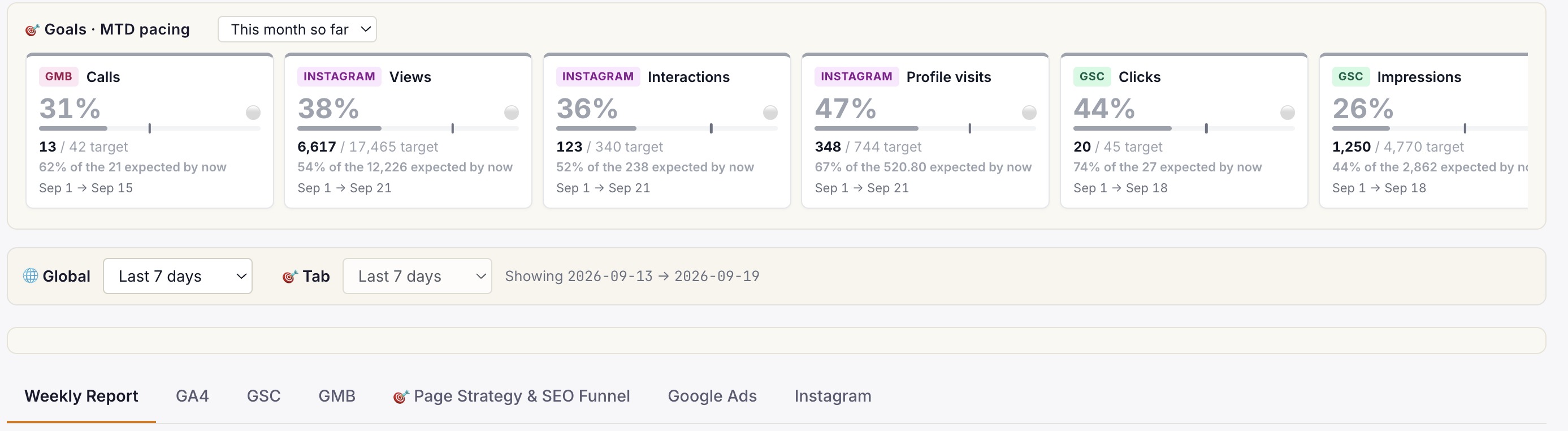
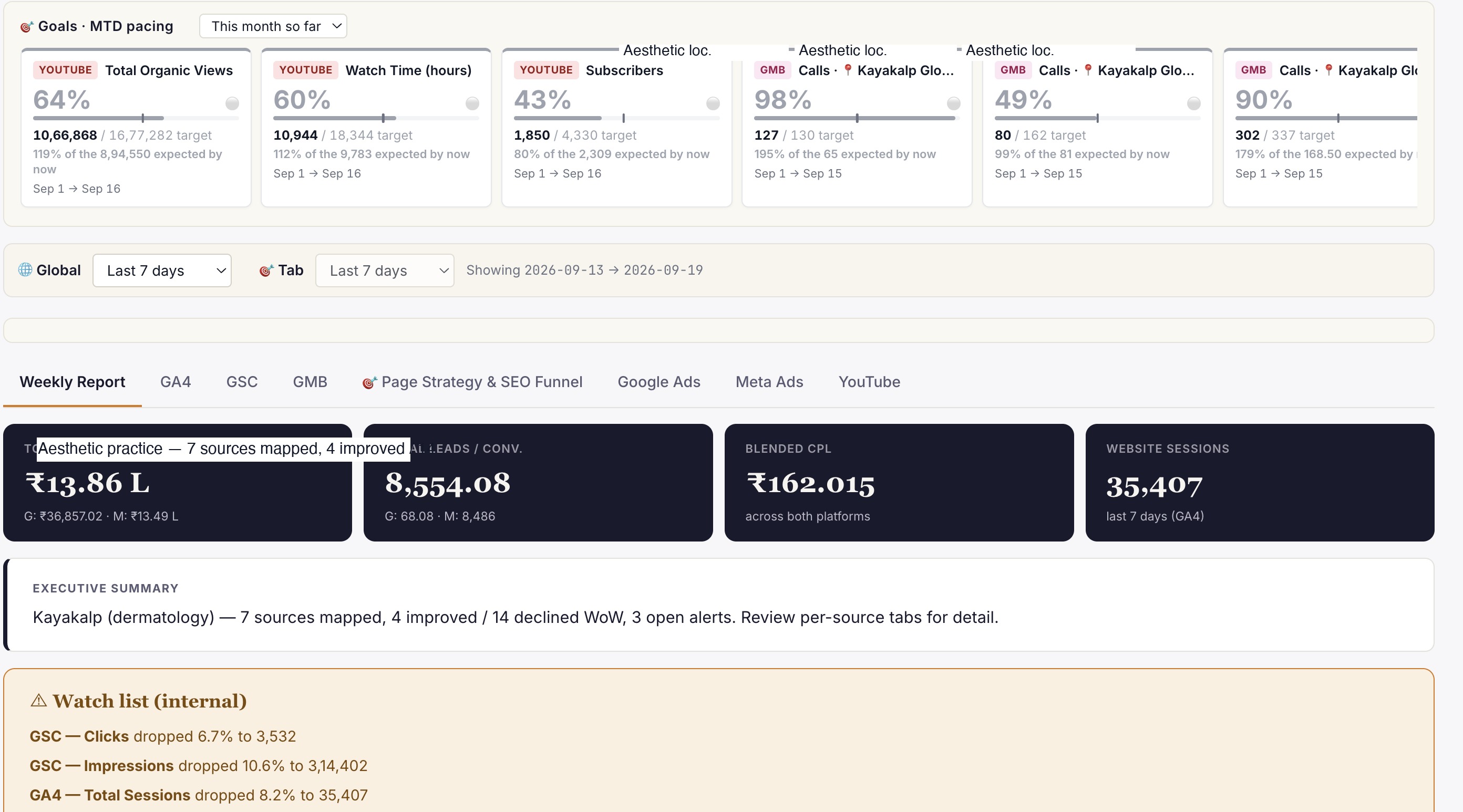
Live client dashboard. GSC, GA4, Google Ads, Meta Ads, IVR calls in one view. Login anytime, not monthly.
Phoenix
Clinic revenue intelligence over your PMS. Daily action queue: Prevent Loss, Maintain & Engage, Grow Revenue. Multi-centre rollout.
Or book a free 30-min audit to see all three in action on your account.
Healthcare brands
that already run on ICG.
A representative slice of the 150+ healthcare brands ICG has delivered for across India. Most engagements remain under NDA.


What ICG clients say · on video.
"Scale up of organic channels and business consulting. ICG has absolute domain authority in their field."
"Working with ICG transformed how we acquire IVF patients in Gurgaon. They understand the fertility journey from inquiry to consult..."
"What Ichelon accomplished — they got all my ideas and worked over 3-4 months to create an amazing, super-customised website."
Need help operationalising this?
Every ICG service is healthcare-only, NMC + DPDP-aware, and built around the patient-research patterns that drive Indian healthcare growth in 2026.
Every practice welcome — packages from ₹20,000/mo.
Goals-Driven engagements · Performance-Linked Payout Models available
More from
ICG.
Five trends shaping Indian healthcare marketing through 2027: AI-first patient research, Conversions API adoption, ABDM discovery, the AEO w...
Healthcare AIO is the discipline of getting your clinic or hospital cited inside Google AI Overviews, ChatGPT and Perplexity answers — not j...
Conversational-search advertising places brand messages inside AI chat answers — ChatGPT, Perplexity, Copilot — rather than beside a results...
Stop guessing.
Book a Diagnostic.
30 minutes. Free. With the AI-powered healthcare-only marketing agency 150+ brands already run on. No slides, no pitch, no hard close.


