


Angryturtle Ask Maps question bank per specialty: how the AIO module sources, scores and expands the questions Google AI Overviews actually cite for fertility, dental, ortho and other healthcare verticals
Angryturtle Ask Maps question bank per specialty — the mechanics of how the AIO module builds a healthcare-vertical-specific question bank from GBP Q&A, Google Autocomplete, People Also Ask, patient forum data and first-party clinic research, how it scores each question for AIO Readiness, and how clinic operators add their own questions.
No pitch. Written root-cause diagnosis. AI-powered, healthcare only.
Direct answer
Angryturtle Ask Maps question bank per specialty — the mechanics of how the AIO module builds a healthcare-vertical-specific question bank from GBP Q&A, Google Autocomplete, People Also Ask, patient forum data and first-party clinic research, how it scores each question for AIO R...
TL;DR
Angryturtle Ask Maps question bank per specialty is the piece healthcare marketing directors use when they want their clinic to be the source Google AI Overviews cites, not the source scrolling under the answer. The Ask Maps module builds a question bank tuned to each specialty — fertility, dental, ortho, derm, cardio, oncology and more — sourced from five real signals rather than a generic keyword list. This piece documents where the questions actually come from, how each question is scored for AIO Readiness, and how a clinic operator adds specialty-specific and clinic-specific questions to strengthen citation eligibility. It sits inside the broader healthcare local SEO in India service, and complements the Rank OS scoring model on the AIO Readiness dimension.
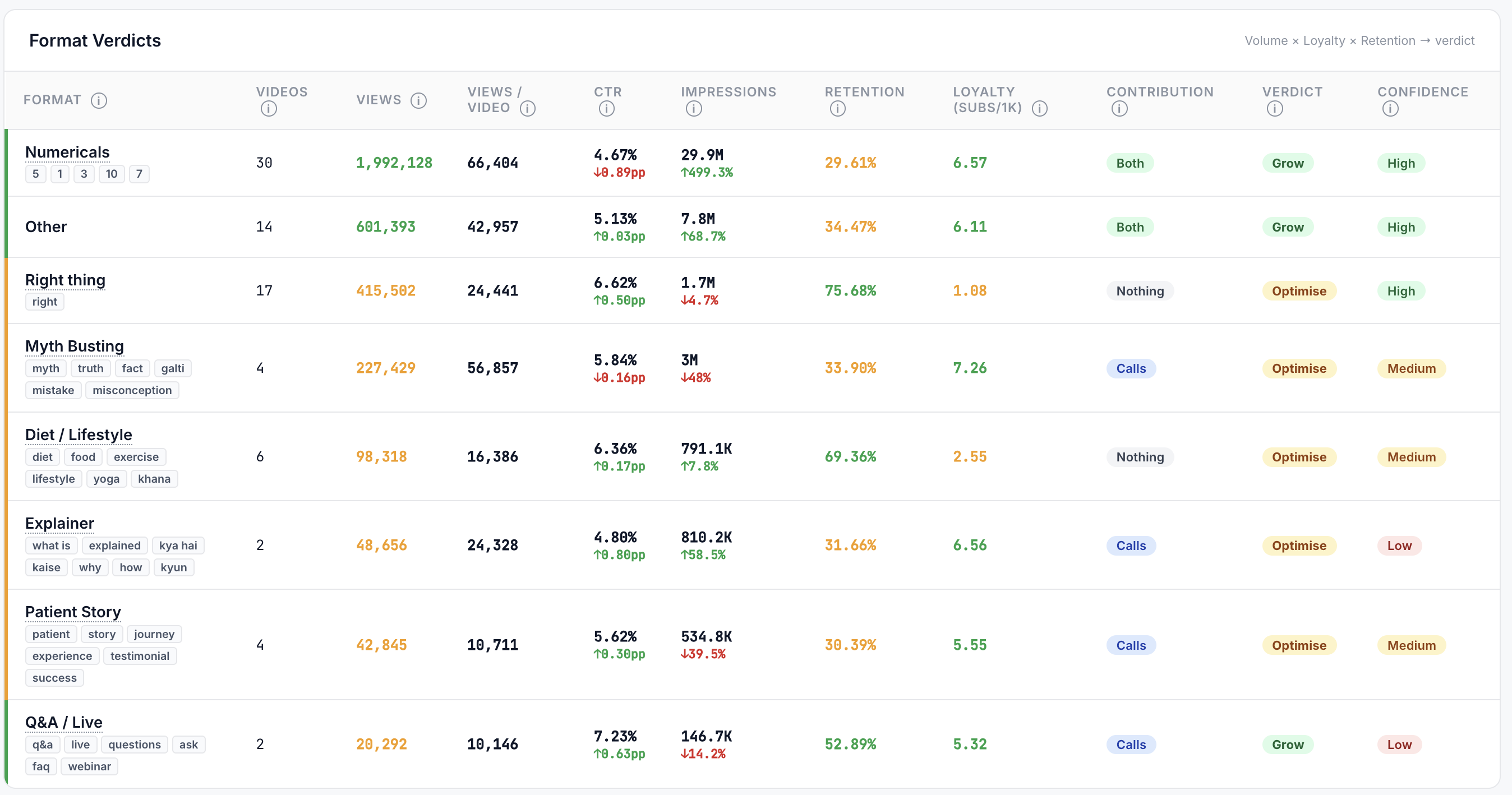
 angryturtle/05-demand-clusters.png" alt="Angryturtle Demand Clusters —
 Why per-specialty question banks matter for AIO
Google AI Overviews cite specific sources for specific questions. The citation logic is question-shaped, not keyword-shaped. Being cited for "IVF cost in Mumbai" requires the source to demonstrate a clean, structured, authoritative answer to that specific question. A generic clinic page that mentions the words "IVF" and "Mumbai" without answering the question directly does not earn citation.
The problem for most healthcare businesses is that the actual patient question landscape inside each specialty is much larger and more specific than the marketing team assumes. A fertility clinic thinks about "IVF cost" as a single question. Patients actually ask "IVF cost first cycle vs second cycle", "IVF cost with ICSI in Delhi", "IVF success rate at 35", "does insurance cover IVF in India", "IVF cost for donor egg" and hundreds of adjacent specific questions.
A per-specialty question bank captures the full landscape rather than the marketing team's assumption. Ask Maps builds that landscape from real signals, scores each question for the client's citation eligibility, and turns AIO optimisation from a guessing exercise into a systematic content plan.
Source one — Google Business Profile Q&A
Every clinic's own GBP Q&A section is a first-party question source. Patients ask specific questions on the profile — many go unanswered. The unanswered questions are the highest-value signal because they are questions Google has already surfaced to real patients, and the practice has failed to respond.
Ask Maps sweeps the GBP Q&A section on the client profile and on the top-5 competitor profiles. Questions asked repeatedly across competitors indicate specialty-wide interest. Questions asked on the client's profile but not on competitors indicate emerging or client-specific interest. Both belong in the question bank.
The module also flags high-value unanswered questions in the GBP Q&A queue so the practice can respond directly on the profile — an intervention that improves both patient experience and the Freshness dimension of the profile's Rank OS score. See our GBP Q&A strategy guide for the strategic layer.
Source two — Google Autocomplete
Google Autocomplete surfaces the questions Google itself considers most-common completions. Ask Maps queries Autocomplete systematically across a specialty's query surface — city, procedure, cost, specialist, comparison, and dozens of other query types — and captures the returned completions as candidate questions.
Autocomplete has three specific values:
- Volume signal. Autocomplete surfaces high-volume queries specifically. Any question Google chooses to autocomplete is a query that carries meaningful volume.
- Freshness signal. Autocomplete refreshes with search trends. Emerging questions appear in Autocomplete before they show up in older keyword databases.
- Local signal. Autocomplete varies by city and user location. Ask Maps queries with city-specific location signals to capture location-tuned autocomplete patterns for the client's catchment.
Autocomplete-sourced questions typically become high-priority content targets because they combine volume signal with AIO-citation eligibility once the content is structured correctly.
Source three — People Also Ask
Google's People Also Ask (PAA) boxes are already the model for how Google surfaces question-answer content in the SERP. PAA questions are exactly the format AIO cites from. Ask Maps sweeps PAA boxes across the specialty's core query surface and captures every PAA question that appears.
Sub-behaviours worth understanding:
- PAA expansion. Clicking a PAA question surfaces additional related PAA questions. Ask Maps traverses PAA expansion chains to capture the deeper question landscape, not just the top-level PAA slots.
- PAA answer sources. The current source Google cites for each PAA question is captured. If a specific competitor is dominating PAA citations across the specialty, that is a competitive-intelligence signal.
- PAA rotation. Google rotates PAA questions over time. Ask Maps refreshes PAA data weekly to capture rotation patterns and identify newly-surfaced questions worth targeting.
PAA questions have the highest AIO citation eligibility of any question source because they are structurally the same as questions AI Overviews summarise. Content that ranks in PAA has a strong statistical chance of also being cited in AI Overviews for the same or adjacent queries.
Source four — patient forums and Q&A sites
Patient-generated question data lives on Quora, Reddit r/india, MedHelp, PatientsLikeMe and specialty-specific forums. These are the questions patients ask when they are researching but are not yet booking. They surface the anxieties, comparisons and clarifications that shape the pre-booking journey.
Ask Maps sweeps patient forum data with a specialty-relevance filter — only questions that map to the specialty's scope are captured. Aggregation happens across many forum threads to identify recurring questions rather than one-off queries.
Forum-sourced questions typically have lower search volume than Autocomplete or PAA questions individually, but their combined footprint is large and their AIO citation eligibility is high because they map to genuinely-asked patient concerns. A fertility clinic answering the top 40 forum-sourced questions typically sees measurable AI Overview citation growth within 60-90 days.
Patient privacy matters here — Ask Maps captures only the question text, never the questioner's identity or personal detail. Aggregated question data respects the DPDP Act 2023 framework.
Source five — first-party clinic research
The most defensible question source is the clinic's own patient-interaction data — the questions actual patients ask during consultations, front-desk conversations, patient calls and post-visit follow-ups. This data lives in the practice, not on the internet.
Ask Maps supports first-party question ingestion in three ways:
- Front-desk log intake. Clinic operators can submit questions patients ask at reception, phone lines, or WhatsApp channels. These questions are highly specific and highly indicative of the actual patient landscape.
- Consultation intake. Doctors and clinical staff can flag questions patients ask during consultations that reveal common information gaps. These become the highest-authority questions for the practice's content plan because they carry medical expertise directly.
- Structured patient surveys. Post-visit surveys or NPS follow-ups can include a "what did you want to know but couldn't find?" question that feeds Ask Maps directly.
First-party questions carry a heavier weighting in the question bank because they are unique to the practice and cannot be scraped by competitors from public sources. A practice that ingests 50-100 first-party questions per quarter builds a durable content moat.
How Angryturtle scores AIO Readiness per question
Every question in the bank gets an AIO Readiness score for the specific practice. The score answers "how likely is our practice to be cited by AI Overviews for this specific question, based on our current content and profile signals?" Sub-signals inside the score include structured answer content, entity clarity, review authority, freshness and schema coverage. The AIO Readiness scoring deep dive covers the sub-signal methodology in detail.
Scores split into four bands mirroring sie" style="color:inherit;text-decoration:underline;text-decoration-color:rgba(42,126,200,.5);text-underline-offset:2px">Rank OS bands — 0-40 Poor (the practice is effectively invisible for this question), 41-70 Developing (the practice has partial signals but is unlikely to be cited), 71-85 Healthy (the practice is a candidate citation source and appears in AI Overviews inconsistently), 86-100 Elite (the practice is a preferred citation source and typically appears in AI Overviews for this question). The band determines the operator's next move.
Adding clinic-specific questions
Every practice has questions that matter specifically to it — questions about a unique procedure the practice offers, a specialist's specific expertise, a clinical trial the practice is participating in, or a service that competitors do not offer. Ask Maps supports clinic-specific question addition through three routes:
Direct entry. Operators add questions manually with the specific answer they want cited. The system scores the current AIO Readiness for the added question and identifies the specific content or profile gaps blocking citation.
Content-driven derivation. Operators point Ask Maps at a specific piece of the practice's content (a service page, a doctor bio, a treatment explainer) and Ask Maps derives the questions that content could plausibly answer for AI Overview citation.
Competitive replication. Operators mark a specific competitor as a strategic threat and Ask Maps identifies the questions where that competitor is dominating AIO citation, so the practice can build competing content directly.
Clinic-specific questions typically become the highest-return content investments because they carry brand differentiation as well as AIO citation eligibility. A practice with 20-30 clinic-specific questions in its bank has a defensible content plan for the following 12 months.
Sample question bank — fertility
A representative slice of a fertility clinic's Ask Maps question bank includes: IVF cost first cycle vs second cycle, IVF success rate at 35 vs 40, ICSI cost in the specific city, does insurance cover IVF in India, donor egg IVF cost and process, IVF vs IUI which is right for me, PGT-A vs PGT-M explained, frozen embryo transfer success rate, IVF cost with ICSI vs conventional, what to eat before IVF egg retrieval, and dozens more. Each question gets an AIO Readiness score, a source attribution (which of the five sources surfaced it), and a recommended content action. PC-PNDT and ART Act compliance filters ensure no question in the fertility bank crosses statutory framing lines. See our local SEO for IVF centres in India guide for the vertical playbook.
Sample question bank — dental
A representative slice of a dental practice's Ask Maps question bank includes: dental implant cost in the specific city, root canal cost and duration, teeth whitening options at home vs clinic, invisible aligners vs metal braces cost, dental crown types and durability, dental insurance coverage in India, wisdom tooth removal cost and recovery time, dental veneer cost per tooth, does dental treatment hurt, best time for a child's first dental visit, and adjacent specific queries. Cross-specialty patterns — cost, comparison, procedure explainer, aftercare — repeat across every dental practice's bank with city-specific and practice-specific variation.
How to get Angryturtle Ask Maps for your clinic
Angryturtle Ask Maps is included in every plan. Self-serve at ₹999/- per month gives access to the question bank, AIO Readiness scoring per question, and single-practice question ingestion. ICG-managed from ₹25,000/- per month adds our healthcare specialists building the specialty-tuned bank, ingesting first-party questions from your operations team, and translating high-priority questions into commissioned content aligned to your practice's E-E-A-T signals. Both are anchored to the Healthcare Local SEO Agency India pillar page with full scope, methodology and pricing.
Book a demo on WhatsApp or start a free trial at angryturtle.ai.
Related reading
- Angryturtle Ask Maps AIO explained — top-level product overview
- AI Overview Readiness scoring explained — the scoring model
- Google AI Overviews optimisation for healthcare India — the strategic playbook
- GBP Q&A strategy for healthcare India — the Q&A layer
- ChatGPT search visibility for healthcare India — the parallel AI channel
- Healthcare Local SEO Agency India — pillar service page
FAQ
How large is a typical specialty question bank? Fertility and dental banks typically hold 300-450 questions across the five sources. Narrower specialties like ENT or gastroenterology sit at 200-300. Multi-specialty hospital banks aggregate to 800-1,200 questions across departments.
How often does the bank refresh? Autocomplete and PAA sources refresh weekly. GBP Q&A refreshes weekly. Patient-forum data refreshes monthly. First-party clinic data refreshes on ingestion.
Can the same question appear from multiple sources? Yes. Cross-source appearance is a strength signal. A question that surfaces in Autocomplete and PAA and patient forums is a high-priority question because it appears in multiple real-user contexts.
Are patient-forum questions curated for medical accuracy? The questions are captured as asked. The practice's answer content is where medical accuracy is enforced — every published answer must be reviewed by the practice's clinical leadership before publication.
Does Ask Maps generate content, or just questions? The bank surfaces the questions and scores AIO Readiness. Content production runs through the Angryturtle Content Studio or through ICG's content team when managed. Ask Maps is the planning layer, not the writing layer.
How does the module handle language-specific questions (Hindi, Tamil, Bengali, etc.)? Non-English question sources are captured in-language. Practices operating in multi-lingual markets can build parallel language-specific banks; the AIO Readiness scoring runs per language.
Can a practice mark specific questions as out-of-scope? Yes. Questions the practice explicitly does not want to answer (procedures the practice does not offer, questions that conflict with the practice's positioning) can be marked out-of-scope and excluded from the content plan.
How does the module handle sensitive-specialty questions (fertility, oncology)? Compliance filters run on every question and every recommended answer. Fertility banks get PC-PNDT and ART Act filters. Oncology banks get NMC-restricted-claim filters. Sensitive questions can be answered compliantly, but the framing is constrained.
Can competitors see our question bank? No. Question banks are private to the practice. Competitive intelligence surfaces the questions competitors are winning citations for; it does not expose the practice's own bank to competitors.
What is the fastest way to improve AIO Readiness across the bank? Structured answer content plus schema markup on the practice's highest-priority 10-15 questions produces the largest early gains. See the schema markup guide for the specific implementation.
Does the bank inform the practice's Google Post content? Yes. High-AIO-Readiness questions frequently become Google Post topics because Post content is one of the surfaces Google indexes for AI Overview citation.
Book a free 30-minute Brand & Growth Diagnostic.
It's a working session, not a sales pitch — you leave with a written root-cause analysis you can act on, whether or not you engage ICG.
The three platforms
behind every ICG engagement.
Beacon
CAPI middleware that fixes Event Match Quality, translates CRM statuses to Meta-standard events, dedups across channels.
Agency OS
Live client dashboard. GSC, GA4, Google Ads, Meta Ads, IVR calls in one view. Login anytime, not monthly.
Phoenix
Clinic revenue intelligence over your PMS. Daily action queue: Prevent Loss, Maintain & Engage, Grow Revenue. Multi-centre rollout.
Or book a free 30-min audit to see all three in action on your account.
Healthcare brands
that already run on ICG.
A representative slice of the 150+ healthcare brands ICG has delivered for across India. Most engagements remain under NDA.


What ICG clients say · on video.
"Scale up of organic channels and business consulting. ICG has absolute domain authority in their field."
"Working with ICG transformed how we acquire IVF patients in Gurgaon. They understand the fertility journey from inquiry to consult..."
"What Ichelon accomplished — they got all my ideas and worked over 3-4 months to create an amazing, super-customised website."
The intelligence stack behind this playbook.
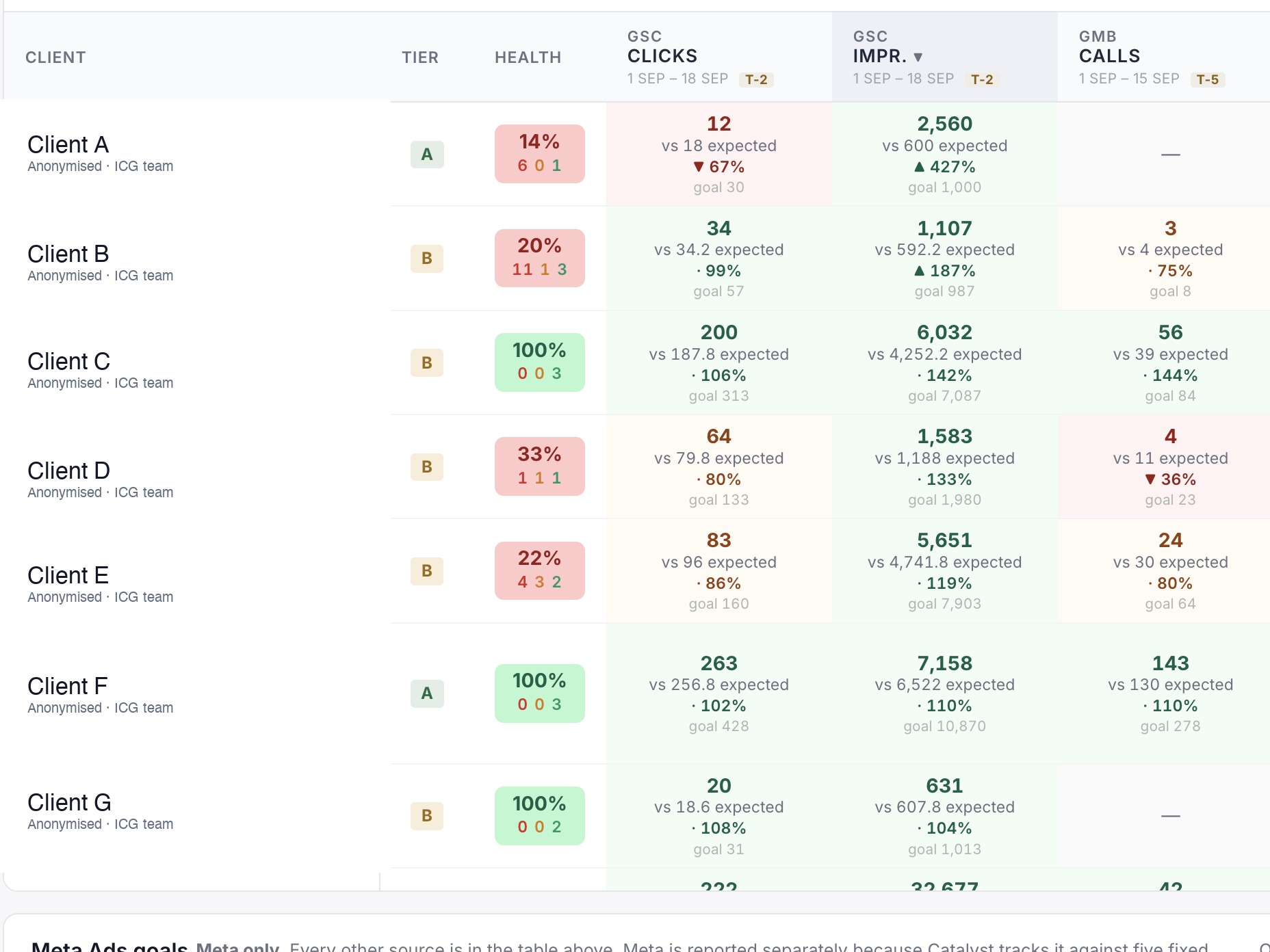
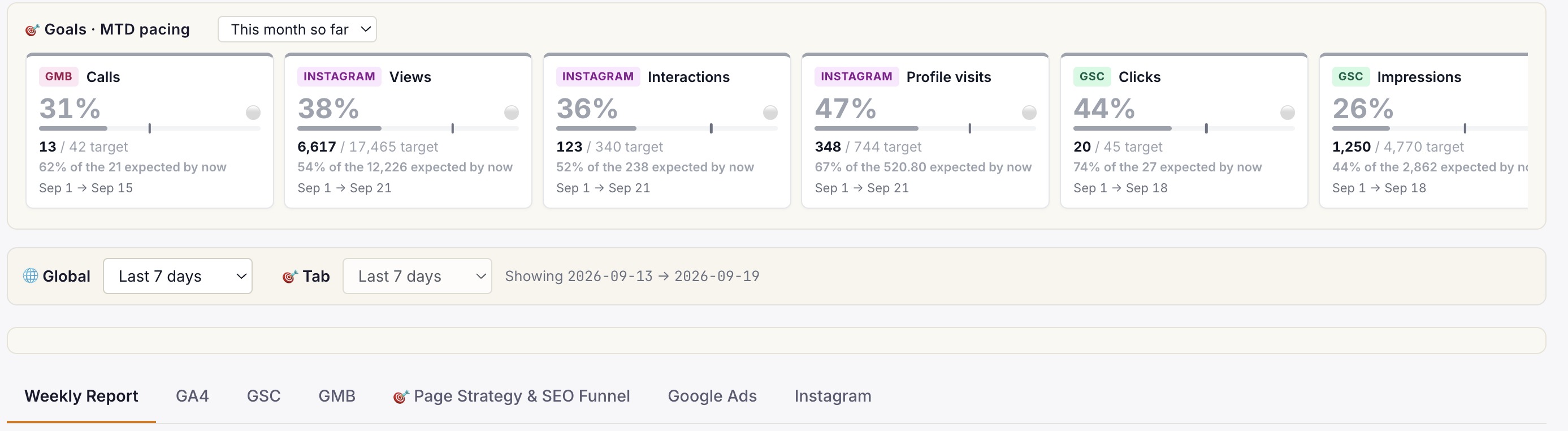
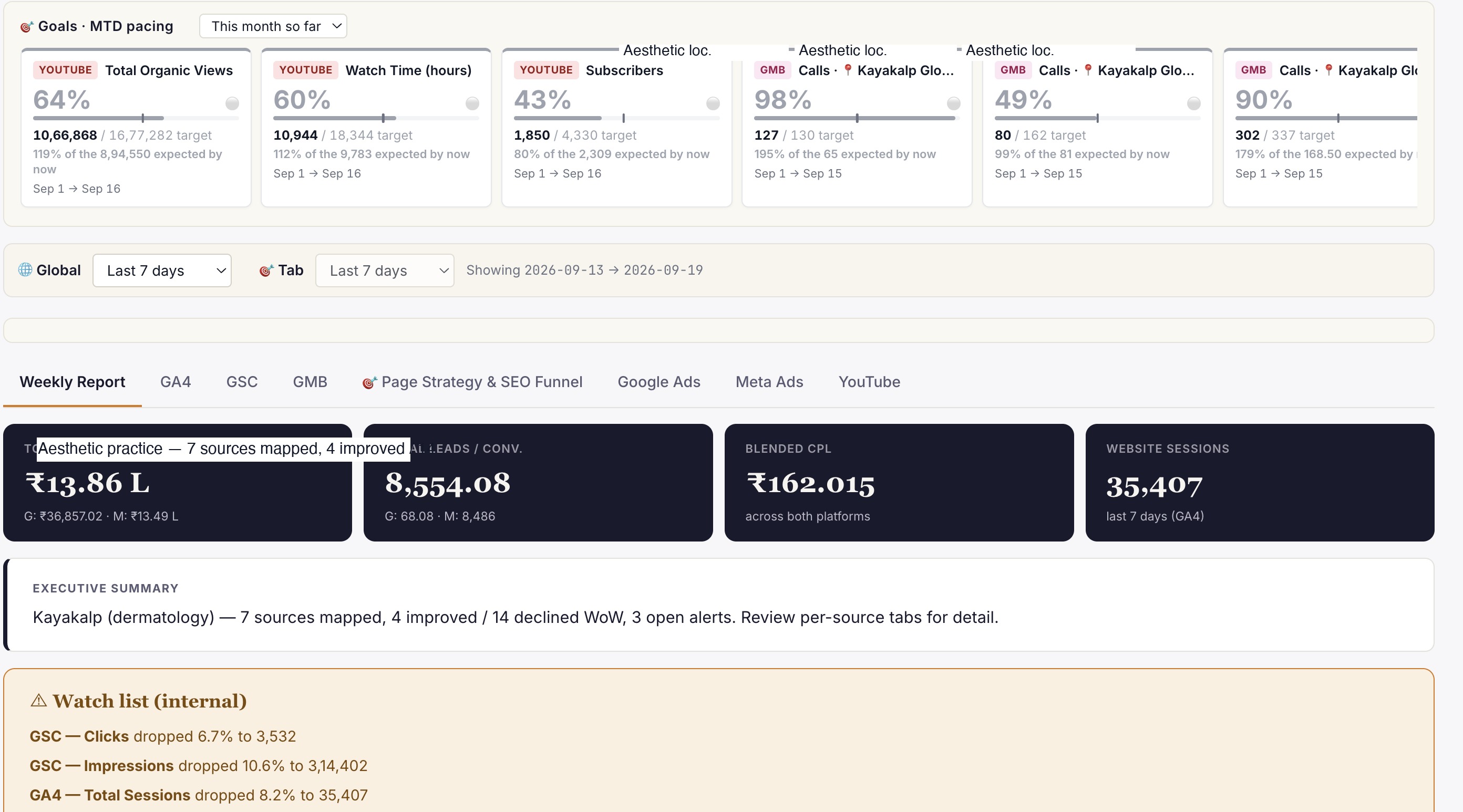
Every ICG engagement runs on the Search Intelligence Trifecta — Angryturtle for GMB, SIE for search and AI Overview, YODA for YouTube. Live product screens below.
Need help operationalising this?
Every ICG service is healthcare-only, NMC + DPDP-aware, and built around the patient-research patterns that drive Indian healthcare growth in 2026.
Every practice welcome — packages from ₹20,000/mo.
Goals-Driven engagements · Performance-Linked Payout Models available
More from
ICG.
Five trends shaping Indian healthcare marketing through 2027: AI-first patient research, Conversions API adoption, ABDM discovery, the AEO w...
Healthcare AIO is the discipline of getting your clinic or hospital cited inside Google AI Overviews, ChatGPT and Perplexity answers — not j...
Conversational-search advertising places brand messages inside AI chat answers — ChatGPT, Perplexity, Copilot — rather than beside a results...
Stop guessing.
Book a Diagnostic.
30 minutes. Free. With the AI-powered healthcare-only marketing agency 150+ brands already run on. No slides, no pitch, no hard close.


