


How to turn repeated patient questions into your next 10 YouTube videos: a healthcare content-mining workflow
A structured workflow to mine repeated patient questions from GBP Q&A, YouTube comments, WhatsApp queries, and front-desk logs — and turn them into a compliance-approved editorial calendar for the next 10 healthcare videos your channel needs to publish.
No pitch. Written root-cause diagnosis. AI-powered, healthcare only.
Direct answer
A structured workflow to mine repeated patient questions from GBP Q&A, YouTube comments, WhatsApp queries, and front-desk logs — and turn them into a compliance-approved editorial calendar for the next 10 healthcare videos your channel needs to publish.
TL;DR
Turning patient questions into video content is the single highest-ROI content strategy an Indian healthcare channel can adopt, and it removes the two failures that kill most clinic YouTube programmes: uncertainty about what to publish next, and content that solves the marketing team's idea of what patients care about rather than what patients actually ask. ICG builds YouTube editorial calendars for the clinics and hospitals we run local SEO and reputation for, and the workflow starts from a simple premise — every patient question your practice hears more than twice is a video brief. The question is only which sources to mine, how to cluster, and how to route the brief through compliance before it becomes a script.
The four question-sources most clinics ignore and how to mine each
Patient questions arrive at a practice through at least four distinct channels, and most healthcare marketing teams monitor at most one of them. The four sources that matter, in order of insight density:
Google Business Profile Q&A. Every GBP has a public Q&A panel where anybody can post a question about the practice. Most clinics either do not know it exists or check it once a quarter. The questions posted here are typically high-intent and pre-consultation — patients trying to decide whether to book. Sample questions we see repeatedly: "do you accept cashless treatment under [insurer]", "is the [specialty] doctor available on weekends", "what is the consultation fee for [condition]". Every one of these is a searchable content brief for a video, a Google Post, or a service-page update.
YouTube comments on existing videos. Covered in detail in our companion piece on using YouTube comments as a patient focus group. The signal density here is unmatched — patients ask what a video missed, what confused them, what they need next.
WhatsApp and inbound-message queries. Most Indian clinics field 20 to 200 inbound WhatsApp messages per day from prospective and existing patients. The questions repeat heavily — cost, availability, procedure specifics, follow-up requirements, insurance. Front-desk staff answer these hundreds of times per month without anyone capturing the pattern. A weekly export of the top question themes from WhatsApp is one of the richest content-brief sources any clinic has.
Front-desk and call-log summaries. Physical front-desk conversations and inbound phone calls surface a different subset of questions — often more anxious, more specific to the moment before an appointment, and more revealing of the mental model patients bring. A one-page weekly summary from the front-desk lead of "top 10 questions this week" changes the content pipeline within a quarter.
A workable question-mining workflow that runs weekly, not quarterly
The workflow that produces a consistent content pipeline runs on a weekly cadence and takes about 90 minutes of marketing-team time plus 30 minutes of clinician review time. Any less frequent than weekly and questions age out; any more frequent and the volume becomes noise.
Monday morning: pull the past week's questions from each of the four sources. GBP Q&A takes 5 minutes to review manually. YouTube comments take 15-30 minutes depending on channel size. WhatsApp requires an operational discipline — the front-desk lead or WA responder tags each message with a topic label at reply time, and the tag list exports at week-end. Front-desk summary is a written note from the reception lead.
Monday midday: cluster the questions by topic and count occurrences. A simple spreadsheet works — three columns for question, source, count. After a few weeks the topic clusters stabilise and the clustering step drops to 15 minutes.
 yoda/07-topic-cluster.png" alt="YODA Topic-wise Cluster Analysis — every video grouped by healthcare topic with performance per cluster" loading="lazy" decoding="async" style="width:100%;height:auto;display:block;">
Monday afternoon: identify the top 5-10 recurring themes and match against existing content. Themes with no existing video, or with an existing video that is under-performing on the specific question, go into the brief pipeline. Themes with adequate coverage get logged as "answered — link in future comments".
Tuesday: draft one-paragraph briefs for the top 3-5 themes. Each brief names the specific patient question, the answer the video will give, the clinician who will present, and any compliance flags.
Wednesday: clinician review of the briefs. This is 20-30 minutes of the presenting clinician's time — approving the medical direction, flagging any content that needs additional sourcing, and confirming the calendar slot.
By end-of-week the pipeline for the next 2-3 weeks of production is set, driven entirely by actual patient signal.
Clustering questions well so you do not publish 15 videos that answer the same thing
The subtle failure mode of question-driven content is publishing five slightly different videos that all answer the same underlying question because the surface phrasing was different. Good clustering separates surface phrasing (which drives SEO variation) from underlying question (which drives content decisions).
A working rule: two questions belong in the same cluster if a competent clinician would answer them with the same core explanation, even if the phrasing or examples differ. "How long is recovery after knee replacement", "when can I walk after knee replacement", "how many weeks until I can drive after knee replacement" are three surface phrasings of the same underlying question — "what does the recovery timeline look like after knee replacement". One video answers the cluster, with the video's title, chapters, and transcript covering all three surface phrasings for SEO.
A different question with genuinely different content demand — "what are the signs my knee replacement is not healing correctly" — is a separate cluster and a separate video.
YODA's question clustering module runs this grouping automatically across a channel's comment corpus and cross-references against existing published video titles and chapter markers to surface true content gaps.
What to name a video so it matches the question patients actually search
Once a question cluster is chosen for production, the video title needs to match the way patients naturally phrase the question, not the way a clinician would describe it. "Recovery timeline after total knee replacement" is a clinician's framing; "how long until I can walk after knee replacement surgery" is a patient's framing, and it maps directly to what people type into YouTube search and Google.
The rule that works: pull the top 3-5 actual surface phrasings from the cluster, pick the one with the highest search volume (a rough check on YouTube's autocomplete and Google Trends is enough for most healthcare topics), and use that phrasing verbatim as the title with a light editorial polish. Do not translate patient language into clinical language for the title.
Chapters inside the video should cover the other surface phrasings — a chapter titled "when can I start driving after knee surgery" tells YouTube and Google that the video answers that specific question and lifts the video for that query variant even though the main title is different.
The editorial calendar template that scales across specialties
A minimal editorial calendar for a mid-sized specialty channel needs eight fields per video: source cluster (which patient-question cluster this video addresses), primary question phrasing (title target), secondary phrasings (chapter markers), presenting clinician, reviewing clinician, compliance flags (any NMC/ASCI/DPDP/PC-PNDT considerations), production week, and publish week.
The calendar cadence for a channel with production-team capacity of 4-6 videos per month: schedule 1 recording day per week where the presenting clinician shoots 2-3 videos back-to-back on approved briefs. This is far more efficient than shooting one video at a time and is more sustainable on the clinician's schedule.
Buffer 20% of the calendar for reactive content — a viral news story, a new treatment approval, a specific comment thread that needs an immediate video response. Rigid calendars underperform because healthcare topicality shifts weekly.
Rotate topic clusters across the calendar so no single condition or procedure dominates the channel. A dermatology channel that publishes only acne content builds narrow topical authority but misses the broader specialty coverage that lifts overall channel ranking.
The compliance approval flow that runs before a video ever becomes a script
Every question-cluster brief needs a compliance check before script writing begins, because a brief that passes compliance is cheap to shoot and a brief that fails compliance after shooting is expensive rework. The checkpoints:
NMC Ethics Code 2026 check. Does the brief involve patient testimonials, comparative superiority claims, or unsubstantiated outcome promises? If yes, restructure the brief or reject. Educational content that describes conditions, treatments, and clinician credentials is generally safe; content that promotes the clinic's superiority is not.
ASCI Guidelines 2022 check. Any comparative claim ("more effective than", "safer than", "faster recovery than") needs substantiation with a citable source, or has to be reframed as a non-comparative statement.
PC-PNDT Act 1994 check (fertility/gynae only). Does the brief touch on prenatal sex determination in any form? If yes, reject — no exceptions. Even educational framing around sex-selective content violates the Act.
ART Act 2021 check (fertility only). Does the brief make success-rate claims for ART procedures? If yes, restructure — success rates in ART marketing are heavily restricted.
DPDP Act 2023 check. Will the video show identifiable patients, staff who have not consented to public appearance, or personal health data of any patient? If yes, restructure to remove identifiable elements or route through a documented consent process.
Briefs that clear all five checks proceed to script development. Briefs that fail on any check get restructured or shelved.
How YODA runs question-mining, clustering, and editorial planning at scale
YODA's Strategy module includes a Content Planner that ingests the four question sources — GBP Q&A pulled via API, YouTube comments pulled via API, WhatsApp topic tags via CSV upload, and front-desk summary via a weekly form — and produces a ranked, clustered question backlog for the channel. The Planner cross-references the backlog against existing published videos and surfaces the true content gaps.
The output includes suggested titles, suggested chapter breakdowns, related videos on the channel, and compliance flags pre-checked against the frameworks above. The clinician review step happens inside the platform with approvals routed to a documented log.
Once a brief is approved, the calendar view shows the production schedule with slots assigned. Once a video is published, YODA closes the loop by tracking whether the video actually captured search traffic for the question cluster it was meant to address — and if it did not, surfaces the video for the SEO Lab to optimise.

What a typical first quarter of question-driven content produces
The measurable outcomes we see in the first quarter of a properly-run question-mining programme on a mid-sized healthcare channel: 12 to 20 new videos published, each ladders to a specific patient-question cluster with documented source evidence; comment engagement on new videos runs 30-50% higher than on the channel's prior generic content because the videos genuinely answer questions viewers are asking; average view duration lifts 15-25% on the new videos because relevance-to-search-intent is materially higher; and consultation booking attribution from YouTube (measured through UTM-tagged description links or coupon codes) begins to show a distinguishable contribution against pre-programme baseline.
The second-quarter effect is where the compounding shows up. Question-driven videos start ranking for the underlying queries, comment sections on the new videos surface fresh questions for the next round, and the editorial pipeline becomes self-sustaining rather than dependent on the marketing team generating topic ideas.
The platform ICG uses to run this at scale: YODA
ICG runs healthcare YouTube marketing for clinics, hospitals, and specialty groups using YODA — our AI-native healthcare YouTube marketing platform. YODA sits on top of a channel's data and does four things no dashboard does: it separates organic from paid views at every step (so a promoted video can never masquerade as organic growth), it gives decisions not dashboards (every video gets a state + next action), it writes back to YouTube directly (improved titles, tags, descriptions, chapters applied straight to the platform), and it tracks the three rank races — YouTube search, Google web, and Google AI Overview citations.
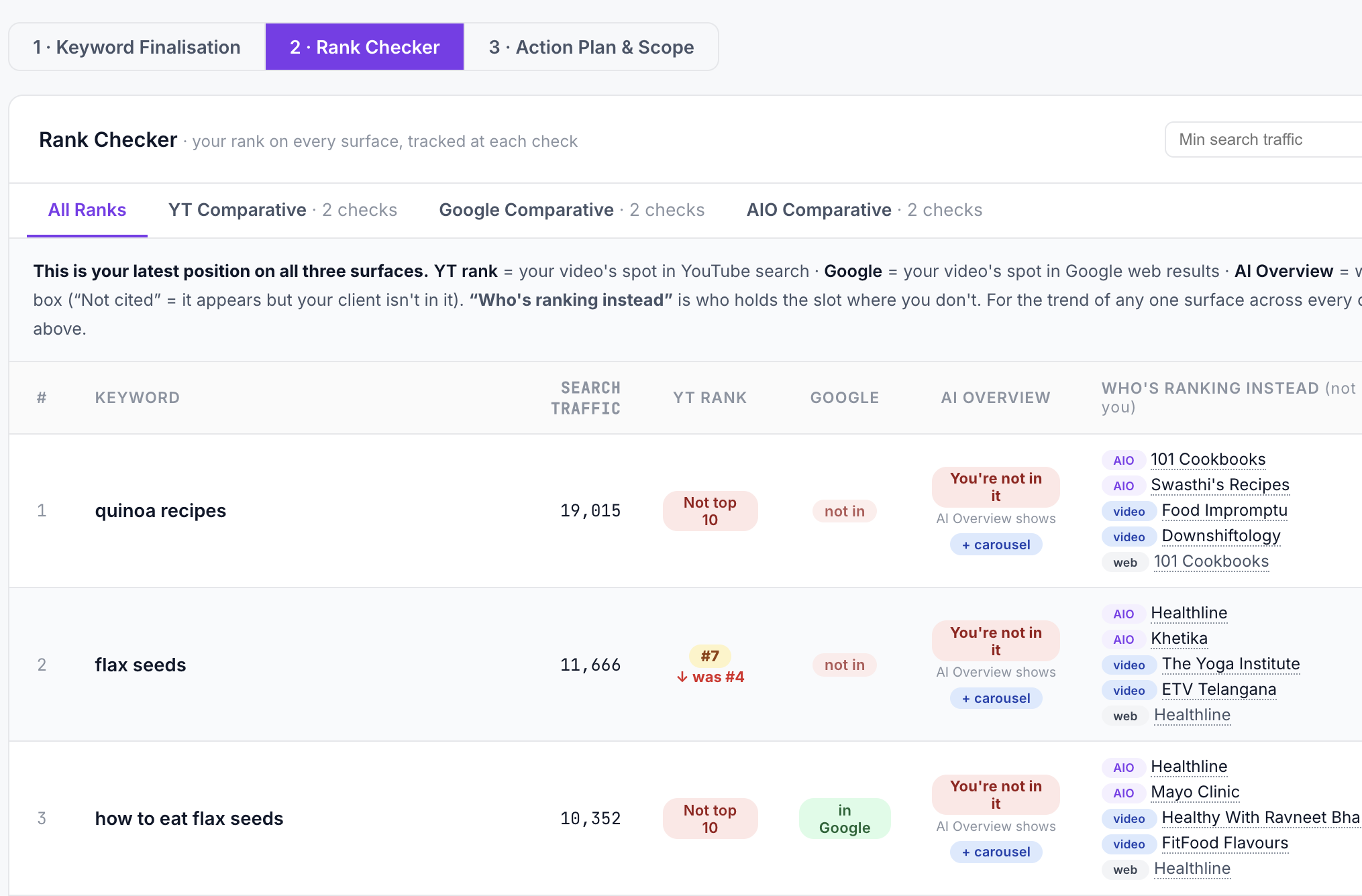
YODA runs the full 6-step workflow — Overview, Diagnostics, Strategy, Optimisation, Reputation (ORM), and Competitor Intel — with 40+ analysis modules organised under those steps. ICG's managed YouTube service uses YODA end-to-end. See the Healthcare YouTube Marketing pillar guide for the full scope, or the Healthcare YouTube Marketing Agency service page for engagement details.
Book a YODA demo on WhatsApp → or request a free healthcare YouTube channel audit →
Related reading
- Healthcare YouTube marketing pillar guide 2026
- YouTube comments as a healthcare focus group
- GBP Q&A strategy for Indian healthcare 2026
- How a doctor's YouTube channel generates consultations in India
- Healthcare YouTube marketing agency service page
FAQ
Do we really need to mine four separate sources or can we just watch YouTube comments? YouTube comments alone will bias your content toward existing viewers and miss the pre-visit questions that GBP Q&A and WhatsApp reveal. All four sources produce different subsets of the underlying question distribution; leaving three of them unmined narrows the input signal materially.
What if a question comes up frequently but is not something we can legally address on video? Log it separately as a "off-video answer needed" theme. Some patient concerns are best addressed in one-on-one consultation, on the clinic website FAQ, or on GBP posts, rather than on YouTube. The mining exercise still surfaces the concern and lets you route the answer to the right channel.
How do we get front-desk staff to actually capture question themes without burdening them? A one-page tick-sheet with 15-20 pre-labelled themes plus an "other" column, filled in during the day and tallied at week-end, is the minimum viable process. Digital tools help but the paper version works and gets adopted; overcomplicated tooling gets abandoned within a month.
Should we publish the underlying data — question counts, cluster themes — anywhere externally? No. The question data reveals which topics your patient base is uncertain about and by extension your competitive intelligence. Keep it internal, use it to inform content, and let the published videos be the outward-facing artefact.
What about patient questions that are asked once but seem important? Log them into a "long-tail watch list" — if the same question surfaces again within 60 days, promote it to the cluster. Individual one-off questions that never repeat rarely justify a video, but they might justify a section in a broader video or a written FAQ update.
How do we handle questions in regional languages that our editorial team does not speak? Translate at intake — either through a bilingual staff member or through machine translation with human review. Ignoring regional-language questions in a multilingual market gives up genuine content signal.
Does the compliance review step slow down the pipeline? Only marginally, and it saves multiples of that time on the back end by preventing rework. A 20-minute clinician review on Wednesday is far cheaper than shooting a video, editing it, and discovering in post-production that a claim needs restructuring.
Can we automate the question mining fully? Partly. YouTube comments and GBP Q&A can be pulled by API and clustered by a model. WhatsApp topic tags need a small human step at reply time. Front-desk summary is fundamentally human input. The whole pipeline can be reduced to about 30-45 minutes of team time per week with good tooling.
What is a reasonable target for how many videos should trace to this workflow versus other sources? For a mature healthcare channel, 70-80% of published videos should trace to patient-question clusters. The remaining 20-30% covers seasonal content, product/service launches, thought-leadership from the clinician team, and reactive news content.
How does this workflow interact with keyword research tools like YouTube search analytics or Google Search Console? Complementarily. Keyword research tools tell you what searches exist at scale; the patient-question workflow tells you what your specific patient base is asking. The best content pipelines cross-reference both — a cluster with high patient signal that also has strong search volume is a top-priority brief.
Book a free 30-minute Brand & Growth Diagnostic.
It's a working session, not a sales pitch — you leave with a written root-cause analysis you can act on, whether or not you engage ICG.
The three platforms
behind every ICG engagement.
Beacon
CAPI middleware that fixes Event Match Quality, translates CRM statuses to Meta-standard events, dedups across channels.
Agency OS
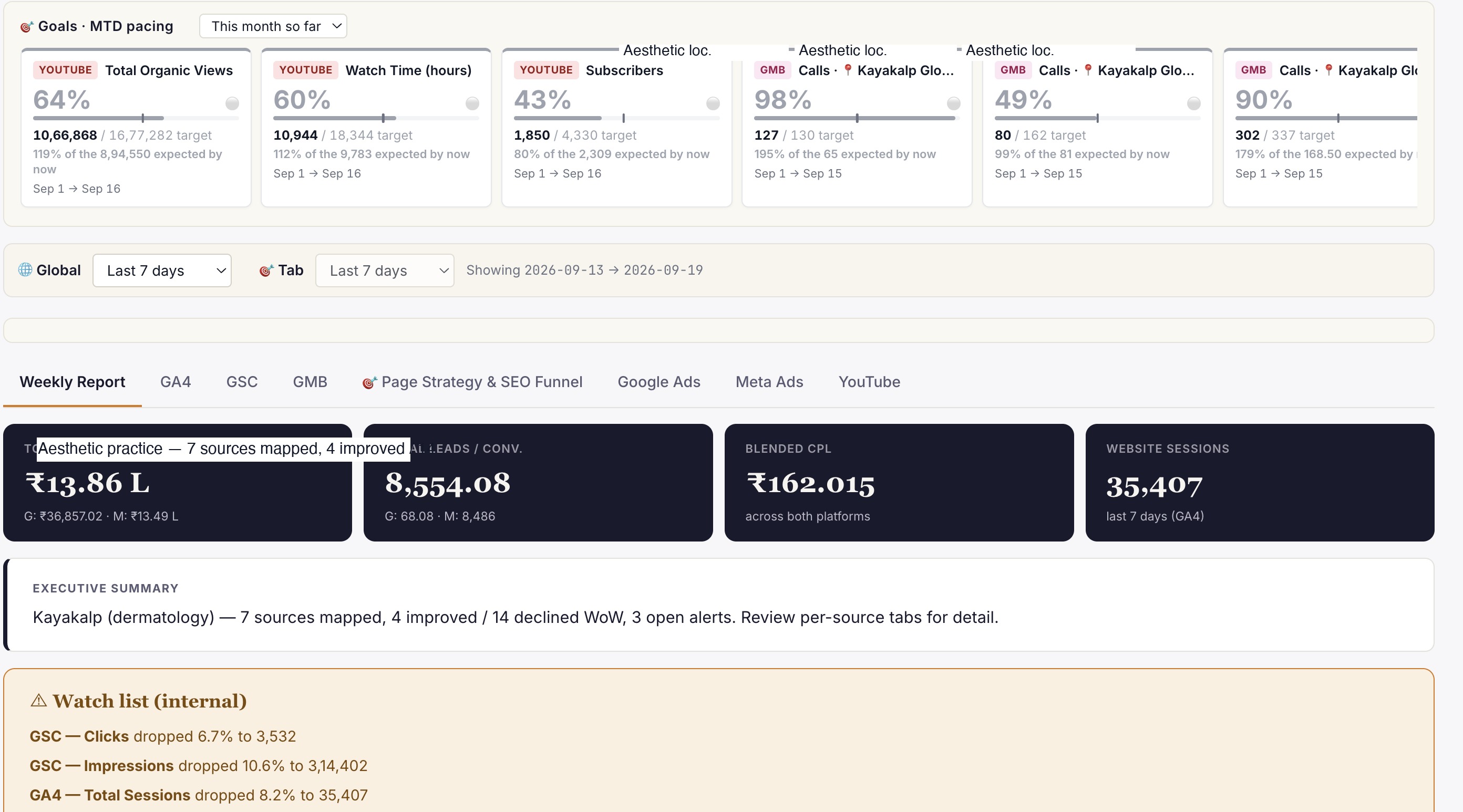
Live client dashboard. GSC, GA4, Google Ads, Meta Ads, IVR calls in one view. Login anytime, not monthly.
Phoenix
Clinic revenue intelligence over your PMS. Daily action queue: Prevent Loss, Maintain & Engage, Grow Revenue. Multi-centre rollout.
Or book a free 30-min audit to see all three in action on your account.
Healthcare brands
that already run on ICG.
A representative slice of the 150+ healthcare brands ICG has delivered for across India. Most engagements remain under NDA.


What ICG clients say · on video.
"Scale up of organic channels and business consulting. ICG has absolute domain authority in their field."
"Working with ICG transformed how we acquire IVF patients in Gurgaon. They understand the fertility journey from inquiry to consult..."
"What Ichelon accomplished — they got all my ideas and worked over 3-4 months to create an amazing, super-customised website."
Need help operationalising this?
Every ICG service is healthcare-only, NMC + DPDP-aware, and built around the patient-research patterns that drive Indian healthcare growth in 2026.
Every practice welcome — packages from ₹20,000/mo.
Goals-Driven engagements · Performance-Linked Payout Models available


More from
ICG.
Five trends shaping Indian healthcare marketing through 2027: AI-first patient research, Conversions API adoption, ABDM discovery, the AEO w...
Healthcare AIO is the discipline of getting your clinic or hospital cited inside Google AI Overviews, ChatGPT and Perplexity answers — not j...
Conversational-search advertising places brand messages inside AI chat answers — ChatGPT, Perplexity, Copilot — rather than beside a results...
Stop guessing.
Book a Diagnostic.
30 minutes. Free. With the AI-powered healthcare-only marketing agency 150+ brands already run on. No slides, no pitch, no hard close.


