


Performance Marketing vs Brand Marketing in Healthcare India: A Buyer's Comparison
A neutral, feature-based comparison of performance marketing, brand marketing and integrated full-funnel approaches for Indian healthcare buyers. Includes a decision table, per-axis analysis, buyer archetypes for 100-bed hospitals, single clinics and IVF chains, plus NMC and DPDP Act considerations.
No pitch. Written root-cause diagnosis. AI-powered, healthcare only.
Direct answer
A neutral, feature-based comparison of performance marketing, brand marketing and integrated full-funnel approaches for Indian healthcare buyers. Includes a decision table, per-axis analysis, buyer archetypes for 100-bed hospitals, single clinics and IVF chains, plus NMC and DPDP...
TL;DR
Last updated: August 2026. Written for hospital administrators, clinic owners and marketing directors evaluating where the next rupee of budget should go.
TL;DR
- Performance marketing buys attention and measures it. It works fastest for elective, high-intent categories (dental, IVF, aesthetics, ophthalmology) where the buyer already knows what they want and price-shops on Google or Meta.
- Brand marketing earns attention over time. It compounds for multi-specialty hospitals, chains and OPD-heavy formats where trust, referral and repeat visits move more revenue than one-off leads.
- Integrated full-funnel is what most Indian healthcare buyers actually need, but very few agencies actually deliver it. The right blend depends on bed count, catchment radius and specialty mix, not on a template.
- Under the NMC 2022 advertising code and the DPDP Act 2023, both approaches carry compliance friction that most legacy media agencies still ignore. That gap is where healthcare-only agencies win.
- Indian pricing bands sit roughly between Rs 49,999 per month at the entry tier and Rs 5-15 lakh per month once paid media is added. Anything cheaper is usually a freelancer stack, anything much more is usually a metro-agency retainer paying for offices you do not use.
Table of Contents
- Why this comparison matters for Indian healthcare buyers
- The seven axes to compare on
- Main comparison table
- Per-axis deep dives
- Which approach fits which buyer
- How Ichelon Consulting Group (ICG) helps
- The 70-30 pricing model, explained
- FAQ
Why this comparison matters for Indian healthcare buyers
Walk into any hospital marketing office in a Tier 1 Indian city on a Monday morning and you will find the same debate. The CMO wants "brand". The CFO wants "leads". The medical director wants "the phone to actually ring". The digital manager, caught between them, is running a 40 percent share to Google Search Ads, 30 percent to Meta lead forms, 20 percent to some SEO retainer that nobody quite trusts and 10 percent to hoardings outside the Chief's clinic. Nobody has clean attribution, nobody has agreed what a "lead" is, and everyone is unhappy by Wednesday.
The performance vs brand debate is not new. What is new for Indian healthcare in 2026 is the compliance floor beneath it. The NMC Professional Conduct Regulations 2022 restrict what a doctor's name, image and claims can appear in. The DPDP Act 2023 changes how patient consent, retention and vendor sharing are handled, with fines that can go up to Rs 250 crore. ABDM's ABHA-based ecosystem is quietly changing how repeat patients find you at all. Any marketing choice that ignores these three moves is going to age badly.
So the real question for a 100-bed hospital, a single dental clinic or a mid-tier IVF chain is not "brand or performance". It is which mix, at what pricing band, with what talent depth, gives a defensible return over 18 to 36 months without a compliance blow-up. That is what this guide compares.
The seven axes to compare on
Before we get to the table, let us agree on what we are measuring. Every healthcare marketing conversation collapses if the axes are unclear. We use seven, in the order that usually matters for an Indian buyer.
- Time to first measurable result. How many weeks before you can honestly point to something that moved.
- Cost per acquisition trajectory. Not the CPA today, the CPA curve over 12 to 24 months as competition and platform costs shift.
- Attribution clarity. Can you tell your board, in one slide, which rupee produced which patient.
- NMC and DPDP compliance posture. How much of the approach is safe to run without a lawyer on speed-dial.
- Talent and skill dependency. Whether the approach needs a rare specialist you cannot easily replace.
- Budget elasticity. What happens when the CFO cuts the marketing budget by 30 percent in a slow quarter.
- Long-term equity and moat. What you own at the end of a three-year run that a competitor cannot copy overnight.
These are the axes we use inside ICG when we sit across the table from a founder or a board. They are the same axes we recommend any agency evaluator use when comparing pitches.
Main comparison table
| Axis | Performance-First Approach | Brand-First Approach | Integrated Full-Funnel |
|---|---|---|---|
| Time to first measurable result | 2 to 4 weeks (paid clicks flow immediately) | 4 to 9 months (recall, direct traffic, referrals build slowly) | Early wins in 3 to 6 weeks, equity in 6 to 12 months |
| CPA trajectory | Flat or rising as auctions get denser | Falling once brand queries and direct visits scale | Falls fastest because brand suppresses paid CPCs |
| Attribution clarity | High for last-click, weak for view-through and offline | Weak; needs brand-lift studies and cohort analysis | Medium to high with proper MMM and call tracking |
| NMC and DPDP posture | Higher risk. Lead forms, retargeting and pixels sit under DPDP purpose limits | Lower risk if content is educational and doctor claims are compliant | Manageable when the agency has a healthcare compliance layer |
| Talent dependency | Media buyer plus landing page specialist plus data analyst | Content strategist, PR lead, brand designer, video team | Both teams, usually pooled across accounts by a specialist agency |
| Budget elasticity | Fragile. Cut the budget and leads stop next week | Resilient. Cuts show up 3 to 6 months later | Balanced. Paid can flex, organic and brand keep the base |
| Long-term equity | Low. You rent traffic and stop when you stop paying | High. Category associations and recall stay with you | Highest. Paid data feeds organic and brand feeds paid CTR |
| Typical monthly spend (India) | Rs 1 lakh to Rs 15 lakh media plus Rs 40k to Rs 1.5 lakh management | Rs 50k to Rs 3 lakh in retainer, production billed on top | Rs 75k to Rs 1 lakh base plus media at 5L+, tied to outcomes |
The table is the map. The territory shows up in the per-axis notes below.
Per-axis deep dives
1. Time to first measurable result
A performance-first setup can put your first Search ad live in a week and your first Meta lead form in about the same. If your landing page is not embarrassing and your call centre answers between 9 am and 9 pm, you will book patients in month one. That speed is real, and for a founder who has just opened a second clinic, it is often the only argument that matters.
Brand-first work does not report anything meaningful for one to two quarters. You are building a content library, a video shelf, PR mentions and a doctor voice that people begin to recognise. What you measure early is process (posts published, videos shipped, PR placements landed), not outcomes. The outcome shows up when a family walks in and says "we found you on YouTube six months ago". The integrated approach threads the needle: paid channels deliver early leads while owned and earned assets build in parallel, so the founder does not have to choose between "phone rings today" and "the brand grows".
2. Cost per acquisition trajectory
This is the axis most Indian buyers under-weight. Every performance-only Meta or Google account we have inherited from another agency shows the same pattern: CPAs are fine for six months, then they drift up 15 to 40 percent as more clinics discover the same auction. Nothing you do to the creative fixes it, because the problem is the market not your ad. Brand-first buyers get the opposite curve. Their branded search queries grow, direct traffic grows, and when they eventually turn paid on, their Quality Score is high enough that they pay 30 to 60 percent less per click than a cold competitor for the same keyword.
Integrated buyers get the best deal. Their branded query volume compresses their paid CPCs, their remarketing pools are larger and warmer, and their creative testing benefits from the tone their content team has already established. This is one of the reasons an integrated setup usually beats a pure performance shop on year-two CPA even when it looks more expensive in month one.
3. Attribution clarity
Performance marketing has a beautiful attribution story on the surface, one campaign, one click, one lead. The story cracks when you realise that most healthcare buyers touch four to seven surfaces before converting. A parent researching paediatric care reads a blog on Sunday night, watches a YouTube explainer on Monday, sees an Instagram Reel on Wednesday, googles the hospital name on Friday, and finally submits a form. Last-click attribution gives 100 percent credit to the fifth touch and 0 percent to the first four, which is why brand teams feel starved even when they are doing the heavy lifting.
Brand-first work has honest attribution only if the agency invests in cohort tracking, brand search lift and Media Mix Modelling. Most do not. Integrated setups solve this by combining call tracking, first-party data captured through a CRM layer (in ICG's stack this is AtomCRM at Rs 14,999 per month), and simple attribution logic that gives brand assets fair credit for assisted conversions. It is not perfect, but it is defensible in a board meeting.
4. NMC and DPDP compliance posture
Both approaches touch compliance, but in different ways. Performance marketing is exposed on data. DPDP Act 2023 requires purpose limitation, consent and reasonable retention for personal data. That includes phone numbers captured in lead forms, remarketing pixels that fire on treatment pages, and third-party pixels that ship data outside India. A hospital running instant-form ads without a lawful basis is running an audit risk, not a marketing programme.
Brand marketing is exposed on claim. The NMC 2022 code restricts advertising by registered medical practitioners, including testimonials, before-and-after imagery and superlative claims. A doctor-led YouTube channel that says "best cardiologist in Delhi" is not just cringe, it is potentially non-compliant. The safest brand work is category education, procedure explainers and patient-friendly demystification, which is why ICG's YODA product for AI-native healthcare YouTube is designed as an education-first format rather than a testimonial-heavy one. Integrated agencies who take healthcare seriously have both a data-protection reviewer and an NMC-aware content editor. Most legacy agencies have neither.
5. Talent and skill dependency
Performance marketing looks like it needs a small team, one media buyer, one landing-page person, one analyst. What it actually needs is a media buyer who has run at least Rs 50 lakh through Google and Meta in the healthcare category, because platform quirks specific to health (disapproved ads, restricted categories, sensitive audience rules) will otherwise eat 20 to 40 percent of your media in learning. That specialist is expensive and rare. Losing them mid-quarter is a real risk for a 100-bed hospital that hired its digital lead six months ago.
Brand marketing is talent-heavy but the roles are more replaceable. Content writers, video editors, designers, PR leads and community managers exist in reasonable numbers. Integrated setups have a talent advantage that is under-appreciated: they pool specialists across many accounts, so a single dental clinic gets access to a Meta buyer who is running budgets ten times larger elsewhere in the same agency. That is exactly the pattern behind ICG's Meta Catalyst IQ engine, where creative learnings and audience signals from 150+ clinics compound into a shared advantage no single-account team can match.
6. Budget elasticity
Ask any Indian hospital CFO what happens in Q3 of a slow year. The marketing budget is the second line item they touch after travel. Performance-only setups fail this test badly. Cut the media by 30 percent and leads fall by roughly 30 percent within a fortnight. Cut it by 60 percent and the funnel closes. That is not a moral failing, it is the shape of paid media.
Brand-first setups are far more forgiving. Cut the content budget for a quarter and nothing visible happens for three to six months, because you are drawing down existing brand equity. Integrated setups let a CFO flex the paid dial without collapsing patient volume, because the organic and brand base keeps producing. This is a structural argument for integration that becomes obvious the first time you sit through a downturn.
7. Long-term equity and moat
Performance marketing rents traffic. When you stop paying, the traffic stops. There is no asset on the balance sheet at the end of a three-year run except a set of ad accounts and a retargeting pool that decays quickly. Brand marketing builds owned assets: a website, a content library, video views, doctor bylines, PR mentions, category associations. Those assets keep working when the budget pauses.
Integrated approaches build the deepest moat because paid and organic feed each other. Paid data tells you what titles and hooks to write about. Organic content lifts paid Quality Scores. Brand PR gets picked up as citations that improve local SEO. Google Business Profile reviews collected through a system like ICG's Angryturtre GBP OS feed both the map pack and the trust signals that lift paid conversion rates. Everything compounds. This is what "moat" actually looks like in healthcare marketing, and it is invisible to buyers who only look at the current month's CPA report.
Which approach fits which buyer

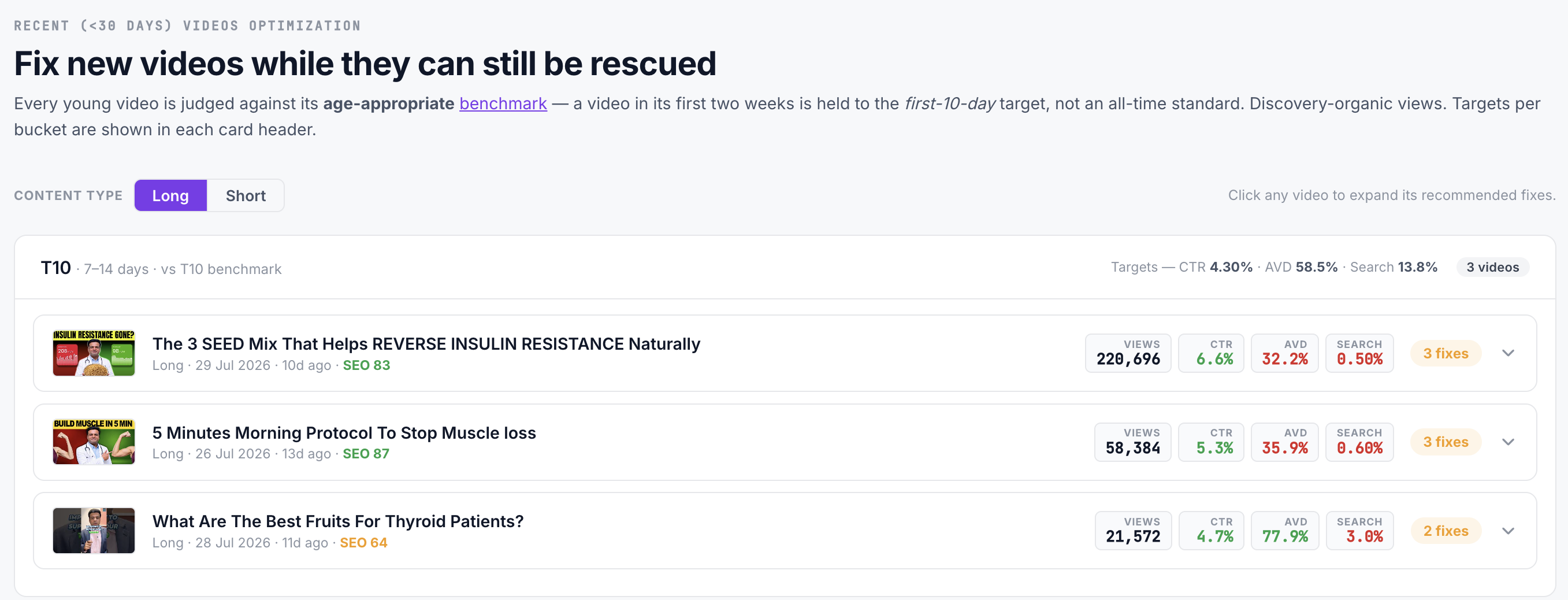
Frameworks are useful, but Indian healthcare buyers make decisions by archetype more than by theory. Here are the four we see most often at ICG, and where each usually lands.
Single dental clinic, one location, Tier 1 or Tier 2 city
Recommendation: performance-first with a light brand layer. Your buyer is intent-driven, price-sensitive and comparing three or four clinics inside a 5 km radius. Google Ads, a well-optimised Google Business Profile and Meta lead forms will produce most of your bookings. Add a monthly cadence of educational Instagram Reels and a Google review programme to lift close rates. Budget band: Rs 40,000 to Rs 1.5 lakh per month all-in. The Foundation tier at Rs 49,999 per month for SEO plus a Rs 30,000 to Rs 1 lakh media budget is a realistic starting point.
Single dental or aesthetic clinic, multi-doctor, premium positioning
Recommendation: integrated, tilted toward brand. Your differentiator is not price, it is trust. Video-led content, doctor bylines, PR in local lifestyle press and a Reels engine will move more revenue than another Rs 50,000 in Meta budget. Performance stays on, but as a harvest layer for existing demand. Budget band: Rs 1.5 to 4 lakh per month.
100-bed multi-specialty hospital, catchment 20 km, cardiology or oncology heavy
Recommendation: integrated full-funnel, non-negotiable. Your buyer journey is 30 to 90 days long, and no single channel closes it alone. You need brand content for trust, SEO for the discovery layer, Meta and YouTube for consideration, Google Search for capture and a CRM layer to nurture the tail. Budget band: Rs 5 to 15 lakh per month, of which a significant share goes to media once you cross the 5L media threshold. Growth tier at Rs 74,999 per month for the SEO base makes sense here, layered with performance retainers.
Mid-tier IVF or fertility chain, 3 to 12 centres across metros
Recommendation: integrated with a strong data spine. IVF buyers research for months, compare across cities and often travel for treatment. You need a national brand layer, city-specific performance, a robust remarketing setup and a competitor intelligence loop (ICG uses Prism Spy for Meta Ads intelligence and Prism Pulse for Instagram analytics inside this exact archetype). Compliance posture must be tight because fertility is a high-scrutiny category under NMC. Budget band: Rs 8 to 25 lakh per month, with Scale tier SEO at Rs 99,999 per month and paid media handled under the 70-30 model described below. A hospital RCM overlay like HealthPro 360 at Rs 14,999 per month is often added to close the loop between marketing spend and revenue realised.
How Ichelon Consulting Group (ICG) helps
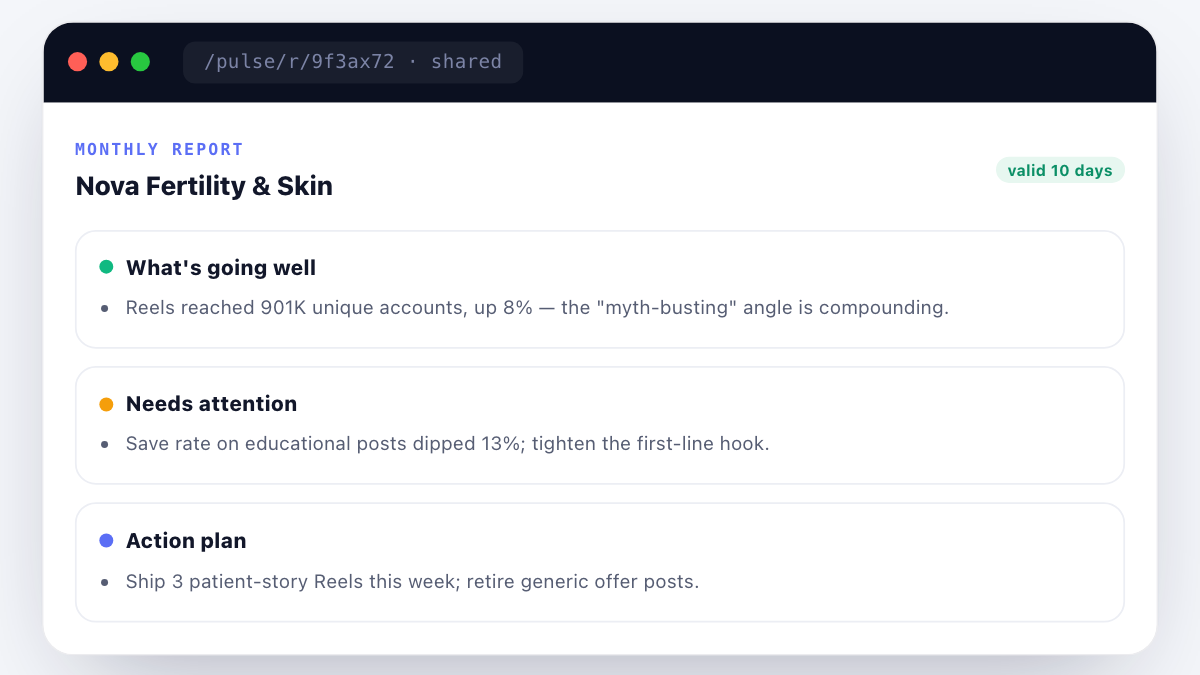

ICG is India's AI-first healthcare marketing agency. We work with 300+ live healthcare clients across 150+ clinics and hospitals. We are founder-led, healthcare-only, and we sit on the buyer's side of the table when we compare approaches. We do not sell one thing and dress the rest as an afterthought. Our stack (Angryturtle for Google Business Profile, YODA for AI-native YouTube, Meta Catalyst IQ for Meta Ads, Prism Spy for competitor Meta intelligence, Prism Pulse for Instagram analytics, AtomCRM for lead management and HealthPro 360 for hospital RCM and EHR overlay) exists because our clients kept asking for outcomes that no single tool could deliver. What we recommend to any buyer, including buyers we do not work with, is to interrogate their agency on the seven axes above and demand written answers.
The 70-30 pricing model, explained
 AI Overview readiness on every healthcare query for the listing specialty and city" width="1200" height="675" loading="lazy" decoding="async" style="width:100%;height:auto;display:block;">
ICG uses a 70-30 model for services where outcomes are measurable. 70 percent of the monthly fee is fixed, funding the team, the tools and the operating cadence. 30 percent is tied to a 12-month outcome target on a sliding-scale slab structure agreed with the client at kick-off. If the outcome band is met, the full 30 percent is earned. If it is exceeded, the slab shifts up. If it is missed, the slab shifts down. The three SEO bands sit at Rs 49,999 per month (Foundation), Rs 74,999 per month (Growth) and Rs 99,999 per month (Scale). The same model extends to Google Ads and Meta Ads once media budgets cross Rs 5 lakh per month, and to YouTube plus AIO work above Rs 50,000 per month.
The point of the model is simple: buyers get downside protection because a chunk of the fee is at risk, and the agency stays honest because it eats what it cooks. It is not the only pricing model in Indian healthcare marketing, but it is one of the few that survives a hostile CFO in a slow quarter.
FAQ
Is performance marketing dying in Indian healthcare?
No. It is getting more expensive and more crowded, especially in categories like dental, aesthetics and IVF, but a well-run performance layer is still the fastest way to move bookings in month one. What is dying is pure performance, done in isolation, without a brand and content base underneath.
Can a single clinic really afford brand marketing?
Yes, if brand is defined sensibly. For a single clinic, brand does not mean TV ads or celebrity endorsements. It means a consistent doctor voice on Instagram Reels, a Google Business Profile that is actively managed, patient education content on YouTube and reviews collected systematically. All of that fits inside a Rs 40,000 to Rs 80,000 per month envelope.
What is the DPDP Act 2023 impact on healthcare lead ads?
The Act requires notice, consent, purpose limitation and reasonable retention for personal data. Practically, this means your lead-form privacy notice must be specific, your CRM must have deletion workflows, third-party pixels must be reviewed and cross-border data transfers may be restricted for sensitive categories. Agencies that treat this as a legal problem alone are missing the operational work.
How do I evaluate an agency's compliance maturity?
Ask them three questions. First, show me your Meta lead-form privacy notice for a healthcare client. Second, what is your NMC-compliance review workflow for doctor-fronted creatives. Third, how do you handle data-deletion requests under DPDP. If they cannot answer in specifics, treat that as a data point.
Should I run YouTube if I only have a small budget?
YouTube is now a search engine as much as it is a video platform, and healthcare buyers use it heavily for consideration. A modest, education-first channel with 2 to 4 videos per month is affordable inside a Rs 50,000 to Rs 1.5 lakh per month band, and it compounds. ICG's YODA product exists specifically to make this affordable at the sub-Rs 1 lakh band without cutting quality.
What is a realistic time frame for brand marketing to show ROI?
Six to twelve months for early signals (branded search volume, direct traffic, review velocity, YouTube subscriber growth). Twelve to twenty-four months for revenue signals that a CFO can read. Anyone promising brand ROI in a quarter is either selling something else or measuring something loose.
How do the ABDM and ABHA ecosystem changes affect marketing?
ABDM's ABHA-based patient journey means repeat patients increasingly find you through the digital health ecosystem rather than only through search. That does not replace marketing, but it does change how a hospital thinks about lifetime value and repeat visit tracking, which in turn affects how brand and performance budgets are split.
Is an in-house team better than an agency for healthcare marketing?
It depends on scale and specialisation. An in-house team of 8 to 12 people can outperform an agency for a 500+ bed chain. Below that, a specialist healthcare agency almost always wins on unit economics and talent pooling, because the same paid-media specialist who runs your Meta account also runs fifty others in the same category and brings that pattern library to your account.
What is the single most common mistake Indian healthcare buyers make when choosing between approaches?
Judging month one on brand and month twelve on performance. It is the wrong way around. Judge performance on month one, month three and month six CPAs and lead quality. Judge brand on month six and month twelve signals (branded search, direct traffic, review volume, PR mentions, YouTube retention). Mixing the timeframes is how good work gets killed early.
How do I get started with ICG on the right approach for my clinic or hospital?
Send us your current numbers (monthly spend by channel, bookings, CPA, catchment radius, specialty mix). We will map you to one of the four buyer archetypes above and come back with a written recommendation that includes the axis-by-axis reasoning. If we think you are better off staying with your current setup, we will say so.
ICG is a healthcare-only marketing agency working with 300+ live clients across India. We are founder-led, AI-first and neutral on tools when it comes to your buying decision. If this comparison was useful, our team is happy to walk you through it against your actual account.
Book a free 30-minute Brand & Growth Diagnostic.
It's a working session, not a sales pitch — you leave with a written root-cause analysis you can act on, whether or not you engage ICG.
Questions readers ask
about this topic.
The three platforms
behind every ICG engagement.
Beacon
CAPI middleware that fixes Event Match Quality, translates CRM statuses to Meta-standard events, dedups across channels.
Agency OS
Live client dashboard. GSC, GA4, Google Ads, Meta Ads, IVR calls in one view. Login anytime, not monthly.
Phoenix
Clinic revenue intelligence over your PMS. Daily action queue: Prevent Loss, Maintain & Engage, Grow Revenue. Multi-centre rollout.
Or book a free 30-min audit to see all three in action on your account.
Healthcare brands
that already run on ICG.
A representative slice of the 150+ healthcare brands ICG has delivered for across India. Most engagements remain under NDA.


What ICG clients say · on video.
"Scale up of organic channels and business consulting. ICG has absolute domain authority in their field."
"Working with ICG transformed how we acquire IVF patients in Gurgaon. They understand the fertility journey from inquiry to consult..."
"What Ichelon accomplished — they got all my ideas and worked over 3-4 months to create an amazing, super-customised website."
Need help operationalising this?
Every ICG service is healthcare-only, NMC + DPDP-aware, and built around the patient-research patterns that drive Indian healthcare growth in 2026.
Every practice welcome — packages from ₹20,000/mo.
Goals-Driven engagements · Performance-Linked Payout Models available



More from
ICG.
Five trends shaping Indian healthcare marketing through 2027: AI-first patient research, Conversions API adoption, ABDM discovery, the AEO w...
Healthcare AIO is the discipline of getting your clinic or hospital cited inside Google AI Overviews, ChatGPT and Perplexity answers — not j...
Conversational-search advertising places brand messages inside AI chat answers — ChatGPT, Perplexity, Copilot — rather than beside a results...
Stop guessing.
Book a Diagnostic.
30 minutes. Free. With the AI-powered healthcare-only marketing agency 150+ brands already run on. No slides, no pitch, no hard close.


