


Local SEO for orthopedic practices and hospitals in India: sub-specialty depth and referral-mediated flow
Local SEO for orthopedic practices in India is shaped by three specialty-specific features: strong referral flow from GPs and physiotherapists which means Google Business Profile serves both patient discovery and referring-professional confidence, high sub-specialty depth where t
No pitch. Written root-cause diagnosis. AI-powered, healthcare only.
Direct answer
Local SEO for orthopedic practices in India is shaped by three specialty-specific features: strong referral flow from GPs and physiotherapists which means Google Business Profile serves both patient discovery and referring-professional confidence, high sub-specialty depth where t
TL;DR

Local SEO for orthopedic practices in India is shaped by three specialty-specific features: strong referral flow from GPs and physiotherapists (which means Google Business Profile serves both patient discovery and referring-professional confidence), high sub-specialty depth where the specialty splits into arthroscopy, joint replacement, spine, sports medicine, paediatric orthopedics, and hand surgery — each with distinct query patterns, and patient consideration cycles that range from urgent (acute trauma) to long (elective joint replacement). ICG runs healthcare local SEO for orthopedic practices at solo-surgeon, group-practice and hospital scales using Angryturtle calibrated for orthopedic query patterns and sub-specialty depth.
Why orthopedic local SEO looks different
Referral flow. Roughly 40-60% of orthopedic patients arrive via referral — from GPs identifying a joint issue, from physiotherapists escalating cases beyond their scope, from emergency rooms handling acute injuries. The remaining 40-60% arrive via self-search, typically for conditions the patient already suspects (knee pain, back pain, shoulder problems). Local SEO serves both channels — self-searchers directly, and referring professionals who check the orthopedic surgeon's Google presence before referring.
Sub-specialty depth. Orthopedics has more sub-specialties than most healthcare disciplines: arthroscopy (minimally invasive joint procedures), joint replacement (hip, knee, shoulder, elbow), spine surgery, sports medicine, paediatric orthopedics, hand and wrist surgery, foot and ankle surgery, oncological orthopedics (bone and soft tissue tumours), trauma surgery. Each sub-specialty has its own patient query pattern, its own referral network, and its own competitive set. A solo arthroscopy specialist competes against arthroscopy specialists, not against general orthopedic surgeons.
Cycle-length variance. Acute trauma patients decide on an orthopedic hospital within hours. Elective joint replacement patients decide over 3-6 months. Sports injury patients decide over 2-4 weeks. Chronic condition management patients (arthritis, back pain) decide over 6-12 weeks. The same profile serves all cycle lengths simultaneously.
Angryturtle's sie" style="color:inherit;text-decoration:underline;text-decoration-color:rgba(42,126,200,.5);text-underline-offset:2px">Rank OS for orthopedic profiles balances Relevance (sub-specialty categorisation matters), Review Health (both patient reviews and referring-professional-facing reputation), Freshness (chronic-condition patients revisit profiles across consideration windows), Entity Authority (medical association listings matter for referring-professional trust), and AIO Readiness (increasing as patients ask AI systems about specific procedures).


GBP configuration for orthopedic practices
Primary category. "Orthopedic Surgeon" for solo orthopedic surgeons or small groups doing general orthopedics. Sub-specialty-focused practices should use sub-specialty as primary: "Orthopedic Clinic" as a generic alternative, "Sports Medicine Physician" for sports-focused practices, "Spine Surgeon" for spine specialists.
Secondary categories (up to 9). Fill with the sub-specialties the practice covers: Arthroscopy, Joint Replacement Surgeon (hip, knee, shoulder — separate if Google offers separate categories), Sports Medicine Physician, Spine Surgeon, Pediatric Orthopedic Surgeon, Hand Surgeon, Foot and Ankle Surgeon, Physical Therapy (if the practice has integrated PT), Orthopedic Hospital (if the practice is hospital-scale).
Services list. Orthopedics has 15-25 distinct procedures worth listing individually: General Orthopedic Consultation, X-ray and Imaging Consultation, Arthroscopy (Knee, Shoulder, Hip — separate services if performed), Total Knee Replacement, Total Hip Replacement, Total Shoulder Replacement, Partial Knee Replacement, Spine Surgery (Discectomy, Fusion, Deformity Correction), Sports Injury Management, Sports Physiotherapy, ACL Reconstruction, Meniscus Repair, Rotator Cuff Repair, Hand and Wrist Surgery (Carpal Tunnel, Trigger Finger), Foot and Ankle Surgery, Paediatric Orthopedics, Fracture Management, Trauma Surgery, Physical Rehabilitation, PRP (Platelet-Rich Plasma) Therapy, Regenerative Medicine consultation.
Business description. 750 characters covering: practice name and orthopedic specialty focus, years of operation, sub-specialties offered, key equipment (arthroscopy suite, computer-assisted joint replacement, spine navigation systems), consultant credentials including Fellowship training (Fellowship-trained specialists are a strong signal for orthopedics), insurance panels, hospital affiliations for surgical procedures.
Attributes. Health-and-safety attributes, appointment scheduling, insurance panels, accessibility features (matters more for orthopedic patients who may have mobility limitations — wheelchair accessible, elevator access, parking proximity), languages spoken.
Review flow expectations for orthopedic practices

Volume expectations: 150-400 minimum for a competitive metro orthopedic practice. Hospital orthopedic units typically 500-2,000+. Elective joint replacement practices tend to accumulate reviews slower (patients decide over 3-6 months, review after full recovery which is 6-12 months post-surgery) but reviews are higher quality (patients write detailed accounts of the surgical experience).
Velocity expectations: 5-15 new reviews per month for solo orthopedic surgeons; 20-40 per month for hospital orthopedic units.
Response requirement: 100% response rate. Referring-professional-facing signal matters — GPs check response patterns before referring.
Compliance for orthopedic reviews. NMC restrictions apply — no confirming specific outcomes in replies. Common pattern: patient writes "Dr. X did my knee replacement and I can walk again." Compliant reply: "Thank you for sharing your experience. Our team is glad to support your recovery. Wishing you continued mobility."
Ask Maps for orthopedic patient queries
Patients ask AI systems specific orthopedic queries. Angryturtle's Ask Maps question bank for orthopedics covers:
- "Best knee replacement surgeon in [city]"
- "Which orthopedic hospital does robotic knee replacement in [neighbourhood]"
- "Does this orthopedic clinic do sports injury physiotherapy"
- "Is there a spine surgeon at this practice"
- "How much does total knee replacement cost at this hospital"
- "Which insurance panels does this orthopedic clinic accept"
- "Does this hospital have paediatric orthopedic capability"
- "What's the recovery time for arthroscopy at this clinic"
- "Are there Fellowship-trained specialists at this practice"
The question bank differs meaningfully across orthopedic sub-specialties. Ask Maps configures per sub-specialty focus.
The referring-professional signal layer
Orthopedics' referral-heavy patient flow means the profile needs to signal to referring GPs and physiotherapists, not just to patients. Referring-professional-relevant signals differ from patient-facing signals:
GP-facing signals: - Orthopedic surgeon's medical qualifications (MS, DNB Ortho, Fellowship training) prominently on GBP or linked website - Publications and research listings if relevant (linked to journal listings or ResearchGate profile) - Sub-specialty depth indicators (GPs prefer referring complex cases to sub-specialists) - Hospital affiliations if the surgeon works across multiple facilities - Response time for referral queries (a GP wants to know the surgeon can see the patient this week, not in a month)
Physiotherapist-facing signals: - Sports medicine focus if the practice serves athletic populations - PRP/regenerative medicine capability - Return-to-sport protocols the practice publishes - Integration with the physiotherapist's own practice for post-surgical rehabilitation
These signals live on the practice's website (linked from GBP) rather than natively on GBP. Physician schema on the About page carrying credentials, MedicalProcedure schema on procedure pages carrying surgical techniques, and MedicalCondition schema on condition pages carrying diagnostic and treatment information all help referring professionals identify the practice as a legitimate referral destination.
ICG's healthcare local SEO service extends beyond the GBP itself into the schema and website content that supports the GBP for the referring-professional audience.
Sub-specialty specific patterns
Arthroscopy-focused practice. Category primary "Orthopedic Surgeon" or "Sports Medicine Physician" depending on positioning. Services list heavy on arthroscopy sub-procedures (Knee Arthroscopy, Shoulder Arthroscopy, Hip Arthroscopy, ACL Reconstruction, Meniscus Repair, Rotator Cuff Repair). Content strategy on sports injury and minimally invasive procedure education. Meta ads viable for younger patient demographic.
Joint replacement-focused practice. Category primary "Orthopedic Surgeon" with "Joint Replacement" prominent in description. Services heavy on Total Knee Replacement, Total Hip Replacement, Partial Knee Replacement, Revision Joint Replacement. Content strategy on joint replacement education, computer-assisted and robotic techniques (if used), recovery timelines. Longer patient consideration cycles mean content must hold up across many visits.
Spine surgery practice. Category primary "Spine Surgeon" or "Orthopedic Surgeon" (spine specialists sometimes register under Neurosurgery categories depending on their training background). Services heavy on Discectomy, Spinal Fusion, Deformity Correction, Minimally Invasive Spine Surgery. Content strategy on back pain management, spine surgery education, non-surgical alternatives (important for building trust — patients want to know the surgeon isn't over-recommending surgery).
Sports medicine practice. Category primary "Sports Medicine Physician." Services heavy on sports injury management, sports physiotherapy integration, return-to-sport protocols. Content strategy on athlete-specific injury patterns, prevention, and rapid-return protocols. Instagram-adjacent content viable for athlete demographic.
Paediatric orthopedic practice. Category primary "Pediatric Orthopedic Surgeon." Services heavy on developmental orthopedic conditions, congenital deformity management, sports injuries in adolescents. Content strategy on parent-education focus.
Angryturtle allows sub-specialty tuning per profile so each orthopedic practice gets appropriate defaults rather than generic orthopedic settings.
Pricing tiers for orthopedic practices
Solo orthopedic surgeon: Starter tier at ₹25,000-₹50,000/month covers GBP optimisation, monthly Post cadence, review operations, monthly rank tracking, quarterly citation audit.

Multi-surgeon orthopedic group: Chain tier at ₹75,000-₹1,50,000/month covers per-surgeon GBP treatment (if separate profiles), weekly Post cadence, review operations with referring-professional-facing signal management, monthly Geo-Grid tracking, monthly citation building.
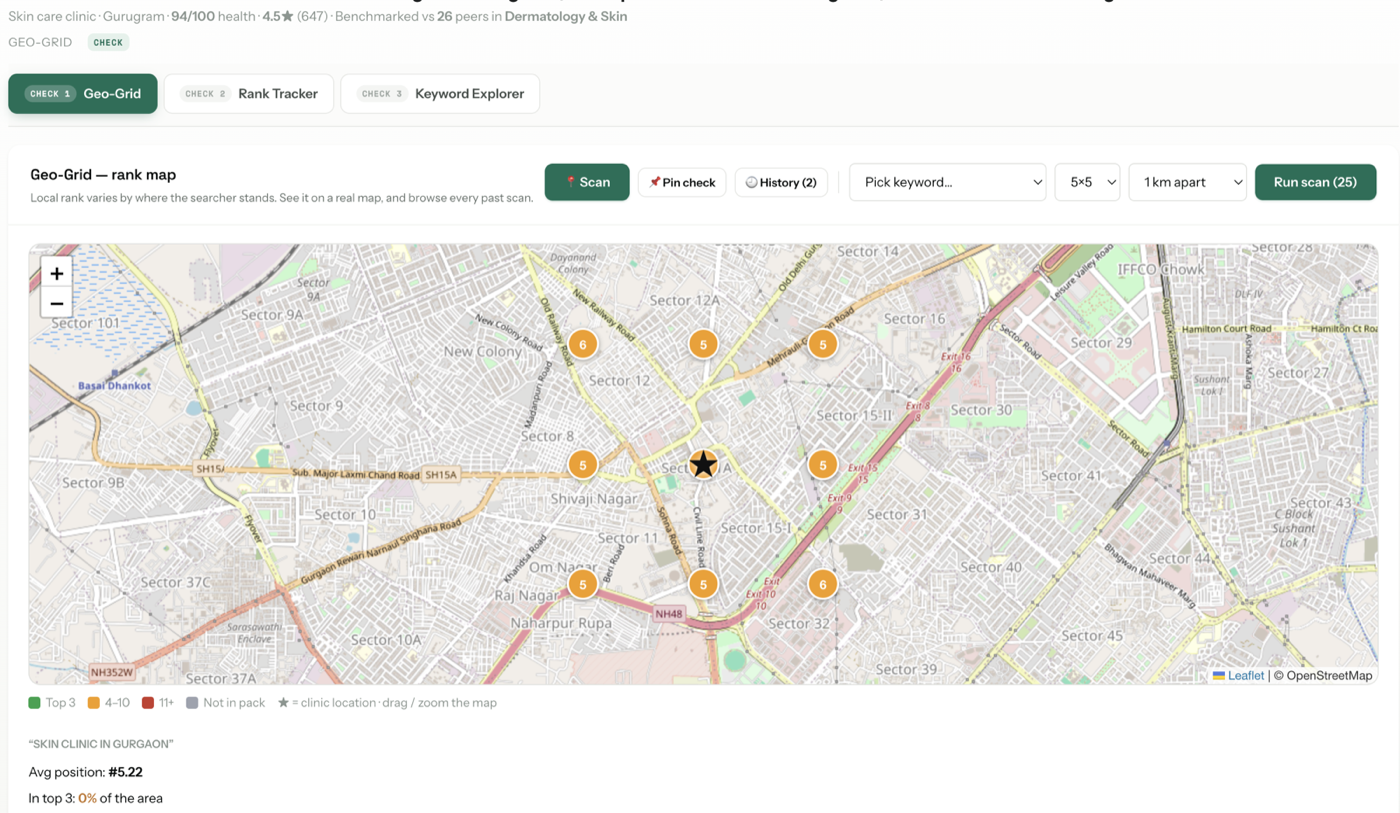
Hospital orthopedic unit or dedicated orthopedic hospital: Hospital tier at ₹1,50,000-₹4,00,000/month covers department-level campaign structuring, daily Post cadence, review operations across the full orthopedic patient footprint, weekly Geo-Grid tracking per location per sub-specialty, ongoing citation building, monthly AIO audit, custom reporting.
Related reading

- Healthcare local SEO agency India — pillar service page
- Local SEO for cardiology clinics India — similar referral-heavy specialty
- Local SEO for dermatology clinics India — comparison specialty
- Local SEO for dental chains India — high-velocity specialty comparison
- Orthopedic marketing cost India — budget context
- Orthopedic patient acquisition cost India — CPQL context
FAQ
How is orthopedic local SEO different from other specialties? Referral flow accounts for 40-60% of patients (higher than most specialties except cardiology). Sub-specialty depth is unusually high — arthroscopy, joint replacement, spine, sports medicine, paediatric, hand — each with distinct query patterns. Patient cycle-length varies from hours (acute trauma) to months (elective joint replacement).
How many reviews does an orthopedic practice need? 150-400 minimum for competitive metro positioning. Hospital orthopedic units typically 500-2,000+. Elective joint replacement practices accumulate slower but higher-quality reviews.
Should sub-specialty orthopedic surgeons use their sub-specialty as primary Google category? Usually yes. Arthroscopy specialists as "Orthopedic Surgeon" with arthroscopy prominent in description; sports medicine specialists as "Sports Medicine Physician"; spine surgeons as "Spine Surgeon." Sub-specialty categorisation ranks better for sub-specialty queries.
How do referring GPs check an orthopedic surgeon's credentials? Google Search of the surgeon's name or practice, which surfaces the GBP with reviews, plus the linked website's About page with credentials. Fellowship training, publications, and hospital affiliations are the top signals GPs weigh.
Can an orthopedic hospital rank for both trauma and elective queries with one GBP? Yes, but the profile needs to signal both capabilities clearly. Trauma signals: 24/7 operating hours, emergency room capability, direct casualty phone line. Elective signals: appointment booking, consultation timings, specific elective procedure services listed.
What's the compliance approach for orthopedic reviews? NMC restrictions apply — no confirming specific surgical outcomes in replies. Compliant pattern acknowledges patient experience without endorsing specific clinical results.
Does ICG handle paediatric orthopedic specifically? Yes. Handled with sub-specialty-appropriate defaults — "Pediatric Orthopedic Surgeon" as primary category, paediatric-focused services list, parent-facing content strategy, appropriate age-related Ask Maps questions.
How does Angryturtle handle orthopedic sub-specialty differences? Rank OS weights, Ask Maps question banks, and Content Studio drafting adjust per sub-specialty. A solo joint-replacement specialist gets different tool defaults than a solo sports-medicine specialist.
What Google category should a spine surgeon use if they have neurosurgery training? Depends on the practice's primary positioning. Practices identifying primarily as orthopedic spine surgeons use "Spine Surgeon" or "Orthopedic Surgeon." Practices identifying primarily as neurosurgeons use "Neurosurgeon." Both categories are legitimate for spine specialists depending on training background and practice self-identification.
Can orthopedic local SEO include physiotherapy integration? Yes. Practices with integrated physiotherapy list "Physical Therapy" as a secondary category and include physiotherapy services in the services list. Content strategy covers surgical-plus-rehabilitation continuity of care.
How long before an orthopedic practice sees ranking improvement? First measurable movement in 4-8 weeks. Substantive ranking improvement in 3-4 months. Full compound effect (top-3 local pack for primary orthopedic queries) in 6-9 months depending on competitive intensity and sub-specialty depth of the practice.
What Angryturtle features matter most for orthopedic practices? Rank OS with orthopedic-specific weighting, Ask Maps AIO with orthopedic-specific question bank (sub-specialty-aware), Geo-Grid for extended catchment mapping (orthopedic patients travel farther than most specialties), and NMC-safe review reply drafting for the surgical-outcome-adjacent reviews orthopedic practices receive.
Book a free SEO diagnostic.
Hanuman Sihag's team runs a live crawl, checks technical health, cannibalisation, schema coverage and content gaps. 60 minutes, prioritised fix list.
The three platforms
behind every ICG engagement.
Beacon
CAPI middleware that fixes Event Match Quality, translates CRM statuses to Meta-standard events, dedups across channels.
Agency OS
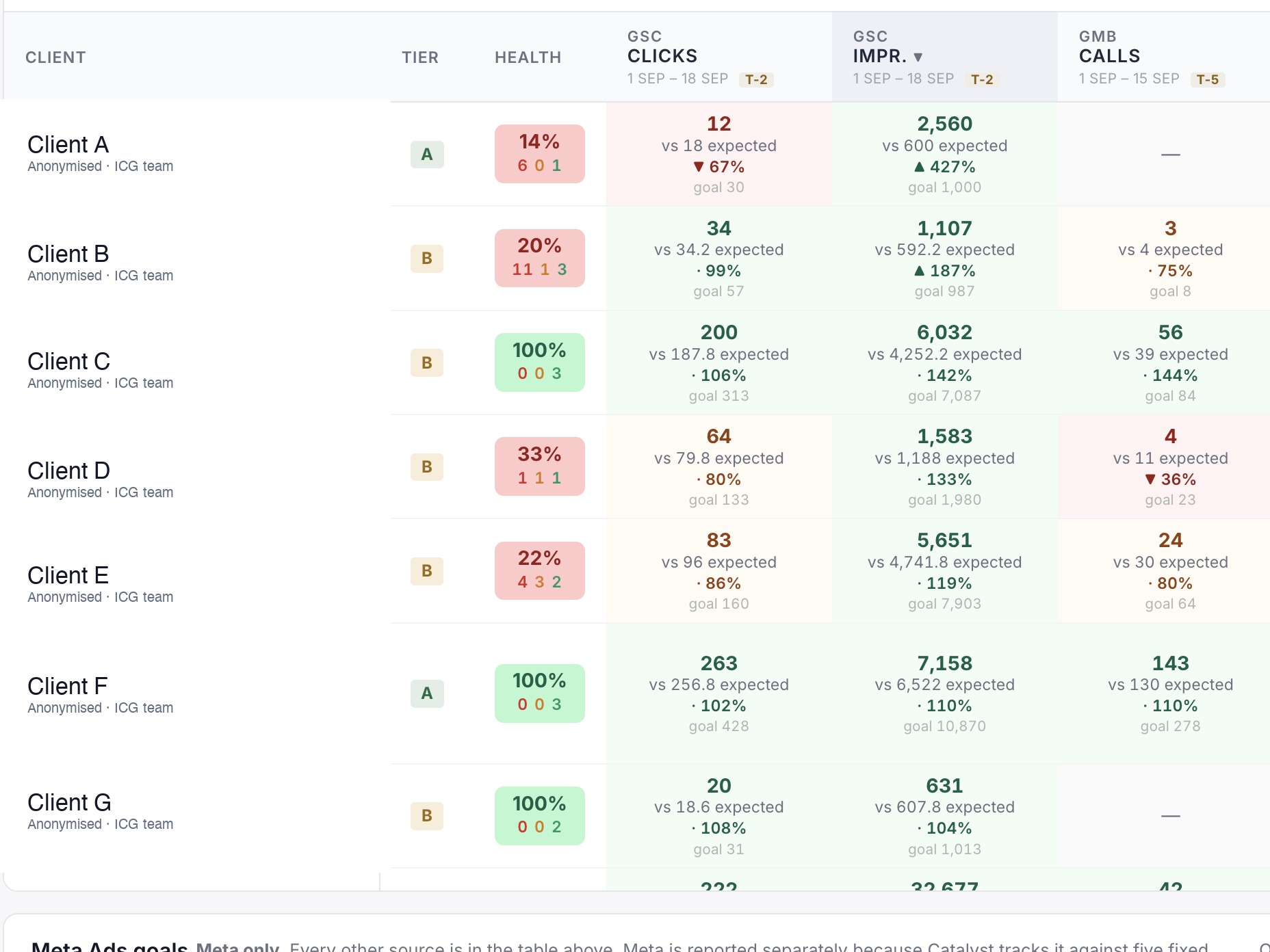
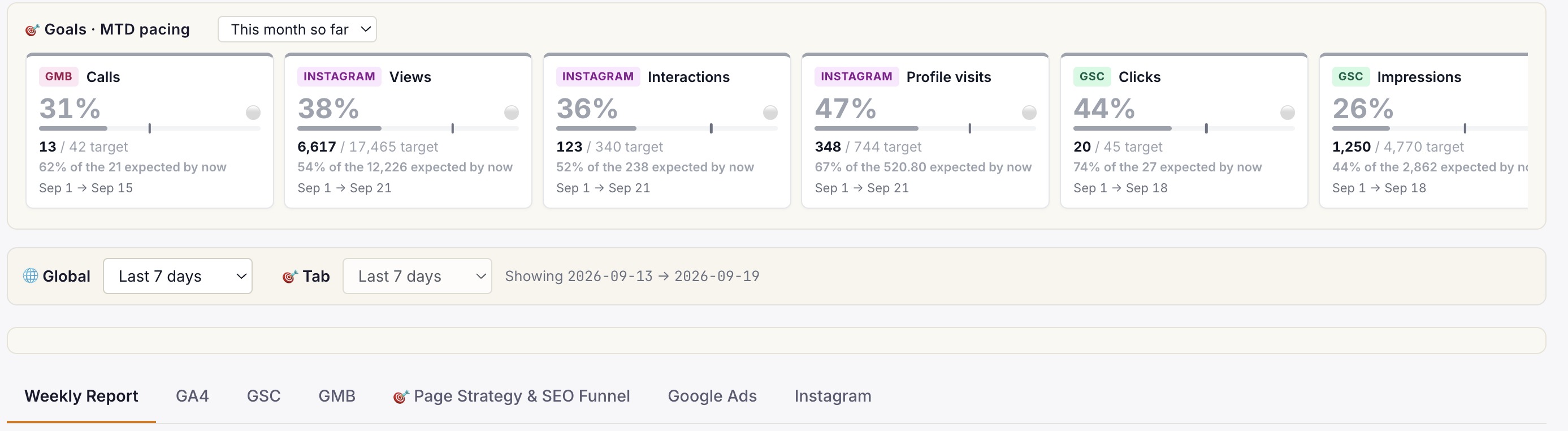
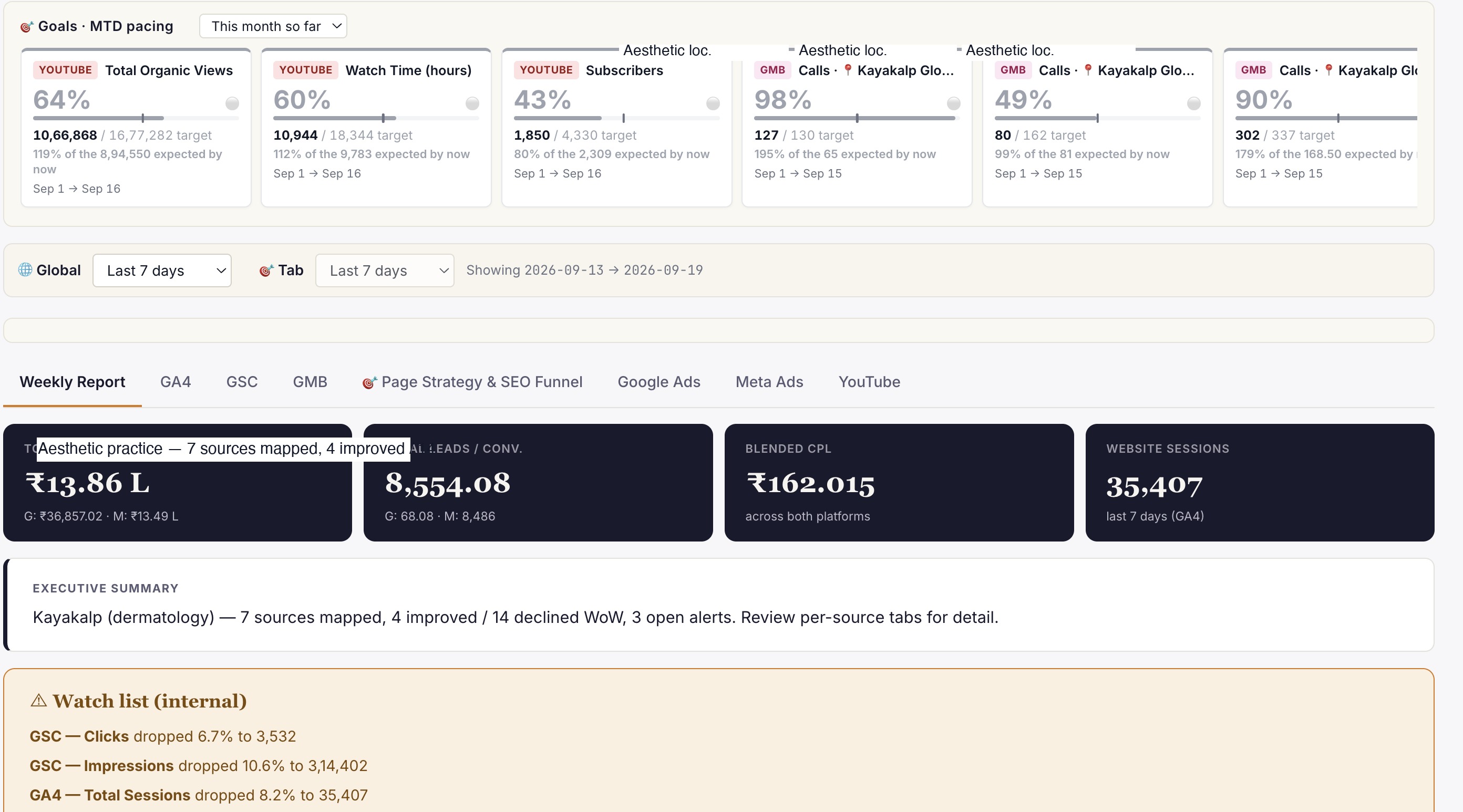
Live client dashboard. GSC, GA4, Google Ads, Meta Ads, IVR calls in one view. Login anytime, not monthly.
Phoenix
Clinic revenue intelligence over your PMS. Daily action queue: Prevent Loss, Maintain & Engage, Grow Revenue. Multi-centre rollout.
Or book a free 30-min audit to see all three in action on your account.
Healthcare brands
that already run on ICG.
A representative slice of the 150+ healthcare brands ICG has delivered for across India. Most engagements remain under NDA.


What ICG clients say · on video.
"ICG's healthcare-only focus made the difference. They speak our language and understand patient acquisition specifics."
"ICG's deep understanding of healthcare patient journeys makes their orthopedic campaigns markedly more effective."
The intelligence stack behind this playbook.
Every ICG engagement runs on the Search Intelligence Trifecta — Angryturtle for GMB, SIE for search and AI Overview, YODA for YouTube. Live product screens below.
Need help operationalising this?
Every ICG service is healthcare-only, NMC + DPDP-aware, and built around the patient-research patterns that drive Indian healthcare growth in 2026.
Every practice welcome — packages from ₹20,000/mo.
Goals-Driven engagements · Performance-Linked Payout Models available
More from
ICG.
Five trends shaping Indian healthcare marketing through 2027: AI-first patient research, Conversions API adoption, ABDM discovery, the AEO w...
Healthcare AIO is the discipline of getting your clinic or hospital cited inside Google AI Overviews, ChatGPT and Perplexity answers — not j...
Conversational-search advertising places brand messages inside AI chat answers — ChatGPT, Perplexity, Copilot — rather than beside a results...
Stop guessing.
Book a Diagnostic.
30 minutes. Free. With the AI-powered healthcare-only marketing agency 150+ brands already run on. No slides, no pitch, no hard close.


