


GBP service area vs storefront for healthcare in India: home-visit doctors, telehealth-first clinics, mobile diagnostic vans, home-nursing services and teleconsult providers explained
Google Business Profile Service Area Business (SAB) vs storefront classification is a load-bearing decision for home-visit doctors, mobile diagnostic vans, home-nursing services, telehealth-first clinics and teleconsult-only providers. This guide covers when to use SAB vs storefront, verification differences, ranking differences, and how Angryturtle handles both configurations.
No pitch. Written root-cause diagnosis. AI-powered, healthcare only.
Direct answer
Google Business Profile Service Area Business (SAB) vs storefront classification is a load-bearing decision for home-visit doctors, mobile diagnostic vans, home-nursing services, telehealth-first clinics and teleconsult-only providers. This guide covers when to use SAB vs storefr...
TL;DR

Google Business Profile splits business types into two configurations that Google treats very differently: storefront businesses that serve customers at a physical location, and Service Area Businesses (SAB) that deliver services to customers' locations. For most Indian healthcare businesses the classification is obvious — a hospital or clinic is a storefront, patients visit — but for a growing set of healthcare service modalities the SAB configuration is either mandatory or genuinely a better fit. Home-visit doctors, mobile diagnostic vans, home-nursing services, physiotherapy home-visit practices, and teleconsult-only providers all sit in the SAB category, and the configuration choice affects verification, ranking, and long-term profile stability materially. ICG runs healthcare local SEO for 150+ Indian clinics and hospitals using Angryturtle, and the SAB-vs-storefront decision is a common early-engagement discussion for the healthcare service brands entering the local search market.
How Google defines SAB vs storefront
Google's definitional split is functional. A storefront business has a physical location where customers visit to receive services. The location is public, the address appears in search, and patients or customers turn up at the address. A Service Area Business delivers services to customer locations. The business may have a physical office (from which staff dispatch, or where equipment is stored), but customers do not typically visit the office. The address is not public.
Some businesses genuinely qualify as hybrid — a physiotherapy clinic that has a public storefront where most patients visit, but also does a small volume of home-visit rehabilitation. Google's guidance is to pick the model that reflects the dominant service delivery pattern. If most patients visit the storefront, configure as storefront. If most patients receive service at their location, configure as SAB.
Google's 2026 tightening on this axis: profiles that operate as SAB but display a public storefront address are now actively flagged. A home-nursing service that had listed its corporate office address publicly (to receive verification postcards, or because the operators wanted a "real" address in search) now must either hide the address entirely (pure SAB) or accept that the address will be validated against physical evidence of a genuine customer-facing storefront (storefront classification).
Healthcare service modalities that fit SAB
Five healthcare service modalities in India typically fit the SAB configuration.
Home-visit doctors. Physicians who consult at patient homes rather than at a fixed clinic. Some are pure home-visit; others split time between home visits and a small consulting room. Pure home-visit practices should configure as SAB with no public address; hybrid practices need to decide based on the dominant delivery pattern.
Mobile diagnostic vans. Diagnostic services delivered from a vehicle that travels to patient locations, often for corporate health camps, community screenings, or bulk-sample collection. These operate as SAB by definition — the vehicle moves, there is no fixed customer-facing address.
Home-nursing services. Nursing care delivered at patient homes for post-surgical recovery, chronic disease management, elderly care, and end-of-life care. Typically operates with a corporate coordination office that dispatches nurses; patients don't visit the office. SAB is the correct configuration.
Physiotherapy home-visit practices. Physiotherapists who visit patients at home rather than operating a clinic. Some also see patients at a small clinic; pure home-visit practices are SAB. Hybrid practices need the same dominant-pattern decision.
Teleconsult-only providers. Doctors or clinics that operate exclusively via teleconsult (video and phone) without any in-person visits. These have no physical customer touchpoint at all and are pure SAB. The 2026 addition of "Telehealth Provider" as a category option in most Indian markets supports this configuration cleanly.
Verification differences between SAB and storefront
SAB and storefront profiles verify through different documentation paths.
Storefront verification (covered in depth in our GBP verification methods guide) validates the physical location — signage, interior facility, equipment, staff presence at the address. Video verification for a storefront must show all of these elements.
SAB verification validates the business as a legitimate service provider without a customer-facing storefront. The video verification typically shows: exterior signage of the corporate office or dispatch location (if applicable), interior of the dispatch or coordination office, service vehicles or equipment used to deliver services, uniforms or staff identification, and business registration documentation.
Postcard verification for SAB is still available in some markets. The postcard is sent to the corporate office or dispatch address, which is not publicly displayed but is on record with Google.
The service-area definition is a critical piece of the SAB verification — the business declares the geographic areas it serves (typically city or district level in India), and Google validates that the areas are plausible for the service type. A home-nursing service in Bengaluru declaring a service area covering "all of Karnataka" without evidence of statewide operations may face additional verification scrutiny.
Ranking differences between SAB and storefront
SAB and storefront profiles rank differently in Google local search because the distance calculation works differently.
Storefront profiles rank based on the searcher's distance to the storefront address. A patient searching in Koramangala, Bengaluru for a "dermatologist near me" sees storefront dermatology clinics ranked by proximity to Koramangala.
SAB profiles rank based on whether the searcher is inside the declared service area. A home-nursing service with a declared service area of "Bengaluru" appears in local search results for searchers anywhere in Bengaluru, regardless of the corporate office location. If the searcher is outside the declared service area, the SAB profile does not appear.
Practical implication: a well-configured SAB profile can rank across a wide geographic area (an entire city or multiple cities) provided the service area is declared honestly and the business genuinely serves that area. This is often materially better geographic coverage than a storefront profile can achieve from a single physical address.
Counter-implication: SAB profiles compete against storefront profiles in local search. A patient searching for "physiotherapist in Whitefield, Bengaluru" sees both storefront physiotherapy clinics near Whitefield and SAB physiotherapy home-visit practices serving Bengaluru. Ranking depends on the usual mix of relevance, distance/service-area, and prominence signals, with reviews and category correctness being the main levers the SAB profile can influence.
Hybrid and edge cases
Several healthcare service configurations are genuinely hybrid and require a considered decision.
Small consulting-room home-visit practices. A physiotherapist or physician who does most work at patient homes but also has a small consulting room where a minority of patients visit. Options: configure as storefront if the consulting room is a genuine customer touchpoint with signage and visible operating hours; configure as SAB and hide the consulting room address if it is used only occasionally.
Diagnostic labs with home-collection. A pathology lab with a physical facility where samples are processed and some patients visit for direct collection, but also offers home-collection services. Configure as storefront (the facility is the primary customer touchpoint) and list home-collection as a service.
Chain-model home-nursing with a public office. A home-nursing chain with a corporate headquarters that has a genuine reception, occasional walk-in patient inquiries, and a receptionist. Edge case — Google could accept either configuration. If the headquarters genuinely functions as a customer touchpoint (patients can walk in for consultation on care plans), storefront is defensible. If it is purely a back-office, SAB with hidden address is safer.
Multi-city telehealth providers. A telehealth clinic operating across multiple Indian cities. SAB with a broadly defined service area covering all served cities is the correct configuration. The Telehealth Provider category as primary matches the service modality.
Common SAB configuration mistakes in healthcare
The mistakes we see most often in new SAB engagements:
- Public address on a SAB profile. Displaying the corporate office address publicly on a SAB profile violates 2026 guidelines and now actively triggers flagging.
- Over-declared service area. Declaring service across an entire state when the business genuinely serves only one city. Triggers verification challenges and can undermine ranking in the actual served area.
- Under-declared service area. Declaring service across only one neighbourhood when the business serves an entire city. Materially limits the ranking surface the profile is eligible for.
- Wrong category selection. Selecting a category that implies a physical facility (Diagnostic Center, Medical Clinic) for a business that operates as pure SAB (mobile diagnostic van, home nursing). Categories should match the service modality — Home Health Care Service, Mobile Diagnostic Service, Telehealth Provider — rather than the equivalent storefront category.
- Storefront pretending to be SAB or vice versa. A physical clinic that hides its address to try to rank across a wider area (misconfigured as SAB) faces verification challenges because the video verification shows a customer-facing storefront that the profile denies exists.
How Angryturtle handles both configurations
Angryturtle supports both storefront and SAB profiles with configuration-specific workflows. For SAB profiles, the platform handles service-area declaration (with recommendations based on the business type and location), keeps the address hidden per 2026 guidelines, generates SAB-appropriate content (Posts about service delivery, home-visit availability, service-area coverage rather than facility features), and adapts the Ask Maps AIO question bank to SAB-specific patient queries ("does this service cover my area," "how quickly can a nurse reach my home," "does this clinic offer teleconsult").

For hybrid businesses considering the SAB-vs-storefront decision, Angryturtle's sie" style="color:inherit;text-decoration:underline;text-decoration-color:rgba(42,126,200,.5);text-underline-offset:2px">Rank OS surfaces which model would score better on Relevance given the specific business profile. The platform doesn't make the choice for the business but flags when the current configuration is likely to underperform, so the operator has a data-informed basis for the decision.

ICG's managed service handles the actual configuration change — updating category, service area, address visibility, and services list — inside the Angryturtle dashboard once the decision is made.
The 2026 SAB vs storefront decision checklist
A short checklist to guide the classification decision:
- Do patients visit a physical location to receive service? If yes and the location is real and staffed, storefront. If no, SAB.
- Is the physical location genuinely customer-facing (signage, reception, operating hours) or is it a back-office? If back-office only, SAB.
- Does the business declare service coverage across a defined geographic area (a city, multiple cities, a state)? If yes and this is the dominant delivery pattern, SAB.
- Is the primary service modality teleconsult or home-visit? If yes, SAB.
- Is the business genuinely hybrid (both storefront and home-visit)? If dominant model is storefront, configure as storefront and list home-visit as a service. If dominant model is home-visit, configure as SAB.
Once the decision is made, configure consistently and don't oscillate — Google penalises profiles that switch between models repeatedly.
The tool ICG uses to run this at scale: Angryturtle
ICG runs local SEO and GBP intelligence for 150+ Indian healthcare brands using Angryturtle — our own AI-native GBP intelligence and management OS. The platform scores every profile 0-100 via a proprietary Rank OS model with five weighted dimensions (Relevance, Review Health, Freshness, Entity Authority, AIO Readiness), publishes edits, Posts, media, and review replies directly to Google, and includes Ask Maps AIO Readiness scoring for Google AI Overviews and ChatGPT visibility.
For SAB profiles specifically, Angryturtle configures service-area boundaries, keeps the address hidden per 2026 guidelines, generates SAB-appropriate Posts and descriptions, and adapts the Ask Maps question bank to SAB-specific patient queries. For hybrid businesses, the Rank OS surfaces the model that would score better on Relevance given the specific service pattern. Available in two shapes: self-serve at ₹999/- per month for solo owners with 1-2 profiles, and ICG's managed service from ₹25,000/- per month where our healthcare specialists execute inside the same platform. Both are anchored in the Healthcare Local SEO Agency India pillar page which has full scope, methodology and pricing.
Book a demo on WhatsApp → or start a free trial at angryturtle.ai →
Related reading
- Healthcare local SEO agency India — the pillar service page
- GBP verification methods for healthcare in India (2026)
- GBP suspension recovery for Indian healthcare
- GBP guidelines 2026: what changed for healthcare
- GBP categories for Indian healthcare
FAQ

What is the difference between SAB and storefront on Google Business Profile? Storefront businesses have a public physical address where customers visit for service. Service Area Businesses (SAB) deliver services at customer locations and do not display a public address. Google treats the two configurations differently for verification, ranking, and content operations.
Which healthcare businesses should use SAB configuration? Home-visit doctors, mobile diagnostic vans, home-nursing services, physiotherapy home-visit practices, and teleconsult-only providers. Any healthcare service that delivers care at the patient's location without a customer-facing storefront fits SAB.
Can a hybrid practice use both SAB and storefront? No, one configuration per profile. Choose the model that reflects the dominant service delivery pattern. If most patients visit a physical location, configure as storefront and list home-visit as a service. If most patients receive service at their location, configure as SAB.
Does an SAB profile need to hide its address entirely? Yes, in 2026. Google actively flags SAB profiles that display a public address. The address is still on record with Google (for verification and internal purposes) but is not visible in search results.
How does SAB verification differ from storefront verification? SAB verification validates the business as a legitimate service provider — corporate office, dispatch operation, service vehicles, uniforms, staff — rather than a customer-facing facility. Video verification shows the dispatch or coordination centre rather than a patient-facing storefront.
How large a service area can I declare on a SAB profile? Declare the area you genuinely serve. Over-declaring (statewide when you serve one city) triggers verification issues; under-declaring limits the ranking surface. City-level or multi-city declarations are typical for Indian healthcare SAB profiles.
Do SAB profiles rank in local pack results? Yes. SAB profiles compete for local pack visibility alongside storefront profiles, subject to whether the searcher is inside the declared service area. Ranking depends on the same relevance, service-area, and prominence signals that govern any local search result.
Should a teleconsult-only clinic use the new Telehealth Provider category? Yes, in markets where the category is available. Telehealth Provider as primary paired with the specialty category as secondary (Dermatologist, Cardiologist) is the compliant configuration for teleconsult-only providers.
Can I switch a profile from storefront to SAB after it is verified? Yes, but Google penalises profiles that switch models repeatedly. Make the decision considered and stable.
Does Angryturtle support both SAB and storefront profiles? Yes. The platform handles configuration-specific workflows for both, including service-area boundaries, content patterns, and Ask Maps question banks for SAB profiles, and standard storefront workflows for physical clinics and hospitals.
Book a free 30-minute Brand & Growth Diagnostic.
It's a working session, not a sales pitch — you leave with a written root-cause analysis you can act on, whether or not you engage ICG.
The three platforms
behind every ICG engagement.
Beacon
CAPI middleware that fixes Event Match Quality, translates CRM statuses to Meta-standard events, dedups across channels.
Agency OS
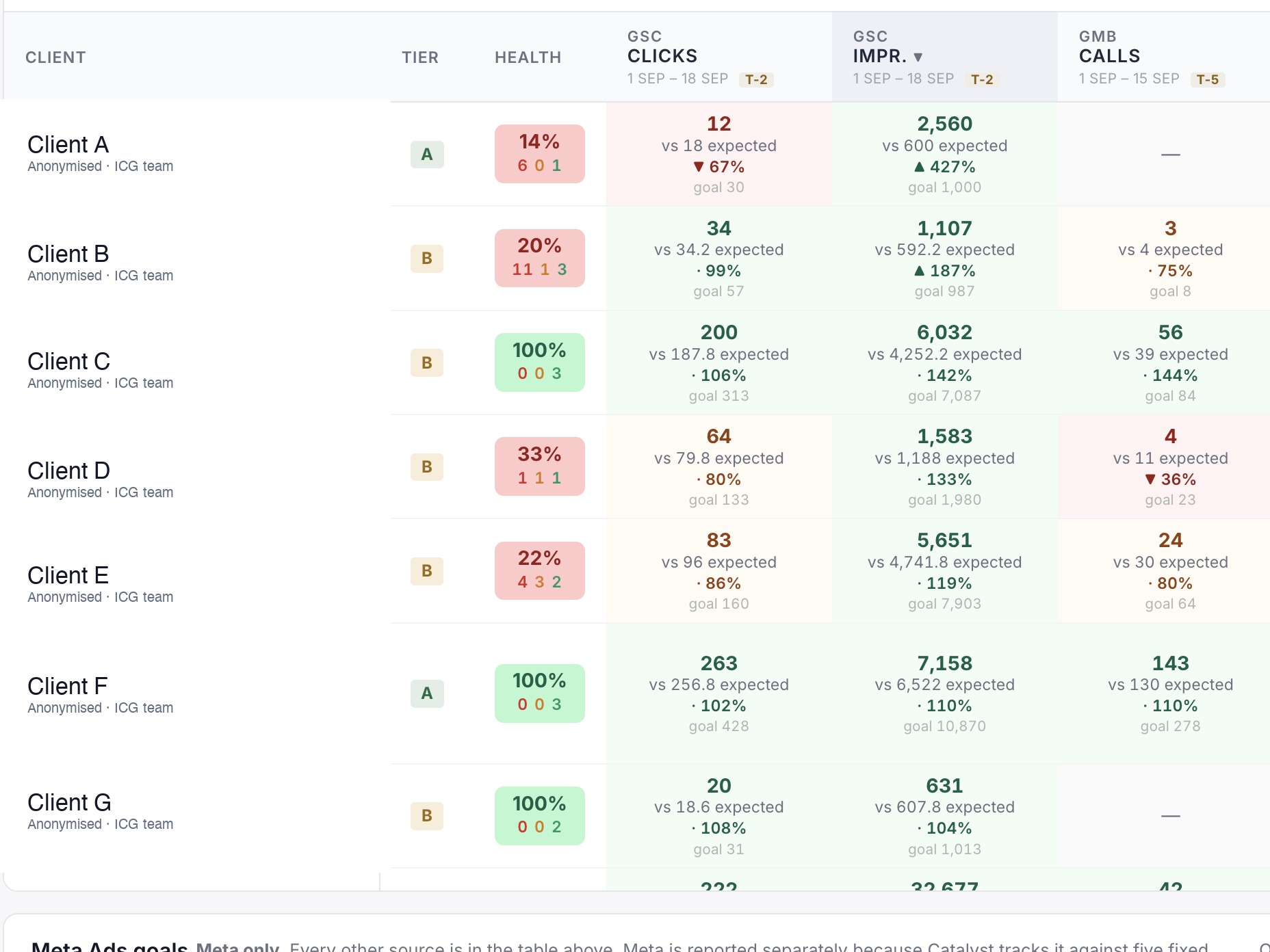
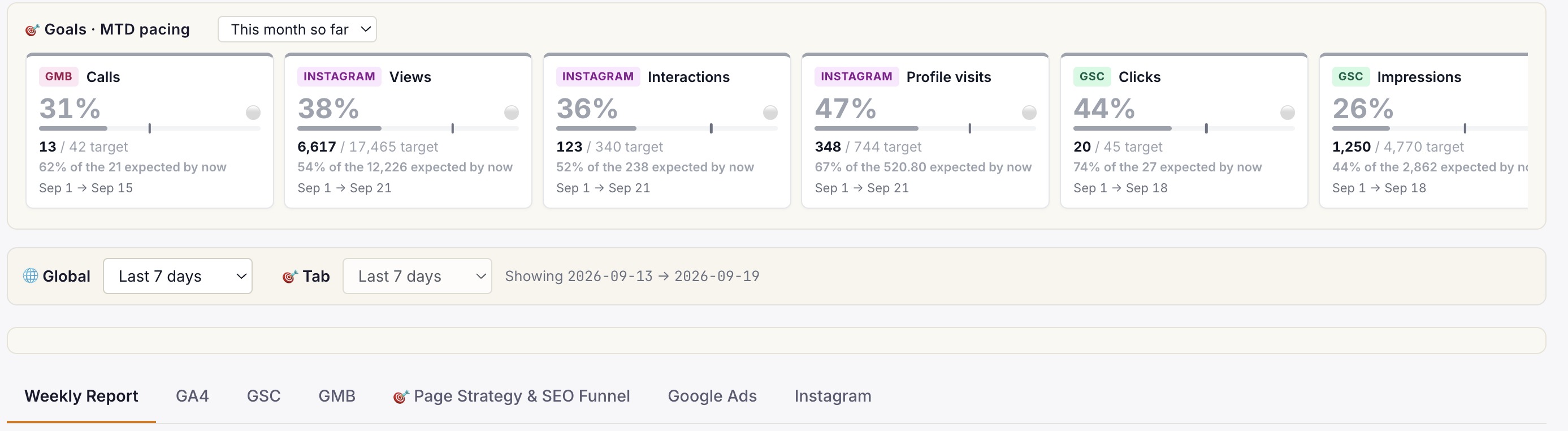
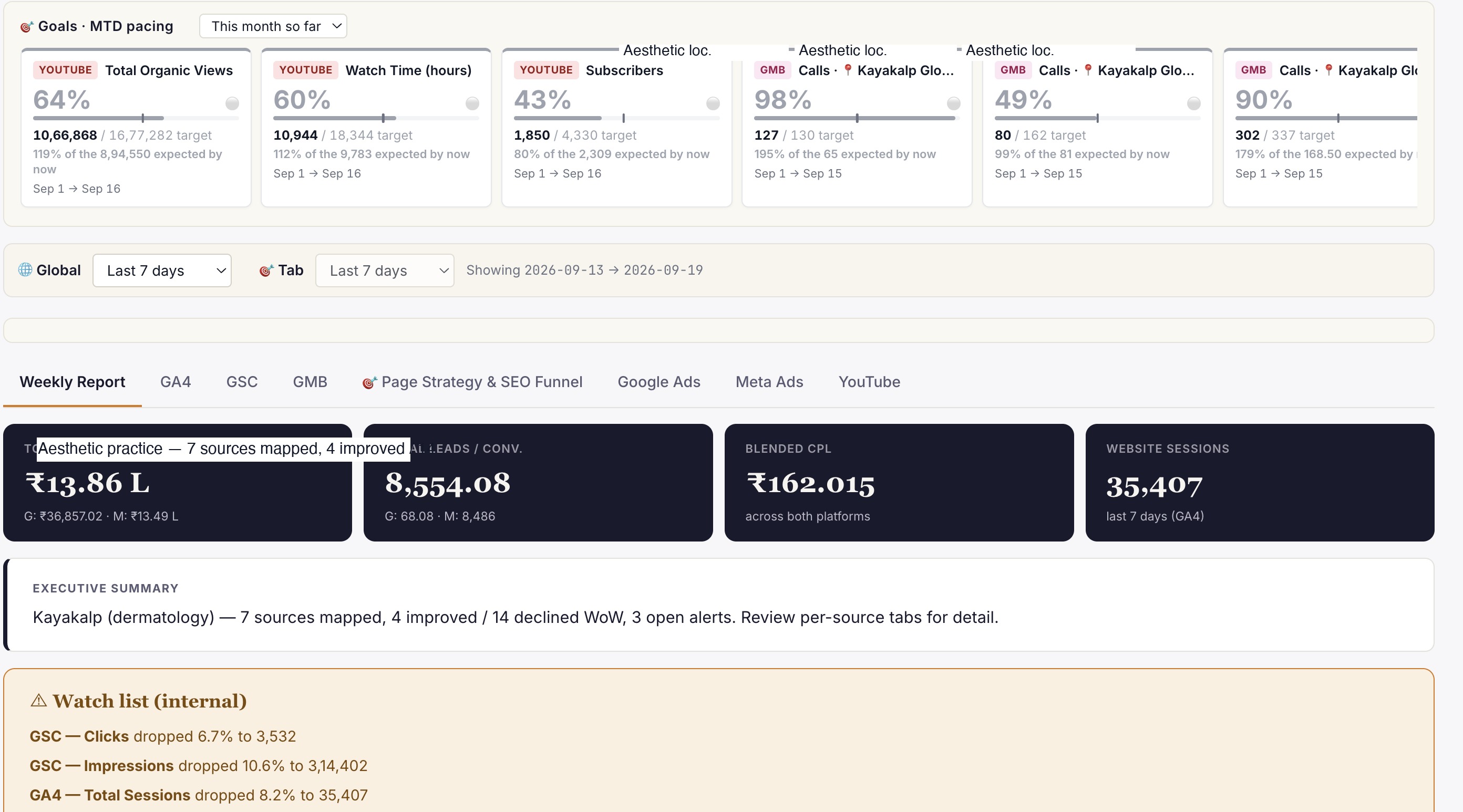
Live client dashboard. GSC, GA4, Google Ads, Meta Ads, IVR calls in one view. Login anytime, not monthly.
Phoenix
Clinic revenue intelligence over your PMS. Daily action queue: Prevent Loss, Maintain & Engage, Grow Revenue. Multi-centre rollout.
Or book a free 30-min audit to see all three in action on your account.
Healthcare brands
that already run on ICG.
A representative slice of the 150+ healthcare brands ICG has delivered for across India. Most engagements remain under NDA.


What ICG clients say · on video.
"Scale up of organic channels and business consulting. ICG has absolute domain authority in their field."
"Working with ICG transformed how we acquire IVF patients in Gurgaon. They understand the fertility journey from inquiry to consult..."
"What Ichelon accomplished — they got all my ideas and worked over 3-4 months to create an amazing, super-customised website."
Need help operationalising this?
Every ICG service is healthcare-only, NMC + DPDP-aware, and built around the patient-research patterns that drive Indian healthcare growth in 2026.
Every practice welcome — packages from ₹20,000/mo.
Goals-Driven engagements · Performance-Linked Payout Models available
More from
ICG.
Five trends shaping Indian healthcare marketing through 2027: AI-first patient research, Conversions API adoption, ABDM discovery, the AEO w...
Healthcare AIO is the discipline of getting your clinic or hospital cited inside Google AI Overviews, ChatGPT and Perplexity answers — not j...
Conversational-search advertising places brand messages inside AI chat answers — ChatGPT, Perplexity, Copilot — rather than beside a results...
Stop guessing.
Book a Diagnostic.
30 minutes. Free. With the AI-powered healthcare-only marketing agency 150+ brands already run on. No slides, no pitch, no hard close.


