


Mumbai Local SEO for Doctors: 2026 Google Maps Playbook
How Mumbai doctors and clinics rank on Google Maps in 2026: suburb GBP tactics, doctor-directory platforms vs Google, review velocity benchmarks, and a geo-grid playbook.
No pitch. Written root-cause diagnosis. AI-powered, healthcare only.
Direct answer
How Mumbai doctors and clinics rank on Google Maps in 2026: suburb GBP tactics, doctor-directory platforms vs Google, review velocity benchmarks, and a geo-grid playbook.
TL;DR
TL;DR
- Mumbai's local search market is fundamentally suburb-by-suburb — a clinic in Andheri does not compete with Bandra or Powai; it competes within a 2–3km radius in a city where patients rarely travel across zones for non-emergency care
- Google Maps rank in Mumbai is highly proximity-sensitive because of traffic: a clinic 4km away in the same suburb can be 25 minutes by road; patients and Google treat this differently than a 4km drive in Delhi
- Doctor-listing platforms have their highest India penetration in Mumbai — for dermatology, paediatrics, and general medicine, doctor-directory visibility is as important as Google Maps for patient discovery
- Review velocity benchmarks in Mumbai are higher than the national average — 80+ reviews at 4.4★ is the competitive floor for most specialties in South Mumbai and the western suburbs
- The western suburbs (Andheri, Bandra, Juhu, Malad, Borivali) and South Mumbai (Colaba, Worli, Lower Parel) have distinct competitive profiles — a strategy built for one zone does not transplant to the other
Mumbai is the most complex local search market in India. The city's combination of geographic fragmentation (limited by sea on three sides), extreme traffic sensitivity (a 5km distance can mean 45 minutes by road in peak hours), and high smartphone-native patient demographics creates a local SEO environment where suburb-level precision is not optional — it is the fundamental unit of competitive analysis.

This guide covers what makes Mumbai's local healthcare search market different, and what the geo-specific strategy looks like across the city's major healthcare zones.
Section 1 — Mumbai's geography as a local SEO constraint
Standard local SEO assumes that proximity is approximately linear — a business 3km away is reasonably accessible, 10km is a stretch for a non-emergency appointment. In most Indian cities, this holds reasonably well.
In Mumbai, it does not.
The sea barrier: Mumbai's north-south peninsula means east-west travel across the city is either a bridge crossing (with significant congestion) or a workaround. A patient in Andheri West does not typically consider a clinic in Andheri East as their neighbourhood option — despite the two being 4km apart in straight-line distance.
Traffic as a practical proximity multiplier: Google's distance calculation is straight-line. A patient's mental model of proximity is driving time. In Mumbai's peak hours, a 5km straight-line distance can translate to 30–45 minutes of driving. Patients adjust their search radius accordingly — and Google Maps, which increasingly uses driving time in its localisation calculations, partially reflects this.
The practical implication for local SEO: Your catchment is smaller in Mumbai than in any comparable-population Indian city. A clinic in Malad West primarily competes with other Malad West and Malad East clinics for most specialties — not with Kandivali or Goregaon. Your GBP strategy must be calibrated to this real catchment, not a theoretical radius.
Section 2 — Mumbai's major healthcare local search zones
2.1 South Mumbai (Colaba, Nariman Point, Cuffe Parade, Fort, Churchgate, Worli, Lower Parel)
Patient profile: High-income, multinational-employed, significant expat population in select pockets. Strong health insurance penetration. Preference for premium positioning and international credentialing.
Competitive profile: Fewer clinics per km² than the suburbs, but each clinic faces competition from premium hospitals (Breach Candy, Bombay Hospital, Jaslok, Hinduja) that dominate branded search. Independent specialists need strong personal brand and credential signals to differentiate.
Local SEO priorities:
- Person schema with international credentials (fellowships, foreign training, international society memberships)
- Premium category selection (avoid over-broad categories — specificity signals quality)
- Paid doctor-directory listing essential (high doctor-directory search volume in South Mumbai for dermatology, psychiatry, and internal medicine)
- Review language matters here — patients write detailed, articulate reviews; response quality is scrutinised
Review benchmark (South Mumbai, 2026): 80+ reviews at 4.5★ for competitive specialties (dermatology, psychiatry, internal medicine).
2.2 Western Suburbs (Bandra, Khar, Santacruz, Vile Parle, Andheri, Jogeshwari, Malad, Kandivali, Borivali)
Patient profile: The largest patient population in the city. Middle to upper-middle income, mix of working professionals and families. High mobile search volume. Significant variation by locality — Bandra skews premium, Borivali skews mass-market.
Competitive profile: Most saturated healthcare local search market in Mumbai. Every specialty in Andheri, Bandra, and the Kandivali-Malad corridor has 8–15 active GBP listings competing for the local pack.
Local SEO priorities:
- Suburb-specific keyword strategy: "dermatologist in Andheri West" not just "dermatologist Mumbai"
- Google Posts targeting suburb-specific search terms (health awareness content with "Bandra," "Andheri West" in post body)
- Review velocity is the key differentiator — the clinics at the top of the pack in Andheri typically have 150–300 reviews at 4.4–4.8★
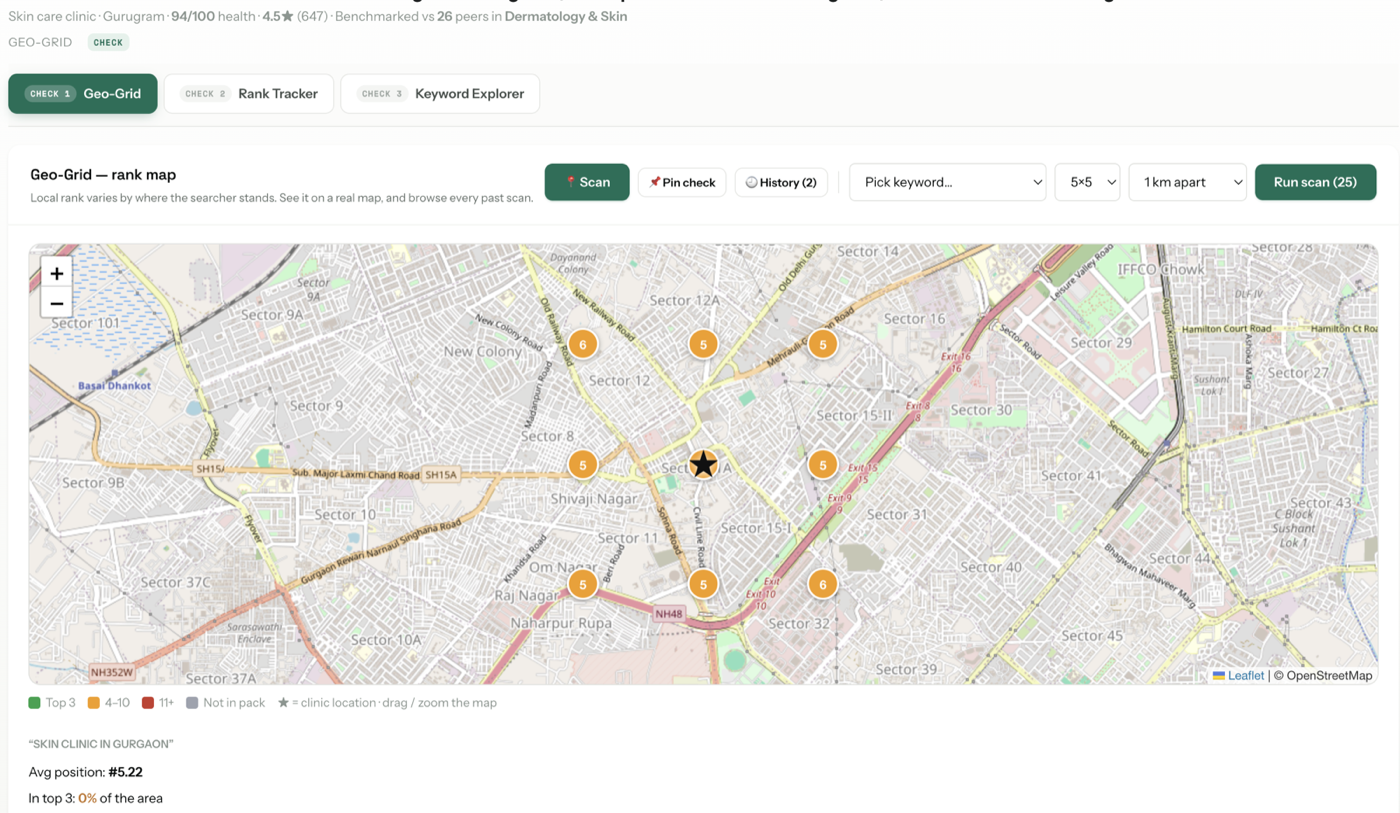
- Geo-grid scanning at 500m–1km spacing (not 1km standard) due to the density of competition
- Local-directory claim and optimisation essential — local-directory search volume in the western suburbs is high
Review benchmark (Western Suburbs, 2026): 120+ reviews at 4.4★ for competitive specialties in Bandra/Andheri; 60+ reviews at 4.3★ in Malad/Kandivali.
2.3 Central Suburbs (Ghatkopar, Vikhroli, Mulund, Bhandup, Powai)
Patient profile: Mix of established residential areas and newer IT/commercial hub (Powai). Growing middle-income patient base. Less competitive than western suburbs — opportunity window still open for well-optimised clinics.
Competitive profile: Lower average listing count than western suburbs but growing quickly. Powai specifically has a distinct tech-professional demographic that skews toward premium healthcare choices.
Local SEO priorities:
- Powai patients frequently consider alternatives in Vikhroli and Ghatkopar — the catchment extends slightly more than in the western suburbs
- Hiranandani district in Powai has its own micro-geography worth targeting in Q&A and posts
- Review benchmarks lower than western suburbs — 50–80 reviews at 4.3★ is competitive in most specialties
2.4 Navi Mumbai (Vashi, Kharghar, Belapur, Nerul, Panvel)
Patient profile: Planned urban development with growing middle-income population. Significant unmet healthcare demand relative to supply. Patients have more tolerance for travel than the island city.
Competitive profile: Less competitive than Mumbai proper. A well-optimised clinic in Vashi can achieve top-3 visibility across a 5–8km radius — significantly wider than island city catchment.
Local SEO priorities:
- Navi Mumbai patients will travel to Mumbai for premium care but prefer local for general and specialist OPD — both audiences need to be addressed
- Sector-specific keywords (Kharghar, Belapur Sector 11, Vashi Sector 30) useful for hyper-local targeting
- Local-directory dominance higher in Navi Mumbai than in the island city — local-directory optimisation is tier-1 priority here
Section 3 — Doctor-directory platforms vs Google in Mumbai
Mumbai has the highest doctor-listing platform user penetration of any Indian city. For certain specialties, doctor-directory search volume in Mumbai rivals Google Maps search volume:
| Specialty | Google Maps search share | Doctor-directory search share (Mumbai est.) |
|---|---|---|
| General Medicine | 65% | 35% |
| Paediatrics | 60% | 40% |
| Dermatology | 58% | 42% |
| Gynaecology | 62% | 38% |
| Psychiatry / Mental Health | 50% | 50% |
| Ophthalmology | 70% | 30% |
| Dentistry | 72% | 28% |
| Orthopaedics | 75% | 25% |
ICG estimates based on keyword research and patient acquisition attribution data across Mumbai healthcare clients, 2025–2026.
Strategic implication: For dermatology, paediatrics, psychiatry, and general medicine in Mumbai, doctor-directory optimisation is not optional — it is as important as GBP optimisation. A Mumbai clinic that is #1 on Google Maps but absent or poorly optimised on doctor-directory platforms is losing 30–40% of its potential digital patient volume.
Section 4 — Review benchmarks and velocity targets
Mumbai patients write reviews more than the national average. Urban, high-smartphone-usage demographics produce higher organic review rates — but also higher expectations from reviews as a trust signal.
Monthly new review targets for competitive Mumbai specialties:
| Specialty / Zone | Minimum to be competitive | Target for top-3 |
|---|---|---|
| Dermatology, Andheri/Bandra | 15–20/month | 25–35/month |
| IVF clinic, Western Suburbs | 10–15/month | 18–25/month |
| Orthopaedic surgeon, South Mumbai | 8–12/month | 15–20/month |
| GP, Central Suburbs | 12–18/month | 20–30/month |
| Dental chain (per location, Western Suburbs) | 12–18/month | 22–30/month |
ICG's review generation SOP for Mumbai healthcare clients: WhatsApp satisfaction check sent within 4 hours of appointment (Mumbai patients expect fast follow-up). 4–5/5 scorers receive the direct Google review link immediately. One follow-up at 24 hours if no review posted. In-practice QR code at checkout desk as parallel channel.
Section 5 — Geo-grid strategy for Mumbai
Standard geo-grid setups use 1km grid spacing. For Mumbai's dense urban environment — particularly the western suburbs and South Mumbai — this overestimates the effective catchment. ICG's Mumbai geo-grid configuration:
- South Mumbai, Bandra, Andheri (dense zones): 5×5 grid at 500m–750m spacing
- Malad, Kandivali, Borivali (mid-density zones): 5×5 grid at 750m–1km spacing
- Powai, Navi Mumbai (lower density): 7×7 grid at 1km–1.5km spacing
The tighter spacing reveals competition patterns that 1km grids miss — a competitor clinic 600m away that is consistently ranking above you for your primary keywords, invisible on a 1km grid.
Frequently asked questions
Q1: What review count does a Mumbai clinic need to be competitive? Depends on specialty and zone. Western suburbs, competitive specialties: 120+ reviews at 4.4★ to enter the top-3 conversation. South Mumbai premium: 80+ at 4.5★. Central suburbs: 50–80 at 4.3★. Navi Mumbai: 40–60 at 4.2★ for most specialties. These are floors, not ceilings — the top-ranking clinics in competitive Mumbai zones often have 300–500+ reviews.
Q2: Should a Mumbai clinic optimise for "Mumbai" or suburb-specific keywords? Both, but weighted toward suburb-specific. A patient searching "dermatologist Mumbai" is at an earlier stage of their search than one searching "dermatologist Andheri West" — the suburb-specific query is closer to booking intent. Your GBP suburb-specific signals (address, service area, Google Posts mentioning suburb names, Q&A referencing local area) help Google match you to these higher-intent suburb queries.
Q3: Are doctor-directory platforms worth investing in for Mumbai healthcare businesses? For dermatology, paediatrics, general medicine, gynaecology, and psychiatry in Mumbai — yes, doctor-directory platforms are a tier-1 priority alongside GBP. For surgical specialties (orthopaedics, cardiac, neurosurgery), Google Maps is the dominant channel. Evaluate your specialty's doctor-directory search volume before deciding on a paid listing tier.
Q4: How does traffic affect local SEO strategy in Mumbai? Google increasingly incorporates driving time into its local relevance calculation for "near me" queries. In Mumbai's traffic environment, a 3km straight-line radius can mean 20–30 minutes driving in peak hours. This reduces the practical catchment for most clinics and increases the importance of being the best-ranked option within the immediate neighbourhood rather than trying to rank across the whole city.
Q5: What is the biggest GBP management mistake Mumbai healthcare clinics make? Using a single "Mumbai" address and expecting to rank across the city. A clinic in Andheri cannot rank in the South Mumbai local pack regardless of how well-optimised its GBP is — Google's distance factor is too significant. The correct approach: optimise aggressively for your specific suburb and the immediately adjacent areas, rather than spreading effort thin across a city-wide strategy.
Q6: How does ICG manage GBPs for Mumbai healthcare clients? ICG uses Turtle's geo-grid scanning at suburb-appropriate spacing (500m–1km in dense zones), tracks review velocity against Mumbai-specific benchmarks, monitors NAP consistency across India-specific directories including doctor-listing platforms and national local-business directories, and adjusts Google Posts content to include suburb-specific keywords. For multi-location Mumbai clients, we manage each location as its own micro-market with its own competitive profile.
Sources:
- Google Maps local search data — Search Central
- ICG patient acquisition attribution data, Mumbai healthcare portfolio, 2025–2026
- Doctor-listing platform usage data — publicly available estimates
Internal links:
- Local SEO for Healthcare — Complete 2026 Guide
- Geo-Grid Rank Tracking — Why Your Map Rank Isn't One Number
- Google Review Management — How Reviews Drive Rankings
- Google Business Profile Management Services
- Healthcare Marketing Agency Mumbai
BLOG 2 of 3
Common Mumbai local SEO mistakes clinics keep making in 2026
After running local-SEO engagements across Bandra, Andheri, Powai, Chembur and South Mumbai clinics, the same handful of mistakes cost most healthcare brands their top-3 Map Pack spot. Fixing these usually moves the needle inside 60 to 90 days — no new content, no new backlinks, just cleaner execution.
- One GBP for a multi-doctor clinic. Mumbai's dense polyclinic model rewards a primary practice listing plus individual practitioner listings. Solo-listing clinics lose to competitors who claim both.
- Ignoring Marathi and Hinglish review language. Google's local algorithm reads review content, not just star count. Reviews mentioning "Marol", "Ghatkopar East", "opposite station" or Devanagari-script neighbourhood names lift suburb-level relevance faster than generic five-star reviews.
- Address inconsistency across doctor-directory platforms, local directories and GBP. Mumbai's building-name culture ("Above HDFC, Linking Road") produces 4-5 address variants. Google reads this as NAP drift. Standardise once, propagate everywhere.
- Skipping Q&A seeding. The Questions section on GBP is a ranking surface most Mumbai clinics leave empty. Seed 8-12 real questions (parking, timings, insurance, home-visit availability) with owner-answered responses.
- No monsoon posts. June-September GBP Posts about waterlogging routes, teleconsult availability and revised timings drive engagement Google reads as freshness. Most clinics go silent for the monsoon quarter.
What changed in 2026 for Mumbai local search
Google's late-2025 local update sharpened two signals for dense metros like Mumbai: proximity decay is steeper (a listing 1.2 km away now loses to one 400 m away far more aggressively than in 2024), and video review weight has increased — 30-second patient walk-throughs count more than text reviews of the same length.
Operationalising both signals is what our Angryturtle GBP OS and YODA YouTube system were built for. If you want an audit of your Mumbai footprint against these 2026 signals, the Client Elevation Programme starts there. Or read the sibling breakdown for Delhi NCR clinics to compare metro dynamics.
Book a free SEO diagnostic.
Hanuman Sihag's team runs a live crawl, checks technical health, cannibalisation, schema coverage and content gaps. 60 minutes, prioritised fix list.
Questions readers ask
about this topic.
The three platforms
behind every ICG engagement.
Beacon
CAPI middleware that fixes Event Match Quality, translates CRM statuses to Meta-standard events, dedups across channels.
Agency OS
Live client dashboard. GSC, GA4, Google Ads, Meta Ads, IVR calls in one view. Login anytime, not monthly.
Phoenix
Clinic revenue intelligence over your PMS. Daily action queue: Prevent Loss, Maintain & Engage, Grow Revenue. Multi-centre rollout.
Or book a free 30-min audit to see all three in action on your account.
Healthcare brands
that already run on ICG.
A representative slice of the 150+ healthcare brands ICG has delivered for across India. Most engagements remain under NDA.


What ICG clients say · on video.
"Scale up of organic channels and business consulting. ICG has absolute domain authority in their field."
"Working with ICG transformed how we acquire IVF patients in Gurgaon. They understand the fertility journey from inquiry to consult..."
"What Ichelon accomplished — they got all my ideas and worked over 3-4 months to create an amazing, super-customised website."
The intelligence stack behind this playbook.
Every ICG engagement runs on the Search Intelligence Trifecta — Angryturtle for GMB, SIE for search and AI Overview, YODA for YouTube. Live product screens below.
Need help operationalising this?
Every ICG service is healthcare-only, NMC + DPDP-aware, and built around the patient-research patterns that drive Indian healthcare growth in 2026.
Every practice welcome — packages from ₹20,000/mo.
Goals-Driven engagements · Performance-Linked Payout Models available



More from
ICG.
Five trends shaping Indian healthcare marketing through 2027: AI-first patient research, Conversions API adoption, ABDM discovery, the AEO w...
Healthcare AIO is the discipline of getting your clinic or hospital cited inside Google AI Overviews, ChatGPT and Perplexity answers — not j...
Conversational-search advertising places brand messages inside AI chat answers — ChatGPT, Perplexity, Copilot — rather than beside a results...
Stop guessing.
Book a Diagnostic.
30 minutes. Free. With the AI-powered healthcare-only marketing agency 150+ brands already run on. No slides, no pitch, no hard close.


