


Local SEO for Healthcare Clinics: The Foundation
Outcomes of consistency in citation,covid-19 Updates and Instant reply to messages for a client dealing in premium bicycle segment Problem Statement Due to COVID-19, there was a massive decline in demand for bicycle industry. While the overall search for the service was done , there was a signifi...
No pitch. Written root-cause diagnosis. AI-powered, healthcare only.
Direct answer
Outcomes of consistency in citation,covid-19 Updates and Instant reply to messages for a client dealing in premium bicycle segment
Problem Statement
Due to COVID-19, there was a massive decline in demand for bicycle industry. While the overall search for the service was done , th...
TL;DR
Problem Statement
Due to COVID-19, there was a massive decline in demand for bicycle industry. While the overall search for the service was done , there was a signifi...
Local SEO is the single highest-margin marketing channel a physical clinic or hospital in India can invest in. Done well, it produces the cheapest cost per booked appointment of any channel — usually Rs 120-380 per patient — and it compounds over 18-24 months into a defensive moat that competitors cannot easily attack. Done badly, it is a Google Business Profile that has not been touched in eight months and a website that no one in your city can find.
This guide is the local SEO fundamentals playbook we run for hospitals, IVF centres, dental groups, dermatology chains, and diagnostics brands across India. It focuses on what actually moves rank for physical-location healthcare in Delhi NCR, Mumbai, Bengaluru, Hyderabad, Chennai, Kolkata, and tier-two cities.
What "local SEO" actually means for a clinic
Local SEO is the practice of getting your clinic to appear in three places: the Google Local Pack (the map with three results at the top of local queries), the Google Business Profile knowledge panel, and the standard organic results for queries with local intent. It is different from national SEO because ranking factors weight your Google Business Profile signals, NAP consistency across the web, and geographic proximity as heavily as they weight your website content.
For a physical clinic, local SEO drives 40-70% of appointment-intent search traffic. It is also the search surface where patient reviews, doctor photos, and clinic amenities influence booking decisions before the patient ever visits your website. Most of your first impression happens inside Google Maps and the local pack, not on your homepage.
The Google Business Profile foundations
Every physical location needs its own claimed and verified Google Business Profile. Do not share one GBP across multiple locations. Category selection is the single most important field — set your primary category to the most specific match (Fertility Clinic, Dental Clinic, Skin Care Clinic, Multi-speciality Hospital) and add 5-8 relevant secondary categories.
Complete every field. Business name (exact legal name, no keyword stuffing — Google will penalise "Dr Sharma Best IVF Clinic Delhi Near Me"), address (matching the sign on the door), phone (local landline where available, not a shared call centre number), hours (with holiday exceptions), website (deep link to a city-specific landing page, not the homepage), service list (all procedures you offer with descriptions), product list (productised services with pricing), and attributes (wheelchair accessible, appointments required, women-led business where applicable).
Photos matter more than owners realise. Upload at least 30 photos across four categories: exterior (2-3 with your signage clearly visible), interior (waiting area, consultation rooms, procedure rooms), team (doctors with name tags visible, front desk staff), and procedure (within compliance). Refresh 3-5 photos per month. GBPs with active photo uploads rank 15-30% higher in local pack in our data.
Reviews: the highest-leverage local SEO input
Reviews are the single biggest local pack ranking factor after proximity and relevance. A clinic with 240 reviews averaging 4.7 stars outranks a clinic with 40 reviews averaging 4.9 stars in almost every local pack we monitor. Volume matters more than average rating above 4.4.
Systematise review generation. Every patient interaction ends with a review request — SMS to the mobile number on file 6-24 hours after the visit, WhatsApp follow-up 48 hours later, in-person QR code at the front desk. Convert 12-18% of visits to reviews within 90 days and you will move up the local pack.
Respond to every review within 48 hours. Positive reviews get a thank-you that mentions the doctor by name and the specific procedure — this is a hidden ranking signal. Negative reviews get a professional response acknowledging the concern, offering a private channel to resolve, and never getting defensive. Google's algorithm rewards active review management.
Do not fake reviews. Google's spam detection is sophisticated and manual reviewers audit healthcare GBPs disproportionately. A single fake review event can result in your GBP being suspended for weeks. Legitimate patient reviews at scale beat fake reviews at any scale.
NAP consistency across the web
NAP (name, address, phone) consistency across every online directory and listing is a foundational local SEO signal. Your NAP on Google Business Profile must match exactly your website, Facebook page, local business directory listings, doctor-directory listings, health directory listings, and every citation across the web. Small inconsistencies (Suite vs Ste, road vs Rd, +91 vs 0) create trust dents that Google's local algorithm penalises.
Audit your NAP citations quarterly. Use a dedicated citation-audit tool (a local SEO tool) for the audit — do not do this manually. Common errors: old phone numbers from a previous location, address suite variations, formatting inconsistencies, and stale listings that duplicate your current listing. Consolidate duplicates via Google's merge request or by claiming and correcting the older listing.
City-specific landing pages that rank
For multi-location clinics, every city (and often every neighbourhood within a city) needs a dedicated landing page. Do not use templated content across city pages — Google detects this and treats it as thin content. Each city page needs unique elements: local doctor names and photos, city-specific patient testimonials, neighbourhood-specific service mentions, embedded map, local NAP, LocalBusiness schema markup with the specific location, and locally relevant FAQ.
Structure the URL clearly. /clinic/mumbai-bandra beats /locations/branch-047. Include the neighbourhood or city name in the H1 and in the first paragraph. Link the city page to your specialty pillar pages and to your appointment booking page.
Local citations that matter in India
India-specific citation sources that carry weight: national local-business directories (verified listing), Sulekha, IndiaMart directory, city-specific business directories (Delhi Yellow Pages, Mumbai Business Guide), health-specific aggregators, and industry association directories (state medical council directories, specialty society listings where applicable). Do not chase mass citation building — 40-60 quality citations outperform 400 low-quality ones.
Skip citation-buying services that promise 200 listings in 48 hours. These use PBN-style directories that Google discounts entirely and often flags as spam.
Local content and query targeting
Beyond your city landing pages, publish long-tail content targeting locally-modified queries. "Best root canal specialist near Andheri", "IVF cost in South Delhi", "dermatologist in Koramangala for acne" — these queries have lower volume individually but compound into meaningful traffic across 50-200 pages.
Structure long-tail local content as: symptom or intent + city/neighbourhood + specific answer + booking CTA. Include LocalBusiness schema with the specific clinic location that would serve this query. Internally link from these long-tail pages up to your city hub page and your specialty pillar page.
Local link building for healthcare
Local links carry disproportionate weight in local SEO. Sources that work in India: local chamber of commerce memberships, city hospital association listings, sponsorship of local health awareness events, partnerships with corporate offices for employee wellness programs, medical education institutes with your doctors as visiting faculty, and coverage in local newspapers (Times of India city editions, local Marathi/Kannada/Bengali papers).
Health-specific local links: partnerships with local pharmacies (do not violate anti-kickback laws — this is a link and cross-referral of information, not payment for patient referrals), local pathology labs, and local diagnostic centres. Cross-linking with other specialty clinics in complementary services (a dental clinic linking to a nutrition clinic) works when the content is genuinely useful, not directory-style.
Tracking local SEO success
Measure at three levels. Rankings — track keyword positions in the local pack from multiple locations across your city using a rank tracker that supports geo-modified queries. Google Business Profile insights — track profile views, discovery searches, direct searches, phone calls initiated, direction requests, and website clicks. Conversions — track calls, form fills, and WhatsApp initiates that originated from local search using UTM parameters on your GBP website link and call tracking on your listed phone number.
Local pack rankings can vary by 4-8 positions across different areas of the same city. Monitor from at least 5 geographic points per city. If you only track from your office IP, you will overstate performance.
Common local SEO mistakes we see
Sharing one GBP across multiple locations. Stuffing keywords into the business name. Using a virtual office or coworking address that fails the verification postcard. Ignoring reviews for months at a time. Publishing templated city pages that Google recognises as duplicates. Buying citations from bulk services. Not tracking rankings from multiple geographic points. Forgetting to update hours during festivals and holidays. Using a shared call centre phone number instead of a local landline.
How local SEO compounds over 18 months
Month 1-3: technical foundation (GBP claimed, NAP audited, city pages built, schema deployed). Month 4-6: content and reviews accelerate (long-tail pages published, review system in place, first ranking movement). Month 7-12: authority builds (backlinks, citations, media mentions). Month 13-18: compounding kicks in (traffic doubles, cost per booking drops to Rs 120-380).
The clinics that dominate local search in their city are almost always the ones who committed to 18 continuous months of the discipline. There is no local SEO shortcut in India that survives 12 months.
Bringing it together
Local SEO is a discipline more than a project. It rewards clinics that maintain their GBP weekly, generate patient reviews systematically, publish locally-relevant content continuously, and treat their NAP citations as a business asset. The clinics that grow to 30-plus new local patients per day did not out-spend competitors — they out-executed on the compounding local signals for 18-30 months.
To size what local SEO could yield in your city, run the numbers through our CPQL calculator. To read how local SEO fits with paid ads, see our SEO vs paid ads breakdown. If you want us to audit your local SEO, our local SEO team returns a written diagnosis within seven working days.
FAQ: Local SEO for Indian clinics
How long does local SEO take to work for a new clinic?
First local pack appearance in 30-60 days after GBP claim and verification. Meaningful ranking in 90-120 days once reviews and citations accumulate. Category-level dominance in 12-18 months.
Do we need a separate GBP for each doctor?
Only if the doctor practices under their own clinic name at a distinct address. Doctors who practice at a shared clinic should be listed on the clinic GBP, not have their own. Individual doctor profiles should live on the website with Physician schema markup.
How many reviews do we need to rank in the local pack?
Depends on your city and specialty. Tier-one city dense competition: 200+ reviews at 4.4+ average. Tier-two city: 80+ reviews at 4.4+. Reviews should grow month-over-month — a static count signals a paused business.
Should we respond to negative reviews publicly or reach out privately?
Both. Reply publicly first (acknowledge, empathise, offer private channel) then contact the reviewer privately to resolve. A well-handled negative review often converts to a positive review revision or removal request.
Can we hide our address if we run a home-visit or teleconsult practice?
Yes — use the Service Area Business setting in GBP. Your address is hidden but you must define a specific service area. This works well for home healthcare, teleconsult, mobile diagnostics, and physiotherapy practices.
Do social media posts affect local SEO?
Directly no, indirectly yes. Active Facebook, Instagram, and YouTube presences create citations, brand searches, and behavioural signals that reinforce local SEO. GBP posts (via the "Add Update" feature) directly affect ranking — post weekly minimum.
How do we handle a clinic that moved to a new address?
Do not delete the old GBP. Update the address, submit the change, wait for Google verification (often re-verification postcard), redirect the old citation address across the web, and add a website page announcing the move. Do this in the same week — a stale address across the web causes NAP inconsistency for 3-6 months.
Is local SEO enough or do we still need paid ads?
Local SEO is enough for most established single-location clinics with mature review flows. Multi-location and new clinics benefit from paid ads for immediate demand capture while local SEO builds. See our SEO vs paid ads guide.
Book a free SEO diagnostic.
Hanuman Sihag's team runs a live crawl, checks technical health, cannibalisation, schema coverage and content gaps. 60 minutes, prioritised fix list.
The three platforms
behind every ICG engagement.
Beacon
CAPI middleware that fixes Event Match Quality, translates CRM statuses to Meta-standard events, dedups across channels.
Agency OS
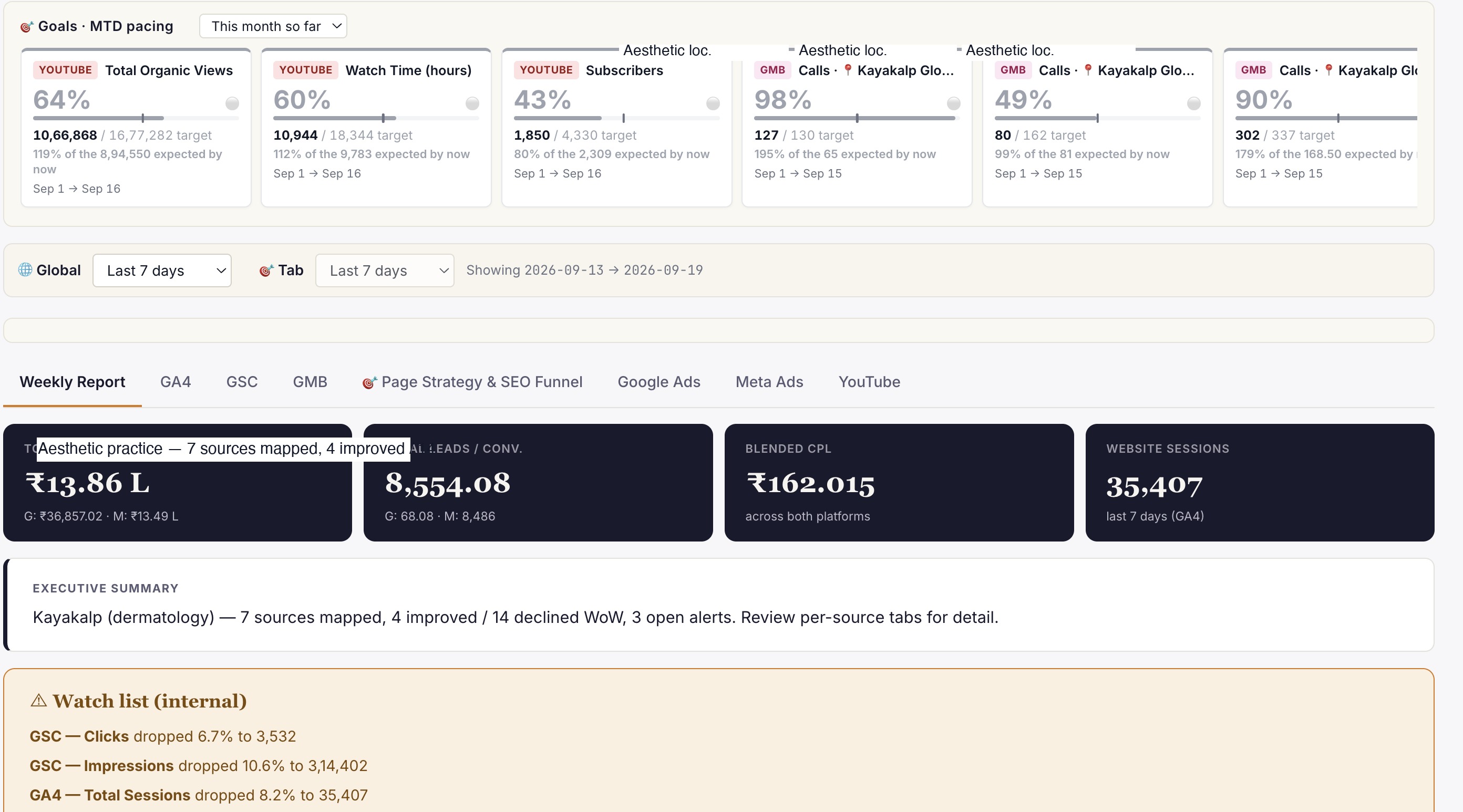
Live client dashboard. GSC, GA4, Google Ads, Meta Ads, IVR calls in one view. Login anytime, not monthly.
Phoenix
Clinic revenue intelligence over your PMS. Daily action queue: Prevent Loss, Maintain & Engage, Grow Revenue. Multi-centre rollout.
Or book a free 30-min audit to see all three in action on your account.
Healthcare brands
that already run on ICG.
A representative slice of the 150+ healthcare brands ICG has delivered for across India. Most engagements remain under NDA.


What ICG clients say · on video.
"Scale up of organic channels and business consulting. ICG has absolute domain authority in their field."
"Working with ICG transformed how we acquire IVF patients in Gurgaon. They understand the fertility journey from inquiry to consult..."
"What Ichelon accomplished — they got all my ideas and worked over 3-4 months to create an amazing, super-customised website."
The intelligence stack behind this playbook.
Every ICG engagement runs on the Search Intelligence Trifecta — Angryturtle for GMB, SIE for search and AI Overview, YODA for YouTube. Live product screens below.
Need help operationalising this?
Every ICG service is healthcare-only, NMC + DPDP-aware, and built around the patient-research patterns that drive Indian healthcare growth in 2026.
Every practice welcome — packages from ₹20,000/mo.
Goals-Driven engagements · Performance-Linked Payout Models available


More from
ICG.
Hindi and regional-language SEO means publishing proper pages in the languages your patients search in, on their own URLs and linked with hr...
A new pharma brand in India should start digital work before launch, built around who it may legally address. This six-month plan covers pro...
Hospitals and clinics in India can still advertise after the NMC's 6 October 2026 guidelines, but only with factual, verifiable information....
Stop guessing.
Book a Diagnostic.
30 minutes. Free. With the AI-powered healthcare-only marketing agency 150+ brands already run on. No slides, no pitch, no hard close.


