


In-house vs agency for clinic YouTube management in India: the real cost, compliance, and craft comparison
The in-house vs agency question for clinic YouTube management is not settled by cost alone. A full-time in-house YouTube manager runs ₹6-15 lakh annual salary before gear, software, and editor support. An agency retainer runs ₹75,000-₹4,00,000/- per month. This decides which model wins for your clinic size, specialty, and video ambition.
No pitch. Written root-cause diagnosis. AI-powered, healthcare only.
Direct answer
The in-house vs agency question for clinic YouTube management is not settled by cost alone. A full-time in-house YouTube manager runs ₹6-15 lakh annual salary before gear, software, and editor support. An agency retainer runs ₹75,000-₹4,00,000/- per month. This decides which mode...
TL;DR

The in-house vs agency question for clinic YouTube management is a real one in Indian healthcare, and it is almost never settled by cost alone. A full-time YouTube manager sitting inside a hospital's marketing team costs a very different thing from a healthcare-specialist agency running the same channel remotely — different not only in rupees but in compliance depth, algorithm literacy, and the discipline to iterate on every video for weeks after it publishes. ICG has migrated clinics both ways over the past three years, from in-house teams onto our YODA platform and from agencies onto internal teams that use YODA as their intelligence layer. This piece lays out the honest tradeoff so a clinic owner can pick the right model rather than the loudest one. The Healthcare YouTube Marketing Agency service page covers the agency-side details.
Why this question is not binary
The framing that dominates most articles on this topic — "should you hire in-house or go with an agency" — is misleading because it treats the two options as equivalent packages with different labels. They are not. An in-house YouTube manager is a permanent capability inside the practice, dedicated to a single brand, present at every doctor huddle, embedded in the culture. An agency is a rented capability, dedicated to many brands, present remotely, and sold as a product.
The correct question is not which one is cheaper. It is which one gives the practice the growth pattern it actually needs at the stage it is currently in. There is also a third option — hybrid — which is under-discussed but works exceptionally well when a clinic can afford both a strong internal producer and a specialist agency running the intelligence layer.
The full cost of in-house — salary is only 55-65% of it
A capable in-house YouTube manager in India costs ₹6,00,000-₹15,00,000/- per year depending on city and experience. Metro rates are higher; tier-2 cities lower. That is the salary line. The full-loaded cost of the function is meaningfully more.
The other lines to count. Equipment: starter kit at ₹1,50,000-₹4,00,000/- amortised over 3-4 years works out to ₹4,000-₹10,000/- per month. Software licences: Adobe Creative Cloud, DaVinci Resolve Studio, vidIQ or TubeBuddy at agency tier, a thumbnail tool, an AI-assist editing tool — combined ₹8,000-₹25,000/- per month. Editor support: no single in-house manager can shoot, edit, thumbnail, upload, optimise and moderate comments at growth-tier volume. Most in-house setups add a part-time or freelance editor at ₹25,000-₹60,000/- per month. Shoot logistics: clinic-based shoots need lighting refits, quiet room bookings, and often a make-up assist for on-camera doctors — call it ₹8,000-₹20,000/- per month.
Add it up: an in-house YouTube function inside a mid-sized clinic realistically runs ₹85,000-₹1,80,000/- per month all-in. Compare that to the agency-tier bands below and the picture becomes clearer.
The freelancer middle ground
Before comparing full in-house against a full agency, most clinics pass through a freelancer stage. A capable freelance video editor charges ₹15,000-₹60,000/- per month for two to four videos, thumbnails and basic upload optimisation. Healthcare-adjacent freelancers with NMC and ASCI awareness sit at the top of that band.
The freelancer model works when the on-camera doctor is very comfortable, produces raw content weekly, and can absorb the strategy and compliance decisions personally. The freelancer model breaks when: algorithm literacy is needed (most freelancers post-and-forget), compliance depth is needed (most freelancers write patient-testimonial-style captions unaware they violate NMC), or when the channel needs to iterate on titles and thumbnails 30-90 days after upload (most freelancers do not do this because they are already booked on the next client's edit).
The agency retainer tiers
Healthcare-specialist agency retainers in India start at ₹75,000/- per month for a solo-practice engagement and scale to ₹4,00,000/- per month for full hospital-group production with ads coordination. The middle band — ₹1,20,000-₹2,00,000/- for a growth retainer — covers most single-hospital or multi-doctor clinic engagements.
The agency tier buys three things the freelancer tier does not: compliance depth (a healthcare-trained editing team plus a compliance reviewer), algorithm literacy (weekly optimisation loops on titles, tags, chapters, thumbnails), and data infrastructure (an intelligence layer like YODA that separates organic from paid views, tracks the three rank races, and turns dashboards into decisions).
General digital agencies at similar prices technically produce comparable output. What they do not produce is compliance-safe output — the very common failure mode where an agency scripts a patient-testimonial-style video, edits before-and-after cuts, or writes an outcome-claim description that violates NMC's 2026 advertising guidelines and ASCI Guidelines 2022 published at ascionline.in.
Decision framework by clinic size
Solo practice (one doctor). Agency retainer at the starter tier (₹75,000-₹1,20,000/- per month) almost always wins on cost and compliance. Hiring a full-time in-house YouTube manager for a single doctor is under-utilised capacity — the manager will spend half the month waiting for shoot slots. Freelancer works if the doctor is exceptionally camera-comfortable and can personally handle strategy.
Multi-doctor clinic (3-8 doctors). Agency retainer at growth tier (₹1,20,000-₹2,00,000/- per month) still wins for most, because the compliance load scales with doctor count and the specialist agency absorbs that load. In-house becomes a legitimate option if the clinic runs high video output (10+ per month) and the internal team has other content responsibilities.
Single-hospital (25-100 beds). Hybrid is often best. Internal producer or content marketer handles daily content capture, shoot coordination and on-site logistics; agency runs strategy, editing, optimisation and reporting. Full in-house works only if the hospital has enough content volume to fully occupy a video producer plus editor.
Hospital group or multi-city chain. Full in-house team of 3-6 people is realistic and often correct, but almost always augmented by a specialist agency running the intelligence layer, quarterly strategy resets, and cross-channel benchmarking. Chains at this scale rarely run either model in pure form.
Decision framework by video ambition
Low output (1-2 long-form per month, 4-6 shorts). Freelancer or starter-tier agency retainer. In-house is over-invested at this cadence.
Medium output (4-6 long-form per month, 12-24 shorts). Growth-tier agency retainer or hybrid model. In-house alone struggles to sustain quality at this cadence without an editor.
High output (8-16 long-form per month, 30+ shorts). Full-tier agency retainer or full in-house team. Both are legitimate; the deciding factors are budget stability and how strategic the CEO considers YouTube to the brand.
Very high output (multi-channel, multi-doctor, weekly shorts, monthly live streams). Hybrid only. Neither pure model has the capacity to run all of it.
Decision framework by specialty
Compliance load varies sharply across specialties, and this changes the calculation. Fertility (ART Act 2021 and PC-PNDT Act 1994), oncology (outcome-claim perimeter), and paediatrics (patient-identification restrictions) demand more legal review per video and tip the balance toward specialist agency involvement. Dermatology (aesthetic side), dental (aesthetic side), and cosmetic surgery need heavy compliance discipline around before-and-after imagery — the specialist agency almost always wins here because in-house teams and general agencies routinely miss the perimeter.
General medicine, ENT, orthopaedics, physiotherapy and diagnostics have lighter compliance loads and are more amenable to freelancer or in-house execution. Fertility, oncology, cosmetic surgery and paediatrics rarely are.
When in-house wins
In-house wins when the clinic's content depends on being physically present for events, patient interactions (with consent, within NMC boundaries), doctor availability at short notice, and cultural fit between the producer and the medical team. Hospital groups with high event density — new department launches, doctor introductions, community outreach camps, CME sessions — often can't run these through a remote agency effectively.
In-house also wins when the clinic wants to build a permanent content capability that outlives any single agency engagement, and when the producer role expands beyond YouTube into full brand-content function (website video, patient education portals, internal training).
When agency wins
Agency wins on compliance depth (specialist agencies build NMC and ASCI framings into every script), algorithm literacy (weekly optimisation loops that individual in-house managers rarely have time to run), execution scale (parallel shoots, thumbnail rotation, comment ORM at volume), intelligence infrastructure (YODA-class platforms that separate organic from paid and track three rank surfaces), and continuity (an internal producer who leaves takes the channel institutional memory with them; an agency retains it).
Agency also wins when the clinic is at an early stage of YouTube maturity and cannot afford to spend six months learning what the algorithm rewards inside its specialty. The agency has already learned it across many clients.
The hybrid model — under-discussed and often correct
The hybrid model puts an internal producer inside the clinic to handle shoot logistics, doctor coordination, and daily content capture, while a specialist agency runs strategy, editing, optimisation, reporting, and compliance review remotely. Total cost typically runs ₹1,20,000-₹2,50,000/- per month all-in — higher than pure agency, lower than full in-house team.
Hybrid works because it takes the strongest part of each model. The internal producer is present for events and doctor moments the agency cannot travel to. The agency brings algorithm literacy, compliance discipline and data infrastructure the internal producer usually lacks. YODA-class intelligence sits in the middle so both teams see the same decisions.
The platform ICG uses to run this at scale: YODA
ICG runs healthcare YouTube marketing for clinics, hospitals, and specialty groups using YODA — our AI-native healthcare YouTube marketing platform. YODA sits on top of a channel's data and does four things no dashboard does: it separates organic from paid views at every step (so a promoted video can never masquerade as organic growth), it gives decisions not dashboards (every video gets a state + next action), it writes back to YouTube directly (improved titles, tags, descriptions, chapters applied straight to the platform), and it tracks the three rank races — YouTube search, Google web, and Google AI Overview citations.
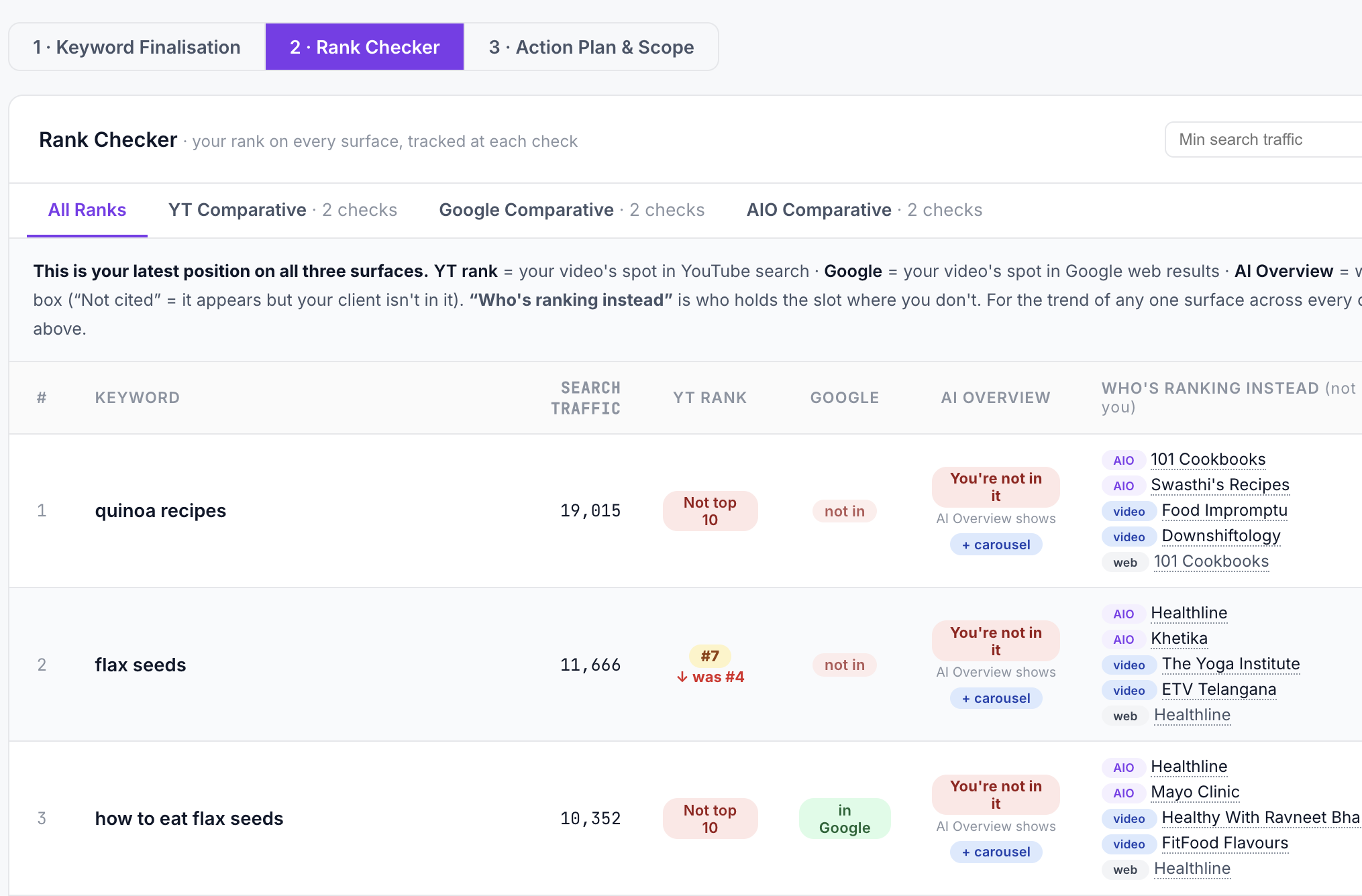
YODA runs the full 6-step workflow — Overview, Diagnostics, Strategy, Optimisation, Reputation (ORM), and Competitor Intel — with 40+ analysis modules organised under those steps. ICG's managed YouTube service uses YODA end-to-end. See the Healthcare YouTube Marketing pillar guide for the full scope, or the Healthcare YouTube Marketing Agency service page for engagement details.
Book a YODA demo on WhatsApp → or request a free healthcare YouTube channel audit →
Related reading
- Healthcare YouTube pillar guide 2026 — full strategy stack
- How much does YouTube marketing for doctors cost in India — full pricing tiers
- How to choose a healthcare YouTube marketing agency — 12-point checklist
- What a healthcare YouTube agency delivers monthly — deliverables list
- How a doctor YouTube channel generates consultations in India — pipeline case
FAQ
What is the true monthly cost of an in-house YouTube manager for a clinic? Between ₹85,000/- and ₹1,80,000/- per month all-in when salary, gear amortisation, software licences, editor support, and shoot logistics are counted honestly. Salary alone is only 55-65% of the true cost.
Can a solo doctor justify hiring an in-house YouTube manager? Rarely. Even at maximum output a solo doctor rarely gives enough shoot slots to fully occupy an in-house producer. Agency starter retainer at ₹75,000-₹1,20,000/- per month is almost always the better economic and compliance choice.
Does an agency actually understand our clinic culture like an in-house person would? Not in the same way. A specialist agency compensates through structured onboarding, quarterly on-site visits at growth-tier and above, and shared documentation. In-house wins on cultural presence; agency wins on breadth of algorithm and compliance expertise.
What happens to the channel if we fire the agency or the in-house producer leaves? Continuity is a real risk in the in-house model — much of the channel's institutional memory sits in one person. Agency contracts typically include documentation and asset transfer clauses that transfer knowledge and creative files back to the clinic on exit.
Can we start in-house and switch to agency later, or vice versa? Yes. About 30-40% of ICG's current engagements began as in-house or freelancer setups that transitioned. The main transition friction is the first 30-60 days of the new model — the clinic pays some duplicated cost during handover.
Which model is better for compliance-heavy specialties like fertility or oncology? Specialist agency almost every time. Compliance load for these specialties is high enough that a general in-house manager will produce work that later has to be taken down. The takedown cost plus reputational cost usually exceeds the agency retainer difference.
Is hybrid always more expensive than the pure models? Yes on the direct cost, no on the risk-adjusted cost. Hybrid runs ₹1,20,000-₹2,50,000/- per month total. In exchange the clinic gets the strongest part of both models and the ability to scale output without either team hitting capacity.
Do agencies use platforms like YODA or is that only for internal use? ICG's managed clients get YODA access as part of the retainer. That means the clinic sees the same dashboards and decisions the agency team acts on, including the organic-vs-paid separation that general agencies typically hide.
How does specialty compliance load actually affect the in-house vs agency decision? Higher compliance load pushes toward specialist agency because a generalist in-house manager is unlikely to know the NMC, ASCI, ART Act and PC-PNDT perimeters at the depth needed. Lower compliance load makes in-house more viable for clinics that want to build permanent internal capability.
How long does an in-house YouTube manager take to become productive? Typical ramp is 90-180 days. That includes learning the clinic's medical vocabulary, understanding compliance boundaries, building relationships with doctors, and iterating through 3-6 videos before a stable production rhythm is set.
Book a free 30-minute Brand & Growth Diagnostic.
It's a working session, not a sales pitch — you leave with a written root-cause analysis you can act on, whether or not you engage ICG.
The three platforms
behind every ICG engagement.
Beacon
CAPI middleware that fixes Event Match Quality, translates CRM statuses to Meta-standard events, dedups across channels.
Agency OS
Live client dashboard. GSC, GA4, Google Ads, Meta Ads, IVR calls in one view. Login anytime, not monthly.
Phoenix
Clinic revenue intelligence over your PMS. Daily action queue: Prevent Loss, Maintain & Engage, Grow Revenue. Multi-centre rollout.
Or book a free 30-min audit to see all three in action on your account.
Healthcare brands
that already run on ICG.
A representative slice of the 150+ healthcare brands ICG has delivered for across India. Most engagements remain under NDA.


What ICG clients say · on video.
"Scale up of organic channels and business consulting. ICG has absolute domain authority in their field."
"Working with ICG transformed how we acquire IVF patients in Gurgaon. They understand the fertility journey from inquiry to consult..."
"What Ichelon accomplished — they got all my ideas and worked over 3-4 months to create an amazing, super-customised website."
Need help operationalising this?
Every ICG service is healthcare-only, NMC + DPDP-aware, and built around the patient-research patterns that drive Indian healthcare growth in 2026.
Every practice welcome — packages from ₹20,000/mo.
Goals-Driven engagements · Performance-Linked Payout Models available



More from
ICG.
Five trends shaping Indian healthcare marketing through 2027: AI-first patient research, Conversions API adoption, ABDM discovery, the AEO w...
Healthcare AIO is the discipline of getting your clinic or hospital cited inside Google AI Overviews, ChatGPT and Perplexity answers — not j...
Conversational-search advertising places brand messages inside AI chat answers — ChatGPT, Perplexity, Copilot — rather than beside a results...
Stop guessing.
Book a Diagnostic.
30 minutes. Free. With the AI-powered healthcare-only marketing agency 150+ brands already run on. No slides, no pitch, no hard close.


