


Healthcare YouTube marketing options in India 2026: generic digital agencies, healthcare-specific agencies, freelancer combos and in-house teams — an honest comparison
An Indian hospital or clinic looking to build serious YouTube presence in 2026 has four real options: generic digital agencies with a YouTube practice, healthcare-specific agencies like ICG, freelancer plus video producer combos, or an in-house team. This piece scores each option on healthcare depth, YouTube algorithm literacy, Indian compliance handling, execution velocity and total cost.
No pitch. Written root-cause diagnosis. AI-powered, healthcare only.
Direct answer
An Indian hospital or clinic looking to build serious YouTube presence in 2026 has four real options: generic digital agencies with a YouTube practice, healthcare-specific agencies like ICG, freelancer plus video producer combos, or an in-house team. This piece scores each option...
TL;DR
An Indian hospital, IVF chain, cosmetic surgery group or specialty clinic that has decided YouTube matters as a growth channel now needs to decide who runs it. Four options exist in the Indian market in 2026: generic digital marketing agencies that have added a YouTube practice on top of their broader social media / performance marketing / SEO offering; healthcare-specific agencies like ICG that specialise in the medical vertical and bring purpose-built platform layers (in ICG's case, YODA — our AI-native healthcare YouTube marketing platform); freelancer combinations (a YouTube strategist + a video producer + an editor stitched together); and fully in-house teams built on the hospital's payroll. Each option has a real fit and a real cost. This piece scores all four honestly on five dimensions — healthcare depth, YouTube algorithm literacy, Indian compliance handling, execution velocity and total cost — and gives a decision matrix at the end. Buyers reading this alongside the healthcare YouTube marketing service page and the broader healthcare local SEO agency stack should be able to make an informed shortlist.
Option one: generic digital agencies with a YouTube practice
India has a well-developed generic digital agency ecosystem serving consumer brands, D2C, financial services, real estate, education, and dozens of other verticals. Many of these agencies have added a YouTube practice on top of their broader social media, performance marketing and SEO offerings. Some are integrated networks with hundreds of employees across metros; some are mid-scale specialists with 30-80 people. The typical service scope includes strategy, content ideation, video production (in-house or outsourced), YouTube upload and metadata, promotion via Google Ads and Meta Ads, community management, and monthly analytics reporting.
Healthcare depth (score: low to moderate). A generic agency that treats healthcare like any other vertical does not carry deep understanding of specialty-specific patient journeys (IVF vs cosmetic surgery vs orthopaedics vs paediatrics have completely different funnel logics), of the language patterns that patients actually search for medical topics in, or of the buyer psychology around choosing a doctor or hospital. Some agencies do have a strong pharma or medical device client history and carry more depth from that experience — worth diligencing before assumptions.
YouTube algorithm literacy (score: moderate to high). Generic agencies with a genuine YouTube practice usually have decent YouTube algorithm literacy — understanding of impressions-to-views funnel, thumbnail-title CTR mechanics, retention curves, session watch time, browse-vs-search-vs-suggested traffic sources. This is table-stakes competence in the category.
 yoda/10-traffic-source.png" alt="YODA Traffic Source Analysis — 6-month split of YouTube traffic sources: YouTube search, external search, suggested, browse, external" loading="lazy" decoding="async" style="width:100%;height:auto;display:block;">
Indian compliance handling (score: low to moderate). This is the weakest dimension. Generic agencies often do not have in-house healthcare compliance capability — NMC Ethics Code 2026, ASCI Guidelines 2022 on unsubstantiated claims, DPDP Act 2023 on patient data in identifiable video content, PC-PNDT Act 1994 on fertility content, ART Act 2021 on ART/IVF success-rate claims — sit outside their typical rules perimeter. This is a real risk area for hospital buyers.
Execution velocity (score: moderate to high). Established agencies can start executing within 30-60 days of engagement start.
Cost (moderate to high). Retainer ranges vary widely — approximate ₹1-5 lakh/- per month depending on scope, agency scale and geography.
Best fit: hospital groups where brand marketing (rather than patient acquisition per se) is the main channel goal, and where internal legal and compliance teams already carry the medical-advertising-rules review workflow separately.
Option two: healthcare-specific agencies (ICG-tier)
 Meta Catalyst IQ Creative Scoring Matrix ranking every Meta ad creative by hook strength, proof density, offer clarity and CTA — with money-wastage column in rupees" width="1200" height="675" loading="lazy" decoding="async" style="width:100%;height:auto;display:block;">
A smaller number of Indian marketing agencies specialise in healthcare — hospitals, clinics, chains, pharma, medical devices, healthtech. The specialisation ranges from single-vertical focus (IVF-only, dental-only, dermatology-only) to broad multi-specialty healthcare agencies. ICG is in the broad multi-specialty healthcare category — serving IVF, cosmetic surgery, dental, dermatology, orthopaedics, gastroenterology, cardiology, oncology, hospital groups, diagnostic centres and workforce/careers marketing across the healthcare vertical.
Healthcare-specific agencies bring three things generic agencies typically do not: (1) deep specialty-level patient journey understanding, (2) Indian medical compliance capability as SOP (NMC, ASCI, DPDP, PC-PNDT, ART Act built into every review), and (3) often purpose-built platform layers for the specific problems that healthcare marketing has — in ICG's case, YODA for YouTube and Angryturtle for local SEO / GBP.
Healthcare depth (score: high). Specialty-level patient journey depth is the point of the category. Understanding that an IVF patient's YouTube search behaviour is different from a knee-replacement patient's search behaviour, and different again from a rhinoplasty consultation-seeker's search behaviour, is baseline competence for the category.
YouTube algorithm literacy (score: high, with healthcare-specific overlay). Beyond generic algorithm literacy, a healthcare-specific agency understands how YouTube's recommendation and search treatment of medical content differs from other verticals — Health authoritativeness signals, restricted content categories, and the interaction with Google web ranking for medical queries. YODA's architecture reflects this — three-race rank tracking specifically because medical query ranking on Google web and Google AI Overview matters as much as ranking on YouTube search itself.
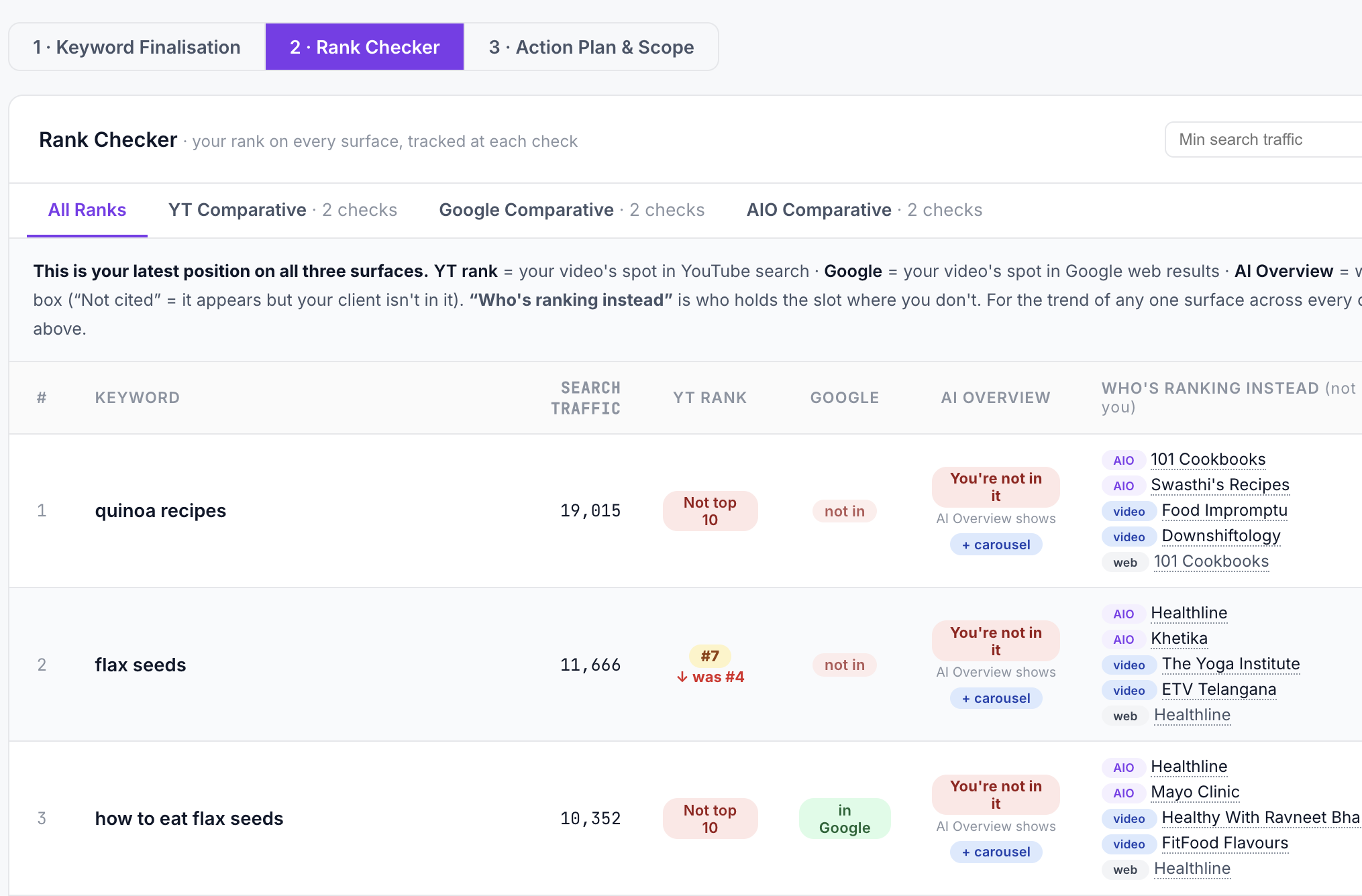
Indian compliance handling (score: high). Compliance-in-workflow is table stakes for a healthcare-specific agency — every title, description, chapter, thumbnail and pinned comment gets read against NMC / ASCI / DPDP / PC-PNDT / ART Act as SOP. This is the biggest single differentiator from generic agencies.
Execution velocity (score: moderate to high). First video output typically 30-45 days from engagement start.
Cost (moderate to high). Retainer ranges typically start around ₹1.5-2 lakh/- per month at the entry tier and rise with scope, video volume and multi-doctor complexity. Comparable to established generic agency ranges — the differentiator is what you get for the spend.
Best fit: hospital groups where YouTube is a patient-acquisition channel, where compliance risk needs to sit in-workflow, and where the specialty depth matters for content strategy.
Option three: freelancer + video producer combos
An alternative to a full agency retainer is stitching together a freelance YouTube strategist, a freelance video producer, a freelance editor and possibly a freelance thumbnail designer into a virtual team that reports directly to the hospital's marketing director. Individual freelancers can be genuinely excellent at their specific craft.
Healthcare depth (variable, depends on the specific freelancers). A YouTube strategist with a genuine track record on medical channels brings real depth. A YouTube strategist whose experience is D2C or gaming or SaaS does not. The talent pool of healthcare-experienced YouTube strategist freelancers in India is narrow — verify claims with actual channel case studies.
YouTube algorithm literacy (variable). Depends entirely on the specific strategist. Good freelance YouTube strategists can be as algorithm-literate as any agency team; less experienced freelancers are not.
Indian compliance handling (score: low). This is the weakest dimension for the freelancer path. Individual freelancers rarely have in-house compliance capability, and the coordination overhead of getting a compliance review done externally for every publish is real. Hospital marketing directors often end up carrying the compliance-checking load themselves in this model.
Execution velocity (variable). Freelancer coordination adds overhead — one hospital marketing director managing four to five independent contractors on different schedules is slower than a single agency team on a defined workflow.
Cost (low to moderate). Approximate range ₹50,000-₹1.5 lakh/- per month depending on the freelancer combination and video volume.
Best fit: small clinics with tight budgets, marketing directors who have both bandwidth and interest in owning coordination, and specialty groups where a proven freelance strategist with genuine healthcare experience is available.
Option four: fully in-house teams
Building the full team on hospital payroll — video producer, video editor, content strategist with medical writing capability, social media manager, thumbnail designer, plus 4-8 hours per week of doctor on-camera time — is the maximum-control option. Some large hospital groups have made this work at scale; many have burned out on it after 12-18 months of underperformance.
Healthcare depth (high, if the team is right). An in-house team that stays for years builds deep hospital-specific institutional knowledge — the specialties, the doctors, the patient journeys, the internal compliance workflow, the historical case studies. This is a genuine advantage.
YouTube algorithm literacy (variable). Depends heavily on hiring. A hospital that hires a genuinely YouTube-native content strategist gets algorithm literacy; a hospital that hires a generalist marketer does not.
Indian compliance handling (variable to high). Hospitals with mature internal compliance and medical review workflows can handle this well. Hospitals without that maturity find it a bottleneck.
Execution velocity (score: low initially, moderate to high once built). First video output typically 4-5 months from the decision to build the team, because of hiring lead time. Once running, an in-house team can match agency velocity.
Cost (moderate to high). Approximate range ₹1.5-3 lakh/- per month all-in for a Tier-1 city (Delhi NCR, Mumbai, Bangalore, Hyderabad, Chennai, Pune) once salaries, benefits, tool subscriptions, kit and editing suite are counted honestly. Often close to managed-agency retainer numbers.
Best fit: large corporate hospital groups where marketing is core to strategy, where the team ownership carries strategic value, and where there is 6-12 months of runway to build velocity.
The five-dimension scorecard
Summarising the four options across the five dimensions helps make the comparison concrete.
Healthcare depth: Healthcare-specific agency (high) > In-house at scale (high) > Freelancer combo (variable) > Generic agency (low to moderate).
YouTube algorithm literacy: Healthcare-specific agency with platform (high, healthcare-tuned) = Generic agency with strong practice (moderate to high) = Good freelance strategist (moderate to high) > In-house without specialist hire (variable).
Indian compliance handling: Healthcare-specific agency (high) > In-house at scale with mature compliance (moderate to high) > Generic agency (low to moderate) > Freelancer combo (low).
Execution velocity: Healthcare-specific agency (30-45 days to first video) = Generic agency (30-60 days) > Freelancer combo (variable, coordination-heavy) > In-house from scratch (4-5 months).
Total cost (all-in monthly range): Freelancer combo ₹50,000-₹1.5 lakh/- < Healthcare-specific agency ₹1.5-4 lakh/- ≈ Generic agency ₹1-5 lakh/- ≈ In-house at Tier-1 city ₹1.5-3 lakh/-.
The compliance perimeter every option must clear
Regardless of which option a hospital picks, the compliance perimeter is the same. NMC Ethics Code 2026 restricts registered medical practitioners from advertising language that guarantees outcomes or makes comparative clinical claims. DPDP Act 2023 treats identifiable patient footage or names as personal data requiring lawful basis and consent, including for social distribution. ASCI Guidelines 2022 require substantiation for advertising claims and disallow unsubstantiated comparative superlatives. PC-PNDT Act 1994 prohibits any content that could be construed as sex-determination advertising, which is a real risk for gynaecology and fertility channels. ART Act 2021 bars unsubstantiated success-rate claims on ART/IVF content.
The differentiator is where the compliance load sits — in-workflow (healthcare-specific agency, mature in-house team) or externalised (generic agency, freelancer combo relying on hospital-side legal review).
What the honest shortlist looks like
A small clinic or single-specialty practice with a limited budget and a marketing director who has bandwidth: freelancer combo, potentially with periodic strategy check-ins from a healthcare-specific agency on a light retainer.
A mid-scale hospital group, IVF chain, cosmetic surgery group, dental chain or dermatology chain: healthcare-specific agency is usually the right answer. Compliance-in-workflow + specialty depth + platform intelligence (YODA for YouTube) are hard to replicate through the other options at that scale.
A large corporate hospital group with an existing marketing team: hybrid — in-house team owns production and day-to-day publishing; healthcare-specific agency owns strategy, platform intelligence layer (YODA), compliance oversight and continuous optimisation.
A hospital brand where YouTube is a light channel and brand presence is the goal rather than patient acquisition: generic digital agency with a YouTube practice can be sufficient, provided compliance review sits elsewhere in the organisation.
The platform ICG uses to run this at scale: YODA
ICG runs healthcare YouTube marketing for clinics, hospitals, and specialty groups using YODA — our AI-native healthcare YouTube marketing platform. YODA sits on top of a channel's data and does four things no dashboard does: it separates organic from paid views at every step (so a promoted video can never masquerade as organic growth), it gives decisions not dashboards (every video gets a state + next action), it writes back to YouTube directly (improved titles, tags, descriptions, chapters applied straight to the platform), and it tracks the three rank races — YouTube search, Google web, and Google AI Overview citations.
YODA runs the full 6-step workflow — Overview, Diagnostics, Strategy, Optimisation, Reputation (ORM), and Competitor Intel — with 40+ analysis modules organised under those steps. ICG's managed YouTube service uses YODA end-to-end. See the Healthcare YouTube Marketing pillar guide for the full scope, or the Healthcare YouTube Marketing Agency service page for engagement details.
Book a YODA demo on WhatsApp → or request a free healthcare YouTube channel audit →
Related reading
- Healthcare YouTube marketing pillar guide — full scope of YouTube for Indian healthcare
- Healthcare YouTube Marketing Agency service page — engagement details
- Hospital video marketing in India 2026
- How a doctor YouTube channel generates consultations in India
- YouTube vs Meta vs Google ROI for IVF clinics in India 2026
FAQ
Which option is cheapest for a healthcare YouTube channel in India? Freelancer combo is typically the lowest cash-out at ₹50,000-₹1.5 lakh/- per month, but carries the highest coordination overhead and compliance risk. Cheapest is not the same as best-value once compliance and coordination time are counted.
What is the biggest risk with a generic digital agency running a healthcare YouTube channel? Compliance failures. NMC, ASCI, DPDP, PC-PNDT and ART Act rules are outside the typical rules perimeter of a generic agency, and hospitals often discover this only after a title or description has already published in violation.
Is an in-house team always the highest-quality option? No. In-house at scale, with the right hires, can be very high quality — but the ramp-up is slow (4-5 months to first quality output) and the hiring risk is real. Many hospitals underperform in-house for 12-18 months before deciding to bring in an agency.
What does a healthcare-specific agency bring that a generic agency does not? Specialty-level patient journey depth, Indian medical compliance capability as SOP, and often a purpose-built platform layer (YODA in ICG's case) that generic agencies do not carry.
Can I combine freelancers with a healthcare-specific agency? Yes — a common pattern is retaining the healthcare-specific agency for strategy, YODA intelligence layer and compliance oversight, while individual freelancers handle production tasks. The hospital marketing director stays lightweight on coordination.
How long should I sign an initial agency contract for? A serious healthcare YouTube channel typically needs 6-9 months to show meaningful ranking traction across the three races (YouTube search, Google web, Google AI Overview). Contracts shorter than 6 months rarely give either side enough runway to prove the model.
What questions should I ask a prospective YouTube agency? Which healthcare specialties have you served, what is your compliance review workflow (NMC, ASCI, DPDP, PC-PNDT, ART Act), how do you separate organic from paid views in reporting, do you track ranking on YouTube search AND Google web AND Google AI Overview, and can you show 2-3 healthcare channel case studies with named references we can verify.
Do agencies own the YouTube channel or does the hospital? The hospital always owns the channel — the Google account, the channel URL, the video files, the analytics data. An agency operates the channel under the hospital's ownership. Any agency claiming otherwise is a red flag.
Which model is best for founder-doctor personal-brand channels? Healthcare-specific agency or a strong freelance strategist with proven healthcare experience. Founder-doctor personal brands need a strategic layer that understands the doctor's clinical positioning, patient audience, and compliance perimeter — this is not a generic content workflow.
How does ICG position against the other three options in this comparison? ICG sits in the healthcare-specific agency category. The differentiators are our multi-specialty depth across the Indian healthcare vertical, YODA as the AI-native platform layer for the YouTube channel (organic-paid separation, three-race rank tracking, writeback, decisions-not-dashboards), and compliance-in-workflow as SOP. See the healthcare YouTube marketing service page or book a demo to evaluate against your specific specialty.
Book a free 30-minute Brand & Growth Diagnostic.
It's a working session, not a sales pitch — you leave with a written root-cause analysis you can act on, whether or not you engage ICG.
The three platforms
behind every ICG engagement.
Beacon
CAPI middleware that fixes Event Match Quality, translates CRM statuses to Meta-standard events, dedups across channels.
Agency OS
Live client dashboard. GSC, GA4, Google Ads, Meta Ads, IVR calls in one view. Login anytime, not monthly.
Phoenix
Clinic revenue intelligence over your PMS. Daily action queue: Prevent Loss, Maintain & Engage, Grow Revenue. Multi-centre rollout.
Or book a free 30-min audit to see all three in action on your account.
Healthcare brands
that already run on ICG.
A representative slice of the 150+ healthcare brands ICG has delivered for across India. Most engagements remain under NDA.


What ICG clients say · on video.
"Scale up of organic channels and business consulting. ICG has absolute domain authority in their field."
"Working with ICG transformed how we acquire IVF patients in Gurgaon. They understand the fertility journey from inquiry to consult..."
"What Ichelon accomplished — they got all my ideas and worked over 3-4 months to create an amazing, super-customised website."
Need help operationalising this?
Every ICG service is healthcare-only, NMC + DPDP-aware, and built around the patient-research patterns that drive Indian healthcare growth in 2026.
Every practice welcome — packages from ₹20,000/mo.
Goals-Driven engagements · Performance-Linked Payout Models available



More from
ICG.
Five trends shaping Indian healthcare marketing through 2027: AI-first patient research, Conversions API adoption, ABDM discovery, the AEO w...
Healthcare AIO is the discipline of getting your clinic or hospital cited inside Google AI Overviews, ChatGPT and Perplexity answers — not j...
Conversational-search advertising places brand messages inside AI chat answers — ChatGPT, Perplexity, Copilot — rather than beside a results...
Stop guessing.
Book a Diagnostic.
30 minutes. Free. With the AI-powered healthcare-only marketing agency 150+ brands already run on. No slides, no pitch, no hard close.


