


Citation Cleanup for Healthcare in India (2026 NAP Audit)
Full NAP audit playbook for Indian clinics and hospitals: drift sources, priority across Google, doctor-directory platforms, local business directories, timeline, and where Angryturtle helps.
No pitch. Written root-cause diagnosis. AI-powered, healthcare only.
Direct answer
Full NAP audit playbook for Indian clinics and hospitals: drift sources, priority across Google, doctor-directory platforms, local business directories, timeline, and where Angryturtle helps.
TL;DR

Citation cleanup for an Indian healthcare brand is the unglamorous but load-bearing local SEO project that most clinics and hospitals defer until their Google Business Profile ranking starts to slip. The reason it matters is boring and mechanical: Google infers whether a clinic is a single real business or several partial ones by matching Name, Address and Phone (NAP) strings across the open web. Any drift — a moved clinic still listed at the old address on the doctor-directory platform, a phone number changed six months ago but still live on the local business directory, a rebrand from "Dr. Sharma Clinic" to "Sharma Healthcare" that never propagated past Google — degrades that inference. ICG runs healthcare local SEO cleanup for chains, single-location clinics and hospital groups using Angryturtle to inventory, prioritise and monitor citation drift continuously instead of once every two years.
What a citation actually is in 2026
A citation, in the local SEO sense, is any public mention of a business's name, address and phone number on a third-party site — with or without a link. For Indian healthcare, the citation universe splits into three tiers. Tier 1 is Google Business Profile itself, plus the largest healthcare-adjacent directories where patients actually search (doctor-directory platforms, local business directories, Sulekha). Tier 2 is medical vertical directories (doctor-consultation directories, MedIndia, DoctorNDTV, Hexahealth, HealthKart) and general business directories that carry weight (IndiaMART, TradeIndia in some categories, Yellow Pages India). Tier 3 is the long tail — chamber-of-commerce listings, hospital-association member pages, insurance-panel provider directories, and geo-specific city guides.
The 2026 nuance is that Google's entity graph now cross-references AI Overview citations and Knowledge Panel data with the classic NAP corpus. A profile with clean, matching NAP across Tier 1 and Tier 2 shows up materially more often as an AIO citation for queries like "best gynaecologist in Pune" than a profile whose NAP is fragmented — even where classic pack ranking looks identical. So the citation-cleanup work now has two payoffs: local pack integrity plus AIO discoverability.
The real sources of NAP drift in Indian healthcare
NAP drift almost always traces back to one of six operational events, and identifying which one hit a specific clinic tells you where to look first.
Physical relocation. The clinic moved. The GBP address was updated. Doctor-directory platforms, local business directories, MedIndia and a dozen sub-tier directories still show the old address. This is the single most common source of drift for growing chains — expansion moves the flagship, and the citation trail lags 12-24 months behind.
Phone number consolidation. The clinic switched from a landline to a virtual number, migrated to a call-tracking system, or centralised multiple location phones into a single hunting queue. The GBP number was updated overnight; the directory ecosystem inherits the old numbers indefinitely.
Rebrand or specialty repositioning. "Dr. Kapoor Clinic" becomes "Kapoor Multispecialty," or "Sunshine IVF" absorbs "Sunshine Gynaecology." The new name lives on Google; the old name lives everywhere else, and Google reads the two as separate — or, worse, as duplicates competing with each other.
Franchise / partnership churn. Chains that acquire single-location clinics inherit whatever citation footprint the acquired clinic had. Often that footprint uses the previous doctor's personal name in the business title, an old address, or a defunct phone.
Staff-managed data-entry variance. A hospital marketing team enters "F-42, First Floor, Sector 14" on Google and "F-42/1st Fl, Sec-14" on the doctor-directory platform and "F 42 Sector 14, Ground+First" on the local business directory. Google reads three subtly different addresses and treats the entity match as weaker than it should be.
Directory-side rot. Some directories carry stale scraped data that nobody at the clinic ever entered. This is common with sub-tier directories that scrape Google or IndiaMART three years ago and never refresh. Cleanup here means either claiming and correcting the listing, or requesting a takedown.
The full NAP audit workflow, step by step
A proper audit produces a single spreadsheet with every live citation, the current NAP string on that citation, the discrepancy against the canonical NAP, and the correction action. It takes 12-20 hours of focused work per single-location clinic done manually, or 2-4 hours per clinic done via Angryturtle's NAP Intelligence engine.

Step 1 — Freeze the canonical NAP. Before auditing, write down exactly one canonical version of Name, Address and Phone. Include phone format (with or without country code, with or without hyphens), address format (comma placement, floor notation, sector abbreviation), and business name (with or without "Pvt Ltd," with or without specialty suffix). This is the reference every listing gets measured against.
Step 2 — Inventory the citation footprint. Search Google for the clinic name in quotes. Search for the phone number. Search for the old phone number if the clinic recently changed it. Search for the address string. Each search surfaces a batch of directory listings. Cross-reference against the Tier 1 and Tier 2 directory list to check every high-priority source explicitly, even if it didn't surface in the Google search.
Step 3 — Log each citation. For every listing, record: source URL, current Name, current Address, current Phone, whether the listing is claimed by the clinic, and the correction needed. A spreadsheet with columns for each field lets you sort by discrepancy severity later.
Step 4 — Classify each discrepancy. Some drift is high-impact (wrong phone that patients would actually call), some is cosmetic (comma placement variance that Google likely still resolves). Classify each row as critical, moderate or cosmetic. Critical rows go into the correction queue immediately.
Step 5 — Build the correction queue. For each critical and moderate row, decide the correction path: claim and update, request correction via directory support, or de-list if the source is a scraper directory nobody actually visits. Prioritise by directory traffic — the big doctor and local directories before a chamber-of-commerce page.
Step 6 — Set up ongoing monitoring. Cleanup is a one-time project. Preventing re-drift is continuous. Angryturtle's NAP Intelligence tracks the canonical NAP against the live citation footprint monthly and surfaces any new drift as an action in the sie" style="color:inherit;text-decoration:underline;text-decoration-color:rgba(42,126,200,.5);text-underline-offset:2px">Rank OS queue.

Tool options: manual, Angryturtle, or third-party
Three viable paths, each with different economics.
Manual cleanup. A junior SEO or marketing coordinator can execute the workflow above with a spreadsheet and 15-20 hours of focused time per single-location clinic. For a solo clinic on a tight budget, this is defensible once. It becomes untenable at 3+ locations or for any brand that needs the audit refreshed more often than every 18 months.
Angryturtle NAP Intelligence. ICG's own Angryturtle platform runs the inventory, discrepancy classification and correction-queue build automatically for every profile connected to the account. The audit that takes a junior 20 hours takes Angryturtle 45 minutes to inventory and a few hours of platform time plus operator confirmation to execute. Monitoring is continuous rather than annual.
Third-party citation tools. Global local SEO tools, citation specialists and listing-syndication tools have limited India coverage — most were built for US and UK directory ecosystems and don't index doctor-directory platforms, local business directories, MedIndia or the healthcare-specific vertical directories properly. They can find drift on the big-name global directories but miss the Indian Tier 1 and Tier 2 sources that actually move rankings for Indian healthcare.
Priority order: Google, doctor-directory platforms, local business directories, then sub-tier
Not every directory is worth the same effort. The ranking-impact hierarchy for Indian healthcare, based on how heavily Google appears to weight each source in the entity graph and how much patient traffic each source actually sends, looks like this.
Google Business Profile. Always first, always fixed before anything else. If GBP itself carries stale data, no amount of doctor-directory cleanup helps. This includes GBP's address, phone, business hours, categories, services and the primary photo — all four data types feed the entity signal.
Doctor-directory platform. Highest-weight healthcare-specific directory in India. Doctor-directory listings surface in Google search results directly, drive patient bookings independently, and feed the entity graph. Cleanup here is second priority.
Local business directory. Broad-coverage local directory with strong Indian brand recognition. Local business directory listings rank in Google search for local queries and drive independent traffic. Third priority.
Sulekha and IndiaMART. Second-tier general directories. Fourth priority.
Medical vertical directories. Doctor-consultation directories, MedIndia, DoctorNDTV, Hexahealth, HealthKart, Apollo247 doctor listings, PharmEasy doctor listings. Fifth priority but important for entity-graph completeness.
Sub-tier and geo-specific listings. Chamber-of-commerce pages, hospital-association member directories, insurance-panel provider lists, city-guide sites. Handled after the top five priorities are clean.
Deliverables from a real cleanup engagement
A citation cleanup engagement, run properly, produces three artefacts. First, the audit spreadsheet — one row per live citation with source URL, current NAP, discrepancy classification and correction action. Second, the cleanup queue — the prioritised list of corrections in progress or completed, with directory-side ticket numbers where the correction requires directory support. Third, the ongoing monitor — the mechanism that catches new drift before it accumulates. Without the third artefact, a cleanup engagement becomes a repeat project every 18-24 months.
ICG's cleanup engagements ship all three, with the monitor running on Angryturtle so the clinic doesn't depend on a spreadsheet-management ritual that a marketing team will inevitably drop.
Realistic timeline: 4 to 8 weeks
Cleanup timelines depend on three variables: number of locations, severity of accumulated drift, and how many directories require support-ticket corrections vs. self-serve claim-and-edit.
Single-location clinic with moderate drift. 4 weeks. Week 1 for inventory and canonical-NAP freeze. Weeks 2-3 for self-serve corrections across Tier 1 and Tier 2. Week 4 for sub-tier cleanup and monitor setup.
Single-location clinic with severe drift (recent move plus rebrand). 6-8 weeks. The extra time is directory-side — support tickets take 2-4 weeks per directory to close, and some directories batch-process corrections weekly.
Multi-location chain, 5-15 locations. 8-12 weeks, running locations in parallel. Chain-level canonical NAP requires an internal agreement on naming convention before Week 1 can start; without that agreement the audit gets redone.
Hospital or hospital group, 15+ locations. 12-16 weeks. Complexity multiplies with department-level listings (some hospitals have separate GBP entries for cardiology, oncology, IVF) and physician-level listings that need their own NAP consistency layer.
What breaks when you skip citation cleanup
Skipping cleanup doesn't produce a dramatic failure. It produces a slow erosion. Rankings for the primary "specialty in city" queries drift down 2-4 positions over 6-12 months. Local pack visibility becomes inconsistent — the clinic shows in the pack for some sessions and not others because Google's entity confidence is borderline. Patients call the wrong phone number and reach a competitor or a disconnected line. Google Ads Location Extensions occasionally fail to serve because the entity match to the GBP is ambiguous. AI Overview citations skip the clinic in favour of a competitor whose entity is cleaner.
None of these individually looks like a citation-cleanup problem. Collectively they cost real bookings, and the clinic often diagnoses them as "SEO stopped working" and hires a new agency instead of doing the boring cleanup work.
The compliance perimeter for NAP corrections
Two frameworks touch citation cleanup even though it looks like a purely mechanical task. The NMC's 2026 advertising guidelines restricts what a doctor's public business listing can say about qualifications, specialties, and treatments — corrections must not add unsubstantiated claims. The ASCI Guidelines 2022 apply to any business description edited during cleanup — comparative superlatives (like "the best cardiologist in Delhi") added during a rebrand-driven cleanup are non-compliant. And for fertility, dermatology, gynaecology and paediatric practices, PC-PNDT Act restrictions on sex-determination advertising apply to descriptions, tags and services — cleanup can't inadvertently introduce non-compliant phrasing.
Cross-reference against the National Medical Commission guidance if you're uncertain about whether a specific description edit is compliant.
The tool ICG uses to run this at scale: Angryturtle
ICG runs local SEO and GBP intelligence for 150+ Indian healthcare brands using Angryturtle — our own AI-native GBP intelligence and management OS. The platform scores every profile 0-100 via a proprietary Rank OS model with five weighted dimensions (Relevance, Review Health, Freshness, Entity Authority, AIO Readiness), publishes edits, Posts, media, and review replies directly to Google, and includes Ask Maps AIO Readiness scoring for Google AI Overviews and ChatGPT visibility.

Available in two shapes: self-serve at ₹999/- per month for solo owners with 1-2 profiles, and ICG's managed service from ₹25,000/- per month where our healthcare specialists execute inside the same platform. Both are anchored in the Healthcare Local SEO Agency India pillar page which has full scope, methodology and pricing.
Book a demo on WhatsApp → or start a free trial at angryturtle.ai →
Related reading
- Healthcare Local SEO Agency India — the pillar service page
- NAP consistency for Indian healthcare clinics — the definition and audit-workflow companion piece
- Top 30 healthcare citation sites in India — the target directory list
- Angryturtle Rank OS explained — how citation health rolls into the profile score
- Multi-location GBP management for Indian healthcare — cleanup at chain scale
FAQ
How often should a healthcare clinic re-audit its citations? Once every 12-18 months if nothing has changed operationally. Immediately after any physical move, phone change, rebrand, or acquisition. Continuously if the clinic is on Angryturtle — the monitor catches drift as it appears rather than waiting for a scheduled audit.
Do I need to correct every single citation, or just the big ones? Tier 1 and Tier 2 are non-negotiable. Sub-tier citations matter less individually but the aggregate signal from cleaning them still helps entity confidence. For a single-location clinic, aim for 90%+ NAP consistency across the top 30 directories.
What happens if a sub-tier directory refuses to update? Escalate to takedown request if the listing is genuinely stale and the directory won't correct. Google's entity graph handles a missing listing better than a persistently wrong one.
Do global citation tools work for Indian healthcare? Partially. They cover global directories reasonably well but miss the Indian healthcare vertical directories that carry the most weight. For Indian healthcare specifically, Angryturtle or a manual audit across the Indian directory list produces a materially more complete picture.
Can citation cleanup fix a ranking drop by itself? Sometimes. If the ranking drop coincided with a move, phone change or rebrand where the citation footprint didn't follow, cleanup typically recovers the position within 6-12 weeks. If the drop is caused by competitor movement or algorithm changes, cleanup helps but is not sufficient alone.
Should I pay a directory for a "featured" or "verified" listing? Only where the paid tier actually drives patient traffic or unlocks a review-generation mechanism you can't get otherwise. Paid doctor-directory tiers and paid local-directory listings can be justified for many practices; most other paid listings are not.
How does ICG price a citation cleanup engagement? Single-location cleanup starts around ₹40,000/- as a one-time project or is included in the Clinic-tier local SEO retainer. Multi-location chain cleanup is scoped based on location count. Hospital-scale cleanup with department and physician layers is scoped individually.
Does citation cleanup help with Ask Maps AIO visibility? Yes. AI Overview citations skew toward entities with high entity-graph confidence. A clean citation footprint materially improves the likelihood of being surfaced as an AIO citation for local healthcare queries.
What is the single biggest cleanup mistake clinics make? Editing GBP alone and assuming doctor-directory platforms, local business directories and the vertical directories will update themselves. They won't. Every directory needs to be handled explicitly.
Do I need to cleanup citations for individual doctors as well as the clinic? Yes for practices where the doctor's personal name carries brand equity. Physician-level NAP consistency (doctor name, clinic address, clinic phone) matters for physician-focused queries like "Dr. Sharma cardiologist Bandra."
Benchmarks: what a typical Indian healthcare citation footprint looks like before cleanup
Across the audits ICG has run for multi-location clinics, dental groups, IVF chains and mid-size hospitals, the pre-cleanup NAP footprint is usually far dirtier than founders assume. The pattern is remarkably consistent, which is why the Angryturtle citation engine ships with these as its default detection thresholds.
| Listing category | Avg listings found per location | Typical mismatch rate | Highest-impact fix |
|---|---|---|---|
| Google Business Profile (primary + duplicates) | 1.4 | 18% (duplicate or unclaimed) | Merge duplicates, reclaim primary |
| Doctor-directory platforms, local business directories, Sulekha, MedIndia | 3.2 | 46% (phone, address, or hours drift) | Phone + hours parity with GBP |
| Sub-tier directories (doctor-consultation directories, DoctorIndia, IndiaMart, city portals) | 11.8 | 62% (stale doctor names, old address, dead numbers) | Bulk phone + address correction |
| Insurance / TPA panels (Star, HDFC Ergo, MediBuddy) | 4.6 | 31% (empanelled doctor list outdated) | Doctor roster + specialty tags |
Mini-case: 6-location dental group, 5-week cleanup
An anonymised ICG client, a 6-clinic dental group in North India, came in ranking outside the local pack on 4 of 6 city queries despite strong reviews. The audit surfaced 71 live citations across the 6 locations, of which 44 had at least one NAP field drifted and 9 were duplicate GBP listings competing with the real one. Cleanup ran on Angryturtle in a 5-week window: week 1 audit, weeks 2-3 GBP merges and doctor-directory and local-directory parity, week 4 sub-tier bulk corrections, week 5 insurance panel refresh. Within 60 days of cleanup, 5 of 6 locations were in the top-3 local pack for the primary "dentist in {city}" query, and direct calls from GBP rose 34% month-on-month with no ad spend change.
Where cleanup fits inside a full growth engagement
Citation cleanup is a foundation task, not a growth strategy. Once NAP parity is real, the same location data feeds every downstream surface: GBP posts and offers on Angryturtle, doctor-video distribution on YODA, and paid Meta campaigns that finally send traffic to a trustworthy business record. Clients on the Client Elevation Programme get citation health rechecked quarterly, because drift starts again the day a receptionist updates hours on one platform and forgets the others.
Book a free 30-minute Brand & Growth Diagnostic.
It's a working session, not a sales pitch — you leave with a written root-cause analysis you can act on, whether or not you engage ICG.
The three platforms
behind every ICG engagement.
Beacon
CAPI middleware that fixes Event Match Quality, translates CRM statuses to Meta-standard events, dedups across channels.
Agency OS
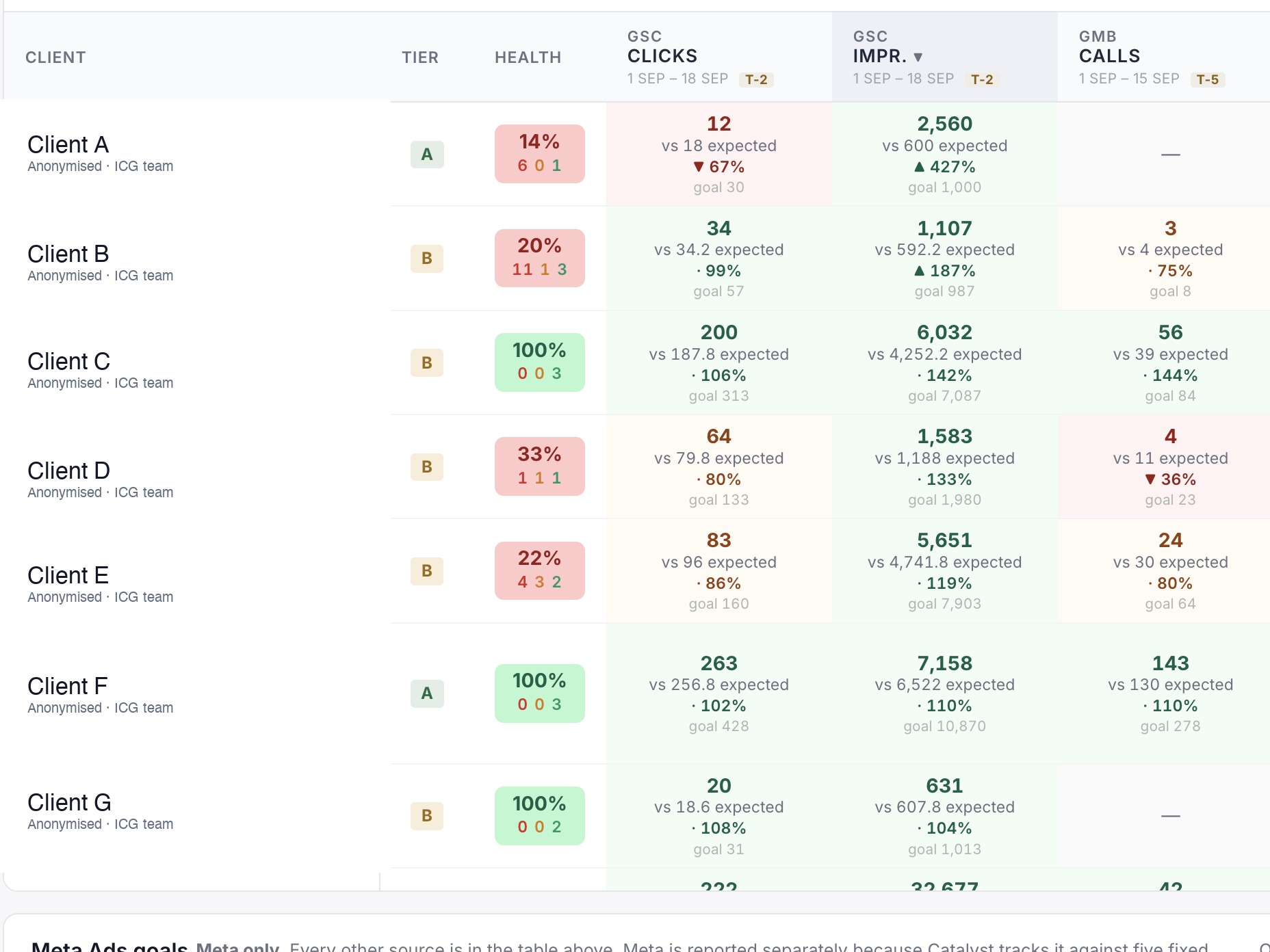
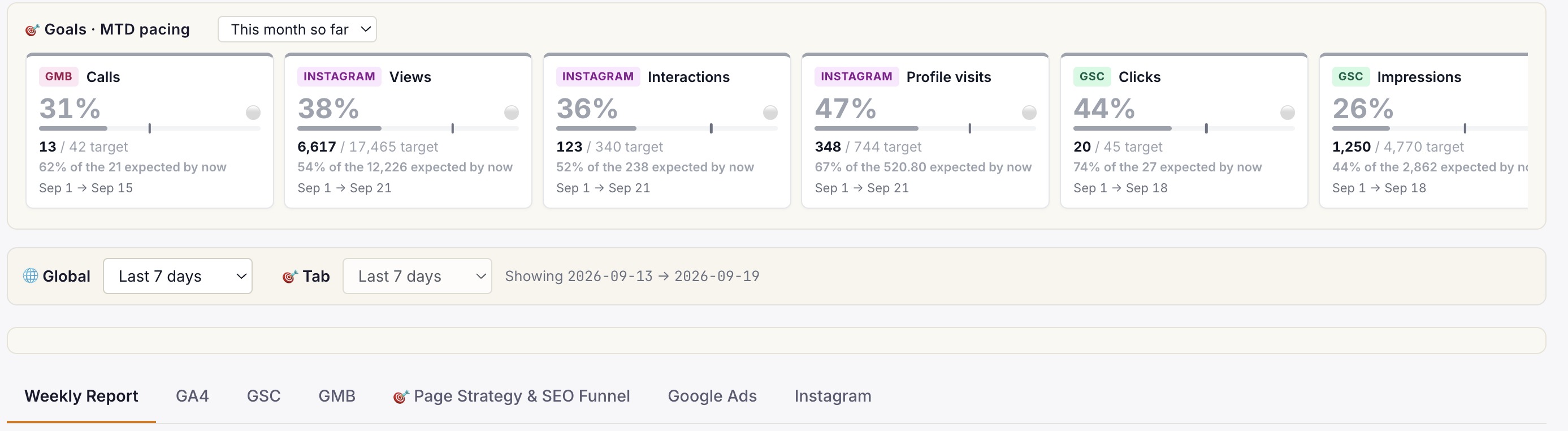
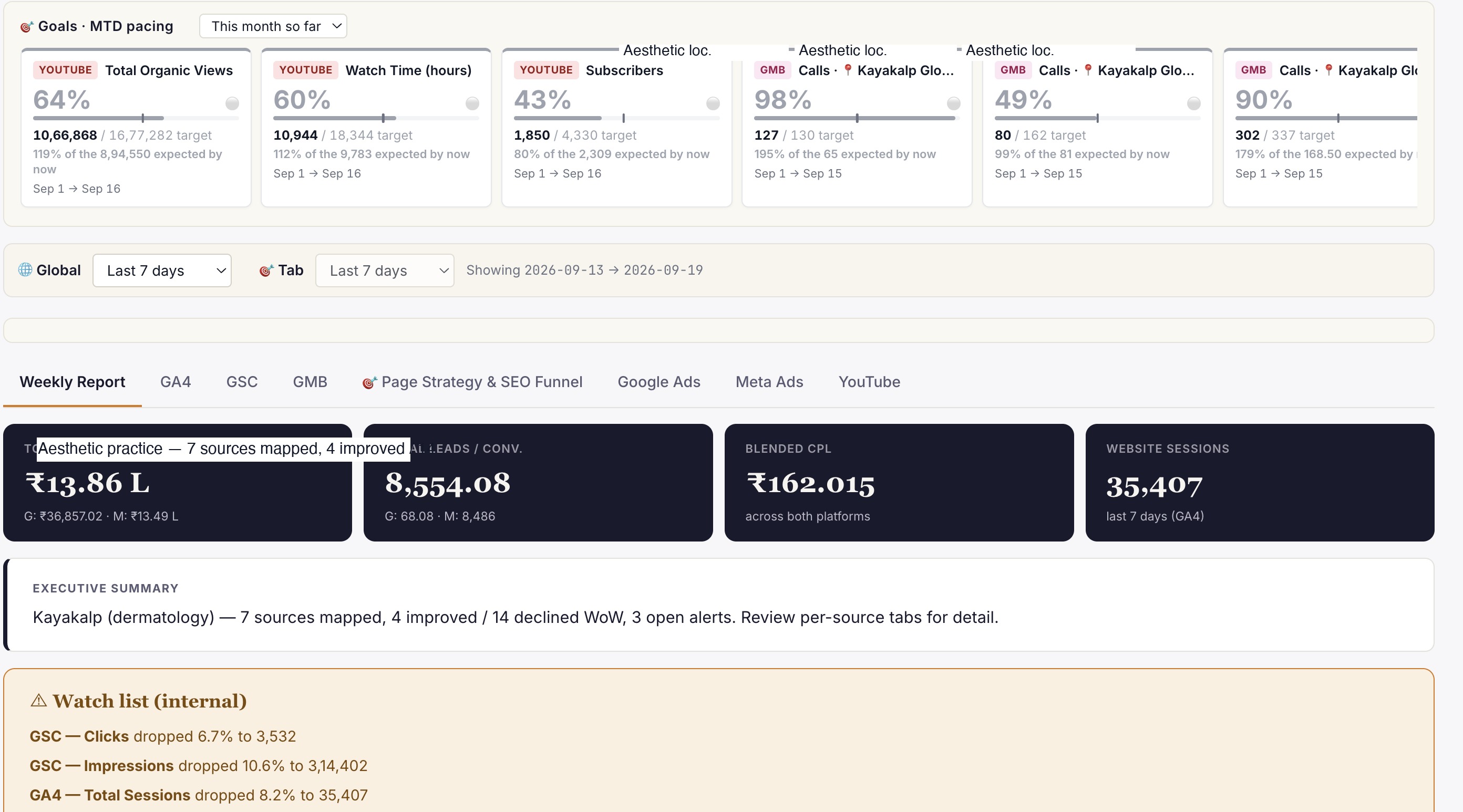
Live client dashboard. GSC, GA4, Google Ads, Meta Ads, IVR calls in one view. Login anytime, not monthly.
Phoenix
Clinic revenue intelligence over your PMS. Daily action queue: Prevent Loss, Maintain & Engage, Grow Revenue. Multi-centre rollout.
Or book a free 30-min audit to see all three in action on your account.
Healthcare brands
that already run on ICG.
A representative slice of the 150+ healthcare brands ICG has delivered for across India. Most engagements remain under NDA.


What ICG clients say · on video.
"Scale up of organic channels and business consulting. ICG has absolute domain authority in their field."
"Working with ICG transformed how we acquire IVF patients in Gurgaon. They understand the fertility journey from inquiry to consult..."
"What Ichelon accomplished — they got all my ideas and worked over 3-4 months to create an amazing, super-customised website."
The intelligence stack behind this playbook.
Every ICG engagement runs on the Search Intelligence Trifecta — Angryturtle for GMB, SIE for search and AI Overview, YODA for YouTube. Live product screens below.
Need help operationalising this?
Every ICG service is healthcare-only, NMC + DPDP-aware, and built around the patient-research patterns that drive Indian healthcare growth in 2026.
Every practice welcome — packages from ₹20,000/mo.
Goals-Driven engagements · Performance-Linked Payout Models available
More from
ICG.
Five trends shaping Indian healthcare marketing through 2027: AI-first patient research, Conversions API adoption, ABDM discovery, the AEO w...
Healthcare AIO is the discipline of getting your clinic or hospital cited inside Google AI Overviews, ChatGPT and Perplexity answers — not j...
Conversational-search advertising places brand messages inside AI chat answers — ChatGPT, Perplexity, Copilot — rather than beside a results...
Stop guessing.
Book a Diagnostic.
30 minutes. Free. With the AI-powered healthcare-only marketing agency 150+ brands already run on. No slides, no pitch, no hard close.


