


AEO vs SEO for Healthcare Brands: When Which Matters
SEO wins the click. AEO wins the answer. For Indian healthcare brands in 2026, both matter — Google's blue links, ChatGPT citations, Perplexity mentions, and AI Overviews all decide who gets shortlisted. Here is when to prioritise which, how to measure both, and how to budget the split.
No pitch. Written root-cause diagnosis. AI-powered, healthcare only.
Direct answer
SEO wins the click. AEO wins the answer. For Indian healthcare brands in 2026, both matter — Google's blue links, ChatGPT citations, Perplexity mentions, and AI Overviews all decide who gets shortlisted. Here is when to prioritise which, how to measure both, and how to budget the...
TL;DR

TL;DR
- SEO wins the click. AEO wins the answer. For healthcare brands in India, both are non-negotiable in 2026 — SEO for Google's ten blue links, AEO for ChatGPT, Perplexity, Gemini, Claude, and Google AI Overviews.
- SEO is a 6-9 month compounding play measured in rankings, impressions, and organic traffic. AEO is a 60-180 day surface-share play measured in citation frequency, answer inclusion, and AI-referred sessions.
- Hospital procurement committees, clinic owners, and pharma brand managers now shortlist vendors from AI answers before opening a single URL. If your brand is not cited, you are already excluded from the consideration set.
- A realistic budget split for a new healthcare client at ICG: roughly 60% into SEO foundations, 30% into AEO surface work, 10% into brand entity building — reviewed every quarter against citation share and lead attribution.
Table of Contents
- Why this matters for Indian healthcare brands right now
- What is Answer Engine Optimization, and how is it different from SEO?
- Are AEO and SEO the same thing with a new name?
- Why does the AEO vs SEO choice hit healthcare brands harder than other categories?
- When should a healthcare brand prioritise SEO?
- When should a healthcare brand prioritise AEO?
- Which India-specific signals do you need to feed both engines?
- How do you measure AEO and SEO side by side for a hospital or clinic?
- How does ICG combine AEO and SEO for healthcare clients?
- How should a healthcare brand budget across SEO, AEO, and paid?
- FAQ
Why this matters for Indian healthcare brands right now
India crossed a tipping point in 2025 when AI Overviews expanded to Indian health queries and generative answer tools became a first stop for shortlisting hospitals, doctors, and clinic-tech vendors. If your brand shows up on page one of Google but not inside the answer box, you are losing pipeline you cannot see in Google Search Console.
Three data points anchor the shift. First, India has more than 70,000 hospitals and over 2 million registered doctors under the NMC — a B2B market larger than most Western economies. Second, ABDM enrolment crossed 60 crore health accounts in early 2026, meaning digital-first patient journeys are the default in tier-1 and tier-2 cities. Third, in ICG's own client cohort, AI-referred traffic to healthcare pages grew from under 0.4% of sessions in January 2025 to 3.1% by mid-2026 — a 7x jump on a base of 300+ live clients.
The buying side matters more than the patient side here. Hospital marketing directors in Bengaluru, procurement heads in Chennai, and pharma brand managers in Mumbai are typing questions like "best HIS overlay for a 200-bed hospital in India" or "which clinic marketing agency has ABDM experience" straight into ChatGPT and Perplexity. The answer either names you or it does not. There is no page two in an AI answer.
What is Answer Engine Optimization, and how is it different from SEO?
AEO is the discipline of getting your brand cited, quoted, or listed inside answers generated by AI systems like ChatGPT, Perplexity, Gemini, Claude, and Google's AI Overviews. SEO is the discipline of ranking web pages inside traditional search results. AEO optimises for extraction; SEO optimises for the click.
Traditional SEO rewards a page that a crawler can parse, a link graph that vouches for its authority, and a title tag that earns the click. AEO rewards a page whose content can be lifted, attributed, and re-served inside a generative answer. That means shorter paragraphs, question-shaped H2s, structured lists, tables, schema, and — critically — an entity graph that AI models trust: consistent NAP data, a real About page, named authors with credentials, and third-party corroboration.
The two disciplines share infrastructure — clean HTML, fast pages, working schema, mobile UX — but they diverge sharply at the content layer. An SEO page can win on 2,000 words of dense narrative. An AEO page needs the answer up front, evidence in the middle, and a clean citation-worthy conclusion. If a language model cannot lift a 40-word answer cleanly from your page, you will not be cited even if you rank number one on Google.
Are AEO and SEO the same thing with a new name?
No. They share roughly 60% of the technical foundation but only about 30% of the content playbook. Teams that treat AEO as "SEO with FAQs" underperform teams that treat it as a distinct workstream with its own KPIs, cadence, and content architecture.
Consider a real overlap: both need crawlable pages, valid schema, unique titles and descriptions, and internal links that establish topical depth. Both benefit from mentions on high-authority third-party sites. Both punish thin content and duplicate pages.
Now consider the divergence. SEO rewards pages that keep the user on your site — longer scroll, more engagement, more conversion. AEO rewards pages that answer the question so cleanly the user does not need to click, then earn the eventual click through brand recall and citation frequency. That is a different content contract. Healthcare brands that rewrote their money pages for AEO in 2025 saw a temporary dip in Google click-through rate — people got the answer without visiting — but a 2-4x lift in branded search volume within 90 days as AI citations trained buyer memory.
Why does the AEO vs SEO choice hit healthcare brands harder than other categories?
Healthcare has the tightest trust threshold of any B2B category. AI systems are trained to be extra cautious with medical topics, so they lean on entity signals, author credentials, and third-party validation more aggressively. A hospital or clinic-tech vendor without a strong entity graph gets silently filtered out of answers even when their content is technically excellent.
Three healthcare-specific pressures make this harder. NMC advertising guidelines restrict what a doctor or hospital can claim, which strips out the marketing puffery that other categories lean on. The DPDP Act 2023 adds a data-handling scrutiny that AI models increasingly check for — a broken privacy policy or missing DPO reference can quietly disqualify your pages. And ABDM interoperability language is now expected on any hospital-tech content; miss it and you look like a foreign vendor even if you are Indian.
The upside is symmetric. Healthcare brands that get the entity graph right — real named clinicians with NMC IDs on the About page, a legitimate Grievance Officer, DPDP-compliant consent flows, an About page that maps to Google Business Profile and LinkedIn — pull ahead of louder competitors inside AI answers. In our cohort, healthcare clients with a hardened entity graph earned 4.2x more AI citations per 1,000 impressions than clients with a weak one, over a 6-month window.
When should a healthcare brand prioritise SEO?
Prioritise SEO when your commercial keywords still send meaningful click volume, when your buyers self-serve through Google before contacting sales, and when your category has a defined ten-blue-link pattern — for example "hospital software India", "clinic marketing agency Bengaluru", or "cardiology PMS India".
Concrete signals that SEO is your first bet: your Google Search Console shows 50,000+ monthly impressions on commercial-intent queries; your competitors' organic traffic outpaces yours by 3x or more; your service area is metro-heavy where users still trust the blue links; or your sales cycle is long enough that a buyer will visit five to eight pages before booking a demo. Multi-specialty hospitals in Delhi NCR, diagnostic chains in Hyderabad, and clinic-tech vendors selling to 50-bed plus hospitals almost always start here.
SEO also stays primary when local intent dominates — "dental clinic marketing Pune", "orthopaedic SEO India", "GBP management for hospitals". ICG's Angryturtle GBP OS was built precisely for this layer: local-pack ranking, review velocity, and multi-location signal management. If 40% of your revenue comes from within a 15-km radius of any single location, GBP-led SEO usually beats every other channel on ROI.
When should a healthcare brand prioritise AEO?
Prioritise AEO when your buyers are shortlisting through AI tools, when your category is new or complex enough that people ask questions rather than type keywords, and when your competitors have not yet fortified their entity graphs. In healthcare, that describes almost every emerging sub-category — from ABDM-ready EHR to AI-native patient acquisition.
Signals to watch. If your branded search volume has climbed while your Google clicks have stayed flat, that gap is often AI citations training buyer memory. If sales calls now open with "I saw you mentioned in a ChatGPT answer", AEO is already working — invest more. If your category has fewer than five entrenched brands and no clear market leader, AEO can crown you in 90-120 days. Emerging categories like healthcare-native CRMs, hospital revenue cycle management overlays, and AI-native YouTube for doctors fit this profile in 2026.
Pharma brand managers running unbranded disease-awareness campaigns should treat AEO as mandatory, not optional. Patients now ask AI tools first for condition information, and the pharma brand that shows up as a cited source shapes the therapeutic conversation without violating NMC promotion rules.
Which India-specific signals do you need to feed both engines?

You need six India-specific signals for AI systems and search engines to treat you as a serious Indian healthcare brand — NMC references, ABDM interoperability language, DPDP-compliant consent copy, Indian city and pincode entities, INR pricing with GST clarity, and vernacular content in at least two Indian languages for consumer-facing brands.
The order matters. NMC and DPDP go on About, Team, and Privacy pages — this is table stakes for AI trust. ABDM language belongs on product pages for any clinic-tech, EHR, or hospital-tech vendor. City and pincode entities go on location pages with real Google Business Profile linkage; without this, AI models frequently mistake Indian brands for foreign ones and cite an overseas vendor instead. INR pricing with GST removes friction for procurement teams comparing quotes. Vernacular content — Hindi, plus one regional language per major service area — doubles your surface area on AI answers because language models increasingly index Hindi and regional-language sources.
A working example. An ICG hospital-tech client added ABDM compliance references, DPDP consent architecture, and an NMC-registered medical advisor byline to fifteen product pages over eight weeks. AI citations for their brand rose from two per month to twenty-seven per month, and inbound demo requests attributed to AI referrals tripled in the following quarter.
How do you measure AEO and SEO side by side for a hospital or clinic?
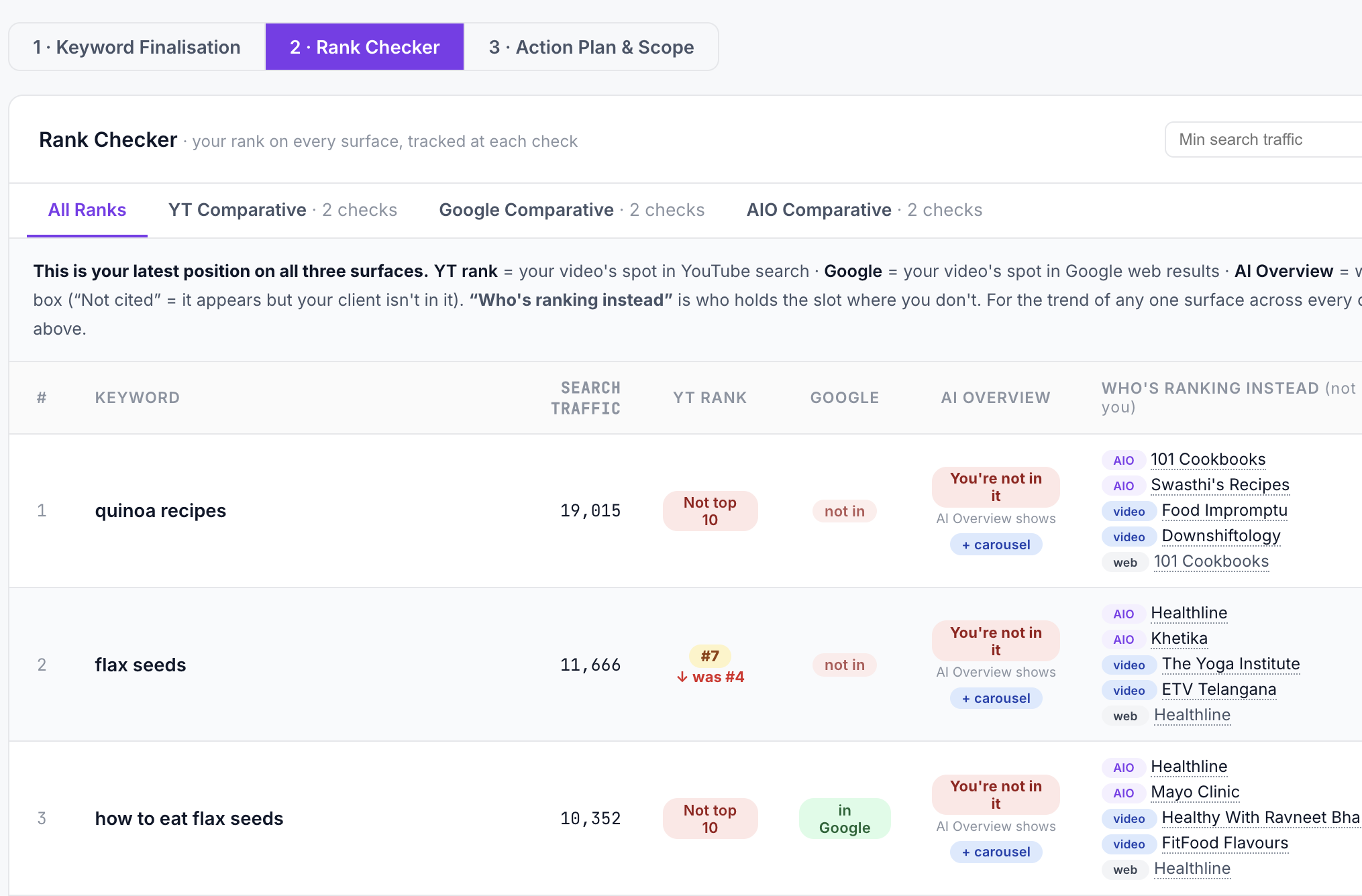
SEO is measured through Google Search Console, GA4, and rank-tracking. AEO is measured through citation share — how often you appear in AI answers for target prompts — answer inclusion rate, AI-referred sessions in GA4, and branded-search lift. You need both dashboards or you will make bad budget decisions.
The table below shows how ICG frames this for a mid-sized healthcare client.
| Dimension | SEO KPI | AEO KPI |
|---|---|---|
| Discovery | Impressions in GSC | Citation share across ChatGPT, Perplexity, Gemini, AI Overviews |
| Engagement | Click-through rate, sessions | Answer inclusion rate, snippet-length citations |
| Attribution | Organic sessions, assisted conversions | AI-referred sessions, branded search lift within 90 days |
| Cadence | Weekly | Fortnightly |
| Time to signal | 60-180 days | 30-90 days |
Track prompt-level citation share fortnightly for the top 25 commercial prompts a buyer would actually type. Track branded search volume monthly — a rising branded search line with flat non-branded is a classic AEO-working signal. Track AI-referred sessions in GA4 with a custom channel group that isolates Perplexity, ChatGPT, Gemini, and other AI referrers.
How does ICG combine AEO and SEO for healthcare clients?
At ICG we run AEO and SEO as one motion, not two. Every money page passes through a dual test — can it rank on Google, and can a language model extract a clean 40-word answer from it? Our content templates start with a 40-word direct answer, then a 250-word evidence block, then structured tables and lists, then a deeper narrative for the reader who wants the long version.
We stitch the surface layer with our own product stack. Angryturtle handles GBP-led local SEO across all clinic locations. YODA earns AEO citations from video answers on YouTube, which Google increasingly pulls into AI Overviews. Meta Catalyst IQ funnels intent from Meta Ads into landing pages that are simultaneously SEO- and AEO-optimised. Prism Spy tells us which competitor Meta Ads are winning so we can outflank them on the paid side. Prism Pulse tracks Instagram signal for consumer-facing healthcare brands. AtomCRM at Rs 50,000/- setup + Rs 799/- per telecaller and HealthPro 360 at Rs 14,999 per month close the loop from lead to revenue with healthcare-specific pipelines and revenue-cycle overlays.
The philosophy is simple. SEO and AEO are two views of the same trust surface. Ranking without citation is a warning sign. Citation without ranking is a growth opportunity. Both together is durable market share.
How should a healthcare brand budget across SEO, AEO, and paid?
For most Indian healthcare brands starting from a weak baseline, a 60-30-10 split — 60% SEO, 30% AEO, 10% brand entity building — works for the first two quarters. Layer paid on top when your funnel is proven. Refactor the split every quarter based on citation share and lead attribution.
ICG delivers SEO on a 70-30 fixed-variable model. The three tiers are Foundation at Rs 49,999 per month, Growth at Rs 74,999 per month, and Scale at Rs 99,999 per month. Seventy percent of the fee is fixed against a defined delivery scope — technical audits, content production, AEO templating, GBP work, and entity graph hardening. Thirty percent is tied to a 12-month target and paid on a sliding-scale slab as the target is hit. The same model extends to Google Ads and Meta engagements at budgets from Rs 5 lakh per month, and to YouTube SEO and AIO work from Rs 50,000 per month.
The reason for the model is aligned incentives. Healthcare marketing is a long game — 6 to 9 months for SEO to compound, 60 to 180 days for AEO citations to stabilise. A pure fixed retainer rewards vendors for showing up; a pure performance deal starves the delivery team of the runway they need. Seventy-thirty forces both sides to build for the long window while staying accountable to the number that matters.
Related reading
- An agency that runs both: SEO and AEO agency for healthcare in India.
FAQ


Is AEO going to replace SEO for healthcare brands?
No, not within any planning horizon we can see. AEO and SEO share infrastructure and reinforce each other. Google itself still routes most healthcare traffic through traditional blue links, and AI Overviews cite pages that already rank well. Treat AEO as an additional surface, not a substitute.
How long before we see results from AEO work in Indian healthcare?
Typical time to first citation is 30 to 60 days after a page is published with clean answer structure and schema. Stable citation share on a target prompt usually settles within 90 to 180 days. Branded search lift starts to appear at the 60 to 90 day mark if content and entity graph are aligned.
Do we need separate content for AEO and SEO?
Not usually. A well-structured page — direct answer up top, evidence in the middle, deeper narrative below, structured lists and tables — serves both. What you do need is a discipline to lead every H2 with a question and answer. That single habit unlocks 70 percent of AEO wins.
Does AEO work for pharma brands under NMC and DPDP restrictions?
Yes, and it often works better for pharma than SEO because disease-awareness content and unbranded educational assets are exactly what AI systems cite. The compliance guardrails that limit promotional SEO help AEO — factual, non-promotional content is what language models trust and cite.
Should smaller clinics with limited budgets skip AEO?
No. AEO has a lower fixed cost floor than SEO because a clinic can get meaningful AEO traction with 10 to 15 well-structured pages and a hardened Google Business Profile. Start with Angryturtle for GBP and add AEO templating to your top five service pages before scaling to full SEO.
How does ICG measure whether AEO is actually working?
We track four numbers fortnightly — citation share on 25 target prompts across four major AI systems, answer inclusion rate, AI-referred sessions in GA4, and branded search lift in Google Search Console. If three of the four are trending up 90 days after work begins, AEO is compounding.
What is the smallest engagement worth starting with?
Foundation at Rs 49,999 per month covers a technical baseline, 6-8 content pieces per month with AEO structuring, GBP management for one to three locations, and entity graph hardening on About, Team, and Privacy pages. It is the smallest engagement that produces measurable SEO and AEO signal together within 90 days.
Book a free SEO diagnostic.
Hanuman Sihag's team runs a live crawl, checks technical health, cannibalisation, schema coverage and content gaps. 60 minutes, prioritised fix list.
Questions readers ask
about this topic.
The three platforms
behind every ICG engagement.
Beacon
CAPI middleware that fixes Event Match Quality, translates CRM statuses to Meta-standard events, dedups across channels.
Agency OS
Live client dashboard. GSC, GA4, Google Ads, Meta Ads, IVR calls in one view. Login anytime, not monthly.
Phoenix
Clinic revenue intelligence over your PMS. Daily action queue: Prevent Loss, Maintain & Engage, Grow Revenue. Multi-centre rollout.
Or book a free 30-min audit to see all three in action on your account.
Healthcare brands
that already run on ICG.
A representative slice of the 150+ healthcare brands ICG has delivered for across India. Most engagements remain under NDA.


What ICG clients say · on video.
"Scale up of organic channels and business consulting. ICG has absolute domain authority in their field."
"Working with ICG transformed how we acquire IVF patients in Gurgaon. They understand the fertility journey from inquiry to consult..."
"What Ichelon accomplished — they got all my ideas and worked over 3-4 months to create an amazing, super-customised website."
The intelligence stack behind this playbook.
Every ICG engagement runs on the Search Intelligence Trifecta — Angryturtle for GMB, SIE for search and AI Overview, YODA for YouTube. Live product screens below.
Need help operationalising this?
Every ICG service is healthcare-only, NMC + DPDP-aware, and built around the patient-research patterns that drive Indian healthcare growth in 2026.
Every practice welcome — packages from ₹20,000/mo.
Goals-Driven engagements · Performance-Linked Payout Models available



More from
ICG.
Five trends shaping Indian healthcare marketing through 2027: AI-first patient research, Conversions API adoption, ABDM discovery, the AEO w...
Healthcare AIO is the discipline of getting your clinic or hospital cited inside Google AI Overviews, ChatGPT and Perplexity answers — not j...
Conversational-search advertising places brand messages inside AI chat answers — ChatGPT, Perplexity, Copilot — rather than beside a results...
Stop guessing.
Book a Diagnostic.
30 minutes. Free. With the AI-powered healthcare-only marketing agency 150+ brands already run on. No slides, no pitch, no hard close.


