Healthcare Pharma & Life Sciences Other Industries
All Services Performance Marketing ChatGPT Ads India · NEW Social Media Marketing SEO & AEO / LLM YouTube Marketing LLM Optimization Brand & Growth Consulting AI Solutions Industries We Serve
Enterprise Hub · All Solutions + Services Growth Transformation AI Transformation Revenue Operations Fractional CGO Growth Operating System Executive Growth Advisory
Clinic Launch Programme (Hub) NABH Consulting India Healthcare Brand Launch Clinic SOP Creation Logo Design (Healthcare) Brand Book Creation Clinic Launch Marketing D2C Brand Launch Clinic Interior Design
Workforce Hub For Employers — post a requirement For Professionals — register Public Openings Training Academy AI Training Flagship
Hawk · CRM Intelligence (NEW) YODA · YouTube Intelligence Angryturtle · GBP Intelligence (NEW) Prism Pulse · Instagram Analytics (NEW) Beacon · Attribution Agency OS · Dashboards Phoenix · Clinic Revenue HealthPro 360 · PMS/HMS AI Patient Lifecycle Bots AI Lead Management System Smart Appointment System Healthcare CRM Patient Feedback System AI, Analytics & Automation Digital Transformation Calculators Free Digital Health Audit →
All 13 calculators → 🎯 Business Exploration Matrix (New) Dental Clinic Setup IVF Clinic + Lab Setup Multi-Specialty Hospital Setup Aesthetic / Cosmetology Clinic Dermatology Clinic Setup Generic Clinic Setup Physiotherapy Clinic Setup Diagnostic Centre Setup CAC Calculator CPQL Calculator Franchise ROI Calculator Revenue Leakage Calculator CRM ROI Calculator
All Events Workshop 1 · Jun 13 · AI in Clinical Practice Workshop 2 · Jun 27–28 · AI in Growth & Governance Hospital Ops Workshop · Jul 12 Pre-Summit Seminar · Aug 16 Grand Summit 2.0 · Oct 10–11 Bihar AI Summit · Recap AI Innovation Awards · Aug 22 Grand Summit 2.0 · Oct 2026 Aarambh 2026 Recap
Case Studies Insights & Blog Research Reports Calculators AI in Healthcare Digest
Our Story Leaders @ Ichelon · IN · US · AU Ichelon India · Gurgaon Ichelon Global · Dallas, TX Ichelon Australia · Sydney Speakers & Panelists Client Elevation Programme 🤝 Partner Connect 🇦🇪 ICG UAE Careers
Book a Growth Diagnostic
We Do It Right. The right diagnosis. The right strategy. The right systems. Giving healthcare leaders the confidence to make better decisions, build stronger operations, and achieve sustainable growth. — Team Ichelon
Trusted by 150+ healthcare & life-sciences brands
Johnson & Johnson
Mankind Pharma
Adonis Phyto
Narang Biotec
Medanta
Redcliffe Labs
Sitaram Bhartia
Metro Hospitals
Tulasi Hospital
Bloom IVF
Milann
Prime IVF
MedLinks
Handa
Bhardwaj
Eye Q
Johnson & Johnson
Mankind Pharma
Adonis Phyto
Narang Biotec
Medanta
Redcliffe Labs
Sitaram Bhartia
Metro Hospitals
Tulasi Hospital
Bloom IVF
Milann
Prime IVF
MedLinks
Handa
Bhardwaj
Eye Q
Johnson & Johnson
Mankind Pharma
Adonis Phyto
Narang Biotec
Medanta
Redcliffe Labs
Sitaram Bhartia
Metro Hospitals
Tulasi Hospital
Bloom IVF
Milann
Prime IVF
MedLinks
Handa
Bhardwaj
Eye Q
Hair Transplant Marketing · India · 2026 Playbook

Hair Transplant Marketing
Agency in India.

Backed by App\Support\NamedExperts::get(). --}}

Hair transplant sits inside the same compliance-restricted zone as plastic surgery, but the buyer, the technique split and the ad-account exposure are different enough that the marketing playbook is its own thing. Section 6 of the NMC Professional Conduct Regulations governs personal advertising for every hair-transplant surgeon on the register. ASCI adds a second filter on outcome and superiority claims. And Meta's Personal Attributes policy is the strictest single machine reviewer in the category — because hair loss is explicitly one of the sensitive attributes the policy is built around, hair-transplant creative is blocked at ad-review more often than almost any other elective medical vertical. On top of that, the buyer's decision cycle is 30 to 90 days, the enquiry is privacy-guarded (most patients will never tell anyone they had the procedure) and the four techniques — FUE, FUT, DHI and Bio-FUE — behave as four different funnels with four different creative libraries and four different CPQL benchmarks. This page is the operator's manual for that craft.

The ICG engagement model
Every practice welcome — packages from ₹20,000/mo.
Goal-linked packages · Fixed retainer + Goal-based Variable Pay · 19-month average client retention — industry-leading. Read the full engagement model →
{-- Agency OS thumbnail · 2026-09-20 --}
Why hair transplant marketing is different

Second most compliance-restricted
category in Indian healthcare.

Almost every other elective category in Indian healthcare — LASIK, dental implants, IVF, cataract — has one dominant regulator and a reasonably predictable ad-account experience. Hair transplant has three regulators layered on top of a fourth machine reviewer at Meta that treats hair loss as a "personal attribute" and blocks first-time creative at ad-review far more often than the industry publicly admits. Any surgeon or chain operator who has run Meta ads for hair transplant for more than a quarter has seen an entire ad set disapproved, an account restricted, or a landing page flagged for reasons that never made it into a human-readable email.

The three regulators. NMC Section 6 (Professional Conduct Regulations 2002, as updated) forbids self-promotional personal advertising by any registered practitioner. That means the "Dr X — India's most-recognised hair transplant surgeon" line that a marketing pitch keeps trying to sell you is a regulator complaint waiting to happen. ASCI's advertising code, applied by broadcasters and by Meta's own compliance layer, adds "no misleading claim" and "no denigration of alternatives" filters. And Meta's Personal Attributes policy — enforced by a pre-human machine reviewer — blocks any creative that implies a negative self-perception based on a physical attribute. The Before/After grid, the "get your hair back" hook and the "target your bald spots" framing all trigger this filter before an ad ever runs.

The privacy-guarded buyer. Unlike almost every other healthcare category, hair-transplant patients rarely tell anyone they had the procedure. Referral flywheels that work brilliantly in dental, LASIK or IVF marketing do not exist here in the same way. The review-generation SOP, the patient-story architecture and the testimonial mechanics all have to be built consent-first and privacy-first. Practices that copy-paste a dental-implant SOP into hair transplant burn trust and lose reviews.

The 30 to 90-day decision cycle. The typical Indian hair-transplant buyer is 26 to 45 years old, male-dominant (though the female category is growing at 20 to 30 per cent year on year), and passively researches for two to eight weeks before the first enquiry. He follows three to seven surgeons on Instagram, saves 10 to 25 Reels, reads Google reviews on all shortlisted surgeons multiple times, and — critically — comparison-shops on price per graft across four to eight clinics before committing. Digital that only shows up at the enquiry stage misses this buyer entirely.

ICG's hair-transplant playbook is built around these constraints, not against them. The clinics that win the category over five years are the clinics whose infrastructure respects all three regulators and the Meta reviewer, treats the buyer's privacy as sacred, and shows up consistently through the 30 to 90 days of passive research — not the clinics chasing lowest CPQL through shortcut creative that eventually burns the ad account.

Technique split — four different funnels

Four techniques.
Four different funnels.

"Hair transplant" is not one market. It is four sub-markets with different buyers, different price-per-graft ranges, different consult cycles, and different ad-policy exposure. A pillar strategy that lumps them together underperforms every time.

Technique 01 · FUE (Follicular Unit Extraction)

India's most-searched hair transplant technique

FUE is the volume category — the majority of Indian hair-transplant search intent lands on FUE queries. Graft-density content ("2500 graft FUE cost", "4000 graft FUE result timeline"), price-transparency landing pages (₹35 to ₹110 per graft), and the "scar-minimal" claim (framed as tradeoff education, never as guarantee) are the three content pillars. CPQL sits in the ₹1,400 to ₹3,200 range depending on city and creative maturity. See the FUE hair transplant marketing operator manual for the technique-specific content architecture.

Technique 02 · FUT (Follicular Unit Transplantation)

Narrower search, higher conversion, cost-advantage angle

FUT — the linear-strip technique — has a much narrower search base but a higher conversion rate for the clinics that stay honest about the tradeoff. The visible linear scar is a real cost, and pretending otherwise damages trust and eventually invites a complaint. Clinics that frame FUT as "the cost-advantaged option for candidates where the tradeoff makes sense" win consistently. CPQL sits in the ₹900 to ₹2,200 range. See the FUT hair transplant marketing operator manual for the candid-education content strategy.

Technique 03 · DHI (Direct Hair Implantation)

Premium-tier positioning with a European-lineage story

DHI is India's fastest-growing premium hair-transplant tier. The Choi implanter, the "no-touch" positioning (framed carefully to survive NMC review) and the European-lineage brand narrative do the trust-building work that price transparency does for FUE. Destination-city dynamics matter — DHI patients travel further than FUE patients — and premium landing-page copy leads with credentials and technique, not price. CPQL sits in the ₹1,800 to ₹3,800 range. See the DHI hair transplant marketing operator manual for the premium-tier content stack.

Technique 04 · Bio-FUE (PRP + FUE combined)

Premium-tier maintenance funnel with recurring revenue

Bio-FUE is a packaging category — FUE combined with a PRP protocol, sold as a premium tier with a maintenance plan. The unit economics are meaningfully better than standalone FUE because the maintenance component turns a one-shot procedure into a 24 to 36-month recurring relationship. CPQL sits in the ₹1,600 to ₹3,600 range. See the Bio-FUE hair transplant marketing operator manual for the maintenance-plan content architecture.

The buyer

Who actually books
a hair transplant consult.

Three buyer archetypes account for almost the entire Indian hair-transplant enquiry base. Every technique funnel gets a mix of the three, but the mix shifts sharply by technique and by city.

Archetype 01 — the 26 to 35-year-old professional. The core volume buyer. Male, urban, professional, hair loss visible for four to eight years, prompted by a specific trigger (wedding, a job change, a photograph he saw of himself). Instagram-native, comparison-heavy. Runs 8 to 15 clinic profiles in his research phase. Books via WhatsApp because a phone call is too high-friction for the enquiry stage. Price-conscious — will ask for price per graft in the first message and compare across four to eight clinics before deciding. Consult book rate 32 to 45 per cent.

Archetype 02 — the 36 to 45-year-old established buyer. The premium-tier buyer. Male, established career, hair loss progressing over 10-plus years, often trying medical therapy (minoxidil, finasteride) for several years first. Less price-sensitive, more brand-conscious. Values credentials, technique differentiation and the surgeon's teaching or research profile. Reads long-form YouTube surgeon explainers rather than 30-second Reels. Books via WhatsApp or through his EA. Consult book rate 45 to 58 per cent because he arrives at the enquiry with high intent.

Archetype 03 — the 30 to 45-year-old female buyer. The fastest-growing category in India, up 20 to 30 per cent year on year. Female-pattern hair loss buyer, PCOS-associated hair loss buyer, post-partum diffuse thinning buyer. The category requires a completely different content library — Reels that use women as the on-camera authority, landing pages that acknowledge the different psychology, and a coordinator SOP that respects the higher privacy sensitivity. Practices that run "hair transplant for men" creative into this audience convert at a third of the rate.

The dermato-trichologist referral bridge sits underneath all three archetypes. Many hair-transplant candidates first arrive at a dermatologist for medical hair-loss workup — thyroid, ferritin, PCOS, telogen effluvium screening — before the surgical conversation is appropriate. The dermatologist-to-surgeon referral pathway is a compliance-safe, high-value B2B channel that most standalone hair-transplant clinics under-invest in. See the medical alopecia marketing playbook for the medical hair funnel and the referral bridge structure.

Consult-first funnel architecture

Nobody books a hair transplant online.
They book a consult.

The single strategic error most first-time hair-transplant marketers make is treating the funnel as a lead-generation funnel. It is not. The purchase happens in the surgeon's chair, after a 45 to 90-minute consultation that includes a scalp examination, a graft-count estimation, a technique recommendation and a pricing conversation. The digital funnel's job is not to sell the procedure. Its job is to book the consult and set the expectation. Everything downstream depends on how well the consult is framed before the patient walks in.

Touch 1 — Instagram passive discovery (weeks minus-12 to minus-4). The patient sees a surgeon-narrated Reel about graft density, or a candid explainer about the difference between FUE and DHI, or a "what actually happens at a hair-transplant consult" walkthrough. He saves it. He may not follow the account for another two weeks. He is not going to comment or DM at this stage.

Touch 2 — Google research (weeks minus-4 to minus-1). The patient searches "hair transplant cost India", "FUE vs DHI", "hair transplant cost per graft in {city}", or specifically searches the surgeon's name after remembering the Reel. He reads three websites in one session. Credentials, technique explainers, price-per-graft transparency and consult experience are what he is scanning for.

Touch 3 — enquiry (week zero). WhatsApp is the preferred channel — silent, private, no phone ring. The intake message that lands enquiries is short, clear on next-step, and privacy-first. "Your enquiry is confidential. We only call if you ask us to. Consult fees and slot availability sent by return. A graft-count estimate is only possible after the scalp examination — we will not quote blind."

Touch 4 — consult booking (weeks zero to plus-2). Consult book rate for hair transplant across ICG portfolio: 34 to 52 per cent. Practices without a coordinator SOP average 28 per cent. Practices with a WhatsApp-first coordinator, a 3-touch reminder cadence, and a clear pre-consult brief cross 48 per cent.

The compliance frame matters at every touch. A landing page that says "guaranteed density" or "you will get your hair back" fails NMC Section 6 and ASCI both. A Reel that shows a Before/After grid or hooks with "target your bald spots" fails Meta Personal Attributes at the ad-review stage. The compliant framing is capability and process — "we perform FUE, DHI, FUT and Bio-FUE. Your suitable technique and expected graft count are determined at the scalp examination. Consult experience is the buying signal, not an outcome guarantee." Honest, structured, and — for the researching buyer — decisive.

CPQL benchmark matrix

Hair transplant CPQL — technique × city.
ICG portfolio, rolling 12 months.

Technique Market avg CPQL ICG portfolio CPQL Case value range Best channel
FUE — volume tier₹1,800–₹3,800₹1,400–₹3,200₹70K–₹3.5L per caseGoogle Ads + Instagram
FUT — cost-advantage tier₹1,200–₹2,600₹900–₹2,200₹35K–₹1.4L per caseGoogle Ads + YouTube
DHI — premium tier₹2,200–₹4,500₹1,800–₹3,800₹1.2L–₹5L per caseInstagram + Google
Bio-FUE — maintenance tier₹2,000–₹4,200₹1,600–₹3,600₹1.4L–₹4.2L incl maintenanceInstagram + email retention
Beard / eyebrow transplant₹2,400–₹5,000₹2,000–₹4,000₹40K–₹1.8L per caseInstagram-heavy
Female hair transplant₹2,600–₹5,400₹2,200–₹4,400₹80K–₹3.2L per caseInstagram + long-form content

Source: ICG portfolio data, rolling 12 months (Sep 2025 - Aug 2026), n=7 hair-transplant engagements. Market averages from ICG in-market benchmarks 2025-26.

Compliance framework · aesthetic

Compliance is where most agencies fail.

Healthcare advertising in India sits at the intersection of NMC (registered medical practitioners), DPDP Act (patient data), and ASCI (advertising standards). Generalist marketing agencies routinely violate one or more.

Primary law
NMC Ethics Code Section 6 + DPDP Act 2023 + ASCI Code

No comparative claims without published data. Patient testimonials require DPDP consent. Advertising must match the specialist's registered scope.

Penalty for violation
Enforcement bite

NMC / ASCI enforcement action + potential takedown of advertising accounts

ICG approach
Compliance-first workflow

Every ad + landing page + email routed through a compliance checkpoint before publishing. Zero enforcement actions across 150+ healthcare clients since 2018.

Frameworks ICG operates under

NMC Ethics Code 2026 · DPDP Act 2023 · ART (Regulation) Act 2021 · NABH 6th Edition · Dental Council of India · Schedule J (drug advertising) · UCPMP 2024 · ASCI Healthcare Guidelines

Compliance interpretations current as of September 2026. Enforcement bulletins tracked weekly by ICG's compliance research desk. See our editorial standards for how we source and update these.

How ICG runs hair transplant marketing

Four tiers.
FUE, DHI, FUT and Bio-FUE under one roof.

Tier 01 · Local SEO and GBP

Sub-technique-aware categories + geo-grid

Hair-transplant clinic GBP category: "Hair transplantation clinic" primary + "Cosmetic surgeon" or "Dermatologist" secondary depending on registration. Geo-grid scanning reveals the destination-city dynamic: hair-transplant catchments run 15 to 40 km in Delhi and Mumbai, well beyond the typical dermatology catchment. Citation building on healthcare listing platforms, transplant-specific directory sites, Apple Maps and Bing. Reviews per branch, never rolled up to a corporate profile.

Tier 02 · Paid acquisition

Technique-specific Google Ads with tight negatives

Google Ads split by technique: FUE, DHI, FUT and Bio-FUE run as separate campaigns with separate keyword pools, separate creative and separate landing pages. Negative-keyword hygiene is the single biggest CPQL lever — free, salon, wig, non-surgical, at-home, EMI-only, ayurvedic and cheapest are all disqualified queries that must be excluded across the account. Meta ads run in a copy-tested library where each creative has already cleared machine review three times before it is scaled.

Tier 03 · Instagram + YouTube

Surgeon-in-frame, technique-first, no Before/After

Reels are surgeon-authored, technique-first, and process-honest. Six templates run the calendar: what-happens-at-consult walkthroughs, technique-explainer 60-second Reels, three-things-I-ask-every-patient direct-to-camera pieces, recovery-reality Reels (voiceover, non-identifying imagery), question-answer Reels from DMs, and long-form YouTube surgeon explainers (10 to 15 minutes) on FUE-vs-DHI and graft-density economics. Zero Before/After grids in public feed.

Tier 04 · Content authority

Four technique clusters + dermato-trichology bridge

FUE cluster: graft-density explainer, price-per-graft guide, scar-minimal framing, recovery timeline. DHI cluster: Choi implanter education, no-touch framing, European-lineage narrative, premium-tier positioning. FUT cluster: candid tradeoff education, linear-scar honesty, cost-advantage positioning. Bio-FUE cluster: PRP-adjacency education, maintenance-plan architecture, ATV lift mechanics. Plus the dermato-trichology bridge — medical hair loss content that refers into the surgical funnel only when clinically appropriate.

Meta Personal Attributes — the ICG advantage

Machine review is the strictest reviewer
in the category. We ship creative that passes it.

Every hair-transplant marketer eventually runs into Meta's Personal Attributes policy. Because hair loss is explicitly named in the sensitive-attributes list, hair-transplant creative is machine-reviewed before a human sees it. Ad accounts get restricted, ad sets get disapproved, and landing pages get flagged for reasons that never make it into the human-readable rejection email. The clinics that keep resetting their ad accounts every quarter are the clinics running Before/After grids, "target your bald spots" hooks, and "get your hair back" copy that trigger the machine reviewer at the pre-human stage.

ICG's approach is compliance-native at the creative brief. Every hair-transplant Reel, image ad and carousel is written against a checklist: no explicit negative-attribute language, no Before/After framing (even implicit), no "problem area" copy, no outcome guarantee, no comparison against another provider. The result is creative that clears machine review the first time, does not burn ad-account trust, and — critically — scales. Meta rewards accounts with a clean review history by lowering CPMs and unlocking optimisation surfaces that restricted accounts never see.

The operational routine that keeps a clinic's ad account healthy: every new creative is tested in a small $50 to $100 spend on a fresh ad set before it is put into a scaled campaign. Any creative that trips machine review is discarded, never re-uploaded with a small change. Landing pages carry the same discipline — no hero image implying negative self-perception, no "before this treatment I felt X" testimonial copy, no problem-solution framing that names the physical attribute in a stigmatising way.

This is one of the reasons ICG's hair-transplant portfolio CPQL sits 15 to 25 per cent below market averages. Compliance-native creative is not slower; it is cheaper, because it stops the ad-account reset cycle that quietly costs most marketers a quarter's worth of learning every year.

Graft-count content architecture

The graft-density content stack
that clears NMC and books consults.

Graft-count content is where hair-transplant search intent is most concentrated. "2500 graft cost", "4000 graft FUE India", "how many grafts for Norwood 4", "graft density for temple reconstruction" — each is a distinct query cluster with meaningful monthly volume. The clinics that own these queries do a specific thing well: they publish honest, structured educational content that never crosses into outcome-guarantee language.

The compliant framing is anatomical and mathematical, not promissory. "A Norwood 4 pattern typically requires 2500 to 3500 grafts to achieve reasonable density across the frontal zone and mid-scalp. Your specific graft count depends on donor density, scalp laxity and the goal density we agree on at consultation. Final density is a function of surviving graft count, hair caliber and distribution — none of which can be guaranteed in advance." That paragraph is factually accurate, medically defensible, NMC-compliant and — for the researching buyer — decisively more trustworthy than "we guarantee 3000 grafts for X price".

The content stack that consistently ranks for graft-count queries: a graft-count explainer hub page (Norwood scale, graft-count ranges by pattern, donor-area math), technique-specific graft-count pages (2500 FUE, 4000 FUE, 5500 DHI), a price-per-graft guide (the range across cities, what drives the range, the technique explanation), and a recovery-timeline explainer. Each authored by a named surgeon with byline, credentials and — where possible — teaching or fellowship credentials.

The chain playbook

Wave 1 (solo surgeon)
to Wave 2 (multi-city chain).

The Indian hair-transplant chain market has changed. Where five years ago the category was dominated by a handful of surgeon-founder practices, the current landscape includes several private-equity-backed Wave-2 chains rolling up regional operators — three to seven-branch groups aiming for ten to fifteen branches inside 30 months, with meaningful marketing budgets and a demand for a scalable playbook that works branch-by-branch and roll-up-by-roll-up.

Brand versus branch topology. The most consequential architecture decision for a multi-city hair-transplant chain is whether to run one brand-level website with programmatic branch pages, or run separate branch websites that share visual identity but operate independently. The brand-level model wins the head-term SEO (a single domain with 30 to 50 authoritative content pieces outranks seven thin branch sites) and is easier to govern. The branch-level model earns better on hyper-local intent ("hair transplant near {locality}") because each branch builds its own GBP-plus-page pairing with locality-specific content. The pragmatic answer for a growing chain is a brand-level primary site with programmatic branch pages that carry locality-specific content, GBP linkage and localised trust signals.

Central content plus local overlay. Content authority for a chain lives at the brand level — one authoritative FUE cost-transparency page, one authoritative DHI premium-tier hub, one authoritative FUT candid-education page, one authoritative graft-count explainer. Each branch page inherits those assets by reference and overlays locality-specific information: the branch's surgeon list, the branch's registered technique credentials, local-language elements, and locality-specific trust signals (case volumes at this branch, local-language reviews).

Reputation architecture per branch. Each branch needs its own GBP profile, its own review generation SOP and its own local citation base. Rolling up reviews to a single "corporate" GBP profile is a suspension-risk misstep — Google treats each physical location as a separate entity, and consolidation reads as a policy violation. A well-run chain has a central-review-management dashboard that reads each branch's incoming reviews, alerts on negative reviews within an hour, and routes responses through a centrally-approved but branch-signed reply framework.

Roll-up integration. When a chain acquires a regional surgeon-founder practice, the marketing integration takes 60 to 90 days done right. Week 1 to 2: audit the acquired brand's digital footprint, GBP profiles, existing content, review base, and paid campaigns. Week 3 to 6: migrate to the chain's brand identity with 301 redirects preserving equity, reclaim GBP profiles under the chain, integrate reviews into the chain's dashboard. Week 7 to 12: publish branch pages, integrate central content authority, launch coordinated Google Ads and Instagram at the new branch. Done right this preserves ranking and captures the acquired book of business; done wrong it can wipe out six to eighteen months of the acquired brand's search equity.

Medical hair vs surgical hair

The dermato-trichologist referral bridge
most clinics under-invest in.

Most Indian hair-transplant enquiries arrive without a proper medical hair-loss workup. The candidate has not had thyroid, ferritin, PCOS or telogen effluvium screening. He assumes his hair loss is androgenetic because that is what the internet said. A responsible surgical practice sends a meaningful fraction of first-time enquiries back to a dermatologist or dermato-trichologist for medical workup before any surgical conversation is appropriate — and the practices that build this referral bridge properly end up with a higher-quality funnel and a better long-term reputation.

The compliant way to build this bridge is not per-referral fees or commission arrangements — those are NMC violations. It is knowledge partnership plus clinical infrastructure. A dedicated dermato-trichologist consulting into the practice, or a formal referral partnership with a partnering dermatology practice, that runs the medical workup and refers surgical-appropriate candidates onward. On the website, a plain-language "when is a hair transplant right, and when is a dermatologist right" page that names the differential (androgenetic vs alopecia areata vs telogen effluvium vs traction alopecia) and refers the reader appropriately. See the medical alopecia marketing playbook for the medical-side content architecture and the referral bridge structure. And see the dermatology marketing pillar for the broader medical dermatology context.

Practices that build this bridge get three compounding benefits. First, a higher-quality surgical funnel — every patient who arrives at consult has already had appropriate medical workup, which shortens the consult and improves consent quality. Second, a lower ASCI and NMC risk profile — you are not selling surgery to a patient whose hair loss is medically reversible without it. Third, a reputational moat — the surgeon becomes "the one who told me to see a dermatologist first", which is the kind of story that produces long-term referrals in a category where testimonials are hard to earn.

AI Overview and ChatGPT visibility

AI Overview & ChatGPT visibility
for hair-transplant queries.

Google AI Overview and ChatGPT are now the first surface many Indian hair-transplant candidates see when they research the procedure. A 32-year-old considering FUE in 2026 will often ask ChatGPT "am I a candidate for a hair transplant?" or "what is the difference between FUE and DHI?" before searching Google, and will scroll past three AI Overview paragraphs on the search result page before reaching the organic listings. The practices that get cited in these AI answers earn a trust anchor that no ad placement can match; the practices that do not get cited effectively disappear from the top of the funnel for that query.

The optimisation work — Answer Engine Optimisation (AEO) — borrows from featured-snippet SEO but goes further. Content should be structured for extraction: a plain-language definition sentence at the top of each concept, a bulleted or numbered elaboration, and a longer discussion. Headings should mirror the questions candidates type ("What is the difference between FUE and DHI?" as an H2 outperforms "FUE vs DHI" for AEO extraction). Structured data helps — FAQPage schema with well-written Q&A blocks, MedicalProcedure schema for each technique page, and Article schema with a named author (a real surgeon with a biography, credentials and a photograph) raise the probability of citation.

Author authority is now weighted meaningfully in AI Overview. An article authored by Dr X, MCh Plastic Surgery or MD Dermatology (Trichology fellowship), with a linked biography page carrying credentials and prior publications, ranks and gets cited above the same article without a named author. The single highest-leverage AEO change most Indian hair-transplant clinics can make is putting a named, credentialled surgeon on every content page — with byline, dateline, dateModified schema, and a linked About page.

90-day activation + 12-month calendar

90-day activation timeline
and 12-month editorial calendar.

A well-scoped hair-transplant marketing engagement moves in three 30-day sprints and settles into a rhythm by month four.

Day 0 to Day 30 — Foundation. Audit the current digital footprint — GBP health scores, existing website content depth, current Google Ads structure, Meta creative catalogue and ad-account health, review counts and rating trends, current CPQL and consult-booking rates. Publish or rebuild the FUE cost-transparency landing page, the graft-count explainer hub, and one technique-specific deep-dive (DHI, FUT or Bio-FUE — whichever technique is highest priority). Claim and optimise all GBP profiles with correct primary categories and photo sets. Wire WhatsApp intake to a shared inbox with routing rules. Launch the consent-first review generation SOP.

Day 30 to Day 60 — Optimisation. First landing-page A/B tests live (headline, price-per-graft table position, surgeon photo placement). Google Ads shifts to Target CPA if conversion volume clears the 30-in-30 threshold; if not, refine keyword lists and negatives while staying on manual CPC. Publish the first three long-form content pieces on the priority technique. Launch Instagram Reels at the target cadence (three per week for FUE-primary, two per week for DHI-primary and Bio-FUE-primary). First dermato-trichologist partnership meeting scheduled if the practice has a B2B referral leg.

Day 60 to Day 90 — Scale. Google Ads expanded to phrase-match research layer. Second technique content spine launched. YouTube long-form monthly cadence begins for surgeon-founder practices where the surgeon is willing to appear on camera. Review count showing target trajectory (30-plus new consent-first reviews in the quarter for a mid-size clinic). CPQL trending toward the target range for the technique mix.

Month 4 to Month 12 — Editorial calendar. A rolling 12-month content plan built around the specific technique mix. For a full-service hair-transplant clinic offering FUE, DHI, FUT and Bio-FUE, a working monthly cadence: one deep-dive long-form (rotating across techniques), three Instagram Reels per week (rotating creators and topics), one YouTube long-form (10 to 15 minutes) per month, monthly refresh of the graft-count content and price-per-graft guide, quarterly dermato-trichologist CE session, and a bi-annual review of the branch-level page and GBP performance across any chain footprint.

CPQL benchmarks · ICG vs market

38–58% lower CPQL
in 90 days. Across every specialty.

Most hair transplant marketing agency india pitches sell on CPL. ICG sells on CPQL — Cost Per Qualified Lead — the cost of a lead that actually shows up for a consultation. The difference is often 3–4×. Here is what our 150+ healthcare clients actually pay.

Specialty Market avg CPQL ICG avg CPQL ICG reduction
IVF & Fertility₹2,400₹1,180−51%
Aesthetic Dermatology₹1,950₹1,020−48%
Plastic Surgery₹3,600₹2,050−43%
Hair Transplant₹4,300₹2,280−47%
Ophthalmology (LASIK / cataract)₹1,700₹720−58%
Mental Health (psychiatry / therapy)₹2,200₹1,310−40%
Dental (chains)₹980₹540−45%

90-day averages from ICG's live portfolio across Delhi NCR, Mumbai, Bangalore, Hyderabad, Pune, Chennai, and tier-2 cities. Adjust for city: metro CPQLs run 20–35% higher than tier-2 across all specialties.

HealthApex OS · The proprietary stack

Eight platforms. One intelligence layer.

Nexus CRM healthcare lead management · Beacon attribution · Hawk CRM intelligence · Phoenix clinic revenue · HealthPro 360 PMS · YODA YouTube intelligence · Agency OS live reporting · AIO Intel AEO+LLM citation tracking. Built in-house since 2018 — included in every hair transplant marketing agency india engagement.

Explore HealthApex OS See all eight platforms in detail
Two products worth knowing

Hawk and YODA.
Standalone offers built for specific gaps.

⏵ Hawk · CRM Intelligence

Is your CRM hiding what it should be showing?

Hawk shows where your leads are leaking: which went cold, which were downgraded by automation, which are recoverable. Free Lead-Leak Audit in 48 hours.

Explore Hawk + free audit →
▶ YODA · YouTube Intelligence

Is your YouTube channel generating patients, or just views?

YODA connects YouTube content to consultation bookings. Patient testimonial videos generate 6.9× more consultations per view than condition explainers.

Explore YODA →
The diagnostic framework

Most healthcare marketing agencies treat symptoms.
ICG diagnoses root causes.

High CPL. Junk leads. Low ROAS. These are symptoms, not problems. ICG's diagnostic framework — built across 150+ healthcare engagements — maps every symptom to its actual root cause and the specific treatment that fixes it.

Symptom Diagnosis ICG Treatment
High CPL across all campaignsPoor channel selectionSLC Matrix
Leads come in, but most are junkInefficient digital operationsDCG Matrix
Leads convert to appointments slowlySales process / telecaller gapsACE Matrix + MIS Tool
CPL keeps rising every monthCross-firing between ad groupsN-Gram + Cross-Firing Analysis
Meta Smart Bidding not optimisingEMQ at 2.5, no first-party signalBeacon CAPI middleware
Traffic is up but enquiries flatWrong T-1 page; no CRODevice ID Tool + OHMRC Model
Invisible to ChatGPT / AI OverviewsNo AEO infrastructureAIO Intel Tool + cluster architecture
Patient database underutilisedNo retention motion on existing patientsPhoenix revenue intelligence
Can't see which leads are leaking from your CRMNo CRM intelligence layer; backward movement invisibleHawk · CRM intelligence + Lead-Leak Audit
YouTube channel has subscribers but no patientsOptimising for views instead of consultation attributionYODA · YouTube intelligence + consultation attribution

Every framework in this table is proprietary to ICG. Calibrated across 150+ live healthcare accounts since 2018. Full ICG methodology → · Glossary →

Complete guides

Read the complete guide
for your category.

Six pillar guides — each 8,000–15,000 words of original ICG methodology, CPQL benchmarks, and live client data. The depth no other Indian healthcare marketing agency publishes.

Healthcare Marketing India — Complete Guide → Doctor Marketing India — Complete Guide → Hospital Marketing India — Complete Guide → IVF Marketing India — Complete Guide → Healthcare Performance Marketing — Complete Guide → Healthcare SEO + AEO India — Complete Guide →

More insights at ichelonconsulting.com/insights · 250+ articles · all healthcare-only

Case study snapshots

Anonymised engagement outcomes
from ICG hair transplant portfolio.

Surgeon-founder FUE-primary practice · Delhi

Situation: Established solo surgeon, five-year practice, strong clinical reputation but visibility gap on Google and Meta. Meta ad account had been restricted twice in the previous 12 months for Personal Attributes policy triggers. CPQL from remaining Google Ads: Rs.3,900. 41 reviews at 4.2 stars.

Diagnosis: Legacy Before/After creative on the landing page and in the Meta library was triggering the machine reviewer. No graft-count content library. Instagram active but staff-narrated. GBP health score 62 of 100.

Intervention: Full creative reset — every Before/After frame retired, surgeon-in-frame Reels library built out over eight weeks, graft-count content hub published (Norwood explainer + four technique-specific pages), FUE cost-transparency landing page rebuilt with compliance-native copy, Meta ad account reset with a clean-creative library that passed machine review three times before scaling. GBP optimised, review generation SOP moved to consent-first.

Result: Meta CPQL dropped to Rs.2,100 at month 4. Google CPQL dropped to Rs.1,800. Review count 41 to 148 at 4.6 stars. Zero Meta ad-account restrictions in the following 9 months. (ICG internal data, 2026.)

5-branch hair-transplant chain · North + West India

Situation: Five-branch chain built via two acquisitions and three greenfield openings, running five independent websites and five unmanaged GBP profiles. Combined CPQL Rs.4,200. No shared content authority — each branch's website had 5 to 9 thin pages, no graft-count hub, no technique-specific pages worth ranking.

Diagnosis: Fragmented brand architecture leaking search equity. Two acquired-brand domains still ranking on legacy content but not redirecting. Reviews scattered across five GBP profiles with no central response cadence. Meta creative library duplicated across branches with no compliance audit.

Intervention: Migrated to a brand-level primary site with five programmatic branch pages. 301 redirects preserved acquired-brand equity. Central content authority built at brand level — FUE cost-transparency page, DHI premium hub, FUT candid-education page, Bio-FUE maintenance content, graft-count explainer cluster. Each branch page carried locality overlay. Central-review-management dashboard live with a one-hour negative-review alert. Google Ads consolidated to a brand-level account with five geo-targeted campaigns and technique-split ad groups.

Result: Blended CPQL Rs.4,200 to Rs.2,050 at month 6. Combined organic sessions +215 per cent by month 9. Consolidated GBP review base 190 to 620 at 4.5 to 4.7 star average across branches. (ICG internal data, 2026.)

DHI premium-tier practice · Mumbai

Situation: Premium DHI practice, single Bandra flagship, high case value but pan-India inflow flat over 18 months. Digital footprint: a moderately good website with a technique overview, one active Instagram handle, no YouTube presence. Consult book rate 34 per cent.

Diagnosis: Premium-tier positioning under-communicated on landing pages. The Choi implanter narrative and the European-lineage story that justify the price premium were nowhere on the site. Reels library was technique-explainer heavy but missing the surgeon-in-frame authority pieces that a premium buyer needs to see before committing.

Intervention: Premium landing page rebuild leading with credentials, technique differentiation and the European-lineage narrative. Choi implanter education content library published (three long-form articles plus five Reels). Surgeon-in-frame YouTube programme launched — one long-form per month plus supporting Reels. Consult SOP tightened with a coordinator-led pre-consult brief.

Result: Consult book rate 34 per cent to 51 per cent at month 6. Pan-India inflow (defined as consult from a patient outside Mumbai metro) +140 per cent. Case value average +18 per cent as more consults booked into DHI rather than converting down to standard FUE. (ICG internal data, 2026.)

YouTube Marketing · ICG YODA Intelligence

Aesthetic clinic marketing on YouTube: the most commercial healthcare specialty.

Aesthetics is the highest-intent + most long-form-dominant specialty in our 180M-view dataset. Patient mental model is product research, not medical research. Procedure-specific funnels + DPDP-compliant before-after + seasonal calendars win.

Aesthetics lifetime views
34.9M
High-intent share
89%
Long-form share
94%
Read the Skin + Aesthetics Patient Intent Report 2026 → Explore ICG's YouTube Marketing service →
Frequently asked

About hair transplant marketing
agencies in India.

ICG portfolio CPQL for FUE ranges Rs.1,400 to Rs.3,200 depending on city and creative maturity. DHI runs Rs.1,800 to Rs.3,800 as a premium tier. FUT runs Rs.900 to Rs.2,200 as a cost-advantage tier. Bio-FUE runs Rs.1,600 to Rs.3,600 as a maintenance tier. Market averages are 15 to 25 per cent higher than ICG portfolio figures, mainly because compliance-native creative that clears Meta's machine reviewer keeps ad accounts healthy and CPMs low.

Hair loss is explicitly listed as a sensitive personal attribute, so hair-transplant creative is machine-reviewed before a human ever sees it. Any Before/After grid, any hook that implies negative self-perception ("get your hair back", "target your bald spots", "stop feeling embarrassed"), and any problem-solution framing that names the physical attribute in a stigmatising way triggers rejection. Compliance-native creative — surgeon-in-frame technique explainers, consult-experience walkthroughs, graft-count education — clears machine review the first time and does not burn ad-account trust.

NMC Section 6 restricts outcome claims and testimonials with photographs. Combined with Meta's Personal Attributes policy, the compliant answer is: not in paid advertising, not on public landing pages, and not on public Instagram. Consent-guarded imagery can be shown one-to-one during a consultation (surgeon-to-patient reference material), but it does not belong in the public marketing surface. Clinics that respect this rule build trust through surgeon-in-frame Reels, graft-count education and consult-experience content instead.

FUE dominates search volume by a wide margin. DHI is the fastest-growing category (up 30 to 45 per cent year on year on branded and technique-specific queries). FUT search volume is narrower but higher-intent — the buyers who actively search FUT are usually cost-motivated and closer to booking. Bio-FUE is a packaging category with meaningful branded volume but limited generic search intent — clinics ranking for it are typically ranking for their own branded execution of the concept.

The pragmatic architecture is a brand-level primary site with programmatic branch pages. Central content authority (FUE cost transparency, DHI premium hub, graft-count explainer cluster) at the brand level. Each branch page overlays locality-specific content — surgeon list, local-language elements, locality reviews. GBP profiles remain per-branch. Google Ads at brand-level account with per-branch geo-targeted campaigns. Instagram at a single brand handle for content authority plus per-branch story highlights. This scales — a seventh branch means one new branch page, not 25 new content pieces.

Yes — three compounding benefits. First, a higher-quality surgical funnel because every patient who arrives at consult has already had appropriate medical workup. Second, a lower ASCI and NMC risk profile because you are not selling surgery to a patient whose hair loss is medically reversible without it. Third, a reputational moat — the surgeon becomes the one who told the patient to see a dermatologist first, which produces long-term referrals in a category where testimonials are hard to earn. The compliant model is knowledge partnership plus clinical infrastructure, not per-referral fees.

Metro hair-transplant flagship: 100-plus reviews at 4.4 stars minimum. Tier-2 city clinic: 50 to 80 reviews at 4.3 stars minimum. Review velocity is harder than in most healthcare categories because hair-transplant patients rarely tell anyone they had the procedure. Realistic monthly review-generation targets are 6 to 15 new reviews per month at a mid-size clinic, driven by a consent-first SOP and first-name-only or initial-only display.

Separate landing pages, separate Meta ad sets, separate Reels library and separate coordinator scripts. Female-pattern hair loss buyers are 20 to 30 per cent year-on-year growth in India, but they convert at a third of the male rate if you serve them male-focused creative. The compliant female content library uses women as the on-camera authority (a female dermato-trichologist, a female counsellor), acknowledges the different psychology (PCOS-associated, post-partum, telogen effluvium as differentials before the surgical conversation), and respects the higher privacy sensitivity.

ICG's 70/30 retainer allocates 70 per cent to always-on work (SEO content, Meta creative production, ad-account management, GBP maintenance, review generation) and 30 per cent to experiments (new technique landing pages, dermato-trichologist partnership pilots, YouTube long-form expansion, new city GBP openings). Wave 1 solo surgeon retainers run Rs.80,000 to Rs.2 lakh per month depending on ad-spend scope. Wave 2 chain retainers run Rs.3 lakh to Rs.8 lakh per month depending on branch count.

They hide meaningful differences. FUE and FUT sit at the lower end of CPQL because the search intent is broad and the ad-account exposure is manageable. DHI and Bio-FUE sit at the higher end because they are premium-tier techniques with narrower search intent and stricter creative discipline required. The all-technique average CPQL of Rs.1,200 to Rs.3,800 published in ICG portfolio data is directionally correct but should always be split by technique mix before it is used for planning.

The ICG technology stack

Nine tools. One compounding system. HealthApex OS
Built in-house. Deployed in every engagement.

ICG's results are reproducible because they are built on proprietary infrastructure — not agency intuition or generic tools. These nine HealthApex OS platforms are what power every ICG engagement.

Healthcare CRM

Nexus CRM

Healthcare CRM & Lead Management

ICG's healthcare-specific CRM and lead management system. Specialty-configured funnel stages for IVF, dental, aesthetic, ortho, hospital OPD. 1-click CAPI + GCLID via Beacon. Hawk intelligence built in. DPDP-compliant by architecture. Deployed across 300+ healthcare centres.

  • Specialty-specific funnel stages, not generic SaaS pipeline
  • 1-click CAPI + GCLID via Beacon attribution
  • Telecaller leaderboard + adherence scoring native
  • DPDP Act 2023 compliant by architecture
Explore Nexus CRM →
Business Layer

Hawk

CRM Intelligence & Lead-Ops MIS

Sits as the business intelligence layer above your CRM — Nexus, Salesforce, LeadSquared, HubSpot, Zoho, or any custom CRM. Shows where leads are leaking, which effort is wasted, and which good leads were quietly downgraded by automation — not by a human decision.

  • Sits above your existing LMS — no replacement
  • 83% of effort goes to dead leads — surfaced Day 1
  • ~75% qualified-lead downgrades by automation
  • Free Lead-Leak Audit in 48 hours
Explore Hawk + free audit →
Attribution Core

Beacon

Attribution Engine & CAPI Middleware

Sits at the centre of every ICG attribution architecture. CAPI middleware connecting Meta Ads, Google Ads, WhatsApp and IVR to your CRM. Lifts Event Match Quality from 2.5 to 6+, reducing CPM 30–40% from the same budget.

  • Server-side CAPI — bypasses iOS privacy changes
  • EMQ 2.5 → 6+ across portfolio
  • 30–40% CPM reduction from EMQ lift alone
  • Multi-touch: ad → consultation → revenue
Explore Beacon →
Practice Management

HealthPro 360

PMS with built-in revenue intelligence layer

The only PMS that tracks cross-sell and up-sell opportunities within your existing patient base. 12 modules covering OPD, IPD, Pharmacy, Labs, Billing, Inventory, Patient Portal, Smart Scheduling, RBAC, AES-256 encrypted storage.

  • Only PMS with built-in Revenue Intelligence
  • Cross-sell signal tracking within existing patients
  • 12 modules: OPD, IPD, Pharmacy, Labs, Billing+
  • Audit trails + RBAC + AES-256 encryption
Explore HealthPro 360 →
Revenue Layer

Phoenix

Revenue intelligence built over your existing PMS

If you already have a PMS — Akhil Systems, Practo, or any other — Phoenix builds the business intelligence layer on top of it without replacement. Currently live across 46 centres for a national chain.

  • Works over your existing PMS — no migration
  • Daily action queue: Prevent Loss / Maintain / Grow
  • Catches unbilled services, collection gaps, lapsing patients
  • CPQL variance ₹620–₹3,800 → ₹680–₹1,420
Explore Phoenix →
YouTube Intelligence

YODA

YouTube analytics that measures patients, not views

The only YouTube intelligence platform built for healthcare business outcomes. Connects video performance to actual consultation bookings — not views, not subscribers. Patient testimonial videos generate 6.9× more consultations per view than condition explainers.

  • Consultation attribution per video — not views
  • Demand-gap: what patients search that your channel misses
  • 50+ doctor channels tracked across India
  • AIO readiness scoring: which videos AI tools cite
Explore YODA →
Governance & Transparency

Agency OS

Full transparency. Instant diagnosis. Zero surprises.

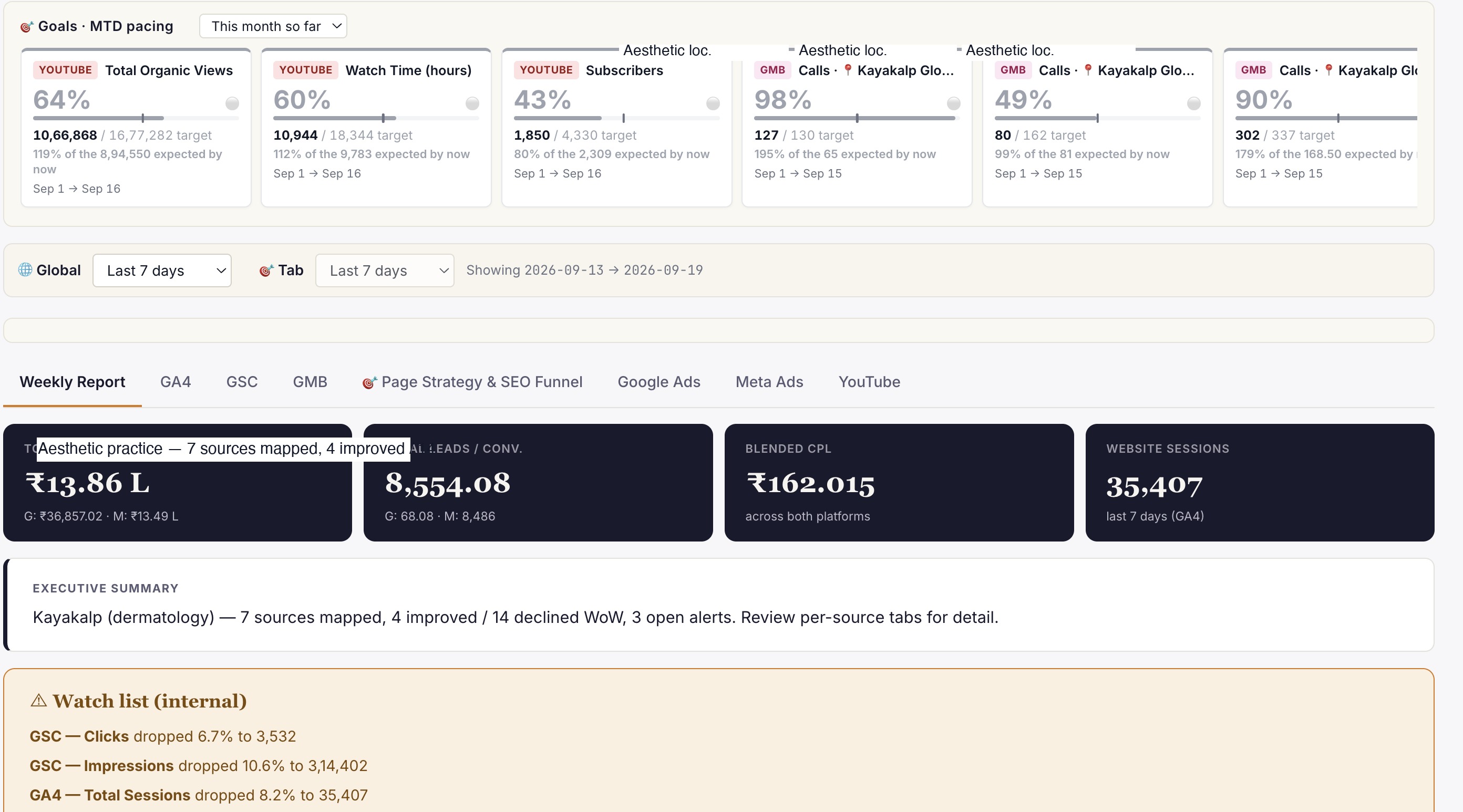
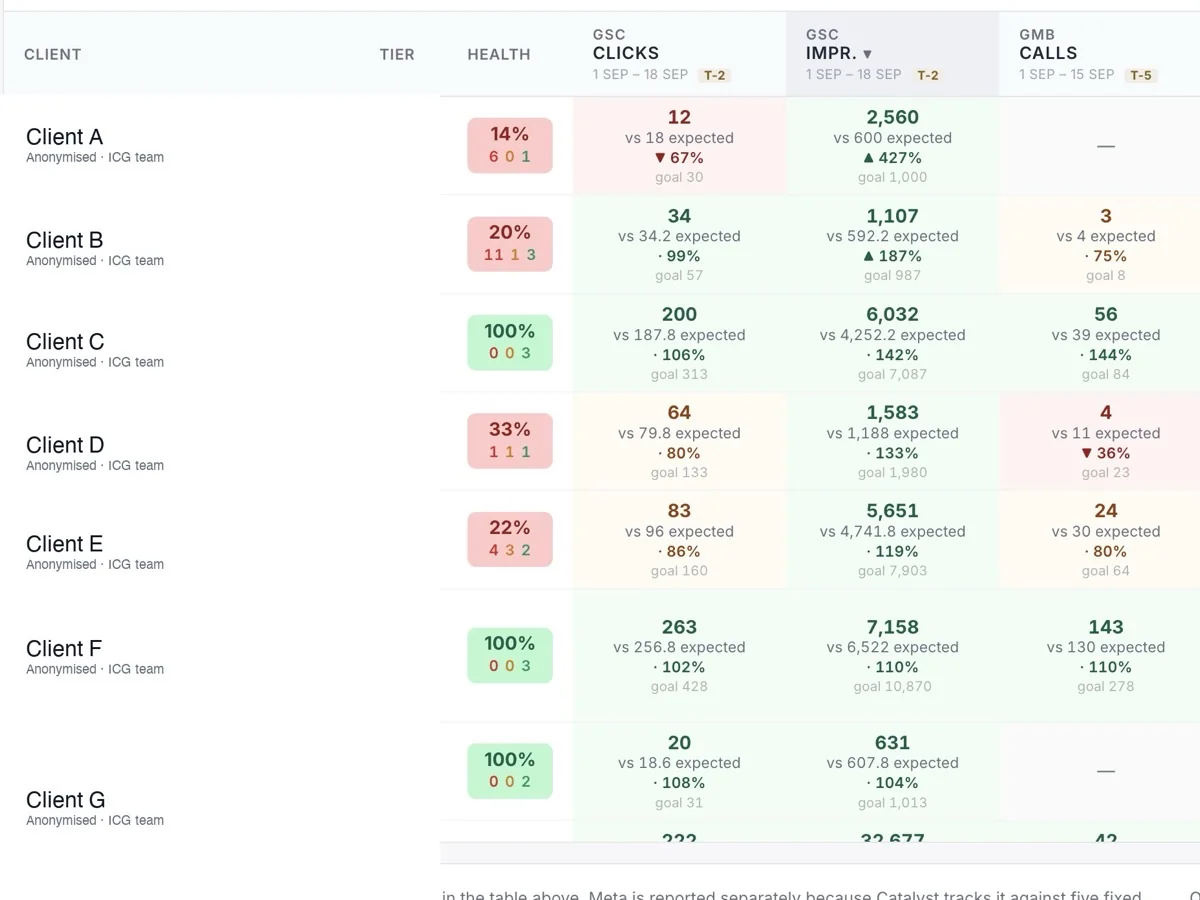
ICG's centralised governance platform — every client sees everything in real time, and ICG's team sees every problem the moment it surfaces. 30+ real-time alert systems fire the moment a metric drifts outside its performance envelope.

  • GSC, GA4, Google Ads, Meta Ads, IVR — one live view
  • 30+ real-time alert systems per account
  • CPQL drift alert at >15% week-on-week change
  • Client login: full transparency on your account
Explore Agency OS →
AEO & LLM Intelligence

AIO Intel

AI Overview + LLM citation tracking, healthcare-tuned

Knows the moment ChatGPT, Perplexity, Google AI Overviews and Gemini cite your brand in patient answers — and which content drove the citation. Bot-aware dashboard with GA4-registered custom dims (AIO source, AIO referrer) and IndexNow + GSC API integration.

  • Live tracking across ChatGPT / Perplexity / Google AIO / Gemini
  • Bot-aware: knows human vs scraper traffic
  • Custom GA4 dims register AIO source + referrer
  • IndexNow + GSC API: content surfaced to LLMs within hours
View AIO Intel dashboard →
Competitor Intelligence

Prism Spy

Every Meta + Google ad your competitors run, watched daily

Tracks 75+ Indian healthcare brands, 2,150+ active ads, ₹50Cr+ aggregate ad spend visibility per month. Surfaces what's working, what's been killed, what offers are emerging. Powers every ICG Meta Ads brief, Performance Marketing diagnostic, and IVF / derm / dental specialty campaign with real competitive intelligence.

  • 75+ brands tracked across 30+ healthcare specialties
  • 2,150+ active ads · daily refresh
  • Activity Feed: every spend / hook / pause logged
  • Offers Intelligence: 250+ offers in market tracked
Explore Prism Spy →
GBP Intelligence Platform

Angryturtle

Every Google Business Profile scored, tracked, protected, and grown from one command centre

ICG's proprietary Google Business Profile intelligence platform. Scores every listing across 7 dimensions, tracks rank on a live geo-grid across your actual service area, audits NAP + citations, monitors 531 suspension-risk factors continuously, and drafts Google Posts on cadence. Currently managing 143 healthcare listings with 0 suspensions and 4.76★ portfolio average across 28,137 reviews.

  • 143 listings under management · 0 suspensions · 4.76★
  • 7-dimension Health Score + 5-factor Rank OS per listing
  • Geo-grid rank tracking + NAP + Citation audit + Profile Shield
  • NMC + NABH + ART Act + DPDP compliance built into every content + review workflow
Explore Angryturtle →

Every ICG engagement runs on some combination of these ten HealthApex OS tools. The diagnostic determines which combination is right for your practice.

Explore HealthApex OS → See the full stack live on your account — free 30-min audit
The team behind your account

Every diagnostic is led by a founder.
You'll know their names before the engagement begins.

ICG was built by three IIT BHU engineers who entered healthcare marketing with a specific intent: to build the tools that didn't exist and run the campaigns that most agencies couldn't. When you book a diagnostic, Rohit or Abhash leads it personally. Not an account manager. Not a senior executive. The people who built what you're evaluating.

The ICG team — 60+ healthcare marketing specialists at Gurgaon HQ

60+ specialists.
One growth engine.

Performance marketers, analysts, AI engineers, content strategists, and operations specialists — all healthcare-only. Headquartered in Gurgaon since 2018.

Rohit Gupta — Leader, ICG

Rohit Gupta

Business & Growth Lead & Director

IIT BHU · IIM Rohtak

Rohit's first question in every diagnostic: "When you ask your agency why patients aren't booking — what do they say?" He says the answer tells him more than any dashboard.

Full profile →
Abhash Kumar — Leader, ICG

Abhash Kumar

Strategy & Analytics Lead & Director

IIT BHU · IIM Bangalore

Abhash built Beacon because most agencies couldn't answer one question: "Which of my campaigns generated that consultation?" He decided the problem was solvable in code. It was.

Full profile →
Deep Das — Leader, ICG

Deep Das

Technology & AI Lead & Director

IIT BHU

Deep built the 4-Bot patient lifecycle system after watching a client lose 60+ qualified leads in one week to a 6-hour WhatsApp response window. He decided the problem was solvable in code. It was.

Full profile →
HealthApex OS Pricing · All-Inclusive · Billed Annually
₹2,999 – 3,999/month
Single Tool
Hawk CRM intelligence overlay (₹2,999), Nexus CRM / HealthPro 360 / Phoenix alone (₹3,999 each).
₹4,999 – 11,999/month
Bundled Suite
Nexus + Hawk ₹4,999. HealthPro 360 + Patient Portal ₹7,999. Operations Suite (HealthPro + Phoenix + Portal) ₹11,999.
₹14,999/month
Complete HealthApex OS ★
All 8 tools: Nexus + Hawk + Beacon + Phoenix + HealthPro 360 + YODA + Agency OS + AIO Intel. Best value. Full integration.

Transparent. Billed annually. No hidden integration fees. Most Indian clinics save 60-80% vs Salesforce Health Cloud (₹3L+/month) or a 5-vendor multi-tool stack. Complete HealthApex OS at ₹14,999/month is 40-60% cheaper than maintaining a multi-vendor stack — plus you get unified data, one compliance officer, one founder-led engagement. Enterprise tier (hospital networks, multi-brand, custom modules): ₹50,000 – ₹3,00,000/month, founder-led.

Book the free 30-min diagnostic →
Selected ICG clients

Healthcare brands ICG
has worked with.

A representative slice of the 300+ healthcare brands ICG has delivered for across India. Full client list available under NDA during a Brand and Growth Diagnostic.

Read full client case studies →

Sources & methodology
View sources cited on this page
  • Association of Hair Restoration Surgeons of India (AHRS-India) clinical guidelines
  • NMC Professional Conduct Regulations 2002 (as updated) — Section 6
  • ASCI Code for Self-Regulation in Advertising
  • Meta Advertising Standards — Personal Attributes policy
  • ICG portfolio data (n=7 hair-transplant engagements, Sep 2025 - Aug 2026)
  • ICG in-market benchmarks 2025-26

Ready to build a
hair transplant marketing engine?

Start with a 30-minute Hair Transplant Growth Diagnostic from ICG. For solo surgeon-founders, multi-city chains and dermato-trichology-integrated practices across India.

Chat with a Co-Founder
🎯 Goal-linked · Fixed + Goal-based Variable Pay · 19-mo retention
Chat with a Co-Founder