


Healthcare SEO & AEO India 2026: Complete Guide
ICG's complete guide to healthcare SEO and AEO in India: the MMT framework, AI Overview strategy, schema markup, and 2026 benchmarks.
No pitch. Written root-cause diagnosis. AI-powered, healthcare only.
Direct answer
ICG's complete guide to healthcare SEO and AEO in India: the MMT framework, AI Overview strategy, schema markup, and 2026 benchmarks.
TL;DR
Healthcare SEO in India in 2026 operates across two search environments simultaneously: traditional Google Search (where 62% of patients still begin their healthcare journey) and AI search — Google AI Overviews, ChatGPT, and Perplexity — where 38% of Indian patients now start. A healthcare brand that optimises only for traditional SEO is invisible to more than a third of its potential patients. ICG was among the first healthcare marketing agencies in India to build AEO (Answer Engine Optimisation) into every SEO engagement — beginning in 2024. This guide documents the full framework.
By Hanuman Sihag, Head of Innovation Chamber at ICG. 7 years building healthcare SEO and AEO systems for Indian healthcare brands. Full profile
The Two-Layer Healthcare Search Landscape in 2026
Layer 1 — Traditional Google Search
Traditional Google Search — the 10 blue links, the local pack, the featured snippet — still handles the majority of healthcare queries in India. Patients searching "IVF clinic Gurgaon", "dermatologist near me", or "best orthopaedic surgeon Delhi" are using traditional Google.
Traditional healthcare SEO is well-understood: keyword research, on-page optimisation, backlinks, schema markup, technical performance, and content depth. ICG's differentiation in traditional SEO is methodology — specifically the MMT Framework and CBO Tool described below.
Layer 2 — AI Search (AEO)
AI search operates differently. When a patient asks ChatGPT "what is the best treatment for hair loss in men under 35?", the response is not a list of links — it is a synthesised answer generated from crawled web content, with citations. The sources cited are those that AI systems have determined to be:
- Credible (strong E-E-A-T signals, named authors, institutional affiliation)
- Comprehensive (full coverage of the topic, not thin pages)
- Structured (clear headings, FAQ blocks, schema markup)
- Original (unique data, frameworks, or clinical perspective not found elsewhere)
The practical implication: Healthcare SEO in 2026 requires building content that satisfies both environments simultaneously. ICG builds every healthcare content piece to be both Google-rankable (traditional SEO) and AI-citable (AEO). The frameworks are compatible — most of what makes content rank on Google (depth, authority, structure) also makes it citable by AI tools.
The MMT Framework: ICG's Healthcare Keyword Management System
MMT (Maximize, Maintain, Trend) is ICG's proprietary framework for managing a healthcare brand's keyword portfolio. It replaces the common approach of treating all keywords identically.
Maximize (M)
Definition: Keywords where the brand ranks positions 4–15 (page 1, below the fold, or early page 2). These keywords are visible but not yet capturing significant traffic. Full effort goes here.What "full effort" means:
- Content expansion or complete rewrite (target 2,500+ words, comprehensive coverage)
- Internal link reinforcement (3–5 links from high-authority pages pointing to this page)
- Schema markup optimisation (FAQPage, Article, or specialty-specific schema)
- Title tag and meta description A/B test
- Backlink acquisition (2–3 relevant healthcare links per quarter)
Maintain (M)
Definition: Keywords where the brand ranks positions 1–3. These are already generating traffic and revenue. Minimal new effort — protect the position.What "maintain" means:
- Refresh content with current-year data every 6 months
- Monitor for featured snippet theft (another site stealing the position)
- Internal link health check quarterly
- Schema accuracy review (no outdated pricing, hours, or credentials)
Trend (T)
Definition: Emerging keywords where search volume is growing and competition is low. First-mover opportunity — build content now before the competition does.What "trend" means:
- Monitor via HMIP (Healthcare Market Intelligence Platform) for rising query volumes
- Create content immediately when a trend query reaches 100+ monthly searches
- Stake the claim with comprehensive content before the keyword becomes competitive
IVF AI embryo selection India— volume rising 340% YoYAI diagnosis dermatology India— early stage, low competitionrobotic knee replacement India— 180% YoY growthChatGPT healthcare India— broad but specialising fastdigital health records India DPDP Act— regulatory-driven surgeproton therapy cancer India cost— new centre openings driving search
The CBO Tool: Crawl Budget Optimisation for Healthcare Sites
Healthcare websites are among the most complex to crawl correctly — they often have hundreds of pages (city pages, doctor pages, condition pages, blog archives, campaign landing pages) competing for Google's crawl allocation.
ICG's CBO (Crawl Budget Optimisation) Tool integrates three data sources:
Input 1 — Apache/Nginx server logs: Every page Google's crawler has visited, how often, and how recently. Identifies pages being crawled frequently despite low value, and high-value pages being undercrawled.
Input 2 — XML Sitemap analysis: Pages in the sitemap that are not being crawled (Google's explicit signal that something is wrong with those pages) and pages being crawled that are not in the sitemap.
Input 3 — Google Search Console data: Coverage errors, crawled-but-not-indexed pages, and URL inspection signals.
Output — Crawl Priority Matrix:
AEO: The Full Framework for Healthcare AI Citation
What AEO is (and is not)
AEO (Answer Engine Optimisation) is the practice of structuring healthcare content so it is cited by AI tools when patients ask health questions. It is NOT:
- A separate content strategy from SEO (the two are compatible and overlapping)
- About gaming AI systems (AI tools do not have an "AEO loophole" — they cite credible sources)
- A short-term tactic (AEO authority builds over 6–12 months, like SEO)
The 6 AEO signals ICG builds into every healthcare content piece
Signal 1 — Named Expert Authorship AI tools weight content more heavily when a specific, credentialed human author is clearly identified. ICG attributes all content to named authors (Hanuman Sihag, Raman Soni, or the treating doctor) with credentials visible.
Schema implementation:
{
  "@type": "Person",
  "name": "Hanuman Sihag",
  "jobTitle": "Head of Innovation Chamber",
  "worksFor": {"@type": "Organization", "name": "Ichelon Consulting Group"},
  "url": "https://ichelonconsulting.com/team/hanuman-sihag"
}
Signal 2 — Structured FAQ Blocks Every healthcare content piece ends with a FAQ section where each question is an H2 or H3 and each answer is 2–4 sentences. AI tools extract FAQ blocks directly.
Schema: FAQPage with Question and acceptedAnswer for every Q&A pair.
Signal 3 — Original Data and Proprietary Statistics AI tools cite sources that have original data not available elsewhere. ICG's proprietary stats (₹1,120 IVF CPQL, 67% CTWA share, 8.6x response time multiplier) are original and unique — which is why AI tools cite them.
For healthcare brands: publish your own clinical outcomes data, patient volume data, procedural benchmarks. Even simple data ("our average consultation wait time is 12 minutes") is citable original content.
Signal 4 — MedicalClinic and Physician Schema AI tools that index healthcare content specifically look for medical entity schema to confirm authority.
Full MedicalClinic schema:
{
  "@context": "https://schema.org",
  "@type": "MedicalClinic",
  "name": "[Clinic Name]",
  "medicalSpecialty": ["IVF", "Fertility"],
  "address": {"@type": "PostalAddress", "addressLocality": "Gurgaon", "addressRegion": "Haryana"},
  "telephone": "[number]",
  "url": "[url]",
  "hasMap": "[Google Maps URL]",
  "availableService": [
    {"@type": "MedicalTherapy", "name": "IVF Treatment"},
    {"@type": "MedicalTherapy", "name": "IUI Treatment"}
  ]
}
Signal 5 — Answer-First Structure (AIO Paragraph) Every page and article starts with an 80–120 word paragraph that directly answers the page's primary question. This is what AI tools extract for AI Overview snippets and direct answers.
 yoda/02-aio-lab-rank-checker.png" alt="YODA AIO Lab Rank Checker — daily monitoring of AI Overview citation status for every tracked healthcare query" loading="lazy" decoding="async" style="width:100%;height:auto;display:block;">
The structure: primary keyword in sentence 1, core answer in sentences 2–4, ICG authority signal in sentence 5.
Signal 6 — E-E-A-T Signals Throughout Experience: specific, named clinical observations and portfolio data Expertise: author credentials prominently displayed Authoritativeness: citations to recognised medical institutions, NMC, ICMR Trust: privacy policy, HTTPS, no misleading claims, accurate information throughout
Schema Markup: The Complete Healthcare Stack
ICG deploys the following schema stack for every healthcare client:
Organisation-level schema (site-wide)
{
  "@type": "MedicalOrganization",
  "name": "[Organisation Name]",
  "url": "[URL]",
  "logo": "[Logo URL]",
  "address": {"@type": "PostalAddress", ...},
  "telephone": "[number]",
  "medicalSpecialty": ["[Specialty 1]", "[Specialty 2]"]
}
Page-level schema (by page type)
{
  "@context": "https://schema.org",
  "@type": "FAQPage",
  "mainEntity": [
    {
      "@type": "Question",
      "name": "[Question text — exactly matches H2/H3 on page]",
      "acceptedAnswer": {
        "@type": "Answer",
        "text": "[Answer text — 2-4 sentences, plain text, no HTML]"
      }
    }
  ]
}
Local SEO for Healthcare India: Google Business Profile Mastery
For clinics and hospitals, Local SEO — appearing in Google Maps and the local pack — is often more valuable than traditional organic rankings. A patient searching "dermatologist near me" sees the 3-pack before any organic results.
ICG manages GBP profiles for 130+ clinic listings. Key findings:
What drives GBP ranking (ICG portfolio data):
- Post-visit WhatsApp (4 hours after consultation): satisfaction check
- If rating ≥ 4: immediate Google Review request with direct link
- If rating ≤ 3: route to patient care team (do not send to Google)
- All Google reviews responded to within 24 hours (management template)
- Monthly audit: flag fake reviews for reporting, identify patterns in negative feedback
Core Web Vitals for Healthcare Sites

Google's Core Web Vitals directly affect rankings. Healthcare sites commonly fail on:
LCP (Largest Contentful Paint) — target < 2.5 seconds Common failure: large hero images of hospital exteriors or doctor photos loaded without compression or lazy loading. Fix: WebP format, lazy loading, CDN delivery.
CLS (Cumulative Layout Shift) — target < 0.1 Common failure: font loading causing text reflow, banner ads injecting content above the fold. Fix: specify font dimensions in CSS, reserve space for dynamic content.
INP (Interaction to Next Paint) — target < 200ms Common failure: JavaScript-heavy consultation booking forms that block main thread. Fix: defer non-critical JS, optimise booking widget.
ICG's technical SEO audit covers all Core Web Vitals for every healthcare site engagement. Passing CWV typically produces a 4–12% organic ranking improvement within 90 days of remediation.
Healthcare Content Architecture: The Topical Authority Engine
The difference between a healthcare site with 50 scattered blog posts and one that ranks is topical authority — comprehensive, interconnected coverage of a specific topic that signals to Google (and AI tools) that this source is the definitive resource.
ICG builds topical authority through the pillar-cluster model:
Pillar page (3,500–5,000 words):
Comprehensive guide to a major topic. Example: this page (/healthcare-seo-aeo-india-complete-guide-2026). Links to all cluster articles. Targets the head keyword.
Cluster articles (1,200–2,500 words):
Deep dives into specific sub-topics of the pillar. Each links back to the pillar AND to 2–3 sibling articles. Targets long-tail keywords. Example: /insights/chatgpt-citation-strategy-healthcare-india (cluster for this pillar).
The authority signal: When Google's algorithm sees 12 well-linked, deeply researched articles about healthcare SEO all pointing to one central pillar — it concludes this site is authoritative on healthcare SEO. That conclusion lifts all pages in the cluster.
ICG's content plan for ichelonconsulting.com: 6 pillars × 12 cluster articles = 72 pieces + 6 pillars = 78 total. At an average of 2,000 words per piece: 156,000 words of topical authority content. This is the SEO strategy that takes a site from 29 clicks/day to 100+ clicks/day within 6 months.
Healthcare Internal Linking Architecture
Internal linking is the infrastructure that makes topical authority measurable. Without internal links, Google cannot detect the relationship between cluster articles and their pillar.
ICG's internal linking rules for healthcare sites:
Rule 1 — Every cluster article must link to its pillar In the first 200 words AND in the related articles section at the end. Anchor text: the pillar's primary keyword (not "click here").
Rule 2 — Every cluster article must link to 2–3 siblings Contextual links within the article body — placed where the linked article is genuinely relevant to the reader.
Rule 3 — Every article must link to 1 service page and 1 product page Service page: the ICG service most relevant to the article. Product page: YODA, HealthPro 360, Beacon, or the relevant ICG product.
Rule 4 — No orphan pages Every new page must receive at least 2 internal links before it is published. Use the bash command from the Claude Code spec to audit for orphan pages quarterly.
Rule 5 — Pillar-to-pillar links Each pillar links to the 2 most related other pillars. This creates a web of authority across the entire content estate.
Frequently Asked Questions
What is AEO in healthcare marketing? AEO (Answer Engine Optimisation) is the practice of structuring healthcare website content to be cited by AI tools — ChatGPT, Perplexity, and Google AI Overviews — when patients ask health questions. In 2026, 38% of Indian patients use AI before Google. ICG builds AEO architecture into every healthcare SEO engagement through named authorship, FAQPage schema, original data, and structured answer-first content.
How long does healthcare SEO take to show results in India? Title tag and meta description improvements on already-ranking pages: 1–2 weeks. New content ranking: first impressions at Week 4–8, meaningful traffic at Month 3–4, full topical authority at Month 6–9. ICG's content cluster approach (6 pillars + 70+ supporting articles) is designed to achieve meaningful organic traffic by Month 4 and significant growth by Month 9.
What is the MMT Framework? MMT (Maximize, Maintain, Trend) is ICG's healthcare keyword management system. Maximize: full effort on keywords ranking positions 4–15. Maintain: protection of keywords already in top 3. Trend: early content creation for emerging healthcare queries before competition builds. It replaces treating all keywords identically — which is how most agencies waste SEO budget.
What schema markup does a healthcare website need? At minimum: MedicalOrganization (site-wide), Physician (doctor pages), MedicalClinic or LocalBusiness (location pages), Article (blog/insights), FAQPage (FAQ sections), BreadcrumbList (all pages). ICG also deploys MedicalCondition, MedicalProcedure, and MedicalTherapy schema for condition and service pages. Full schema stack raises E-E-A-T signals for both Google and AI tools.
What is ICG's CBO Tool? CBO (Crawl Budget Optimisation) Tool integrates Apache server logs, XML sitemap data, and Google Search Console to identify which pages Google is crawling, undercrawling, or wasting crawl allocation on. For healthcare sites with 200+ pages, CBO ensures Google prioritises revenue-generating and authority pages over thin, duplicate, or outdated content.
What is Google AI Overview and how do I appear in it? Google AI Overview is Google's AI-generated answer box that appears above organic results for informational queries. It pulls content from trusted web sources. To appear: strong E-E-A-T signals (named expert authors, medical credentials), FAQPage schema, answer-first content structure, original data, and comprehensive topic coverage. ICG builds AI Overview targeting into every SEO engagement.
Related ICG Insights
- Medical SEO India Complete Guide 2026
- Healthcare AEO — Answer Engine Optimisation Complete Guide
- ChatGPT Citation Strategy for Healthcare India
- Google AI Overview Healthcare India 2026
- Healthcare Schema MedicalClinic Implementation India
Book a free SEO diagnostic.
Hanuman Sihag's team runs a live crawl, checks technical health, cannibalisation, schema coverage and content gaps. 60 minutes, prioritised fix list.
The three platforms
behind every ICG engagement.
Beacon
CAPI middleware that fixes Event Match Quality, translates CRM statuses to Meta-standard events, dedups across channels.
Agency OS
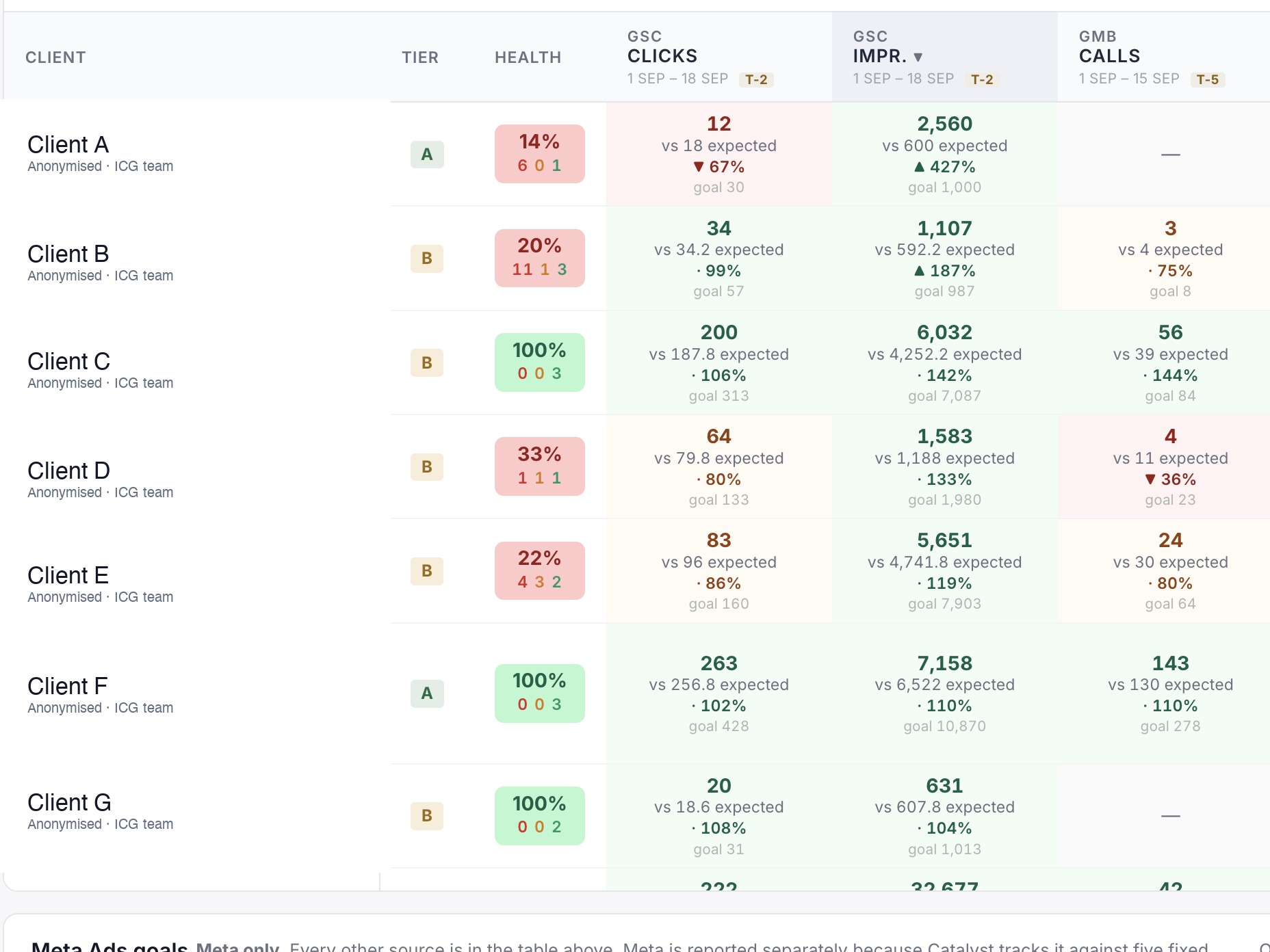
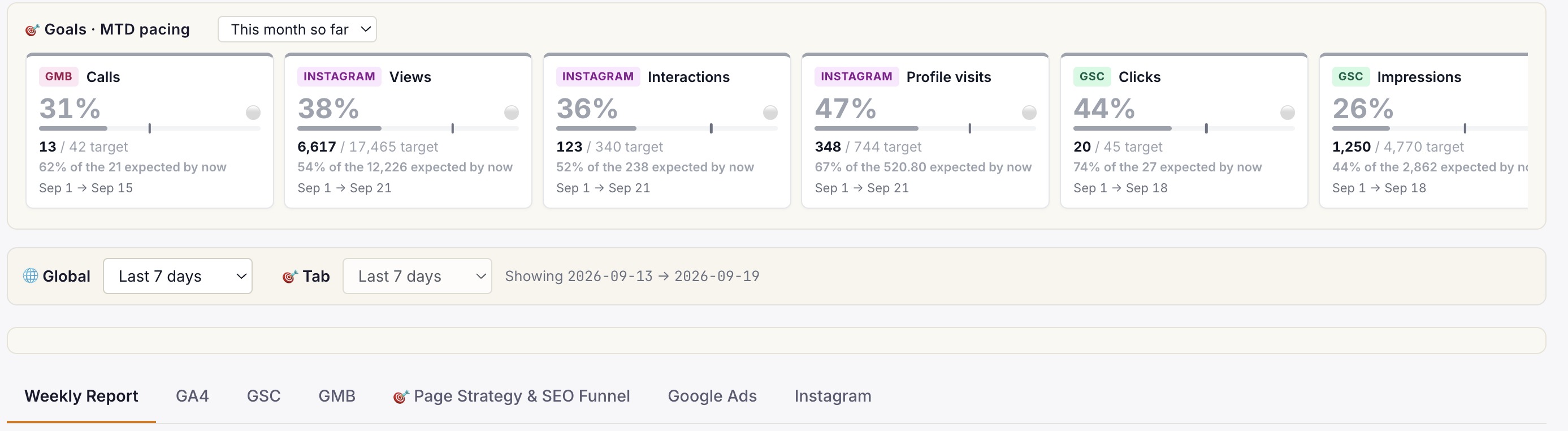
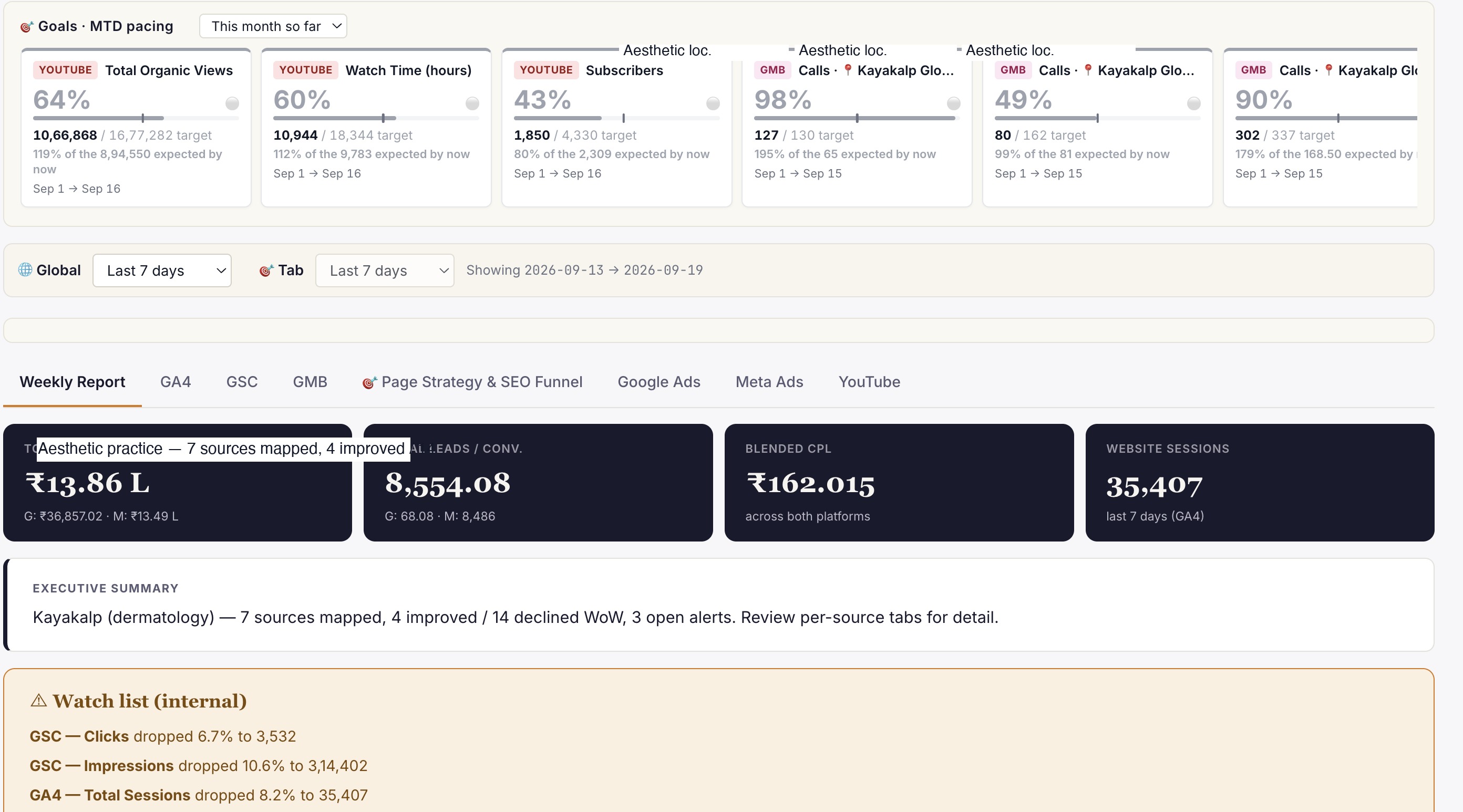
Live client dashboard. GSC, GA4, Google Ads, Meta Ads, IVR calls in one view. Login anytime, not monthly.
Phoenix
Clinic revenue intelligence over your PMS. Daily action queue: Prevent Loss, Maintain & Engage, Grow Revenue. Multi-centre rollout.
Or book a free 30-min audit to see all three in action on your account.
Healthcare brands
that already run on ICG.
A representative slice of the 150+ healthcare brands ICG has delivered for across India. Most engagements remain under NDA.


What ICG clients say · on video.
"Scale up of organic channels and business consulting. ICG has absolute domain authority in their field."
"Working with ICG transformed how we acquire IVF patients in Gurgaon. They understand the fertility journey from inquiry to consult..."
"What Ichelon accomplished — they got all my ideas and worked over 3-4 months to create an amazing, super-customised website."
The intelligence stack behind this playbook.
Every ICG engagement runs on the Search Intelligence Trifecta — Angryturtle for GMB, SIE for search and AI Overview, YODA for YouTube. Live product screens below.
Need help operationalising this?
Every ICG service is healthcare-only, NMC + DPDP-aware, and built around the patient-research patterns that drive Indian healthcare growth in 2026.
Every practice welcome — packages from ₹20,000/mo.
Goals-Driven engagements · Performance-Linked Payout Models available
More from
ICG.
Five trends shaping Indian healthcare marketing through 2027: AI-first patient research, Conversions API adoption, ABDM discovery, the AEO w...
Healthcare AIO is the discipline of getting your clinic or hospital cited inside Google AI Overviews, ChatGPT and Perplexity answers — not j...
Conversational-search advertising places brand messages inside AI chat answers — ChatGPT, Perplexity, Copilot — rather than beside a results...
Stop guessing.
Book a Diagnostic.
30 minutes. Free. With the AI-powered healthcare-only marketing agency 150+ brands already run on. No slides, no pitch, no hard close.


