


Hospital Marketing India: The Complete 2026 Guide
Hospital marketing in India 2026 — the complete guide from the agency that serves 30+ Indian hospital and clinic groups. Multi-specialty, multi-location, multi-language.
No pitch. Written root-cause diagnosis. AI-powered, healthcare only.
Direct answer
Hospital marketing in India 2026 — the complete guide from the agency that serves 30+ Indian hospital and clinic groups. Multi-specialty, multi-location, multi-language.
TL;DR
Hospital marketing in India in 2026 is the practice of building patient volume, institutional authority, and revenue efficiency for multi-specialty hospitals through a coordinated system of paid media, organic search, content, and patient lifecycle automation — designed around the unique complexity of a hospital: multiple departments, multiple patient personas, multiple city catchment zones, and a revenue architecture that spans OPD consultations to high-value IPD procedures. ICG serves 30+ hospital and clinic group clients across India, including national brands, with CPQL benchmarks and attribution frameworks built specifically for multi-specialty complexity.
By Hanuman Sihag, Head of Innovation Chamber, and the ICG Editorial team.
Why Hospital Marketing Is Fundamentally Different
A solo dermatologist and a 150-bed multi-specialty hospital have the same surface-level marketing need (more patients) but fundamentally different marketing architectures.
Four complexities unique to hospital marketing:
1. Multiple revenue streams with different patient journeys An IVF wing, an orthopaedic surgery department, a dermatology OPD, a cardiac ICU, and a corporate wellness programme have nothing in common from a patient acquisition standpoint. Each requires a distinct campaign, distinct landing page, distinct WhatsApp qualification flow, and distinct content cluster. Treating a hospital as a single brand with a single campaign is the most common failure mode in Indian hospital marketing.
2. OPD vs IPD funnel architecture OPD (outpatient) and IPD (inpatient) patients arrive via completely different paths. OPD patients search locally and book quickly — Google Ads and local SEO are primary acquisition channels. IPD patients (joint replacement, cardiac surgery, oncology, neurosurgery) research extensively over weeks or months, often travel from other cities, and require trust-building content and multi-touch attribution. The same campaign architecture cannot serve both.
3. Revenue per patient is orders of magnitude different An OPD consultation generates ₹500–₹2,000 in direct revenue. An orthopaedic joint replacement generates ₹3–₹8 lakhs. A cardiac bypass generates ₹5–₹12 lakhs. A liver transplant generates ₹25–₹40 lakhs. The marketing economics — how much to spend per lead, how long the nurture cycle can be, how much to invest in content — are completely different across these revenue tiers.
4. Multi-location coordination A hospital chain with 5 locations in 3 cities requires 5 separate Google Business Profiles, 5 sets of location-specific landing pages, 5 local citation builds, and city-specific campaign budgets — plus a consolidated brand narrative that ties them together. Managing this as a single monolith produces locally irrelevant marketing; managing it as 5 completely independent entities fragments brand authority.
The Hospital Marketing Architecture
ICG builds hospital marketing across 4 layers simultaneously:
Layer 1 — Departmental Acquisition Campaigns
Each revenue-generating department gets its own campaign architecture:
The hospital's institutional brand — its overall reputation, authority, and differentiation — is built through:
Named consultant marketing: The most underused brand asset most hospitals have. The senior surgeons, department heads, and nationally recognised specialists within the hospital are personal brands that can be activated separately. A Dr. [Name]'s YouTube channel, Google rankings, and professional profile all drive referrals and direct patient bookings to the hospital without any ad spend.
ICG builds named consultant marketing programmes for 10–20 of a hospital's most visible doctors — each with their own content strategy, indexed profile pages, and YouTube presence — creating a distributed brand amplification network that no single institutional campaign can replicate.
Institutional content: Hospital-level content targets institutional credibility queries: accreditations (NABH, JCI), technology investments (robotic surgery, proton therapy), clinical outcomes publications, CSR initiatives, and expert commentary on healthcare policy. This content builds Google E-E-A-T signals and AEO visibility for the hospital brand.
Layer 3 — Patient Lifecycle System
Hospitals have the most complex patient lifecycle requirements of any healthcare organisation — and most Indian hospitals manage it with a mix of ad-hoc WhatsApp messages and phone calls.
ICG's 4-Bot AI Patient Lifecycle for hospitals:
OPD patient lifecycle:
- Day 0: Consultation booked → confirmation + pre-consultation instructions
- Day -1: Reminder + directions + what to bring
- Day 0 (post-visit): Feedback survey + prescription reminder
- Day 7: Follow-up: "How are you feeling? Any questions about your prescription?"
- Day 30: Re-activation + health monitoring touch
- Day 90: Health check-up reminder relevant to their condition
- Pre-admission: Admission checklist, insurance pre-auth status, room selection
- During admission: Daily status update to nominated family contact
- Discharge: Discharge summary on WhatsApp, post-care instructions, emergency contact
- Day 3 post-discharge: Recovery check-in
- Day 7: Follow-up consultation prompt
- Day 30: Outcome assessment + next appointment
Layer 4 — Revenue Intelligence
ICG deploys a custom Business MIS (Management Information System) for hospital clients through HealthPro 360 — providing management with real-time visibility into:
- Daily OPD and IPD revenue vs target
- Department-wise revenue contribution and trend
- Loss and leakage detection: unbilled services, package underutilisation, collection gaps
- Doctor-wise revenue generation
- Bed occupancy and IPD revenue per bed day
- Marketing attribution: which campaign, channel, and ad generated which consultation and procedure revenue
CPQL Benchmarks for Hospital Marketing India 2026
Multi-Location Hospital Chain Marketing
For hospitals with 3 or more locations, ICG deploys a hub-and-spoke brand architecture:
Hub (institutional brand): The central hospital brand — managed at the corporate marketing level. Responsible for:
- National/pan-India brand campaigns
- Named consultant marketing coordination
- Institutional PR and content
- Cross-location patient referral system
- Location-specific Google Ads campaigns (city + catchment area targeting)
- Dedicated Google Business Profile optimised for local search
- Location landing pages with local team, services, and reviews
- Local content (city-specific health event coverage, local partnership announcements)
- WhatsApp number and automation configured per location
- CPQL range compressed from ₹620–₹3,800 (pre-ICG) to ₹680–₹1,420
- Revenue intelligence dashboard live across all 46 centres for management visibility
- Under-performing centres identified within 30 days of deployment
- Standardised WhatsApp lifecycle active within 60 days
Hospital SEO: The 4-Content-Type Framework
Hospital SEO requires content across 4 distinct types, each serving a different search intent:

Type 1 — Department pages (commercial intent)
One page per major department/service. Optimised for "[Department] hospital [city]" queries.
Structure: what we treat, our team, our outcomes, our technology, our process, FAQ, CTA.
Example: /departments/cardiac-surgery optimised for "cardiac hospital Delhi" + "heart surgery cost Delhi"
Type 2 — Named doctor pages (trust + direct booking) One page per senior doctor/consultant. Optimised for "[Doctor name] [specialty]" queries. Schema: Physician + Person. Credentials, case volume, publications, video embed, CTA.
Type 3 — Condition and procedure pages (informational + consideration)
One page per condition treated and procedure performed.
Example: /conditions/knee-arthritis → builds trust for "best treatment for knee arthritis India" queries
Type 4 — AEO content (AI citation capture) FAQ and explainer content specifically structured for AI Overview and AI tool citation. Example: "What is the best hospital for liver transplant in Delhi?" — if answered on the hospital's site with an authoritative, well-structured response, AI tools cite it.
 yoda/02-aio-lab-rank-checker.png" alt="YODA AIO Lab Rank Checker — daily monitoring of AI Overview citation status for every tracked healthcare query" loading="lazy" decoding="async" style="width:100%;height:auto;display:block;">
Hospital Marketing Compliance: Beyond NMC
Hospital marketing must navigate a layered compliance environment:
NMC (National Medical Commission): Same constraints as individual doctor marketing — no outcome guarantees, no comparative superiority, no misleading claims. Additionally: NABH-accredited hospitals should not imply that non-NABH hospitals are unsafe (comparative superiority constraint).
NABH and JCI: Accreditation status can and should be marketed — but only accurately. "NABH-accredited" is a valid marketing claim for an accredited hospital. "The only NABH-accredited hospital in [area]" requires verification.
Insurance and TPA marketing: If marketing to insurance-covered patients, all empanelled insurance and TPA details must be accurate and current. False or outdated insurance claims generate patient complaints.
AERB (Atomic Energy Regulatory Board): Hospitals with nuclear medicine or radiotherapy departments have specific patient communication requirements under AERB guidelines.
ICG's hospital compliance team checks all content and creative against all applicable frameworks before launch.
Frequently Asked Questions
How much does hospital marketing cost in India? ICG's hospital marketing retainers start at ₹2,50,000/month for a single-location hospital (up to 100 beds, 5 departments). Full hospital chain marketing (5+ locations, all departments) ranges from ₹5,00,000 to ₹15,00,000/month in agency fees. Ad spend is separate and scales with department count and city tier. All engagements begin with a free Digital Health Audit.
What is the most important marketing channel for a hospital? It depends on the revenue mix. For OPD-heavy hospitals: Google Ads and local SEO are primary. For IPD and elective surgical departments: content authority, named doctor marketing, and AEO are more important than paid media. ICG never recommends a channel mix before diagnosing the hospital's revenue architecture and patient acquisition gaps.
How does ICG attribute hospital marketing to actual revenue? ICG uses Beacon — its proprietary attribution platform — to connect ad clicks and organic visits to consultation bookings and procedure revenue via HealthPro 360 (PMS/HMS) integration. The output is a revenue attribution dashboard that shows exactly which campaigns, keywords, and content generated which procedures and what revenue.
Can hospitals market their NABH accreditation? Yes — NABH accreditation is a valid and powerful marketing signal. ICG recommends featuring it prominently across the website, Google Business Profile, and paid ad copy. The constraint: do not make comparative claims about other hospitals based on accreditation status.
What is the typical timeline for hospital marketing results? Google Ads for OPD specialties: first leads within 7–14 days. CPQL stabilisation: Month 2–3. Named doctor content and SEO: meaningful organic traffic at Month 3–6. Full multi-department content authority: Month 6–12. Revenue intelligence integration (Beacon + HealthPro 360): live within 30 days of engagement start.
Related ICG Insights
- Multi-Specialty Hospital Marketing India
- Hospital Department-Level Marketing India
- Hospital Revenue Cycle Management Marketing India
- Hospital Chain Marketing — 46-Centre Playbook
- HealthPro 360 — PMS/HMS for Indian Hospitals
Book a free 30-minute Brand & Growth Diagnostic.
It's a working session, not a sales pitch — you leave with a written root-cause analysis you can act on, whether or not you engage ICG.
The three platforms
behind every ICG engagement.
Beacon
CAPI middleware that fixes Event Match Quality, translates CRM statuses to Meta-standard events, dedups across channels.
Agency OS
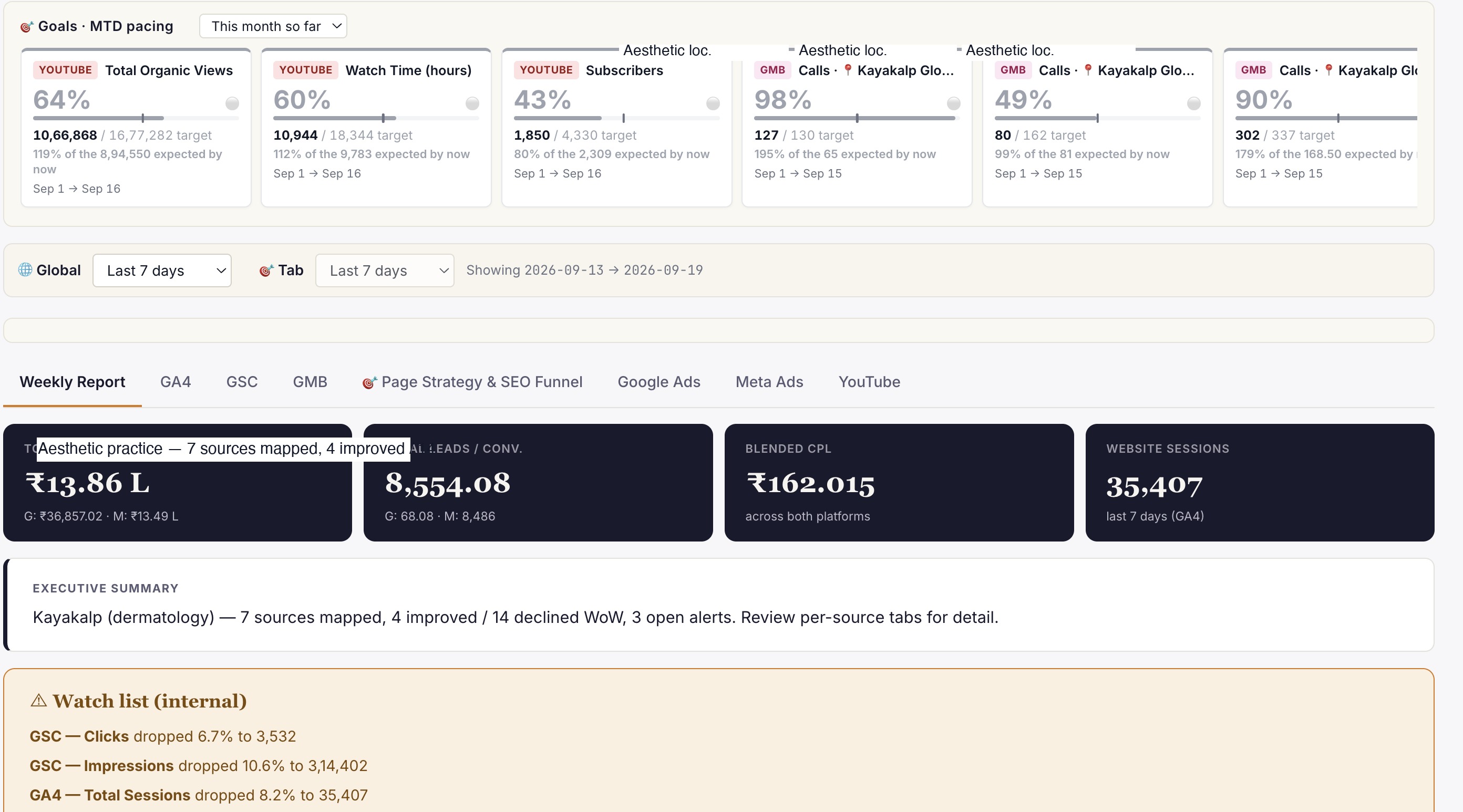
Live client dashboard. GSC, GA4, Google Ads, Meta Ads, IVR calls in one view. Login anytime, not monthly.
Phoenix
Clinic revenue intelligence over your PMS. Daily action queue: Prevent Loss, Maintain & Engage, Grow Revenue. Multi-centre rollout.
Or book a free 30-min audit to see all three in action on your account.
Healthcare brands
that already run on ICG.
A representative slice of the 150+ healthcare brands ICG has delivered for across India. Most engagements remain under NDA.


What ICG clients say · on video.
"Mental health marketing requires a different sensitivity. ICG built compliance-aware campaigns that respect both patients and our..."
"Bariatric surgery patients need a long consideration cycle. ICG built a content + paid system that respects that timeline."
"Working with ICG felt like working with an in-house growth team that happens to specialise in healthcare."
Need help operationalising this?
Every ICG service is healthcare-only, NMC + DPDP-aware, and built around the patient-research patterns that drive Indian healthcare growth in 2026.
Every practice welcome — packages from ₹20,000/mo.
Goals-Driven engagements · Performance-Linked Payout Models available


More from
ICG.
Five trends shaping Indian healthcare marketing through 2027: AI-first patient research, Conversions API adoption, ABDM discovery, the AEO w...
Healthcare AIO is the discipline of getting your clinic or hospital cited inside Google AI Overviews, ChatGPT and Perplexity answers — not j...
Conversational-search advertising places brand messages inside AI chat answers — ChatGPT, Perplexity, Copilot — rather than beside a results...
Stop guessing.
Book a Diagnostic.
30 minutes. Free. With the AI-powered healthcare-only marketing agency 150+ brands already run on. No slides, no pitch, no hard close.


