


YouTube marketing for dermatologists in Mumbai (2026): aesthetic derma channel playbook for Bandra, Andheri, Juhu, Lower Parel, and South Mumbai practices
How dermatology clinics in Mumbai should run YouTube — the film-adjacent credibility economy, evening 8-11 PM watch patterns, the underused Marathi content opportunity, Maharashtra Medical Council + NMC + ASCI + DPDP compliance perimeter, LTV maths on ₹1-3L aesthetic packages, and the YODA 6-step workflow adapted for a Mumbai aesthetic derma channel.
No pitch. Written root-cause diagnosis. AI-powered, healthcare only.
Direct answer
How dermatology clinics in Mumbai should run YouTube — the film-adjacent credibility economy, evening 8-11 PM watch patterns, the underused Marathi content opportunity, Maharashtra Medical Council + NMC + ASCI + DPDP compliance perimeter, LTV maths on ₹1-3L aesthetic packages, an...
TL;DR
Mumbai has roughly 800 dermatology clinics — more than any other Indian metro — and yet only a handful of them show up on YouTube when a woman in Bandra searches "HydraFacial vs regular facial" or a professional in Andheri West types "PRP hair loss cost Mumbai" into his phone at 10:47 PM on a Wednesday. The gap between clinic density and video presence is the entire opportunity. Mumbai patients research aesthetic dermatology in a very specific way — evening prime-time watch behaviour, three-language content preferences, film-industry-adjacent credibility signals, and package-heavy purchase patterns — and the clinics that build a YouTube channel calibrated to those local patterns pull consult bookings from the exact micro-markets where premium aesthetic packages actually sell. This playbook is the version of ICG's dermatology YouTube framework tuned specifically to Mumbai — the local search dynamics, the Maharashtra Medical Council perimeter around before-after visuals, the language mix that lifts retention, and how the YODA 6-step workflow gets adapted for a Mumbai aesthetic derma practice.
Why Mumbai is a distinctive market for dermatology YouTube
Mumbai concentrates aesthetic dermatology demand in a way no other Indian city does. The 800-odd clinics operate across the metro with the densest clusters running through Bandra, Andheri West, Lower Parel, Juhu, and pockets of top-tier South Mumbai aesthetic derma clusters. The film-adjacent economy pushes aesthetic dermatology into the largest treatment category by revenue — PRP for hair, laser hair removal, HydraFacial, thread lifts, and injectable consult volumes are higher per capita here than in any other Indian metro because visual-outcome buyers with high disposable income cluster in the same postcodes as the studios and production houses that employ them.
The watch-time pattern is unusually late. Mumbai YouTube consumption for aesthetic derma queries skews to the 8-11 PM prime-time band, driven by professional viewers watching after commute and dinner. Weekend afternoons are a secondary peak. A Mumbai derma channel that publishes at 6 PM local time and rides the evening surge outperforms one that publishes at 10 AM on the same day.
Language mix is the underused lever. Marathi content is genuinely undervalued in Mumbai aesthetic derma — very few clinics produce Marathi-first videos, yet a substantial portion of the patient base is more comfortable in Marathi than English for medical decisions. Hindi covers the migrant professional segment. English covers the film-adjacent buyer. A three-language channel that maintains linguistic authenticity in each language, rather than dubbing English content into Marathi as an afterthought, wins retention in every audience.
Seasonality has two peaks — the pre-wedding stretch from September through February, and the pre-monsoon window from April through May.
The 3-races math for dermatology in Mumbai
YODA's core framing is that a dermatology video runs three ranking races simultaneously, and Mumbai has local dynamics inside each race that a generic derma playbook misses.
 yoda/02-aio-lab-rank-checker.png" alt="YODA AIO Lab Rank Checker — daily monitoring of
 Race 1 — YouTube search. The winning Mumbai title pattern layers three signals: the treatment name, a Mumbai geo-signal where relevant, and a credential signal. A title like "PRP for Hair Loss in Mumbai: Bandra Dermatologist Explains Cost, Realistic Timeline, and What Actually Works (2026)" outranks a generic "PRP Hair Loss Treatment" on Mumbai-attributed YouTube searches by a meaningful margin. Marathi-language titles for identical treatment topics catch a second tail of search demand that English-only channels never see — a Marathi search for hair-loss PRP treatment competes against near-zero supply, and the retention on a Marathi explainer for a Marathi-primary viewer is materially higher than a dubbed English version.
Race 2 — Google web search. When someone in Powai searches Google for "HydraFacial Mumbai" and Google returns a video carousel inside the SERP, the videos that surface are the ones with local embeds. A Mumbai clinic that embeds its own YouTube videos on its clinic website with proper schema markup wins this race far more consistently than clinics that treat YouTube and the website as separate channels. Mumbai's density of clinic websites means Google has a rich local corpus to draw from, so the local-signal weight in this race is above the national average.
Race 3 — Google AI Overview. Mumbai-attributed queries increasingly trigger AI Overviews that cite video sources — particularly for treatment-with-visual-outcome queries like "does PRP actually work for hair loss." The Mumbai clinic that structures its videos with chapter markers, factual density in the first 45 seconds, and a clear treatment-question-answer framing gets cited. This surface is where Mumbai's higher YouTube-to-consult conversion rate compounds — Mumbai buyers who see the clinic cited in an AI Overview click through, watch the video, and often book the consult inside the same evening session.
Compliance perimeter for dermatology content in Mumbai
A Mumbai dermatology YouTube channel operates inside four overlapping regulatory perimeters, and getting any of them wrong produces content that has to be pulled after publication or triggers a formal complaint against the treating doctor.
Maharashtra Medical Council. The state medical council retains disciplinary jurisdiction over doctors practising in Maharashtra and applies restrictions on advertising, testimonials, and superlative claims that go beyond the NMC baseline. Mumbai channels should design content so that every on-camera claim is defensible if a complaint is filed with the MMC — this is stricter than the national standard and stricter than what most agencies plan for.
NMC Ethics Code 2026. The National Medical Commission restricts doctors from soliciting patient testimonials and from presenting patient stories as clinical evidence. Testimonial-format videos require documented informed consent, cannot claim clinical superiority, and cannot be structured to read as evidence of treatment efficacy.
ASCI Guidelines 2022. The Advertising Standards Council of India prohibits superlative claims ("best," "safest," "guaranteed," "permanent") without substantiation. For a film-adjacent Mumbai clinic, the temptation to lean on celebrity-adjacent framing runs high — this needs careful handling because any endorsement-style content triggers ASCI's endorsement guidelines in addition to the medical advertising rules.
DPDP Act 2023. Patient identity in video content is personal data under the Digital Personal Data Protection Act. Any patient-facing footage, even skin close-ups without face visibility, requires documented consent covering the specific channels, retention period, and withdrawal mechanism. YODA's compliance filter reviews every derma script and cut against all four perimeters before publication.
Content archetypes that convert dermatology patients in Mumbai
Four archetypes carry Mumbai aesthetic derma channels — with local calibration on each.
Explainer, Mumbai-tuned. The dermatologist explains a treatment on camera, with a Mumbai-specific example woven in — "the humidity in Mumbai changes how HydraFacial extractions behave" or "PRP recovery during a Mumbai monsoon has three practical considerations most patients don't plan for." These local specificities are the retention lift versus generic explainer content. Explainers should be 40-50% of the channel and rotate across the highest-margin treatment clusters.
Myth-vs-Fact, three-language. Common Mumbai misconceptions — "Botox is only for older women," "PRP is a scam," "HydraFacial ruins your skin barrier" — get walked through with evidence. This is the format where Marathi-first versions catch a distinct audience the English versions never reach. Should be 15-20% of the channel and produced in the language mix most-fit for each specific myth (some myths are Marathi-cluster dominant, others English-cluster).
Q&A anchored to Mumbai season and event patterns. The Mumbai calendar has natural questioning cycles — pre-wedding season prompts "how many PRP sessions before the wedding" questions, pre-monsoon prompts "acne during monsoon" queries, awards season spikes HydraFacial and skin-prep enquiries. Q&A videos that group real questions from Mumbai patients, YouTube comments, and Ask Maps queries and answer three or four in each 8-12 minute episode are the fastest audience-fit format on the channel.
Testimonial, compliance-safe. Real patients narrate their experience with signed consent and inside NMC restrictions. In Mumbai, testimonial videos convert cold viewers into consult bookings at higher rates than any other format — provided the framing avoids any celebrity-adjacent endorsement structure and reads as personal experience rather than clinical proof. Maximum 10-15% of the channel. Notable absences: celebrity-endorsement content, product-review content, and dermatologist-versus-influencer debunk content — all ASCI-adjacent traps in the Mumbai context.
Real budget expectations for dermatology YouTube in Mumbai
Mumbai production costs run 20-35% above the national average because studio rentals, editor day rates, and cameraperson costs in the Bandra-Andheri belt reflect the surrounding film-industry market. A well-produced 10-12 minute derma explainer in Mumbai costs ₹35,000/- to ₹75,000/- per video for a mid-production-value shoot including scripting, one shoot day, editing, thumbnail design, SEO writeback, and one round of revisions.
Against that cost, Mumbai LTV per converted patient is the highest in Indian derma — typically ₹1,00,000/- to ₹3,00,000/- across a first-year treatment plan for aesthetic buyers who convert into package customers. HydraFacial series, PRP protocols, laser courses, and thread-lift maintenance produce the largest per-patient revenue in this range.
ICG Chain tier — ₹75,000/- to ₹1.5L/- per month. Fits single-location aesthetic derma clinics and small chains up to three locations in Mumbai. Includes YODA platform access, monthly content plan for 6-8 videos, script support inside the Maharashtra Medical Council + NMC + ASCI + DPDP perimeters, SEO writebacks, thumbnail A/B tests, comment moderation, and one strategy review per month.
ICG Hospital tier — ₹1.5L/- to ₹4L/- per month. Fits multi-location Mumbai derma chains (four or more locations), academic dermatology departments, and groups running paid media budgets large enough to warrant integrated organic-plus-paid planning. Includes everything in Chain tier plus multi-channel management if the group runs city-cluster channels, deeper Competitor Intel across a larger Mumbai peer set, and paid-media coordination through the Ad-Spend Picks module. Below ₹75,000/- monthly, run YODA self-serve if an in-house marketing person can execute daily.
YODA 6-step workflow for a Mumbai dermatology channel
Step 1 — Overview. Connect the channel, calibrate against the Mumbai aesthetic derma benchmark band (typically 3-6 minute view duration and 5-9% CTR on target queries — higher than the national average because Mumbai viewers commit more evening time to research), and separate any paid promotion history from organic history so downstream diagnostics stay clean.
Step 2 — Diagnostics. Cluster existing videos by topical group (hair loss, laser, HydraFacial, injectables, acne, pigmentation) and by format (Explainer, Myth-vs-Fact, Q&A, Testimonial). For Mumbai specifically, YODA layers language attribution — which clusters are winning in Marathi versus Hindi versus English — because the format-language cross-tab is where the real Mumbai insight sits.
Step 3 — Strategy. Produce a 90-day content plan that reinforces the winning clusters and languages, closes gaps identified in Competitor Intel across the Bandra-Andheri-Juhu cluster, and includes ad-spend picks on 2-3 organic Winners per month for modest paid amplification during pre-wedding season peaks.
Step 4 — Optimisation. Rewrite titles, descriptions, tags, and chapters on the existing library. Score each video for Google AI Overview citation readiness — Mumbai-attributed AI Overviews cite video sources more heavily than the national average — and apply structured chapter markers plus factual first-45-second density.
Step 5 — Reputation (ORM). Cluster comments by theme (cost questions dominate Mumbai comment sections because premium pricing invites more comparison), reply inside NMC and DPDP constraints, and feed comment themes back into next-cycle Strategy as explicit FAQ topics.
Step 6 — Competitor Intel. Track 6-10 peer Mumbai dermatology channels and 2 aspirational large channels. Identify which topical clusters and formats a peer clinic is winning that the client is not. Feed insights into next Strategy cycle.
The platform ICG uses to run this at scale: YODA
ICG runs healthcare YouTube marketing for clinics, hospitals, and specialty groups using YODA — our AI-native healthcare YouTube marketing platform. YODA sits on top of a channel's data and does four things no dashboard does: it separates organic from paid views at every step (so a promoted video can never masquerade as organic growth), it gives decisions not dashboards (every video gets a state + next action), it writes back to YouTube directly (improved titles, tags, descriptions, chapters applied straight to the platform), and it tracks the three rank races — YouTube search, Google web, and Google AI Overview citations.
YODA runs the full 6-step workflow — Overview, Diagnostics, Strategy, Optimisation, Reputation (ORM), and Competitor Intel — with 40+ analysis modules organised under those steps. ICG's managed YouTube service uses YODA end-to-end. See the Healthcare YouTube Marketing pillar guide for the full scope, or the Healthcare YouTube Marketing Agency service page for engagement details.
Book a YODA demo on WhatsApp → or request a free healthcare YouTube channel audit →
Related reading
- YouTube marketing for dermatologists in India (2026) — the specialty parent guide
- Local SEO for doctors and clinics in Mumbai (2026)
- YODA 6-step workflow explained for healthcare marketing agencies
- YouTube vs Meta vs Google ROI comparison for Indian healthcare clinics
- Healthcare YouTube marketing agency service page
FAQ
Should our Mumbai derma channel be primarily in English, Hindi, or Marathi? The honest answer is all three, in a calibrated ratio. English carries the film-adjacent premium buyer, Hindi carries migrant professionals, and Marathi is the underserved lane where retention lifts because supply is scarce. Start with English as the core, add Marathi versions of the top 4-6 videos in the first quarter, and layer Hindi thereafter.
How does the pre-wedding season affect our YouTube content plan in Mumbai? September through February is the peak for wedding-adjacent aesthetic queries — HydraFacial series, PRP timelines, laser courses, and skin-prep questions all spike. Plan the content calendar so wedding-window content publishes 90-120 days before each peak so the videos have time to earn Suggested traffic before the actual booking rush.
Can we use celebrity-adjacent framing in our Mumbai derma videos without ASCI trouble? Not directly. Endorsement-style content triggers ASCI's endorsement rules alongside the medical advertising restrictions. Educational content that discusses treatments popular with public figures is defensible; content that positions the clinic as "dermatologist to the stars" is not. YODA's compliance filter flags the boundary.
What monthly retainer should a Bandra-based aesthetic derma clinic budget for? For a single-location Bandra practice with ₹40L-₹1.5Cr monthly aesthetic revenue, the ICG Chain tier at ₹75,000/- to ₹1.5L/- per month fits. Larger Mumbai chains with four or more locations sit inside the Hospital tier at ₹1.5L/- to ₹4L/- per month.
Which treatment cluster should a Mumbai derma clinic build content around first? Start with the highest-margin treatment the clinic actually wants to grow. For most Mumbai practices this is PRP for hair loss or a HydraFacial series programme — both have strong Mumbai search volume, package economics that support the marketing spend, and content archetypes that translate easily across English, Hindi, and Marathi.
How does the Maharashtra Medical Council affect what we can say on camera? The MMC applies restrictions beyond the NMC baseline on advertising, superlatives, and testimonial framing. Every on-camera claim should be defensible if a complaint is filed with the MMC — this is a stricter bar than most agencies plan for and needs to sit inside the compliance review before publication, not after.
Is Mumbai LTV really higher than other Indian cities for aesthetic derma? Yes, meaningfully. Package sizes are larger, maintenance cycles longer, and cross-treatment conversion higher in Mumbai than the national average — first-year LTV per converted patient typically sits in the ₹1,00,000/- to ₹3,00,000/- band for aesthetic buyers who convert into package customers.
What is a realistic timeline before our Mumbai derma channel starts producing consult bookings? First measurable consult bookings from organic YouTube typically show up in weeks 8-12 for a Mumbai channel that publishes on a disciplined weekly cadence. Meaningful compounding starts around month 6 as the library grows large enough that new videos benefit from Suggested traffic from existing videos.
Book a free 30-minute Brand & Growth Diagnostic.
It's a working session, not a sales pitch — you leave with a written root-cause analysis you can act on, whether or not you engage ICG.
The three platforms
behind every ICG engagement.
Beacon
CAPI middleware that fixes Event Match Quality, translates CRM statuses to Meta-standard events, dedups across channels.
Agency OS
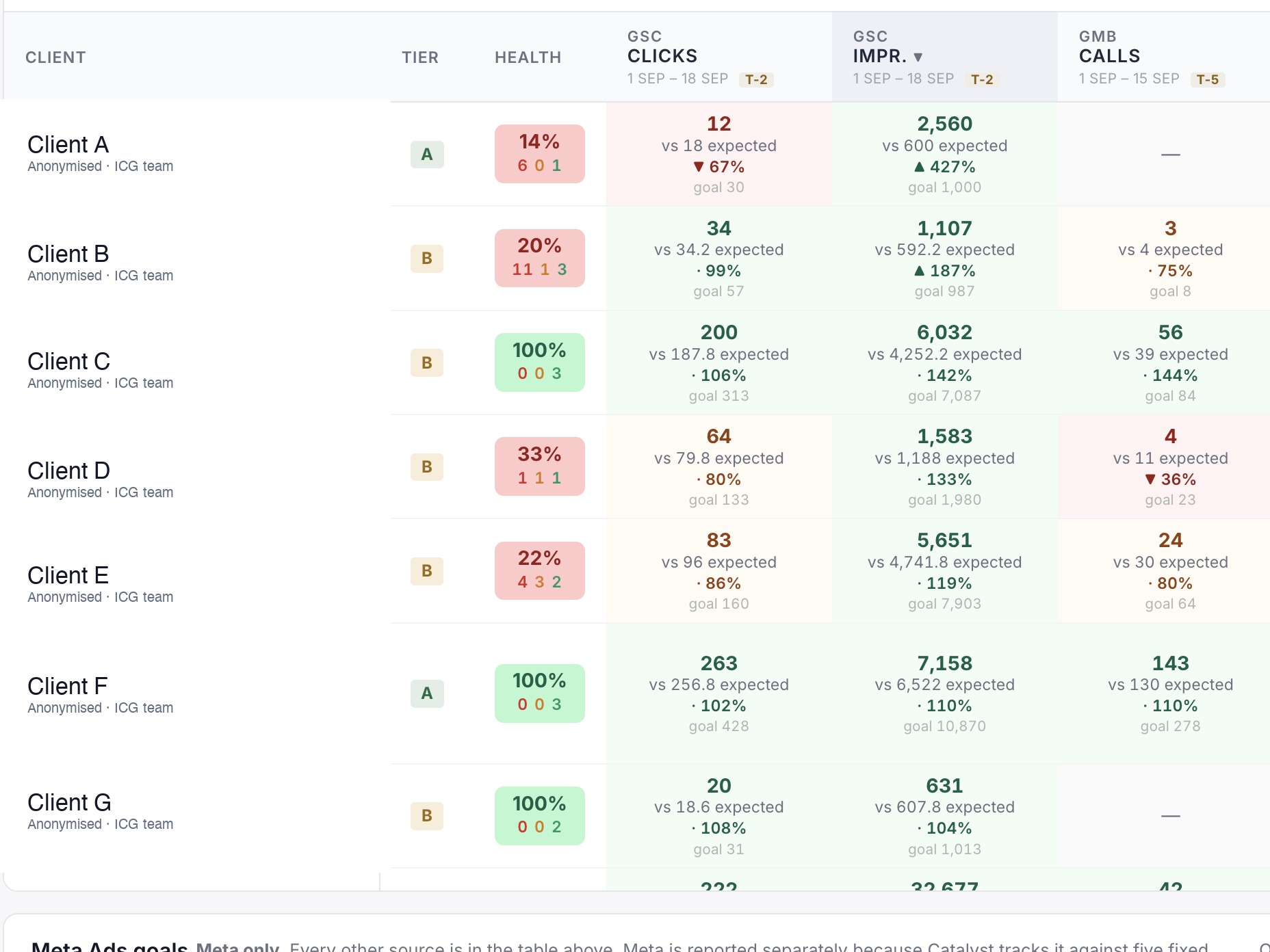
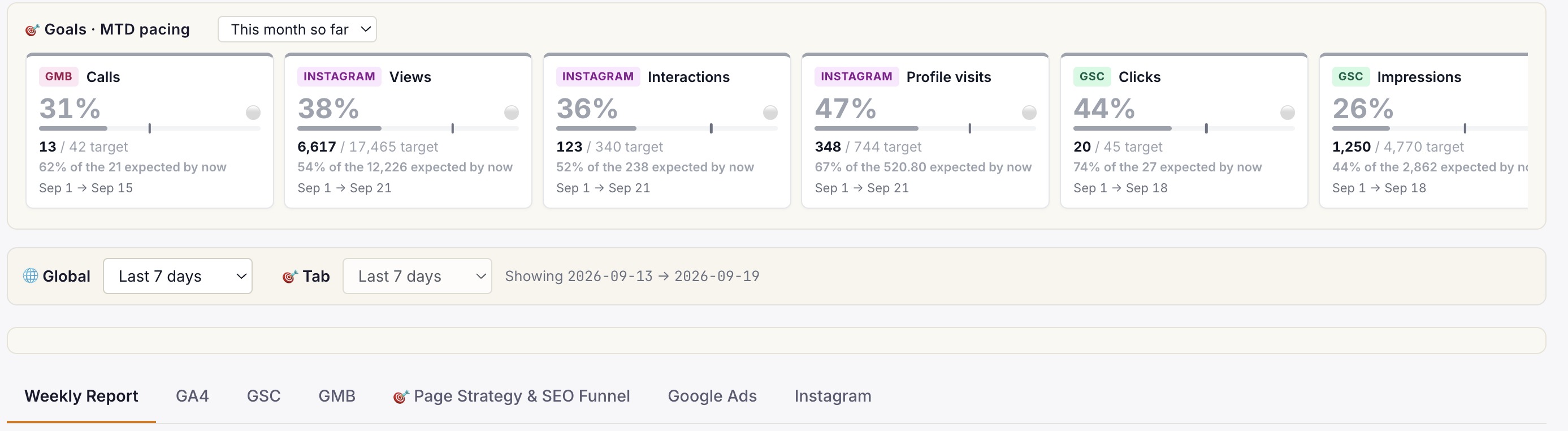
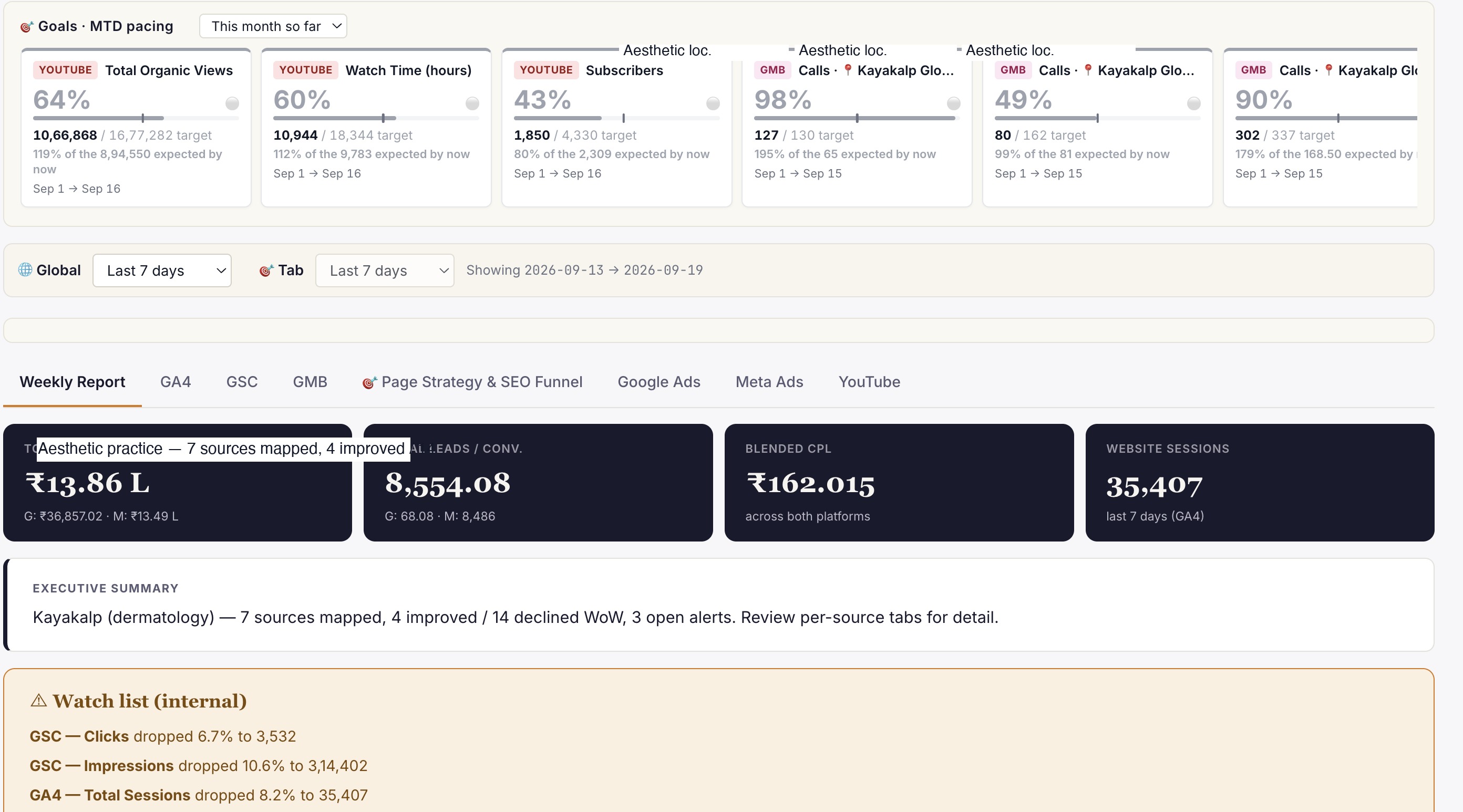
Live client dashboard. GSC, GA4, Google Ads, Meta Ads, IVR calls in one view. Login anytime, not monthly.
Phoenix
Clinic revenue intelligence over your PMS. Daily action queue: Prevent Loss, Maintain & Engage, Grow Revenue. Multi-centre rollout.
Or book a free 30-min audit to see all three in action on your account.
Healthcare brands
that already run on ICG.
A representative slice of the 150+ healthcare brands ICG has delivered for across India. Most engagements remain under NDA.


What ICG clients say · on video.
"Scale up of organic channels and business consulting. ICG has absolute domain authority in their field."
"What Ichelon accomplished — they got all my ideas and worked over 3-4 months to create an amazing, super-customised website."
"Working with ICG felt like working with an in-house growth team that happens to specialise in healthcare."
Need help operationalising this?
Every ICG service is healthcare-only, NMC + DPDP-aware, and built around the patient-research patterns that drive Indian healthcare growth in 2026.
Every practice welcome — packages from ₹20,000/mo.
Goals-Driven engagements · Performance-Linked Payout Models available
More from
ICG.
Five trends shaping Indian healthcare marketing through 2027: AI-first patient research, Conversions API adoption, ABDM discovery, the AEO w...
Healthcare AIO is the discipline of getting your clinic or hospital cited inside Google AI Overviews, ChatGPT and Perplexity answers — not j...
Conversational-search advertising places brand messages inside AI chat answers — ChatGPT, Perplexity, Copilot — rather than beside a results...
Stop guessing.
Book a Diagnostic.
30 minutes. Free. With the AI-powered healthcare-only marketing agency 150+ brands already run on. No slides, no pitch, no hard close.


