Healthcare Pharma & Life Sciences Other Industries
All Services Performance Marketing ChatGPT Ads India · NEW Social Media Marketing SEO & AEO / LLM YouTube Marketing LLM Optimization Brand & Growth Consulting AI Solutions Industries We Serve
Enterprise Hub · All Solutions + Services Growth Transformation AI Transformation Revenue Operations Fractional CGO Growth Operating System Executive Growth Advisory
Clinic Launch Programme (Hub) NABH Consulting India Healthcare Brand Launch Clinic SOP Creation Logo Design (Healthcare) Brand Book Creation Clinic Launch Marketing D2C Brand Launch Clinic Interior Design
Workforce Hub For Employers — post a requirement For Professionals — register Public Openings Training Academy AI Training Flagship
Hawk · CRM Intelligence (NEW) YODA · YouTube Intelligence Angryturtle · GBP Intelligence (NEW) Prism Pulse · Instagram Analytics (NEW) Beacon · Attribution Agency OS · Dashboards Phoenix · Clinic Revenue HealthPro 360 · PMS/HMS AI Patient Lifecycle Bots AI Lead Management System Smart Appointment System Healthcare CRM Patient Feedback System AI, Analytics & Automation Digital Transformation Calculators Free Digital Health Audit →
All 13 calculators → 🎯 Business Exploration Matrix (New) Dental Clinic Setup IVF Clinic + Lab Setup Multi-Specialty Hospital Setup Aesthetic / Cosmetology Clinic Dermatology Clinic Setup Generic Clinic Setup Physiotherapy Clinic Setup Diagnostic Centre Setup CAC Calculator CPQL Calculator Franchise ROI Calculator Revenue Leakage Calculator CRM ROI Calculator
All Events Workshop 1 · Jun 13 · AI in Clinical Practice Workshop 2 · Jun 27–28 · AI in Growth & Governance Hospital Ops Workshop · Jul 12 Pre-Summit Seminar · Aug 16 Grand Summit 2.0 · Oct 10–11 Bihar AI Summit · Recap AI Innovation Awards · Aug 22 Grand Summit 2.0 · Oct 2026 Aarambh 2026 Recap
Case Studies Insights & Blog Research Reports Calculators AI in Healthcare Digest
Our Story Leaders @ Ichelon · IN · US · AU Ichelon India · Gurgaon Ichelon Global · Dallas, TX Ichelon Australia · Sydney Speakers & Panelists Client Elevation Programme 🤝 Partner Connect 🇦🇪 ICG UAE Careers
Book a Growth Diagnostic
We Do It Right. The right diagnosis. The right strategy. The right systems. Giving healthcare leaders the confidence to make better decisions, build stronger operations, and achieve sustainable growth. — Team Ichelon
Trusted by 150+ healthcare & life-sciences brands
Johnson & Johnson
Mankind Pharma
Adonis Phyto
Narang Biotec
Medanta
Redcliffe Labs
Sitaram Bhartia
Metro Hospitals
Tulasi Hospital
Bloom IVF
Milann
Prime IVF
MedLinks
Handa
Bhardwaj
Eye Q
Johnson & Johnson
Mankind Pharma
Adonis Phyto
Narang Biotec
Medanta
Redcliffe Labs
Sitaram Bhartia
Metro Hospitals
Tulasi Hospital
Bloom IVF
Milann
Prime IVF
MedLinks
Handa
Bhardwaj
Eye Q
Johnson & Johnson
Mankind Pharma
Adonis Phyto
Narang Biotec
Medanta
Redcliffe Labs
Sitaram Bhartia
Metro Hospitals
Tulasi Hospital
Bloom IVF
Milann
Prime IVF
MedLinks
Handa
Bhardwaj
Eye Q
Article

SEO vs AEO for Healthcare: Why You Need Both in 2026

Search in 2026 has two layers. The traditional layer: a patient searches Google, sees 10 blue links, and clicks the most relevant result. SEO governs this layer. The new layer: a patient asks ChatGPT a question, or triggers Google AI Overviews, and receiv

Hanuman Sihag · · · 6 min read
Book a free 30-min Diagnostic Chat on WhatsApp

No pitch. Written root-cause diagnosis. AI-powered, healthcare only.

Editorial standards: This article was reviewed by the ICG Editorial Review Board for NMC Section 6 compliance, Schedule J screening, DPDP privacy, and source verification before publication. · Our editorial process →
ICG · AI-Powered Healthcare-Only Marketing Agency
Why are your CPQL numbers stuck? Talk to the team behind 150+ healthcare brands.
30-minute free diagnostic. Written, not pitched. CPQL benchmarks for your specialty, on the call.

Direct answer

Search in 2026 has two layers. The traditional layer: a patient searches Google, sees 10 blue links, and clicks the most relevant result. SEO governs this layer. The new layer: a patient asks ChatGPT a question, or triggers Google AI Overviews, and receiv

TL;DR

Search in 2026 has two layers. The traditional layer: a patient searches Google, sees 10 blue links, and clicks the most relevant result. SEO governs this layer. The new layer: a patient asks ChatGPT a question, or triggers Google AI Overviews, and receiv

By Hanuman Sihag, Head of Innovation Chamber & SEO Lead at ICG.

The fundamental question: do you need SEO, AEO, or both?

Search in 2026 has two layers. The traditional layer: a patient searches Google, sees 10 blue links, and clicks the most relevant result. SEO governs this layer. The new layer: a patient asks ChatGPT a question, or triggers Google AI Overviews, and receives an AI-generated summary that cites specific sources. AEO governs this layer.

Healthcare brands that invest in SEO only are optimising for the traditional layer while the new layer grows uncaptured. Healthcare brands that invest in AEO without SEO foundation are building on a structure that has no authority behind it. The answer is both — and because the content investment overlaps significantly, doing both costs less than twice what either costs alone.

How Google Search ranks vs how ChatGPT cites

Google Search rankings are determined by: domain authority (link equity from credible sources), on-page relevance (keyword match, schema accuracy, content quality), technical performance (Core Web Vitals, mobile-first indexing), and EEAT signals (author credentials, factual accuracy, update recency). Rankings take months to build and are relatively stable once established.

ChatGPT (and other LLMs) cite content based on: retrieval relevance (does the content directly answer the query?), citation quality (is the answer specific, accurate, and under 300 characters?), structured data (does FAQPage or Speakable schema mark the answer explicitly?), and source credibility (is the domain known for authoritative healthcare content?). Citations can appear within days of high-quality content being indexed.

The practical implication: the same piece of content can serve both systems — if it is written correctly. Long-form SEO content with strong E-E-A-T signals serves the ranking system. FAQPage schema and Speakable markup on the same content serves the AI citation system. This is why doing both in one editorial pipeline is the right approach.

Schema: where SEO and AEO overlap and where they diverge

Schema type

SEO value

AEO value

Priority

Title + Meta description

High — click-through from SERP

Low — not extracted by LLMs

Day 1

Organization/LocalBusiness

High — knowledge panel

Medium — entity recognition

Day 1

MedicalClinic + Physician

High — specialty authority

High — LLM entity verification

Day 1

FAQPage

High — rich results in SERP

Very high — primary LLM citation unit

Day 1

Speakable

Low — voice search

High — AI extraction marker

Per article

BreadcrumbList

High — rich results, CTR

Low

Day 2

MedicalProcedure

High — procedure pages

High — procedure query citations

Per procedure page

Article + Person

High — EEAT signal

High — author credibility for YMYL

Per article

Content structure differences: same goal, different format

SEO content structure: long-form (1,200-2,000 words), keyword-dense introduction, H2 headings that contain target keywords, internal links to related pages, external links to credible sources. The goal is to demonstrate comprehensive coverage of a topic and signal topical authority to Google's crawlers.

AEO content structure: question-led H2 headings ("What is CPQL in healthcare?"), direct answers in the first 60 words after each H2, specific data points that are citation-quality (under 300 characters, verifiable), FAQ section at the end with each Q and A in separate schema-marked elements. The goal is to make the content extractable and citeable by AI engines.

The integration: write SEO-depth content (1,200-1,500 words) with AEO structure (question H2s, direct first answers, FAQ section with schema). This is exactly the format of every article in ICG's 30-piece content plan. One piece of content serves both systems simultaneously.

The unified workflow: SEO + AEO in one editorial pipeline

Keyword research: identify the primary SEO target keyword and the top 6-8 questions patients ask about that topic (these become the H2 headings and FAQ questions).

TL;DR box: write a 50-word direct answer to the primary question. This is the AEO citation unit and the SEO click-through hook.

Article body: 1,200-1,500 words with question-format H2s, direct answers in first 60 words per section, specific data points.

FAQ section: 6-8 questions with answers under 60 words each. These map to FAQPage schema.

Schema markup: Article + Person (author) for SEO. FAQPage + Speakable for AEO. MedicalProcedure or MedicalClinic for specialty pages.

Author byline: named doctor or ICG co-founder with credentials. EEAT signal for SEO; authority signal for AEO.

Tracking and measuring both

SEO measurement: Google Search Console — position tracking, click-through rate, impressions per keyword. Set up weekly position tracking for your 20 target keywords. Measure at 30, 60, 90, and 180-day intervals.

AEO measurement: there is no native GSC report for AI citation. Run this manually: search your 10 target queries in Google AI Overviews, ChatGPT, and Perplexity weekly. Record whether your content is cited. Track the percentage of queries where you appear — aim for 30-50% within 60 days of publishing well-structured content.

Budget allocation: should SEO and AEO have separate budgets?

No. Because the content investment is shared, the budget should be unified under a "search content" allocation. The schema implementation (FAQPage, Speakable, MedicalClinic) is a one-time developer cost per page or article — typically 30-60 minutes of developer time per piece. The ongoing marginal cost of adding AEO to an SEO content programme is close to zero once the schema templates are set up.

ICG recommendation: allocate 60% of search marketing budget to SEO + AEO content production, 25% to technical SEO and schema implementation, and 15% to link building and citation development. Do not split the budget between "SEO" and "AEO" as separate line items — they share the same content infrastructure.

Frequently asked questions

What is the difference between SEO and AEO?

SEO (Search Engine Optimisation) targets traditional Google blue-link rankings. AEO (Answer Engine Optimisation) targets AI-generated answers in ChatGPT, Perplexity, and Google AI Overviews. SEO uses keyword optimisation, domain authority, and E-E-A-T signals. AEO uses FAQPage schema, Speakable markup, and citation-quality answers under 300 characters. Both can be served by the same content piece with proper structure.

Which is more important for healthcare in 2026 — SEO or AEO?

SEO delivers the majority of organic search traffic today. AEO captures the fast-growing AI search layer. Healthcare brands should invest in both simultaneously. Prioritise SEO foundation first (technical, schema, content), then layer AEO (FAQPage schema, Speakable, citation-quality answers) on top. The content investment is almost entirely shared — doing both does not double the cost.

How quickly does AEO show results compared to SEO?

AEO results appear faster. Well-structured cornerstone content with FAQPage and Speakable schema can appear in Google AI Overviews within 7-14 days of indexing. Perplexity citations typically appear within 3-7 days for topically relevant, citation-quality content. SEO rankings take 60-180 days for competitive terms. For a clinic launching a new content programme, AEO quick wins provide visible results while SEO authority builds.

Does AI search cannibalise SEO traffic?

AI Overviews do reduce organic click-through rates for queries that trigger them — users get the answer without clicking. For healthcare YMYL queries, however, Google is conservative about AI Overviews because incorrect health information is high-stakes. Healthcare queries are more likely to show traditional blue links plus a limited AI Overview than to replace blue links entirely. The risk of SEO cannibalisation is lower in healthcare than in informational categories.
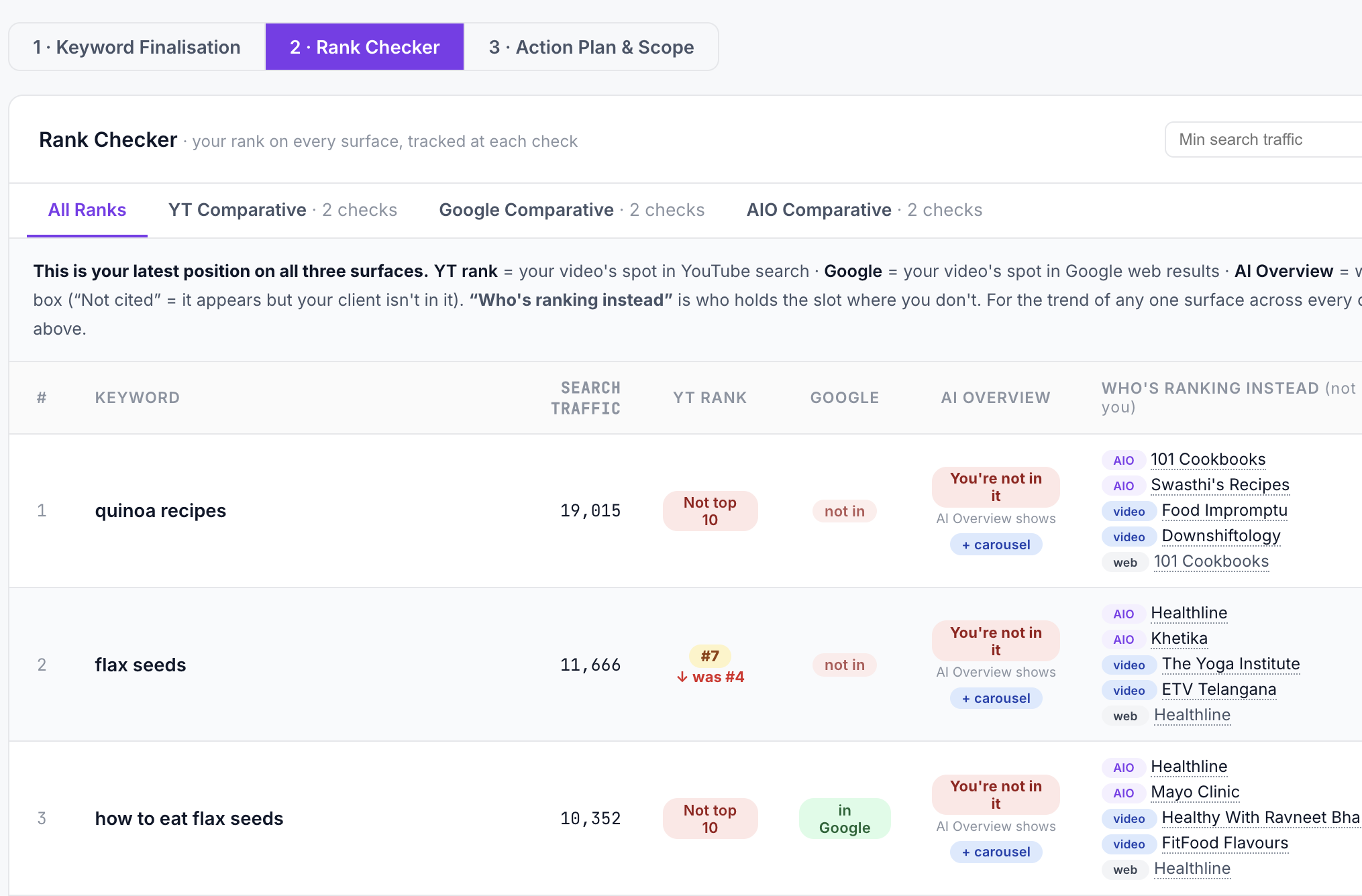
yoda/02-aio-lab-rank-checker.png" alt="YODA AIO Lab Rank Checker — daily monitoring of AI Overview citation status for every tracked healthcare query" loading="lazy" decoding="async" style="width:100%;height:auto;display:block;">
YODA · AIO Rank CheckerDaily monitoring of AI Overview citation status per healthcare query. Green = cited · yellow = citation-adjacent · red = not cited. The single most-watched metric on ICG YouTube retainers.

What content format does ChatGPT prefer to cite?

ChatGPT cites content that has: a direct answer in the first 60 words, specific verifiable data (numbers, sources, dates), structured FAQ format with short (under 60-word) answers, and clear authority signals (named author with credentials, publication date, credible domain). Long-form narrative content without clear citation units is rarely cited directly — even if it ranks well for SEO.

Should I update my old content for AEO?

Yes. Any existing page with FAQ content can be retrofitted for AEO in 30-45 minutes of developer time: add FAQPage schema, add Speakable markup to the TL;DR and first paragraph, and ensure the first answer after each H2 is under 60 words and direct. This is one of the highest-ROI quick wins available — converting existing SEO-optimised content to AEO-ready content without rewriting it.

Where does your SEO stand?

Book a free SEO diagnostic.

Hanuman Sihag's team runs a live crawl, checks technical health, cannibalisation, schema coverage and content gaps. 60 minutes, prioritised fix list.

Frequently asked

Questions readers ask
about this topic.

SEO (Search Engine Optimisation) targets traditional Google blue-link rankings. AEO (Answer Engine Optimisation) targets AI-generated answers in ChatGPT, Perplexity, and Google AI Overviews. SEO uses keyword optimisation, domain authority, and E-E-A-T signals. AEO uses FAQPage schema, Speakable markup, and citation-quality answers under 300 characters. Both can be served by the same content piece with proper structure.

SEO delivers the majority of organic search traffic today. AEO captures the fast-growing AI search layer. Healthcare brands should invest in both simultaneously. Prioritise SEO foundation first (technical, schema, content), then layer AEO (FAQPage schema, Speakable, citation-quality answers) on top. The content investment is almost entirely shared — doing both does not double the cost.

AEO results appear faster. Well-structured cornerstone content with FAQPage and Speakable schema can appear in Google AI Overviews within 7-14 days of indexing. Perplexity citations typically appear within 3-7 days for topically relevant, citation-quality content. SEO rankings take 60-180 days for competitive terms. For a clinic launching a new content programme, AEO quick wins provide visible results while SEO authority builds.

AI Overviews do reduce organic click-through rates for queries that trigger them — users get the answer without clicking. For healthcare YMYL queries, however, Google is conservative about AI Overviews because incorrect health information is high-stakes. Healthcare queries are more likely to show traditional blue links plus a limited AI Overview than to replace blue links entirely. The risk of SEO cannibalisation is lower in healthcare than in informational categories.

ChatGPT cites content that has: a direct answer in the first 60 words, specific verifiable data (numbers, sources, dates), structured FAQ format with short (under 60-word) answers, and clear authority signals (named author with credentials, publication date, credible domain). Long-form narrative content without clear citation units is rarely cited directly — even if it ranks well for SEO.

Yes. Any existing page with FAQ content can be retrofitted for AEO in 30-45 minutes of developer time: add FAQPage schema, add Speakable markup to the TL;DR and first paragraph, and ensure the first answer after each H2 is under 60 words and direct. This is one of the highest-ROI quick wins available — converting existing SEO-optimised content to AEO-ready content without rewriting it.

Trusted by

Healthcare brands
that already run on ICG.

A representative slice of the 150+ healthcare brands ICG has delivered for across India. Most engagements remain under NDA.

Read full client case studies →

Client video stories

What ICG clients say · on video.

Dr. Samyak Dhawan
Co-Founder, Kayakalp Global · Kayakalp Global (D2C Derma)

"Scale up of organic channels and business consulting. ICG has absolute domain authority in their field."

Dr. Nishi Singh
Founder, Prime IVF · Prime IVF · Gurgaon

"Working with ICG transformed how we acquire IVF patients in Gurgaon. They understand the fertility journey from inquiry to consult..."

Dr. Prerna Taneja
Founder, Clinic Eximus · Clinic Eximus · Delhi

"What Ichelon accomplished — they got all my ideas and worked over 3-4 months to create an amazing, super-customised website."

See all client video testimonials →
Powered by the ICG Trifecta

The intelligence stack behind this playbook.

Every ICG engagement runs on the Search Intelligence Trifecta — Angryturtle for GMB, SIE for search and AI Overview, YODA for YouTube. Live product screens below.

sie.ichelonconsulting.com · rank os
Rank OS — Score Card healthcare-seo-agency.com 78 /100 Rank OS Crawl 92 Index 85 Rank 71 AIO Citation 63 Compound 79 NEXT-BEST-ACTION Close the AIO Citation gap — 4 striking-distance queries ready to move into an AI Overview this week.
See how the Trifecta works → Chat with a Co-Founder
Healthcare growth services · explore the stack

Need help operationalising this?

Every ICG service is healthcare-only, NMC + DPDP-aware, and built around the patient-research patterns that drive Indian healthcare growth in 2026.

Healthcare SEO Healthcare PPC Meta Ads Content Marketing Local SEO + GMB AI Overview (AIO) Healthcare Branding Website Development YouTube Marketing

Stop guessing.
Book a Diagnostic.

30 minutes. Free. With the AI-powered healthcare-only marketing agency 150+ brands already run on. No slides, no pitch, no hard close.

The ICG technology stack

Nine tools. One compounding system. HealthApex OS
Built in-house. Deployed in every engagement.

ICG's results are reproducible because they are built on proprietary infrastructure — not agency intuition or generic tools. These nine HealthApex OS platforms are what power every ICG engagement.

Healthcare CRM

Nexus CRM

Healthcare CRM & Lead Management

ICG's healthcare-specific CRM and lead management system. Specialty-configured funnel stages for IVF, dental, aesthetic, ortho, hospital OPD. 1-click CAPI + GCLID via Beacon. Hawk intelligence built in. DPDP-compliant by architecture. Deployed across 300+ healthcare centres.

  • Specialty-specific funnel stages, not generic SaaS pipeline
  • 1-click CAPI + GCLID via Beacon attribution
  • Telecaller leaderboard + adherence scoring native
  • DPDP Act 2023 compliant by architecture
Explore Nexus CRM →
Business Layer

Hawk

CRM Intelligence & Lead-Ops MIS

Sits as the business intelligence layer above your CRM — Nexus, Salesforce, LeadSquared, HubSpot, Zoho, or any custom CRM. Shows where leads are leaking, which effort is wasted, and which good leads were quietly downgraded by automation — not by a human decision.

  • Sits above your existing LMS — no replacement
  • 83% of effort goes to dead leads — surfaced Day 1
  • ~75% qualified-lead downgrades by automation
  • Free Lead-Leak Audit in 48 hours
Explore Hawk + free audit →
Attribution Core

Beacon

Attribution Engine & CAPI Middleware

Sits at the centre of every ICG attribution architecture. CAPI middleware connecting Meta Ads, Google Ads, WhatsApp and IVR to your CRM. Lifts Event Match Quality from 2.5 to 6+, reducing CPM 30–40% from the same budget.

  • Server-side CAPI — bypasses iOS privacy changes
  • EMQ 2.5 → 6+ across portfolio
  • 30–40% CPM reduction from EMQ lift alone
  • Multi-touch: ad → consultation → revenue
Explore Beacon →
Practice Management

HealthPro 360

PMS with built-in revenue intelligence layer

The only PMS that tracks cross-sell and up-sell opportunities within your existing patient base. 12 modules covering OPD, IPD, Pharmacy, Labs, Billing, Inventory, Patient Portal, Smart Scheduling, RBAC, AES-256 encrypted storage.

  • Only PMS with built-in Revenue Intelligence
  • Cross-sell signal tracking within existing patients
  • 12 modules: OPD, IPD, Pharmacy, Labs, Billing+
  • Audit trails + RBAC + AES-256 encryption
Explore HealthPro 360 →
Revenue Layer

Phoenix

Revenue intelligence built over your existing PMS

If you already have a PMS — Akhil Systems, Practo, or any other — Phoenix builds the business intelligence layer on top of it without replacement. Currently live across 46 centres for a national chain.

  • Works over your existing PMS — no migration
  • Daily action queue: Prevent Loss / Maintain / Grow
  • Catches unbilled services, collection gaps, lapsing patients
  • CPQL variance ₹620–₹3,800 → ₹680–₹1,420
Explore Phoenix →
YouTube Intelligence

YODA

YouTube analytics that measures patients, not views

The only YouTube intelligence platform built for healthcare business outcomes. Connects video performance to actual consultation bookings — not views, not subscribers. Patient testimonial videos generate 6.9× more consultations per view than condition explainers.

  • Consultation attribution per video — not views
  • Demand-gap: what patients search that your channel misses
  • 50+ doctor channels tracked across India
  • AIO readiness scoring: which videos AI tools cite
Explore YODA →
Governance & Transparency

Agency OS

Full transparency. Instant diagnosis. Zero surprises.

ICG's centralised governance platform — every client sees everything in real time, and ICG's team sees every problem the moment it surfaces. 30+ real-time alert systems fire the moment a metric drifts outside its performance envelope.

  • GSC, GA4, Google Ads, Meta Ads, IVR — one live view
  • 30+ real-time alert systems per account
  • CPQL drift alert at >15% week-on-week change
  • Client login: full transparency on your account
Explore Agency OS →
AEO & LLM Intelligence

AIO Intel

AI Overview + LLM citation tracking, healthcare-tuned

Knows the moment ChatGPT, Perplexity, Google AI Overviews and Gemini cite your brand in patient answers — and which content drove the citation. Bot-aware dashboard with GA4-registered custom dims (AIO source, AIO referrer) and IndexNow + GSC API integration.

  • Live tracking across ChatGPT / Perplexity / Google AIO / Gemini
  • Bot-aware: knows human vs scraper traffic
  • Custom GA4 dims register AIO source + referrer
  • IndexNow + GSC API: content surfaced to LLMs within hours
View AIO Intel dashboard →
Competitor Intelligence

Prism Spy

Every Meta + Google ad your competitors run, watched daily

Tracks 75+ Indian healthcare brands, 2,150+ active ads, ₹50Cr+ aggregate ad spend visibility per month. Surfaces what's working, what's been killed, what offers are emerging. Powers every ICG Meta Ads brief, Performance Marketing diagnostic, and IVF / derm / dental specialty campaign with real competitive intelligence.

  • 75+ brands tracked across 30+ healthcare specialties
  • 2,150+ active ads · daily refresh
  • Activity Feed: every spend / hook / pause logged
  • Offers Intelligence: 250+ offers in market tracked
Explore Prism Spy →
GBP Intelligence Platform

Angryturtle

Every Google Business Profile scored, tracked, protected, and grown from one command centre

ICG's proprietary Google Business Profile intelligence platform. Scores every listing across 7 dimensions, tracks rank on a live geo-grid across your actual service area, audits NAP + citations, monitors 531 suspension-risk factors continuously, and drafts Google Posts on cadence. Currently managing 143 healthcare listings with 0 suspensions and 4.76★ portfolio average across 28,137 reviews.

  • 143 listings under management · 0 suspensions · 4.76★
  • 7-dimension Health Score + 5-factor Rank OS per listing
  • Geo-grid rank tracking + NAP + Citation audit + Profile Shield
  • NMC + NABH + ART Act + DPDP compliance built into every content + review workflow
Explore Angryturtle →

Every ICG engagement runs on some combination of these ten HealthApex OS tools. The diagnostic determines which combination is right for your practice.

Explore HealthApex OS → See the full stack live on your account — free 30-min audit
The team behind your account

Every diagnostic is led by a founder.
You'll know their names before the engagement begins.

ICG was built by three IIT BHU engineers who entered healthcare marketing with a specific intent: to build the tools that didn't exist and run the campaigns that most agencies couldn't. When you book a diagnostic, Rohit or Abhash leads it personally. Not an account manager. Not a senior executive. The people who built what you're evaluating.

The ICG team — 60+ healthcare marketing specialists at Gurgaon HQ

60+ specialists.
One growth engine.

Performance marketers, analysts, AI engineers, content strategists, and operations specialists — all healthcare-only. Headquartered in Gurgaon since 2018.

Rohit Gupta — Leader, ICG

Rohit Gupta

Business & Growth Lead & Director

IIT BHU · IIM Rohtak

Rohit's first question in every diagnostic: "When you ask your agency why patients aren't booking — what do they say?" He says the answer tells him more than any dashboard.

Full profile →
Abhash Kumar — Leader, ICG

Abhash Kumar

Strategy & Analytics Lead & Director

IIT BHU · IIM Bangalore

Abhash built Beacon because most agencies couldn't answer one question: "Which of my campaigns generated that consultation?" He decided the problem was solvable in code. It was.

Full profile →
Deep Das — Leader, ICG

Deep Das

Technology & AI Lead & Director

IIT BHU

Deep built the 4-Bot patient lifecycle system after watching a client lose 60+ qualified leads in one week to a 6-hour WhatsApp response window. He decided the problem was solvable in code. It was.

Full profile →
Chat with a Co-Founder