


Healthcare YouTube DIY tools versus managed agency in India 2026: vidIQ, TubeBuddy and in-house teams vs ICG with YODA — real cost, time and quality comparison
A healthcare group can run YouTube DIY (vidIQ or TubeBuddy plus YouTube Studio plus an in-house team) or run it through a managed healthcare agency like ICG with YODA. Honest cost, time and quality comparison for Indian hospitals, clinics and specialty groups — plus a decision matrix for when to pick which.
No pitch. Written root-cause diagnosis. AI-powered, healthcare only.
Direct answer
A healthcare group can run YouTube DIY (vidIQ or TubeBuddy plus YouTube Studio plus an in-house team) or run it through a managed healthcare agency like ICG with YODA. Honest cost, time and quality comparison for Indian hospitals, clinics and specialty groups — plus a decision ma...
TL;DR

An Indian hospital, IVF chain or specialty clinic deciding how to run YouTube seriously in 2026 has two real paths. Path one is DIY-with-tools — hire an in-house team (video producer, editor, content strategist, sometimes a social media manager) and pay for a stack of self-serve SaaS tools such as vidIQ, TubeBuddy and YouTube Studio itself to get analytics, keyword research and metadata suggestions. Path two is managed-agency — retain a specialist healthcare marketing agency such as ICG that runs the channel end-to-end using a purpose-built platform (in ICG's case, YODA — our AI-native healthcare YouTube marketing platform). Both paths can work. Which one fits depends on the hospital's scale, its existing team, its channel maturity and how attributable the channel is to patient inquiries. This piece maps the two paths honestly across cost, time, quality and control dimensions, and gives a decision matrix at the end. Buyers reading this alongside the healthcare YouTube marketing service page and the broader healthcare local SEO agency stack should be able to make an informed call before signing anything or hiring anyone.
What the DIY-with-tools path actually looks like
DIY-with-tools does not mean a doctor uploading a phone video every week from the clinic — that is hobby-YouTube, not serious healthcare YouTube marketing. Serious DIY means the hospital builds an in-house team and buys a stack of SaaS tools that layer intelligence on top of YouTube Studio's native reporting.
The typical in-house team looks like: a video producer (₹40,000-₹80,000/- per month depending on city and experience), a video editor (₹25,000-₹60,000/- per month), a content strategist or scriptwriter with medical writing capability (₹40,000-₹80,000/- per month), and either a fractional or full-time social media manager to run publishing, comments and community (₹25,000-₹50,000/- per month). A doctor giving 4-8 hours a week to on-camera shoots and script review is the fifth role and the one that is hardest to scale.
The tool stack layered on top typically includes vidIQ (approximate — verify current pricing with vendor — Pro tier around $7.50/month, Boost around $39/month, Boost+ around $79/month, Enterprise custom) for keyword research, competitor tracking, tag suggestions and daily productivity coaching; TubeBuddy (approximate — Pro around $7.50/month, Legend around $22.50/month, Enterprise custom) for bulk metadata editing, A/B thumbnail testing, tag lists, best-time-to-publish analysis; and YouTube Studio itself (free) for the underlying uploads, real-time analytics, monetisation and comments.
Total monthly burn for a serious in-house healthcare YouTube team in a Tier-1 Indian city typically lands somewhere between ₹1.5 lakh and ₹3 lakh per month once salaries, tool subscriptions, video production overhead (kit, lighting, editing suite) and the opportunity cost of doctor time are counted honestly.
What the managed-agency path actually looks like
A specialist healthcare marketing agency running YouTube for a hospital runs the full workflow — strategy, content planning, on-location shoots (or remote-directed shoots), editing, thumbnail design, SEO optimisation, upload, distribution, community management, monthly reporting and continuous optimisation. Some elements involve the doctor (on-camera, script approval) and some do not.
ICG's managed healthcare YouTube service is anchored on YODA — the AI-native healthcare YouTube marketing platform we built ourselves. YODA sits on top of the channel's data and does four things no dashboard does: separates organic from paid views at every step (so ad-driven views can never masquerade as organic momentum), gives decisions not dashboards (every video gets a state + next action), writes back to YouTube directly (improved titles, tags, descriptions, chapters applied via API), and tracks the three rank races (YouTube search, Google web, Google AI Overview citations).
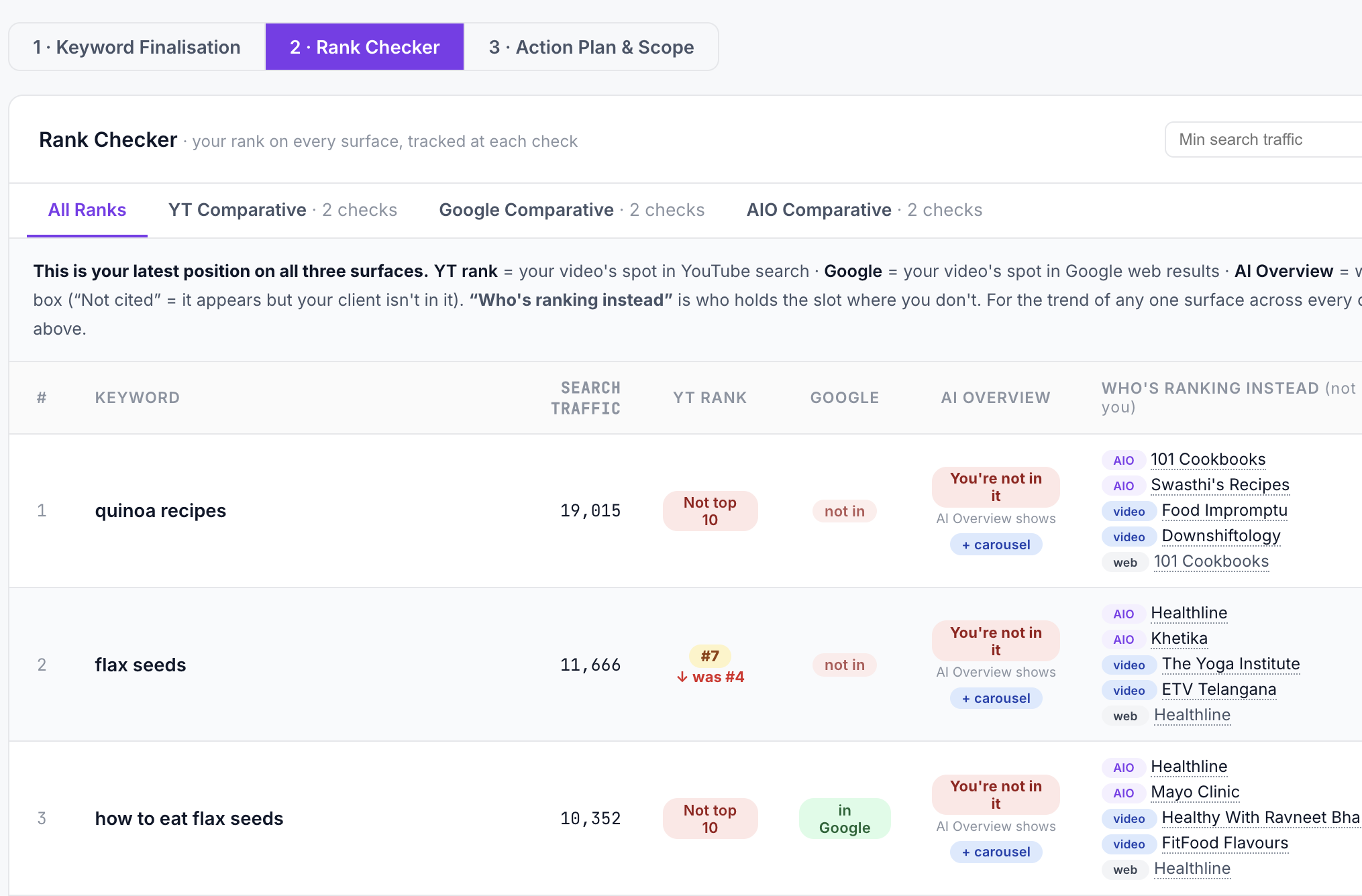
The 6-step YODA workflow — Overview & Setup, Diagnostics, Strategy, Optimisation, Reputation (ORM), Competitor Intel — runs continuously across a 40+ analysis module set. Managed engagement typically involves a healthcare content specialist, an SEO/YouTube specialist, a video production lead (either ICG's team or coordinated third-party production), and a compliance reviewer for NMC / ASCI / DPDP / PC-PNDT / ART Act alignment on every publish.
Engagement pricing sits on the healthcare YouTube marketing service page — a managed retainer for a serious channel typically starts around ₹1.5-2 lakh per month at the entry tier and rises with scope, video volume and multi-doctor complexity.
Cost comparison — honest numbers

The apples-to-apples cost comparison depends on the true cost of the in-house build. A hospital that already has a video producer and editor on payroll and just needs to buy vidIQ or TubeBuddy on top runs the DIY path at a genuinely low marginal cost — ₹1,500-₹7,000/- per month in tools for those two roles.
A hospital building the team from scratch is not comparing tool cost against agency retainer. The comparison is fully-loaded team cost (salaries, benefits, kit, doctor time, hiring risk, ramp-up time, retention risk) versus fully-loaded agency retainer.
DIY-with-tools, in-house team built from scratch:
Approximate range ₹1.5-₹3 lakh/- per month all-in for a Tier-1 city (Delhi NCR, Mumbai, Bangalore, Hyderabad, Chennai, Pune) once salaries, tool subscriptions, kit, editing suite and the fractional cost of doctor time are counted. Time-to-first-video-out is 60-90 days once hiring begins.
DIY-with-tools, existing team plus SaaS layer:
Approximate range ₹5,000-₹15,000/- per month in incremental SaaS spend (vidIQ + TubeBuddy + optionally a scheduler like Later or Hootsuite Team plan). Team cost is already sunk. Depends heavily on how well the existing team executes on YouTube-specific workflows.
Managed-agency (ICG with YODA):
Approximate range starting around ₹1.5-2 lakh/- per month at entry tier, rising with scope. Includes strategy, YODA platform, content planning, SEO optimisation, distribution, community management and monthly reporting. Video production may be bundled or handled separately depending on the engagement.
Total cost is often surprisingly close between the two paths at Tier-1 city rates. The differentiator is usually not raw spend — it is what you get for the spend.
Time comparison — what actually takes longer
DIY-with-tools time cost is heavy on the front end. Hiring the right video producer, editor, content strategist and social media manager takes 60-90 days in most Indian metros. Onboarding, training on healthcare-specific compliance, building the SOP for a shoot, editing pipeline and publish cadence takes another 30-60 days. First high-quality video is typically 4-5 months from the decision to build the team.
Once running, DIY time cost sits on the marketing director (who owns the team) and the doctor (who owns on-camera time). Every video needs someone competent in healthcare compliance to review title, description, chapters, thumbnail language and any patient-facing consent before publish. That review load is real and continuous.
Managed-agency time cost is heavy on the doctor time side (script approval, on-camera shoot slots, compliance review) but light on the marketing director side. First video output is typically 30-45 days from engagement start once shoot scheduling and script approvals are in place. Ongoing marketing director involvement is monthly review, quarterly strategy, and campaign-level decisions rather than day-to-day production management.
Quality comparison — what actually differs
Quality is the dimension where the two paths often diverge most.
Healthcare specialisation. A DIY in-house team has to build healthcare marketing expertise from scratch or hire someone who already has it (which is a narrow talent pool in India). A specialist healthcare agency brings that specialisation from day one.
Ranking depth. DIY-with-tools reaches keyword research and metadata suggestion depth. Three-race rank tracking (YouTube search, Google web, Google AI Overview), organic-paid separation everywhere, per-video state-and-next-action decisions, and direct SEO Lab writeback to the platform are YODA-specific capabilities that vidIQ, TubeBuddy and YouTube Studio native do not carry.

Compliance risk. DIY carries the compliance-checking load internally. Every title, description, chapter, thumbnail and pinned comment needs a competent read against NMC's 2026 advertising guidelines, ASCI Guidelines 2022, DPDP Act 2023, PC-PNDT Act 1994 (for gynae/fertility) and ART Act 2021 (for ART/IVF). A managed healthcare agency carries this as baseline standard operating procedure.
Execution velocity. A high-performing in-house team can match agency velocity once fully built. Getting to that state takes 6-12 months of hiring, training and iteration. A managed agency lands at velocity from month 2-3.
Neither path is unambiguously higher quality. The right answer depends on the hospital's existing capability, tolerance for building a specialist team, and the compliance risk appetite.
Control and ownership comparison
DIY-with-tools gives full control — the team is on payroll, the tools are self-serve, the SOPs are internal, IP and workflows stay with the hospital. This is genuinely valuable for large hospital groups where marketing is core to strategy.
Managed-agency trades some control for expertise. Content strategy, execution decisions and platform intelligence sit with the agency, though final approval on every video, script and compliance-sensitive publish always stays with the hospital.
A hybrid — the hospital owns strategy and doctor-facing decisions, the agency owns production, optimisation and platform intelligence — is often the honest middle path for mid-scale hospital groups.
The compliance perimeter either path must clear
Both paths need to clear the same compliance perimeter. NMC's 2026 advertising guidelines restricts registered medical practitioners from advertising language that guarantees outcomes or makes comparative clinical claims. DPDP Act 2023 treats identifiable patient footage or names as personal data requiring lawful basis and consent. ASCI Guidelines 2022 require substantiation for advertising claims. PC-PNDT Act 1994 prohibits any content that could be construed as sex-determination advertising. ART Act 2021 bars unsubstantiated success-rate claims.
DIY carries this as internal review load and legal risk. Managed agency (specifically a specialist healthcare agency) carries it as SOP.
Decision matrix — when to pick which
Pick DIY-with-tools if: the hospital already has a video producer and editor on payroll with good healthcare compliance instincts, marketing is core-strategy so team ownership matters, the hospital has 6-12 months of runway to build velocity, and the marketing director has bandwidth to own the day-to-day. Best fit: large corporate hospital groups with existing content teams.
Pick managed-agency if: YouTube is a new channel or one that has under-performed for the hospital, the hospital wants healthcare specialisation from day one, three-race rank tracking and organic-paid separation are decision-relevant, compliance-in-workflow is a hard requirement, and time-to-first-quality-video needs to be under 60 days. Best fit: mid-scale hospital groups, IVF chains, cosmetic surgery groups, specialty hospital networks, founder-doctor personal brands.
Pick hybrid if: the hospital has strong internal video production capability but weak YouTube-specific intelligence and compliance layer. Keep production in-house, retain the agency for strategy, YODA intelligence layer and compliance oversight.
The platform ICG uses to run this at scale: YODA
ICG runs healthcare YouTube marketing for clinics, hospitals, and specialty groups using YODA — our AI-native healthcare YouTube marketing platform. YODA sits on top of a channel's data and does four things no dashboard does: it separates organic from paid views at every step (so a promoted video can never masquerade as organic growth), it gives decisions not dashboards (every video gets a state + next action), it writes back to YouTube directly (improved titles, tags, descriptions, chapters applied straight to the platform), and it tracks the three rank races — YouTube search, Google web, and Google AI Overview citations.
YODA runs the full 6-step workflow — Overview, Diagnostics, Strategy, Optimisation, Reputation (ORM), and Competitor Intel — with 40+ analysis modules organised under those steps. ICG's managed YouTube service uses YODA end-to-end. See the Healthcare YouTube Marketing pillar guide for the full scope, or the Healthcare YouTube Marketing Agency service page for engagement details.
Book a YODA demo on WhatsApp → or request a free healthcare YouTube channel audit →
Related reading
- Healthcare YouTube marketing pillar guide — full scope of YouTube for Indian healthcare
- Healthcare YouTube Marketing Agency service page — engagement details
- How a doctor YouTube channel generates consultations in India
- Hospital video marketing in India 2026
- YouTube vs Meta vs Google ROI for IVF clinics in India 2026
FAQ
Is DIY-with-tools cheaper than a managed agency? Not necessarily. Once salaries, benefits, kit, editing suite, tool subscriptions and the opportunity cost of doctor and marketing director time are counted honestly, DIY at Tier-1 city rates and a managed retainer often land in the same ballpark. The differentiator is what you get for the spend.
Which path is faster to first quality video? Managed agency, typically 30-45 days once engagement starts. DIY-with-tools building from scratch is usually 4-5 months to first high-quality output because of the hiring cycle.
Can vidIQ and TubeBuddy replace YODA? No. vidIQ and TubeBuddy are strong generalist creator tools for keyword research, tag suggestions, thumbnail A/B and metadata bulk-edit. They do not do organic-paid separation everywhere, three-race rank tracking (YouTube search + Google web + Google AI Overview), decisions-not-dashboards state assignment, direct SEO Lab writeback with healthcare compliance flags, or healthcare-specific competitor channel intelligence.
What roles do I need for a serious in-house healthcare YouTube team? Video producer, video editor, content strategist with medical writing capability, social media manager, plus 4-8 hours per week of on-camera doctor time. Add a healthcare compliance reviewer if that role does not already exist elsewhere in the organisation.
Which specialty groups benefit most from managed-agency? IVF and fertility chains, cosmetic surgery groups, dermatology chains, dental chains, multi-location hospital groups, specialty hospital networks, and founder-doctor personal-brand channels. Any specialty where YouTube materially contributes to patient inquiries.
Can I run a hybrid model? Yes. Keep video production in-house, retain the agency for strategy, YODA intelligence layer, SEO optimisation, three-race rank tracking, ORM and compliance oversight. This is a common pattern for hospital groups with strong internal video capability but no YouTube-specific intelligence stack.
How much time does the doctor need to give either path? Both paths need doctor time for on-camera shoots and script approval — typically 4-8 hours per week for a channel publishing 2-4 videos per month. Managed agency reduces the doctor's administrative time (scheduling, coordination, compliance review turnaround) but does not reduce shoot time itself.
Does managed agency mean loss of control over content? No. Every video, script and compliance-sensitive publish requires hospital-side final approval regardless of who executes. What the agency owns is strategy, execution, platform intelligence and continuous optimisation.
What is the risk of DIY going wrong? The two biggest risks are compliance failures (an under-trained team publishing a title or description that breaches NMC or ASCI, or a testimonial video that breaches DPDP consent) and slow ramp-up leaving the channel underperforming for 12-18 months while the team learns. Both risks are real and material.
What is the risk of managed-agency going wrong? Picking a non-specialist agency that treats healthcare like any other vertical. A generalist digital agency without healthcare compliance instincts is a worse pick than a well-run in-house team. This is why the choice is not DIY versus agency in the abstract — it is DIY versus a specialist healthcare agency specifically.
Book a free 30-minute Brand & Growth Diagnostic.
It's a working session, not a sales pitch — you leave with a written root-cause analysis you can act on, whether or not you engage ICG.
The three platforms
behind every ICG engagement.
Beacon
CAPI middleware that fixes Event Match Quality, translates CRM statuses to Meta-standard events, dedups across channels.
Agency OS
Live client dashboard. GSC, GA4, Google Ads, Meta Ads, IVR calls in one view. Login anytime, not monthly.
Phoenix
Clinic revenue intelligence over your PMS. Daily action queue: Prevent Loss, Maintain & Engage, Grow Revenue. Multi-centre rollout.
Or book a free 30-min audit to see all three in action on your account.
Healthcare brands
that already run on ICG.
A representative slice of the 150+ healthcare brands ICG has delivered for across India. Most engagements remain under NDA.


What ICG clients say · on video.
"Scale up of organic channels and business consulting. ICG has absolute domain authority in their field."
"Working with ICG transformed how we acquire IVF patients in Gurgaon. They understand the fertility journey from inquiry to consult..."
"What Ichelon accomplished — they got all my ideas and worked over 3-4 months to create an amazing, super-customised website."
Need help operationalising this?
Every ICG service is healthcare-only, NMC + DPDP-aware, and built around the patient-research patterns that drive Indian healthcare growth in 2026.
Every practice welcome — packages from ₹20,000/mo.
Goals-Driven engagements · Performance-Linked Payout Models available



More from
ICG.
Five trends shaping Indian healthcare marketing through 2027: AI-first patient research, Conversions API adoption, ABDM discovery, the AEO w...
Healthcare AIO is the discipline of getting your clinic or hospital cited inside Google AI Overviews, ChatGPT and Perplexity answers — not j...
Conversational-search advertising places brand messages inside AI chat answers — ChatGPT, Perplexity, Copilot — rather than beside a results...
Stop guessing.
Book a Diagnostic.
30 minutes. Free. With the AI-powered healthcare-only marketing agency 150+ brands already run on. No slides, no pitch, no hard close.


