


Paid vs Organic Healthcare Marketing India: Buyer Guide 2026
A feature-based comparison of paid and organic healthcare marketing channels for Indian hospitals, clinics, IVF chains, and dental groups. Eight decision axes, four buyer archetypes, and a clear framework to pick your channel mix under NMC and DPDP Act 2023 constraints.
No pitch. Written root-cause diagnosis. AI-powered, healthcare only.
Direct answer
A feature-based comparison of paid and organic healthcare marketing channels for Indian hospitals, clinics, IVF chains, and dental groups. Eight decision axes, four buyer archetypes, and a clear framework to pick your channel mix under NMC and DPDP Act 2023 constraints.
TL;DR
TL;DR: Paid vs Organic for Indian Healthcare Buyers
- Paid wins on speed. A well-structured Google Ads or Meta Ads account can produce qualified patient inquiries in 7-14 days. Organic (SEO, GBP, YouTube) needs 90-180 days minimum to compound.
- Organic wins on cost trajectory. A Rs 1,200 CPQL from paid usually stays at Rs 1,200. Organic starts higher (Rs 3,000+ for the first quarter of setup) then drops toward Rs 200-400 by month 12 as compounding kicks in.
- Neither wins alone. For Indian hospitals under NMC advertising guidelines and the DPDP Act 2023, a paid-only stack burns cash on branded queries you already own; an organic-only stack leaves emergency and time-sensitive procedures unfunded.
- Channel fit follows buyer type. A 100-bed multi-specialty leans 60-40 organic-paid. A single dental clinic in Tier-2 India leans 70-30 paid-organic in year one, then flips. A mid-tier IVF chain needs both from day one because the buying cycle is 3-9 months.
- Compliance is not neutral. Paid claims live under Google Healthcare policy plus Advertising Standards Council of India (ASCI) rules; organic content sits under NMC's Code of Ethics for physician advertising. The risk profile is different, not smaller.
Table of Contents
- Why this comparison matters for Indian healthcare
- The 8 axes to compare on
- Main comparison table
- Per-axis deep dives
- Which fits which buyer
- How ICG helps
- Our 70-30 pricing model
- FAQ
Why this comparison matters for Indian healthcare
Ask any hospital marketing head in India what keeps them up at night and the answer usually isn't creative or targeting. It's the trade-off. Board wants leads this quarter. CFO wants CAC down every quarter. Chief medical officer wants zero DPDP or NMC exposure. And the marketing team, sitting in the middle, is asked to pick a channel mix without a shared vocabulary for what "paid" and "organic" actually mean in 2026.
The terrain has shifted. ABDM adoption is pushing patients toward digital-first discovery. The DPDP Act 2023 has made consent capture non-optional for any form on any landing page. AI Overviews inside Google Search are eating 30-40% of top-of-funnel organic clicks for symptom queries. Meta's algorithm rewards accounts with tight event signal, not accounts with big budgets. YouTube has quietly become the highest-trust discovery layer for procedures like IVF, hair transplant, and cardiac care where patients research for weeks before enquiring.
The old debate was paid versus organic. The 2026 debate is a channel-mix debate under four hard constraints: cost per qualified lead, time-to-first-inquiry, compliance surface area, and compounding value. This guide gives you a feature-level comparison of every major channel a healthcare buyer in India will evaluate, structured so a finance-minded reader can defend the mix to a board that has never opened Google Ads.
The 8 axes to compare on
Before we compare channels, we need shared vocabulary. Every serious healthcare marketing decision in India comes down to eight axes. Pick the wrong axis to optimise on and even a great channel looks like a bad investment.
- Time to first qualified lead. How many days from account launch to the first inquiry that a hospital front desk would call "worth chasing"?
- CPQL trajectory over 12 months. Not opening CPQL. The month-1 to month-12 curve, which is what actually pays for the channel.
- Compounding effect. If you stop spending in month 13, what happens? Some channels flatline instantly. Others keep producing for years.
- DPDP Act 2023 and NMC compliance surface. Where does the risk sit? Ad claims, landing-page consent, testimonial usage, before-after imagery, doctor-name usage.
- Trust signal strength. How much of the channel is E-E-A-T-friendly for surgical and life-altering procedures? Not all impressions are equal.
- Attribution complexity. Can a non-technical marketing head defend the ROI number to a board? A channel you can't measure is a channel you can't scale.
- Team skills required. Is this a specialist channel, a generalist channel, or something an in-house team of two can run?
- Scale ceiling and saturation. How much can you spend before the channel stops returning? For Indian healthcare, this ceiling is often lower than agencies admit.
Main comparison table
The table below compares five common channel categories a healthcare buyer in India will encounter. Read down the columns to understand each channel; read across the rows to understand how the channels differ on any one axis.
| Axis | Paid Search (Google Ads) | Paid Social (Meta Ads) | Organic SEO | Organic Local (GBP) | Organic Video (YouTube) |
|---|---|---|---|---|---|
| Time to first qualified lead | 7-14 days | 14-30 days | 90-180 days | 30-60 days | 60-120 days |
| CPQL month 1 | Rs 900-2,500 | Rs 400-1,200 | Rs 4,000+ | Rs 1,500-3,000 | Rs 6,000+ |
| CPQL month 12 | Rs 900-2,500 (flat) | Rs 400-1,200 (flat) | Rs 200-500 | Rs 150-400 | Rs 300-800 |
| Compounding when spend stops | Zero, instant | Zero, instant | Very high, decays over 12-24 months | High, decays over 6-12 months | Very high, indexes for years |
| DPDP or NMC exposure | High: ad claims plus landing pages | High: creative claims plus lead-form consent | Medium: on-page claims and doctor bios | Low-Medium: reviews and Q&A moderation | Medium-High: doctor on-camera claims |
| Trust signal strength | Medium (intent, not authority) | Low-Medium (interruption) | High (E-E-A-T authoritative content) | Very High (proximity, reviews) | Very High (face, voice, demonstration) |
| Attribution difficulty | Easy (GA4 + CRM) | Medium (iOS 14 signal loss) | Medium-Hard (assisted conversions) | Easy (call tracking, direction requests) | Hard (view-through, long lag) |
| Team skill required | Specialist | Specialist | Specialist plus editorial | Generalist plus review ops | Specialist plus production |
| Realistic monthly ceiling (single-city buyer) | Rs 8-15 lakh | Rs 4-10 lakh | No hard ceiling | Effort-bound, not budget-bound | Rs 2-5 lakh production budget |
Per-axis deep dives
1. Time to first qualified lead
Paid search is the fastest channel because you're buying attention from users who are already searching for "best cardiologist in Gurgaon" or "IVF cost in Chennai." A properly warmed-up campaign, with call extensions and location extensions, will produce inquiries in the first week. Paid social takes slightly longer because the algorithm needs 40-50 conversion events to stabilise. Organic SEO for competitive procedures rarely produces a genuine inquiry inside 90 days unless the site already has topical authority. GBP is the underrated speed play: a well-optimised Google Business Profile with review velocity can start producing calls in three to four weeks even without paid support. YouTube sits in the middle because a video that lands well can produce inquiries in weeks two or three, but you're still gambling on which video breaks through.
2. Cost per qualified lead trajectory
This is the axis most buyers get wrong. Opening CPQL is not the number that matters. What matters is where CPQL sits in month 12 and month 24. Paid channels are essentially flat: your month-24 CPQL is roughly what your month-1 CPQL was, adjusted for auction inflation and creative fatigue. Organic channels curve. A dental clinic that spends Rs 3 lakh on 90 days of foundational SEO might see a month-3 CPQL of Rs 4,500. By month 12, that same corpus of content produces leads at Rs 350 each because the traffic keeps arriving without new spend. This is the mathematics that lets a founder-led clinic in Kochi or Coimbatore out-market a corporate hospital chain. Not budget. Time.
3. Compounding effect
Turn off Google Ads on a Friday evening and inquiries stop by Saturday morning. Turn off Meta Ads and the pipeline dies inside a week. Turn off organic SEO in month 18 of a well-structured program and the traffic will continue for another 12-24 months, decaying gradually. Turn off YouTube uploads and videos published two years ago will still be indexing new keywords. This asymmetry is why the CFO conversation matters so much. Paid is rented reach. Organic is owned reach. In healthcare, where lifetime patient value can run into lakhs for chronic care or fertility, an owned reach asset that keeps producing for years is worth more than the same-year lead cost suggests.
4. DPDP and NMC compliance surface
The DPDP Act 2023 introduced explicit consent requirements for personal data collection. Every ad landing page that captures a name, phone, or condition detail now needs a properly worded consent notice, purpose limitation, and a data-fiduciary contact. Paid channels carry the highest compliance load because the ad copy itself, the landing page, and the CRM ingestion are all in scope. NMC guidelines further restrict what an Indian doctor or hospital can claim in advertising: no comparative superlatives, no guarantees of outcomes, no misleading before-after imagery. Organic content is not exempt but has a lower per-page enforcement risk because the click intent is different. GBP has its own risk surface: fake reviews, unverified Q&A entries, and doctor-name misuse can all trigger review or profile suspension. YouTube demands the tightest on-camera discipline; a specialist making an unqualified claim in a video is legally exposed in the same way a print ad would be.
5. Trust signal strength
A patient researching hip replacement or IVF isn't looking for the loudest ad. They're looking for evidence that this hospital or specialist has done this procedure hundreds of times, safely, with real outcomes. Trust signal strength is a function of authorship, longevity, third-party validation, and demonstration. Paid ads are weak on all four. Organic SEO with named-doctor bylines, published clinical content, and citations from medical bodies is strong on authorship. GBP is strong on third-party validation when reviews are earned rather than solicited. YouTube is the strongest channel available to Indian healthcare because it combines authorship (a real doctor's face), longevity (videos accumulate over years), validation (comments, likes, view duration), and demonstration (procedure explainers, patient interviews). For high-consideration specialties, YouTube is now closer to a moat than a channel.
6. Attribution complexity
Paid search is easy to attribute because click-to-conversion is a short, measurable path. Paid social has become harder since 2021 due to signal loss on iOS and cookie-consent friction; a Meta-reported cost per lead of Rs 800 often maps to a CRM-verified qualified lead cost of Rs 1,400-1,800 once you strip junk fills. Organic SEO attribution requires an assisted-conversion mindset: the blog that a patient read three weeks before booking a consult may never appear in last-click reporting but is doing real work. GBP attribution is surprisingly clean when call tracking and UTM-tagged direction links are set up properly. YouTube is the hardest channel to attribute correctly because view-through effects can lag by weeks and last-click reporting will systematically undervalue it. Building attribution literacy at the marketing head level is often worth more than adding another Rs 2 lakh to the ad budget.
7. Team skills required
Paid search and paid social both need genuine specialists. A generalist marketing manager running a Rs 8 lakh monthly Meta budget without a paid-social specialist is almost always leaving 30-40% on the table. Organic SEO needs a specialist plus a content editorial function; without editorial rigour, technical SEO produces empty scaffolding that never ranks. GBP is the most in-house-able channel: a trained office manager or front-desk lead can run a strong GBP with a written playbook. YouTube demands specialist strategy plus production capacity, which is why so many Indian hospitals abandon it after six months. The realistic staffing math: a Rs 30 lakh annual marketing budget cannot support in-house specialists across all five channels. Something has to be outsourced or productised.
8. Scale ceiling and saturation
Every channel has a ceiling in a given city. In Delhi NCR, a mid-sized cardiac hospital will typically saturate its Google Ads keyword universe at Rs 12-15 lakh per month; adding more budget past that produces sharply lower marginal returns because you're bidding on unqualified traffic. Meta saturates faster, at Rs 6-8 lakh, before creative fatigue sets in and CPMs blow out. Organic SEO has no hard budget ceiling but does have a topical ceiling: once you've covered every commercial-intent keyword in cardiology, you can only grow by adding new specialties or new cities. GBP is effort-bound rather than budget-bound; the ceiling is how many reviews and photos your team can generate. YouTube has almost no ceiling because the platform serves globally, but production quality becomes the constraint. Knowing where your ceiling is prevents the common mistake of stuffing more budget into a saturated channel when the pipeline actually needs a second channel added.
Which fits which buyer
Buyer archetype 1: single dental clinic, Tier-2 Indian city
A single-location dental clinic in a city like Indore, Nagpur, or Vijayawada has a small catchment (typically 6-10 km) and a limited monthly budget of Rs 40,000 to Rs 1.5 lakh. The right mix here is 70% organic (GBP + hyperlocal SEO + a modest YouTube presence built around the founding dentist) and 30% paid (Google Ads on high-intent keywords like "root canal near me" and "dental implants cost"). Meta Ads is usually a distraction at this scale unless the clinic runs a specific promotional cycle. Time-to-lead pressure here is modest because monthly patient throughput is small, so investing in the compounding curve pays off inside 12 months.
Buyer archetype 2: 100-bed multi-specialty hospital, Tier-1 metro
A 100-bed hospital in Bangalore, Chennai, or Pune has a wider catchment, multiple revenue-driving specialties, and a marketing budget usually in the Rs 8-25 lakh per month band. The right mix here is 60% organic (specialty-specific SEO clusters, named-consultant content, YouTube for each department head, review ops at three or four GBP locations if there are satellite clinics) and 40% paid (Google Ads for emergency and time-sensitive procedures like stroke, cardiac, and trauma; Meta Ads for planned specialties like bariatric or joint replacement). Attribution investment is critical at this scale because a badly measured Rs 12 lakh Meta spend can hide a Rs 4 lakh leak.
Buyer archetype 3: mid-tier IVF chain, 4-6 cities
An IVF chain has a long consideration cycle (3-9 months from first search to first consult), high average revenue per patient (Rs 1.5-4 lakh per cycle), and a national brand-building need. This buyer cannot afford to be paid-only because the acquisition cost will crush the P&L; it cannot afford to be organic-only because the demand exists today. Right mix: 50-50, with paid handling high-intent city-specific queries and Meta lookalikes for repeat-visitor retargeting, and organic building the fertility-education content library plus a heavily invested YouTube channel featuring the medical directors. This is one of the few buyer types where YouTube alone can carry 30-40% of pipeline by year two.
Buyer archetype 4: hospital group with 500+ beds across states
A multi-state hospital group has budget in crores, procurement processes, and a board that wants monthly boardroom metrics. The right mix is portfolio management, not single-channel optimisation. Typically 45% organic, 35% paid, 20% owned properties (loyalty apps, patient portals, ABDM-linked HRM extensions). At this scale, in-house specialists exist for each channel and the agency conversation is about intelligence, tooling, and creative velocity rather than execution. Attribution investment moves from "which channel is working" to "which patient journey is working," which requires stitching CRM, EHR, and marketing platform data together.
How ICG helps
ICG is a healthcare-only marketing group, founder-led, working across 300+ live healthcare clients including 150+ clinics of various sizes. We don't pick a channel first and then justify it. We start with buyer type, budget, and compliance profile, then recommend a mix that survives the CFO conversation as well as the CMO conversation. Our product stack (Angryturtle for GBP, YODA for YouTube, Meta Catalyst IQ for Meta Ads, Prism Spy for competitor Meta Ads intelligence, Prism Pulse for Instagram analytics, HealthPro 360 for hospital RCM/EHR overlay, and AtomCRM for CRM) lets us run the mix rather than lecture about it. Because we own the tools, the reporting is transparent and the CPQL numbers are auditable rather than agency-fudged. Because we work only in healthcare, the compliance conversation is a starting point, not an afterthought.
Our 70-30 pricing model
Traditional agency retainers pay for effort, not outcomes, which is why so many healthcare marketing engagements feel expensive relative to what actually moves. ICG uses a 70-30 model across every service line. Seventy percent of the monthly fee is fixed (covering strategy, execution, tooling, reporting) and thirty percent is tied to an annual outcome target agreed at kickoff. If we hit the target, the full fee is earned. If we miss, a portion of the 30 refunds or rolls forward. This is available for SEO (Foundation Rs 49,999/mo, Growth Rs 74,999/mo, Scale Rs 99,999/mo), Google Ads (managed on budgets of Rs 5 lakh and above), Meta Ads (same tiering), and YouTube plus AIO programs (on budgets of Rs 50,000/mo and above). Product subscriptions like AtomCRM (Rs 14,999/mo) and HealthPro 360 (Rs 14,999/mo) sit outside the 70-30 model because they are software, not services.
Frequently Asked Questions


 sie" style="color:inherit;text-decoration:underline;text-decoration-color:rgba(42,126,200,.5);text-underline-offset:2px">Rank OS scoring a GBP across five dimensions — Completeness, Consistency, Authority, Activity, Sentiment — refreshed daily" width="1200" height="675" loading="lazy" decoding="async" style="width:100%;height:auto;display:block;">
If I only have Rs 50,000 per month to spend on marketing, should I pick paid or organic?
Neither, entirely. At Rs 50,000 per month, split roughly Rs 20,000 into paid (mostly Google Ads on high-intent local queries) and Rs 30,000 into GBP optimisation plus a small SEO foundation. Paid gives you inquiries this month while organic builds the compounding asset. Going all-in on paid at this budget usually produces 20-30 leads per month with no long-term value; going all-in on organic produces almost no leads for 90 days.
How long before organic SEO for a hospital actually starts producing bookings?
For a hospital site with reasonable technical foundations, the honest answer is 90-180 days to first inquiries and 9-12 months to a stable monthly lead volume. Sites with significant technical debt or historical Google penalties can take 12-18 months. Any agency promising rank-and-lead delivery in 30 days for a competitive specialty is either misrepresenting the timeline or targeting keywords no patient actually searches for.
Is Meta Ads still worth it for healthcare in India after the iOS attribution changes?
Yes, but the operating model has changed. Meta Ads for healthcare now requires stronger event signal (server-side Conversions API is essentially mandatory), tighter creative velocity (10-15 new creatives per month, not per quarter), and a willingness to accept that platform-reported CPL is 30-60% optimistic versus CRM-verified qualified leads. When run correctly, Meta remains one of the strongest channels for planned procedures where the buying decision involves a partner or family member.
Do I need to worry about the DPDP Act 2023 if I only run organic content?
Yes. The DPDP Act applies to any personal data collection, whether the traffic came from a paid ad or an organic blog. If your blog has an "Enquire Now" form, the same consent notice, purpose limitation, and data fiduciary obligations apply. The channel that brought the patient to your site is not what determines your obligations; the data collection event on your side is.
Which channel has the strongest E-E-A-T signal for medical content?
For India in 2026, YouTube leads on E-E-A-T for medical content because it combines a real doctor's face and voice, verifiable specialty credentials in the channel bio, third-party engagement signals (comments, watch time), and content longevity. Named-doctor-bylined long-form blog content is second. GBP is third because reviews carry validation weight but the format doesn't allow deep authority demonstration.
Can I run all this in-house instead of hiring an agency?
In-house works well for GBP and for the review-response layer of reputation management. It becomes hard for paid ads and organic SEO once budget crosses roughly Rs 5 lakh per month because the specialist skill gap and the tool cost start compounding. It becomes very hard for YouTube because production capacity is the bottleneck. Most Indian hospitals we work with run a hybrid model: an in-house marketing manager who owns strategy, brand, and vendor management, plus specialist partners for execution.
How do I compare agency proposals when everyone claims different CPQL numbers?
Insist on three things in writing before signing anything. First, a definition of "qualified lead" that your front desk agrees with, not just the agency. Second, monthly CRM-side reconciliation, not just platform-side reporting. Third, a genuine outcome-linked component to the fee (our 70-30 model is one example, but the principle matters more than the exact percentage). Any agency that resists all three is optimising for their retention, not your outcomes.
Should I stop paid ads once organic starts producing?
Rarely. The right move once organic reaches steady state is to reallocate paid spend, not remove it. Paid still owns branded-keyword defence, time-sensitive procedure coverage (emergency cardiac, trauma), promotional cycles (annual health check camps), and geographic expansion into new cities where you haven't built organic authority yet. The mature buyer typically shifts from 70-30 paid-organic in year one to 40-60 paid-organic in year three, but the paid line item almost never zeroes out.
Book a free 30-minute Brand & Growth Diagnostic.
It's a working session, not a sales pitch — you leave with a written root-cause analysis you can act on, whether or not you engage ICG.
Questions readers ask
about this topic.
The three platforms
behind every ICG engagement.
Beacon
CAPI middleware that fixes Event Match Quality, translates CRM statuses to Meta-standard events, dedups across channels.
Agency OS
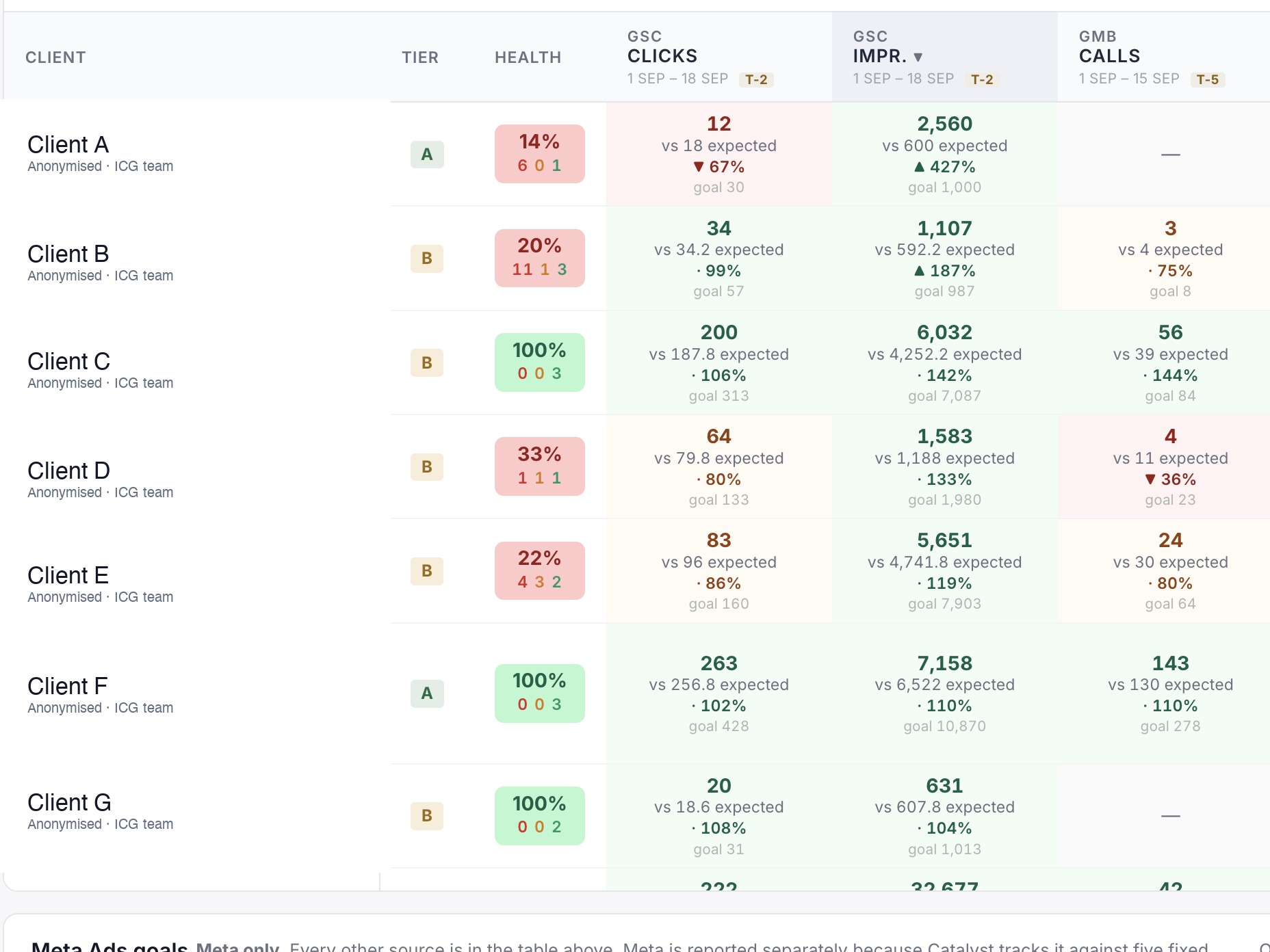
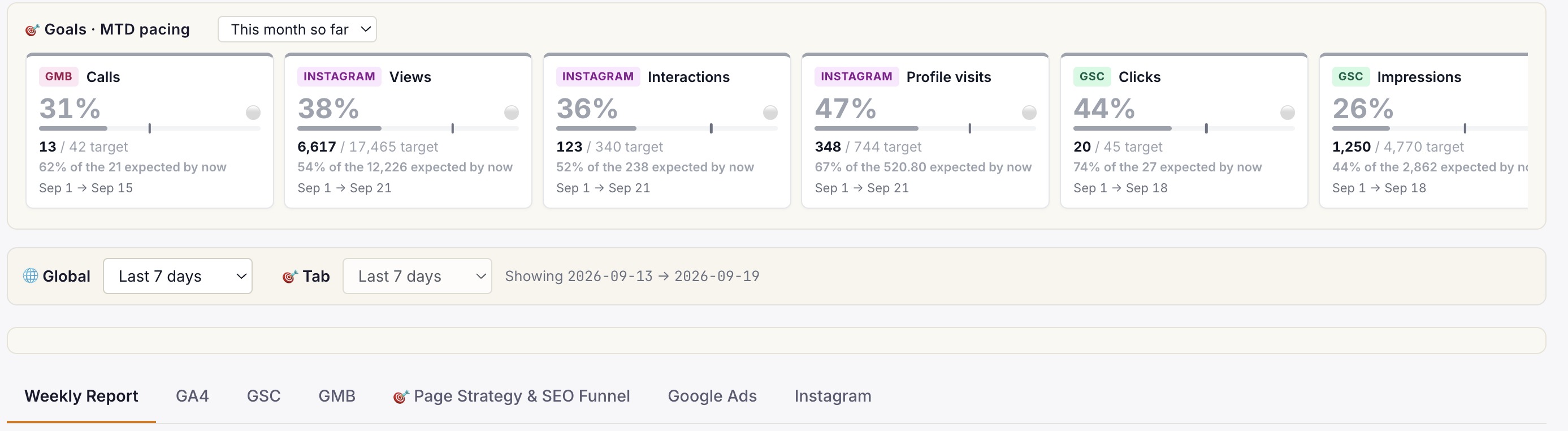
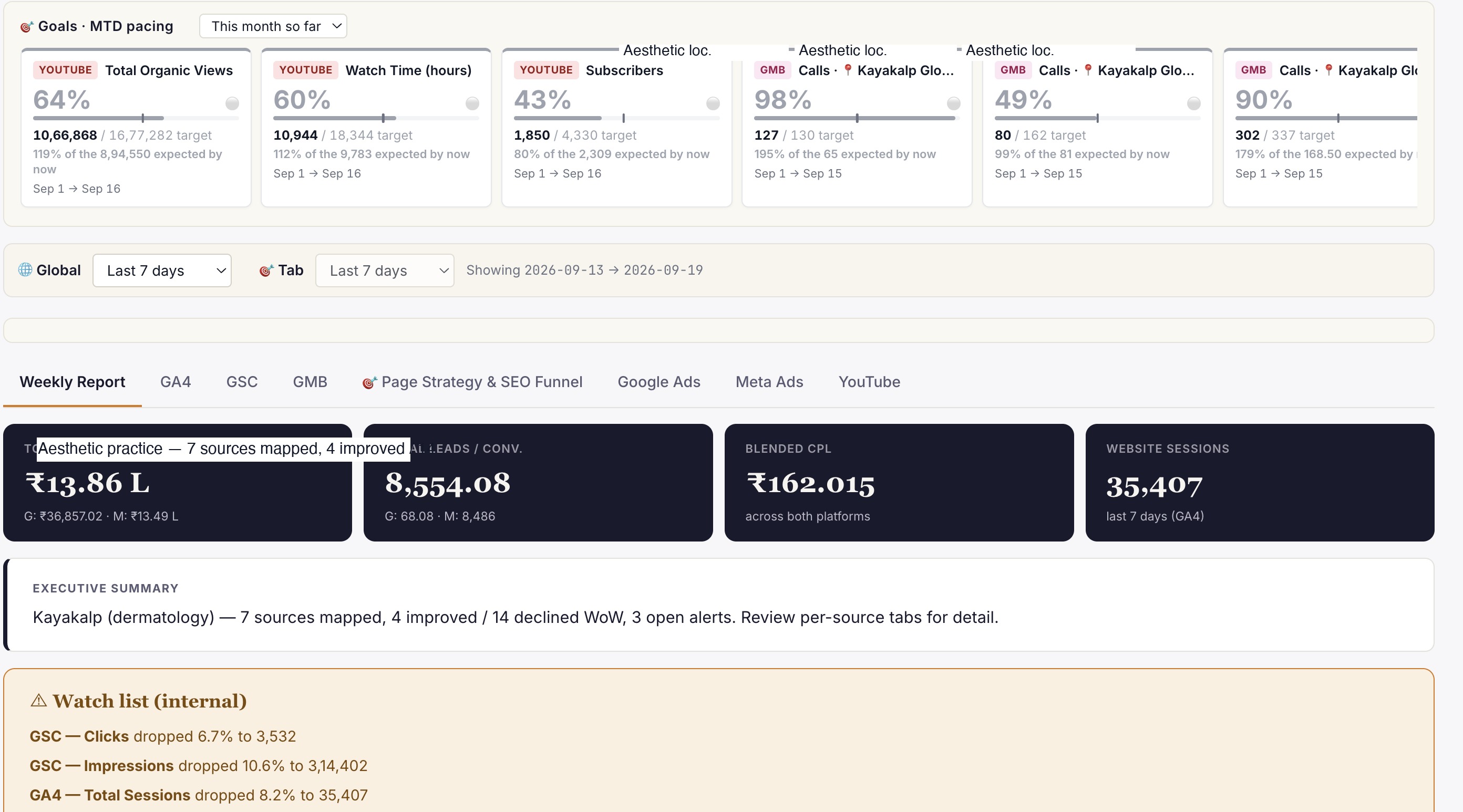
Live client dashboard. GSC, GA4, Google Ads, Meta Ads, IVR calls in one view. Login anytime, not monthly.
Phoenix
Clinic revenue intelligence over your PMS. Daily action queue: Prevent Loss, Maintain & Engage, Grow Revenue. Multi-centre rollout.
Or book a free 30-min audit to see all three in action on your account.
Healthcare brands
that already run on ICG.
A representative slice of the 150+ healthcare brands ICG has delivered for across India. Most engagements remain under NDA.


What ICG clients say · on video.
"Scale up of organic channels and business consulting. ICG has absolute domain authority in their field."
"Working with ICG transformed how we acquire IVF patients in Gurgaon. They understand the fertility journey from inquiry to consult..."
"What Ichelon accomplished — they got all my ideas and worked over 3-4 months to create an amazing, super-customised website."
Need help operationalising this?
Every ICG service is healthcare-only, NMC + DPDP-aware, and built around the patient-research patterns that drive Indian healthcare growth in 2026.
Every practice welcome — packages from ₹20,000/mo.
Goals-Driven engagements · Performance-Linked Payout Models available
More from
ICG.
Five trends shaping Indian healthcare marketing through 2027: AI-first patient research, Conversions API adoption, ABDM discovery, the AEO w...
Healthcare AIO is the discipline of getting your clinic or hospital cited inside Google AI Overviews, ChatGPT and Perplexity answers — not j...
Conversational-search advertising places brand messages inside AI chat answers — ChatGPT, Perplexity, Copilot — rather than beside a results...
Stop guessing.
Book a Diagnostic.
30 minutes. Free. With the AI-powered healthcare-only marketing agency 150+ brands already run on. No slides, no pitch, no hard close.


