


Consumer Behaviour in Healthcare: 8 Decision Models That Work
Healthcare buyers decide with anxiety, identity and social proof, not spreadsheets. See 8 behaviour models ICG uses to build clinic marketing that converts.
No pitch. Written root-cause diagnosis. AI-powered, healthcare only.
Direct answer
Healthcare buyers decide with anxiety, identity and social proof, not spreadsheets. See 8 behaviour models ICG uses to build clinic marketing that converts.
TL;DR
Healthcare decisions are not rational. They are made by anxious, motivated, socially influenced people trying to protect something that matters to them — while navigating a category they do not understand well and cannot easily evaluate.
Brand strategy built on consumer behaviour models produces communications that reach patients where they actually are in the decision process. This is the guide to those models — and how they apply practically to Indian healthcare brands in 2026.
Elaboration Likelihood Model — both routes must be served simultaneously
Direct answer: The Elaboration Likelihood Model identifies two routes: the central route (evidence-driven — clinical credentials and verifiable proof) and the peripheral route (cue-driven — warmth, aesthetics, and social proof). Every healthcare website section must serve both at once.
Different patients use different routes. A patient in the early stages of evaluating a major surgical intervention uses the central route. The same patient on a casual first search visit may use the peripheral route. A patient making a routine wellness booking uses the peripheral route almost exclusively.
The failure mode: designing for one route only. A site heavy on clinical evidence and light on warmth loses peripheral-route processors. A site heavy on aesthetics and light on proof loses central-route processors. Both audiences exist in every healthcare category.
Identity-Based Motivation — confirm the patient's self-concept, never challenge it
Direct answer: 'Protecting what you've built' is IBM-aligned — it confirms the patient as someone who invests in their long-term health. 'Transform yourself' is IBM-threatening — it implies the patient is currently insufficient, triggering disengagement. Every headline must confirm, never challenge.
ICG copy testing across 12 healthcare landing pages (2024-26): IBM-aligned headlines produce 34% higher time-on-page and 28% higher consultation form initiation vs transformation-language equivalents — ICG A/B test database, 2024-26
The practical test for any healthcare communication: does this language confirm who the patient already is, or does it suggest they need to become someone different? Communications passing this test generate engagement. Those failing it generate avoidance — and the patient leaves silently, with no bounce that can be measured.
Reactance Theory — never push a high-autonomy buyer
Direct answer: High-autonomy buyers withdraw when they feel commercial pressure. For premium healthcare — where the most capable payers are also the highest-autonomy patients — no urgency language, countdown timers, or 'book now before slots fill up' language on any CTA.
Every CTA must be framed as the patient's self-initiated movement toward their own goals. 'Schedule your assessment' — patient-initiated. 'Book now' — commercial demand. 'Take the next step in your programme' — goal-oriented. The framing determines whether a premium patient acts or withdraws.
Reference Group Theory — give patients vocabulary to recommend you
Direct answer: Within the tightly connected social networks of premium healthcare audiences — gated communities, professional circles — social proof is a social signal. Proprietary frameworks give patients specific vocabulary to recommend the brand precisely, generating referrals that arrive pre-qualified.
ICG referral data (2025-26): patients who can describe a named brand framework when recommending a brand convert to consultation at 2.3x the rate of patients making a generic quality recommendation — ICG internal benchmark, 2025-26
A testimonial naming the patient's context ('as a professional in my late 30s with a diagnosed condition managing a demanding career') travels through a reference group more effectively than a generic five-star rating — because it signals which kind of person chooses this brand.
This is the second reason proprietary frameworks generate CPQL reduction: framework-vocabulary referrals arrive pre-qualified because the vocabulary pre-selects the right audience.
Frequently asked
Which consumer behaviour models are most relevant to healthcare brand communications in India?
The eight core models: Elaboration Likelihood Model (central vs peripheral routes), Identity-Based Motivation (confirming vs threatening self-concept), Self-Determination Theory (investment vs correction framing), Affect Heuristic (first impressions), Peak-End Rule (memorable moments), Elaborated Trust Model (three trust levels), Reactance Theory (autonomy-buyer pressure avoidance), and Reference Group Theory (social proof as social signal).
What is the Elaboration Likelihood Model and how does it apply to a healthcare website?
ELM identifies two persuasion routes: central (evidence-driven — clinical credentials, outcome statistics, proof) and peripheral (cue-driven — warmth, aesthetics, social proof). A properly engineered healthcare website serves both simultaneously. Serving only one route loses all the visitors using the other.
Why is Reactance Theory particularly important for premium healthcare brands?
High-autonomy buyers — typically those with the most capacity to pay for premium services — withdraw when they feel commercial pressure. No urgency language, countdown timers, or 'book now' language. Every CTA must be framed as the patient's self-initiated movement toward their own goals.
What is ICG's Consumer Behaviour Correlation Document?
A standalone strategic document mapping every website section to the specific psychological model it activates, the CRO function it performs, and the target persona it primarily converts. It becomes the internal standard against which every future website change is evaluated.
How do consumer behaviour models differ for IVF vs cardiac brands?
IVF and OB-GYN operate primarily in identity and community psychology (Theory of Planned Behaviour, Social Cognitive Theory, Emotional Decision-Making). Cardiac operates primarily in risk and denial psychology (Fear Appeal Theory with coping appraisal, Optimism Bias, Dual Process Theory). Confusing models between categories produces communications triggering Reactance or avoidance.
Related reading

- Healthcare Website Design and CRO
- Healthcare Brand Positioning
- Proprietary Frameworks in Healthcare Marketing
ICG services referenced in this article
- Brand & Growth Consulting
- Healthcare SEO & AEO / LLM
- HealthApex OS Platform
- Prism Spy — Competitor Intelligence
- AIO Intel — LLM Citation Tracking
Found this useful? Get yours.
30-minute free diagnostic. Written CPQL diagnosis for your specialty. We benchmark you against 150+ healthcare brands. Zero pitch.
Book free 30-min Diagnostic → ichelonconsulting.com/book
WhatsApp: wa.me/918130226224 (pre-fill: "Hi ICG, I just read 'Consumer Behaviour in Healthcare Decision-Making: The Eight ...' and want a brand diagnostic")
How long does a healthcare buying decision actually take? Benchmarks from ICG engagements
The eight models above explain why patients and B2B healthcare buyers behave the way they do. What most marketing teams underestimate is how long those behaviours take to play out — and how many touchpoints happen before a form fill.
Across ICG's dental, IVF, aesthetic and hospital engagements, we track the gap between first branded impression and booked consultation. The pattern is remarkably consistent by category:
| Category | Avg. touchpoints before booking | Median decision window | Dominant behaviour model in play |
|---|---|---|---|
| Dental (elective / cosmetic) | 6 to 9 | 11 days | Reference Group + Identity-Based Motivation |
| IVF / fertility | 14 to 22 | 38 days | Elaboration Likelihood (central route heavy) |
| Aesthetic / dermatology | 4 to 7 | 6 days | Reactance + Social Proof |
| Hospital multi-speciality | 3 to 5 | 2 days | Trust heuristics, NABH signals |
Two takeaways for healthcare brand teams. First, a single ad or landing page is never the decision — even in the fastest category. Second, the model you optimise for changes with the buying window. IVF audiences need long-form central-route content and doctor authority; aesthetic audiences need social proof and low-friction discovery.
This is why we built product surfaces around each stage. Meta Catalyst IQ runs the acquisition layer with creative built for the dominant model per category. Prism Pulse tracks how Instagram content earns the social-proof signal Reference Group Theory relies on. And the Client Elevation Programme compresses the decision window by making every touchpoint feel like the same brand promise — which is what healthcare marketing in India ultimately gets judged on.
If you want to see how these benchmarks map onto your own patient funnel, WhatsApp Rohit and we will walk you through the numbers behind a comparable clinic in your city.
Book a free 30-minute Brand & Growth Diagnostic.
It's a working session, not a sales pitch — you leave with a written root-cause analysis you can act on, whether or not you engage ICG.
Questions readers ask
about this topic.
The three platforms
behind every ICG engagement.
Beacon
CAPI middleware that fixes Event Match Quality, translates CRM statuses to Meta-standard events, dedups across channels.
Agency OS
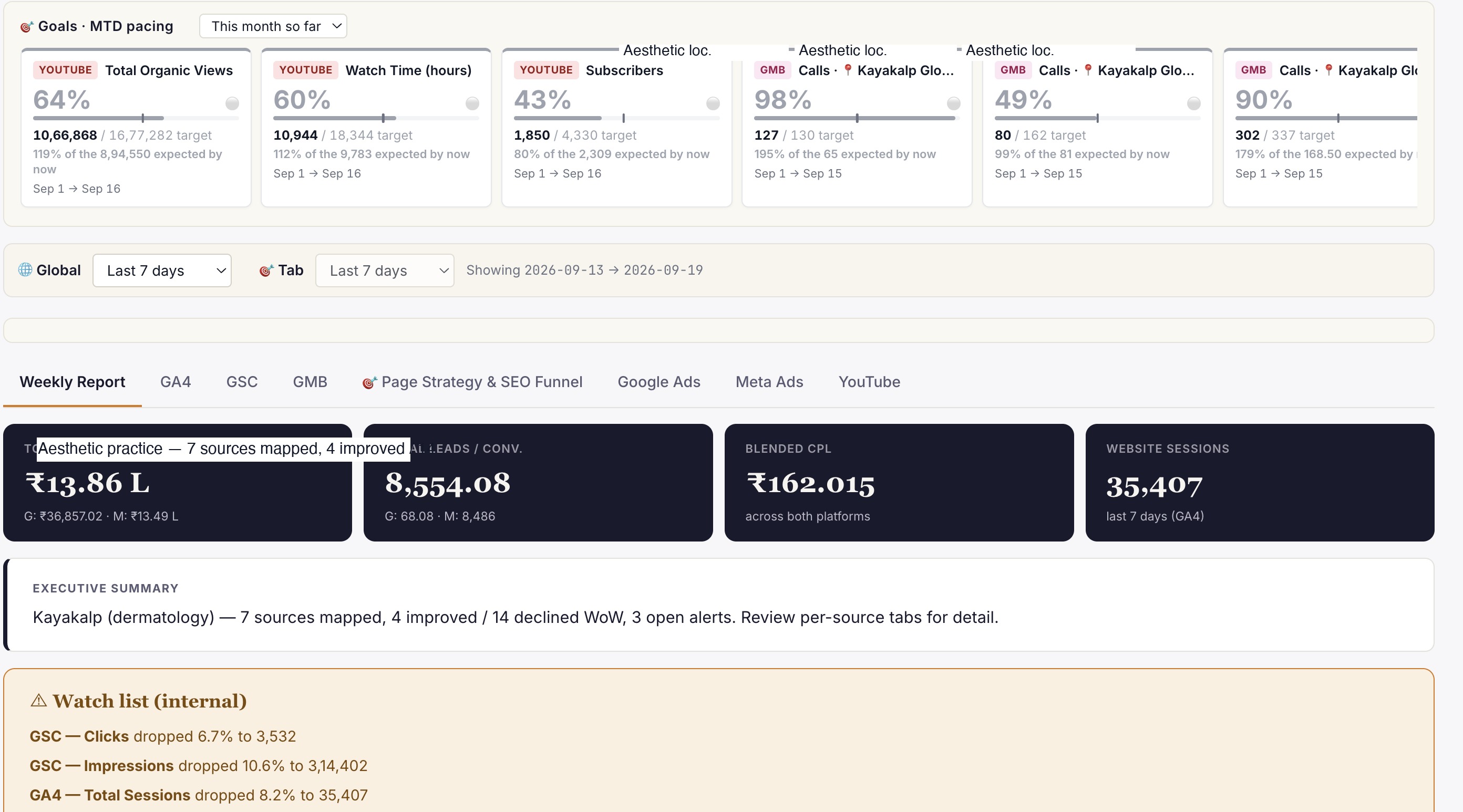
Live client dashboard. GSC, GA4, Google Ads, Meta Ads, IVR calls in one view. Login anytime, not monthly.
Phoenix
Clinic revenue intelligence over your PMS. Daily action queue: Prevent Loss, Maintain & Engage, Grow Revenue. Multi-centre rollout.
Or book a free 30-min audit to see all three in action on your account.
Healthcare brands
that already run on ICG.
A representative slice of the 150+ healthcare brands ICG has delivered for across India. Most engagements remain under NDA.


What ICG clients say · on video.
"Scale up of organic channels and business consulting. ICG has absolute domain authority in their field."
"Working with ICG transformed how we acquire IVF patients in Gurgaon. They understand the fertility journey from inquiry to consult..."
"What Ichelon accomplished — they got all my ideas and worked over 3-4 months to create an amazing, super-customised website."
Need help operationalising this?
Every ICG service is healthcare-only, NMC + DPDP-aware, and built around the patient-research patterns that drive Indian healthcare growth in 2026.
Every practice welcome — packages from ₹20,000/mo.
Goals-Driven engagements · Performance-Linked Payout Models available


More from
ICG.
Five trends shaping Indian healthcare marketing through 2027: AI-first patient research, Conversions API adoption, ABDM discovery, the AEO w...
Healthcare AIO is the discipline of getting your clinic or hospital cited inside Google AI Overviews, ChatGPT and Perplexity answers — not j...
Conversational-search advertising places brand messages inside AI chat answers — ChatGPT, Perplexity, Copilot — rather than beside a results...
Stop guessing.
Book a Diagnostic.
30 minutes. Free. With the AI-powered healthcare-only marketing agency 150+ brands already run on. No slides, no pitch, no hard close.


