Angryturtle vs BrightLocal for healthcare local SEO: what changes when the tool is built for hospitals
Angryturtle and BrightLocal both do local SEO, but they were built for different problems. BrightLocal is a mature generalist local SEO platform used across every vertical; Angryturtle is India's healthcare-first GBP intelligence and management OS with an AI-answer visibility lay
No pitch. Written root-cause diagnosis. AI-powered, healthcare only.
Direct answer
Angryturtle and BrightLocal both do local SEO, but they were built for different problems. BrightLocal is a mature generalist local SEO platform used across every vertical; Angryturtle is India's healthcare-first GBP intelligence and management OS with an AI-answer visibility lay
TL;DR
Angryturtle and BrightLocal both do local SEO, but they were built for different problems. BrightLocal is a mature generalist local SEO platform used across every vertical; Angryturtle is India's healthcare-first GBP intelligence and management OS with an AI-answer visibility layer, NMC/DPDP compliance workflows, and direct write-back to Google that most healthcare buyers only realise they needed after they've spent 18 months on a generalist tool. The choice is not "which is better software" — it's "which is built for the problem." For a healthcare brand in India, the answer is Angryturtle every time; for a florist or a plumber in Denver, BrightLocal is the safer pick. This piece explains what changes when the tool actually understands healthcare, and where the meaningful capability gaps sit. If you're evaluating healthcare local SEO agency options, knowing which platform the agency runs on tells you more than any pitch deck will.
The category difference: generalist tool versus healthcare-first platform
BrightLocal was founded in 2009 as a citation-building tool and grew into a full local SEO platform. It serves every vertical — restaurants, home services, retail, legal, medical, financial services — with a consistent feature set. The strength of that positioning is broad market coverage. The weakness is that no single vertical gets its category-specific rules built into the tool.
For a healthcare brand, the missing pieces are consequential. NMC Ethics Code 2026 review workflows don't exist as native features. DPDP Act 2023 consent frameworks for review-request messaging don't exist. Healthcare-specific directory lists (Practo, HealthEnclave, insurance-panel directories, medical association listings) aren't in the standard citation targets. Medical-category taxonomy (the difference between "Hospital," "Multi-specialty Hospital," "Cardiology Hospital," "Cardiologist," "Cardiac Rehabilitation Center") isn't surfaced in a way that helps a healthcare user pick correctly. Ask Maps / AI Overview readiness for patient queries doesn't exist as a scored dimension.
Angryturtle was built specifically because ICG's healthcare team was running BrightLocal, Yext and Whitespark across the client portfolio for years and kept hitting the same friction: manual compliance review outside the tool, manual healthcare-directory management outside the tool, manual healthcare-category selection using external references, no scoring for AI-answer visibility, and — worst — recommendations that never got executed because the audit tool and the execution tool were separate. Angryturtle rebuilt the workflow with healthcare as the primary user, AI-answer visibility as a first-class dimension, and direct write-back to Google as the default execution path.
Feature-by-feature: what each tool does and where the gaps sit
Rank tracking and reporting
BrightLocal has strong rank tracking. Local Rank Tracker checks GBP rankings across a grid of locations, supports multi-location businesses, and generates client-ready reports. The reports are clean, the data is reliable, and the interface is mature.
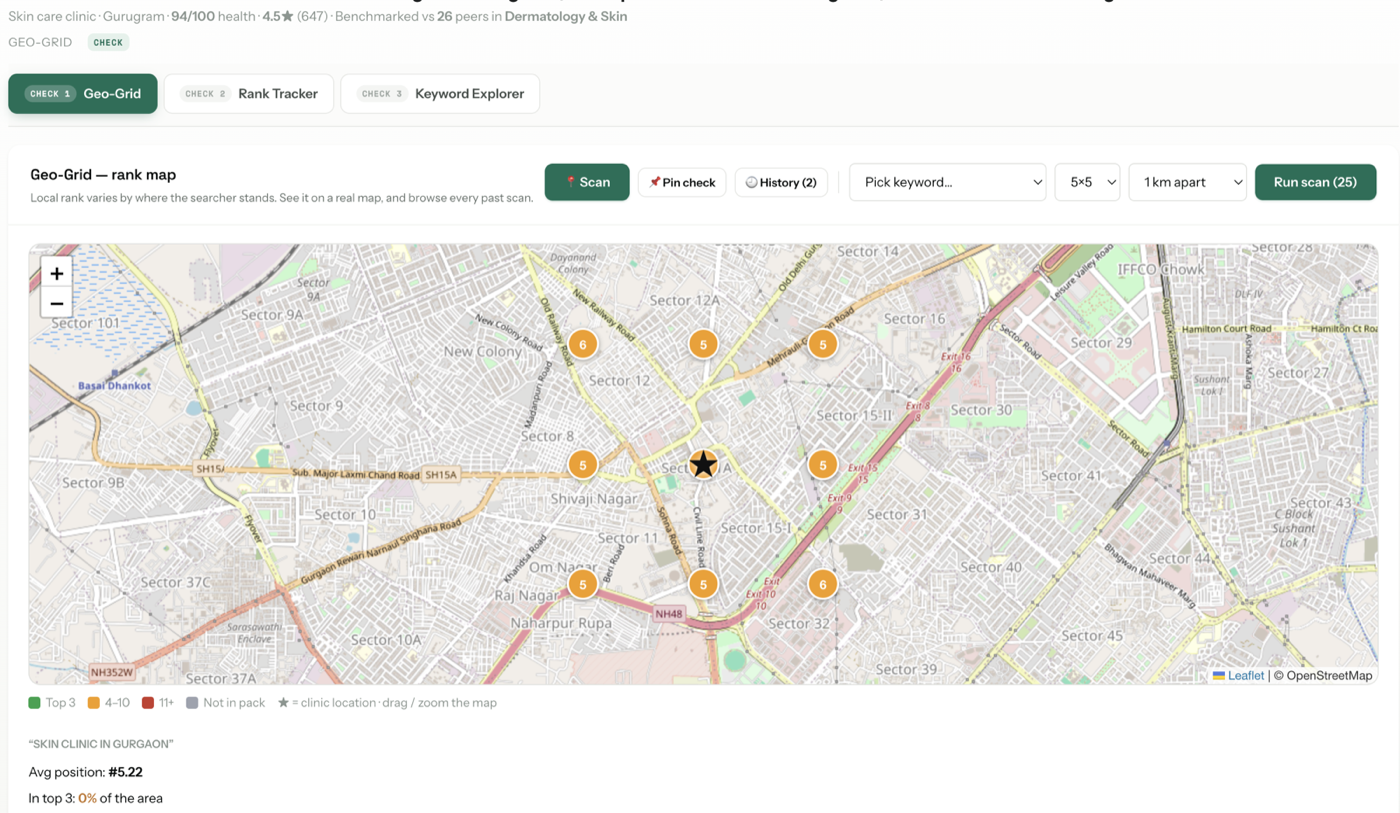
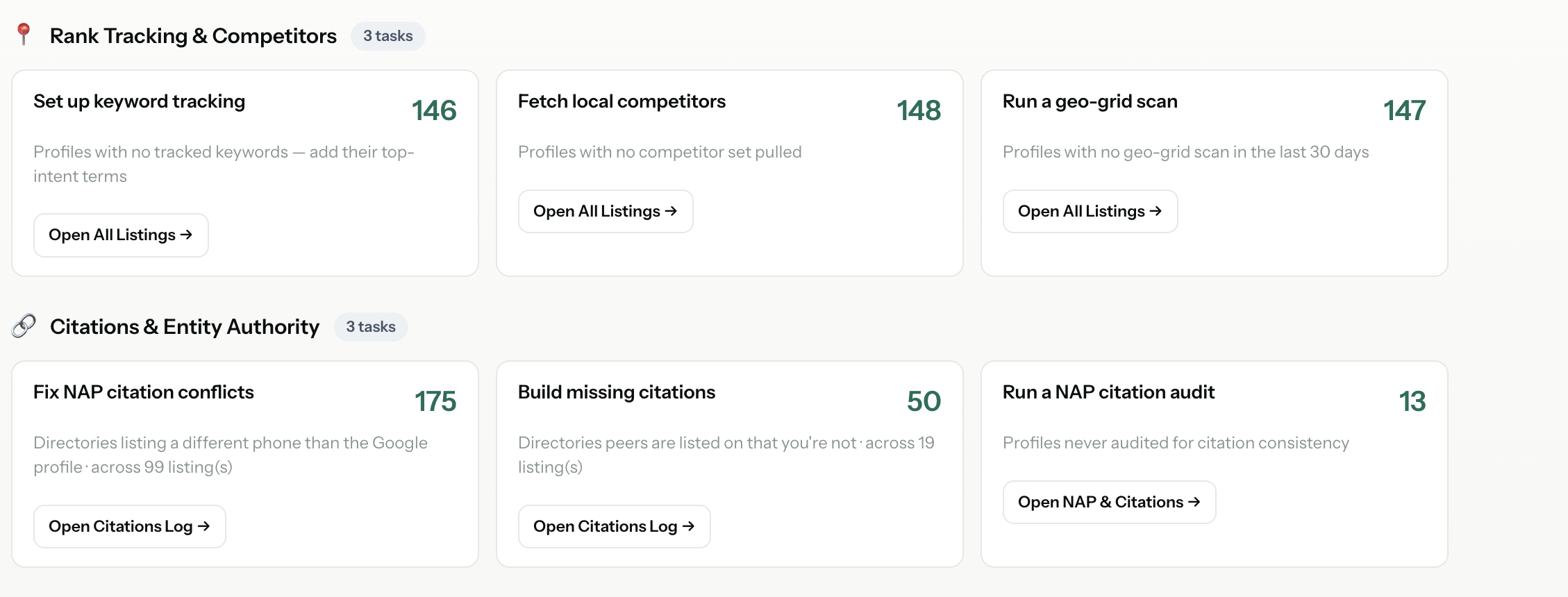
Angryturtle has functional parity on rank tracking (SearchApi.io for the underlying data, geo-grid visualisation, historical scans, competitor ranking). The differentiator is that Angryturtle's rank data ties into the Rank OS scoring — a rank position isn't just a number, it's a signal that either supports the profile's sie" style="color:inherit;text-decoration:underline;text-decoration-color:rgba(42,126,200,.5);text-underline-offset:2px">Rank OS score or shows where the score is unsupported by actual ranking. For a healthcare buyer, ranking data without a scoring context is just data; ranking data feeding a diagnosis is decision-support.
Review management
BrightLocal has Reputation Manager — review monitoring across Google, Facebook and industry-specific sites, alerts on new reviews, and reply capability. It's competent generalist functionality.
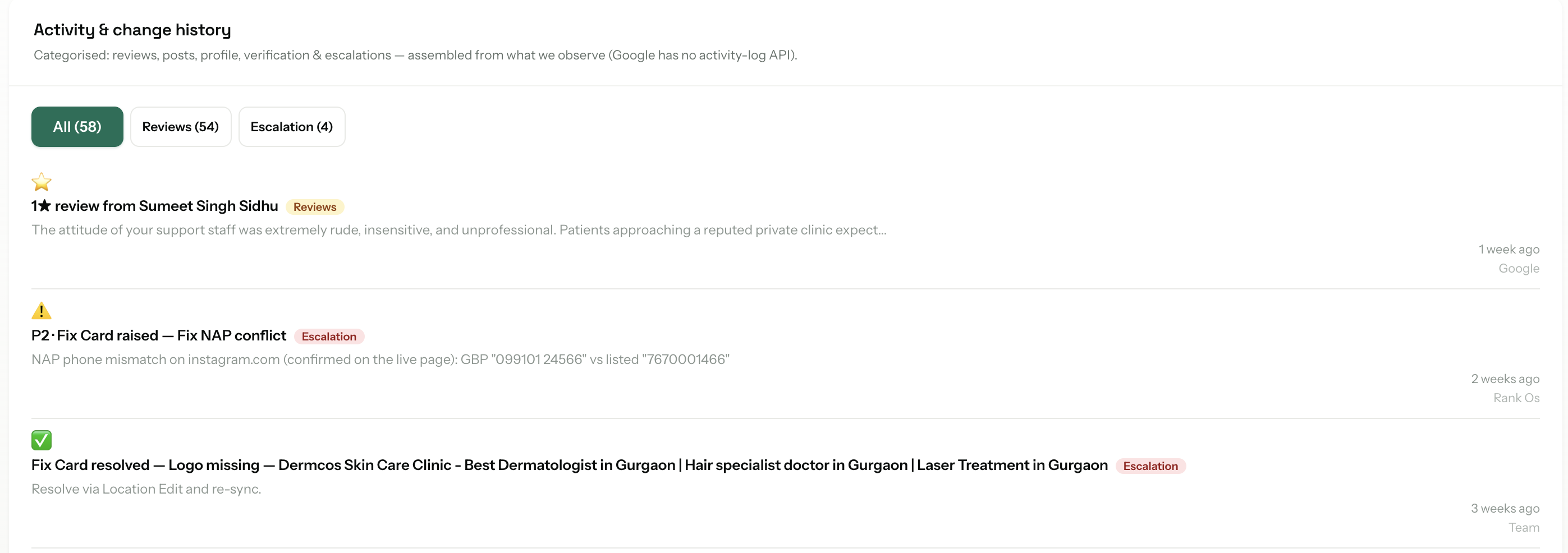
Angryturtle's review layer adds three things BrightLocal doesn't: AI-drafted replies in the hospital's brand voice with NMC-safe compliance framing built in (no promises of specific treatment outcomes, no clinical claims, appropriate for medical practice), automatic routing of reviews mentioning specific treatments received to internal compliance review before publication, and Brand Identity vs Image gap analysis that reads the review corpus for patient-perception patterns versus the hospital's own positioning. The compliance layer alone is why healthcare agencies that started on BrightLocal typically move — the manual compliance-review workflow outside the tool destroys reply velocity.
Citation management
BrightLocal's Citation Tracker is one of the tool's oldest and strongest capabilities. It monitors NAP consistency across hundreds of directories, identifies inconsistencies, and offers citation-building services (paid manual submissions) as an add-on.
Angryturtle has citation-tracking parity plus a healthcare-specific directory list. Practo (India's largest healthcare directory), HealthEnclave, MediBuddy provider directory, insurance-panel provider directories (Star Health, HDFC ERGO, Care Health, Bajaj Allianz), Indian Medical Association listings, and medical-society directories (Society for Assisted Reproduction, Indian Society of Cataract and Refractive Surgeons, cardiology societies, orthopedic societies) are in Angryturtle's citation targets by default. A generic tool user has to build this list manually and manage submissions outside the tool.
GBP profile editing
BrightLocal's GBP integration is read-oriented. It surfaces profile data, changes over time, and audit findings. Direct editing — pushing changes back to Google — is limited compared to Angryturtle's design.
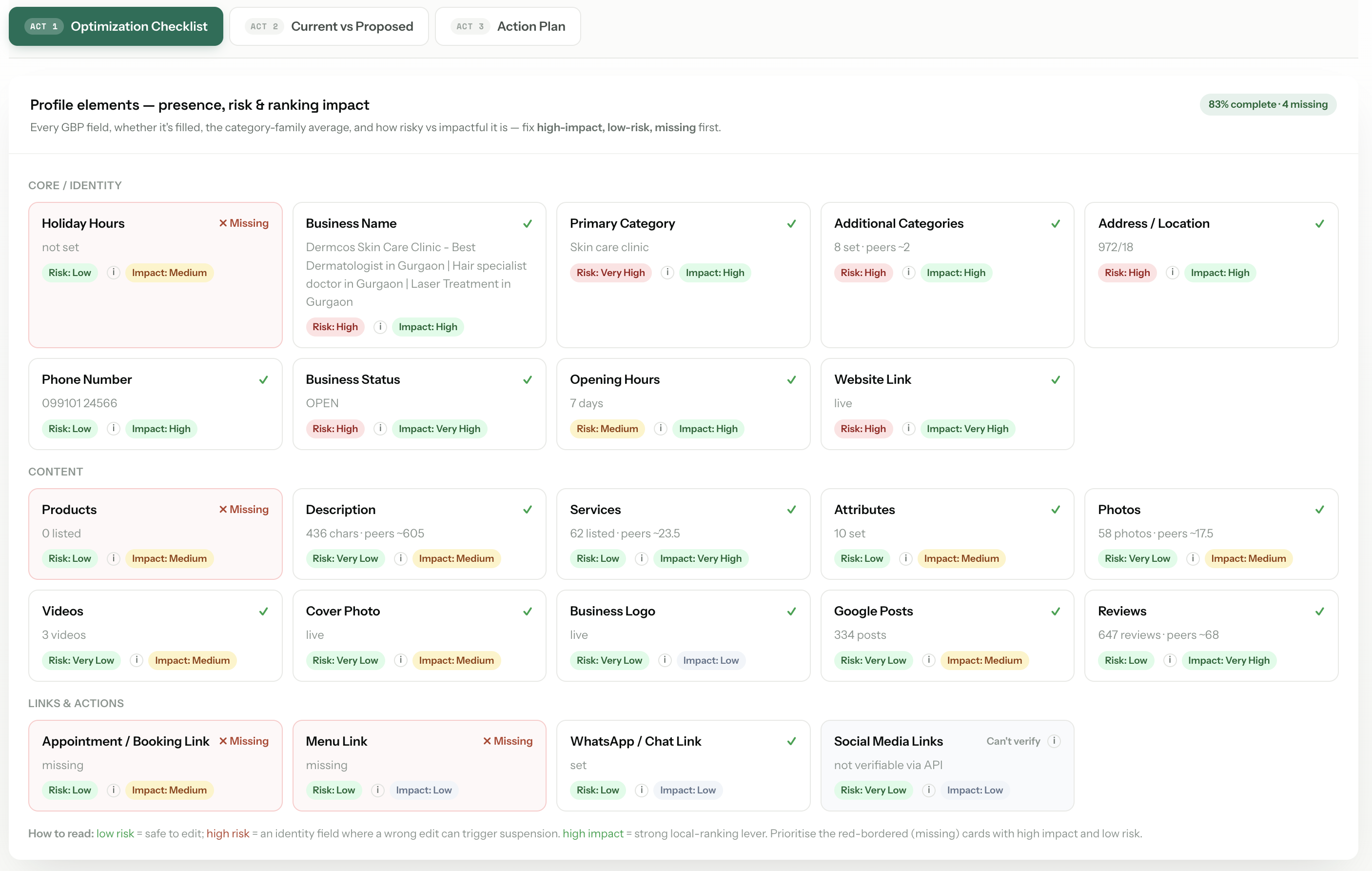
Angryturtle publishes edits, Posts, media and review replies directly to Google through the GBP API. The audit and the execution happen in the same tool. For a multi-location hospital chain making 30-50 profile edits per week across the portfolio, that architecture is the difference between a workflow that runs and one that stalls. BrightLocal's typical user pattern involves the tool for audit and Google's own GBP dashboard for execution — the context switch loses recommendations.
AI-answer / AIO readiness
BrightLocal does not have a dedicated AI-answer visibility feature. Google AI Overviews and ChatGPT citation of local businesses is a 2025-2026 development that generalist tools are still adapting to.
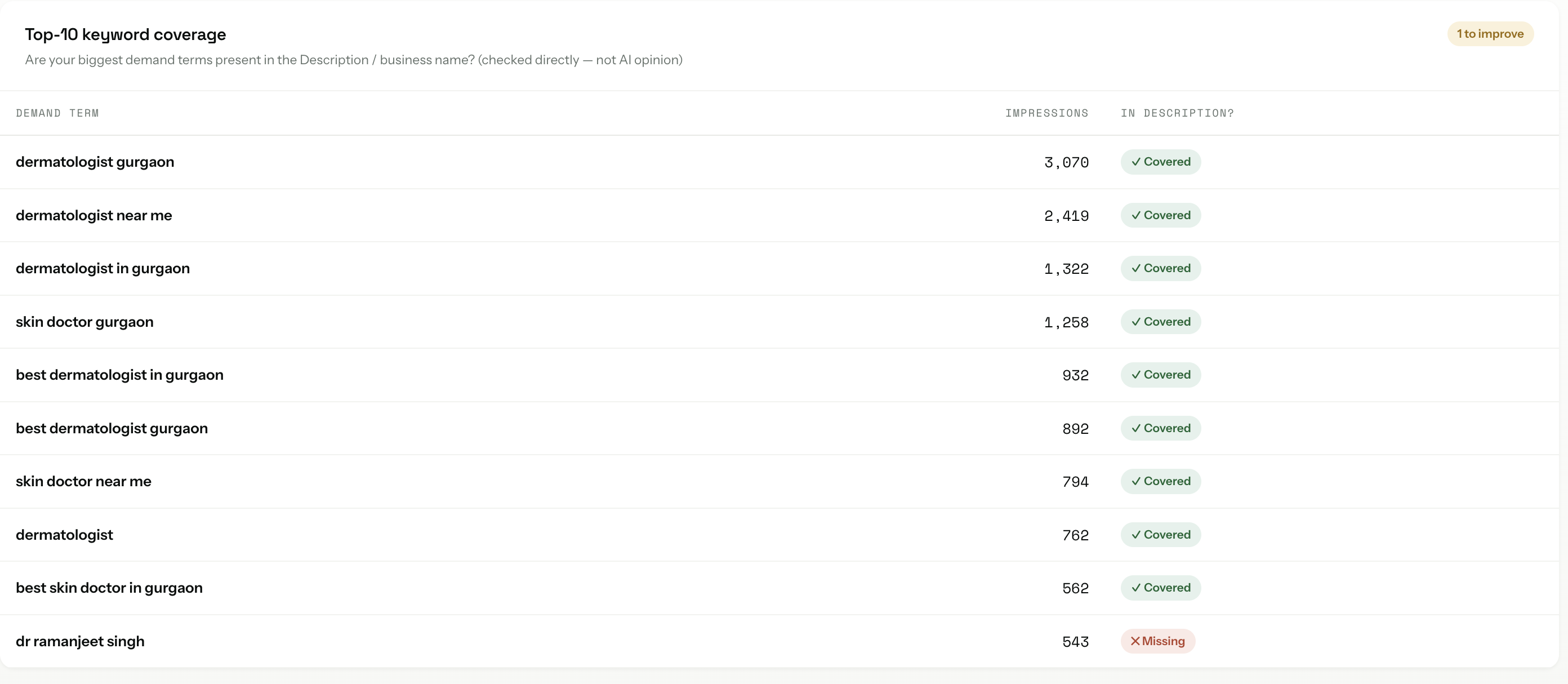
Angryturtle's Ask Maps module is built specifically for this — a per-listing question bank of natural-language queries a patient might ask an AI system about the healthcare business, scored for whether the profile is answerable, with the specific edits (Services, Description, Attributes, Questions & Answers) required to close the gap. This is the newest dimension of local SEO in 2026 and the one competitors haven't caught up to yet.
Rank OS scoring
BrightLocal has various scoring modules (Local Search Grid, Reputation Manager score) but no unified rank-probability score that composites the full profile against a rank-prediction model.
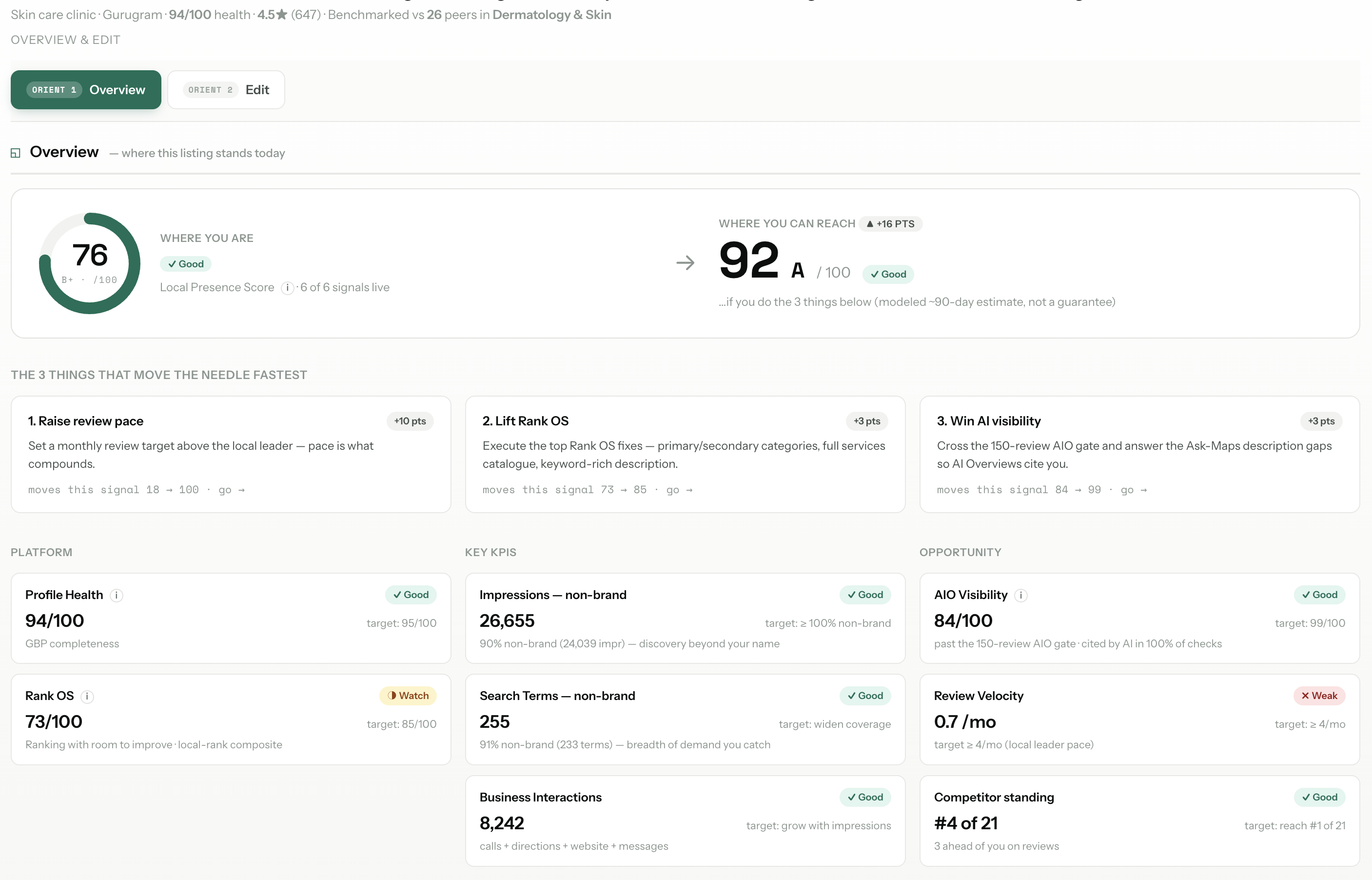
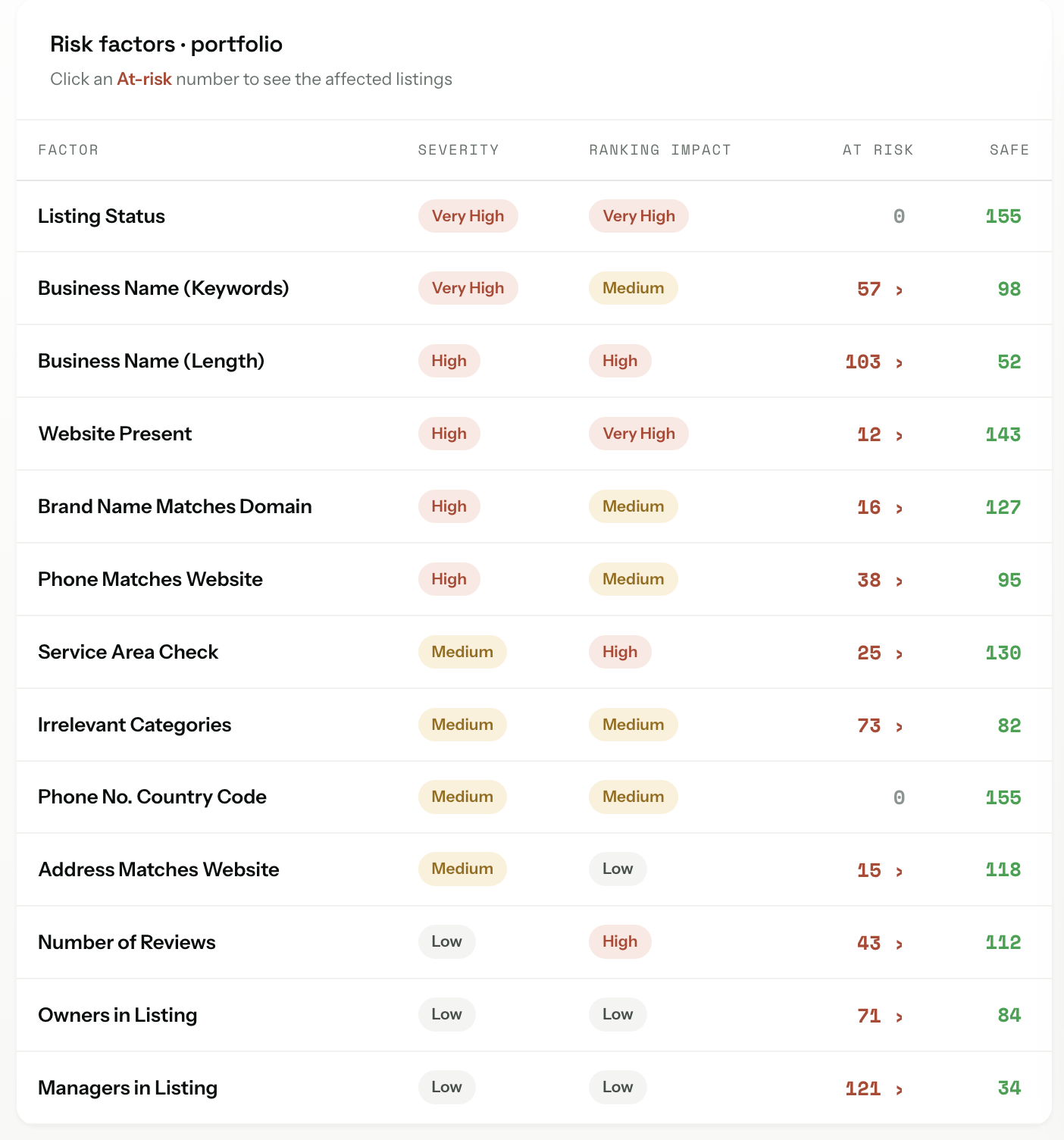
Angryturtle's Rank OS is a 0-100 rank-probability score built from five weighted dimensions (Relevance, Review Health, Freshness, Entity Authority, AIO Readiness) with tunable weights per agency and per client. It gives the operator one number to track, five dimensions to diagnose, and — critically — a ranked list of actions with expected point-lift for each. This is the biggest single UX difference between the two tools. BrightLocal delivers metrics; Angryturtle delivers a plan.
What BrightLocal does better
Not every dimension favours Angryturtle. Being honest about where BrightLocal is stronger matters for anyone making the evaluation.
Global market maturity. BrightLocal has 10+ years of accumulated feature depth, a very large user base, extensive documentation, and integration with US-and-Europe-specific citation ecosystems that Angryturtle doesn't cover. For a healthcare brand serving US or European patients, BrightLocal's global directory coverage is meaningfully broader.
Non-healthcare category depth. BrightLocal serves restaurants, home services, retail and every other local business type. If a healthcare group also runs a wellness-adjacent business (a spa, a diet-and-nutrition consultancy that isn't NMC-regulated), BrightLocal handles the mixed portfolio in one tool. Angryturtle's healthcare-first categorisation makes non-healthcare businesses feel like second-class citizens in the tool.
Reporting template maturity. BrightLocal's white-label report library is extensive with many pre-built templates for different client types. Angryturtle's reports are cleaner and more focused (one Rank OS report, structured around the five dimensions) but the template variety is thinner.
Pricing at large scale. BrightLocal's per-location pricing gets aggressive at 100+ location tiers. Angryturtle's Enterprise pricing is custom; for very large operations (500+ locations) the direct cost comparison depends on the specifics of the deal.
The healthcare-buyer decision framework
For a healthcare brand or agency deciding between the two tools:
Pick Angryturtle if the primary business is Indian healthcare, if AI-answer visibility matters, if NMC and DPDP compliance workflows need to be built in rather than layered on, if direct GBP write-back is required for execution speed, and if the operator wants a scoring-and-plan interface rather than a metrics dashboard. This is most Indian healthcare brands, most healthcare-focused agencies, and any multi-location hospital chain.
Pick BrightLocal if the business is not healthcare-primary, if the portfolio includes multiple non-healthcare verticals, if global (US/Europe) citation coverage is needed, or if the agency has existing BrightLocal workflow depth that would be costly to migrate. This is the right pick for a very small fraction of Indian healthcare buyers.
Use both if the operation is genuinely global mixed-vertical with a healthcare sub-portfolio — BrightLocal for the non-healthcare and international assets, Angryturtle for the Indian healthcare. Rare, but real for large multi-national agencies.
What ICG does with Angryturtle that a BrightLocal-based agency cannot
ICG built Angryturtle because the healthcare local SEO problem needed a tool designed for healthcare — not a generic tool with healthcare use-cases layered on. The specific capabilities ICG uses across the 150+ client portfolio that a BrightLocal-based competitor can't match:
Compliance-safe review reply at scale. Every AI-drafted reply passes through NMC framing rules before it's suggested to the operator. A BrightLocal-based agency has to run compliance review externally, which either slows reply velocity or produces occasional compliance failures.
AI-answer readiness scoring per specialty. Ask Maps questions are seeded from specialty-specific patient query patterns — the questions a fertility patient asks are different from the questions an orthopedic patient asks, and Angryturtle's question bank knows the difference. BrightLocal has no equivalent.
Healthcare-specific citation targets. The full Indian healthcare directory landscape — insurance panels, medical associations, specialty societies — is in Angryturtle's default citation list. BrightLocal users build this list manually.
Rank OS scoring against healthcare peers. The competitive benchmark for a cardiology hospital is other cardiology hospitals, not restaurants or plumbers. Angryturtle's benchmarking uses healthcare-vertical peer sets by default.
Content Studio with NMC compliance. Google Post drafting for healthcare avoids treatment claims, patient testimonials as evidence, and comparative superlatives that violate ASCI. Angryturtle's AI drafts within these constraints; BrightLocal's post-scheduling module doesn't.
Every one of these is a workflow that BrightLocal-based agencies can build manually. The question is whether the agency's operations team consistently executes the manual step across 10, 50, 150+ client accounts. In practice, manual compliance checks slip. Manual healthcare directory management gets skipped when the ops team is busy. Manual peer benchmarking uses whatever peers the analyst happens to know about. Angryturtle enforces the workflow because it's built into the tool.
Pricing comparison at a glance
BrightLocal starts at $39/month for Single Business (1 location) and scales to $89/month for Multi Business (5 locations) and custom pricing for enterprise / agency tiers. Agency plans start at $79/month for 20 businesses and scale up.
Angryturtle starts at ₹999/month for Solo (2 profiles), ₹3,499+/month for Agency (10 profiles, white-label, unlimited seats), custom Enterprise pricing.
At exchange rates approximately valid for 2026, ₹999/month is roughly $12/month and ₹3,499/month is roughly $42/month. Angryturtle's pricing is materially lower for comparable functionality inside the healthcare vertical, though direct cost comparison depends on which capabilities each buyer weighs highest.
When to switch from BrightLocal to Angryturtle
The migration timing matters more than the migration itself. A healthcare agency currently running BrightLocal typically justifies migration to Angryturtle when: (a) the compliance review workflow outside BrightLocal is consuming meaningful ops team time or producing compliance incidents, (b) AI-answer visibility becomes a client conversation ICG needs to answer for, (c) the healthcare-specific citation and directory landscape becomes a client-facing gap, (d) the audit-to-execution workflow gap is losing recommendations, or (e) the client portfolio is now healthcare-majority and the generalist tool feels like the wrong fit.
The migration itself is straightforward. Angryturtle connects to existing GBP profiles via OAuth (the same authentication BrightLocal uses). Historical data from BrightLocal doesn't migrate directly — Angryturtle starts fresh from the current profile state — but the operational continuity is preserved because the GBP itself doesn't change, only which management platform reads and writes to it.
Related reading
- Healthcare local SEO agency India — ICG's service page with the full Angryturtle-powered scope
- How to rank a hospital on Google Maps in India — the six controllable signals for hospital local ranking
- GBP optimization for multi-specialty hospitals — the department-level playbook
- How to choose a healthcare SEO agency — broader agency evaluation framework
FAQ
Is Angryturtle a BrightLocal alternative? Yes, for Indian healthcare. Angryturtle has functional parity on the core capabilities (rank tracking, review management, citation coverage, reporting) plus healthcare-specific capabilities (NMC compliance workflows, healthcare directory targets, AIO readiness, direct GBP write-back) that BrightLocal doesn't offer for the healthcare vertical.
Can a US-based healthcare agency use Angryturtle? Technically yes, but Angryturtle's default configuration is India-first. US-specific directory coverage, US healthcare regulatory frameworks (HIPAA vs India's DPDP Act), and US medical association listings would need custom configuration. For US healthcare, BrightLocal or Whitespark are more appropriate defaults.
Does Angryturtle integrate with BrightLocal for hybrid setups? Not directly. The two tools authenticate to Google Business Profile separately. If a healthcare agency runs both, each connects to the GBP independently. Angryturtle for the healthcare accounts, BrightLocal for the non-healthcare accounts.
What is Angryturtle's biggest capability advantage over BrightLocal for healthcare? Three tie for biggest: (1) direct GBP write-back (edit and publish in the same tool), (2) AI-answer visibility scoring via Ask Maps, (3) NMC / DPDP compliance workflows built into review reply and Post drafting. Any one of them is a meaningful workflow win; combined, they're the whole reason Angryturtle exists.
Does BrightLocal have anything Angryturtle doesn't? Yes — deeper US and European citation coverage, non-healthcare category depth, and a longer track record with a large global user base. For an Indian healthcare buyer, none of these matter much; for a US-based mixed-portfolio agency, they matter a lot.
How does ICG position Angryturtle versus BrightLocal for prospects? As a category difference, not a feature difference. BrightLocal is generalist local SEO; Angryturtle is healthcare-first GBP intelligence with AI-answer visibility. The prospect's answer to "is your business primarily Indian healthcare?" determines the right tool almost every time.
Can Angryturtle replace BrightLocal, or does it complement it? For an Indian-healthcare-only operation, Angryturtle replaces BrightLocal entirely. For a mixed-portfolio operation, the two complement (Angryturtle for healthcare, BrightLocal for other verticals).
What's the switching cost from BrightLocal to Angryturtle? Low. The GBP connection re-authenticates via OAuth in 15-30 minutes per profile. Client-facing reporting continuity is preserved because both tools generate PDF reports; the specific format differs but clients typically adapt within one reporting cycle. Historical data from BrightLocal doesn't migrate.
Does Angryturtle have geo-grid rank tracking like BrightLocal's Local Search Grid? Yes. Angryturtle's Geo-Grid module scans rank across a configurable grid of lat/long points, produces a heatmap showing where the profile ranks well and where it drops out, and supports historical scan comparison. Functional parity with BrightLocal's Local Search Grid plus a Pin Checker for exact-location rank tests.
What tier of Angryturtle matches BrightLocal's Multi Business tier? Angryturtle Solo at ₹999/month covers 2 profiles and 200 credits. Angryturtle Agency at ₹3,499+/month covers 10 profiles scalable with 1,000 credits and unlimited seats plus white-label. For most agencies that would sit on BrightLocal's Multi Business tier (5 locations at $89/month), Angryturtle Agency at ₹3,499/month covers more locations with healthcare-specific capabilities.
Which tool has better AI capabilities? Angryturtle has more healthcare-specific AI — Rank OS scoring, Ask Maps AIO readiness, AI-drafted NMC-safe review replies, Content Studio for compliant Post drafting, Virtual CMO grounded in the listing's own data. BrightLocal has AI features but they're generalist rather than healthcare-tuned.
How does the migration process actually work? Sign up for Angryturtle at angryturtle.ai. Connect the GBP profile via Google OAuth (same authentication BrightLocal uses). Run the initial Rank OS audit to establish baseline. Cancel BrightLocal subscription at the current billing cycle end. Total elapsed time: under an hour per profile. ICG's healthcare team handles migration for managed-service clients as part of onboarding.
Book a free 30-minute Brand & Growth Diagnostic.
It's a working session, not a sales pitch — you leave with a written root-cause analysis you can act on, whether or not you engage ICG.
The three platforms
behind every ICG engagement.
Beacon
CAPI middleware that fixes Event Match Quality, translates CRM statuses to Meta-standard events, dedups across channels.
Agency OS
Live client dashboard. GSC, GA4, Google Ads, Meta Ads, IVR calls in one view. Login anytime, not monthly.
Phoenix
Clinic revenue intelligence over your PMS. Daily action queue: Prevent Loss, Maintain & Engage, Grow Revenue. 46-centre rollout.
Or book a free 30-min audit to see all three in action on your account.
Healthcare brands
that already run on ICG.
A representative slice of the 150+ healthcare brands ICG has delivered for across India. Most engagements remain under NDA.
What ICG clients say · on video.
"Scale up of organic channels and business consulting. ICG has absolute domain authority in their field."
"Working with ICG transformed how we acquire IVF patients in Gurgaon. They understand the fertility journey from inquiry to consult..."
"What Ichelon accomplished — they got all my ideas and worked over 3-4 months to create an amazing, super-customised website."
The intelligence stack behind this playbook.
Every ICG engagement runs on the Search Intelligence Trifecta — Angryturtle for GMB, SIE for search and AI Overview, YODA for YouTube. Live product screens below.
Need help operationalising this?
Every ICG service is healthcare-only, NMC + DPDP-aware, and built around the patient-research patterns that drive Indian healthcare growth in 2026.
Every practice welcome — packages from ₹20,000/mo.
Goal-linked packages · Fixed retainer + Goal-based Variable Pay · 19-month average client retention — industry-leading.
More from
ICG.
Healthcare AIO is the discipline of getting your clinic or hospital cited inside Google AI Overviews, ChatGPT and Perplexity answers — not j...
Conversational-search advertising places brand messages inside AI chat answers — ChatGPT, Perplexity, Copilot — rather than beside a results...
NABH digital compliance means every claim, image and testimonial your hospital publishes online matches what an accreditation surveyor can v...
Stop guessing.
Book a Diagnostic.
30 minutes. Free. With the AI-powered healthcare-only marketing agency 150+ brands already run on. No slides, no pitch, no hard close.