Dental marketing agency for US practices
A dental marketing agency brings new patients to a dental practice and keeps existing patients returning. It runs local SEO and Google Business Profile, Google Ads, Meta ads, reviews, the website, recall and front-desk follow-up as one system. Ichelon Consulting US does this for general, cosmetic, implant, pediatric and multi-location practices, measured in booked appointments, under a signed BAA.

- Measure booked patients, not clicks: agree KPIs such as cost per booked appointment and case acceptance before any campaign starts.
- Local search leads for most practices: a complete Google Business Profile, steady reviews and one page per service and location.
- Protect patient data: no ad pixels on booking or intake pages, written authorization for patient stories, and a BAA with your agency.
- Ichelon Consulting US retainers start from $499/month, custom-scoped and Goals-Driven, with Performance-Linked Payout Models available.
- Every practice welcome — retainers from $499/mo, Goals-Driven engagements, Performance-Linked Payout Models available.
- Dallas, Texas LLC
- US client team · Central Time (CST)
- 25+ US healthcare clients
- BAA signed with every client
- HIPAA compliance training across client and delivery teams
- Contracts and invoices in USD
-
 Primary Care · North Dallas, TXCase study →
-
 MedSpa · North Dallas, TX
-
 Skin Care · Beverly Hills, CA
-
 Dental · Christiansburg, VACase study →
-
 Pediatrics · Blacksburg, VACase study →
-
 Pediatric Dentistry · Blacksburg, VACase study →
-
 Dental · Roanoke, VACase study →
-
 Functional Medicine · Telehealth · USACase study →
“They were able to get all my ideas and work with me over a period of three to four months and create this amazing website. It's super customized, very modern, and it incorporates all the elements that I had wanted — the patient portal, nice pictures, a very interactive website, patient reviews. I would highly recommend their company to anyone who wants to make an excellent website.”
What does a dental marketing agency do, and who is it for?
A dental marketing agency plans and runs the channels that bring new patients to a dental practice and keep existing patients coming back. That usually means local search and Google Business Profile, Google Ads, social ads, the website, reviews, recall and the follow-up that turns calls and forms into booked appointments.
The work is not the same as general small-business marketing. Dental patients search for specific needs: an emergency appointment today, a dentist who takes their insurance, a cleaning for a child, a consultation for implants or veneers. Each of those searches has a different value to the practice and a different path to a booked chair. A good agency builds the plan around those patient intents and around your production goals, not around a generic list of tactics.
For a plain walk-through of the deliverables, read what a dental marketing agency actually does.
Who we build dental programs for
- General and family dentists who want a steady flow of new patients, more hygiene appointments and fewer gaps in the schedule.
- Cosmetic dentists who need qualified consultations for veneers, whitening, bonding and smile makeovers, and who need to show work carefully and lawfully.
- Implant and full-arch practices where each case is high value, the decision is slow, and financing questions decide whether a consultation turns into treatment.
- Pediatric dental practices that market to parents, often across Medicaid/CHIP and commercial plans, and that depend on referrals from pediatricians and schools.
- Multi-location groups and DSOs that need one system for many offices: location pages, a profile per office, shared reporting and brand control.
What a dental agency should not do
It should not run campaigns your front desk cannot handle, promise rankings, or buy reviews. It should not put tracking code on booking and intake pages without a HIPAA-safe setup. And it should not report on clicks and impressions while ignoring the number that matters to you: new patients who actually came in and the treatment they accepted.
The rest of this page explains the problems dental practices face, the services in detail, the compliance rules, how results are measured, what the first 90 days look like, how pricing works and how to pick an agency.
Why do dental practices struggle to grow new patients?
Most dental practices do not lack marketing activity. They lack a connected system. Ads, the Google profile, the website and the front desk are run separately, so demand leaks between them. The common problems are local visibility, an unclear offer, slow follow-up, weak recall and reporting that cannot tie spend to production.
The map pack is crowded
In most US metros, many dental offices compete for the same "dentist near me" search. The few practices shown in the Google map results take most of the clicks and calls. Ranking there depends on relevance, distance and prominence, which in practice means a complete profile, steady fresh reviews and a website that supports each service.
High-value services are hidden
Many dental websites list implants, clear aligners, veneers and sedation on one crowded services page. Patients searching for those treatments land on a page that does not answer their questions about cost, financing, timelines and the dentist's experience. They go back to the search results and choose someone else.
Calls go unanswered or unconverted
Front desks are busy checking patients in and out, verifying insurance and handling billing. New-patient calls ring out at lunch, after hours and during the morning rush. Many callers who reach voicemail hang up and call the next practice instead. Paid campaigns make this worse, because they add calls without adding people to answer them.
Recall and reactivation are neglected
Every practice has patients who are overdue for hygiene, have unscheduled treatment, or have not visited in a long time. Reaching them is usually cheaper than finding a stranger, but it often depends on one busy coordinator and a reminder system that nobody owns.
Insurance mix shapes everything
A PPO-heavy practice and a fee-for-service practice need different messages, different keywords and different offers. Our guide to PPO versus fee-for-service dental marketing covers the trade-offs, including in-house membership plans for uninsured patients.
Reports do not reach the chair
Many practices receive monthly reports full of impressions, clicks and "leads" but cannot say how many new patients the marketing produced, what they spent, or what treatment was accepted. Without that link to practice-management data, budgets get set by habit rather than evidence.
How do local SEO and Google Business Profile bring in dental patients?
Local SEO makes your practice appear when nearby patients search for a dentist or a dental service. It combines a complete, active Google Business Profile, steady reviews, consistent listings, and a website with a page for each service and location. For most general practices it is the largest long-term source of new patients.
Google Business Profile
- Categories: the right primary category ("Dentist", or a specialty category where your dentists qualify) and accurate secondary categories.
- Services: every service you want to be found for, written the way patients search.
- Hours and attributes: regular and holiday hours, emergency availability, accessibility, languages spoken and the booking link.
- Photos: real photos of the building, the team, the operatories and the waiting room, refreshed over time.
- Posts and Q&A: short updates and clear answers to common questions such as insurance, parking and same-day emergencies.
Our step-by-step guide to optimizing a dental Google Business Profile covers categories, services and review routines in detail.
Website SEO for dentists
Search engines and patients both need one clear page per service: dental implants, emergency dentistry, clear aligners, pediatric dentistry, sedation, veneers and so on. Each page should answer real questions: who the treatment suits, what happens at each visit, how long it takes, how payment and financing work, and who performs it. Multi-location practices need one page per office with its own address, hours, team and directions.
Technical basics matter too: fast mobile pages, clean structure, schema markup that describes the practice and its locations, and consistent name, address and phone number across directories.
Content that earns trust
Useful content answers the questions patients ask before booking: what an implant consultation involves, how to handle a broken tooth on a weekend, what to expect at a child's first visit. It should be reviewed by a dentist, written plainly, and free of guarantees. Thin, keyword-stuffed blog posts do little for rankings and nothing for trust.
Local SEO compounds. It usually takes months rather than weeks to move map rankings in a competitive market, which is why most practices pair it with paid search while it builds. Read how long dental marketing takes to work for realistic timelines by channel.
How should a dental practice use Google Ads and Meta ads?
Google Ads captures patients who are already searching for a dentist or a treatment, so it suits emergencies, implants, clear aligners and new-patient exams. Meta ads on Facebook and Instagram create demand among people who are not searching yet, so they suit cosmetic offers, membership plans and new-office launches. Both need tight targeting and careful tracking.
Google Ads for dentists
- Structure by service and intent. Separate campaigns for emergency, implants, cosmetic and general new patients, each with its own landing page and budget.
- Tight geography. Target the area patients will realistically travel from, which is smaller for a cleaning than for full-arch implants.
- Schedule to your phones. Run call-focused ads only when someone can answer. Push forms and online booking after hours.
- Negative keywords. Exclude job seekers, dental school searches, cheap "free" hunters where they do not fit, and do-it-yourself queries.
- Measure booked patients. Track calls and forms, then match them to appointments, not just clicks.
The full setup is in our Google Ads guide for dentists, linked at the end of this page.
Meta ads for dental practices
Meta limits targeting based on health conditions, so dental campaigns rely on location, broad audiences, creative and the offer. Before-and-after images, patient stories and video testimonials need written patient authorization and must reflect typical results. Lead forms should collect only what you need to call the person back.
The most important safeguard is tracking. Meta and Google pixels should not send health information from booking, intake or patient-portal pages to an ad platform. Our guide to running Facebook and Instagram ads safely for dental practices explains the safe setup.
Other paid channels
Microsoft Advertising on Bing adds a smaller pool of search traffic and is worth testing once Google Ads is stable. YouTube works for implant and cosmetic practices that have strong video: a dentist explaining a procedure, a tour of the office, or answers to common cost questions. Local Services Ads, where available for dentists in your area, show at the top of some searches and are paid per lead; they need careful review of lead quality and disputes.
How we decide the paid budget
We size paid media from the goal backward: how many new patients the practice wants, what share should come from paid channels, how many calls and forms that takes, and what the front desk can handle. Then we test, measure cost per booked appointment and move budget toward the services and locations that produce accepted treatment. Ad spend is paid directly to Google and Meta and is separate from our fee.
How do dentists show up in ChatGPT and Google AI Overviews?
Google AI Overviews, ChatGPT, Perplexity and Gemini answer questions such as "which dentists near me do implants on a Saturday" by drawing on websites, Google Business Profile data, reviews and other public sources. Practices that publish clear, consistent, specific facts about services, locations and dentists are easier for these tools to cite.
What AI answers draw on
- Your website: service and location pages that state plainly what you offer, where, for whom and how to book.
- Your Google Business Profile: categories, services, hours, attributes and review text.
- Third-party mentions: directories, local news, community sponsorships and professional profiles.
- Structured data: schema markup that describes the practice, each location and each dentist.
What we do to improve AI visibility
- Write answer-first pages. Each service page opens with a direct answer to the question patients ask, followed by detail, a table or checklist where helpful, and an FAQ section.
- Make facts consistent. Name, address, phone, hours, insurance accepted and services match across the website, the profile and directories.
- Show expertise. Dentist bios with training, memberships and the services each dentist performs, plus content reviewed by a dentist.
- Build reviews that mention services. Patients naturally describe the treatment they had, which helps both map rankings and AI answers.
- Track mentions. We test a set of buyer and patient questions across AI tools each month and record which practices are named.
Questions worth answering on your site
Good candidates are the questions patients ask the front desk every week: do you take my insurance, can I be seen today for a broken tooth, how long do implants take, is sedation available, what does a first visit for a three-year-old involve, do you offer a membership plan for patients without insurance. Each answer should be short, specific to your practice and kept up to date.
No one can guarantee placement in an AI answer, and anyone who promises it is overselling. What you can control is being the clearest, most consistent source. Our guide on how dentists show up in ChatGPT and AI Overviews goes further.
How do reviews, the website, follow-up and recall turn searches into booked patients?
Reviews, the website and the front desk convert searches into appointments, and recall brings patients back. Patients compare your rating, recent review content and whether your website answers questions about insurance, cost, availability and the team. Strong visibility with weak reviews or a slow, vague website loses patients the practice already paid to attract.
A review routine that stays within the rules
- Ask every patient after the visit, by text or email, with their consent to be contacted.
- Do not offer discounts, gifts or entries in exchange for reviews, and do not ask only happy patients in a way that filters out the rest. Google's review policies also prohibit incentives and selective soliciting.
- Never write, buy or edit reviews. The FTC's rule on consumer reviews and testimonials, in effect since October 2024, prohibits fake reviews, buying reviews and certain review-suppression tactics. Confirm specifics with your counsel.
- Reply to reviews without confirming that the reviewer is a patient or discussing their care. Under HIPAA, even confirming someone is a patient can be a disclosure.
What a dental website needs
| Element | Why it matters |
|---|---|
| Click-to-call and online booking above the fold | Many patients search on phones; the next step should be one tap away |
| Insurance accepted and payment options | The first question many patients have; uncertainty sends them elsewhere |
| One page per service and per location | Matches how patients search and gives AI tools clear facts to cite |
| Dentist and team bios with real photos | Patients choose people, not logos; bios also support expertise signals |
| New-patient and emergency information | Explains what happens at the first visit and how to get seen fast |
| Financing and membership plan details | Removes the cost barrier for implants, cosmetic work and uninsured patients |
| Fast load and accessible design | Slow pages lose mobile visitors; accessibility helps every patient |
| HIPAA-safe forms and tracking | Protects patient information and keeps analytics usable |
For a page-by-page checklist, see what a dental website needs to convert new patients.
Why follow-up and recall matter
They protect the demand you already have. Speed-to-lead means answering or returning every new-patient call and form quickly. Recall means bringing existing patients back for hygiene and unscheduled treatment. Email and SMS, sent with documented consent, keep patients engaged. Together they often raise booked appointments without any extra ad spend.
Speed-to-lead at the front desk
- Measure missed calls first. Call tracking with HIPAA-safe settings shows how many new-patient calls go unanswered and when.
- Set a callback rule. Every missed call and web form gets a call back within a fixed window during business hours.
- Use a script. A short new-patient script covers the reason for the visit, insurance, the first available appointment and how to prepare.
- Record outcomes. Each enquiry is marked booked, not booked (with a reason) or follow-up, so marketing and front desk see the same numbers.
Where practices need help, we set up AtomCRM, our healthcare CRM and calling tool for front desks, so every enquiry from every channel lands in one queue with a status and an owner.
Recall and reactivation
Recall campaigns remind patients when hygiene is due. Reactivation campaigns reach patients who have not been seen in a long time. Unscheduled-treatment follow-up reminds patients about care the dentist already recommended. Each should be segmented, sent from the practice's own name, and tracked to appointments booked.
Email and SMS with consent
Appointment reminders and marketing messages are treated differently. Marketing texts need prior express written consent under the Telephone Consumer Protection Act, and every message must make opting out easy. Keep a record of consent, honor opt-outs promptly and keep health details out of message content. Confirm your consent language with counsel.
Our guide to dental recall and email marketing shows how to plan the calendar and the segments.
How does marketing differ for cosmetic, implant, pediatric and multi-location practices?
The channels are similar, but the patient, the decision time and the message change. Cosmetic and implant work needs consultation-focused campaigns and financing clarity. Pediatric dentistry markets to parents and referral sources. Multi-location groups and DSOs need a shared system with local execution for every office.
| Practice type | Main patient question | Channels that usually lead | What to measure |
|---|---|---|---|
| General and family | Is this dentist near me, open, and in my network? | Google Business Profile, local SEO, Google Ads for new patients and emergencies, recall | New patients per month, hygiene appointments, reactivated patients |
| Cosmetic | Will I like the result, and what will it cost? | Service pages with real cases, Meta and Instagram, Google Ads for specific treatments | Consultations booked, consultation-to-treatment rate |
| Implant and full-arch | Can I trust this dentist with a large, lasting decision, and can I pay for it? | Google Ads, detailed implant pages, video, email nurture, financing pages | Qualified consultations, case acceptance, time from enquiry to start |
| Pediatric | Will my child be comfortable, and do you take our plan? | Google Business Profile, parent-focused content, pediatrician and school referrals | New child patients, sibling bookings, recall completion |
| Multi-location and DSO | Which office is closest and open soonest? | A profile and page per office, central paid media, shared call handling | New patients by office, cost per booked appointment by office |
Cosmetic and implant specifics
These patients research for weeks. They watch videos, compare dentists and worry about cost. Campaigns should lead to a consultation, with clear information on what happens at it, who performs the treatment and how financing works. Before-and-after photos need written patient authorization and should not imply that every patient gets the same result.
Pediatric specifics
Parents choose. Content should cover first visits, sealants, comfort and behavior guidance, written for parents rather than children. Practices that accept Medicaid/CHIP should explain enrollment and coverage clearly. Referral relationships with pediatricians, schools and community programs often matter as much as ads.
Groups and DSOs
Groups need brand rules, shared reporting and central call handling, while each office still needs its own profile, reviews and local presence. Read our guide for DSOs and dental groups for how to organize the work.
What compliance rules apply to dental marketing in the US?
Dental marketing is shaped by HIPAA, FTC rules on advertising and reviews, TCPA rules on texts and calls, ad-platform health policies and state dental board advertising rules. The core principles are simple: protect patient information, make only truthful claims, get written authorization before using patient stories, and follow your state board. Confirm specifics with your counsel.
HIPAA and website tracking
The HHS Office for Civil Rights issued guidance on online tracking technologies in December 2022 and updated it in March 2024. In June 2024, a federal court in AHA v. Becerra vacated the part covering unauthenticated public pages. Tracking on patient portals and other authenticated pages is still covered, and pixels on booking and intake flows remain risky. Read the HHS guidance and set up analytics with HIPAA-safe tools and Business Associate Agreements.
Patient stories and photos
Using a patient's photos, name or story in marketing generally requires the patient's written HIPAA authorization. Keep the signed form on file, and remove content promptly if a patient revokes permission.
Truthful claims and reviews
- Claims about results, pain, speed or longevity must be truthful and supportable. Avoid guarantees.
- Testimonials that describe unusual results should not be presented as typical, and any material connection, such as a staff member or a paid influencer, should be disclosed under the FTC's Endorsement Guides, revised in 2023.
- The FTC rule that took effect in October 2024 prohibits fake reviews and testimonials, and suppressing negative reviews through threats or intimidation.
State dental board rules
Each state board sets its own advertising rules. Common themes include limits on calling a dentist a "specialist" unless they meet the state's specialty requirements, rules on how fees, discounts and "free" offers are presented, and requirements to name the licensed dentist responsible for the advertisement. Rules vary, so check your state board and confirm with your counsel before launching campaigns.
Texts, calls and ad platforms
Automated marketing texts generally need prior express written consent under the TCPA, plus an easy opt-out; confirm your consent language with counsel. Google and Meta restrict health-related targeting and certain ad content, so campaigns should rely on location and creative rather than health-based audiences.
Our HIPAA dental advertising compliance guide goes deeper. We sign a Business Associate Agreement (BAA) with every US client and build HIPAA-aware setups from the start.
How should a dental marketing agency measure results?
Results should be measured in new patients and production, not clicks. A useful report connects each channel to calls, forms and online bookings, then to appointments kept and treatment accepted. The agency and the practice should agree on a short set of KPIs, their definitions and the data source for each before any campaign starts.
| KPI | Definition | Where the data comes from |
|---|---|---|
| New-patient enquiries | Unique calls, forms and online booking requests from people who are not current patients | Call tracking, forms, booking tool |
| Answer rate | Share of new-patient calls answered live during business hours | Call tracking, phone system |
| Booked appointments | New-patient enquiries that became a scheduled appointment | CRM or front-desk log |
| Show rate | Share of booked new patients who arrived for the appointment | Practice-management software |
| Cost per booked appointment | Marketing cost (fees plus ad spend) divided by booked new-patient appointments | Invoices, ad accounts, CRM |
| Case acceptance | Share of presented treatment plans the patient accepted, for key services | Practice-management software |
| Production from new patients | Value of treatment completed for patients who arrived through marketing | Practice-management software |
| Map pack visibility | How often the practice appears in the local map results for priority searches across the service area | Local rank tracking, Google Business Profile insights |
| Review velocity and rating | New reviews per month and the overall rating per location | Google Business Profile |
| Recall completion | Share of patients due for hygiene who booked | Practice-management software |
Attribution without guesswork
Patients often touch several channels before booking. They see an Instagram ad, search the practice name a week later, read reviews and call from the Google profile. Last-click reports give all the credit to the final step. We use call tracking numbers by channel, UTM tags on every link, a "how did you hear about us" field the front desk actually fills in, and a monthly match of new patients against marketing records. None of these is perfect alone; together they give a usable picture.
We also separate brand searches (people typing your practice name) from non-brand searches (people looking for "dentist near me"). Brand search mostly reflects demand you already have. Non-brand growth shows whether marketing is reaching new people.
How we report
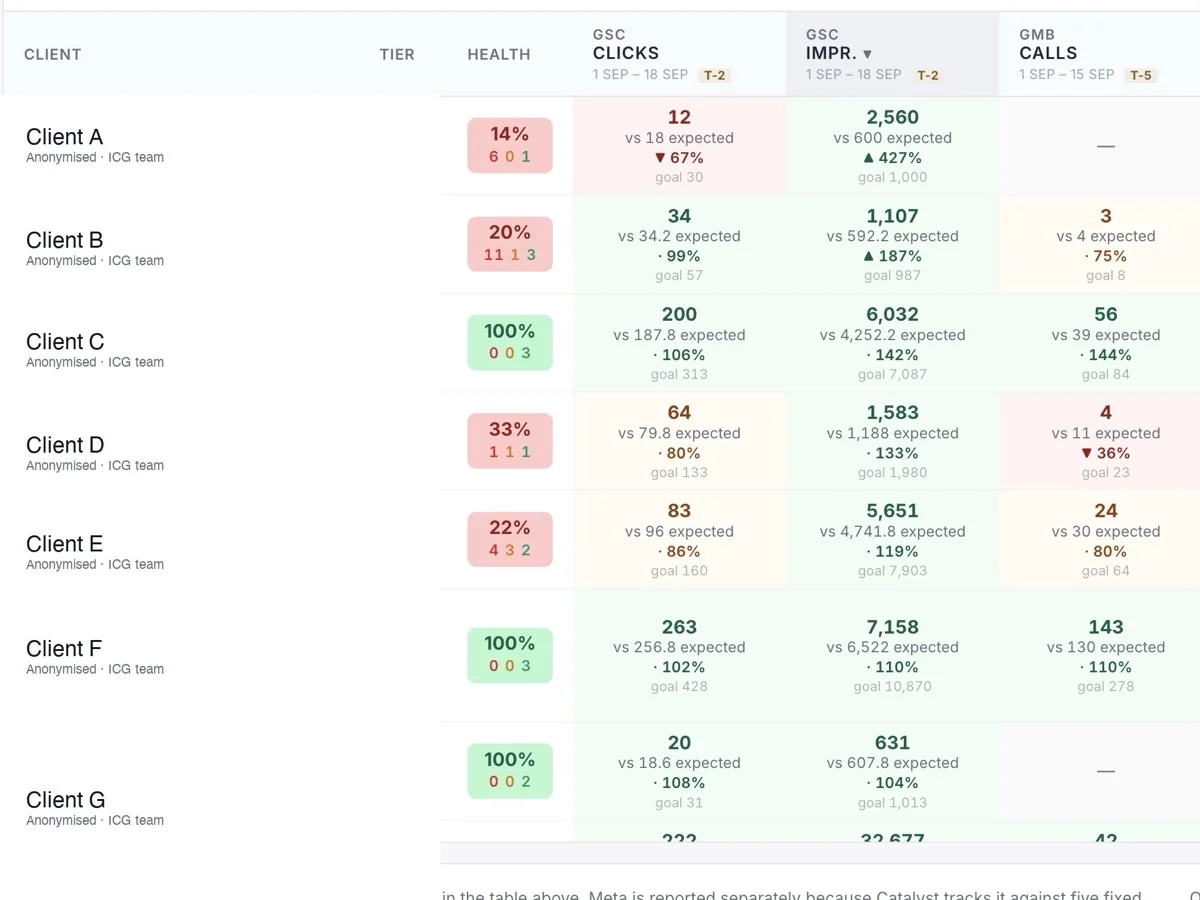
Every engagement is Goals-Driven. We agree monthly goals with you, track them live on Ichelon Agency OS, and send a report every Monday showing progress against each goal, what changed and what we will do next. Where we cannot see practice-management data directly, we agree a simple weekly export with your office manager.
For a deeper look at which numbers matter, read the marketing KPIs every dental practice owner should track.
What happens in the first 90 days with a dental marketing agency?
The first 90 days should move from audit and fixes to launch and then optimization. Month one fixes tracking, the Google profile, the website basics and the front-desk process. Month two launches or rebuilds campaigns and content. Month three cuts what does not work and scales what does. Expect early signals from paid search and slower gains from SEO.
Days 1–30: audit and foundations
- Sign the BAA and get access to the website, Google Business Profile, ad accounts and call tracking.
- Audit local rankings, reviews, competitors, website speed, service pages and current campaigns.
- Set up HIPAA-aware analytics and call tracking, and remove risky pixels from booking and intake pages.
- Fix the Google Business Profile: categories, services, hours, photos and booking link.
- Agree goals, KPI definitions and the weekly data export with the practice.
- Review the new-patient call process and missed-call callback rule with the front desk.
Days 31–60: launch
- Launch or restructure Google Ads by service and location, with call scheduling and negative keywords.
- Publish or rebuild the highest-value service and location pages.
- Start a consent-based review request routine.
- Launch a recall or reactivation campaign to overdue patients.
- Test Meta ads where the offer suits them, such as cosmetic consultations or a membership plan.
Days 61–90: optimize
- Move budget toward the services, keywords and locations with the lowest cost per booked appointment.
- Tighten landing pages based on call and form data.
- Expand content for AI search and local SEO around proven services.
- Review the front-desk answer rate and booking rate with the office manager.
- Set the plan and goals for the next quarter.
What the practice needs to provide
The plan moves faster when the practice is ready. We will ask for admin access to the accounts, a contact at the front desk, an hour with the lead dentist to agree priority services and the patients you want more of, and a short weekly export of new-patient appointments. We will also ask about capacity: which days have open chair time, which providers can take more new patients, and whether hygiene or doctor time is the bottleneck. Marketing that fills a schedule you cannot staff only creates frustration.
If you are starting a brand-new office, the order changes. Our guide to marketing a de novo dental practice covers pre-opening work.
How much does a dental marketing agency cost, and how do we price?
Dental marketing agency fees in the US vary widely, from a few hundred to many thousands of dollars a month, depending on scope, the number of locations, the channels involved and ad spend. Ichelon Consulting US retainers start from $499/month and are custom-scoped to the practice. Ad spend is paid directly to the platforms and is separate.
What drives the cost
| Cost driver | Why it changes the fee |
|---|---|
| Number of locations | Each office needs its own profile, page, reviews and tracking |
| Channels in scope | SEO, Google Ads, Meta, email and front-desk support each add work |
| Market competition | Crowded metros need more content, links and testing to rank and convert |
| Website work | New builds and service-page rewrites take more effort than updates |
| Ad spend managed | Larger budgets need more campaigns, creative and monitoring |
| Reporting depth | Connecting marketing to practice-management data takes setup and upkeep |
How we engage
- Custom-scoped retainers from $499/month. We price what your practice needs, not a fixed package.
- Goals-Driven. Monthly goals agreed with you and tracked live, with a report every Monday.
- Performance-Linked Payout Models. Where the data allows, part of our fee can be linked to agreed outcomes such as booked new-patient appointments.
- Transparent ad accounts. Your practice owns the ad accounts, the Google Business Profile and the website.
For a fuller breakdown, read how much a dental marketing agency costs. To see what your practice would need, book a call with the US team.
How do you choose the right dental marketing agency, and should you hire in-house instead?
Choose an agency that understands dental patients, measures booked appointments and production, explains its work plainly, signs a BAA, and lets you own your accounts. Ask how it tracks results, what it will do in the first 90 days, who will work on your account, and what happens if you leave. Vague answers are a warning sign.
| Question to ask | A good answer sounds like |
|---|---|
| Will you sign a Business Associate Agreement? | Yes, before we touch any patient data or tracking |
| How will you measure success? | Booked new patients, cost per booked appointment and case acceptance, agreed in writing |
| Who owns the ad accounts, website and Google profile? | The practice does; we work with access you can remove |
| How do you handle tracking on booking and intake pages? | HIPAA-safe tools, no ad pixels sending health information |
| How do you get reviews? | A consent-based routine that asks every patient, with no incentives or filtering |
| What will you do in the first 90 days? | A written plan with priorities, owners and dates |
| What are the contract terms? | Clear notice period and a handover of all assets if you leave |
| Who will work on our account? | Named people, with a regular review meeting |
Watch for guaranteed rankings, long lock-in contracts, agency-owned ad accounts, reports without booked appointments and fake or incentivized reviews. Our checklist on how to choose a dental marketing agency has more detail.
Agency, in-house coordinator, or both?
It depends on the size of the practice and the work involved. A single office often gets more from an agency than from one coordinator, because the work spans ads, SEO, the website, analytics and compliance. Larger groups often combine both: an in-house person who owns local relationships and content, and an agency that runs specialist channels and reporting.
What an in-house coordinator does well
- Knows the dentists, the team and the patients, and can capture photos, videos and stories quickly, with authorization.
- Builds local relationships with schools, employers, pediatricians and community groups.
- Runs the review request routine and keeps the Google Business Profile fresh day to day.
- Coordinates recall and reactivation with the front desk.
What an agency usually does better
- Runs Google Ads and Meta campaigns with testing, bidding and tracking experience across many accounts.
- Handles technical SEO, schema, site speed and HIPAA-aware analytics setup.
- Brings writers, designers and analysts without the cost of hiring each role.
- Gives an outside view of what is working and what is not, backed by reporting.
Making a hybrid model work
If you have both, write down who owns each task. A simple split is that the coordinator owns on-site content capture, reviews, community outreach and front-desk coordination, while the agency owns paid media, SEO, the website, tracking and the weekly report. Both should work from the same goals and the same KPI definitions, so nobody argues about whose numbers are right.
Whatever you choose, keep ownership of your accounts. The ad accounts, the Google Business Profile, the domain, the website and the analytics should belong to the practice. People and agencies change; your marketing assets should not leave with them.
Our comparison of a dental marketing agency versus an in-house coordinator walks through the trade-offs, including how to brief either one.
Why practices work with Ichelon Consulting US
- Healthcare only. ICG has worked only in healthcare since 2018, with 150+ healthcare and life-sciences brands across ICG.
- A US entity. Ichelon Consulting US is a Dallas, Texas LLC, and our US client team works Central Time.
- HIPAA-aware by default. We sign a BAA with every US client.
- Goals you can see. Goals-Driven engagements tracked live on Ichelon Agency OS, with a report every Monday.
- Flexible commercial models. Custom-scoped retainers from $499/month, with Performance-Linked Payout Models available.
What we found when we studied 2,318 US dental practices on Google
Patients praise the care and the people. Where they push back is the treatment-plan conversation: upselling is the one review theme where complaints dominate.
2,318 US dental practices across 20 metros · review themes, pace and replies from a 120-practice subsample · every headline figure re-derived from raw data.
Dental practice owners ask
How much does a dental marketing agency cost?
A dental marketing agency costs a monthly management fee plus your ad spend. Scope, channels, locations and content volume set the price. Here is how.
How do I choose a dental marketing agency?
Choose a dental marketing agency by its dental experience, booking-level reporting, HIPAA readiness, account ownership terms and who runs your account.
What does a dental marketing agency actually do?
A dental marketing agency brings in and tracks new patients: local SEO, Google Ads, your Google profile, web pages, reviews, recall and reporting.
How do I measure the ROI of dental marketing?
Measure dental marketing ROI by matching each new patient to its source, then comparing collected revenue with total marketing cost for the same period.
How long does dental marketing take to work?
Dental marketing timing depends on the channel: Google Ads can bring calls within days, while SEO and reviews build over months. Here is what to expect.
Dental marketing agency vs an in-house marketing coordinator: which is better?
An agency fits most single-location dental practices; an in-house coordinator fits groups with steady volume. Many use a hybrid of both.
What are the red flags when hiring a dental marketing agency?
The biggest dental agency red flags: guaranteed rankings, agency-owned accounts, no BAA, review gating, long lock-ins and reports with no booked patients.
Which marketing channels bring dental practices the most new patients?
For most dental practices, Google Business Profile, local SEO and Google Ads bring the most new patients, with recall, referrals and Meta ads in support.
How should dental practices run Facebook and Instagram ads safely?
Run dental Facebook and Instagram ads safely: no pixels on booking pages, no condition-based targeting, no patient lists without counsel, and fast follow-up.
How do dentists optimize a Google Business Profile to rank in the map pack?
Dentists rank in the map pack by choosing the right categories, filling every field, earning steady reviews, posting real photos and matching the website.
How can a dental practice show up in ChatGPT and Google AI Overviews?
Dentists show up in ChatGPT and AI Overviews by publishing clear answer pages, a complete Google profile and consistent facts AI tools can verify.
How should a dental practice use email and recall marketing?
Dental practices should use email and text mainly for recall: timed reminders, overdue-patient reactivation and treatment follow-up, sent with consent.
What does a dental website need to convert new patients?
A dental website converts new patients with clear insurance and fee information, easy booking, real team photos, fast mobile pages and visible trust.
Which marketing KPIs should a dental practice owner track?
Dental owners should track new patients by source, cost per new patient, call answer rate, booking rate, show rate and case acceptance every month.
How much should a dental practice spend on marketing?
A dental practice should set its marketing budget from a new-patient goal and the most it can afford per new patient, then check it against collections.
How do you market a brand-new (de novo) dental practice?
Market a de novo dental practice in stages: build the website and Google profile before opening, then add paid search and a review routine from day one.
How should a DSO or dental group organize its marketing?
A DSO should centralize brand, paid media, data and compliance, and keep reviews, community ties and front desk follow-up local at each office.
How do you switch dental marketing agencies without losing rankings?
Switch dental marketing agencies safely: secure ownership of your domain, website, Google profile, ad accounts and data first, then migrate with redirects.
How does marketing differ for PPO and fee-for-service dental practices?
PPO practices market access, convenience and in-network status to many patients; fee-for-service practices market experience, outcomes and trust to fewer.
How do you market an in-house dental membership plan?
Market an in-house dental membership plan to uninsured patients first: one clear page, front desk scripts, a launch to your list, then local search.
How to market specific services
How should dentists market clear aligner treatment?
Dentists should market clear aligners as supervised, in-office care: an exam-led consult offer, local search, social proof with consent and FDA-accurate claims.
How do dental practices market emergency dental appointments?
Emergency dental marketing is won on speed: accurate hours on Google, call-first ads, protected same-day slots and a phone team that books on the first call.
How should a practice market sedation dentistry?
Market sedation dentistry to anxious adults with calm, permit-accurate language, a low-pressure first visit, patient-led content and claims your board allows.
How do dentists market oral appliance therapy for sleep apnea?
Dentists market oral appliance therapy through physician referrals, CPAP-alternative search pages and careful claims. Channels, compliance, KPIs, a plan.
How should dentists market TMJ and jaw pain treatment?
Dentists should market TMJ care around a careful evaluation, conservative claims and referral partners. Channels, page checklist, KPIs and a plan.
How do practices market dentures and denture services?
Practices market dentures by reaching older adults and their families with clear coverage answers, local search, repair visibility and honest offers.
How should a dental practice market same-day crowns?
Market same-day crowns on time saved and fewer visits, with honest limits on which teeth qualify. Channels, page checklist, claims rules and KPIs.
State-by-state rules and what they mean for marketing
What are the California rules for dental advertising?
California dental ads fall under Bus. & Prof. Code § 651: no misleading claims, exact prices, labeled before-and-after photos and a permit for trade names.
What are the Texas rules for dental advertising?
Texas dental ads follow 22 TAC Chapter 108, Subchapter E: name disclosure, "General Dentist" labels, fee disclaimers, testimonial limits and 4-year ad records.
What are the Florida rules for dental advertising?
Florida dental ads follow § 466.019 and Rule 64B5-4: no laudatory claims, a named responsible dentist, minimum-fee disclaimers and the 72-hour free-offer notice.
What are the New York rules for dental advertising?
New York dental ads fall under Regents Rules Part 29: no guarantees, substantiated claims only, strict testimonial and specialty rules. Checklist inside.
What are the Illinois rules for dental advertising?
Illinois licenses dental specialties, so specialty words in ads need a license or a disclaimer. Section 45 and Rule 1220.421 explained, with a checklist.
What are the Pennsylvania rules for dental advertising?
Pennsylvania dental ads must name a dentist, flag general-dentist status on specialty terms and hold advertised fees 60 days (49 Pa. Code 33.203).
What are the Georgia rules for dental advertising?
Georgia dental ads follow Board Rule 150-10-.01: dentist responsibility, 1-year ad records, fee and free-offer conditions, and seven banned claim types.
What are the Ohio rules for dental advertising?
Ohio dental ads follow OAC Chapter 4715-13: owner names on every ad, owner dentist in trade names, patient-of-record testimonials and a 2-year ad archive.
What are the North Carolina rules for dental advertising?
North Carolina dental ads follow 21 NCAC 16P: name and designation in every ad, fee and discount disclosures, consent for patient identity, specialist limits.
What are the Arizona rules for dental advertising?
Arizona dental ads need "Services provided by an Arizona licensed general dentist," specialist claims limited to nine areas, and no paid patient referrals.
What are the Colorado rules for dental advertising?
Colorado dental ads fall under Dental Board Rule 1.17: a licensee approves each ad, claims need proof on file, and testimonial and specialty rules apply.
What are the Washington rules for dental advertising?
Washington dental ads must not claim superiority over nearby dentists (RCW 18.32.665), and specialist titles need qualifying training (WAC 246-817-420).
What are the Massachusetts rules for dental advertising?
Massachusetts dental ads must name a licensed owner, state how long fees apply and value any free offer (234 CMR 5.18). Specialty claims are limited.
What are the New Jersey rules for dental advertising?
New Jersey dental ads must show the dentist's name with "General Dentist" or a Board specialty permit, and fee offers need disclosures (N.J.A.C. 13:30-6.2).
Checklists and templates for hiring an agency
What should a dental practice check in a marketing agency contract?
Check nine clauses before signing a dental marketing contract: term and notice, scope, fees, ad-spend billing, account ownership, BAA, reporting and handover.
How should a dental practice write a marketing agency RFP?
A dental marketing RFP should cover practice background, goals, scope, budget range, compliance needs, weighted evaluation criteria, timeline and agency questions.
How can a dental practice audit its own marketing?
Audit your dental marketing in nine areas: Google Business Profile, website, search, ads, social, reviews, speed-to-lead, HIPAA-safe tracking and reporting.
What should happen in the first 90 days with a new marketing agency for a dental practice?
In the first 90 days a dental marketing agency should sign a BAA, audit tracking, fix your Google profile, ship quick wins and agree a weekly report.
What should a 2027 marketing plan for a dental practice include?
A 2027 dental marketing plan sets new-patient goals by service, target patients, channel mix and budget, a calendar, KPIs and compliance checks.
Answers to questions US buyers search
Dental consultant vs dental marketing agency: what is the difference and what do they cost?
A dental consultant fixes how the practice runs; a dental marketing agency brings new patients in. Here is how each is priced and which to hire first.
How can a dental practice attract more high-value cases?
Dental practices attract more high-value cases with dedicated service pages, case-specific ads, clear financing, a trained consult process and patient proof.
Should a dental practice advertise on TikTok?
TikTok ads suit dental practices selling visual, elective treatments like aligners or whitening once search and the Google profile already convert well.
Should a dental practice use an AI receptionist for calls and bookings?
An AI receptionist helps a dental practice answer overflow and after-hours calls, if it books into real schedules, hands off to staff and runs under a BAA.
How do you market a dental practice in a small town or rural area?
Market a small-town dental practice by owning Google results across nearby towns, building community ties, keeping recall tight and protecting your name.
What is the 80/20 rule in dental practice marketing?
The 80/20 rule in dental marketing: a few channels, procedures and patients drive most new-patient revenue. How to find yours and shift budget to them.
How can an independent dentist compete with DSO marketing?
Independent dentists compete with DSO marketing by owning local search, reviews that name the dentist, continuity of care and fast, personal follow-up.
How much does dental SEO cost?
Dental SEO cost depends on competition, locations, services and content needed. See the pricing models, cost drivers and what a fair scope includes.
How should a dental practice ask patients for Google reviews?
Ask every dental patient for a Google review, in person and by a consented link, with no incentives or filtering, and reply without confirming care.
How can a dental practice increase new patient flow?
Increase dental new patient flow by fixing phone handling, your Google Business Profile and reviews first, then adding search, ads and reactivation.
Marketing calendars and plans for 2027
What should the 2027 marketing calendar look like for dental practices?
A 2027 dental marketing calendar: benefit resets in January, kids' month in February, back-to-school in August and year-end benefits campaigns in Q4.
Guides for the people who run marketing day to day
What does a dental office manager need to know about marketing?
A dental office manager owns the marketing that happens at the desk: new-patient calls, recall, reviews, case follow-up and a weekly report to the dentist.
Step-by-step guides by specialty and channel
Social Media Marketing for Dental Practices
Dental social media works when posts show the dentist, the office and the next step to book. Platforms, post ideas, ad ideas, HIPAA rules and KPIs.
Dental Website Conversion Optimization: Turning Visitors into Booked Patients
A dental website converts when booking is obvious, trust is visible and pages load fast on a phone. The checklist, tests and KPIs to book more patients.
YouTube Marketing for Dental Practices
YouTube helps dental practices win implant, aligner and anxious-patient decisions. What to film, how to get found, ad ideas, compliance and KPIs.
Tell us what your practice needs
Send a short note and a member of our US team replies within one US business day with next steps. No obligation.
Prefer to talk? Book a 30-minute call or call +1 (724) 612-3694.
Related pages from the US team
US dental practice marketing hub
City pages, guides and research for US dental practices.
Dental SEO guide
How SEO for dentists works, from service pages to the map pack.
Google Ads for dentists
A step-by-step setup for dental search campaigns.
Dental marketing statistics 2026
Public data points dental practice owners ask about.
HIPAA dental advertising compliance
Tracking, patient stories and reviews under HIPAA.
What a dental marketing agency costs
Cost drivers and pricing models explained.
Every practice welcome — Goals-Driven engagements from $499/mo
We benchmark your last 90 days, agree monthly goals with you, and track them live on Ichelon Agency OS with a report every Monday. Performance-Linked Payout Models are available. Our US leadership is based in Dallas, and strategy calls run in US business hours.
Common questions
What does a dental marketing agency do?
A dental marketing agency plans and runs the channels that bring new patients to a dental practice: local SEO and Google Business Profile, Google Ads, Meta ads, the website, reviews, recall and email or SMS. A good one also improves how calls and forms are followed up and reports results as booked appointments and treatment accepted, not just clicks.
How much does a dental marketing agency cost in the US?
Fees vary widely, from a few hundred to many thousands of dollars a month, depending on the number of locations, channels in scope, market competition and ad spend. Ad spend is usually paid directly to Google and Meta on top of the fee. Ichelon Consulting US retainers start from $499/month and are custom-scoped to each practice.
How long does dental marketing take to show results?
Google Ads can produce calls within days of launch once tracking and landing pages are ready. Google Business Profile fixes and review routines tend to show gains over weeks. Local SEO and content usually take several months in competitive markets. Most practices run paid search while SEO builds, then rebalance budget as organic visibility grows.
Is SEO or Google Ads better for a dental practice?
Most dental practices need both. Google Ads captures patients searching right now for services such as emergency care or implants, and it can be switched on quickly. Local SEO and Google Business Profile build lasting visibility in the map results at lower ongoing cost. The right balance depends on your goals, competition, budget and front-desk capacity.
Can dental practices use Facebook and Instagram ads under HIPAA?
Yes, with care. Meta limits health-based targeting, so campaigns rely on location, creative and offers. Ad pixels should not send health information from booking, intake or patient-portal pages. Patient photos and stories need written HIPAA authorization. Use HIPAA-safe tracking, work with vendors who sign Business Associate Agreements, and confirm your setup with counsel.
What KPIs should a dental practice track from its marketing?
Track new-patient enquiries, call answer rate, booked appointments, show rate, cost per booked appointment, case acceptance for key services, production from new patients, map pack visibility, review velocity and recall completion. Agree on the definition and data source for each KPI with your agency before campaigns start, so reports connect marketing to the chair.
Does a dental marketing agency need to sign a BAA?
If the agency will create, receive, maintain or transmit protected health information on the practice's behalf, such as call recordings, form submissions or patient lists for recall campaigns, it generally acts as a business associate and should sign a Business Associate Agreement. Ichelon Consulting US signs a BAA with every US client. Confirm your obligations with counsel.
What are red flags when hiring a dental marketing agency?
Warning signs include guaranteed rankings or patient numbers, long lock-in contracts, ad accounts or websites owned by the agency, refusal to sign a Business Associate Agreement, buying or incentivizing reviews, ad pixels on booking pages, and reports that show clicks but never booked appointments or production. Ask for a written 90-day plan before signing.
A note on this guide: it explains marketing practice, not legal advice. Rules on privacy, advertising and insurance change and vary by state, so confirm anything compliance-related with your own counsel.
Want a dental marketing plan built around booked patients?
Book a call with the US team. We'll review your Google profile, ads, website and new-patient call handling and tell you what we would fix first.
We cover every stage, from first search to repeat visit
- 0Foundations
- 1Demand gen
- 2Capture
- 3Lead quality
- 4Lead mgmt
- 5Scheduling
- 6Show-up
- 7Conversion
- 8Retention
We work across all nine stages, from foundations to past patients, and fix the stage that leaks first. Our own software runs the work, and every stage is reported against a monthly target on Ichelon Agency OS.
See all nine stages and the tool behind each one →