


YODA vs Hootsuite for healthcare YouTube 2026: multi-platform social management breadth versus healthcare-YouTube depth and Indian compliance
Hootsuite is one of the best-known multi-platform social media management tools — scheduling, inbox, analytics and listening across many networks. Video is one piece of a broader footprint. YODA is a healthcare-YouTube-only intelligence platform with organic-paid separation, three-race rank tracking and Indian compliance built in. Where each fits for an Indian hospital, clinic or specialty group.
No pitch. Written root-cause diagnosis. AI-powered, healthcare only.
Direct answer
Hootsuite is one of the best-known multi-platform social media management tools — scheduling, inbox, analytics and listening across many networks. Video is one piece of a broader footprint. YODA is a healthcare-YouTube-only intelligence platform with organic-paid separation, thre...
TL;DR
Hootsuite is one of the best-known social media management platforms in the world — a Canadian company founded in 2008 that today gives marketing teams a single console for scheduling posts, monitoring inboxes, listening to conversations and reporting on analytics across a long list of social networks including Facebook, Instagram, LinkedIn, X (Twitter), TikTok, Pinterest, YouTube and threads-style newer networks. YODA is a different category of tool entirely — an AI-native healthcare YouTube marketing platform built by ICG that focuses only on YouTube, only on healthcare use cases, and only on turning raw channel data into decisions plus writeback to the platform. Both tools can technically touch YouTube. Neither tool is a straight substitute for the other. This piece maps where they overlap, where they diverge, and which Indian healthcare buyers should reach for which. Buyers evaluating healthcare YouTube marketing engagement alongside the broader healthcare local SEO agency stack benefit from an honest read of the trade-offs before picking a tool.
The category difference: multi-platform social versus healthcare-YouTube depth
Hootsuite is a social media management platform for marketing teams that need one console for many networks. The buyer profile is the marketing team running a brand across at least four or five social channels, where the cost of context-switching between native apps outweighs the cost of a paid consolidator. Hootsuite's design and pricing (approximate self-serve plans start around $99/month for individuals and rise to $249-$739+/month for team and business plans, verify current pricing with vendor) reflect that assumption — you are paying for breadth, not depth on any single platform.
YODA's design assumption is the opposite. A healthcare channel where YouTube matters — a hospital group, an IVF chain, a founder-doctor building personal brand, a specialty cosmetic surgery group — needs depth on YouTube specifically, and needs healthcare compliance flags a general social tool does not carry. Depth over breadth, YouTube over multi-network, healthcare over generic.
Both design assumptions are internally valid for their target buyer. The mistake is expecting one tool to do both jobs.
What Hootsuite does well when video is involved
Being honest about Hootsuite's strengths matters. On the video side, Hootsuite covers scheduling YouTube uploads (including Shorts), scheduling native video uploads to Facebook, Instagram Reels and TikTok, providing an inbox that surfaces YouTube comments alongside comments from other networks, offering basic engagement analytics per video across the networks it supports, and giving cross-network reporting where the same short-form video can be tracked as it lives on multiple networks. For a marketing team already invested in Hootsuite for the rest of their social footprint, adding YouTube scheduling and comment moderation to the same console is a real productivity win.
Hootsuite's AI features (Amplify content ideas, OwlyAI writing assist and similar in-tool AI helpers) also generate on-brand caption and post copy across networks, and the Insights add-on layers listening across social platforms for brand mentions and sentiment. For a hospital brand with a marketing team already running Twitter/X, Instagram, LinkedIn and Facebook alongside YouTube, that is a genuinely coherent workflow.
Where Hootsuite stops when the problem is healthcare YouTube specifically
Six specific gaps show up when a healthcare channel evaluates Hootsuite as the tool of record for YouTube.
Video is one product among many. Hootsuite's roadmap has to serve Facebook advertisers, LinkedIn B2B marketers, TikTok short-form creators and Instagram community managers in addition to YouTube. YouTube-specific depth (retention curves per video, per-cluster diagnostics, format analysis, three-race rank tracking) is not the roadmap's centre of gravity.
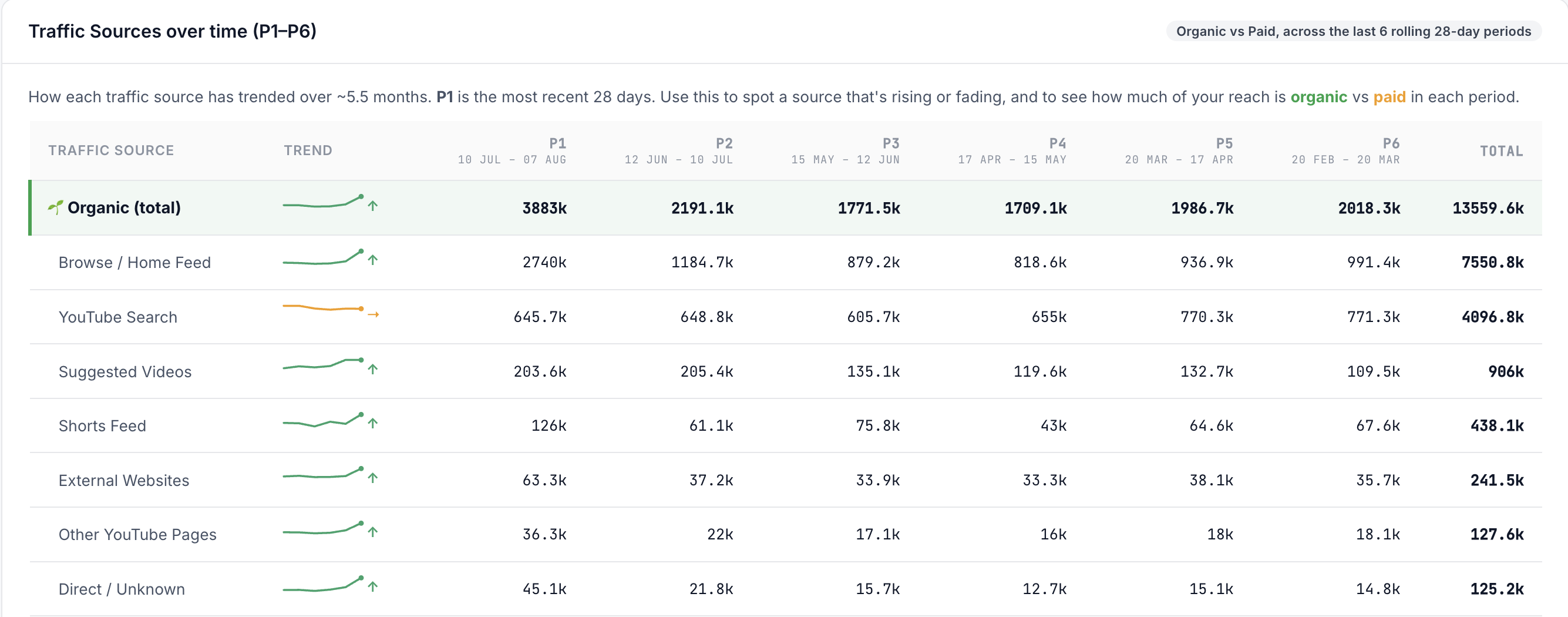
No separation of organic from paid views. Hootsuite's analytics show views without distinguishing paid promotion from organic reach on YouTube. A hospital that ran a Google Ads video campaign on last quarter's founder-doctor video sees the cumulative views without the clean paid-vs-organic split YODA enforces everywhere.
No rank tracking on YouTube search, Google web or Google AI Overview. Hootsuite reports engagement, not rankings. Whether a hospital's videos rank on YouTube search for the specialty's core queries, whether they show in Google web video carousels, and whether they are cited in Google AI Overview — none of that is inside Hootsuite. YODA tracks all three as separate rank races.
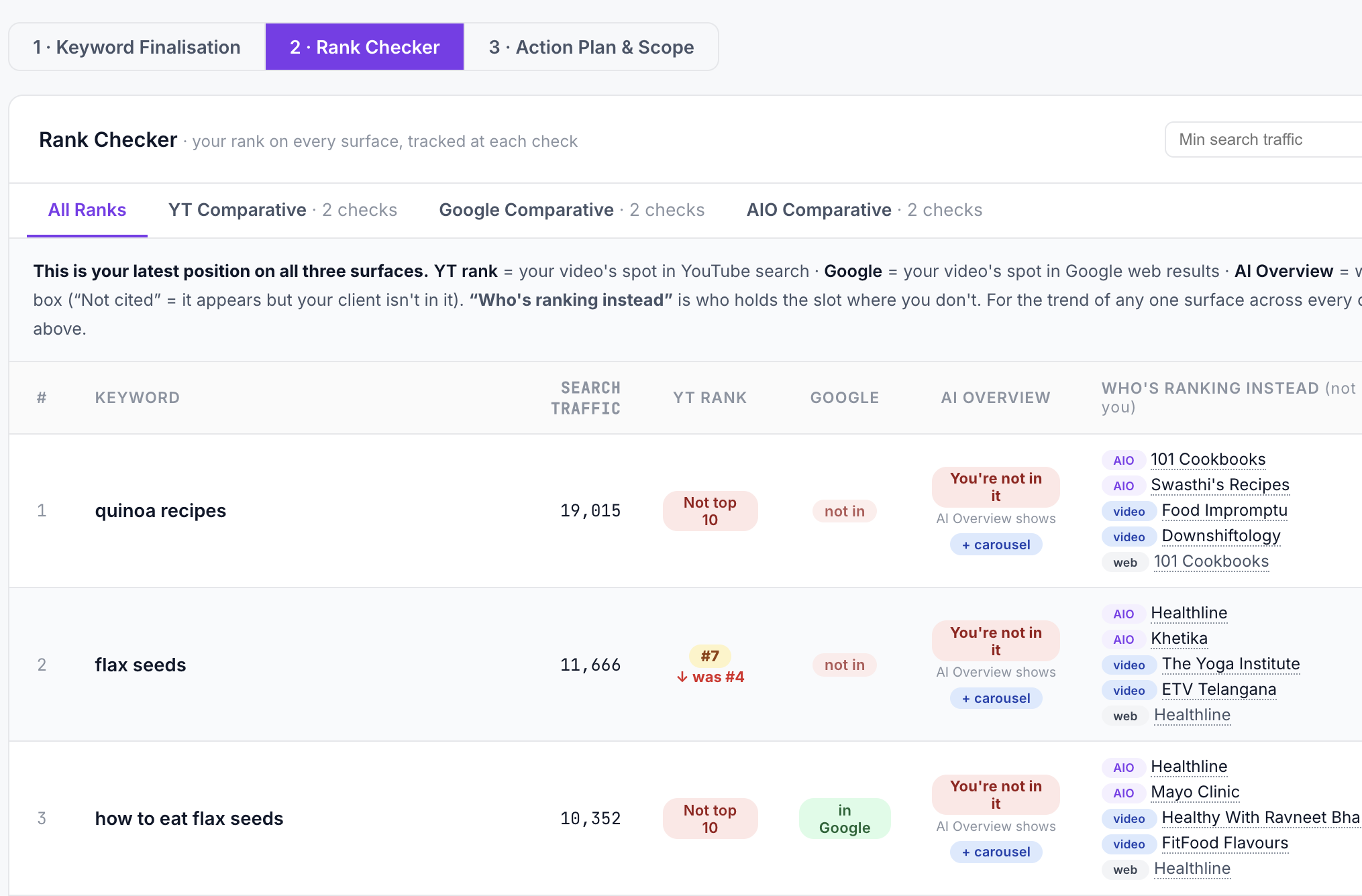
No writeback of YouTube-specific metadata. Hootsuite lets you schedule the initial upload with a title and description, but does not run an SEO Lab that drafts improved titles/tags/descriptions/chapters based on ranking analysis and applies them to an already-published video. YODA does — with operator review.

No healthcare-specific compliance layer. Hootsuite is a generic social platform. It does not know NMC Ethics Code 2026 restricts doctor advertising language, does not flag ASCI-non-compliant unsubstantiated superlatives in a video description, does not know DPDP Act 2023 treats identifiable patient footage as personal data, does not check PC-PNDT Act 1994 constraints on fertility content, and does not check ART Act 2021 rules on ART clinic content. YODA is built for this specifically.
No competitor channel intelligence. Hootsuite Insights covers social listening across networks, but does not benchmark a hospital's YouTube channel against the specialty's other YouTube channels the way YODA's Competitor Intel step does — competitor video coverage, topical gaps, format performance benchmarks, ranking overlap.
What YODA adds on top of a general social platform
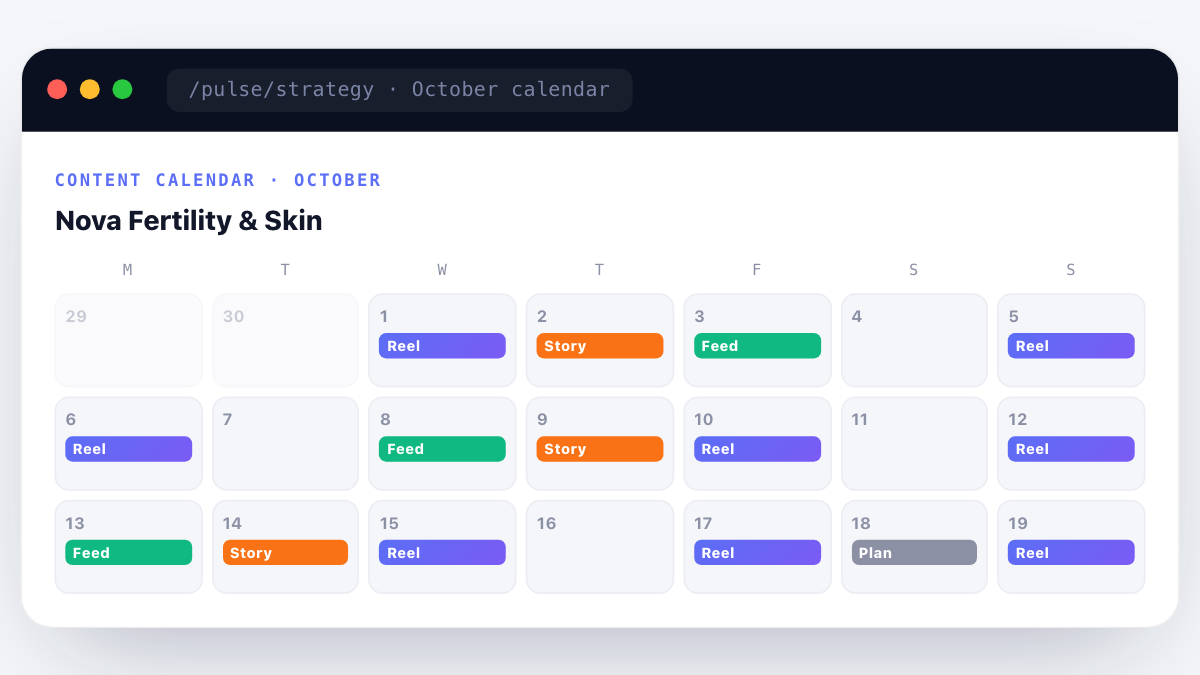 Prism Pulse content calendar showing the month ahead with Reel, Feed and Story slots colour-coded per day for a healthcare Instagram account" width="1200" height="675" loading="lazy" decoding="async" style="width:100%;height:auto;display:block;">
YODA is not attempting to be a multi-network social console. It is attempting to be the intelligence and decisions layer for a healthcare YouTube channel, and its architecture reflects that.
Organic-paid separation everywhere. Paid views are subtracted before any judgement in any module. A promoted video's ad-driven views can never masquerade as organic growth inside YODA.
Decisions not dashboards. Every video gets a state (winning, holding, losing, dead) and a next action (retitle, re-thumbnail, add chapters, republish, retire, ad-boost). Every targeted keyword gets a rank across the three races plus a plan (protect, improve, chase, drop). Studio and Hootsuite show numbers; YODA turns them into a ranked to-do list.
Direct writeback to YouTube. Improved titles, tags, descriptions, chapters drafted inside YODA can be pushed back to YouTube via API in one operator-reviewed action.
Three rank races tracked. YouTube search, Google web (video carousels, featured video snippets), Google AI Overview citations. Each is a separate race with separate signals and a separate action plan.
Healthcare compliance in the fabric. SEO Lab flags NMC/ASCI risk in titles and descriptions. Reputation module flags DPDP-sensitive comments. Content Studio proposes topics ranked by search opportunity and compliance fit. PC-PNDT and ART Act boundaries are surfaced for fertility channels specifically.
The 6-step YODA workflow vs Hootsuite's tab structure
Hootsuite is organised as tabs — Streams (feed of posts across networks), Publisher (scheduling), Inbox (unified inbox), Analytics, Listening, Advertise, and various admin functions. YODA is organised as a 6-step workflow mirroring how a healthcare YouTube channel actually gets run — Overview & Setup, Diagnostics, Strategy, Optimisation, Reputation (ORM), Competitor Intel — with 40+ analysis modules distributed across those steps.
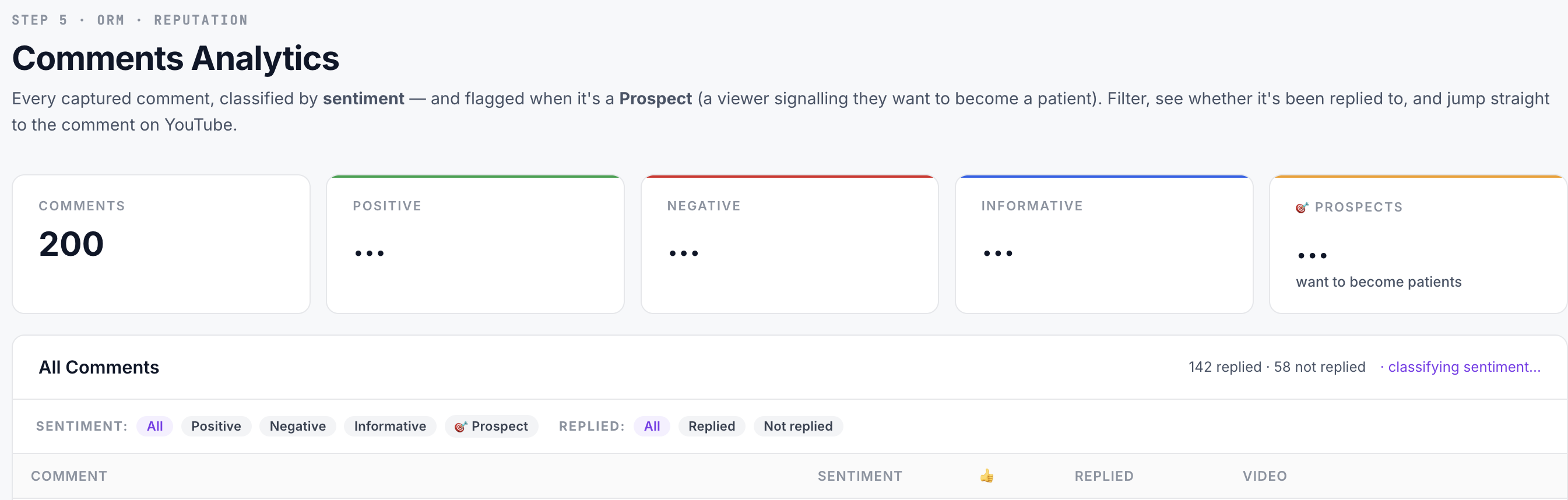
Overview & Setup connects data sources and sets benchmarks. Diagnostics clusters videos by format, retention, traffic source, funnel stage, geography and cohort. Strategy surfaces trending topics for the specialty, a content planner, ad-spend picks, and a 30-day action plan. Optimisation runs the SEO Lab, AIO engine, distribution planner, thumbnail assistant and per-video impact tracker. Reputation analyses comment sentiment and audience voice, groups audience by intent, flags NMC-sensitive comments. Competitor Intel benchmarks the channel against the specialty's other channels and feeds a decision engine.
The compliance perimeter Hootsuite cannot see
Hootsuite is a global platform serving retail brands, financial services, education, hospitality and dozens of other verticals. Its compliance features are enterprise-level content approvals, role permissions, and audit trails — not vertical-specific medical advertising rules.
Indian healthcare has a specific rules perimeter. NMC Ethics Code 2026 restricts registered medical practitioners from soliciting patients through advertisement that guarantees outcomes or makes comparative claims about clinical results. DPDP Act 2023 treats identifiable patient footage or names in video content as personal data requiring lawful basis and consent, including for social distribution. ASCI Guidelines 2022 require substantiation for advertising claims and disallow unsubstantiated comparative superlatives. PC-PNDT Act 1994 prohibits any content that could be construed as sex-determination advertising, which shows up as a real risk for gynaecology and fertility channels. ART Act 2021 bars unsubstantiated success-rate claims on ART/IVF content.
YODA is built for this rules perimeter. Hootsuite is not — nor should Hootsuite be expected to be, given its multi-vertical global positioning. A hospital that runs YouTube through Hootsuite carries the compliance-checking burden itself, or through a separate legal review workflow.
When Hootsuite is the right pick
Hootsuite genuinely fits when: the hospital brand runs at least four or five social networks with meaningful investment on each, YouTube is one channel among many rather than the primary growth channel, the marketing team wants a single scheduling and inbox console, the video work is fairly evenly split between short-form (Reels, Shorts, TikTok) and long-form YouTube, and the hospital already has separate legal/compliance review workflows for medical advertising rules. For a large hospital brand with a full multi-channel social media team, Hootsuite is a reasonable core stack decision.
When YODA is warranted
YODA earns its place when YouTube is a serious growth channel — patient inquiries are attributable to YouTube, Google Ads or Meta Ads spend is going behind videos, more than two videos a month are being published, the specialty is competitive enough that competitor channel intelligence matters, ranking in Google AI Overview for brand queries matters, and the operator wants healthcare-compliance flags in-tool rather than through separate legal review. Multi-location hospital groups, IVF and fertility chains, cosmetic surgery groups, specialty hospital networks, and founder-doctor personal-brand channels will typically hit this threshold.
YODA and Hootsuite are not mutually exclusive. A large hospital can genuinely run Hootsuite for cross-network social scheduling and reporting while running YODA for the YouTube-specific intelligence, decisions and compliance layer. The overlap is small — Hootsuite handles scheduling the initial upload and unified inbox for multi-network comment moderation; YODA handles diagnostics, three-race rank tracking, SEO Lab writeback, competitor intel and compliance flags.
Pricing — honest picture
Hootsuite pricing is approximate at time of writing (verify with vendor for current plans): Professional around $99/month for a single user and 10 social accounts, Team around $249/month for 3 users and 20 accounts, Business around $739/month for 5 users and 35 accounts, and Enterprise on custom pricing. Add-ons like Insights (advanced listening) and Advertise are priced separately.
YODA is a paid layer inside ICG's managed healthcare YouTube marketing service, typically bundled with content production, thumbnail design, distribution and reporting — engagement pricing sits on the healthcare YouTube marketing service page where a managed retainer for a serious healthcare channel starts. It is not sold as a self-serve tool at Hootsuite-style tool pricing.
Decision matrix — YODA, Hootsuite, or both
 Meta Catalyst IQ Creative Scoring Matrix ranking every Meta ad creative by hook strength, proof density, offer clarity and CTA — with money-wastage column in rupees" width="1200" height="675" loading="lazy" decoding="async" style="width:100%;height:auto;display:block;">
Pick Hootsuite alone if: multi-network social scheduling is the primary need, YouTube is one channel among many, and healthcare compliance review sits in a separate workflow.
Pick YODA alone if: YouTube is the primary growth channel, the hospital does not need heavy multi-network scheduling, and healthcare compliance needs to be in-tool.
Run both if: the hospital brand runs many networks (Hootsuite for the cross-network layer) AND YouTube is a serious growth channel with meaningful spend, ranking goals and compliance-sensitivity (YODA for the YouTube intelligence layer).
The platform ICG uses to run this at scale: YODA
ICG runs healthcare YouTube marketing for clinics, hospitals, and specialty groups using YODA — our AI-native healthcare YouTube marketing platform. YODA sits on top of a channel's data and does four things no dashboard does: it separates organic from paid views at every step (so a promoted video can never masquerade as organic growth), it gives decisions not dashboards (every video gets a state + next action), it writes back to YouTube directly (improved titles, tags, descriptions, chapters applied straight to the platform), and it tracks the three rank races — YouTube search, Google web, and Google AI Overview citations.
YODA runs the full 6-step workflow — Overview, Diagnostics, Strategy, Optimisation, Reputation (ORM), and Competitor Intel — with 40+ analysis modules organised under those steps. ICG's managed YouTube service uses YODA end-to-end. See the Healthcare YouTube Marketing pillar guide for the full scope, or the Healthcare YouTube Marketing Agency service page for engagement details.
Book a YODA demo on WhatsApp → or request a free healthcare YouTube channel audit →
Related reading
- Healthcare YouTube marketing pillar guide — full scope of YouTube for Indian healthcare
- Healthcare YouTube Marketing Agency service page — engagement details
- Hospital video marketing in India 2026
- YouTube for doctors — from views to patient consults
- Best time to post on YouTube for healthcare in India 2026
FAQ
Is Hootsuite a good tool for YouTube marketing? It is good for scheduling uploads and running comments in a unified inbox across networks. It is not a YouTube-depth intelligence tool — no rank tracking, no organic-paid separation, no writeback beyond initial upload, no competitor channel intel.
Can Hootsuite track YouTube rankings? No. Hootsuite reports engagement metrics, not search rankings. Whether a video ranks on YouTube search, Google web or Google AI Overview is not something Hootsuite surfaces.
Does Hootsuite separate organic from paid YouTube views? Not cleanly. Hootsuite reports cumulative views without the strict organic-paid split YODA enforces everywhere. Operators who need paid subtracted before any judgement should not rely on Hootsuite for that.
Does Hootsuite check healthcare advertising compliance? No — it is a general-purpose multi-vertical platform. NMC, ASCI, DPDP, PC-PNDT and ART Act compliance are outside its scope. Hospitals using Hootsuite carry the compliance-checking burden externally.
Should a hospital run YODA and Hootsuite together? Yes, if the hospital brand runs multi-network social AND YouTube is a serious growth channel. Hootsuite covers cross-network scheduling and inbox; YODA covers YouTube intelligence, three-race rank tracking, writeback and healthcare compliance.
What does YODA do that Hootsuite does not for YouTube? Diagnostics with format/retention/funnel/cohort clustering, three-race rank tracking (YouTube search, Google web, Google AI Overview), SEO Lab writeback of improved metadata to the platform, organic-paid separation everywhere, competitor channel intelligence and healthcare-specific compliance flags in-tool.
Is YODA a self-serve tool like Hootsuite? No. YODA is a paid layer inside ICG's managed healthcare YouTube marketing service. Hootsuite has self-serve plans; YODA is bundled with content production, thumbnail design, distribution and reporting as part of a managed retainer.
What does Hootsuite do that YODA does not? Multi-network scheduling and inbox across Facebook, Instagram, LinkedIn, X, TikTok, Pinterest and others; cross-network reporting; social listening across networks. YODA is YouTube-only by design.
Does Hootsuite support YouTube Shorts? Yes, Shorts can be scheduled alongside Reels and TikTok content in Hootsuite's publisher. YODA analyses Shorts as one of the video types inside the healthcare channel, separately from long-form.
Which Indian healthcare buyers should pick YODA over Hootsuite? Multi-location hospital groups, IVF and fertility chains, cosmetic surgery groups, specialty hospital networks, and founder-doctor personal-brand channels — anywhere YouTube is a serious growth channel, ranking matters, paid spend is behind videos, and healthcare compliance needs to sit in-tool.
Book a free 30-minute Brand & Growth Diagnostic.
It's a working session, not a sales pitch — you leave with a written root-cause analysis you can act on, whether or not you engage ICG.
The three platforms
behind every ICG engagement.
Beacon
CAPI middleware that fixes Event Match Quality, translates CRM statuses to Meta-standard events, dedups across channels.
Agency OS
Live client dashboard. GSC, GA4, Google Ads, Meta Ads, IVR calls in one view. Login anytime, not monthly.
Phoenix
Clinic revenue intelligence over your PMS. Daily action queue: Prevent Loss, Maintain & Engage, Grow Revenue. 46-centre rollout.
Or book a free 30-min audit to see all three in action on your account.
Healthcare brands
that already run on ICG.
A representative slice of the 150+ healthcare brands ICG has delivered for across India. Most engagements remain under NDA.


What ICG clients say · on video.
"Scale up of organic channels and business consulting. ICG has absolute domain authority in their field."
"Working with ICG transformed how we acquire IVF patients in Gurgaon. They understand the fertility journey from inquiry to consult..."
"What Ichelon accomplished — they got all my ideas and worked over 3-4 months to create an amazing, super-customised website."
Need help operationalising this?
Every ICG service is healthcare-only, NMC + DPDP-aware, and built around the patient-research patterns that drive Indian healthcare growth in 2026.
More from
ICG.
Healthcare AIO is the discipline of getting your clinic or hospital cited inside Google AI Overviews, ChatGPT and Perplexity answers — not j...
Conversational-search advertising places brand messages inside AI chat answers — ChatGPT, Perplexity, Copilot — rather than beside a results...
NABH digital compliance means every claim, image and testimonial your hospital publishes online matches what an accreditation surveyor can v...
Stop guessing.
Book a Diagnostic.
30 minutes. Free. With the AI-powered healthcare-only marketing agency 150+ brands already run on. No slides, no pitch, no hard close.


