


Schedule J 2026: 54 Conditions India Bans in Health Ads | ICG
Schedule J bans ads for 54 conditions under India's DMR Act. See the full list, 2026 enforcement cases, and a compliance framework for healthcare marketers.
No pitch. Written root-cause diagnosis. AI-powered, healthcare only.
Direct answer
Schedule J bans ads for 54 conditions under India's DMR Act. See the full list, 2026 enforcement cases, and a compliance framework for healthcare marketers.
TL;DR
Schedule J of the Drugs and Magic Remedies (Objectionable Advertisements) Act, 1954 is one of the most consequential and least understood regulations in Indian healthcare marketing. It lists 54 conditions — from cancer to alopecia to sterility — for which advertising of treatments to the general public is prohibited.
The confusion is widespread. Most healthcare marketers know Schedule J exists. Very few understand what "advertising" means in this context, which media channels are covered, and how to frame content for Schedule J conditions compliantly.
This article is the definitive resource. ICG's pharma practice has navigated Schedule J across 150+ healthcare client engagements since 2018. This is what we know.
What Is the Drugs and Magic Remedies Act?
The Drugs and Magic Remedies (Objectionable Advertisements) Act, 1954 (DMRA) prohibits advertisements of:
- Drugs claiming to cure, prevent, or treat certain diseases
- "Magic remedies" claiming efficacy without scientific basis
The Act was designed to protect the public from quackery and fraudulent health claims. It remains in force, with Schedule J listing the conditions where advertising of treatments is prohibited for the general public.
The penalty for violation: imprisonment up to six months, or a fine, or both. Repeat violations carry stricter penalties. The Ministry of Health and Family Welfare and state drug controllers are the enforcement authorities.
The Full Schedule J List (54 Conditions)
The following conditions are listed under Schedule J. Advertising treatment for any of these conditions to the general public is prohibited:
Serious/life-threatening diseases: Cancer, Cataracts, Deafness, Epilepsy/fits, Heart disease, High/low blood pressure
Reproductive and sexual health: Female diseases (menstrual disorders), Sterility in women, Venereal disease (STDs/STIs), Sexual impotence, Breasts (underdeveloped), Conception control (contraception claims beyond approved labelling)
Metabolic and endocrine: Diabetes, Glaucoma, Goitre, Leprosy, Paralysis, Ruptures/hernia
Mental health and neurological: Mental illness, Blindness
Skin and hair: Alopecia (hair loss), Leucoderma/vitiligo, Obesity
Other listed conditions: Appendicitis, Arteriosclerosis, Blood poisoning, Bright's disease (kidney), Dropsy, Infantile paralysis, Plague, Pleurisy, Pneumonia, Smallpox, Tuberculosis, Typhoid fever, Ulcer (stomach), Whooping cough, Yellow fever, Locomotor ataxia, Rheumatism, Sciatica
Note: The complete, authoritative list is available at the Ministry of Health and Family Welfare website. Marketers should verify the current version as the schedule may be updated.
What Does "Advertising" Mean Under Schedule J?
The DMRA defines advertising broadly. It includes:
- Print advertisements (newspapers, magazines, brochures)
- Audio and visual broadcasts (television, radio)
- Digital content (websites, social media, email)
- Outdoor advertising (hoardings, posters)
- Any notice, circular, label, or wrapper
This means a clinic's Instagram post claiming "we treat hair loss effectively" could be an advertisement under Schedule J — even if the doctor believes the statement to be true.
What Is Permitted: Service Framing vs Drug Advertising
Here is the critical distinction that most healthcare marketers miss:
Schedule J prohibits advertising of drug treatments for listed conditions to the general public.
It does NOT prohibit:
- Advertising the existence of a clinical service
- Educational content about a condition
- A doctor describing their qualification to treat a condition
- Patient-facing information about what a consultation involves
The ICG framework applies "service framing" as the compliant alternative:
| Prohibited (Drug/Treatment Framing) | Permitted (Service Framing) |
|---|---|
| "Our clinic cures diabetes with innovative treatment X" | "Dr [Name] is an endocrinologist specialising in metabolic health. Book a consultation." |
| "Beat cancer — our chemotherapy protocol has a 70% response rate" | "Our oncology department offers comprehensive cancer care. Speak to our team." |
| "Cure alopecia with our hair growth formula" | "Our dermatology clinic offers consultation for hair and scalp conditions." |
| "We treat sexual impotence — guaranteed results" | "Our andrology clinic provides confidential consultation for men's health concerns." |
| "Control diabetes permanently with our programme" | "Endocrinology consultation available. Individual outcomes depend on diagnosis and treatment plan." |
The test: does your content make a claim about a specific treatment curing, preventing, or treating a Schedule J condition? If yes — revise to service framing.
High-Risk Areas by Specialty
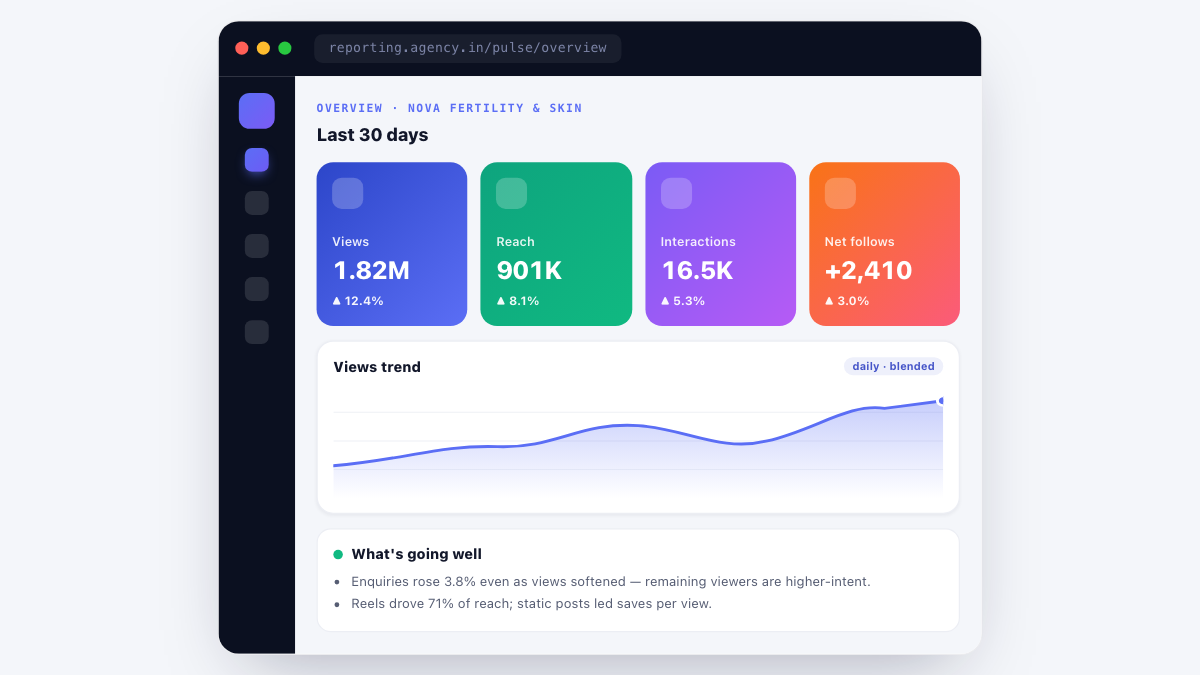
IVF and Fertility Clinics Schedule J lists sterility in women. This means advertising any fertility treatment's outcomes — success rates, pregnancy rates — for the general public is prohibited. The ART Act 2021 adds further restrictions specific to IVF. ICG's IVF clients operate under a dual-compliance framework: Schedule J + ART Act.
CPQL benchmark for ICG's IVF clients: ₹1,180 (market median approximately ₹2,400). This performance differential is achieved entirely through educational and service-framed content — not outcome claims.
Dermatology and Hair Clinics Alopecia and leucoderma/vitiligo are both Schedule J conditions. Skin clinics regularly run campaigns claiming "treat hair loss" or "recover from vitiligo." These campaigns are in breach.
The compliant alternative for a hair clinic: "Dr [Name], Dermatologist, offers consultation for hair and scalp concerns." No treatment outcome claim. Service framing only.
Cardiology and Hypertension Heart disease and high/low blood pressure are Schedule J conditions. A cardiologist clinic cannot advertise "advanced heart treatment" or "lower your blood pressure with our programme." What they can do: publish educational content about cardiac health, signpost to a consultation, and reference the doctor's qualifications and institutional affiliations.
Oncology / Cancer Cancer is explicitly Schedule J. ICG's oncology marketing framework is built entirely around: (a) educational content about cancer screening and early detection, (b) institutional credibility content, and (c) consultation pathway signposting.
Mental Health and Psychiatry Mental illness is Schedule J. A psychiatry clinic cannot advertise "treat depression, anxiety, OCD" by claiming specific treatments. What is permitted: advertising the availability of psychiatric consultation, the doctor's qualifications, and general awareness content about mental health conditions.
Obesity Obesity is Schedule J. This catches many weight management clinics running Google Ads for "obesity treatment" or "lose weight with our programme." The compliant path: position as "metabolic health consultation" with service framing.
Media-Specific Examples
Google Ads: Ad headlines claiming treatment outcomes for Schedule J conditions are the most common violation ICG encounters in new client audits. The fix is ad copy revision — from "Treat hair loss today" to "Hair loss consultation with Dr [Name]" — combined with landing page revisions that remove outcome claims.
Instagram: Reels showing dramatic before-and-after results for Schedule J conditions (hair, skin, weight, vitiligo) are the second most common violation. Remedy: replace with educational content format, remove outcome claims, retain the educational value.
YouTube: Long-form video explaining conditions in educational format is the safest vehicle for Schedule J conditions. A video titled "Understanding Vitiligo: What Patients Should Know" is educational. A video titled "How We Cured Vitiligo — Patient Journey" is advertising.
Email and WhatsApp broadcast: Any broadcast message claiming to treat or cure a Schedule J condition is in scope. ICG advises all broadcast communications for Schedule J specialties to use service and education framing exclusively.
Recent Enforcement Cases
The Ministry of Health and Family Welfare and ASCI (Advertising Standards Council of India) have both taken enforcement actions in the 2023-2026 period. Without citing specific case identifiers, the pattern includes:
- Hair growth product and clinic advertisements making outcome claims for alopecia
- Weight-loss clinic advertisements claiming to "cure obesity"
- Telehealth platforms running performance ads for mental health "treatment"
- IVF clinic Google Ads citing success rate percentages in headline copy
In each category, the enforcement path has been: advertiser notice → ad withdrawal → platform removal → potential prosecution for severe or repeat cases.
ICG's Schedule J Compliance Framework
ICG applies a four-step Schedule J check to every piece of content produced for healthcare clients:
Step 1 — Condition check: Is the target condition on Schedule J? (Check the Ministry's current list.)
Step 2 — Framing check: Does the content make a treatment outcome claim, or does it use service/educational framing?
Step 3 — Media channel check: Even compliant content needs to fit the channel. YouTube educational content has different requirements than a Google Ads headline.
Step 4 — Sign-off: All content for Schedule J conditions is reviewed by a senior ICG team member with regulatory background before publication.
This four-step process, applied across 150+ client engagements, has maintained ICG's zero formal complaints record since 2018.
Working Within Schedule J: It Is Not as Limiting as It Sounds
A recurring concern from new ICG clients is that Schedule J makes healthcare marketing nearly impossible for specialties like dermatology, fertility, cardiology, and oncology.
The experience of our 150+ client engagements is the opposite. Service-framed, education-led content consistently builds deeper patient trust than outcome-claims content. Patients who arrive at a clinic after consuming educational content have higher consultation-to-procedure conversion rates. The CPQL numbers bear this out.
Marketing within compliance is not a constraint. It is a competitive advantage — because most clinics in these specialties are running non-compliant content, and the ones who build their authority on education stand apart.
ICG works long-term with clients in Schedule J specialties — typical 18-24 month engagements scaling from ₹20,000/month to ₹3,00,000+/month. The compliance framework is designed once. Then it compounds.
Read next on ICG
- Pharma marketing agency India
- ICG methodology — compliance by design
- Medical content writing agency India
Schedule J Compliance Mistakes We See Most Often in 2026
After auditing several hundred healthcare landing pages, ad accounts and doctor-led social feeds this year, the same Schedule J trip-wires keep showing up. Most are not deliberate; they come from marketing teams borrowing generic Indian-e-commerce playbooks that were never designed for regulated categories. Here are the patterns we flag before a single rupee of budget goes live.
- Outcome language on service pages. "Cure diabetes," "reverse hair loss," "guaranteed fertility" — even when the underlying service is legitimate, the promise crosses into Schedule J territory. Reframe as process, credentials and access.
- Testimonial videos with condition names. A patient saying "my diabetes is gone" on a clinic reel is technically an advertisement for a Schedule J condition. We route those through our YODA review workflow before publishing.
- Google and Meta ad copy written by generalist agencies. Copy that would pass in D2C fails Schedule J. Our Meta Catalyst IQ and Prism Spy stacks now include a Schedule J filter as a pre-flight step.
- Local-SEO GBP posts. The Google Business Profile is the single most under-audited surface. Angryturtle screens every GBP post for condition-name and outcome-claim language.
- Influencer briefs without a Schedule J clause. A doctor collaborating with an unrelated brand can still create a Schedule J violation for your clinic. Every brief we issue now carries a one-page compliance rider.
Penalty Snapshot: What Non-Compliance Actually Costs
| Violation type | Statutory penalty (post-2020 revision proposals) | Real-world business cost |
|---|---|---|
| First-time DMR Act violation | Up to six months imprisonment and fine | Ad account suspension, GBP delisting risk |
| Repeat violation | Up to one year and higher fine | Platform-wide ban, brand-safety flag |
| Misleading claim on Meta/Google | Platform-level takedown | Lost quality-score, higher future CPQL |
The regulatory fine is rarely the largest number. The compounding cost is the ad account you cannot easily recover and the review-panel scrutiny every future campaign then inherits. Our Client Elevation Programme builds Schedule J review into the weekly ops rhythm so this never becomes a fire drill.
Book a free 30-minute Brand & Growth Diagnostic.
It's a working session, not a sales pitch — you leave with a written root-cause analysis you can act on, whether or not you engage ICG.
Questions readers ask
about this topic.
The three platforms
behind every ICG engagement.
Beacon
CAPI middleware that fixes Event Match Quality, translates CRM statuses to Meta-standard events, dedups across channels.
Agency OS
Live client dashboard. GSC, GA4, Google Ads, Meta Ads, IVR calls in one view. Login anytime, not monthly.
Phoenix
Clinic revenue intelligence over your PMS. Daily action queue: Prevent Loss, Maintain & Engage, Grow Revenue. Multi-centre rollout.
Or book a free 30-min audit to see all three in action on your account.
Healthcare brands
that already run on ICG.
A representative slice of the 150+ healthcare brands ICG has delivered for across India. Most engagements remain under NDA.


What ICG clients say · on video.
"Scale up of organic channels and business consulting. ICG has absolute domain authority in their field."
"Working with ICG transformed how we acquire IVF patients in Gurgaon. They understand the fertility journey from inquiry to consult..."
"What Ichelon accomplished — they got all my ideas and worked over 3-4 months to create an amazing, super-customised website."
Need help operationalising this?
Every ICG service is healthcare-only, NMC + DPDP-aware, and built around the patient-research patterns that drive Indian healthcare growth in 2026.
Every practice welcome — packages from ₹20,000/mo.
Goals-Driven engagements · Performance-Linked Payout Models available



More from
ICG.
Five trends shaping Indian healthcare marketing through 2027: AI-first patient research, Conversions API adoption, ABDM discovery, the AEO w...
Healthcare AIO is the discipline of getting your clinic or hospital cited inside Google AI Overviews, ChatGPT and Perplexity answers — not j...
Conversational-search advertising places brand messages inside AI chat answers — ChatGPT, Perplexity, Copilot — rather than beside a results...
Stop guessing.
Book a Diagnostic.
30 minutes. Free. With the AI-powered healthcare-only marketing agency 150+ brands already run on. No slides, no pitch, no hard close.


