


The Prism Spy Monday Morning Briefing — Competitor Intel in 15 Minutes
A five-block, 15-minute Monday competitor intelligence briefing built on Prism Spy Activity Feed and Comparative Insights. Repeatable ritual that produces insight bullets before client calls start.
No pitch. Written root-cause diagnosis. AI-powered, healthcare only.
Direct answer
A five-block, 15-minute Monday competitor intelligence briefing built on Prism Spy Activity Feed and Comparative Insights. Repeatable ritual that produces insight bullets before client calls start.
TL;DR

Every healthcare agency I have worked inside has a Monday morning ritual it wishes it had. Competitor intelligence briefing, produced by 10 AM, distributed to every account lead before the client calls start at 11 AM. Most agencies attempt this ritual, none I have seen actually sustain it past six months without a purpose-built intelligence tool underneath. The friction is boring but real — pulling the data manually takes 90 minutes, synthesising it takes another 60, and by the time the brief is ready the day is half gone.
This is the 15-minute version of that Monday briefing, built around Prism Spy's Activity Feed and Comparative Insights views. The workflow assumes your watchlist is already configured (30 to 75 brands per specialty cluster, added to the account). If you are still evaluating whether the 15-minute briefing is worth structuring, this is the template to test against your own current process.
Minute 0 to 2: The one-line brand delta scan
Open the Prism Spy dashboard. First view: the watchlist summary card at the top. It shows four numbers — new ads launched this week, ads killed this week, offers appearing this week, total active ads across the watchlist. Compare each number to the previous week's Monday reading. The comparison itself is not the insight; it is the anomaly detector. If any of the four numbers is 40+ percent above or below trend, dig in. If all four are within trend, move to the next block.
Roughly 60 percent of Mondays, all four numbers are within trend and the scan stays at two minutes. Roughly 40 percent of Mondays, one number is anomalous and you spend an extra three to five minutes tracing which brand or which specialty caused the shift. That is the exact right ratio of scan-to-investigate for a sustainable weekly ritual.
Minute 2 to 5: The Activity Feed skim

Filter the Activity Feed to the past 7 days. Skim, do not read. Look for three specific event types: Spend deltas above 40 percent (either direction) on any tracked brand, new offer launches on brands that had not been running offers, and doctor Page launches or new location Page launches from tracked chains. Everything else is background noise on a first pass and can be reviewed at lower priority.
Screenshot or bookmark two to four Activity Feed events that look like they might turn into an insight. Do not analyse yet — the analysis block comes later. This is triage.
Minute 5 to 8: The Comparative Insights sweep
Move to the Comparative Insights view. Three sub-views matter for the Monday briefing. Highest Quality ads — check if any new ad joined the top-10 this week (a competitor just shipped a strong creative). Longest Run Creatives — check if any historically-long-running ad dropped off the top-10 this week (a proven converter finally died, market fatigue signal). Emerging Offers — check what new offer language appeared in the past 7 days that was not in the corpus 14 days ago.
These three sub-views take about three minutes total to review because the Comparative Insights layer pre-ranks the data. Manually, the same review would take 45+ minutes because you would have to sort and rank ad libraries yourself.
Minute 8 to 11: The specialty drill-down
Pick one specialty cluster (the one you have the most client engagements in this week). Open the Service Cluster view for that specialty. Check three columns: which services in the specialty are gaining ad share this week (competitors piling in), which services are losing ad share (competitors pulling back), and which services have offer intensity spiking. This is the specialty-specific version of the Activity Feed skim, focused on your client-relevant specialty for the week.
Rotate specialties across Mondays. Even a five-specialty agency covers every specialty at least once every 5 weeks with this rhythm, which is enough to keep the specialty briefing tight for account leads.
Minute 11 to 15: The insight write-up
You now have between two and six raw signals from the past 13 minutes. Convert them into three-to-five bullet insights, each formatted as: what happened + which competitor + what it might mean + which client engagement or specialty it should influence this week. Post the bullets in your team Slack, email the account leads, and update the shared strategy doc. The insights are the deliverable. Everything before them is scaffolding.
Insight bullet format that works well:
- "[Competitor name] launched 7 new IVF Reels-native ads this week (previously ran zero Reels-native). Signals format-mix strategic shift. Bring this up in the [client name] creative brief on Wednesday — consider testing Reels-native for their IVF stream."
- "[National dental chain] paused 12 previously-active aligner ads this week and launched 4 new price-anchor ads at ₹4,999/month EMI. Signals price war escalation in aligners. Flag to [client name] account lead — check if we need to defend positioning."
- "Three tracked hair transplant chains simultaneously introduced the '₹19 per graft first 30 patients' offer this week. Signals coordinated pricing floor push. Advise [client name] to run counter-positioning creative around outcome guarantee within 14 days."
What the 15-minute briefing does not attempt
Deliberately out of scope: creative teardowns of specific competitor ads (that is a separate 20-to-40-minute block, done later in the week for the two most important insights), campaign calendar reconstruction (monthly cadence, not weekly), full spend estimation (updated monthly, not weekly), and hospital brand specialty attribution deep-dives (done at the specialty programme monthly review). Trying to do any of these in the Monday 15 minutes is what kills the ritual.
The 15-minute briefing is the anomaly detector and the insight-generator. Everything deeper waits for its own block during the week.
How the briefing plugs into the rest of the agency's week
The three-to-five Monday insight bullets become the input to two specific downstream artefacts. First, the creative brief queue — every insight that suggests a creative response goes onto the brief queue for the Tuesday or Wednesday creative planning meeting. Second, the client strategy update — every insight that affects a specific client engagement gets added to that client's weekly report or the account lead's Friday strategy call. This is where Meta Catalyst IQ operationalises the intelligence layer directly into campaign execution, closing the loop between the Monday briefing and the actual media buying and creative production decisions of the week. Without this downstream wiring, the briefing becomes theatre. With it, the briefing becomes the highest-leverage 15 minutes of the agency's week and the anchor of the broader healthcare social media agency engagement.
Frequently asked
Want ICG to run competitor Meta Ads intelligence on your top 5 rivals? Book a 20-min call →
Book a free 30-minute Brand & Growth Diagnostic.
It's a working session, not a sales pitch — you leave with a written root-cause analysis you can act on, whether or not you engage ICG.
The three platforms
behind every ICG engagement.
Beacon
CAPI middleware that fixes Event Match Quality, translates CRM statuses to Meta-standard events, dedups across channels.
Agency OS
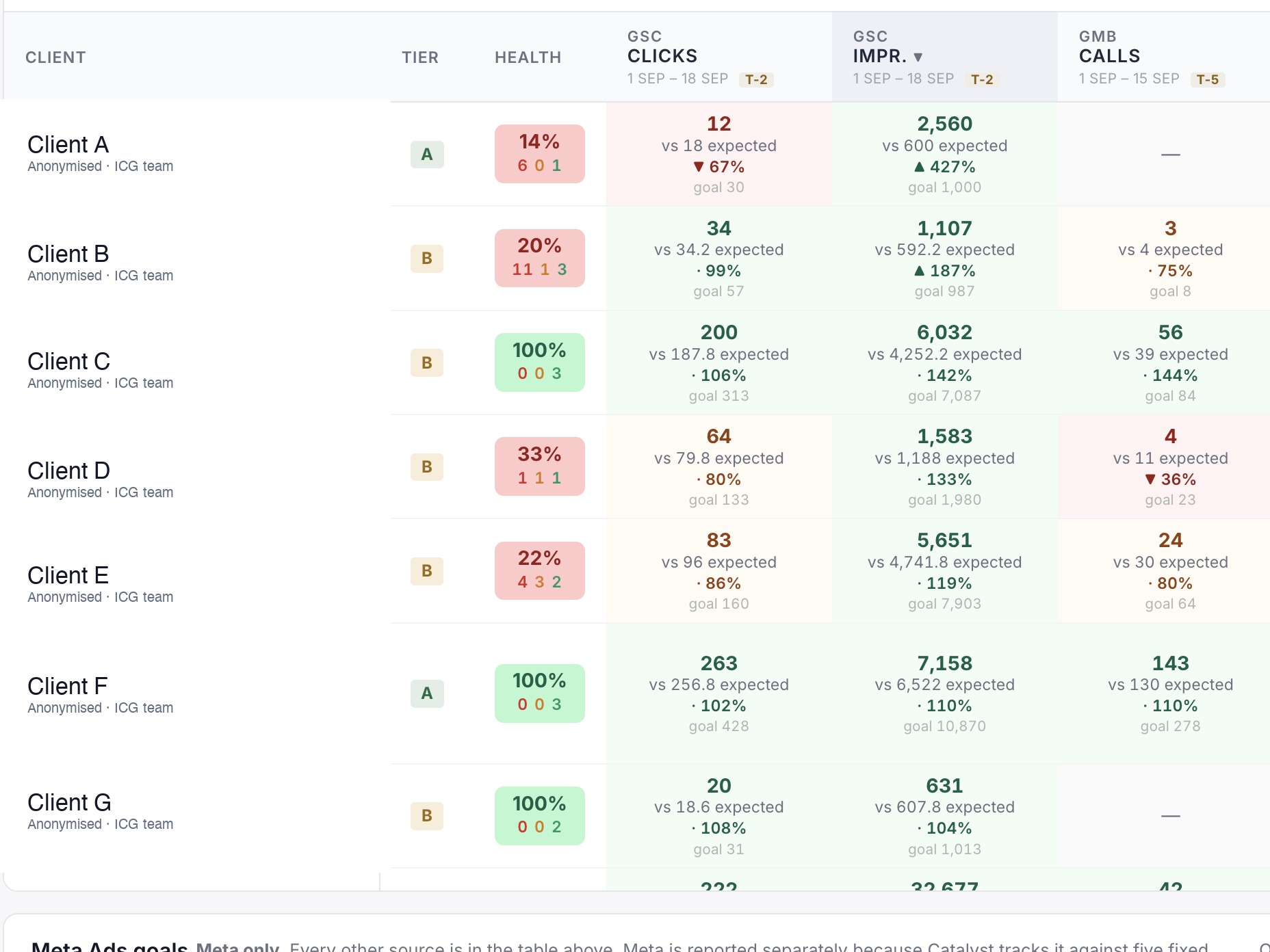
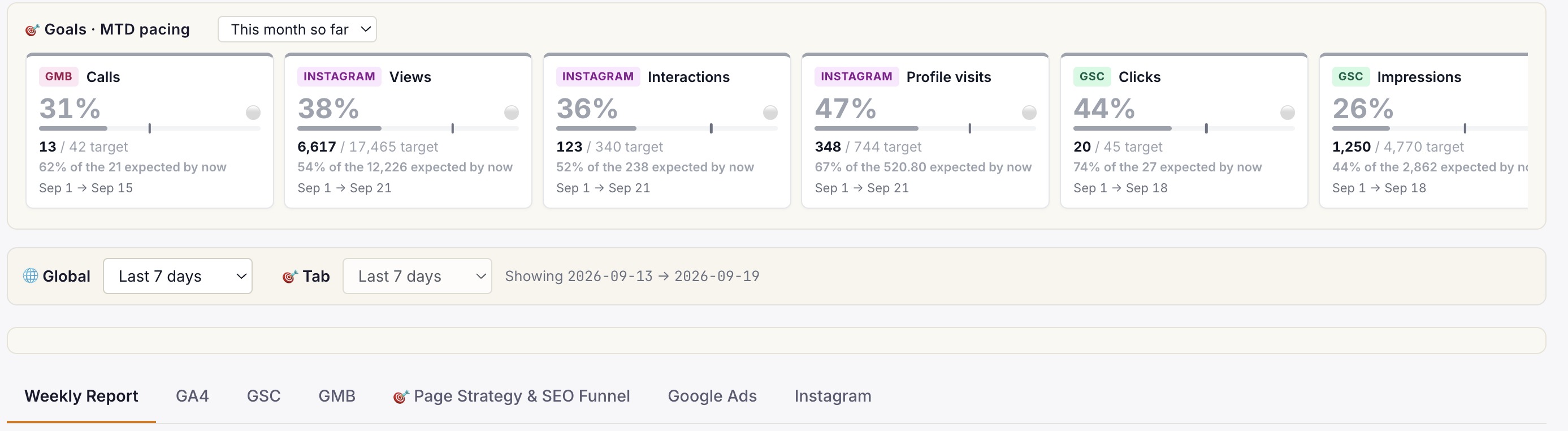
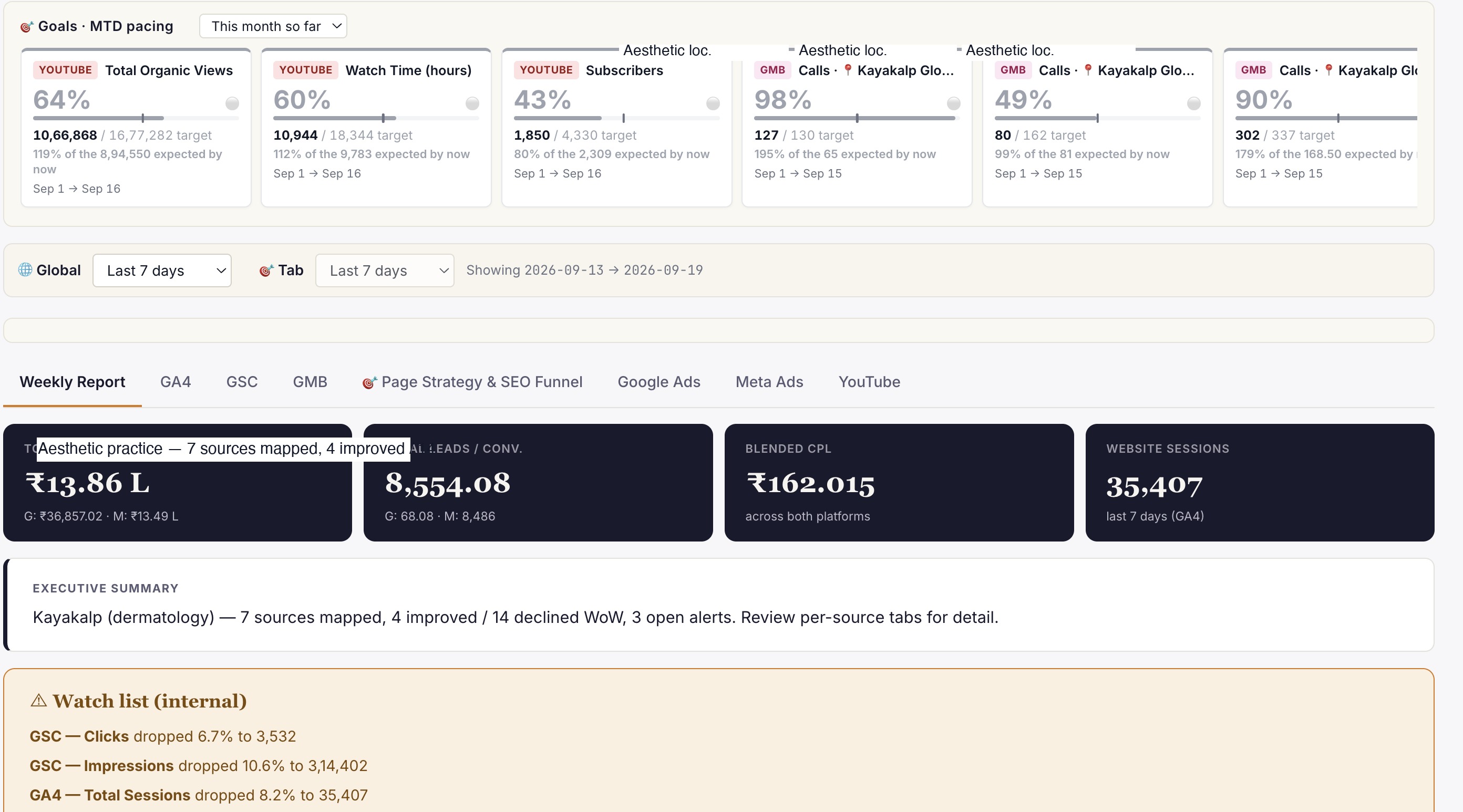
Live client dashboard. GSC, GA4, Google Ads, Meta Ads, IVR calls in one view. Login anytime, not monthly.
Phoenix
Clinic revenue intelligence over your PMS. Daily action queue: Prevent Loss, Maintain & Engage, Grow Revenue. Multi-centre rollout.
Or book a free 30-min audit to see all three in action on your account.
Healthcare brands
that already run on ICG.
A representative slice of the 150+ healthcare brands ICG has delivered for across India. Most engagements remain under NDA.


What ICG clients say · on video.
"Scale up of organic channels and business consulting. ICG has absolute domain authority in their field."
"Working with ICG transformed how we acquire IVF patients in Gurgaon. They understand the fertility journey from inquiry to consult..."
"What Ichelon accomplished — they got all my ideas and worked over 3-4 months to create an amazing, super-customised website."
Need help operationalising this?
Every ICG service is healthcare-only, NMC + DPDP-aware, and built around the patient-research patterns that drive Indian healthcare growth in 2026.
Every practice welcome — packages from ₹20,000/mo.
Goals-Driven engagements · Performance-Linked Payout Models available
More from
ICG.
Five trends shaping Indian healthcare marketing through 2027: AI-first patient research, Conversions API adoption, ABDM discovery, the AEO w...
Healthcare AIO is the discipline of getting your clinic or hospital cited inside Google AI Overviews, ChatGPT and Perplexity answers — not j...
Conversational-search advertising places brand messages inside AI chat answers — ChatGPT, Perplexity, Copilot — rather than beside a results...
Stop guessing.
Book a Diagnostic.
30 minutes. Free. With the AI-powered healthcare-only marketing agency 150+ brands already run on. No slides, no pitch, no hard close.


