


Patient trust and YouTube E-E-A-T for Indian healthcare in 2026: what actually earns credibility on a channel
Patient trust and YouTube E-E-A-T for Indian healthcare in 2026 depends on named clinician bylines, physician-reviewed video descriptions, NMC-registered credentials on-screen, and disciplined YMYL signals. This guide covers what channel owners and hospital marketing leads have to build into every upload to earn algorithmic trust, human trust, and AI Overview citations.
No pitch. Written root-cause diagnosis. AI-powered, healthcare only.
Direct answer
Patient trust and YouTube E-E-A-T for Indian healthcare in 2026 depends on named clinician bylines, physician-reviewed video descriptions, NMC-registered credentials on-screen, and disciplined YMYL signals. This guide covers what channel owners and hospital marketing leads have t...
TL;DR

Patient trust and YouTube E-E-A-T for Indian healthcare in 2026 is not a soft branding topic anymore — it is the specific set of signals YouTube search, Google web, and Google AI Overview all use to decide whether a healthcare video deserves distribution to somebody researching a symptom, a procedure, or a clinic. YMYL content sits under stricter quality thresholds than any other niche, and Indian healthcare marketers who copy generic YouTube advice from lifestyle channels almost always underperform on discovery. ICG runs YouTube for clinics and hospital groups through our local SEO and reputation stack, and the pattern that separates trusted channels from ignored ones is consistent: identity, credentials, and physician review, executed visibly and repeatedly.
Why YMYL makes healthcare YouTube a different sport from every other niche
Your Money or Your Life content — anything that could materially affect a viewer's health, finances, safety or major life decisions — is held to a stricter quality bar by every serious ranking system. Google's public Search Rater Guidelines devote entire sections to YMYL, and while those guidelines govern web search rather than YouTube directly, the underlying quality model has been extended into video ranking through the shared distribution surfaces (Google web results now include video carousels; AI Overview cites video transcripts; YouTube search itself has quietly tightened medical-content thresholds since 2022).
The practical implication for a dermatology, IVF, cardiology or oncology channel is that a video without a visible clinician identity, without displayed credentials, and without any physician-review signal is treated by the ranking systems as low-trust content by default. It does not matter how technically correct the medical content is if the trust signals are absent — the algorithm has no way to distinguish a genuine dermatologist's advice from a wellness influencer's speculation without those signals.
This is why the standard advice for beauty or gaming channels (post consistently, chase trending topics, hook the first 15 seconds) is necessary but wildly insufficient for a healthcare channel. Trust signals are the load-bearing layer.
What E-E-A-T actually means on a video, not a webpage
E-E-A-T stands for Experience, Expertise, Authoritativeness, and Trustworthiness — the four dimensions Google's Rater Guidelines use to score content quality. On a webpage the signals are byline, author bio, publisher identity, citations, HTTPS, contact information, reviewed-by editorial workflow. On a video the surface is different, so the signals have to move to where the algorithm and the human viewer both look.
Experience is signalled by the video itself — a clinician on camera doing the thing they are talking about (an ophthalmologist beside a slit lamp, a paediatrician in a real consultation room, a dentist demonstrating on an anatomical model) reads as genuine practising experience in a way that a stock-video voiceover never does. YouTube's systems do not "understand" this the way a human does, but the downstream engagement metrics (watch time, retention curve, return-viewer rate) do reflect the difference and feed back into ranking.
Expertise is signalled by named clinician identity, on-screen credential display, and the video description block. Authoritativeness is signalled by channel-level entity strength — a channel branded to a real hospital or clinic with matching Google Business Profile, NMC-registered clinician list, and third-party citations outperforms a generic "health tips" channel. Trustworthiness is the sum of the above plus disciplined disclosure — reviewed-by credit, published-date visibility, factual claim citation, no unsubstantiated outcome promises.
Named clinician bylines and channel-owner identity signals
The single biggest E-E-A-T lift most Indian healthcare channels can make in a week is to attach a named clinician to every video and stop publishing anonymous "Health Tips" content. Anonymous is the default state of underperforming healthcare channels; named-clinician is the default state of the ones that get cited by AI Overview and picked up in Google web video results.
Practical execution: every video's first 5 seconds should display an on-screen lower-third with the clinician's name, specialty, and NMC or state medical council registration number. The video description opens with a one-line named byline ("Reviewed by Dr Meera Kapoor, MBBS, MD (Dermatology), Delhi Medical Council Reg. 12345"). The channel-level About page carries the same clinician biographies with cross-links to their listing on the clinic's website team page — this bidirectional entity signal is what search systems use to bind the video to the real professional identity.
For hospitals with multiple specialists appearing across the channel, the pattern is the same at video level but the channel identity should belong to the hospital brand, not to any individual clinician, so that ownership survives specialist turnover. YODA's channel setup module handles the entity mapping between the hospital brand and the individual clinicians who appear in specific videos.
Physician review signals: reviewedBy schema, on-screen credit, and pinned comments

A "reviewed by" signal on a healthcare video does something specific — it tells the ranking system that the content passed a subject-matter expert's review before publication, which materially reduces perceived misinformation risk. On the web, this is delivered through the reviewedBy property of MedicalWebPage schema. On YouTube, the equivalent has to be delivered through three surfaces because there is no schema slot in a video description.
Surface one — the video description block. A dedicated line: "Medically reviewed by Dr [Name], [Specialty], [Registration]." This line, placed above the fold in the description, is picked up by AI Overview when Google cites the video's transcript-plus-metadata block. Surface two — an on-screen credit card that appears in the first 10 seconds and again at the end, briefly stating the reviewing clinician's name and credentials. Surface three — a pinned first comment on the video that repeats the reviewer credit and links to the reviewing clinician's clinic profile.
The redundancy matters because different ranking systems parse different surfaces — YouTube search reads description, Google web reads description plus title plus transcript, AI Overview reads description plus transcript plus on-screen text where its multimodal parsers can extract it, and human viewers see the on-screen credit and the pinned comment. Missing any one surface leaves an E-E-A-T gap for one of the audiences.
NMC registration numbers on-screen without violating advertising rules
Displaying a clinician's NMC or state medical council registration number is a permitted and encouraged trust signal — the National Medical Commission requires registered practitioners to disclose their registration on professional communication, and the disclosure itself is not advertising. The advertising restrictions in NMC's 2026 advertising guidelines constrain claims made about the clinician (comparative superiority, guaranteed outcomes, testimonial-driven promotion), not the disclosure of factual credentials.
The practical rule: display registration number, degree, specialty, and years of practice as factual identity — safe. Add "best in the city", "highest success rate", or "trusted by 10,000 patients" alongside — not safe, and independently a violation of ASCI Guidelines 2022 if unsubstantiated. Patient outcome claims of any kind belong nowhere near credential display.
For hospital channels featuring multiple clinicians, keep a stable format across videos: name, primary degree, specialty, registration council + number, years of practice. Consistency reads as a professional publishing operation; inconsistency reads as marketing-driven and reduces algorithmic trust.
Video description E-E-A-T patterns that AI Overview actually cites
Google AI Overview has become an important discovery surface for healthcare queries because Indian patients now increasingly get a generative answer before they see any blue link. When AI Overview cites a video, it draws from the video's title, description, transcript, and structured metadata. The description block is the highest-signal surface a channel owner controls.
The pattern that gets cited: an opening line naming the reviewing clinician; a 2-3 sentence factual summary of the video's medical content in plain language; a bulleted list of the specific questions the video answers (Google's systems match these against user queries); a "sources" block naming any medical guideline or peer-reviewed reference the video content is based on; a footer with clinic contact details and appointment booking link.
What underperforms: descriptions that open with marketing copy about the clinic; descriptions padded with hashtags; descriptions that link out to unrelated content; descriptions that make outcome claims. AI Overview's citation logic filters aggressively against promotional-tone content on YMYL topics.
The trust perimeter YouTube itself enforces on medical content
YouTube has its own layered enforcement on medical content that operates independently of the ranking signals. The platform's medical misinformation policy explicitly prohibits content that contradicts established public health guidance on specified topics, and the platform maintains an authoritative-source panel that surfaces above search results for sensitive health queries. Channels that publish content flagged as contradicting authoritative guidance can be demonetised, restricted from recommendation, or removed entirely.
The practical implications for Indian healthcare channels: any content touching vaccines, cancer treatments, reproductive health, mental health crisis topics, or contested clinical areas should be over-conservative on citation and match established Indian Council of Medical Research or Ministry of Health guidance where available. Any content that could be interpreted as suggesting alternatives to mainstream care needs particular caution.
Channels associated with recognised medical institutions get preferential treatment inside YouTube's authoritative-source signal — hospital YouTube channels linked from the hospital's verified website and Google Knowledge Panel are treated differently from independent clinician channels of comparable content quality.
What breaks patient trust in the first 20 seconds of a healthcare video
Retention curves on healthcare videos drop off differently from lifestyle content — patients researching a symptom are looking for a genuine expert, and the wrong opening triggers an immediate close. The specific failure modes we see across Indian healthcare channels: an overproduced intro with animation and music before any clinician appears; a marketing-tone script that spends 30 seconds selling the clinic before answering the question; anonymous voiceover with stock footage instead of a real clinician; and outcome claims in the first minute that trigger scepticism.
The openings that hold retention: the clinician on camera introducing themselves by name and credentials in the first 10 seconds; a direct restatement of the question the video is answering ("Today I'll explain why some patients need a second opinion before undergoing spinal surgery"); a clear preview of the answer structure (three points, five myths, four warning signs).
YODA's retention module surfaces the drop-off timestamps for every video against the channel's baseline, and the pattern almost always maps to one of these opening failure modes. Fixing the opening on the ten worst-performing videos often lifts channel-average retention 15 to 25% inside two months.
The 30 / 60 / 90 day trust build for a new healthcare channel
Days 1 to 30. Nail the channel identity. About page with hospital or clinic name, verified website link, registered address, phone. Named clinician list with photos, degrees, specialties, and registration numbers. Channel banner and profile image that visually match the clinic's Google Business Profile and website. Publish 3-4 videos with strong named-clinician on-screen presence, physician-review credit, and disciplined description blocks.
Days 31 to 60. Build the reviewed-by workflow. Every new video passes through a documented physician review before publication (a Google Doc checklist works fine as evidence); the reviewer credit appears in description, on-screen, and pinned comment. Add ImageObject-style thumbnails that carry the clinician's face and specialty text, not generic medical stock imagery. Start replying to comments with the reviewing clinician's name — the response cadence itself becomes an E-E-A-T signal.
Days 61 to 90. Institutional trust building. Cross-link the channel from the clinic website's About and Team pages; embed the strongest videos on relevant service pages; ensure the clinic's Google Business Profile links to the YouTube channel and vice versa; publish an "Our Editorial Process" page on the clinic website explaining who reviews videos and how. This external entity graph is what moves a channel from "trustworthy content" to "trustworthy source" in the ranking systems' eyes.
Expected outcome for a well-executed 90-day trust build on a new healthcare channel: search-driven views begin to grow independently of subscriber base (a leading indicator of ranking system trust), average view duration climbs above the channel's early baseline, and AI Overview citations start appearing for queries where the channel has topical coverage.
The platform ICG uses to run this at scale: YODA
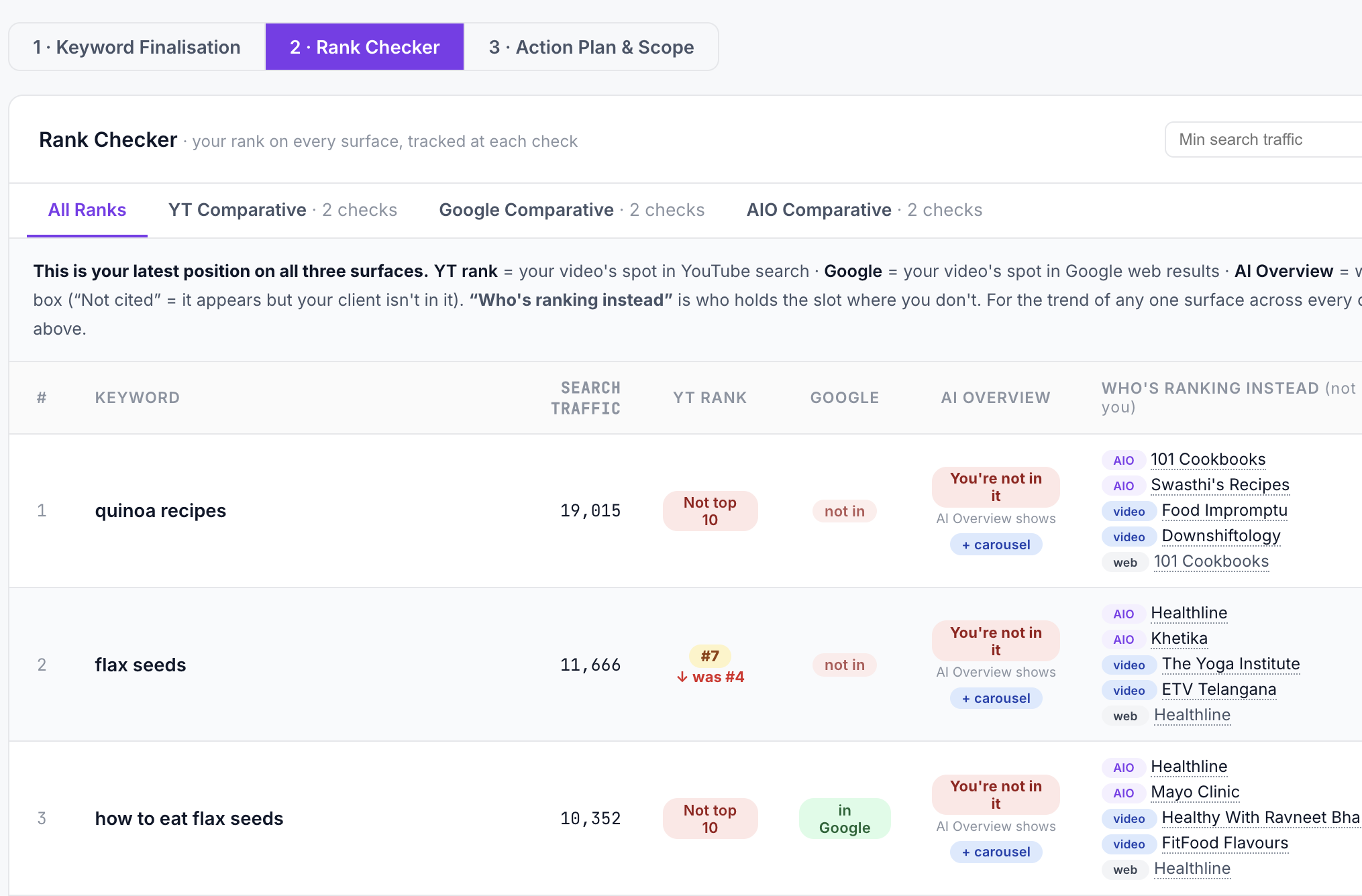
ICG runs healthcare YouTube marketing for clinics, hospitals, and specialty groups using YODA — our AI-native healthcare YouTube marketing platform. YODA sits on top of a channel's data and does four things no dashboard does: it separates organic from paid views at every step (so a promoted video can never masquerade as organic growth), it gives decisions not dashboards (every video gets a state + next action), it writes back to YouTube directly (improved titles, tags, descriptions, chapters applied straight to the platform), and it tracks the three rank races — YouTube search, Google web, and Google AI Overview citations.
YODA runs the full 6-step workflow — Overview, Diagnostics, Strategy, Optimisation, Reputation (ORM), and Competitor Intel — with 40+ analysis modules organised under those steps. ICG's managed YouTube service uses YODA end-to-end. See the Healthcare YouTube Marketing pillar guide for the full scope, or the Healthcare YouTube Marketing Agency service page for engagement details.
Book a YODA demo on WhatsApp → or request a free healthcare YouTube channel audit →
Related reading
- Healthcare YouTube marketing pillar guide 2026 — the umbrella resource
- E-E-A-T signals for Indian healthcare clinics — the on-site equivalent
- How a doctor's YouTube channel generates consultations in India
- YouTube for doctors: converting views into patient consultations
- Healthcare YouTube marketing agency service page
FAQ
Do I have to appear on camera myself or can a presenter deliver clinician-written scripts? Named clinician presence on camera outperforms a presenter reading a script on every E-E-A-T signal that matters — retention, comment quality, subscriber growth, and AI Overview citation rate. If clinician time is limited, a shorter video with the clinician actually appearing beats a longer polished video without them.
Is there a Schema.org markup for YouTube videos the way MedicalWebPage works for articles? Not on YouTube itself — you cannot inject schema into a video's YouTube page. What you can do is publish the video with structured metadata on your clinic website (embedded in a MedicalWebPage with reviewedBy attribution), which gives Google web the schema signal even though YouTube search reads only the description.
Should I disclose the clinician's NMC registration on every single video or only on the channel About page? Every video description. AI Overview and Google web parse each video's description independently and channel-level context does not transfer to individual video ranking. Repeating the credential per video is the safe pattern.
Does YouTube's medical authoritative-source panel work for Indian channels? Yes, though the qualifying signal is stronger for large recognised institutions (major hospital chains, medical colleges) than for single-clinician channels. Getting on the panel requires demonstrable institutional identity and matched external entity signals across Google web.
Can a marketing agency reply to comments on behalf of the clinician without violating NMC rules? Yes if the reply is factual and non-clinical — general information, appointment logistics, thanks for the question. Comments that request individual clinical advice have to be routed to the clinician directly or answered with a "please book a consultation for a personalised assessment" response. Never issue individualised medical advice through comment replies.
How long does E-E-A-T investment take to move rankings? YouTube search responds to trust signals faster than Google web — often 4 to 8 weeks after a channel-wide E-E-A-T upgrade. Google web video results take 3 to 6 months. AI Overview citations follow the web timeline, sometimes longer for competitive query clusters.
Do older videos need to be retrofitted with reviewed-by signals or can we start from the next upload? Retrofit the top 20 performers by view count — they get the most future distribution and represent the strongest opportunity to lift channel-level E-E-A-T perception. Older long-tail videos can be updated in a second pass or left alone if not driving meaningful traffic.
Is a hospital marketing team good enough to review videos, or does the reviewer have to be a physician? The reviewer credited on-screen and in description must be a registered physician for the E-E-A-T signal to work. Marketing team can handle production, script development, and compliance-adjacent checks, but the physician review credit needs a real clinician who has actually reviewed the medical accuracy.
What breaks E-E-A-T fastest on an established channel? Anonymous re-uploads without clinician appearance, comment sections that get spammed with unrelated links (drop moderation cadence and it degrades within weeks), and content that starts making outcome claims to chase views. Any of these can undo months of trust building.
Should we register the channel to the hospital or to the individual clinician? Hospital or clinic if the entity is stable and the video content will feature multiple clinicians over time. Individual clinician only if it is genuinely a personal-brand channel and there is no institutional context. Registering to an individual and then trying to shift ownership later is technically possible but disruptive.
Book a free 30-minute Brand & Growth Diagnostic.
It's a working session, not a sales pitch — you leave with a written root-cause analysis you can act on, whether or not you engage ICG.
The three platforms
behind every ICG engagement.
Beacon
CAPI middleware that fixes Event Match Quality, translates CRM statuses to Meta-standard events, dedups across channels.
Agency OS
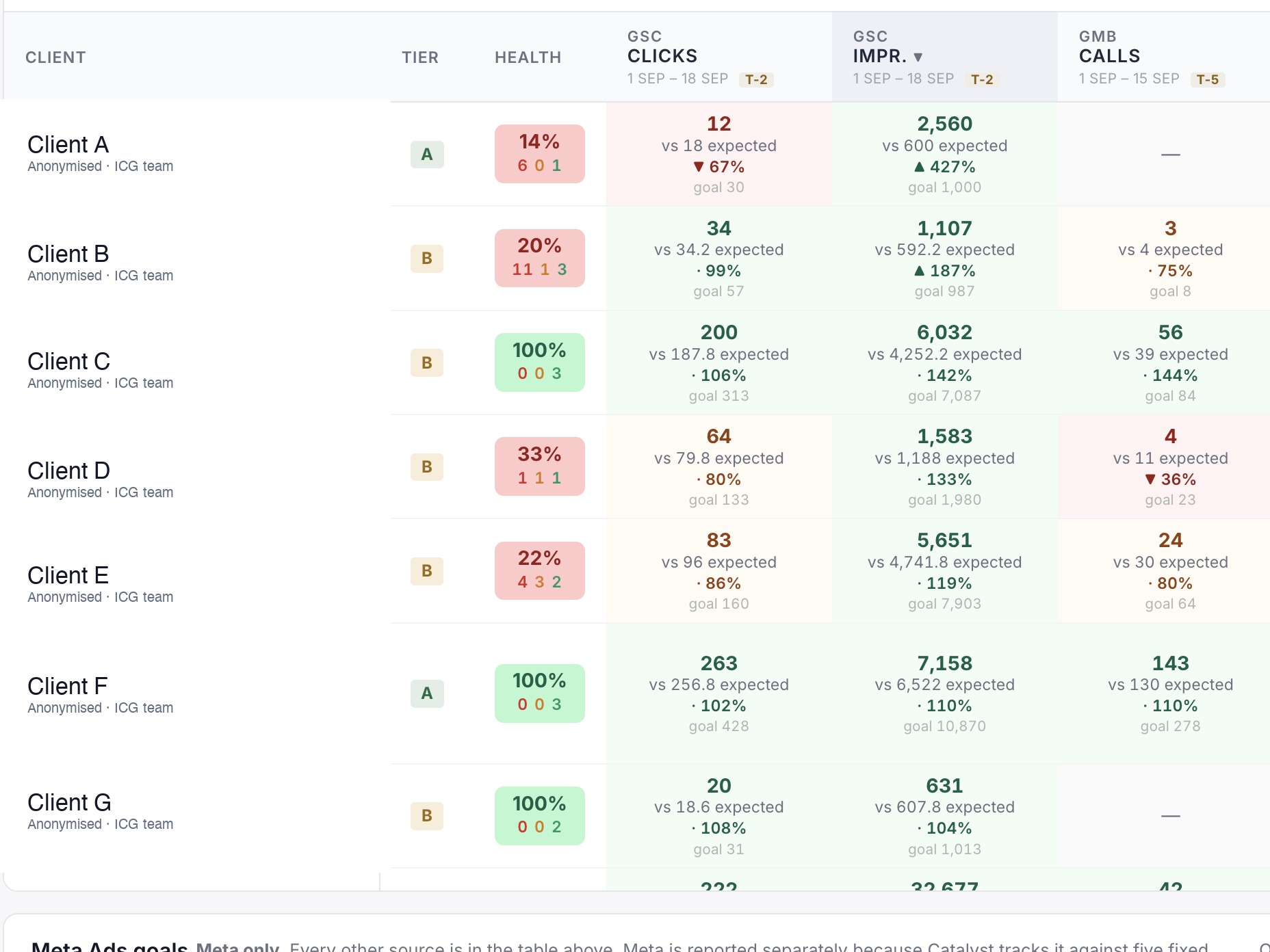
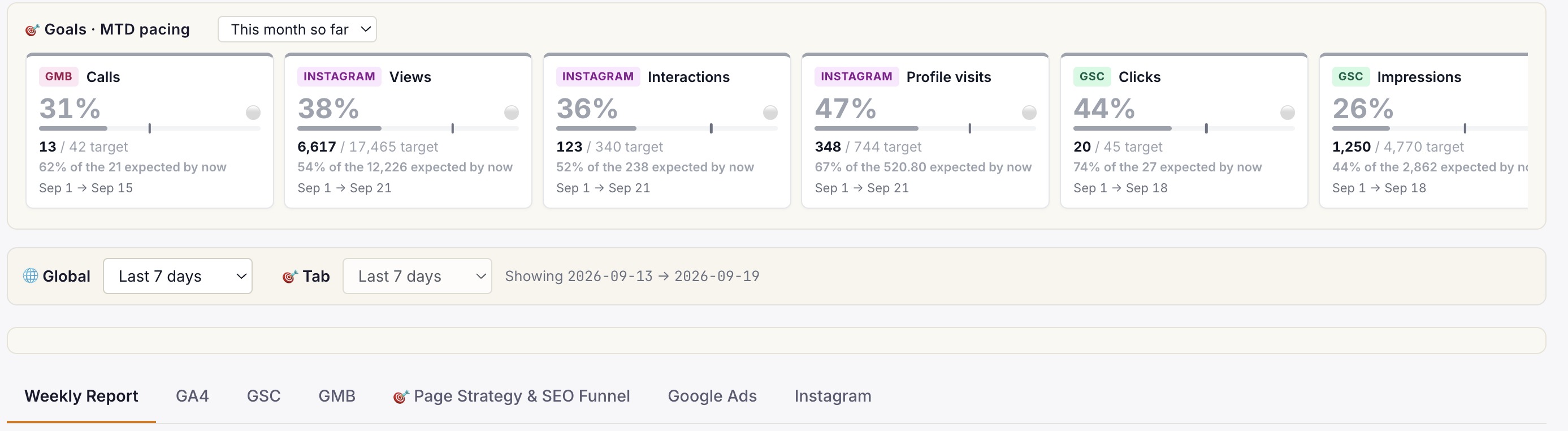
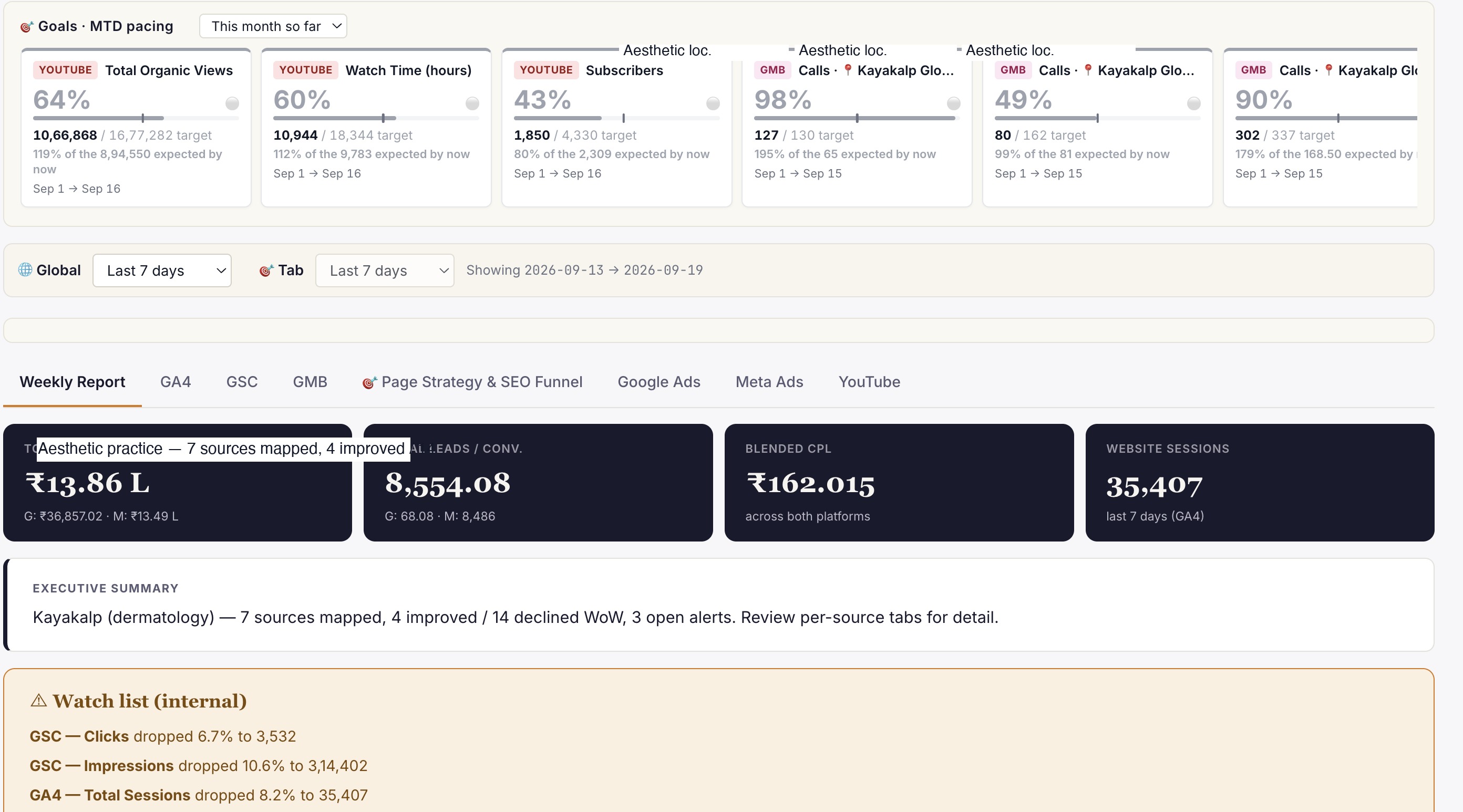
Live client dashboard. GSC, GA4, Google Ads, Meta Ads, IVR calls in one view. Login anytime, not monthly.
Phoenix
Clinic revenue intelligence over your PMS. Daily action queue: Prevent Loss, Maintain & Engage, Grow Revenue. Multi-centre rollout.
Or book a free 30-min audit to see all three in action on your account.
Healthcare brands
that already run on ICG.
A representative slice of the 150+ healthcare brands ICG has delivered for across India. Most engagements remain under NDA.


What ICG clients say · on video.
"Scale up of organic channels and business consulting. ICG has absolute domain authority in their field."
"Working with ICG transformed how we acquire IVF patients in Gurgaon. They understand the fertility journey from inquiry to consult..."
"What Ichelon accomplished — they got all my ideas and worked over 3-4 months to create an amazing, super-customised website."
Need help operationalising this?
Every ICG service is healthcare-only, NMC + DPDP-aware, and built around the patient-research patterns that drive Indian healthcare growth in 2026.
Every practice welcome — packages from ₹20,000/mo.
Goals-Driven engagements · Performance-Linked Payout Models available
More from
ICG.
Five trends shaping Indian healthcare marketing through 2027: AI-first patient research, Conversions API adoption, ABDM discovery, the AEO w...
Healthcare AIO is the discipline of getting your clinic or hospital cited inside Google AI Overviews, ChatGPT and Perplexity answers — not j...
Conversational-search advertising places brand messages inside AI chat answers — ChatGPT, Perplexity, Copilot — rather than beside a results...
Stop guessing.
Book a Diagnostic.
30 minutes. Free. With the AI-powered healthcare-only marketing agency 150+ brands already run on. No slides, no pitch, no hard close.


