


Local SEO for gastroenterology clinics in India: Gastroenterologist plus Endoscopy Center configuration, hepatology sub-specialty, and hospital-attached vs standalone signal strategy
Local SEO for gastroenterology clinics in India needs specific configuration for Gastroenterologist versus Endoscopy Center categories, hepatology sub-specialty depth, IBS and liver-disease query coverage, and the very different signal strategy required for hospital-attached departments versus standalone clinics. ICG runs this at scale with Angryturtle.
No pitch. Written root-cause diagnosis. AI-powered, healthcare only.
Direct answer
Local SEO for gastroenterology clinics in India needs specific configuration for Gastroenterologist versus Endoscopy Center categories, hepatology sub-specialty depth, IBS and liver-disease query coverage, and the very different signal strategy required for hospital-attached depa...
TL;DR
Local SEO for gastroenterology clinics in India is defined by four specialty-specific configuration decisions that generic agencies routinely mishandle. Category selection between Gastroenterologist and Endoscopy Center changes the query surface entirely. Hepatology as a sub-specialty carries its own citation set and Ask Maps question bank that a general gastro configuration misses. Query patterns split across acute abdominal pain, chronic IBS management, endoscopy scheduling, and progressive liver disease consideration — each with its own consideration cycle. And the hospital-attached department versus standalone clinic distinction fundamentally changes how the profile should be configured, cross-linked, and signalled. ICG runs healthcare local SEO for gastroenterology clinics using Angryturtle with gastro-specific configuration tuned for each of these decisions.
 angryturtle/05-demand-clusters.png" alt="Angryturtle Demand Clusters —
 Why gastroenterology local SEO is distinct in Indian healthcare
Gastroenterology combines a procedure-heavy service line (endoscopy, colonoscopy, ERCP, EUS) with a consultation-heavy service line (IBS management, chronic liver disease follow-up, GERD management) inside the same practice. The procedure line runs on scheduled bookings and short consideration cycles once the referral is in hand. The consultation line runs on longer consideration cycles as patients research chronic-condition specialists.
Hepatology as a sub-specialty deserves its own emphasis. Liver disease patients — Hepatitis B, Hepatitis C, cirrhosis, NAFLD, liver-transplant evaluation — research for months and evaluate hepatologists on credential depth, hospital affiliation for transplant workup, and specific-condition experience. A pure general-gastroenterology configuration under-serves this segment.
The specialty also has an unusual referral-flow dependency. Many patients arrive through GP referral rather than direct search, but the pre-consultation research they do is heavy on Google reviews and website content. A profile that fails to hold up under research post-referral leaks conversions the referral pipeline earned.
Endoscopy itself is unusually competitive in Indian metros as diagnostic-imaging-adjacent players (large-chain diagnostic centres with endoscopy suites) compete with hospital gastro departments and standalone specialists for the same query stream.
GBP category configuration: Gastroenterologist and Endoscopy Center
Google's category tree carries "Gastroenterologist" as the practitioner-level category and does not carry a formal "Endoscopy Center" primary in all regional trees, though "Medical Diagnostic Imaging Center" and related categories capture some of the endoscopy positioning where it applies.
The rule we apply: solo gastroenterologists and gastro-clinic practices should use Gastroenterologist as primary. Endoscopy-heavy standalone facilities that market the endoscopy suite as the primary offering should still use Gastroenterologist as primary but emphasise the endoscopy service in the services list and description. Hospital gastro departments keep the hospital primary and use Gastroenterologist as secondary alongside the hospital's multi-specialty configuration.
Secondary categories worth considering: Hepatologist as a sub-specialty in regional Google trees where the category exists, Internist (as a low-weight secondary for gastroenterologists whose practice includes broader internal-medicine consultation), Surgeon (for gastro-surgery or GI-surgery integrated practices), Medical Clinic (as a low-weight generic secondary).
Services list — gastroenterology has a wide procedural surface: upper GI endoscopy, colonoscopy, ERCP, EUS (endoscopic ultrasound), capsule endoscopy, liver biopsy, paracentesis, hepatitis B management, hepatitis C treatment, NAFLD management, cirrhosis management, IBS management, GERD management, IBD (Crohn's, ulcerative colitis) management, functional GI disorders, motility disorders, pancreatic disease management. Each is a distinct query surface.
Hepatology sub-specialty configuration
Hepatology as a sub-specialty needs its own configuration overlay when the practice actually delivers hepatology services beyond general gastroenterology.
The services list additions: Hepatitis B management, Hepatitis C treatment protocols (with the newer direct-acting antiviral regimens), NAFLD and NASH management, cirrhosis staging and follow-up, liver-transplant workup and referral, hepatocellular carcinoma screening, autoimmune hepatitis management, primary biliary cholangitis management. These services communicate hepatology depth clearly.
Description additions: hepatology sub-specialty focus, transplant-hospital affiliation where applicable, Hepatitis-C treatment-experience count where substantiable, participation in national hepatitis-elimination programmes where relevant. These build Entity Authority for the hepatology query cluster.
Ask Maps question bank expansion: hepatology-specific patient queries that a general-gastro question bank would miss (see the pattern list below).
Citation set expansion: Indian Association for the Study of the Liver (INASL) directory becomes a flagship citation for hepatology-focused practices, alongside the general gastro directory set.
Angryturtle's sie" style="color:inherit;text-decoration:underline;text-decoration-color:rgba(42,126,200,.5);text-underline-offset:2px">Rank OS surfaces hepatology-specific gaps as separate action items when a profile is tagged as hepatology-active.

IBS, liver-disease, and endoscopy query patterns
The three query clusters behave differently in the ranking model.
Endoscopy cluster: "endoscopy near me," "colonoscopy in [city]," "ERCP specialist [city]," "upper GI endoscopy cost [city]," "colonoscopy appointment [area]." These reward category correctness, service listing depth, price transparency where possible, and open-scheduling signalling.
IBS and functional-GI cluster: "best gastroenterologist for IBS in [city]," "IBS specialist near me," "chronic constipation doctor [city]," "GERD specialist [city]." These reward consultation-depth content, patient-education content on chronic condition management (compliance-safe), and review coverage that reflects long-term patient relationships.
Liver-disease cluster: "best hepatologist in [city]," "liver specialist [city]," "Hepatitis C treatment [city]," "cirrhosis specialist [city]," "fatty liver doctor near me." These reward Entity Authority (credential depth, transplant-hospital affiliation), Hepatology-specific citation coverage, and long-form content on liver-disease management.
Angryturtle configures Rank OS weights and Ask Maps question banks separately for each cluster based on which sub-specialties the profile actually delivers.
Hospital-attached vs standalone considerations
The signalling strategy for a hospital-attached gastro department differs fundamentally from a standalone clinic.
Hospital-attached gastro departments ride the hospital's primary Google Business Profile signal for the multi-specialty and facility-adjacent queries but need their own department-level identity for gastro-specific queries. Options include a separate department-level Google Business Profile (allowed by Google under specific circumstances for large multi-specialty hospitals), department-level pages on the hospital website with clear cross-linking to the hospital's main profile, and individual specialist profiles for named gastroenterologists in the department.
Standalone gastro clinics operate on a single Google Business Profile that carries all the signal. The description, services, review corpus, and Post cadence all concentrate on this one profile. Standalone clinics generally out-perform hospital-attached departments on primary specialist queries because the entire signal is focused on the specialty, but under-perform on multi-specialty and facility queries where the hospital's scale wins.
The correct choice depends on the practice's ownership structure and the hospital's marketing willingness to allow department-level identity. ICG's engagement scoping surfaces this decision in the first two weeks.
Review dynamics for gastroenterology practices
Gastroenterology reviews split by service line. Endoscopy reviews are often short and procedural — the patient describes the pre-procedure experience, the sedation, the recovery, the report handover. IBS and chronic-condition reviews are longer and describe the doctor's consultation style and the patient's functional improvement over time. Liver-disease reviews are the most detailed and often describe treatment journeys across months or years.
Review-request framing has to avoid soliciting specific-treatment testimonials that cross the NMC line. The Angryturtle default for gastro profiles: "we would appreciate your feedback on your visit experience with our team." Neutral, procedure-agnostic, compliant.
Volume target for competitive metros: 200-400 reviews for a solo gastroenterologist, 400-800 for a multi-doctor practice or hospital department. Endoscopy-heavy practices generate faster review flow because the procedure itself is a natural review-request moment.
Ask Maps question patterns for gastroenterology patients
Prospective gastro patients ask AI systems specific questions:
- "Is there a gastroenterologist near me for endoscopy?"
- "Which hospital in [city] has a hepatologist for Hepatitis B?"
- "Does this clinic do colonoscopy under sedation?"
- "Is capsule endoscopy available at this centre?"
- "Does this gastro specialist treat IBS with dietary counselling?"
- "What is the cost of upper GI endoscopy at this hospital?"
- "Is Hepatitis C treatment with DAAs available here?"
- "Does this centre offer ERCP for pancreatic disease?"
- "Is there a paediatric gastroenterologist available?"
Ask Maps scores the profile against each question pattern the practice actually needs to answer, based on the sub-specialty tagging in the platform.
Content operations for gastroenterology profiles
Post patterns that work: educational content on colonoscopy screening age (aligning with ICMR and international cancer-screening guidelines), IBS management explainers, fatty-liver awareness content, Hepatitis awareness content (World Hepatitis Day, July 28), team introductions with sub-specialty credentials, facility updates on new endoscopy equipment or techniques.
Post patterns to avoid: named-patient testimonials with specific procedure details, cure claims for Hepatitis C or other chronic conditions, comparative superiority claims on procedure success rates, before-and-after imagery from endoscopy that runs into patient privacy or platform restrictions.
Angryturtle's Content Studio for gastro profiles drafts within the NMC, ASCI, and DPDP Act compliance perimeter by default.
Citation targets for gastroenterology practices
Beyond the general Indian healthcare directory set:
- Indian Society of Gastroenterology (ISG) member directory — flagship citation for the specialty
- Indian Association for the Study of the Liver (INASL) directory — flagship for hepatology sub-specialty
- Indian Society of Pediatric Gastroenterology, Hepatology and Nutrition (ISPGHAN) for paediatric-gastro-active practices
- State chapter directories for each of the above where the specialist is a member
- Insurance panel directories carrying gastroenterology procedural coverage — Star Health, HDFC ERGO, Bajaj Allianz, Care Health surgical panels
- Doctor-directory platforms under the correct Gastroenterologist sub-category
- Corporate group health insurance TPA empanelment listings for gastroenterology and endoscopy
Angryturtle's citation engine includes the gastro directory list as a specialty default with hepatology overlay when the sub-specialty tag is active.
Geographic catchment for gastroenterology practices
Endoscopy patients tend to travel within a 10-15 km radius because scheduling and follow-up bring them back multiple times. IBS and chronic-condition patients travel similarly within the practice's catchment. Hepatology and liver-disease patients travel farther — 20+ km catchment is common, and inter-city travel is not unusual for hepatologists with strong transplant-hospital affiliation.
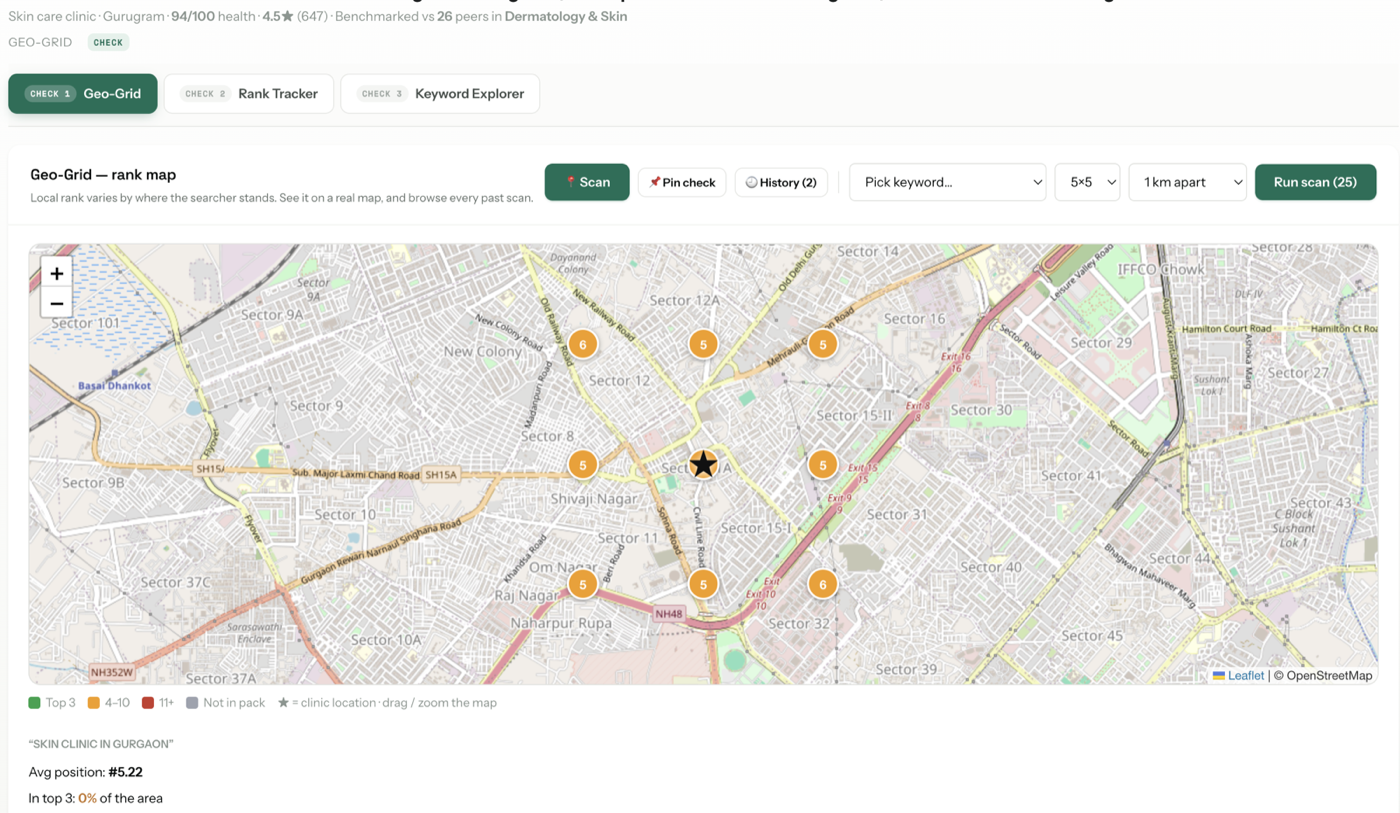
Geo-Grid tracking sizing: general gastro on a 10-12 km grid, hepatology-focused practices on a 20+ km grid, multi-location gastro chains with per-location grids and catchment overlap analysis.
Pricing tier for gastroenterology practices
Solo gastroenterologist OPD or endoscopy practice: Boutique tier at ₹35,000/- to ₹75,000/- per month covers profile management, review operations, weekly Post cadence, monthly Geo-Grid, quarterly citation build.
Multi-doctor gastro group with endoscopy and hepatology: Chain tier at ₹75,000/- to ₹1.5L/- per month covers per-doctor plus per-location profile management, higher Post cadence, weekly Geo-Grid, monthly citation build, Ask Maps AIO scoring with sub-specialty coverage.
Hospital gastro department with sub-specialty depth: Hospital tier at ₹1.5L/- to ₹4L/- per month covers hospital-level plus department-level plus per-doctor profile management, daily Post cadence, review operations with escalation workflow, weekly Geo-Grid per location, custom AIO audit.
Solo owner with 1-2 profiles running it themselves: Angryturtle self-serve at ₹999/- per month covers Rank OS scoring, Ask Maps, review draft assistance, and Content Studio inside the same platform ICG's managed team uses.
The 30/60/90 day playbook
Days 1-30: primary category correction (Gastroenterologist), hospital-attached-vs-standalone decision executed, sub-specialty overlay (hepatology, paediatric) applied where applicable, full services build-out across endoscopy plus consultation lines, description rewrite covering full scope, first citation batch across ISG and INASL directories, review-request workflow initiated.
Days 31-60: weekly Google Posts live across educational, awareness, and facility-update patterns, Geo-Grid baseline captured, ISG plus state-chapter citations built and NAP-verified, first Ask Maps gap-closure pass targeting the highest-value queries across three clusters, review velocity compounding.

Days 61-90: Rank OS score improvement of 15-25 points typical, first measurable ranking movement on primary "gastroenterologist in [city]" and sub-specialty queries, insurance-panel citation set completed, AIO Readiness improved as Ask Maps question coverage closes. Compound gains visible from months 4-6 onward.
The tool ICG uses to run this at scale: Angryturtle
ICG runs local SEO and GBP intelligence for 150+ Indian healthcare brands using Angryturtle — our own AI-native GBP intelligence and management OS. The platform scores every profile 0-100 via a proprietary Rank OS model with five weighted dimensions (Relevance, Review Health, Freshness, Entity Authority, AIO Readiness), publishes edits, Posts, media, and review replies directly to Google, and includes Ask Maps AIO Readiness scoring for Google AI Overviews and ChatGPT visibility.
Available in two shapes: self-serve at ₹999/- per month for solo owners with 1-2 profiles, and ICG's managed service from ₹25,000/- per month where our healthcare specialists execute inside the same platform. Both are anchored in the Healthcare Local SEO Agency India pillar page which has full scope, methodology and pricing.
Book a demo on WhatsApp → or start a free trial at angryturtle.ai →
Related reading
- Healthcare local SEO agency India — the pillar service page
- Local SEO for diagnostic centres — imaging-referral partner context
- Angryturtle Rank OS explained — the five-dimension scoring model
- Angryturtle Ask Maps AIO Readiness — AI-answer visibility scoring
- Local SEO for urology clinics — companion procedural specialty guide
FAQ
Should a gastroenterology clinic use Gastroenterologist or Endoscopy Center as the primary category? Gastroenterologist. Endoscopy Center is not a formal Google primary in all regional trees, and Gastroenterologist captures the query surface most cleanly with endoscopy services listed in the services list and emphasised in the description.
How should hepatology sub-specialty focus be configured? Hepatology-specific services listed (Hepatitis B and C management, NAFLD, cirrhosis, transplant workup), description emphasising sub-specialty focus, INASL directory citation added to the citation set, Ask Maps question bank expanded to cover hepatology-specific patterns.
Should a hospital-attached gastro department have its own Google Business Profile? Sometimes. Google allows department-level profiles for large multi-specialty hospitals under specific circumstances. Where allowed, a separate department profile captures gastro-specific queries the hospital-level profile dilutes. Otherwise, department-level pages on the hospital website with clear cross-linking work as the substitute.
What compliance frameworks affect gastroenterology content? NMC Ethics Code 2026 on named-patient testimonials and comparative claims, ASCI Guidelines 2022 on cure claims (especially relevant for Hepatitis C DAA content), DPDP Act 2023 on patient data protection for any patient story referencing.
How many Google reviews does a competitive gastroenterology practice need? 200-400 for a solo gastroenterologist. 400-800 for a multi-doctor group or hospital department. Endoscopy-heavy practices produce faster review flow because the procedure is a natural review-request moment.
Which gastroenterology-specific citations matter most? Indian Society of Gastroenterology (ISG) directory, Indian Association for the Study of the Liver (INASL) directory for hepatology sub-specialty, ISPGHAN for paediatric-gastro practices, state chapter directories, insurance-panel procedural directories.
Should the profile publish endoscopy pricing? Range-based pricing display is generally compliant provided no misleading claims accompany it. Some hospitals prefer not to publish because of insurance-negotiation complexity, but publication improves conversion on the endoscopy query cluster.
Can a gastroenterology practice buy Angryturtle self-serve instead of the ICG managed retainer? Yes. Solo gastroenterologists with 1-2 profiles can run Angryturtle self-serve at ₹999/- per month. Multi-doctor groups and hospital departments typically prefer ICG's managed tier starting at ₹25,000/- per month.
How long before a gastroenterology profile shows ranking improvement? First measurable movement in 4-6 weeks after category correction and initial citation build. Substantive ranking improvement in 3-4 months. Compound effect visible from month 6 onward with consistent execution across all query clusters.
Book a free SEO diagnostic.
Hanuman Sihag's team runs a live crawl, checks technical health, cannibalisation, schema coverage and content gaps. 60 minutes, prioritised fix list.
The three platforms
behind every ICG engagement.
Beacon
CAPI middleware that fixes Event Match Quality, translates CRM statuses to Meta-standard events, dedups across channels.
Agency OS
Live client dashboard. GSC, GA4, Google Ads, Meta Ads, IVR calls in one view. Login anytime, not monthly.
Phoenix
Clinic revenue intelligence over your PMS. Daily action queue: Prevent Loss, Maintain & Engage, Grow Revenue. Multi-centre rollout.
Or book a free 30-min audit to see all three in action on your account.
Healthcare brands
that already run on ICG.
A representative slice of the 150+ healthcare brands ICG has delivered for across India. Most engagements remain under NDA.


What ICG clients say · on video.
"Scale up of organic channels and business consulting. ICG has absolute domain authority in their field."
"Working with ICG transformed how we acquire IVF patients in Gurgaon. They understand the fertility journey from inquiry to consult..."
"What Ichelon accomplished — they got all my ideas and worked over 3-4 months to create an amazing, super-customised website."
The intelligence stack behind this playbook.
Every ICG engagement runs on the Search Intelligence Trifecta — Angryturtle for GMB, SIE for search and AI Overview, YODA for YouTube. Live product screens below.
Need help operationalising this?
Every ICG service is healthcare-only, NMC + DPDP-aware, and built around the patient-research patterns that drive Indian healthcare growth in 2026.
Every practice welcome — packages from ₹20,000/mo.
Goals-Driven engagements · Performance-Linked Payout Models available



More from
ICG.
Five trends shaping Indian healthcare marketing through 2027: AI-first patient research, Conversions API adoption, ABDM discovery, the AEO w...
Healthcare AIO is the discipline of getting your clinic or hospital cited inside Google AI Overviews, ChatGPT and Perplexity answers — not j...
Conversational-search advertising places brand messages inside AI chat answers — ChatGPT, Perplexity, Copilot — rather than beside a results...
Stop guessing.
Book a Diagnostic.
30 minutes. Free. With the AI-powered healthcare-only marketing agency 150+ brands already run on. No slides, no pitch, no hard close.


