


Local SEO for diagnostic centres in India: Diagnostic Center plus Pathology Lab plus Radiology Center configuration, home-sample-collection SAB decisions, NABL trust signal, and insurance-TPA panel visibility
Local SEO for diagnostic centres in India spans three overlapping GBP categories, the home-sample-collection Service Area Business decision, NABL accreditation as a decisive trust signal, corporate wellness and insurance-TPA client segments, and doctor-referral flow signalling that generic agencies routinely miss. ICG runs this at scale with Angryturtle.
No pitch. Written root-cause diagnosis. AI-powered, healthcare only.
Direct answer
Local SEO for diagnostic centres in India spans three overlapping GBP categories, the home-sample-collection Service Area Business decision, NABL accreditation as a decisive trust signal, corporate wellness and insurance-TPA client segments, and doctor-referral flow signalling th...
TL;DR
Local SEO for diagnostic centres in India is unusual because the specialty spans three separate Google Business Profile primary categories (Diagnostic Center, Medical Diagnostic Imaging Center, Pathology Lab), operates across two channel modes (walk-in centre and home-sample-collection Service Area Business), serves three distinct client segments (individual patients, doctor referrals, corporate wellness and insurance-TPA panels), and treats NABL accreditation as a trust signal that materially shifts conversion in a way no other Indian healthcare specialty relies on. ICG runs healthcare local SEO for diagnostic centres using Angryturtle with diagnostic-centre-specific configuration tuned for the exact category, channel, client, and accreditation-signalling this sub-industry needs.
Why diagnostic-centre local SEO is distinct in Indian healthcare
Diagnostic centres sit at the intersection of retail-healthcare consumer behaviour and B2B referral flow in a way that few other specialties match.
On the retail side, individual patients search for specific tests ("thyroid test near me," "MRI knee cost in [city]," "CBC test home collection") with short consideration cycles and heavy price sensitivity. The retail patient often compares three or four diagnostic centres on the local pack before booking.
On the B2B side, referring doctors send patients to specific labs and imaging centres based on trust relationships built over years. The referral flow accounts for meaningful test volume for most centres, and the profile has to reinforce the doctor's referral choice when the patient looks up the recommended lab online. A lab that a doctor recommended but that has poor Google reviews leaks patients to competitors even inside a warm referral.
Corporate wellness contracts and insurance-TPA panel empanelment add a third client segment. Corporate HR teams and insurance-TPA account managers use Google reviews and profile completeness as informal shortlist signals when evaluating vendors. NABL accreditation is a decisive signal here.
Home-sample-collection has become a competitive default among urban Indian diagnostic centres. The configuration decision — whether to run it as a Service Area Business, integrate it into a storefront profile, or split into separate profiles — changes the ranking narrative significantly.
GBP category configuration: Diagnostic Center, Pathology Lab, Medical Diagnostic Imaging Center
Google's category tree offers several related primaries. The choice depends on the centre's actual service mix.
Diagnostic Center works as a broad primary for full-service diagnostic centres that combine pathology and radiology under one roof. It captures the widest diagnostic-related query surface and is the default recommendation for most multi-modality centres.
Pathology Lab or Medical Laboratory works as the primary for pathology-only labs (blood tests, urine tests, biopsy processing, microbiology, biochemistry, immunology). Using Diagnostic Center for a pathology-only lab dilutes signal on the imaging query cluster it does not serve; using Pathology Lab keeps the ranking narrative tight.
Medical Diagnostic Imaging Center or Radiology Center works as the primary for imaging-only facilities (X-ray, ultrasound, CT, MRI, PET-CT, mammography). Same principle — matching the primary to the actual service mix concentrates Relevance signal on the queries the centre can actually serve.
Secondary categories to layer where relevant: X-ray Lab, MRI Center (where the category exists), Blood Testing Service, Ultrasound Clinic, and Medical Center as a low-weight generic secondary.
Services list — diagnostic centres have the longest service surface of any healthcare specialty: individual test listings (thyroid profile, lipid profile, HbA1c, CBC, LFT, KFT, vitamin D, vitamin B12, iron studies), package listings (basic health checkup, comprehensive checkup, cardiac risk package, diabetes package, women's health checkup, senior citizen package, executive health checkup), imaging service listings (X-ray, USG, CT, MRI, mammography, DEXA scan), specialised test listings (histopathology, immunohistochemistry, molecular diagnostics, genetic testing), home-sample-collection availability. Every listing is a query surface.
Home-sample-collection Service Area Business decision
Home-sample-collection has become table-stakes in urban Indian diagnostic markets. The Google Business Profile configuration decision is not trivial.
Storefront configuration with home-collection service listed: the walk-in centre address is public, and home collection is documented as one of the services in the services list and in the description. This works when the walk-in centre generates meaningful walk-in traffic and the home-collection radius is comparable to the walk-in catchment.
Storefront primary plus a separate SAB profile for the home-collection service in adjacent catchments: Google generally does not permit two profiles for the same business unless they are genuinely separate operational locations, so this pattern is limited to multi-city chains that maintain both walk-in centres and separate home-collection operations in nearby cities.
Pure SAB configuration: the physical address is hidden and a service-area radius is shown. This works for home-collection-only operations that do not accept walk-in patients (some newer digital-first pathology brands run this model in urban markets).
The mis-configuration we see most often: a walk-in centre registered as SAB (which hides the address and loses walk-in traffic) or a home-collection service registered as a second profile against Google's guidelines (which risks profile suspension). Angryturtle's sie" style="color:inherit;text-decoration:underline;text-decoration-color:rgba(42,126,200,.5);text-underline-offset:2px">Rank OS flags SAB-versus-storefront mismatch as a top-priority action.
 angryturtle/02-rank-os.png" alt="Angryturtle Rank OS — 5-dimension health scoring (Completeness · Consistency · Authority · Activity · Sentiment) across the portfolio" loading="lazy" decoding="async" style="width:100%;height:auto;display:block;">
NABL accreditation as a trust signal
NABL (National Accreditation Board for Testing and Calibration Laboratories) accreditation is the flagship quality signal for Indian diagnostic centres. It is issued under the quality council of India framework and is treated by hospital groups, corporate wellness teams, and insurance TPAs as a shortlist filter.
On the Google Business Profile: NABL accreditation status should be documented in the business description ("NABL-accredited laboratory since [year]") and reinforced through Post cadence around accreditation renewal, scope expansion, and proficiency-testing performance. The certificate itself can be documented in the photos section, which is under-used by most centres.
On the linked website: NABL accreditation should have its own trust-signal page with accreditation certificate, scope of accreditation (which specific test parameters are within scope), issuing date, and validity period. This page is often the highest-authority page on a diagnostic centre's website and drives B2B trust.
Angryturtle's Rank OS gives explicit weight to NABL-signal presence in the Entity Authority dimension for diagnostic-centre-tagged profiles. Missing NABL signal is one of the highest-priority actions surfaced for accredited centres that are under-communicating the accreditation.
NABH accreditation (Blood Banks, Medical Imaging Services) and CAP (College of American Pathologists) accreditation for premium labs add further trust-signal weight for centres that hold them.
Doctor-referral flow signalling
Diagnostic centres depend on referring-doctor relationships for a meaningful share of test volume. The Google Business Profile can reinforce the referral flow with specific signals.
Explicit service listings for referral-relevant tests (immunohistochemistry, specialised molecular diagnostics, advanced imaging protocols) tell referring doctors the centre handles the tests they are sending. Report-turnaround-time documentation in the description signals reliability. Photos of the laboratory or imaging facility showing equipment and quality-control workflow build trust. Post cadence around new equipment installation, new test scope, and clinical-conference participation reinforces the centre's clinical credibility.
The specific patient-facing content strategy differs from the referral-facing strategy. Angryturtle's Content Studio for diagnostic-centre profiles maintains separate content tracks for retail-patient content and B2B-referral-signal content, both published to the same profile without cannibalising either audience.
Corporate wellness client segment
Corporate wellness contracts — annual health checkup programmes for company employees — are a meaningful revenue segment for mid-scale and large diagnostic centres. The evaluation criteria HR teams use include NABL accreditation status, network of walk-in centres, home-collection capability, insurance-TPA panel coverage, corporate-package pricing, and turnaround-time commitments.
The Google Business Profile supports the corporate segment through explicit service listings for corporate health checkup packages, description language that references corporate wellness capabilities, Post cadence around corporate partnerships and new corporate contracts (compliance-safe, without naming the corporate customer without their consent), and a linked website that has a dedicated corporate wellness page HR teams can shortlist against.
Corporate wellness client acquisition happens through direct outreach and RFP response, but the Google-visible profile is the first credibility check any HR team runs on a shortlisted vendor.
Insurance-TPA panel signal
Empanelment on major insurance-TPA panels (Vidal Health, Medi Assist, Family Health Plan, Paramount Healthcare, MDIndia, and others) is both a revenue driver and a trust signal. Patients whose insurance policies cover diagnostic tests preferentially choose empanelled centres, and TPA account managers use Google-visible profile completeness as an informal shortlist filter.
The profile supports TPA-panel visibility through explicit disclosure of major TPAs the centre is empanelled with, insurance-panel service listings, and Post cadence around new TPA empanelments or scope expansion. The linked website should have a dedicated insurance-panel page that lists TPAs, corporate group health insurance panels, and any direct insurance-company arrangements.
Review dynamics for diagnostic centres
Diagnostic-centre reviews concentrate around visit experience, report accuracy, report turnaround time, staff behaviour at sample collection, and phlebotomy skill for blood tests. Positive reviews often describe the entire journey from booking to report delivery. Negative reviews concentrate on report errors, delayed reports, sample-collection issues, and billing disputes.
Review-request framing has to stay compliant. The Angryturtle default for diagnostic-centre profiles: "we would appreciate your feedback on your visit or home-collection experience." Neutral, service-agnostic, does not solicit test-result-related content.
Volume target for competitive metros: 300-800 reviews for a single-location diagnostic centre. 1,000-3,000 for a multi-location chain. Recency matters because the specialty produces high-frequency visits, and stale review flow reads as inactive.
Ask Maps question patterns for diagnostic centres
Patients ask AI systems very specific questions:
- "Which lab in [city] does thyroid test with same-day report?"
- "Does this diagnostic centre offer home sample collection?"
- "Is MRI available at this centre and what does the knee MRI cost?"
- "Is this lab NABL-accredited?"
- "Does this centre accept my insurance for diagnostic tests?"
- "What is the turnaround time for HbA1c report at this lab?"
- "Does this centre offer complete health checkup packages?"
- "Is this diagnostic centre empanelled with [insurance TPA]?"
- "Can I book a CT scan appointment at this centre?"
Ask Maps scores the profile against each pattern based on the service mix and NABL-plus-TPA signalling.
Content operations for diagnostic centres
Post patterns that work: package launches (new corporate wellness package, new preventive health checkup), individual test-education content (why fasting matters for lipid profile, what a thyroid panel measures), NABL and NABH accreditation renewal or scope-expansion updates, new equipment installation (new MRI, new CT, new automated pathology analyser), corporate partnership announcements (compliance-safe), World Health Day and awareness-week content (World Cancer Day, World Diabetes Day, World Hypertension Day).
Post patterns to avoid: patient-report imagery even with names redacted (DPDP Act 2023 patient-data-protection risk), specific-patient testimonials with test results, comparative superiority claims on report accuracy or turnaround.
Angryturtle's Content Studio for diagnostic-centre profiles drafts within the NMC, ASCI, and DPDP Act compliance perimeter by default.
Citation targets for diagnostic centres
Beyond the general Indian healthcare directory list:
- NABL public directory of accredited laboratories — flagship citation for accredited centres
- NABH directory for accredited blood banks and imaging services
- Indian Association of Pathologists and Microbiologists (IAPM) member directory for pathology-specialist listings
- Indian Radiological and Imaging Association (IRIA) directory for imaging-specialist listings
- Insurance-TPA public directories where centres are empanelled — visible on TPA websites
- Corporate group health insurance provider empanelment listings
- Doctor-directory platforms under the correct diagnostic-centre sub-category
- Municipal and state health department empanelment listings where applicable
Angryturtle's citation engine includes the diagnostic-centre directory list as a specialty default with NABL and TPA overlays.
Geographic catchment for diagnostic centres
Walk-in diagnostic centres see catchment concentrated within 3-7 km because patients travel short distances for routine testing. Specialised imaging (MRI, PET-CT) draws patients from a wider catchment of 15-25 km because equipment access is scarcer. Home-collection services operate on service-area radii of 10-15 km typically.
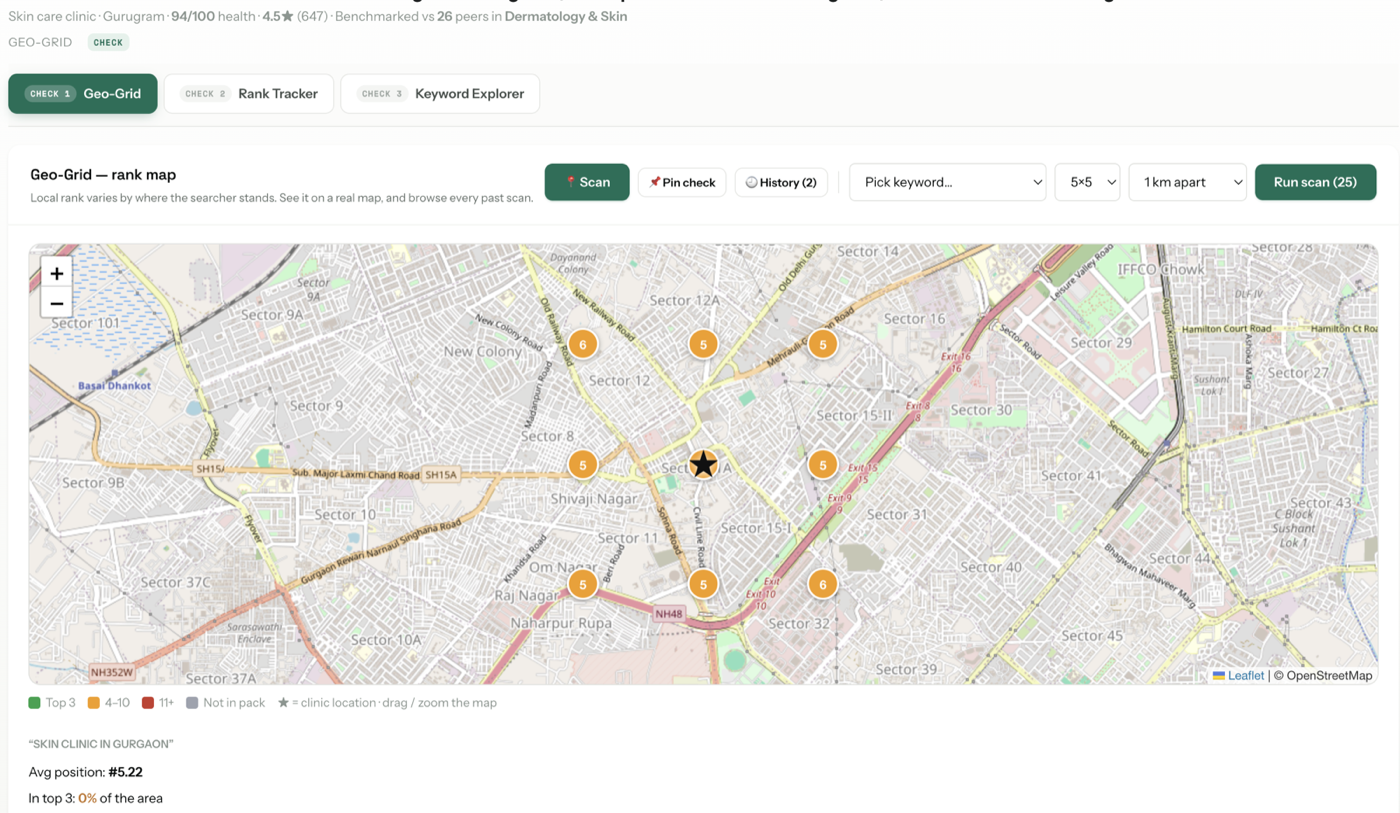
Geo-Grid tracking sizing: general diagnostic centres on a 5-7 km grid, specialised imaging centres on a 15-20 km grid, home-collection SAB configurations on the actual service-area radius. Multi-location chains need per-location grids with catchment overlap analysis to avoid cannibalisation between neighbouring centres.
Pricing tier for diagnostic centres
Single-location diagnostic centre or standalone pathology lab: Boutique tier at ₹35,000/- to ₹75,000/- per month covers profile management, review operations, weekly Post cadence, monthly Geo-Grid, quarterly citation build with NABL overlay.
Multi-location diagnostic chain or hospital diagnostic department: Chain tier at ₹75,000/- to ₹1.5L/- per month covers per-location profile management, higher Post cadence, weekly Geo-Grid, monthly citation build, Ask Maps AIO scoring, corporate-wellness content track.
Large multi-city diagnostic chain (10+ locations): Hospital tier at ₹1.5L/- to ₹4L/- per month covers per-location profile management, daily Post cadence, review operations with escalation workflow, weekly Geo-Grid per location, custom AIO audit, dedicated corporate-wellness and TPA-panel content tracks.
Solo owner with 1-2 profiles running it themselves: Angryturtle self-serve at ₹999/- per month covers Rank OS scoring, Ask Maps, review draft assistance, and Content Studio inside the same platform ICG's managed team uses.
The 30/60/90 day playbook
Days 1-30: primary category correction (Diagnostic Center vs Pathology Lab vs Medical Diagnostic Imaging Center), storefront-vs-SAB decision, secondary categories aligned to service mix, full services build-out including test listings and package listings, NABL and NABH accreditation signalling built into description, first citation batch across the diagnostic-centre directory list, review-request workflow initiated.
Days 31-60: weekly Google Posts live across educational, package-launch, and accreditation-signal patterns, Geo-Grid baseline captured, NABL public directory and TPA panel citations built and NAP-verified, first Ask Maps gap-closure pass targeting the highest-value queries including test-cost and turnaround-time queries, review velocity compounding.

Days 61-90: Rank OS score improvement of 15-25 points typical, first measurable ranking movement on primary "diagnostic centre in [city]" and specific-test queries, insurance-TPA panel citation set completed, AIO Readiness improved as Ask Maps question coverage closes. Compound gains visible from months 4-6 onward.
The tool ICG uses to run this at scale: Angryturtle
ICG runs local SEO and GBP intelligence for 150+ Indian healthcare brands using Angryturtle — our own AI-native GBP intelligence and management OS. The platform scores every profile 0-100 via a proprietary Rank OS model with five weighted dimensions (Relevance, Review Health, Freshness, Entity Authority, AIO Readiness), publishes edits, Posts, media, and review replies directly to Google, and includes Ask Maps AIO Readiness scoring for Google AI Overviews and ChatGPT visibility.
Available in two shapes: self-serve at ₹999/- per month for solo owners with 1-2 profiles, and ICG's managed service from ₹25,000/- per month where our healthcare specialists execute inside the same platform. Both are anchored in the Healthcare Local SEO Agency India pillar page which has full scope, methodology and pricing.
Book a demo on WhatsApp → or start a free trial at angryturtle.ai →
Related reading
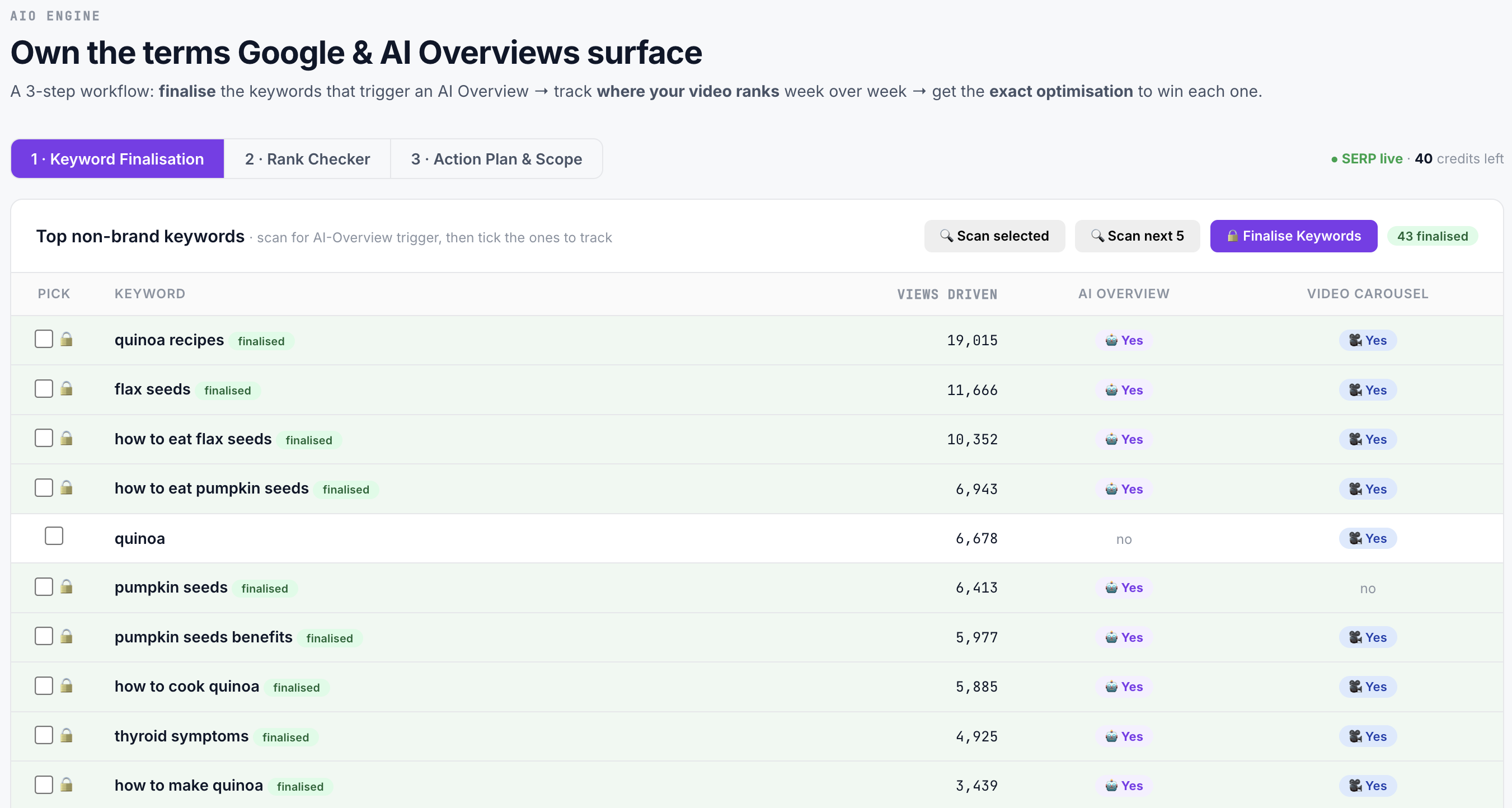 AI Overview opportunity across YouTube search, Google web and Google AI Overview" width="1200" height="675" loading="lazy" decoding="async" style="width:100%;height:auto;display:block;">
- Healthcare local SEO agency India — the pillar service page
- Local SEO for gastroenterology clinics — referral-partner specialty context
- Local SEO for urology clinics — imaging-referral specialty context
- Angryturtle Rank OS explained — the five-dimension scoring model
- Angryturtle Ask Maps AIO Readiness — AI-answer visibility scoring
FAQ
Should a full-service diagnostic centre use Diagnostic Center or split across Pathology Lab and Medical Diagnostic Imaging Center? Diagnostic Center as the primary for centres combining pathology and radiology under one roof. Split configuration (separate primaries) applies only when the pathology and imaging arms are operationally separate entities with different addresses and different management. Two primaries on one physical location violate Google guidelines.
Should home-sample-collection be configured as a Service Area Business? Only if the operation is genuinely home-collection-only with no walk-in centre. Hybrid centres should stay storefront with home-collection listed as a service and documented in the description.
How important is NABL accreditation as a Google-visible signal? Decisive for B2B trust (doctor referrals, corporate wellness, insurance-TPA panels) and materially important for retail patient conversion. NABL signal belongs in the description, in Post cadence around renewal and scope expansion, in the photos section, and on a dedicated website trust page.
Should diagnostic-centre profiles publish test pricing? Yes, package-level and common-test pricing display drives conversion in this specialty. Compliance is generally straightforward provided pricing is transparent and no misleading claims accompany it. TPA-empanelled centres should note that displayed pricing is retail; empanelled patients pay per TPA rates.
Which diagnostic-centre-specific citations matter most? NABL public directory, NABH directory for accredited blood banks and imaging services, IAPM directory for pathology specialists, IRIA directory for imaging specialists, insurance-TPA public panel directories, corporate group health insurance provider empanelment listings.
How does the corporate wellness segment affect content strategy? Corporate wellness clients evaluate on NABL status, network coverage, home-collection capability, TPA-panel breadth, and corporate-package pricing. Content and profile signalling around each of these attributes supports the segment even though corporate acquisition happens through direct outreach.
How many reviews does a competitive diagnostic centre need? 300-800 for a single-location centre in a metro. 1,000-3,000 for a multi-location chain. High-frequency visit pattern in this specialty means recency matters as much as absolute volume.
Can a diagnostic centre buy Angryturtle self-serve instead of the ICG managed retainer? Yes. Single-location centres with 1-2 profiles can run Angryturtle self-serve at ₹999/- per month. Multi-location chains typically prefer ICG's managed tier starting at ₹25,000/- per month for the specialist NABL and TPA overlay and integration work.
How long before a diagnostic-centre profile shows ranking improvement? First measurable movement in 4-6 weeks after category correction and initial NABL-signal build. Substantive ranking improvement in 3-4 months. Compound effect visible from month 6 onward with consistent execution across retail, referral, and corporate segments.
Book a free SEO diagnostic.
Hanuman Sihag's team runs a live crawl, checks technical health, cannibalisation, schema coverage and content gaps. 60 minutes, prioritised fix list.
The three platforms
behind every ICG engagement.
Beacon
CAPI middleware that fixes Event Match Quality, translates CRM statuses to Meta-standard events, dedups across channels.
Agency OS
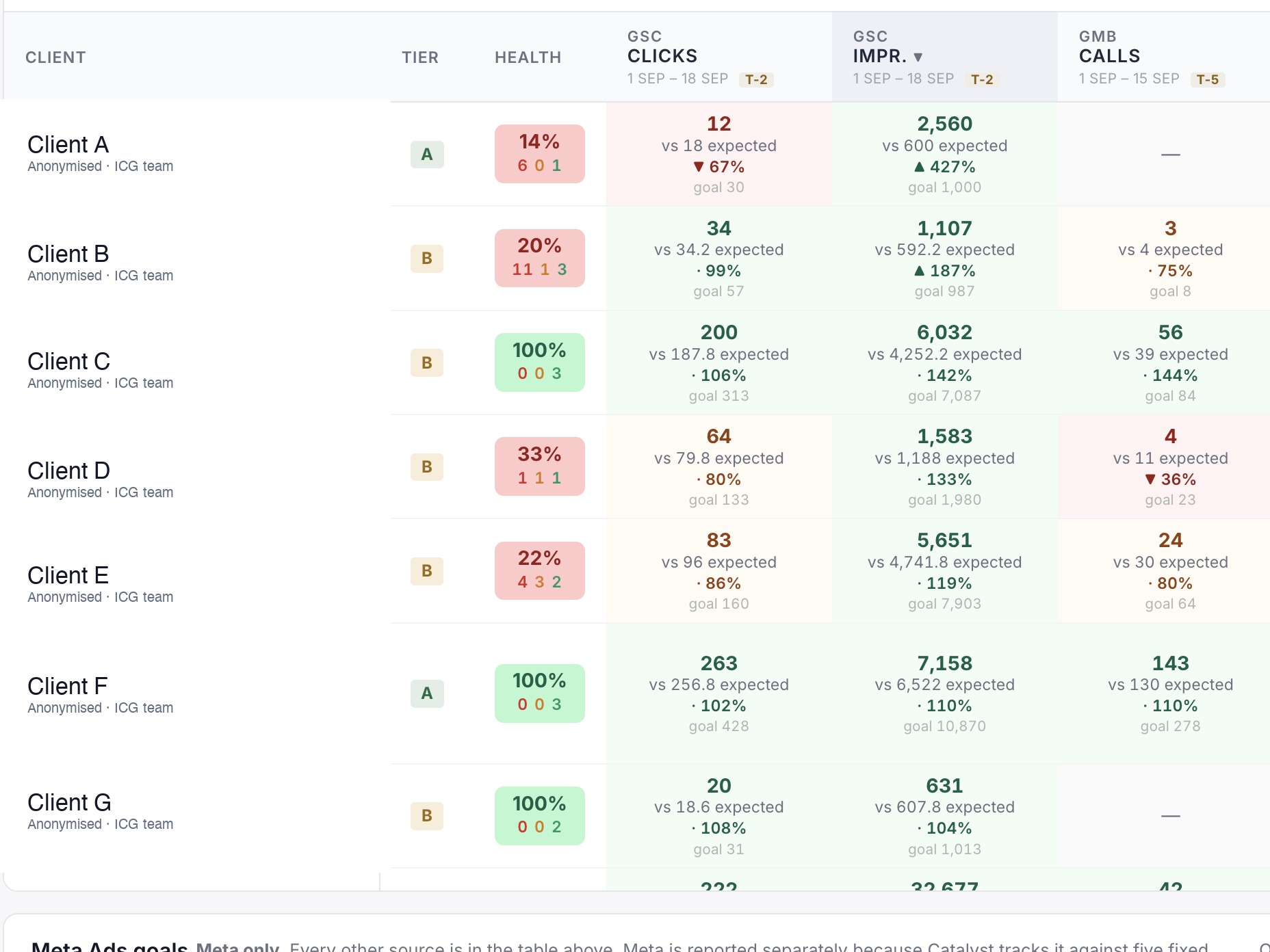
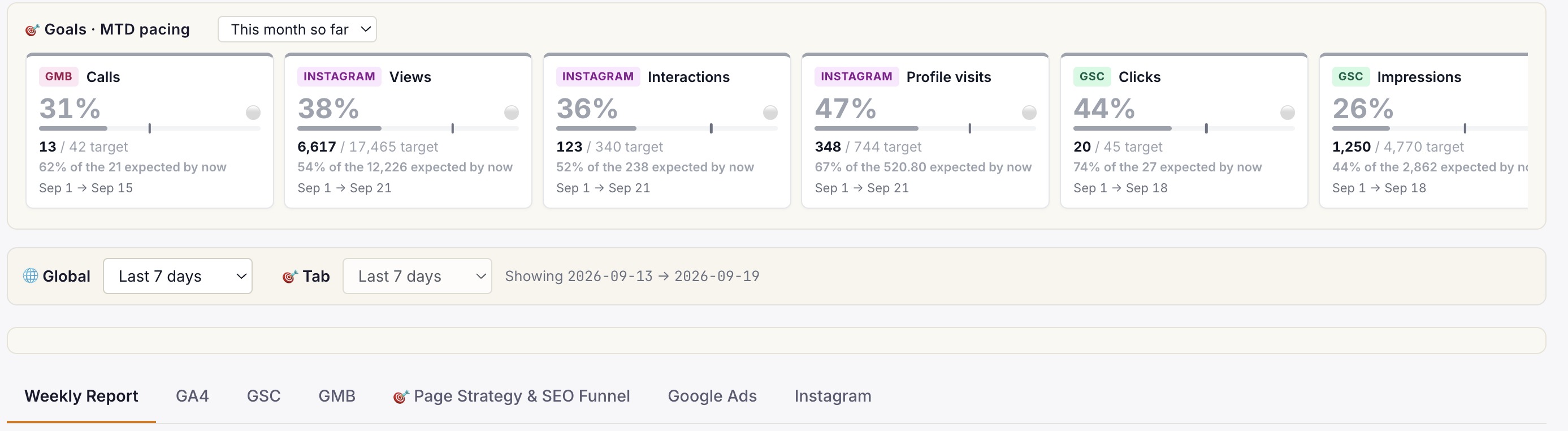
Live client dashboard. GSC, GA4, Google Ads, Meta Ads, IVR calls in one view. Login anytime, not monthly.
Phoenix
Clinic revenue intelligence over your PMS. Daily action queue: Prevent Loss, Maintain & Engage, Grow Revenue. Multi-centre rollout.
Or book a free 30-min audit to see all three in action on your account.
Healthcare brands
that already run on ICG.
A representative slice of the 150+ healthcare brands ICG has delivered for across India. Most engagements remain under NDA.


What ICG clients say · on video.
"Scale up of organic channels and business consulting. ICG has absolute domain authority in their field."
"Working with ICG transformed how we acquire IVF patients in Gurgaon. They understand the fertility journey from inquiry to consult..."
"What Ichelon accomplished — they got all my ideas and worked over 3-4 months to create an amazing, super-customised website."
The intelligence stack behind this playbook.
Every ICG engagement runs on the Search Intelligence Trifecta — Angryturtle for GMB, SIE for search and AI Overview, YODA for YouTube. Live product screens below.
Need help operationalising this?
Every ICG service is healthcare-only, NMC + DPDP-aware, and built around the patient-research patterns that drive Indian healthcare growth in 2026.
Every practice welcome — packages from ₹20,000/mo.
Goals-Driven engagements · Performance-Linked Payout Models available
More from
ICG.
Five trends shaping Indian healthcare marketing through 2027: AI-first patient research, Conversions API adoption, ABDM discovery, the AEO w...
Healthcare AIO is the discipline of getting your clinic or hospital cited inside Google AI Overviews, ChatGPT and Perplexity answers — not j...
Conversational-search advertising places brand messages inside AI chat answers — ChatGPT, Perplexity, Copilot — rather than beside a results...
Stop guessing.
Book a Diagnostic.
30 minutes. Free. With the AI-powered healthcare-only marketing agency 150+ brands already run on. No slides, no pitch, no hard close.


