


Single Doctor Channel vs Hospital Channel Strategy in India: A Feature Comparison
Should Indian hospitals and clinics back a single-doctor channel, an institutional hospital channel, or a hybrid? A neutral, feature-based comparison across 8 axes — brand equity, NMC compliance, DPDP controllership, referral fabric, unit economics — with buyer archetypes and 8 FAQs.
No pitch. Written root-cause diagnosis. AI-powered, healthcare only.
Direct answer
Should Indian hospitals and clinics back a single-doctor channel, an institutional hospital channel, or a hybrid? A neutral, feature-based comparison across 8 axes — brand equity, NMC compliance, DPDP controllership, referral fabric, unit economics — with buyer archetypes and 8 F...
TL;DR
Feature-based comparison for Indian healthcare marketing decision-makers · August 2026
TL;DR
- Single Doctor Channel wins on trust, E-E-A-T depth, and referral-worthy authority for procedures where the patient Googles the surgeon's name before the address. It caps out at one clinician's calendar and carries continuity risk the day that doctor moves cities.
- Institutional Hospital Channel scales across service lines, absorbs staff churn, wins B2B tie-ups (corporate, TPA, CGHS empanelment), and is the safer NMC advertising-code posture. It struggles to earn intimate trust for high-consideration procedures like IVF, bariatrics, joint replacement, cardiac surgery.
- A Hybrid Channel — hospital brand at the roof with named consultants underneath, wired through clean DPDP Act 2023 consent flows — is the default answer for roughly 60% of mid-to-large Indian setups.
- The decision hinges on eight axes: brand equity ownership, NMC compliance surface, DPDP data controllership, specialty type, referral network integration, continuity risk, unit economics, and attribution complexity. Cost is not a tiebreaker — a doctor channel is cheaper to launch but pricier per lead once the calendar caps.
- Buyer archetypes matter more than budget. A solo dental practice runs a different playbook from a 100-bed multispecialty, which runs a different playbook from a five-centre IVF chain. Pick the model that matches the patient decision journey for your top three service lines, not the model your peers picked.
Table of Contents
- Why this matters for Indian buyers
- The eight axes to compare on
- Main comparison table
- Per-axis deep dives
- Which channel fits which buyer
- How ICG helps you make this call
- The 70-30 services model
- FAQ
Why this comparison matters for Indian healthcare buyers
A hospital administrator in Pune emailed us last quarter with a familiar question. Two of the hospital's cardiologists had spent eighteen months building personal YouTube channels. Both got poached by a competing chain. The hospital lost roughly 30% of its cardiac consultation volume within ninety days, and a portion of the search traffic followed the doctors to their new employer. His question was blunt: did we mess up by letting the doctors build personal channels, or by not building an institutional channel alongside?
The honest answer is both. And it is the single most under-planned decision in Indian healthcare marketing today. Every hospital owner, clinic founder, and medical director eventually faces this fork. The answer used to be dictated by whichever partner shouted loudest in the leadership meeting. Post-2023, three regulatory and technology shifts have made this a serious strategic question with financial consequences.
First, the National Medical Commission's Code of Ethics tightened the boundary on what a doctor can and cannot say in solicitation-style promotion. Testimonials, before-after photographs, and comparative claims sit in restricted territory. A hospital brand has slightly more room to run outcome-based communication because it can lean on aggregate service-line data, accreditation status, and empanelment credentials. A doctor's personal channel operates in a narrower corridor.
Second, the Digital Personal Data Protection Act 2023 changed who is legally on the hook when a patient's phone number arrives via a form fill. If a lead comes in through a doctor's landing page, is the doctor the data fiduciary? Or is the hospital, since it hosts the doctor and stores the record in its EMR? Ambiguity here is not academic — grievance officers and consent artefacts have to be assigned to a named entity.
Third, the Ayushman Bharat Digital Mission has begun to reshape how referrals move. HPR-linked doctors and HFR-linked facilities operate as separate identities on the ABDM stack. The way patients discover, book, and share records with a doctor or a facility now flows through parallel infrastructure, and your channel strategy needs to sit cleanly on top of both identity types.
The upshot: a channel decision made in 2020 on gut feel is now a decision with compliance, data-protection, and search-visibility consequences that compound over years. This comparison exists so you can make it deliberately.
The eight axes to compare on
Before you look at any table, agree with your leadership team on what you are actually optimising for. In our conversations with 300-plus healthcare clients across India, we keep coming back to the same eight axes. Score your setup on each, and the answer usually becomes obvious.
- Brand equity ownership — who legally and practically owns the search demand you are building?
- NMC Code compliance surface — how much regulatory risk does each channel carry, and who signs off on creative?
- DPDP Act 2023 controllership — who is the data fiduciary, and does your consent architecture match?
- Content authority signal (E-E-A-T) — where does Google and the patient locate the "expert" — the doctor, the department, the institution?
- Referral network integration — how well does the channel fit into peer referrals, corporate tie-ups, and the ABDM referral fabric?
- Continuity and attrition risk — what happens if a doctor leaves, retires, or the hospital restructures?
- Unit economics (CAC, LTV, calendar ceiling) — cost per qualified lead today versus at your scale ceiling twenty-four months out?
- Attribution and measurement complexity — can you actually tell what worked, or are you flying on assumption?
Note what is not on this list. Budget size is not an axis. Neither is "what our competitor does." Both mislead more than they help.
Main comparison table
| Axis | Single Doctor Channel | Hybrid (Doctor-in-Hospital) | Institutional Hospital Channel |
|---|---|---|---|
| Brand equity ownership | Doctor owns. Portable to next employer. | Shared, split by contract clauses. | Institution owns. Survives staff churn. |
| NMC compliance surface | Narrower corridor. Personal endorsement rules apply. | Managed at institutional review board. | Wider corridor for outcome, empanelment, accreditation claims. |
| DPDP fiduciary | Doctor as fiduciary. Individual grievance officer needed. | Hospital as fiduciary; doctor as processor. | Hospital as fiduciary. Cleanest posture. |
| E-E-A-T source | Individual clinician. Deepest for procedures. | Doctor + department + institution layered. | Department and institution. Broad but shallow. |
| Referral integration | Strong for peer GP referrals. Weak for corporate. | Handles both peer and B2B (corporate, TPA, CGHS). | Strong for B2B tie-ups and empanelment. |
| Continuity risk | High. Doctor exit = channel death. | Medium. Named consultants swappable if the brand is set up right. | Low. Institution outlives clinicians. |
| Unit economics | Cheap to launch. Expensive per lead at calendar ceiling. | Mid-cost to launch. Best per-lead economics at scale. | Expensive to launch. Amortises across service lines. |
| Attribution | Simple. One doctor, one calendar. | Complex. Needs department-level and doctor-level attribution. | Moderate. Service-line attribution standard. |
Per-axis deep dives
Brand equity ownership
The Pune cardiology story turned on this axis. When a doctor builds a personal YouTube channel, Instagram following, and name-based Google Business Profile, the goodwill is legally the doctor's. Even where the hospital funded production, the persona walks with the doctor.
The workaround Indian hospitals use is a contractual IP and audience-data assignment at the point of employment. This works on paper. In practice, patient loyalty follows the face, not the entity. The safer play, when you cannot lock the doctor for a decade, is to build the institutional channel in parallel and let named consultants appear as contributors — the way most large teaching hospitals structure their content.
NMC Code of Ethics compliance surface
The NMC's regulations on professional conduct restrict how an individual doctor can solicit, use testimonials, share before-after imagery in aesthetic or dermatology contexts, and make comparative claims. A hospital-level communication has more room, particularly around accreditation status, empanelments, service-line breadth, and aggregate outcome data expressed carefully.
This does not mean doctor channels cannot run compliant content. They can and do. It means the compliance review process for a doctor channel is more restrictive per asset, and the cost of a violation lands personally on the doctor's registration rather than on a corporate entity. Set up a two-tier review: a clinical claim reviewer and a communications reviewer, both signing off before any doctor-branded asset goes live.
DPDP Act 2023 data controllership
If a patient submits a form on a page branded to Dr Someone, the question of who is the data fiduciary depends on who determines the purpose and means of processing. In most hospital-employed doctor setups, the hospital is the fiduciary and the doctor operates as a processor or a joint fiduciary — but only if the notice, consent, and grievance officer artefacts reflect that arrangement.
What we see most often in the field is a mismatch: a doctor's landing page collects leads with a hospital's grievance officer named in the privacy notice, or vice versa. When the Data Protection Board eventually starts issuing orders on healthcare complaints, this mismatch will be an easy target. Fix the paperwork before you spend on traffic.
Content authority (E-E-A-T)
Google's evaluation of medical content leans hard on named authorship, credentials, first-hand experience, and traceable provenance. A doctor channel wins the "experience" and "expertise" evaluation naturally — a named MCh cardiothoracic surgeon with 22 years and 4,000 procedures is a clear author entity.
A hospital channel wins the "authoritativeness" and "trust" evaluation more easily — accreditation, department depth, published journals, and institutional legacy stack up. The best-performing pages in Indian healthcare search today combine both: hospital-published content with named-consultant authorship, structured markup that links the doctor's Person schema to the hospital's Organization schema, and internal linking that lets the department page and the doctor page reinforce each other.
Referral network integration
General practitioner referrals in India remain a doctor-to-doctor conversation. A GP refers a patient to a specific ENT surgeon or a specific paediatric intensivist, not to a hospital in the abstract. A strong doctor channel earns peer referrals because peers can see the surgeon's work, technique preferences, and published views.
B2B referrals — corporate tie-ups, TPA panels, PSU and CGHS empanelment, insurance network inclusion — run the other way. Empanelment is granted to the institution. A hospital channel that carries the accreditation, infrastructure inventory, and specialty breadth wins these conversations. Under ABDM, the HPR (Healthcare Professionals Registry) and HFR (Health Facility Registry) formally split these two worlds. Your channel strategy should match the split.
Continuity and attrition risk
Indian doctor mobility in the ten-year post-COVID window has been high. Consultants shift chains for equity offers, retention bonuses, and department-head positions. If your marketing budget has funded a personal brand that walks out the door with the doctor, you are not just losing revenue — you are potentially subsidising a competitor.
The counter-move is not to refuse to invest in doctors. It is to build a hybrid where the hospital owns the platform, the departmental brand owns the search authority, and the doctor is a named contributor within that architecture. When a doctor leaves, the department page continues, the incoming consultant is added, and the search equity is retained.
Unit economics: CAC, LTV, and calendar ceiling
A single doctor channel is genuinely cheap to launch. A one-doctor YouTube presence with disciplined content and a well-optimised Google Business Profile can produce qualified consultations for well under the industry-typical customer acquisition cost within six to nine months. This is a real advantage.
The trap is the calendar ceiling. Once a doctor is booked out four weeks in advance, additional marketing spend produces diminishing returns — you cannot convert leads that cannot get an appointment. Cost per marginal qualified consultation rises sharply. A hospital channel avoids this because incremental demand can be routed across multiple consultants and service lines. The break-even point where hospital channel economics beat doctor channel economics typically sits around the 400-600 monthly consultation mark, depending on specialty.
Attribution and measurement complexity
A one-doctor setup is analytically clean. One calendar, one form, one WhatsApp number, one first-consultation revenue figure. You can run reliable payback maths inside a spreadsheet.
A hospital channel needs department-level attribution at minimum, ideally down to the individual consultant. Every enquiry needs to carry the source, the intended specialty, the routing decision, and the eventual OPD or IPD outcome. Without a CRM stitched to the EHR or PMS layer, hospital channel spend is essentially blind. This is where most institutional channels underperform — the money is spent, the leads flow, but the CFO cannot get a clean answer on payback per rupee.
Which channel fits which buyer
Solo dental practice, owner-dentist, tier-1 or tier-2 city
Answer: Single Doctor Channel, unambiguously. The owner-dentist is the brand, the calendar, and the accountable clinician. A hospital-style institutional channel would be over-engineered and would dilute the personal trust that dental patients specifically look for. Invest in a strong Google Business Profile operating system, a disciplined Instagram Reels cadence on procedures the dentist personally performs, and a treatment-comparison content library on the website. The AtomCRM at ₹50,000/- setup + ₹799/- per telecaller covers the ops layer; the personal brand does the demand generation.
100-bed multispecialty hospital, tier-2 city, cardiology-heavy
Answer: Hybrid Channel with cardiology as the flagship service-line brand under the hospital roof. The institution needs to win corporate tie-ups and empanelments; the cardiology department needs to win named-surgeon trust for angioplasty and CABG consultations. Structure the search architecture so that the hospital site hosts a strong cardiology department hub, with individual consultant pages linked to Person schema, and let each senior consultant maintain a personal YouTube presence that funnels back to the departmental booking page. HealthPro 360 at ₹14,999 per month wires the RCM and EHR overlay so attribution can go all the way from a Meta ad impression to an IPD discharge revenue figure.
Mid-tier IVF chain, three to five centres across two states
Answer: Hybrid Channel, but with the doctor axis dominant. IVF is a high-consideration, high-emotion, name-searched decision. Patients research embryologists and reproductive endocrinologists by name, read their published views, and often travel across cities for a specific clinician. The chain brand carries the accreditation and cost transparency; the named senior consultants carry the trust. Build a stable of five to seven named consultant channels across YouTube and Instagram, keep the chain brand as the booking layer and the empanelment holder, and coordinate content calendars so departmental and personal content reinforce each other.
Standalone specialist, tier-2 city, cardiologist or endocrinologist
Answer: Single Doctor Channel, with a lightweight practice brand as the booking wrapper. The specialist is the entire proposition. Invest disciplined effort in a personal YouTube channel — YODA-style AI-native production is genuinely game-changing at this scale — a well-run Google Business Profile, and a WhatsApp-native intake flow. Skip the institutional brand play; it will only dilute focus.
Aesthetic and cosmetic surgery chain, metro-heavy
Answer: Institutional Channel with named surgeon contributors — the opposite balance from IVF. Aesthetic patients respond to visual outcomes and location convenience more than to individual surgeon reputation for most procedures. Let the chain brand carry the search authority and the compliance-reviewed content library; let named surgeons be introduced during the consultation, not before it.
How ICG helps you make this call
Ichelon Consulting Group works with 300-plus healthcare clients across India — from single-dentist practices in tier-3 cities to hospital chains with multiple accredited facilities. Our position on this decision is deliberately neutral. We do not sell a doctor-channel or hospital-channel bias. We start with your top three revenue service lines, map the patient decision journey for each, and let the architecture fall out of the evidence.
Where we do add value is in wiring the channels once the strategic call is made. Angryturtle handles the Google Business Profile operating layer for both individual doctors and multi-location hospitals. YODA runs the AI-native YouTube programme, whether it belongs to a doctor persona or a hospital service-line channel. Meta Catalyst IQ handles the paid Meta engine; Prism Spy watches peer Meta ad activity in your catchment; Prism Pulse monitors Instagram engagement quality for every named consultant or department account. AtomCRM is our clinic-tier ops layer; HealthPro 360 is the hospital-tier RCM and EHR overlay that lets attribution flow from ad impression to discharge revenue.
The tooling should match the strategic decision, not the other way around. Too many hospital teams inherit a stack that assumes an institutional channel, then spend budget trying to build named-doctor authority on top of it. Or a clinic that outgrew its founder-dentist origin story keeps operating a personal-brand-only playbook that no longer fits the multi-doctor practice it has become.
Where the 70-30 services model fits
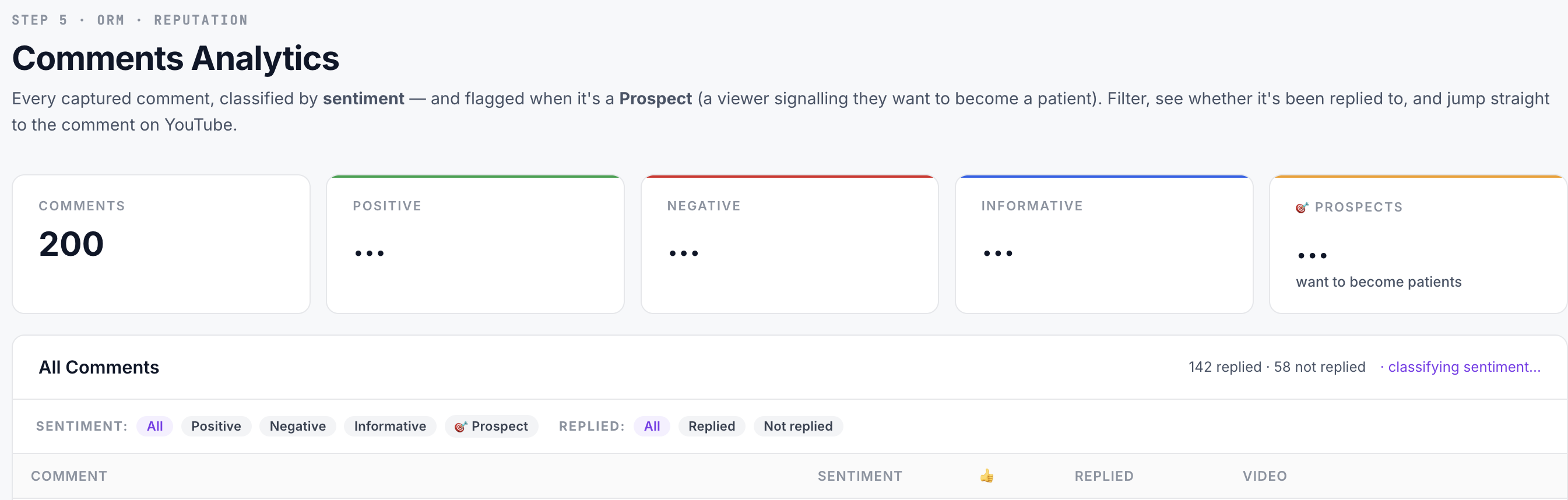
Whichever channel strategy you land on, the marketing services underneath run on Ichelon's 70-30 pricing model. The idea is straightforward: 70% of the monthly fee is fixed and covers the retainer work; 30% is tied to a twelve-month outcome target on a sliding-scale slab. If we hit the target range, we earn the variable. If we miss, we don't.
For SEO the tiers are Foundation ₹49,999 per month, Growth ₹74,999 per month, and Scale ₹99,999 per month. Foundation suits a single-doctor channel or a small clinic starting from a low search-visibility baseline. Growth fits a hybrid channel or a multi-consultant practice that needs departmental and doctor-level content operating in parallel. Scale is the institutional channel play — hospital-brand SEO with multiple service-line hubs, ABDM-aligned identity work, and compliance-reviewed content workflows.
The same 70-30 model extends to Google Ads (from ₹5 lakh per month in ad spend upwards) and YouTube plus AIO retainers (from ₹50,000 per month upwards). The variable slab is calibrated to the channel model you have picked — a doctor channel is measured on named-doctor consultation volume; a hospital channel is measured on service-line lead quality and downstream conversion.
Frequently Asked Questions



Can a hospital ethically promote a specific doctor by name under NMC rules?
Yes, with care. Naming a consultant, listing credentials, and describing the services they provide is factual information and permitted. The restricted zone is solicitation-style promotion — testimonials attributed to patients, before-after aesthetic imagery outside permitted contexts, and comparative claims positioning one doctor above another. A two-tier review process with a clinical reviewer and a communications reviewer, both approving each asset, is the standard operational safeguard.
If our star surgeon leaves, what happens to a doctor-led channel we built with hospital money?
Legally, the goodwill attached to the personal brand walks with the doctor unless an enforceable IP assignment exists at the point of employment. Practically, even a strong contract does not force patients to keep loyalty to the hospital when the face they trust moves. The mitigation is architectural, not contractual: keep the departmental brand strong enough that a consultant exit is disruptive but not fatal.
Who is the data fiduciary under DPDP Act 2023 for leads on a doctor's landing page hosted by the hospital?
It depends on who determines the purpose and means of processing. In most hospital-employed doctor setups, the hospital is the fiduciary and the doctor is a processor or joint fiduciary. The consent notice, grievance officer, and retention policy on the landing page must reflect that arrangement. Do a legal audit of your existing landing pages before assuming your paperwork matches your practice.
How do you split Google Business Profile listings between the hospital and its doctors?
The Google Business Profile guidelines permit one listing per hospital location and separate listings for individual practitioners who see patients at that address. In a hybrid model, both are legitimate. Keep the hospital GBP as the empanelment and departmental listing; let each named consultant maintain a Doctor-category GBP if they are the actual patient contact for their appointments. Do not create fake departmental listings — that violates GBP policy and risks all your listings.
Does a personal doctor channel work for a chain with five branches?
Partially. Named consultants at each branch can maintain personal channels, and this often works for high-consideration specialties like IVF or oncology. What does not work is a single chain-founder personal channel trying to carry the demand for all five branches — the geographic dispersion breaks the local search advantage a doctor channel is supposed to enjoy. Match channel type to catchment.
Is YouTube fundamentally a doctor channel or a hospital channel play?
Both, but they earn attention differently. Doctor channels win on face-driven trust, procedure explanations, and patient-question formats. Hospital channels win on facility walkthroughs, department capability films, and multi-consultant panels. The strongest institutional YouTube presences in India today are hybrid — a hospital channel featuring named consultants regularly, with each consultant also maintaining a personal channel that cross-promotes when appropriate.
How does ABDM change the doctor versus hospital calculus?
ABDM formally separates the Healthcare Professionals Registry from the Health Facility Registry. Patients using ABHA-linked booking flows can discover and share records with either identity. This makes the underlying architecture explicit — you now need both identities properly registered, verified, and connected before your channel strategy sits on stable rails. The hybrid model maps to this cleanly; a pure doctor channel without an HFR-linked facility identity leaves a gap in the discovery flow.
How long before we see results from either channel model?
A single doctor channel typically shows meaningful consultation volume by month four to six if the content cadence is disciplined and the specialty is name-searched. An institutional hospital channel takes nine to twelve months on branded and service-line search terms, but produces more durable equity thereafter. A hybrid channel takes six to nine months to warm up on both fronts and needs a larger initial investment. Payback windows differ; durability profiles differ more.
Book a free Brand & Growth Diagnostic.
60 minutes with Sr. Leadership. You leave with a written root-cause analysis of where growth is stalling and what to fix first — whether or not you engage ICG.
Questions readers ask
about this topic.
The three platforms
behind every ICG engagement.
Beacon
CAPI middleware that fixes Event Match Quality, translates CRM statuses to Meta-standard events, dedups across channels.
Agency OS
Live client dashboard. GSC, GA4, Google Ads, Meta Ads, IVR calls in one view. Login anytime, not monthly.
Phoenix
Clinic revenue intelligence over your PMS. Daily action queue: Prevent Loss, Maintain & Engage, Grow Revenue. Multi-centre rollout.
Or book a free 30-min audit to see all three in action on your account.
Healthcare brands
that already run on ICG.
A representative slice of the 150+ healthcare brands ICG has delivered for across India. Most engagements remain under NDA.


What ICG clients say · on video.
"Mental health marketing requires a different sensitivity. ICG built compliance-aware campaigns that respect both patients and our..."
"Bariatric surgery patients need a long consideration cycle. ICG built a content + paid system that respects that timeline."
"Working with ICG felt like working with an in-house growth team that happens to specialise in healthcare."
Need help operationalising this?
Every ICG service is healthcare-only, NMC + DPDP-aware, and built around the patient-research patterns that drive Indian healthcare growth in 2026.
Every practice welcome — packages from ₹20,000/mo.
Goals-Driven engagements · Performance-Linked Payout Models available



More from
ICG.
Five trends shaping Indian healthcare marketing through 2027: AI-first patient research, Conversions API adoption, ABDM discovery, the AEO w...
Healthcare AIO is the discipline of getting your clinic or hospital cited inside Google AI Overviews, ChatGPT and Perplexity answers — not j...
Conversational-search advertising places brand messages inside AI chat answers — ChatGPT, Perplexity, Copilot — rather than beside a results...
Stop guessing.
Book a Diagnostic.
30 minutes. Free. With the AI-powered healthcare-only marketing agency 150+ brands already run on. No slides, no pitch, no hard close.


