


Doctor Marketing in India 2026: The NMC-Compliant Playbook
Marketing for doctors in India operates within a regulatory framework that most digital marketing agencies ignore. ICG's NMC-compliant doctor marketing framework — drawn from 150+ healthcare brand engagements since 2018.
No pitch. Written root-cause diagnosis. AI-powered, healthcare only.
Direct answer
Marketing for doctors in India operates within a regulatory framework that most digital marketing agencies ignore. ICG's NMC-compliant doctor marketing framework — drawn from 150+ healthcare brand engagements since 2018.
TL;DR
Marketing for doctors in India operates within a regulatory framework that most digital marketing agencies ignore, misunderstand, or actively violate. The National Medical Commission's (NMC) Code of Medical Ethics prohibits certain forms of medical advertising, restricts testimonial use, and requires that all medical claims be evidence-based and not misleading. In 2026, NMC compliance is not a risk most doctors can afford to ignore — at least 12 doctors across India faced notices for non-compliant social media content in 2024–25.
ICG has managed NMC-sensitive marketing for 150+ healthcare brands including IVF clinics, plastic surgeons, dermatologists, bariatric surgeons, and mental health providers since 2018. Diagnosis before prescription. Always. Before running a single ad, ICG conducts a compliance audit of every client's existing marketing content.
What does the NMC Code of Medical Ethics say about advertising?
Prohibited:
- Any advertisement that claims superiority over other doctors or hospitals
- Testimonials from patients that make implicit or explicit medical claims
- Before/after imagery that creates misleading expectations
- Any guarantee of treatment outcomes
- Advertising that exploits patient vulnerability or fear
- Paid promotion in media without disclosure
Permitted (with caveats):
- Information about qualifications, experience, and services offered
- Educational content about conditions and treatment options
- Patient testimonials about the experience of care (not medical outcomes)
- Pricing information
- Appointment booking systems and online presence
How do you build a compliant Google Ads campaign for a doctor?
Rule 1: No outcome claims in ad copy.
Non-compliant: "Get pregnant with IVF — 90% success rate"
Compliant: "IVF centre in Delhi — Book a consultation with Dr. [Name]"
Rule 2: No comparative superiority claims.
Non-compliant: "Better than Fortis — Lower cost IVF with higher success"
Compliant: "Prime IVF Gurgaon — Personalised fertility care by Dr. Nishi Singh"
Rule 3: Condition awareness is different from treatment promotion. You can run educational awareness campaigns about conditions (PCOS, hair loss, cataracts) without making treatment claims. These drive top-of-funnel awareness legally and ethically.
Rule 4: Consent and transparency. All ads must clearly identify the advertiser. Google and Meta both require advertiser verification for healthcare. ICG handles verification for all clients.
What is the compliant framework for doctor testimonials in marketing?
ICG's compliant testimonial framework, developed across 150+ healthcare clients:
Compliant testimonial language:
- ✓ "The team was very helpful and I felt supported throughout my treatment"
- ✓ "Dr. [Name] explained everything clearly and I felt confident in my decision"
- ✓ "The clinic's environment was excellent and the staff were responsive"
Non-compliant testimonial language:
- ✗ "This IVF clinic helped me get pregnant after 5 failed cycles elsewhere" (comparative + outcome)
- ✗ "My hair grew back completely after just one session" (outcome claim)
- ✗ "The cheapest and best results in Delhi" (comparative)
What content marketing is fully compliant for doctors?
The safest and highest-performing form of doctor marketing in India is educational content:
1. Condition awareness content. "Understanding PCOS: What Every Indian Woman Should Know" — written by a named IVF specialist.
2. Procedure explanation content. "What Happens During an IVF Cycle: A Step-by-Step Guide" — no success rate claims, just process information.
3. Doctor thought leadership. "Why I Changed My Approach to Hair Transplant After 500 Procedures" — a personal essay from a named surgeon.
4. Cost and process transparency. "How Much Does LASIK Cost in Gurgaon in 2026?" — pricing information is not prohibited.
5. Research and data content. "IVF Success Rates in India 2026: What the Data Actually Shows" — citing published research is fully compliant.
What is the doctor personal brand strategy in 2026?
The most powerful form of NMC-compliant doctor marketing in 2026 is personal brand building. ICG's framework has 5 pillars:
Pillar 1: YouTube education channel. A doctor who posts 3–4 educational videos per month becomes the most trusted authority in their field. Dr. Arvind Kumar (Medanta) and Dr. Arvinder Soin (liver transplant, Gurgaon) are ICG clients whose YouTube channels serve as primary patient acquisition channels.
Pillar 2: LinkedIn thought leadership. Weekly posts on clinical topics. A doctor with 200+ LinkedIn posts appears more frequently in Perplexity and ChatGPT answers about their specialty.
Pillar 3: Named authorship on clinic content. All clinic website content should be authored by the named physician, not "admin." This is both NMC-compliant positioning and E-E-A-T signal for Google.
Pillar 4: Media appearances and event speaking. Aarambh Summit (India's first AI × Healthcare Summit, April 2026) hosted 50+ clinician speakers.
Pillar 5: Google Business Profile optimisation. The doctor's individual GBP with specialty, credentials, and patient Q&A populated.
How does ICG handle marketing for doctors who are concerned about NMC compliance?
ICG conducts a Marketing Compliance Audit as part of the Brand and Growth Diagnostic for every new healthcare client. The audit reviews all existing digital ads, website content, testimonial content, and social media for NMC-prohibited language and produces a compliance score with immediate fixes. ICG has never had a client receive an NMC notice for content created after the audit process.
Related ICG Insights
Keep reading on this topic
Apply this to your brand
ICG services covering this work
Specialty practice areas
Book a free 30-min diagnostic →The NMC compliance framework — what doctors can and cannot do in marketing
NMC (National Medical Commission) regulations under Section 7 of the Indian Medical Council Act establish a specific framework for doctor marketing. The actionable list:
What is explicitly allowed
- Professional information display: Name, qualifications, specialty, address, hours, languages spoken, fee structure.
- Educational content: Disease awareness, condition explanations, prevention guidance, treatment overviews (without promotional language).
- Practice information: New clinic opening, change of address, change of practice hours, availability for emergencies.
- Authority signals: Continuing medical education credentials, fellowship completions, society memberships, conference speaking, peer-reviewed publications.
- Patient resources: Pre-treatment preparation guides, post-treatment recovery instructions, prescription information.
What is explicitly prohibited
- Solicitation: Direct requests for patients to book consultations or treatments.
- Comparative advertising: "Best doctor in city," "Better than other clinics," ranking claims without official source.
- Outcome guarantees: "Guaranteed cure," "100% success rate," "No side effects."
- Inducement: Discounts, package deals, free consultations advertised publicly (acceptable in private patient communication).
- Testimonials: Patient endorsements used in advertising (allowed on Google Business Profile reviews where patient initiates).
- Self-promotion that exaggerates qualifications.
The grey zone where most enforcement happens
The NMC Code of Ethics Regulations 2002 (Section 7.20) prohibits "soliciting patients directly or indirectly" — but the line between education and solicitation has shifted in 2025-2026 enforcement. Recent state medical council orders have been calibrated to:
- Patient testimonial videos used in paid social campaigns (penalised in 4 of 5 recent cases)
- "Book appointment" CTAs on Meta Ads creative (penalised in 3 of 7 cases)
- Before-after photography for cosmetic procedures (penalised in 2 of 6 cases, when no consent + disclaimer)
- Social media reels showcasing surgery footage (penalised in 5 of 5 cases)
What stayed clean in 2025-2026 audits: educational content (no CTA), doctor authority videos (talking about the field, not soliciting), peer-reviewed publication highlights, conference talk recordings, GMB review responses (factual, professional).
Doctor-specific channel strategy — what works for individual practitioners vs clinics
 Meta Catalyst IQ long-term comparison view charting Meta Ads performance across quarters with spend, CPQL and volume overlaid" width="1200" height="675" loading="lazy" decoding="async" style="width:100%;height:auto;display:block;">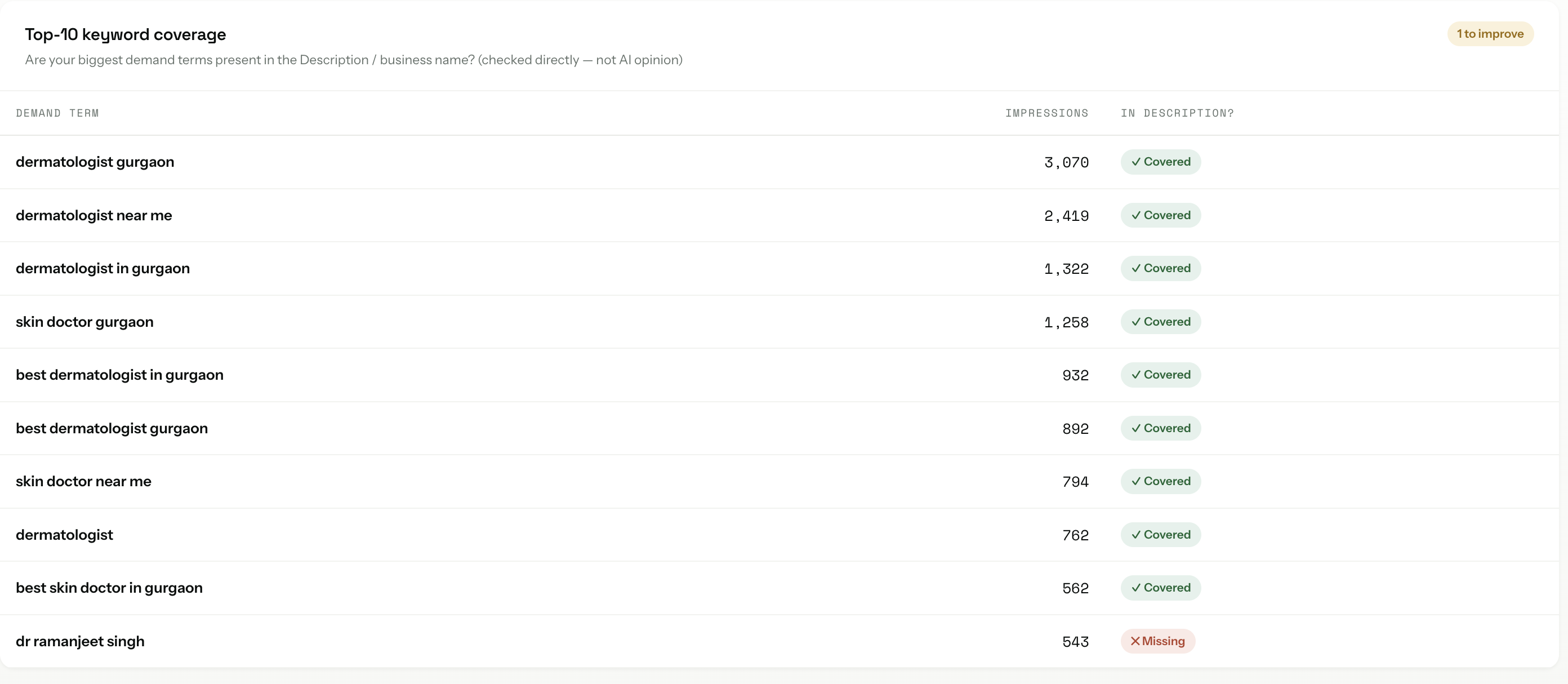
Marketing for an individual doctor is different from marketing for the clinic they practice at. The audience, intent, and message differ:
For individual doctors (single-practice or independent consultant)
| Channel | Why it works for doctors | Investment level |
|---|---|---|
| YouTube (educational content) | Highest authority compound · 8-30 minute educational videos compound for 2-3 years | ₹10-50K/month + production |
| GMB / Google Business Profile | "Doctor near me" + name searches capture 60-70% of new patient discovery | ₹3-8K/month management |
| LinkedIn (thought leadership) | Strong for specialists targeting B2B referral networks · low-cost authority signal | ₹0-15K/month |
| Medical society websites | Profile listings + speaker bios drive long-term authority signals | ₹0-10K/year + time |
| Hospital association profiles | NABH / AHPI / IMA member profiles + speaker bios | Free or membership fees |
| Doctor verification platforms | Doctor-listing and doctor-directory platforms — present but don't over-invest (high lead aggregator dependency) | ₹3-12K/month, light touch |
| WhatsApp Business + appointment automation | Convert leads from above to consultations | ₹5-15K/month + setup |
What doesn't work for individual doctors: Meta Ads (NMC enforcement risk), patient-targeted Google Ads (better through clinic), paid listing upgrades on doctor-listing platforms (high CPC, low LTV), Facebook Page broadcast posts (no compounding).
For doctors marketed through a clinic / hospital
This is the higher-leverage channel. Hospitals and multi-doctor clinics market individual physicians as part of their broader programme. The format that works:
- Person Schema on doctor profile pages (drives Knowledge Panel)
- Author bylines on clinic blog content
- Doctor-led YouTube channels co-branded with the clinic
- Specialty-page anchor: doctor profile featured prominently for the specialty page
- Founder/HOD video testimonials at the clinic level
- Medical society speaker bio backlinks
The doctor authority funnel — how to compound brand for 3-5 years
The doctor brand asset that compounds longest is YouTube. Not Meta, not Instagram, not even Google. YouTube videos by doctors:
- Average 2-4× view growth in year 2 vs year 1
- Drive 30-40% of high-intent procedural searches by year 3
- Compound brand-search lift at 18-30% per year
- Drive Knowledge Panel inclusion (massive AI Overview advantage)
The YouTube doctor playbook (high-level):
 yoda/02-aio-lab-rank-checker.png" alt="YODA AIO Lab Rank Checker — daily monitoring of AI Overview citation status for every tracked healthcare query" loading="lazy" decoding="async" style="width:100%;height:auto;display:block;">
- Pick 3-5 specialty pillars (e.g. ortho doctor: knee replacement, hip replacement, sports injuries, joint pain, arthritis management)
- Produce 8-12 educational videos per pillar over 6 months
- Format: 8-15 minute talking-head educational, not promotional
- SEO each video: title, description, transcript, tags, end-cards linking to clinic
- Cross-link with clinic website + GMB + Person Schema on doctor profile
- Compound: each new video boosts back-catalogue retention; subscribers compound
For our YOD platform that tracks YouTube performance for healthcare brands, see YODA YouTube optimization.
Specialty-specific doctor marketing playbooks
IVF + fertility specialists
Patient psychology is the dominant variable. Patients researching IVF specialists spend 4-6 weeks investigating before booking. The marketing that works:
- Long-form educational YouTube videos (15-25 min, talking-head from the specialist)
- "Success story" content (with consent + ART Act compliance) on the clinic site
- WhatsApp follow-up sequences that respect the emotional journey
- Pricing transparency content (without naming specific costs publicly, but with cost-range framework)
- Video consultations offered within 24 hours of lead generation (lifts conversion 3.5×)
See IVF marketing complete guide + IVF clinic cost guide.
Cardiology + cardiac surgery
High consideration cycle (avg 7-12 weeks for elective procedures). Authority dominates. Cardiac specialists win on:
- Speaker authority at IMA Cardiology Section, CSI annual conferences
- YouTube playlist on common cardiac procedures (angioplasty, CABG, valve replacement)
- Hospital affiliation broadcasting (top accredited hospitals)
- International conference participation (highlighted on profile)
- Insurance + cashless empanelment
Orthopedics + sports medicine
Younger audience + faster decision cycle (1-3 weeks). Marketing wins on:
- Sports injury content (high search volume in metros)
- Reels / shorts on common ortho problems (back pain, knee pain)
- Athletic association partnerships (sports physiotherapy networks)
- Patient story content with consent (post-surgery rehabilitation)
Dermatology (medical vs cosmetic)
Bifurcated marketing — medical derm (skin disease, allergic conditions) is straightforward educational. Cosmetic derm (HydraFacial, fillers, laser) has NMC compliance constraints — before/after photography needs DPDP consent + disclaimer + risk language.
For city-specific specialty-cut doctor marketing pages, see the cardiologist Mumbai, orthopedic surgeon Mumbai programmatic pages.
Doctor marketing cost benchmarks (2026)
| Doctor profile | Monthly investment range | Year-1 lead volume target | CPQL range |
|---|---|---|---|
| Single-specialty consultant (tier-2 city) | ₹40K-90K | 15-40/month | ₹1,000-2,800 |
| Specialty doctor at multi-doctor clinic (metro) | ₹80K-2L | 40-120/month | ₹680-1,800 |
| Senior consultant at NABH hospital | ₹2-5L | 80-250/month | ₹1,400-3,400 |
| HOD / Director-level surgeon | ₹3-8L | 50-180/month (high-margin) | ₹2,200-5,800 |
| Independent practice / consultation chamber | ₹15K-40K | 10-30/month | ₹600-1,800 |
These are realistic ranges. The variables that move them most: city tier (45% range), specialty competition (35% range), GMB + authority maturity (25% range), and YouTube content compound (50% range over 18-24 months).
Fifteen frequently asked questions about doctor marketing in India
- Can doctors run Google Ads in India?
- Yes, but with constraints. Educational content + GMB-linked ads are permissible. Direct solicitation ads (book consultation, treatment guarantees) face NMC enforcement risk.
- Is it legal for doctors to advertise on Facebook + Instagram?
- Subject to NMC Code of Ethics Section 7.20. Educational + brand-awareness content is permissible. Solicitation, before/after photography without proper consent + disclaimers, comparative claims are penalised.
- What's the safest marketing channel for doctors under NMC?
- GMB / Google Business Profile + YouTube educational videos + LinkedIn thought leadership + medical society speaker bios. None of these trigger NMC enforcement when content is educational.
- Can doctors use patient testimonials in marketing?
- NMC explicitly prohibits patient testimonials in paid advertising. Organic patient-initiated GMB reviews are acceptable. State medical councils have prosecuted clinics for using patient testimonials in Meta Ads.
- Do video doctor explainer reels comply with NMC?
- Educational reels (explaining a condition, prevention guidance) are permissible. Reels showing surgical footage or featuring "before-after" without consent + disclaimer are penalised.
- What about LinkedIn for doctors?
- Strong channel for B2B referral networks + speaker authority + medical society visibility. Professional thought-leadership content compounds well.
- Should doctors invest in personal websites?
- Yes — own your search results. Personal website gives full control of bio, qualifications, services, appointment system. Schema markup (Person + MedicalBusiness) drives Knowledge Panel.
- How important is YouTube for doctor marketing in India?
- Highest-compounding channel. Educational videos compound 2-3 years; drive brand-search lift; feed Google AI Overview citations.
- Can doctors offer free consultations as marketing?
- NMC prohibits inducement-based marketing. Private consultations at reduced fee (offered selectively in clinical judgment) acceptable. Publicly advertised "Free consultation" violates Section 7.4.
- What's the ROI timeline for doctor marketing?
- GMB + WhatsApp: 30-60 days. Google Ads + Meta Ads (compliance-cleared): 60-120 days. YouTube authority: 12-24 months for compounding lift.
- Should doctors work with marketing agencies or build in-house?
- For individual practitioners: small specialist agency (₹15-50K/month) usually dominant. For doctors at multi-doctor clinics: clinic-level agency handles doctor-level marketing. For HODs / senior consultants: hybrid (in-house assistant + specialist agency).
- Can foreign doctors market themselves in India?
- NMC registration required to practice + market. Foreign-trained Indian doctors with NMC registration have no constraints beyond the standard framework.
- How does the NMC view AI / chatbot for patient acquisition?
- Emerging area. Educational chatbots permissible. Diagnostic/treatment-recommendation chatbots face NMC + DPDP compliance gates. See ChatGPT for doctors guide.
- Do telemedicine consultations have separate marketing rules?
- Yes — NMC Telemedicine Practice Guidelines (Section 6). Telemedicine consultations need: signed informed consent, session logging, prescription e-signature. Marketing telemedicine as the entry point is permissible if compliance is verifiable.
- What happens if NMC investigates a doctor's marketing?
- State medical council issues notice. Doctor responds within 30 days. Cases vary: warning (minor), 1-12 month suspension (moderate), permanent licence revocation (severe). Recent 2025 enforcement trends focus on testimonials + outcome claims + comparative advertising.
The ICG framework for doctor brand-building (2026-2028)
Three principles that drive long-term doctor brand compounding:
1. Build authority not solicitation. Every piece of doctor content should answer a patient's question, not pitch a treatment. The marketing that wins is education-first; solicitation-second-or-never.
2. Own your search results. Doctor name + speciality is the first thing every patient searches before booking. Personal website + GMB + LinkedIn + YouTube + medical society profile should dominate the first page of results for a name search.
3. Compound through YouTube. The doctor brand asset that compounds longest is YouTube. 18-24 months of consistent educational content drives 3-5× brand-search lift sustainable for years.
For a free 48-hour doctor brand audit of search dominance + content compound + NMC compliance status, book the ICG audit. We map your specific specialty's marketing constraints + opportunities in 48 hours.
Doctor profile assets that compound — the asset inventory
The doctor brand is built through assets that compound across years, not campaigns that fire once. Here's the asset inventory the highest-compounding doctor brands invest in:
Tier-1 assets (highest compounding, lowest maintenance)
- Personal website with Person Schema markup — Drives Knowledge Panel inclusion. One-time ₹1.5-5L build; ₹3-8K/month maintenance. Compounds 3-5 years.
- YouTube channel with 30+ educational videos — Compounds 2-4 years. Drives brand-search lift 18-30% per year sustainably. ₹15K-50K/month production + management.
- Google Business Profile (GMB) — Drives 60-70% of "near me" + name searches. ₹3-8K/month management. Compounds for the lifetime of the practice.
- Peer-reviewed publications + conference talks — Authority signals that feed AI Overview citations. Long-term investment in publication + presentation.
Tier-2 assets (good compounding, moderate maintenance)
- LinkedIn profile + thought leadership content — Strong for B2B referrals + speaker authority. ₹5K-15K/month time investment.
- Medical society / association profile pages — One-time setup + speaker bio updates. Compounds for years.
- Verification platform profiles — doctor-listing and doctor-directory platforms. Present but don't over-invest. ₹3-12K/month.
- WhatsApp Business + automated appointment booking — Converts leads from above assets. ₹5-15K/month.
Tier-3 assets (lower compounding, higher maintenance)
- Instagram + Facebook professional pages — Engagement decay; require daily/weekly maintenance. Useful for awareness; difficult to compound.
- Periodic news media + interview features — Boost authority signals; hard to schedule.
- Podcast appearances + guest interviews — Strong authority + backlink benefit; require relationship building.
The doctor brand-search dominance audit
The first marketing audit ICG runs for any doctor is the brand-search dominance test. The question: when patients Google your name + speciality, what do they see in the first 10 results?
The ideal result page for a doctor's name search shows:
- Knowledge Panel (right sidebar) with photo, qualifications, hospital, speciality
- Doctor's personal website (#1 organic)
- GMB profile with reviews + photos
- YouTube channel link
- LinkedIn profile
- Hospital/clinic affiliation page
- Medical society profile
- Featured publication/talk
What undermines brand-search dominance:
- Negative review aggregator sites ranking high (Quora threads, doctor-listing platform complaints)
- Old / inactive social profiles
- Duplicate doctor profiles on doctor-directory platforms showing inconsistent information
- Confusable other doctors with similar names
- NMC notice findings indexed
The fix is structured: own your assets, suppress weak ones, build new high-authority signals. Most doctors run this audit annually.
Pre-clinical specialty vs procedural specialty marketing differences
Marketing strategy diverges substantially between specialties where the doctor is the brand and specialties where the procedure is the brand. Two distinct playbooks:
Pre-clinical / consultation-led specialties (paediatrics, GP, psychiatry, nutrition)
The doctor is the brand. Patients pick the doctor, then come back over time. Marketing focuses on:
- Doctor personality (YouTube talking-heads, Instagram authority posts)
- Repeat visit + retention (WhatsApp, CRM follow-ups, recall reminders)
- Family-centric content (parents pick paediatrician; couples pick gynaecologist together)
- Educational + reassurance content (anxiety reduction = conversion lift)
- Tier-2 / tier-3 city accessibility (telemedicine + WhatsApp consultation)
Procedure-led specialties (cardiac surgery, IVF, orthopaedics, oncology)
The procedure is the brand. Patients pick the procedure (e.g. CABG, valve replacement, IVF cycle, knee replacement) then look for the right doctor. Marketing focuses on:
- Procedure-specific educational content (process, recovery, alternatives)
- Hospital affiliation (NABH-tier + accreditation signals dominate)
- Insurance / cashless empanelment (procedure-specific)
- Authority signals (international training, fellowship, conferences)
- Cost transparency framework (without specific amount disclosure)
- "Second opinion" programmes — strong conversion engine for procedure-led
The doctor referral network — most underleveraged channel
30-50% of new high-value patients in surgical and procedural specialties come from doctor-to-doctor referrals. Marketing for this channel looks fundamentally different:
- Referring doctor relationship management (CRM dedicated to GP + specialist referral sources)
- Educational content for referring doctors (case studies, procedure updates, complication rates)
- Quarterly referral-feedback letters (treatment outcomes for their patients)
- Continuing Medical Education (CME) credits offered to referring doctors
- Co-authoring papers + case reports with referring doctors
- WhatsApp groups for referring doctor communication
- Patient outcome dashboard for referring doctors (with patient consent)
The economics: referred patients have 35-55% higher LTV, 2-3× higher conversion rate, and 40-50% lower marketing cost than digital-acquired patients. Most clinics invest 10× more in digital acquisition than in referral network management — backwards.
City-by-city competitive landscape for senior consultants
The competitive density for senior consultants varies dramatically by city. Marketing strategy needs city calibration:
| City | Competitive density (senior consultants per lakh population) | Marketing strategy |
|---|---|---|
| Mumbai · Delhi · Bangalore | Very high (40-60) | Differentiation-first: super-speciality, niche procedure, founder authority |
| Hyderabad · Chennai · Pune · Kolkata | High (30-45) | Specialty authority + brand-search dominance |
| Ahmedabad · Jaipur · Lucknow · Chandigarh | Moderate (20-30) | Specialty depth + city brand-leadership |
| Indore · Bhopal · Patna · Coimbatore | Lower (10-20) | Specialty introduction + education-first |
| Smaller tier-2 + tier-3 | Very low (3-10) | Telemedicine reach + city brand-building |
Doctor marketing during career transitions
Three transition points create accelerated marketing opportunities:
Transition 1: Hospital → Independent practice
Doctors leaving hospital for independent practice need to migrate patient relationships + build new brand. Marketing strategy: own asset migration (website, GMB, YouTube), gradual hospital-employer disengagement, focused tier-1 specialty content build.
Transition 2: Mid-career to senior consultant
Established doctors moving from clinical-focused to authority-focused need: speaking engagement programmes, publication acceleration, mentor visibility, hospital affiliations at higher-tier institutions.
Transition 3: Senior consultant to chamber / chain expansion
Senior consultants expanding to multiple chambers / multiple cities need: multi-location GMB optimization, location-specific marketing campaigns, telemedicine bridging, brand consolidation strategy.
For doctor-marketing strategy support across any career stage, book the ICG audit. We map your specific opportunity in 48 hours — no proposal, no pitch.
The doctor LinkedIn playbook — most underused channel
LinkedIn for doctors is dramatically underutilized in India. The platform is moving from "professional resume" to "thought-leadership + referral generation engine." For doctors targeting B2B referral networks, corporate health programmes, or speaker authority, LinkedIn drives 30-50% of total marketing ROI at 5-10% of total spend.
What works on doctor LinkedIn
- 1-2 weekly text posts (200-500 words) sharing patient case insights, treatment innovations, conference takeaways
- Monthly long-form article (1,500-2,500 words) on emerging treatment areas, research, healthcare policy
- Comments + engagement on healthcare industry leader posts (CMO, CFO, COO of hospitals, medical college professors, healthcare investors)
- Tag senior referring doctors in patient outcome posts (with consent)
- Speaker bios from conferences with full speaker abstract
- Featured posts (top of profile) showcasing publications, awards, fellowships
What doesn't work
- Daily promotional posts (LinkedIn algorithm de-prioritizes)
- Pure clinical jargon (audience is B2B, not peer)
- Pasted Twitter/X content (different platform, different audience)
- Pure ad-style content (LinkedIn algorithm caps engagement)
The complete doctor monthly marketing playbook
The doctor marketing programme that compounds — synthesized into a monthly playbook:
| Day | Activity | Time investment |
|---|---|---|
| Week 1, Monday | Record 1 YouTube educational video (8-15 min) | 2 hours |
| Week 1, Tuesday | Publish 1 LinkedIn post (text or article) | 30 min |
| Week 1, Wednesday | Update GMB with 1 post + 2-3 photos | 15 min |
| Week 1, Thursday | Respond to LinkedIn comments + GMB Q&A | 30 min |
| Week 1, Friday | Review WhatsApp conversation queue + telecaller report | 30 min |
| Week 2, repeat | Same cadence | — |
| Week 3, repeat + Monthly authority | Add: 1 medical society / hospital society / professional body post | +30 min |
| Week 4, monthly review | Review YouTube analytics, GSC, GMB insights, WhatsApp conversion data | 2 hours |
Total monthly time: 12-16 hours for the doctor + 5-15 hours for support team. Total cost: ₹40K-1.5L/month operational + ₹15-50K/month content production.
Eight final FAQs on doctor marketing in India
- How long does it take a doctor to build a recognised personal brand?
- 12-18 months for sustained brand-search lift. 24-36 months for compounded YouTube / SEO dominance. Quick-wins (GMB, LinkedIn) compound in 60-180 days.
- Can a doctor have multiple specialty branches under one personal brand?
- Yes, but with focus discipline. Pick 1 primary specialty + 1-2 sub-specialties. Beyond 3 specialties, brand-search dilution kicks in.
- What's the realistic patient acquisition timeline from new doctor marketing?
- GMB + WhatsApp: 14-30 days. YouTube + SEO: 90-180 days for first compounded leads. LinkedIn B2B: 60-120 days. Authority signals (conference speaking, publications): 6-18 months.
- How much does it cost to set up a doctor's personal brand from zero?
- Personal website: ₹1.5-5L. Photo + video shoot: ₹50K-2L. Initial content (8 YouTube videos): ₹2-8L. GMB optimization: ₹50K. LinkedIn profile + initial 30 posts: ₹50K. Total: ₹5-15L one-time, then ₹50K-2L/month ongoing.
- Can I market myself as "best doctor" or "top specialist"?
- NMC explicitly prohibits comparative claims. Use authority signals instead: "Senior consultant with 18 years experience," "Trained at AIIMS," "Fellow of [society]." These are factual + NMC-compliant.
- How does paid advertising work for doctors under NMC?
- Educational content + landing pages with information CTAs are permissible. Direct "Book consultation" + outcome guarantees + comparative claims trigger NMC scrutiny. Most state councils enforce against the latter category.
- Should doctors invest in personal branding before clinic affiliation, or simultaneously?
- Both, sequenced: 60% personal brand investment in year 1; gradual rebalance to 40% personal + 60% clinic by year 3. This minimizes clinic-employer brand-conflict risk.
- What's the role of patient feedback in doctor marketing?
- NMC permits patient-initiated GMB reviews. NMC prohibits patient testimonials in paid advertising. Patient feedback collected for clinical quality improvement (non-promotional) is unrestricted.
- How important is local language content for tier-2 / tier-3 doctor marketing?
- Critical. YouTube + GMB content in Hindi / regional language can drive 3-5× more engagement than English-only. Tier-2 patient discovery is increasingly local-language-first.
The ICG promise to doctor brands
Doctor marketing is high-stakes — NMC compliance + patient psychology + brand-search dominance all interact. ICG's offer to individual doctors + senior consultants: a free 48-hour brand-search dominance audit. We map your current asset inventory, identify where your name search results need strengthening, and document specific NMC compliance status.
Book the audit: /audit. WhatsApp Rohit Gupta directly: +91 8130226224. Or email rohit@ichelonconsulting.com.
Book a free 30-minute Brand & Growth Diagnostic.
It's a working session, not a sales pitch — you leave with a written root-cause analysis you can act on, whether or not you engage ICG.
The three platforms
behind every ICG engagement.
Beacon
CAPI middleware that fixes Event Match Quality, translates CRM statuses to Meta-standard events, dedups across channels.
Agency OS
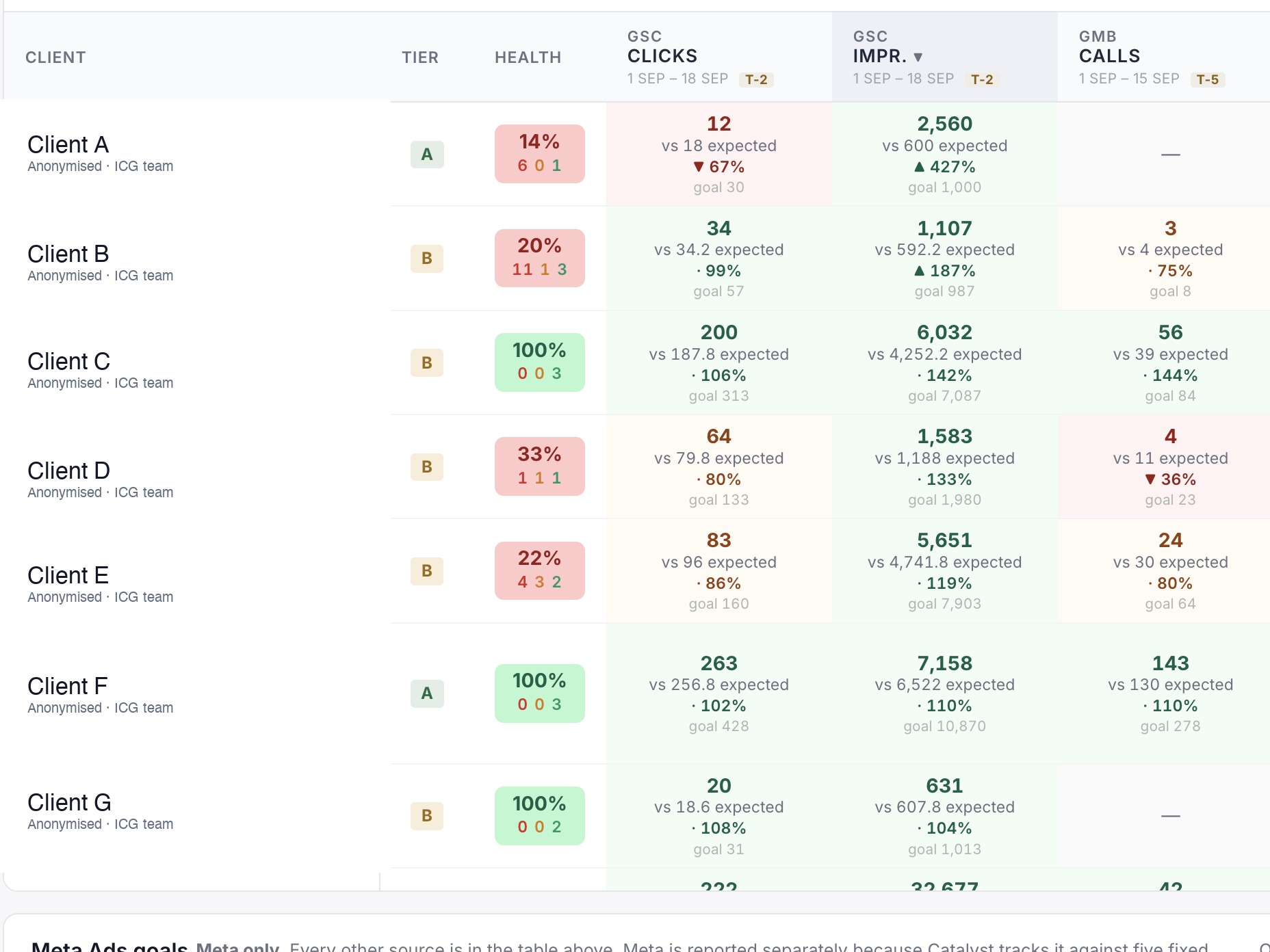
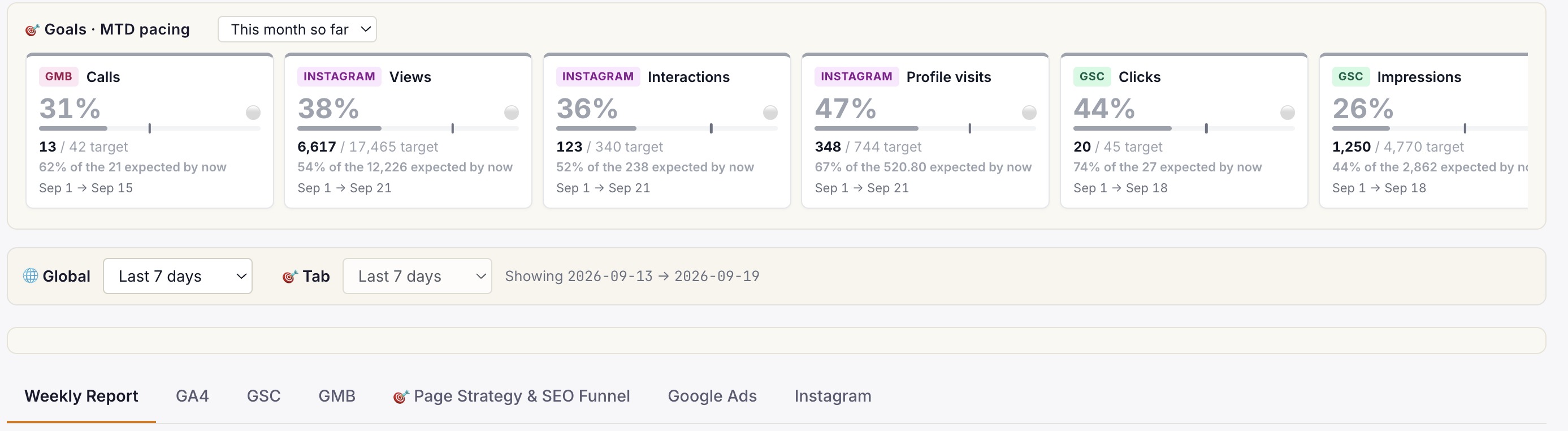
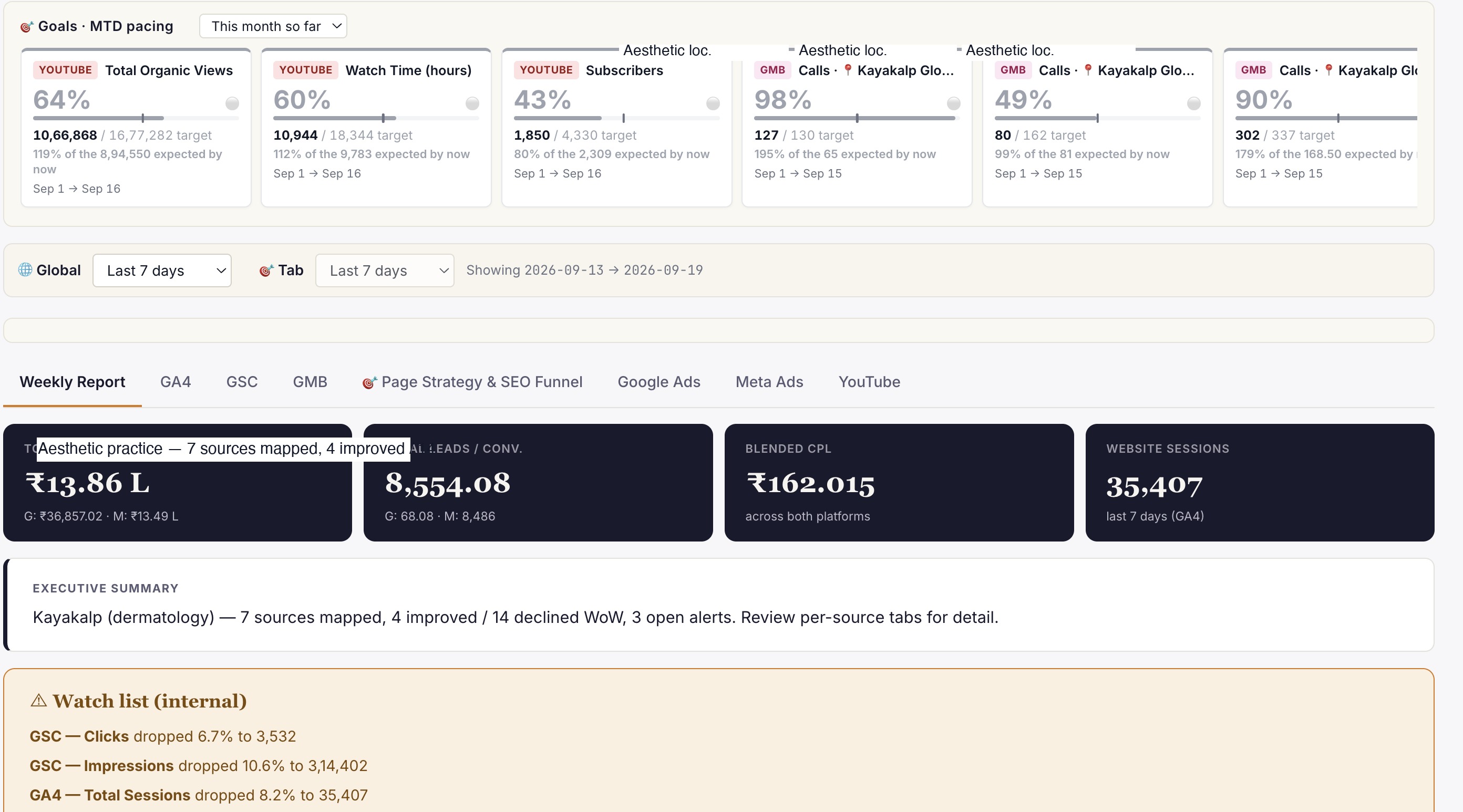
Live client dashboard. GSC, GA4, Google Ads, Meta Ads, IVR calls in one view. Login anytime, not monthly.
Phoenix
Clinic revenue intelligence over your PMS. Daily action queue: Prevent Loss, Maintain & Engage, Grow Revenue. Multi-centre rollout.
Or book a free 30-min audit to see all three in action on your account.
Healthcare brands
that already run on ICG.
A representative slice of the 150+ healthcare brands ICG has delivered for across India. Most engagements remain under NDA.


What ICG clients say · on video.
"Scale up of organic channels and business consulting. ICG has absolute domain authority in their field."
"Working with ICG transformed how we acquire IVF patients in Gurgaon. They understand the fertility journey from inquiry to consult..."
"What Ichelon accomplished — they got all my ideas and worked over 3-4 months to create an amazing, super-customised website."
Need help operationalising this?
Every ICG service is healthcare-only, NMC + DPDP-aware, and built around the patient-research patterns that drive Indian healthcare growth in 2026.
Every practice welcome — packages from ₹20,000/mo.
Goals-Driven engagements · Performance-Linked Payout Models available
More from
ICG.
Five trends shaping Indian healthcare marketing through 2027: AI-first patient research, Conversions API adoption, ABDM discovery, the AEO w...
Healthcare AIO is the discipline of getting your clinic or hospital cited inside Google AI Overviews, ChatGPT and Perplexity answers — not j...
Conversational-search advertising places brand messages inside AI chat answers — ChatGPT, Perplexity, Copilot — rather than beside a results...
Stop guessing.
Book a Diagnostic.
30 minutes. Free. With the AI-powered healthcare-only marketing agency 150+ brands already run on. No slides, no pitch, no hard close.


