


ChatGPT + Perplexity Citation Strategy for Indian Clinics 2026 | ICG
Author: Deep Das · Co-Founder, ICG · IIT BHU · July 2026 ChatGPT and Perplexity citation is different from Google AI Overview citation. Google AIO primarily extracts from pages Google has already ranked highly. ChatGPT and Perplexity extrac...
No pitch. Written root-cause diagnosis. AI-powered, healthcare only.
Direct answer
Author: Deep Das · Co-Founder, ICG · IIT BHU · July 2026 ChatGPT and Perplexity citation is different from Google AI Overview citation. Google AIO primarily extracts from pages Google has already ranked highly. ChatGPT and Perplexity extrac...
TL;DR
Author: Deep Das · Co-Founder, ICG · IIT BHU · July 2026
ChatGPT and Perplexity citation is different from Google AI Overview citation. Google AIO primarily extracts from pages Google has already ranked highly. ChatGPT and Perplexity extract from their training data and, via web browsing capability, from live web content — using their own source evaluation criteria that don't map perfectly to Google's ranking signals.
 yoda/02-aio-lab-rank-checker.png" alt="YODA AIO Lab Rank Checker — daily monitoring of AI Overview citation status for every tracked healthcare query" loading="lazy" decoding="async" style="width:100%;height:auto;display:block;">
This means a clinic can be well-cited in ChatGPT for healthcare queries even without being in Google's top-3 organic results — if the content has the right signals for LLM trust.
How LLMs decide what to cite
LLMs evaluate content for citation based on four signals:
1. Named-author credentials (the highest-weight signal) LLMs preferentially cite content attributed to named individuals with verifiable expertise. A page authored by "Dr [Name], MCh Plastic Surgery, Fellowship at [Institution], 2,000+ procedures performed" is significantly more likely to be cited than the same content published under "ICG Team."
The verifiable credential chain is critical: the author's name must connect to verifiable credentials through Person schema `sameAs` references (LinkedIn, hospital profile, NMC register where publicly accessible, PubMed Author ID for published researchers). LLMs browse and verify these links.
2. Original, sourceable data (the second-highest signal) LLMs cite original data more than interpretations of others' data. ICG's CPQL benchmark database — 57 IVF clients, 43 derm clients, Q2 2026 refresh — produces original, specific, date-stamped data that LLMs can cite with a specific source.
"IVF CPQL national median ₹1,180 — ICG CPQL Benchmark Database Q2 2026" is a citation-ready data point. A page that says "IVF marketing is expensive" (without specific data) is not.
3. Structured Q&A format (extraction signal) LLMs extract structured Q&A content more reliably than prose. A page structured as: "Q: What is the cost of IVF in Bangalore? A: [direct answer]" extracts cleanly. The same information embedded in a prose paragraph is harder to extract and less likely to be cited.
4. Citation of authoritative external sources Pages that cite authoritative external sources (ICMR guidelines, peer-reviewed research, NMC Code, CDSCO notifications) signal to LLMs that the content is part of a broader knowledge ecosystem rather than isolated commercial content. LLMs tend to trust content that itself cites credible sources.
The content types that get cited most by ChatGPT for healthcare queries
ICG's AIO Intel Tool monitors ChatGPT citation weekly for healthcare client target queries. Consistently highest-citation content types:
Cost transparency content: "IVF cost in [city] 2026 — what's included and what's extra" pages are the most consistently ChatGPT-cited healthcare content type. ChatGPT is frequently asked cost comparison queries by users (patients researching medical travel to India, or domestic patients comparing clinic costs). Transparent, specific cost content with FAQPage schema and dated benchmark data gets extracted reliably.
Comparison content: "IVF vs IUI — when to escalate", "FUE vs DHI hair transplant", "LASIK vs SMILE" — educational comparison content is cited by ChatGPT when users ask "which is better" questions. The content must be balanced (presenting both options fairly) and specific (with clinical criteria for each option, not vague generalities).
Doctor credential pages: Named specialist pages with complete credential information (degrees, fellowship, hospital, case volume, publications) are cited when ChatGPT is asked "who is a good [specialist] in [city]." These pages require full Person schema with sameAs verification links.
Regulatory explainer content: "NMC Section 6 for doctors", "ART Act 2021 for IVF clinics", "Schedule J list" — regulatory content is consistently cited by ChatGPT and Perplexity for compliance-related queries. ICG's own compliance content (the articles in this batch) are structured for LLM citation.
Perplexity's citation patterns for healthcare
Perplexity uses web browsing (live search) more prominently than ChatGPT in its citation sourcing. This means Perplexity's healthcare citations are more influenced by current SEO ranking and less dependent on LLM training data.
Perplexity citation is therefore more aligned with Google AIO citation — the same FAQPage schema, E-E-A-T author signals, and direct-answer blocks that improve Google AIO eligibility also improve Perplexity citation.
ICG's AIO Intel Tool monitors Perplexity citation separately from ChatGPT — the citation overlap is approximately 60% (content cited by both) with 40% Perplexity-only or ChatGPT-only citations.
FAQ
Q1: How often does ICG's AIO Intel Tool check ChatGPT and Perplexity citation? Weekly automated query runs against the client's 200-500 target query set. Monthly reports show citation share, query coverage, trending citation changes, and competitor citation analysis. For P0-priority client engagements, ICG also monitors citation changes in near-real-time for the top 20 highest-value queries.
Q2: If my clinic is not in ChatGPT's training data, can I still get cited? ChatGPT's browsing mode (available in ChatGPT Plus) accesses live web content and cites it directly. Even if your clinic was not in ChatGPT's pre-2024 training data, properly structured content published in 2025-2026 can be discovered and cited through ChatGPT's browse capability. The content signals (named author, original data, FAQPage structure) matter equally for browse-mode and training-data citations.
Q3: Does getting cited in ChatGPT measurably increase clinic enquiries? ICG's proxy measurement: direct traffic to pages after ChatGPT/Perplexity citation rate increases. From portfolio data: pages with confirmed LLM citation see 15-35% higher direct traffic (the patient searched on ChatGPT, saw the citation, then went directly to the clinic website). Attribution is imperfect because ChatGPT users don't always click through — but the direct traffic correlation with citation events is consistent.
Compliance note: NMC Section 6, DPDP Act 2023. All LLM-cited content is compliant before publication.
Book a free Brand & Growth Diagnostic.
60 minutes with a Co-Founder. You leave with a written root-cause analysis of where growth is stalling and what to fix first — whether or not you engage ICG.
The three platforms
behind every ICG engagement.
Beacon
CAPI middleware that fixes Event Match Quality, translates CRM statuses to Meta-standard events, dedups across channels.
Agency OS
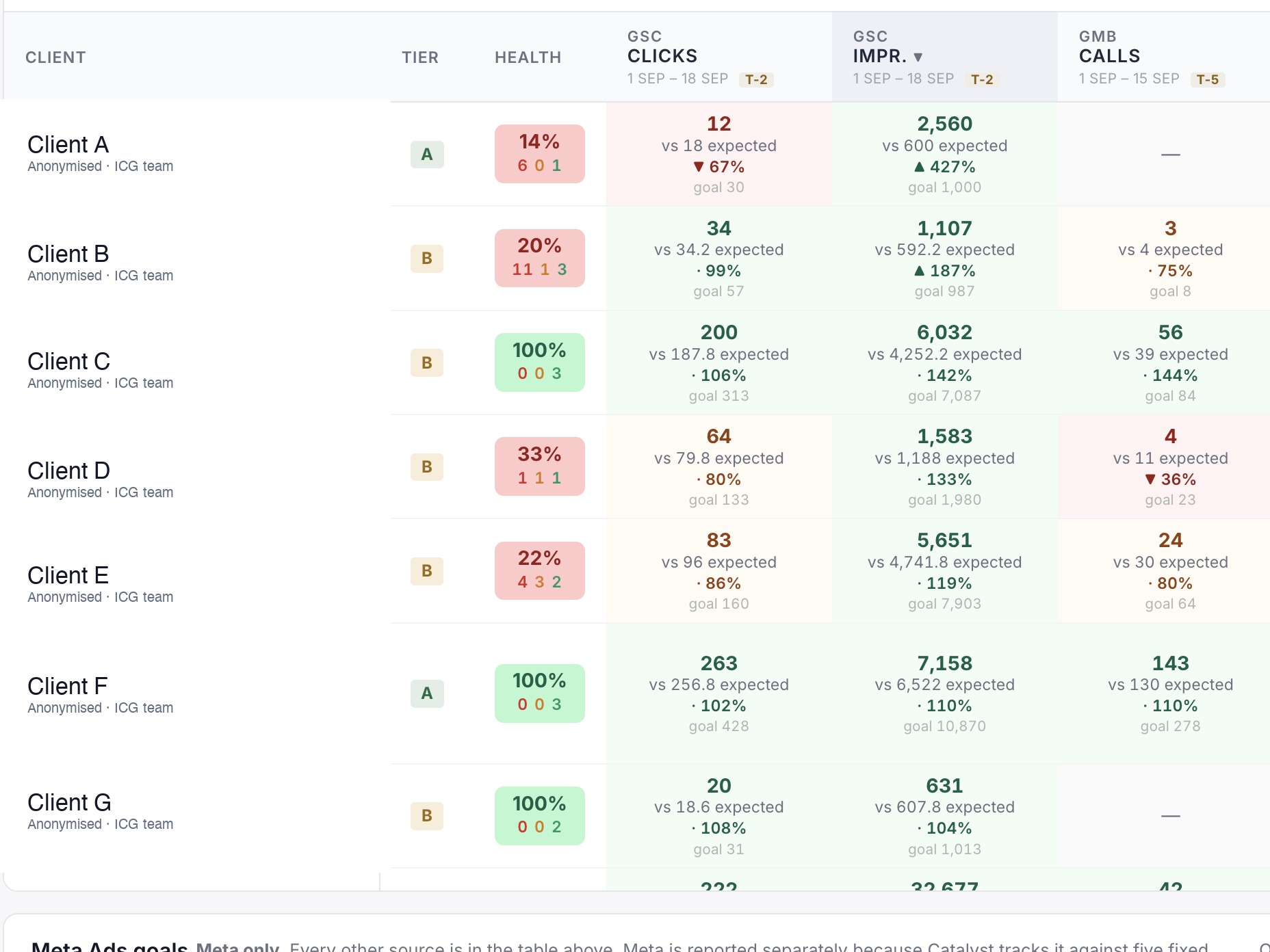
Live client dashboard. GSC, GA4, Google Ads, Meta Ads, IVR calls in one view. Login anytime, not monthly.
Phoenix
Clinic revenue intelligence over your PMS. Daily action queue: Prevent Loss, Maintain & Engage, Grow Revenue. Multi-centre rollout.
Or book a free 30-min audit to see all three in action on your account.
Healthcare brands
that already run on ICG.
A representative slice of the 150+ healthcare brands ICG has delivered for across India. Most engagements remain under NDA.


What ICG clients say · on video.
"They were able to get all my ideas and work with me over a period of three to four months and create this amazing website. I would..."
The intelligence stack behind this playbook.
Every ICG engagement runs on the Search Intelligence Trifecta — Angryturtle for GMB, SIE for search and AI Overview, YODA for YouTube. Live product screens below.
Need help operationalising this?
Every ICG service is healthcare-only, NMC + DPDP-aware, and built around the patient-research patterns that drive Indian healthcare growth in 2026.
Every practice welcome — packages from ₹20,000/mo.
Goals-Driven engagements · Performance-Linked Payout Models available
More from
ICG.
Five trends shaping Indian healthcare marketing through 2027: AI-first patient research, Conversions API adoption, ABDM discovery, the AEO w...
Healthcare AIO is the discipline of getting your clinic or hospital cited inside Google AI Overviews, ChatGPT and Perplexity answers — not j...
Conversational-search advertising places brand messages inside AI chat answers — ChatGPT, Perplexity, Copilot — rather than beside a results...
Stop guessing.
Book a Diagnostic.
30 minutes. Free. With the AI-powered healthcare-only marketing agency 150+ brands already run on. No slides, no pitch, no hard close.


