


Aesthetic Clinic Local SEO — Dermatology and Cosmetic Practice Google Maps 2026
Aesthetic clinics and dermatology practices occupy a unique position in Indian healthcare marketing. They have the highest patient lifetime value of any outpatient specialty (a patient who begins with
No pitch. Written root-cause diagnosis. AI-powered, healthcare only.
Direct answer
Aesthetic clinics and dermatology practices occupy a unique position in Indian healthcare marketing. They have the highest patient lifetime value of any outpatient specialty (a patient who begins with
TL;DR
TL;DR
- Aesthetic clinics and dermatology practices have the highest CPL and the highest CLTV of any outpatient healthcare specialty in India — the local SEO economics strongly justify significant GBP investment
- The patient discovery journey for aesthetic services is Instagram-first, then Google confirmation — your GBP needs to convert patients who already know they want a procedure and are confirming you're the right clinic
- Before/after content is the aesthetic clinic's most powerful trust signal and its greatest compliance risk simultaneously — NMC and Meta policies both restrict before/after in paid promotion contexts; organic GBP handling is nuanced
- "Laser clinic near me," "skin specialist," and procedure-specific queries ("HIFU treatment," "chemical peel cost") each represent different patient intent stages with different optimisation priorities
- Review management for aesthetic clinics requires particular sensitivity: patient reviews often reference appearance-related outcomes and personal details that require careful DPDP-compliant response handling
Aesthetic clinics and dermatology practices occupy a unique position in Indian healthcare marketing. They have the highest patient lifetime value of any outpatient specialty (a patient who begins with acne treatment may progress to laser procedures, injectables, HIFU, body contouring, and skincare memberships over 5–10 years). They have the highest social-media-to-Google conversion funnel intensity (patients discover on Instagram, validate on Google). And they have the most nuanced compliance situation — NMC Ethics Code applies as it does to all medical practice, but the aesthetic category's content naturally leans toward visual and outcome-claim language that requires active compliance management.
This guide covers the local SEO strategy for both dermatology-led aesthetic clinics and standalone cosmetic/aesthetic practices.
Section 1 — The Instagram-to-Google funnel
Aesthetic clinic patient discovery in India increasingly follows a predictable funnel:
Stage 1 — Instagram discovery: A patient discovers an aesthetic procedure (HIFU, Korean Glass Skin treatment, laser hair removal, lip filler) via Instagram Reels from a clinic or aesthetician. They save the post or follow the account.
Stage 2 — Consideration: They research the procedure on Google ("HIFU cost India," "HIFU before after," "is HIFU safe") and look at multiple content sources. They search the clinic's name on Google to see their reviews and rating.
Stage 3 — Google Maps validation: Before booking, they check the clinic's Google Business Profile — rating, review count, photos, location. This is the validation step, not the discovery step for many aesthetic patients.
Stage 4 — Booking: They DM the clinic on Instagram OR call/book via the GBP depending on which is easier.
Implication for local SEO strategy:
Your GBP is the validation layer, not the discovery layer, for Instagram-acquired aesthetic patients. This means:
- Rating and review count are more important than ever (they're specifically checking these)
- Photo quality in GBP is highly scrutinised (aesthetic patients are visually discerning)
- The GBP call button and website link need to be frictionless (they're ready to book — don't lose them to a clunky form)
- Your Instagram handle in the Q&A or business description creates a loop back to the channel where they first found you
Implication for content: For patients who discover via Google search (not Instagram), condition-specific content is important — "skin specialist for acne in [city]," "pigmentation treatment near me." These are direct Google discovery queries that require keyword-optimised GBP services list and linked website content.
Section 2 — Keyword architecture for aesthetic clinics
Aesthetic clinics serve two distinct patient populations with different search behaviour:
Population A — Medical dermatology patients: Searching for treatment of specific conditions. Acne, eczema, psoriasis, vitiligo, hair loss (alopecia), pigmentation, melasma, skin allergies. These are condition-queries primarily discovered via Google Search and Google Maps, with doctor-directory platforms as a secondary channel.
Population B — Aesthetic/cosmetic patients: Searching for enhancement procedures. Laser hair removal, HIFU, Botox, fillers, chemical peels, HydraFacial, body contouring, tattoo removal. These are procedure-queries where Instagram is often the discovery channel and Google Maps is the validation channel.
GBP optimisation for both populations:
Services list must cover both populations explicitly:
Medical dermatology services (for Population A):
- Acne treatment (medical and procedural)
- Pigmentation and melasma treatment
- Hair loss evaluation and treatment (alopecia, PRP for hair)
- Psoriasis management
- Vitiligo treatment
- Eczema and atopic dermatitis
- Mole and skin lesion evaluation
Aesthetic/cosmetic services (for Population B):
- Laser hair removal
- HIFU (High Intensity Focused Ultrasound)
- Botox and anti-wrinkle injections
- Dermal fillers (lip, cheek, under-eye)
- Chemical peels (specify types: glycolic, salicylic, TCA)
- HydraFacial and medical facials
- Body contouring (Coolsculpting, radiofrequency)
- Tattoo removal (Q-switch laser)
A GBP services list that covers both populations captures twice the query surface area.
Section 3 — Before/after compliance — the nuanced reality
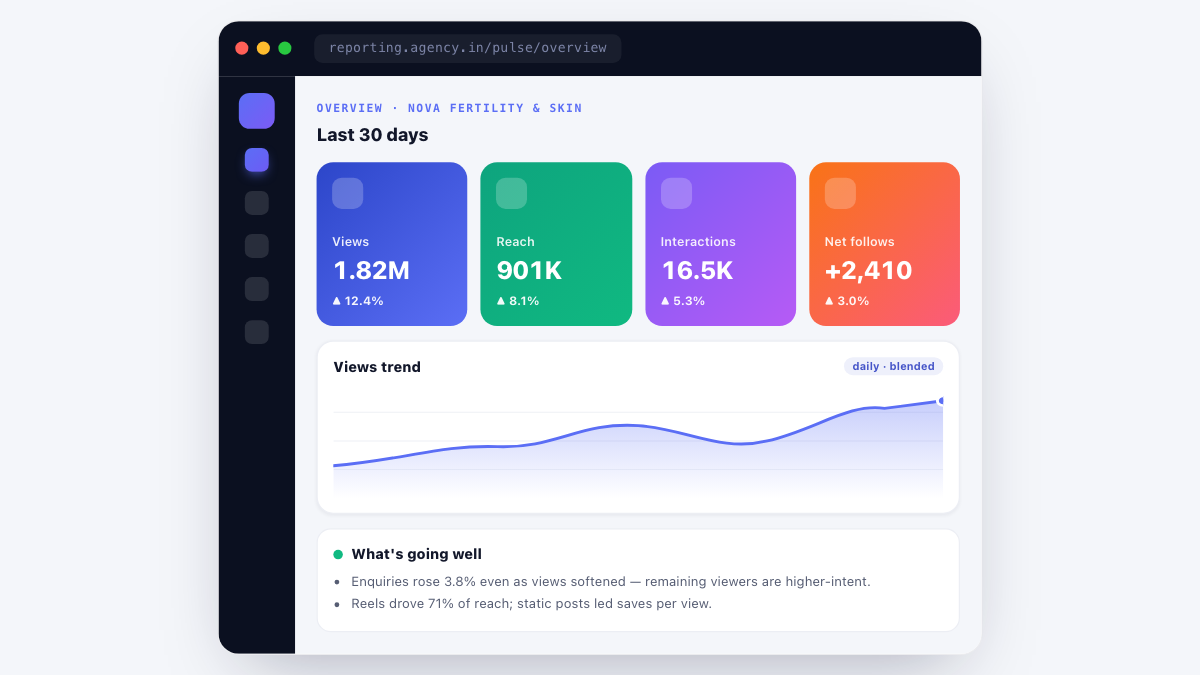 Prism Pulse Overview dashboard for a healthcare Instagram account showing 30-day views, reach, interactions and net follows with an AI-summarised what-is-working panel" width="1200" height="675" loading="lazy" decoding="async" style="width:100%;height:auto;display:block;">
Before/after imagery is the aesthetic clinic's most powerful trust signal. A well-documented acne treatment outcome or HIFU result communicates clinical efficacy more powerfully than any written claim. It is also the most compliance-sensitive content in the aesthetic category.
The regulatory landscape:
NMC Ethics Code 2026: Before/after imagery in paid promotion contexts is restricted. The code's prohibition on "misleading before/after representations" applies to structured promotional content.
Meta (Instagram/Facebook) advertising policies: Before/after content in paid ads is restricted by Meta's healthcare advertising policies. "Ads must not use before-and-after images or images that contain unexpected or unlikely results."
Google Ads: Similar restrictions on before/after content in healthcare paid advertising.
Organic GBP (not paid promotion): The GBP photo section is organic, not paid promotion. Before/after clinical photography in GBP photos sits in a grey area not explicitly addressed by the current NMC Ethics Code for organic non-paid contexts.
ICG's practical guidance for aesthetic clinic GBP photos:
- Do: Use high-quality portfolio photography of clinical work with documented patient consent
- Do: Include the phrase "Individual results may vary" either in the photo caption or in a prominent location near where the photos appear
- Do: Ensure patient consent documentation covers GBP photo use specifically (separate from general marketing consent)
- Do not: Use before/after imagery in paid GBP promotion (Google Ads for GBP, promoted pins)
- Do not: Present before/after imagery in a way that implies guaranteed outcomes
- When in doubt: use the after-only approach — single high-quality images of positive outcomes without the before comparison
Review responses for aesthetic outcomes: Aesthetic patients often reference their specific treatment and result in reviews. DPDP compliance applies: do not confirm the specific procedure, confirm outcome claims, or add clinical detail in response. Standard compliant response framework applies (experience-language, not clinical-language).
Section 4 — Geo-grid strategy for aesthetic clinics
Aesthetic clinic catchment varies significantly by procedure type:
General dermatology (acne, eczema, skin allergies): Short catchment — 2–4km in metro, 5–8km in smaller cities. Patients seek proximity for regular appointments.
High-value aesthetic procedures (HIFU, body contouring, advanced lasers): Extended catchment — patients travel further for premium procedures from credential-strong clinics. 5–10km catchment in metro, 10–20km in smaller cities.
Geo-grid configuration:
- Run two separate geo-grids: one at 500m–750m spacing for medical dermatology queries, one at 1km–1.5km spacing for aesthetic procedure queries
- The two grids will often reveal different competitive landscapes — the clinics competing with you for "acne treatment Andheri" are not necessarily the same ones competing for "HIFU Andheri"
The South Delhi cosmetic surgery geo-grid data in Turtle (visible in ICG's screenshot: average position #2.88, top-3 in 64% of the service area for "rhinoplasty in Delhi") illustrates the extended-catchment pattern — the clinic ranks strongly near its location and maintains reasonable visibility across a 5km+ radius, with slippage toward the eastern edge where competitor proximity becomes a factor.
Section 5 — Rating management for aesthetic clinics
Aesthetic clinics have specific rating management challenges:
Higher patient expectations: Aesthetic patients pay premium prices and have aspirational expectations. A 4.0★ rating that would be acceptable for a GP is competitive weakness for a premium aesthetic clinic. Target: 4.6★+ for premium positioning.
Appearance-focused negative reviews: Negative reviews in aesthetic practices often involve patients who are dissatisfied with cosmetic outcomes — the most subjective of all clinical outcomes. Responses must be empathetic, non-defensive, and must not make clinical claims or confirm the specific procedure.
Review volume context: Aesthetic clinics typically see fewer patients per day than GPs or dentists — review volume accumulates more slowly. Focus on 100% response rate and consistent velocity over time.
Rating benchmark by segment:
| Aesthetic clinic type | Minimum competitive rating | Target |
|---|---|---|
| Premium cosmetic surgery (South Delhi, Bandra) | 4.5★ | 4.7★+ |
| Mid-market aesthetic clinic (metro) | 4.3★ | 4.6★ |
| Dermatology-led aesthetic practice | 4.3★ | 4.5★ |
| Tier-2 city aesthetic clinic | 4.2★ | 4.5★ |
Section 6 — Practitioner credentialing in GBP for aesthetic clinics
Aesthetic medicine in India has a credentialing complexity: some practitioners are qualified dermatologists (MD/DNB Dermatology), some are aesthetic physicians (with aesthetic medicine training), and some are operating in regulatory grey areas. GBP content must accurately reflect the practitioner's actual credentials.
For MD/DNB Dermatologists: Full dermatologist credentials in GBP: "Dr [Name], MD Dermatology, [institution]." This is the strongest credential signal for both patient trust and Google E-E-A-T.
For aesthetic physicians: Accurate credential statement without misrepresentation: "Dr [Name], MBBS, [aesthetic medicine training/certification]." Do not imply dermatologist-level training that is not held.
For laser/aesthetic technicians operating under medical supervision: GBP should prominently feature the supervising medical practitioner's credentials. The GBP should represent the medical practice, not the technician.
This matters for local SEO because credential signals in GBP content (via business description and Person schema on the linked website) contribute to E-E-A-T — and patients in the aesthetic category are increasingly credential-aware.
Frequently asked questions
Q1: Can aesthetic clinics use before/after photos in their Google Business Profile? In the organic GBP photo section (not paid promotion): yes, with documented patient consent for marketing use and "results may vary" disclosure. The NMC restriction on before/after content applies primarily to paid promotion contexts. ICG recommends erring toward high-quality single-outcome photos rather than side-by-side before/after to minimise compliance risk while maintaining visual portfolio impact.
Q2: How important is Instagram for aesthetic clinic local SEO? Instagram drives discovery; Google Maps validates the decision. A strong Instagram presence increases branded Google searches (patients searching your clinic name after seeing you on Instagram) — which is a GBP relevance signal. ICG tracks the Instagram-to-branded-search correlation for aesthetic clients via GSC data. High Instagram presence clinics see 40–60% higher branded search volume than Instagram-inactive competitors with comparable Google Maps performance.
Q3: What rating does an aesthetic clinic need to convert on Google Maps? 4.5★ minimum for premium aesthetic positioning. Below 4.3★, conversion from GBP listing view to appointment call drops significantly in the aesthetic category — more so than in medical dermatology, where clinical credential signals partially offset the rating. Aesthetic patients are making discretionary choices and rating acts as a quality proxy more strongly than in urgent-care specialties.
Q4: How should an aesthetic clinic respond to a review about an unsatisfying cosmetic outcome? With empathy and without clinical confirmation. Never confirm the specific procedure or the outcome in a public response. "We're sorry to hear your experience didn't meet your expectations — this is always something we take seriously. Please reach out to us privately at [contact] so we can understand your concerns and see how we can help. — [Clinic name] team." Then follow up genuinely via private channel.
Q5: What GBP category should an aesthetic clinic use? "Dermatologist" if led by an MD/DNB Dermatologist. "Medical spa" or "Skin care clinic" for aesthetic-only practices. "Plastic surgeon" for cosmetic surgery-led practices. Secondary categories should reflect all service lines (Laser hair removal service, Medical spa, Cosmetic surgeon as applicable). ICG reviews category selection against the actual services offered and the primary patient acquisition goal (medical dermatology patients vs aesthetic procedure patients have different primary category optimal choices).
Q6: How does CLTV economics affect local SEO investment justification for aesthetic clinics? A new aesthetic patient acquired via GBP in year 1 might pay ₹8,000 for an acne treatment package. The same patient, retained over 5 years, generates ₹80,000–₹2,50,000 in cumulative procedure revenue (laser hair removal, HIFU, injectables, annual skincare memberships). The acquisition cost for the first appointment — which local SEO drives — is ₹0 (organic GBP) versus ₹2,000–₹5,000 for a paid acquisition. The CLTV-to-CAC ratio for local SEO in the aesthetic vertical is among the strongest in all of healthcare, justifying significant ongoing GBP management investment.
Sources:
- NMC Ethics Code 2026 — nmc.org.in
- Meta healthcare advertising policies — meta.com/policies
- Google Ads healthcare policies — support.google.com/adspolicy
- CDSCO device regulations (for laser and energy-based devices)
- ICG patient acquisition attribution data, aesthetic clinic portfolio, 2025–2026
Internal links:
- NMC-Safe GBP Content for Doctors
- Local SEO for Healthcare — Complete 2026 Guide
- Google Review Management for Healthcare
- Google Business Profile Management Services
- Healthcare Performance Marketing India 2026
- Geo-Grid Rank Tracking
Book a free SEO diagnostic.
Hanuman Sihag's team runs a live crawl, checks technical health, cannibalisation, schema coverage and content gaps. 60 minutes, prioritised fix list.
Questions readers ask
about this topic.
The three platforms
behind every ICG engagement.
Beacon
CAPI middleware that fixes Event Match Quality, translates CRM statuses to Meta-standard events, dedups across channels.
Agency OS
Live client dashboard. GSC, GA4, Google Ads, Meta Ads, IVR calls in one view. Login anytime, not monthly.
Phoenix
Clinic revenue intelligence over your PMS. Daily action queue: Prevent Loss, Maintain & Engage, Grow Revenue. Multi-centre rollout.
Or book a free 30-min audit to see all three in action on your account.
Healthcare brands
that already run on ICG.
A representative slice of the 150+ healthcare brands ICG has delivered for across India. Most engagements remain under NDA.


What ICG clients say · on video.
"Scale up of organic channels and business consulting. ICG has absolute domain authority in their field."
"What Ichelon accomplished — they got all my ideas and worked over 3-4 months to create an amazing, super-customised website."
"Working with ICG felt like working with an in-house growth team that happens to specialise in healthcare."
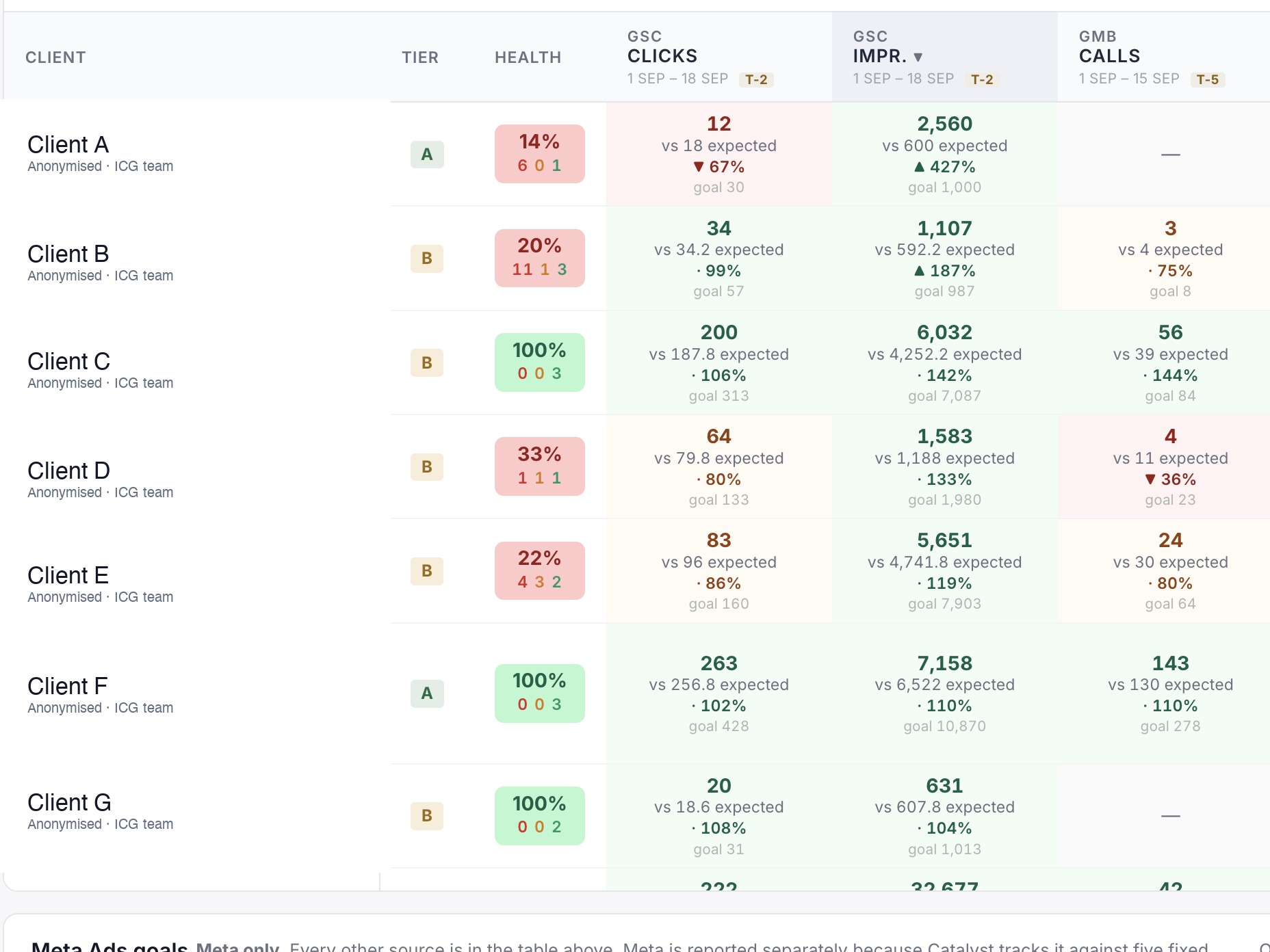
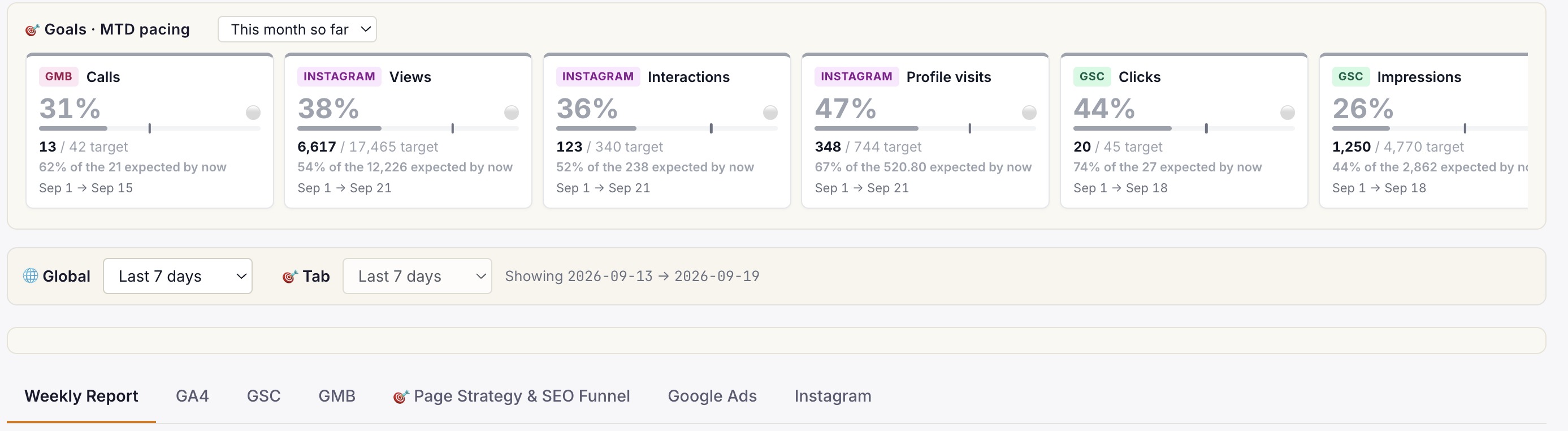
The intelligence stack behind this playbook.
Every ICG engagement runs on the Search Intelligence Trifecta — Angryturtle for GMB, SIE for search and AI Overview, YODA for YouTube. Live product screens below.
Need help operationalising this?
Every ICG service is healthcare-only, NMC + DPDP-aware, and built around the patient-research patterns that drive Indian healthcare growth in 2026.
Every practice welcome — packages from ₹20,000/mo.
Goals-Driven engagements · Performance-Linked Payout Models available
More from
ICG.
Five trends shaping Indian healthcare marketing through 2027: AI-first patient research, Conversions API adoption, ABDM discovery, the AEO w...
Healthcare AIO is the discipline of getting your clinic or hospital cited inside Google AI Overviews, ChatGPT and Perplexity answers — not j...
Conversational-search advertising places brand messages inside AI chat answers — ChatGPT, Perplexity, Copilot — rather than beside a results...
Stop guessing.
Book a Diagnostic.
30 minutes. Free. With the AI-powered healthcare-only marketing agency 150+ brands already run on. No slides, no pitch, no hard close.


